
If you have ever wondered why your Korean friend says 안녕 to one person and 안녕하세요 to another, you have already met the Korean honorific system. It is the single feature that surprises new learners the most — and the single feature that will make you sound genuinely fluent once you understand it.
The good news: Korean honorifics look terrifying from the outside, but they follow a small number of predictable patterns. In this guide we will break the whole system into pieces you can actually use, starting today.
If you are still working through the alphabet, start with our guide to learning Hangul in a week — honorifics are much easier to absorb once you can read Korean comfortably.
What Korean Honorifics Actually Are
In English, politeness is mostly about word choice. You might say “Could you possibly pass the salt?” instead of “Give me the salt.” The grammar itself does not change.
In Korean, politeness is built into the grammar. Verb endings change. Some verbs get replaced by entirely different verbs. Even the particles attached to nouns change. Korean speakers make these adjustments automatically based on who they are talking to and who they are talking about.
Korean has a general word for polite speech — 존댓말 (jondaenmal) — and its opposite, casual speech — 반말 (banmal). But “존댓말” is an umbrella term covering several systems, and mixing them up is exactly why beginners get confused.
The Two Systems Hiding Inside “Honorifics”
Almost every honorifics headache disappears once you separate these two ideas.
| System | Who it respects | How it works | Example |
|---|---|---|---|
| Speech level 상대높임법 | The person you are talking to | Sentence ending | 먹어 → 먹어요 → 먹습니다 |
| Subject honorification 주체높임법 | The person you are talking about | The marker -시- and special vocabulary | 먹다 → 드시다 |
These two operate independently. You can speak casually to a close friend while still elevating the professor you are gossiping about. Once that clicks, the rest is just vocabulary.
Speech Levels: The Three You Actually Need
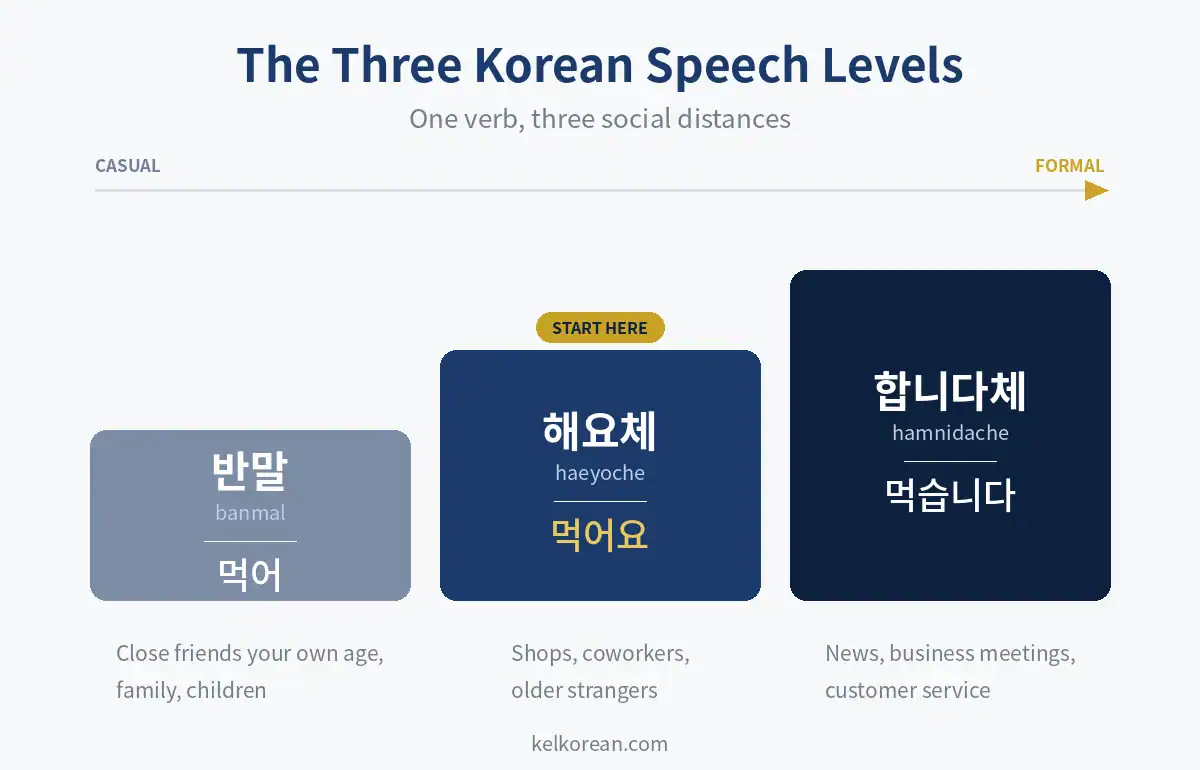
Korean textbooks sometimes list seven speech levels. In real modern life, three cover roughly 95% of your daily conversations.
| Level | “To eat” | When to use it |
|---|---|---|
| 합니다체 formal polite | 먹습니다 / 먹습니까? meokseumnida | News, presentations, military, customer service, first business meetings |
| 해요체 polite | 먹어요 / 먹어요? meogeoyo | Everyday politeness — shops, coworkers, new acquaintances, older strangers |
| 해체 · 반말 casual | 먹어 / 먹어? meogeo | Close friends the same age, younger people you are close to, family, children |
If you remember one thing: as a learner, default to 해요체. It is warm, polite, and appropriate almost everywhere. Nobody will be offended by it, and it buys you time to observe how others are speaking.
The Magic Syllable: -시-
The honorific infix -시- is inserted into a verb to show respect for the person performing the action. It sits between the verb stem and the ending. After a consonant, use -으시-; after a vowel, use -시-.
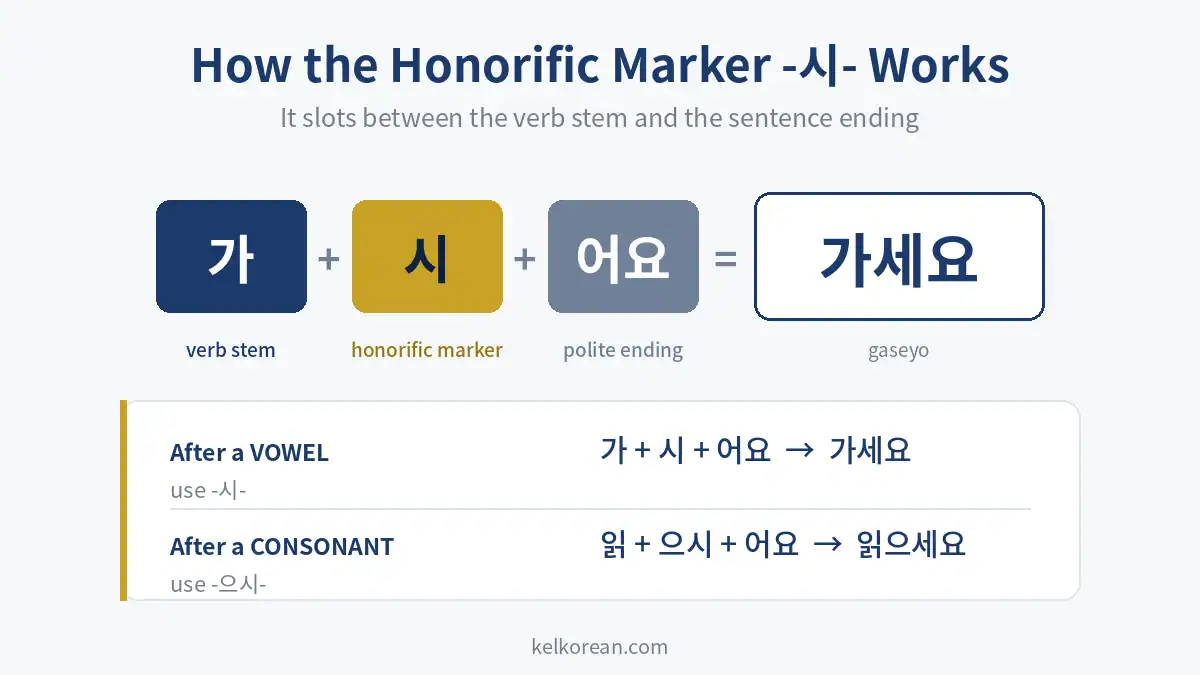
| Plain verb | Honorific | 해요체 | 합니다체 |
|---|---|---|---|
| 가다 to go | 가시다 | 가세요 | 가십니다 |
| 읽다 to read | 읽으시다 | 읽으세요 | 읽으십니다 |
| 앉다 to sit | 앉으시다 | 앉으세요 | 앉으십니다 |
| 바쁘다 to be busy | 바쁘시다 | 바쁘세요 | 바쁘십니다 |
Now compare these two sentences carefully — the difference is who is doing the action:
| Sentence | Meaning | Why |
|---|---|---|
| 제가 갈게요. | I will go. | Polite to the listener. No -시-, because I am the one going. |
| 선생님이 가세요. | The teacher is going. | Polite to the listener and elevating the teacher with -시-. |
This is the mistake that trips up nearly every beginner: never use -시- about yourself. Saying “제가 가세요” is like bowing to your own reflection.
Special Honorific Verbs You Have to Memorize
Some very common verbs do not simply take -시-. They get swapped for completely different words. There are not many, so memorizing them is one of the highest-value things a Korean learner can do.
| Plain | Honorific | Meaning | Example |
|---|---|---|---|
| 있다 | 계시다 gyesida | to be present | 아버지 집에 계세요? |
| 먹다 · 마시다 | 드시다 deusida | to eat / drink | 천천히 드세요. |
| 먹다 (elderly) | 잡수시다 japsusida | to eat | 할아버지 잡수셨어요? |
| 자다 | 주무시다 jumusida | to sleep | 안녕히 주무세요. |
| 말하다 | 말씀하시다 malsseumhasida | to speak | 다시 말씀해 주세요. |
| 아프다 | 편찮으시다 pyeonchaneusida | to be sick | 어머니가 편찮으세요. |
| 죽다 | 돌아가시다 doragasida | to pass away | 작년에 돌아가셨어요. |
| 데리고 가다 | 모시고 가다 mosigo gada | to escort | 부모님을 모시고 갔어요. |
Note that 잡수시다 is stronger than 드시다 and is usually reserved for elderly people. 드시다 is your safe everyday choice.
Putting -시- Into the Past Tense
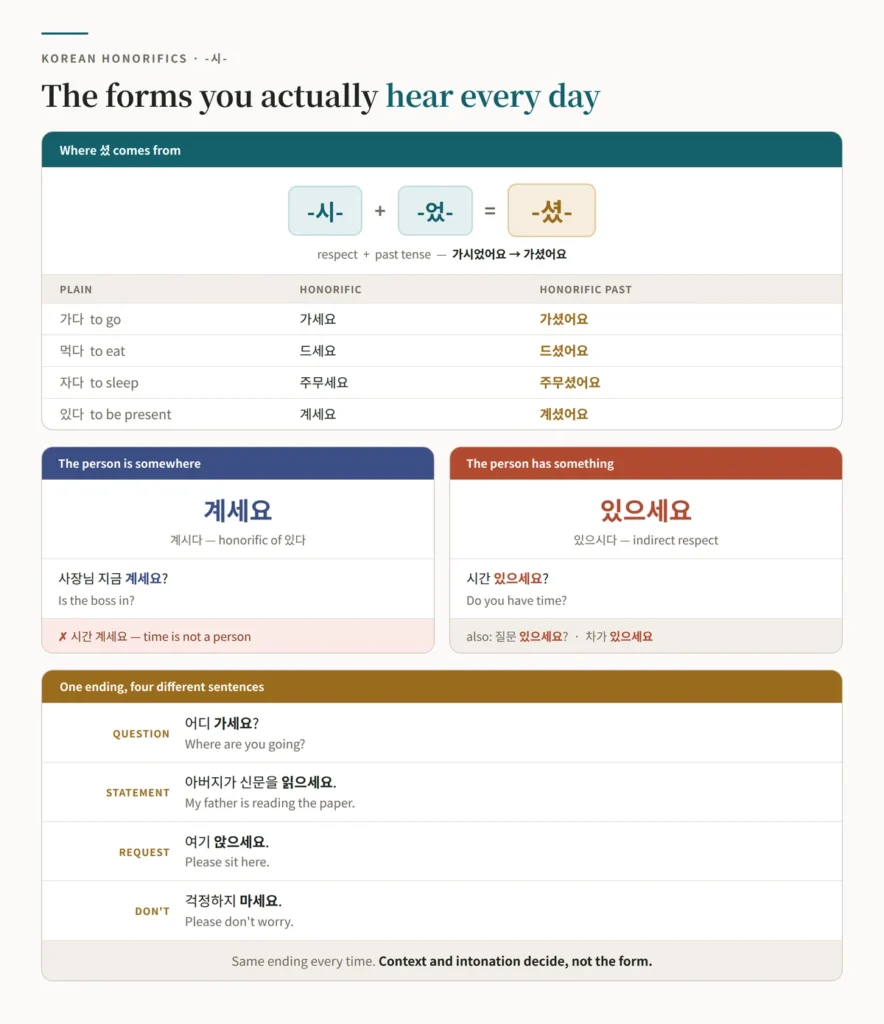
You will hear 셨 constantly, and it looks like a syllable you were never taught. It is not a new form — it is -시- and the past tense marker -었- squeezed together.
가시었어요 → 가셨어요. Nobody says the long version. The contraction is the only form you will ever meet.
| Plain | Honorific present | Honorific past |
|---|---|---|
| 가다 to go | 가세요 | 가셨어요 |
| 하다 to do | 하세요 | 하셨어요 |
| 먹다 to eat | 드세요 | 드셨어요 |
| 자다 to sleep | 주무세요 | 주무셨어요 |
| 있다 to be present | 계세요 | 계셨어요 |
| 말하다 to speak | 말씀하세요 | 말씀하셨어요 |
The formal level works the same way — 가셨습니다, 오셨습니다. And the pattern holds for the special verbs too, because they are ordinary verbs once -시- is already inside them.
아버지가 어제 오셨어요. — My father came yesterday.
식사 하셨어요? — Have you eaten? (the standard polite greeting)
If you can hear 셨 and mentally unpack it into respect + past, a large amount of adult Korean stops sounding like noise.
계세요 or 있으세요? People Versus What They Have
계시다 was in the table above as the honorific of 있다. That is true, but only for one of the two things 있다 does — and picking the wrong one is one of the most common intermediate mistakes.
| Use | Example | |
|---|---|---|
| 계시다 | the person is somewhere | 사장님 지금 계세요? — Is the boss in? |
| 있으시다 | the person has something | 시간 있으세요? — Do you have time? |
The rule in one line: 계시다 is for the person, 있으시다 is for the thing they possess. You raise the person directly in the first case, and indirectly — through their belongings — in the second.
- 질문 있으세요? — Any questions? (the questions belong to you)
- 아버지는 차가 있으세요. — My father has a car.
- ✗ 시간 계세요 — wrong. Time is not a person.
- ✗ 사장님 있으세요 — technically about possession, so it sounds off when you mean “is he here.”
This is the same machinery behind 사물 존대 in the mistakes section below. The difference is that 있으시다 is correct indirect honorification — the thing genuinely belongs to the person you are respecting — while 커피 나오셨습니다 attaches respect to a cup that belongs to nobody.
-(으)세요 Does Four Different Jobs
Here is something that trips up almost every learner: -(으)세요 can be a question, a statement or a request, and the form does not change. Only the context and the intonation tell you which.
| Question | 어디 가세요? — Where are you going? |
| Statement | 아버지가 신문을 읽으세요. — My father is reading the paper. |
| Request | 여기 앉으세요. — Please sit here. |
| Negative request | 걱정하지 마세요. — Please don’t worry. |
English needs four different structures for those. Korean uses one, because -시- is not about commanding — it is about who deserves the respect, and that is the same person whether you are asking, telling or requesting.
Attaching it is mechanical. No 받침 on the stem → -세요 (가다 → 가세요). 받침 → -으세요 (읽다 → 읽으세요, 앉다 → 앉으세요). A ㄹ 받침 drops out first: 살다 → 사세요, 만들다 → 만드세요.
마세요 is not an exception either — it is 말다 (“to not do”) losing its ㄹ, exactly like 살다.
When the Verb Is 이다: -(이)세요
이다 — “to be” — takes -시- as well, and the result is a phrase you will hear on your first day in Korea.
- 학생이세요? — Are you a student? (받침 → 이세요)
- 의사세요? — Are you a doctor? (no 받침 → 세요)
- 몇 분이세요? — How many people? (what a restaurant asks at the door)
- 김민수 씨세요? — Are you Mr Kim Minsu?
It maps straight onto the plain forms you already know: 이에요 → 이세요, 예요 → 세요. And the past tense behaves exactly as above — 학생이셨어요?
Honorific Nouns
Nouns belonging to a respected person also get upgraded.
| Plain | Honorific | Meaning | You will hear it as |
|---|---|---|---|
| 이름 | 성함 seongham | name | 성함이 어떻게 되세요? |
| 나이 | 연세 yeonse | age | 연세가 어떻게 되세요? |
| 집 | 댁 daek | home | 댁이 어디세요? |
| 밥 | 진지 jinji | meal | 진지 드셨어요? |
| 생일 | 생신 saengsin | birthday | 생신 축하드립니다. |
| 말 | 말씀 malsseum | words | 말씀 감사합니다. |
| 사람 | 분 bun | person | 저분이 누구세요? |
So instead of “이름이 뭐예요?” you would ask an older person or a client: “성함이 어떻게 되세요?” — a phrase you will hear constantly at banks, clinics, and reception desks in Korea.
Humble Language: Making Yourself Smaller
Korean has a mirror-image system called 겸양어 (humble language). Instead of raising the other person, you lower yourself. The effect is the same: a bigger gap between you and them.
| Normal | Humble | Meaning | Example |
|---|---|---|---|
| 나 | 저 jeo | I | 저는 학생이에요. |
| 내 | 제 je | my | 제 이름은 안나예요. |
| 우리 | 저희 jeohui | we / our | 저희 회사입니다. |
| 주다 | 드리다 deurida | to give | 선물을 드릴게요. |
| 보다 · 만나다 | 뵙다 boepda | to meet | 내일 뵙겠습니다. |
| 묻다 | 여쭙다 yeojjupda | to ask | 하나 여쭤볼게요. |
Here is a nice detail: 말씀 works in both directions. “선생님 말씀” means the teacher’s words (honorific), while “제가 말씀드릴게요” means “I will tell you” (humble). Context decides.
Particles Change Too
Even the little grammar particles have honorific versions. This is a small detail that instantly makes your Korean sound more polished.
| Plain | Honorific | Function | Example |
|---|---|---|---|
| 이 / 가 | 께서 | subject marker | 할머니께서 오셨어요. |
| 은 / 는 | 께서는 | topic marker | 사장님께서는 회의 중이십니다. |
| 에게 / 한테 | 께 | to (a person) | 선생님께 드렸어요. |
Look at 할머니께서 진지를 드십니다. — the particle, the noun, and the verb are all elevated at once. This is what Koreans mean when they say honorifics “agree” across the sentence.
In casual spoken Korean, 께서 is often dropped even when the verb keeps -시-. In writing and formal speech, use it. If particles are still new to you, our post on Korean sentence structure and SOV word order explains how they hold a Korean sentence together.
Names, Titles, and the 님 Suffix
Koreans rarely use bare first names with anyone who is not a close peer. Instead, they use titles.
| Form | Examples | Use it with | Watch out |
|---|---|---|---|
| -씨 | 민형 씨 | Colleagues of similar rank or age | Sounds cold if the person is clearly senior |
| -님 | 선생님, 고객님, 작가님 | Anyone you want to clearly respect | Safe default — hard to overuse |
| 직급 + 님 | 팀장님, 과장님, 사장님 | Everyone at a Korean workplace | Address people by rank, not by name |
| Kinship terms | 언니, 오빠, 누나, 형 | Close people slightly older than you | Only once some closeness exists |
And one warning: 당신 is listed in dictionaries as “you,” but in real conversation it sounds either poetic, distant, or aggressive. Use the person’s title instead, or simply omit the subject — Korean drops pronouns freely.
Age Isn’t the Only Factor
Learners often reduce Korean honorifics to a single rule: “older person = 존댓말.” Age matters, but three factors interact:
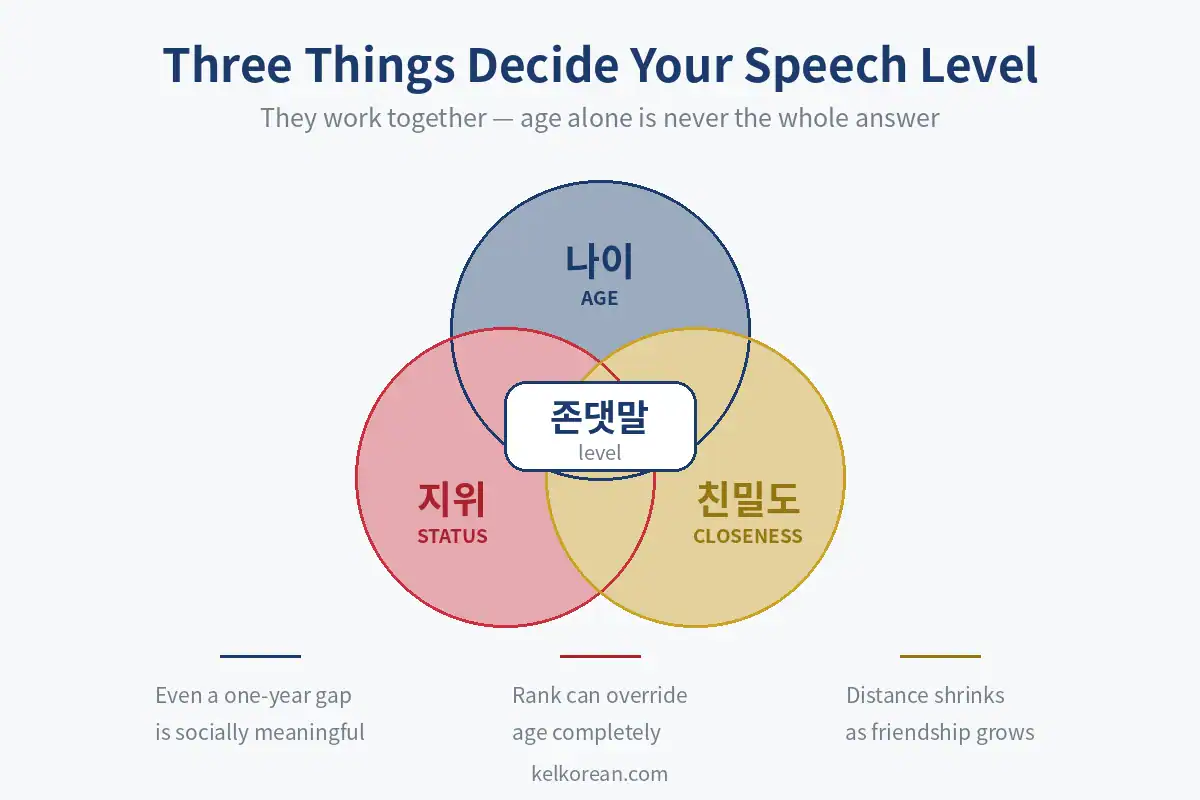
| Factor | What it means | Real-life example |
|---|---|---|
| Age | Even a one-year gap is socially meaningful | A sophomore uses 반말 to a freshman, 존댓말 to a junior |
| Status | Rank can override age completely | A 40-year-old new hire uses 존댓말 to a 25-year-old manager |
| Closeness | Distance shrinks as friendship grows | Same-age coworkers start with 존댓말, switch to 반말 after months |
That third factor is why you should never switch to 반말 on your own. Wait for the invitation: “말 놓으세요” or “편하게 하세요” — “Please speak comfortably.”
Five Mistakes Beginners (and Even Koreans) Make
| Mistake | Wrong | Correct | Why |
|---|---|---|---|
| Using -시- about yourself | 제가 도와드리시겠습니다 | 제가 도와드리겠습니다 | -시- elevates someone else, never you |
| Honoring objects (사물 존대) | 커피 나오셨습니다 5천 원이십니다 | 커피 나왔습니다 5천 원입니다 | Coffee and money cannot be respected |
| Mixing levels mid-sentence | 야, 뭐 해요? | 뭐 해요? · 야, 뭐 해? | Pick one level and stay consistent |
| Assuming 요 fixes everything | 할머니가 밥 먹어요 | 할머니께서 진지를 드세요 | 요 respects the listener, not the subject |
| Over-applying 압존법 | 팀장님은 자리에 없습니다 | 팀장님은 자리에 안 계십니다 | 압존법 is not standard in workplaces |
Two of these deserve a closer look. 사물 존대 is so common in Korean cafés and shops that you will hear it every single day — but Korea’s National Institute of Korean Language considers it incorrect, and many Koreans find it grating.
압존법 is the traditional rule that you drop honorifics for a mid-ranking person when speaking to someone even higher — for example, referring to your father without honorifics while talking to your grandfather. Modern guidance treats this as optional within families and not standard in workplaces. So when your CEO asks where your team leader is, keep the honorifics.
Same Sentence, Four Levels
Let’s take one idea — “Did you eat?” — and watch it climb the ladder.
| Korean | Romanization | Say it to |
|---|---|---|
| 밥 먹었어? | bap meogeosseo? | A close friend your own age |
| 밥 먹었어요? | bap meogeosseoyo? | A coworker or acquaintance |
| 식사하셨어요? | siksahasyeosseoyo? | Someone older or senior to you |
| 진지 잡수셨습니까? | jinji japsusyeotseumnikka? | An elderly person, formal setting |
Same meaning, four different social relationships. Korean packs an enormous amount of information into a few syllables — which is exactly what makes it such a rewarding language to learn.
Your Practical Starting Strategy
- Default to 해요체 in every new situation.
- Add -시- whenever the subject is older or senior to you.
- Memorize the eight special verbs in the table above. They cover most real conversations.
- Use titles, not names, until someone tells you otherwise.
- Never initiate 반말. Let the other person offer it.
Frequently Asked Questions
Can I just use 해요체 for everything?
As a learner, essentially yes. It may feel slightly formal with close friends, but it will never be rude. Native speakers understand that foreigners are still calibrating.
Will Koreans be offended if I get honorifics wrong?
Almost never. Koreans are generally delighted that a foreigner is trying at all, and mistakes are read as inexperience rather than disrespect. The effort itself reads as politeness.
Are honorifics disappearing among young Koreans?
They are softening, not disappearing. Rigid formal endings like 합니다체 are less common in casual settings, and many workplaces have flattened their title systems. But 존댓말 versus 반말 remains a fundamental everyday distinction.
How long does it take to feel comfortable with this?
Recognizing honorifics takes a few weeks. Producing them naturally takes a few months of regular conversation. The -시- pattern becomes automatic surprisingly fast once you start using it out loud.
What does 셨 mean in Korean?
It is the honorific marker -시- and the past tense marker -었- contracted into one syllable. 가시었어요 becomes 가셨어요, so 가셨어요 means “[someone I respect] went.” Whenever you see 셨, read it as respect plus past tense.
What is the difference between 계세요 and 있으세요?
계세요 is for a person being somewhere — 사장님 계세요? (“Is the boss in?”). 있으세요 is for something a respected person has — 시간 있으세요? (“Do you have time?”). Use 계시다 for the person and 있으시다 for their belongings.
Does -(으)세요 mean “please” or is it a question?
Both, and also a plain statement. 어디 가세요? is a question, 아버지가 읽으세요 is a statement, and 여기 앉으세요 is a polite request — all the same ending. Context and intonation decide, not the form.
How do you say “please don’t” politely in Korean?
Verb stem + 지 마세요 — 걱정하지 마세요 (“please don’t worry”), 가지 마세요 (“please don’t go”). 마세요 comes from 말다 losing its ㄹ before -세요, the same way 살다 becomes 사세요.
What does 몇 분이세요 mean?
“How many people are you?” — what a restaurant asks as you walk in. 분 is the honorific counter for people, and 이세요 is 이다 with -시- attached, the same form as 학생이세요? (“Are you a student?”).
Final Thoughts
Korean honorifics are not an obstacle standing between you and the language — they are the language. Every time you choose between 먹어, 먹어요, and 드세요, you are describing a relationship. That is a kind of expressiveness English simply does not have.
Start with 해요체, add -시- for people above you, learn the special verbs, and let the rest come from listening. In a few months you will be adjusting your endings without thinking about it — and that is the moment Korean starts to feel like yours.
Honorifics are the final beginner stage. Our roadmap for learning Korean shows everything that comes before them.
Leave a Reply