If you’ve ever looked at a Korean street sign, a K-pop album cover, or a menu at your local Korean restaurant and thought “there’s no way I could read that” — I have good news. You almost certainly can, and it will take less time than you think. This is how to learn Hangul in a week, without the usual promises.
Hangul, the Korean writing system, is widely considered one of the most logical alphabets ever created. It was designed from scratch in 1443 under King Sejong the Great, specifically so that ordinary people could learn to read quickly. That design goal still works in your favor almost six hundred years later.
I ran an English academy in Korea for more than fifteen years. Every year or so a new native-speaking teacher would arrive from Toronto or Manchester or Cape Town, land at Gimhae with two suitcases, and realize somewhere on the bus into the city that they couldn’t read a single sign between the airport and their apartment. Teaching them Korean was never part of my job — they came to teach English. But a lot of them wanted to learn, and since I was the person in the building who could answer questions, they asked me. Nearly all of the ones who tried could read Korean within two or three weeks. The ones who sat down and did it properly got there in about seven days.
This guide is essentially what I ended up telling them, cleaned up and put in order. It takes you from zero to reading Korean text out loud in a week. Let’s be clear about what that means, though, because the internet is full of misleading promises.
What “learning Hangul in a week” actually means
In one week of focused practice, you can realistically:
- Recognize every Korean letter and know the sound it makes
- Combine letters into syllable blocks and read them correctly
- Sound out real words on signs, menus, and song titles
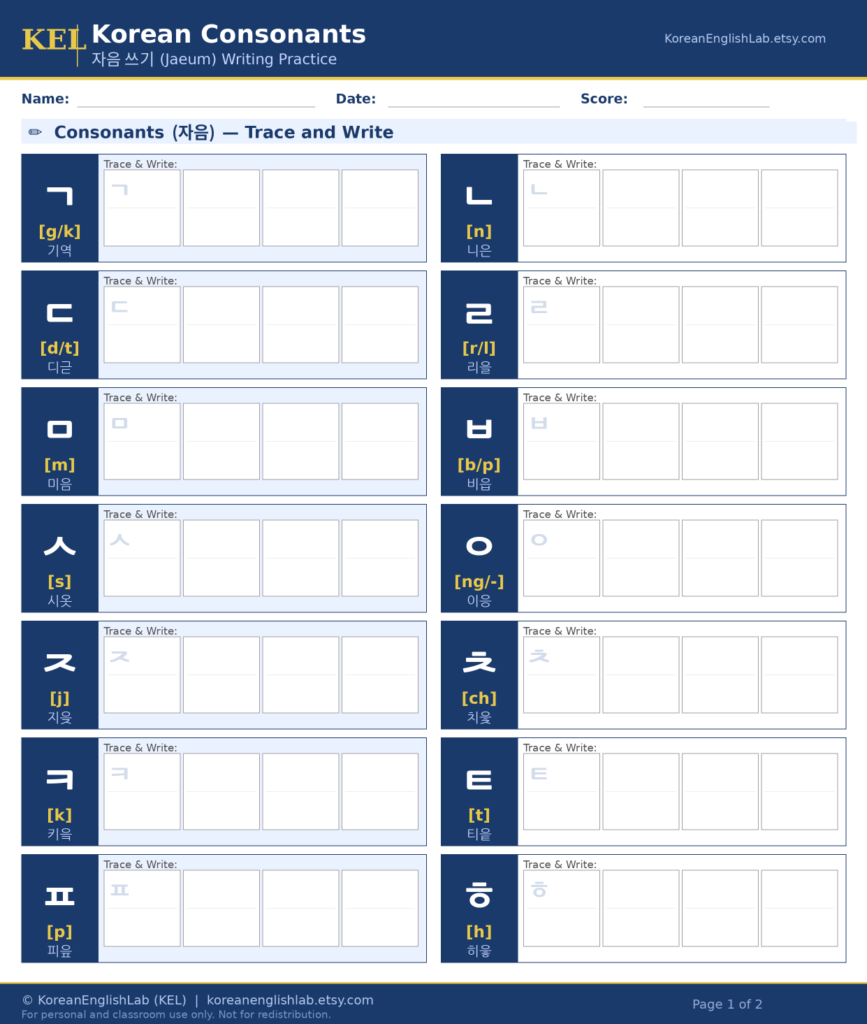
- Write your own name and simple words by hand
- Handle the most common pronunciation rules
What you will not be able to do in a week:
- Understand what you’re reading
- Hold a conversation
- Know Korean grammar or a useful vocabulary base
Reading Hangul and knowing Korean are two different skills. Hangul is the door. Korean is the house behind it. But you have to walk through the door first, and the door opens much faster than most people expect — this is genuinely the easiest part of learning Korean, and it’s the part that makes everything afterward possible.
Why Hangul is faster to learn than you expect
Three features make Hangul unusually beginner-friendly.
It’s an alphabet, not a character system. Unlike Chinese characters, where each symbol is a word or concept you must memorize individually, Hangul has 24 basic letters — 14 consonants and 10 vowels. Learn 24 things, and you can read anything.
The letter shapes are systematic. Consonant shapes were designed to resemble the position of your mouth and tongue when you make the sound. Related sounds share related shapes. ㄱ (g) becomes ㅋ (k) with one extra stroke and ㄲ (kk) when doubled. ㄷ (d) becomes ㅌ (t), ㅂ (b) becomes ㅍ (p), ㅈ (j) becomes ㅊ (ch). Once you notice this pattern, you’re not memorizing 19 consonants — you’re memorizing about 9 and applying a rule.
Spelling is highly consistent. Korean has pronunciation rules, but nothing like English, where “though,” “through,” “tough,” and “thought” all behave differently. Once you know how a letter sounds, it generally sounds that way.
Before you start: two rules that make or break your week
Rule 1: Abandon romanization immediately.
Romanization is the practice of writing Korean sounds using the Latin alphabet — writing “annyeonghaseyo” instead of 안녕하세요. It feels helpful on day one and becomes a serious handicap by day ten. Romanization can’t accurately represent several Korean sounds, and every minute your brain spends reading the Latin version is a minute it isn’t spending building recognition of the actual letters.
Use romanization for the first day or two as training wheels if you must. Drop it after that. The learners who struggle hardest with Korean reading, months in, are almost always the ones who never let go of romanization.
I lost count of the teachers who told me they’d “learned some Korean” before arriving, which usually meant they could say annyeonghaseyo without any idea which shapes on a page corresponded to it. One of them had worked through a romanized phrasebook cover to cover and still couldn’t find his own name on the building directory in our lobby. He had a head full of sounds attached to nothing.
Rule 2: Write everything by hand.
Typing is faster, but handwriting builds letter recognition in a way that typing does not. You only need a cheap notebook and about ten minutes a day. Write each new letter twenty times, then write words using it.
Our teachers wrote their own name in Hangul on the whiteboard on their first day, mostly so the younger students could read it. It wasn’t meant as a Korean lesson, but it worked better than one. Working out why Chris becomes 크리스 and not 크리스트 or 츠리스 teaches you more about syllable structure than any chart will.
Day 1: The 10 basic vowels and how blocks work
Start with vowels, because every Korean syllable contains one.
| Letter | Sound | Roughly like |
|---|---|---|
| ㅏ | a | father |
| ㅑ | ya | yacht |
| ㅓ | eo | son (British “cot”) |
| ㅕ | yeo | young |
| ㅗ | o | boat |
| ㅛ | yo | yoke |
| ㅜ | u | moon |
| ㅠ | yu | you |
| ㅡ | eu | (no English match — say “oo” with lips flat and spread) |
| ㅣ | i | see |
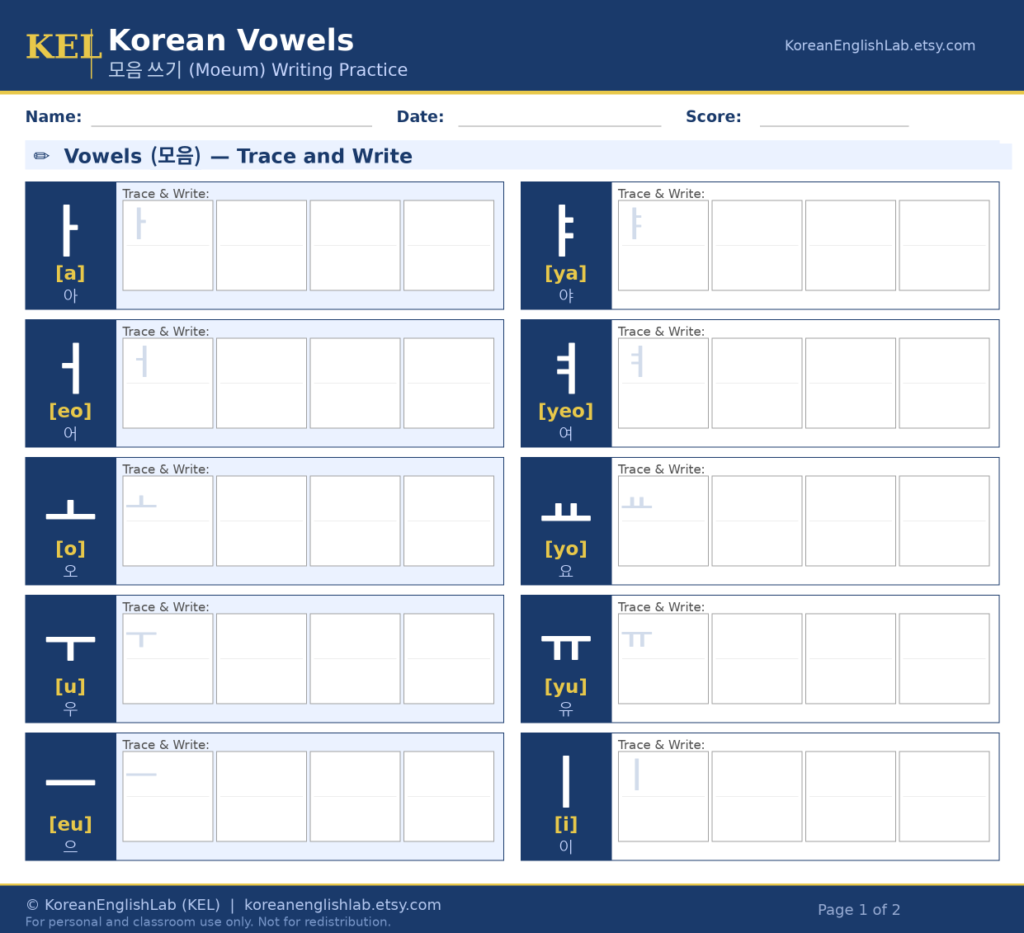
Notice the pattern: adding a second short stroke adds a “y” sound. ㅏ → ㅑ, ㅓ → ㅕ, ㅗ → ㅛ, ㅜ → ㅠ. That’s four fewer things to memorize.
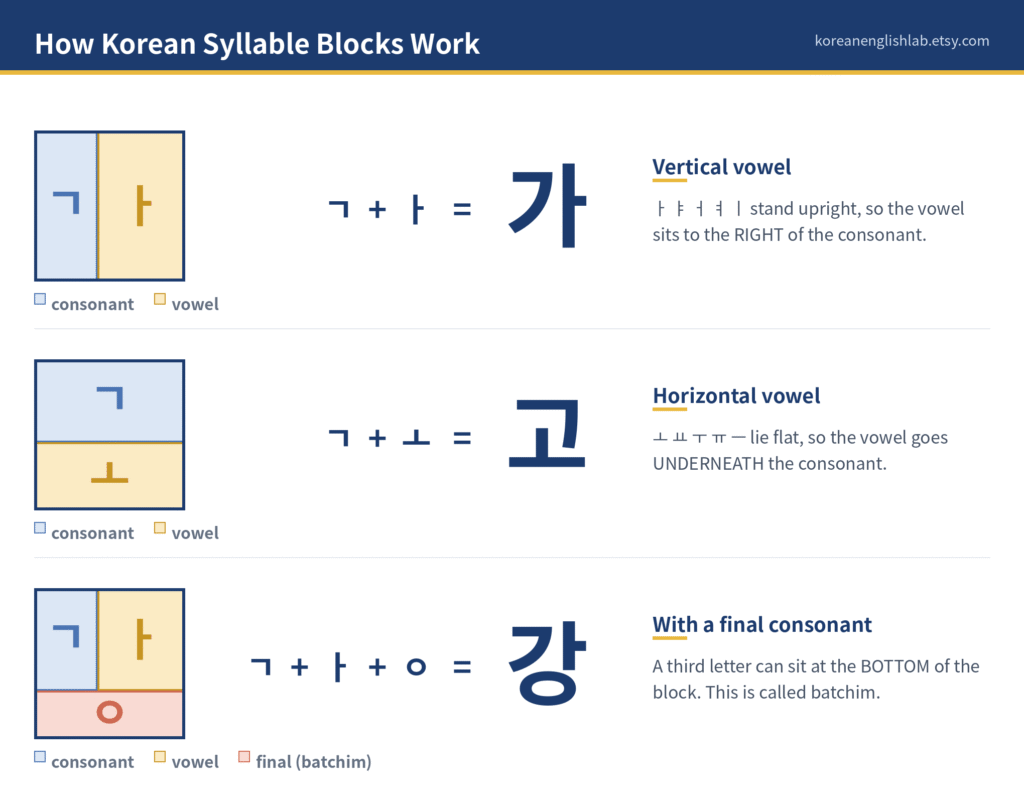
Now, the single most important structural concept in Hangul: letters are not written in a straight line. They are grouped into square syllable blocks.
Every block starts with a consonant. When a syllable begins with a vowel sound, Korean uses the placeholder consonant ㅇ, which is silent in that position. So the vowel ㅏ on its own is written 아.
Practice reading these aloud: 아 야 어 여 오 요 우 유 으 이
That’s your day one goal. Ten vowels, written and pronounced. It should take about 30–40 minutes.
Day 2: Nine basic consonants and your first real words
| Letter | Sound |
|---|---|
| ㄱ | g / k |
| ㄴ | n |
| ㄷ | d / t |
| ㄹ | r / l |
| ㅁ | m |
| ㅂ | b / p |
| ㅅ | s |
| ㅈ | j |
| ㅎ | h |
Two of these deserve a note. ㄹ sits between English “r” and “l” — the tongue taps the roof of the mouth briefly, similar to the “tt” in the American pronunciation of “butter.” Don’t overthink it; approximate it and refine later. ㄱ, ㄷ, ㅂ, ㅈ sound softer at the start of a word than English speakers expect — closer to k, t, p, ch than to g, d, b, j — but they soften into g/d/b/j between vowels.
How blocks are arranged: it depends on the vowel’s shape.
- Vertical vowels (ㅏㅑㅓㅕㅣ) sit to the right of the consonant: 가, 너, 미
- Horizontal vowels (ㅗㅛㅜㅠㅡ) sit underneath the consonant: 고, 누, 므
Read these real words out loud:
- 가구 (furniture)
- 나무 (tree)
- 머리 (head)
- 바다 (sea)
- 사자 (lion)
- 하나 (one)
- 아기 (baby)
- 우리 (we / us)
This is the moment it clicks for most people. You are reading Korean.
I always knew when a teacher hit this point, because they’d stop mid-worksheet, look out the window at the 미용실 sign across the street, and start sounding it out under their breath. Then they’d do the next sign, and the next one. It’s the first time a Korean city stops being wallpaper and turns into text, and nothing you write on a whiteboard produces that reaction.
Day 3: Aspirated consonants
Five more consonants, and four of them are just day-two letters with an extra stroke and an extra puff of air.
| Letter | Sound | Built from |
|---|---|---|
| ㅋ | k (aspirated) | ㄱ |
| ㅌ | t (aspirated) | ㄷ |
| ㅍ | p (aspirated) | ㅂ |
| ㅊ | ch (aspirated) | ㅈ |
| ㅇ | silent (as first letter) | — |
To feel the difference, hold a sheet of paper in front of your mouth. Saying ㅋ, ㅌ, ㅍ, or ㅊ should move it. Saying ㄱ, ㄷ, ㅂ, or ㅈ should barely move it at all.
Loanwords make ideal practice here, because you already know what they mean — you just have to decode them:
- 커피 (coffee)
- 카페 (cafe)
- 택시 (taxi)
- 피자 (pizza)
- 바나나 (banana)
- 초콜릿 (chocolate)
- 티셔츠 (T-shirt)
You now know all 14 basic consonants and all 10 basic vowels — the full core alphabet, in three days.
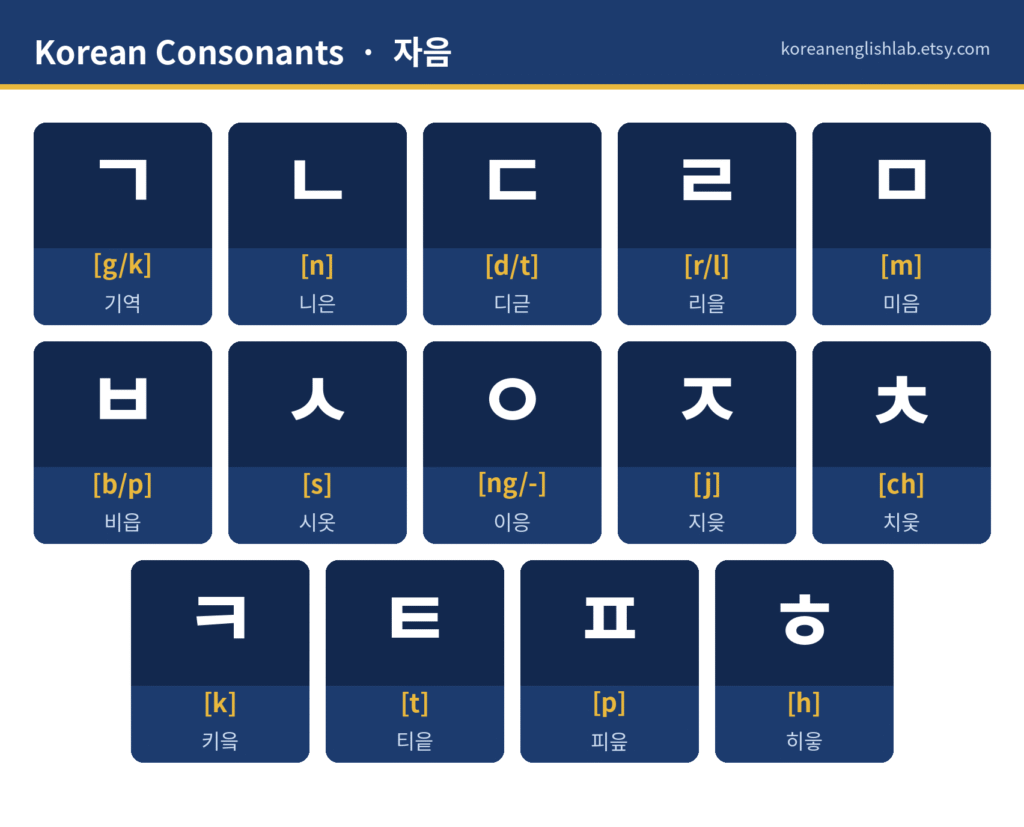
Day 4: Compound vowels
These are combinations of the vowels you already know. Don’t memorize them as new symbols; read them as their parts.
| Letter | Sound |
|---|---|
| ㅐ | ae (like “cat”) |
| ㅒ | yae |
| ㅔ | e (like “bed”) |
| ㅖ | ye |
| ㅘ | wa |
| ㅙ | wae |
| ㅚ | oe (≈ “we”) |
| ㅝ | wo |
| ㅞ | we |
| ㅟ | wi |
| ㅢ | ui |
Good news for your ears: in modern standard Seoul speech, ㅐ and ㅔ have effectively merged, and ㅙ, ㅚ, and ㅞ all sound very close to “we.” Native speakers distinguish them in spelling, not in sound. So this day is about recognizing shapes, not mastering fine pronunciation differences that no longer exist.
Teachers used to bring this to me as a complaint. They’d spend an evening drilling the difference between ㅐ and ㅔ, then find a student spelling the same word both ways on one notebook page and getting away with it. The distinction is real in spelling and survives in some older speakers’ pronunciation. In everyday speech around here, you will not hear it.
Practice: 애기, 네, 왜, 회사, 뭐, 쉬다, 의사
Day 5: Tense consonants
Five doubled letters, each a tightened, harder version of its single form.
| Letter | From |
|---|---|
| ㄲ | ㄱ |
| ㄸ | ㄷ |
| ㅃ | ㅂ |
| ㅆ | ㅅ |
| ㅉ | ㅈ |
These are made with a tense throat and no puff of air — think of the tightness in the “sk” of “sky” compared to the loose “k” of “key.”
Practice: 꿈 (dream), 딸기 (strawberry), 빵 (bread), 싸다 (cheap), 짜다 (salty)
Take today easy. Five letters is a light load, and you’ll want the energy for tomorrow.
Day 6: Batchim — the final consonant
Korean syllable blocks can carry a third position: a consonant at the bottom, called batchim (받침). This is what turns 가 into 각, or 바 into 밥.
Layout: 강 = ㄱ + ㅏ + ㅇ. The final consonant goes underneath the whole block.
Here’s the crucial simplification. Even though many different consonants can appear in the batchim position, they only produce seven possible sounds:
| Sound | Letters that make it |
|---|---|
| k | ㄱ ㅋ ㄲ |
| n | ㄴ |
| t | ㄷ ㅌ ㅅ ㅆ ㅈ ㅊ ㅎ |
| l | ㄹ |
| m | ㅁ |
| p | ㅂ ㅍ |
| ng | ㅇ |
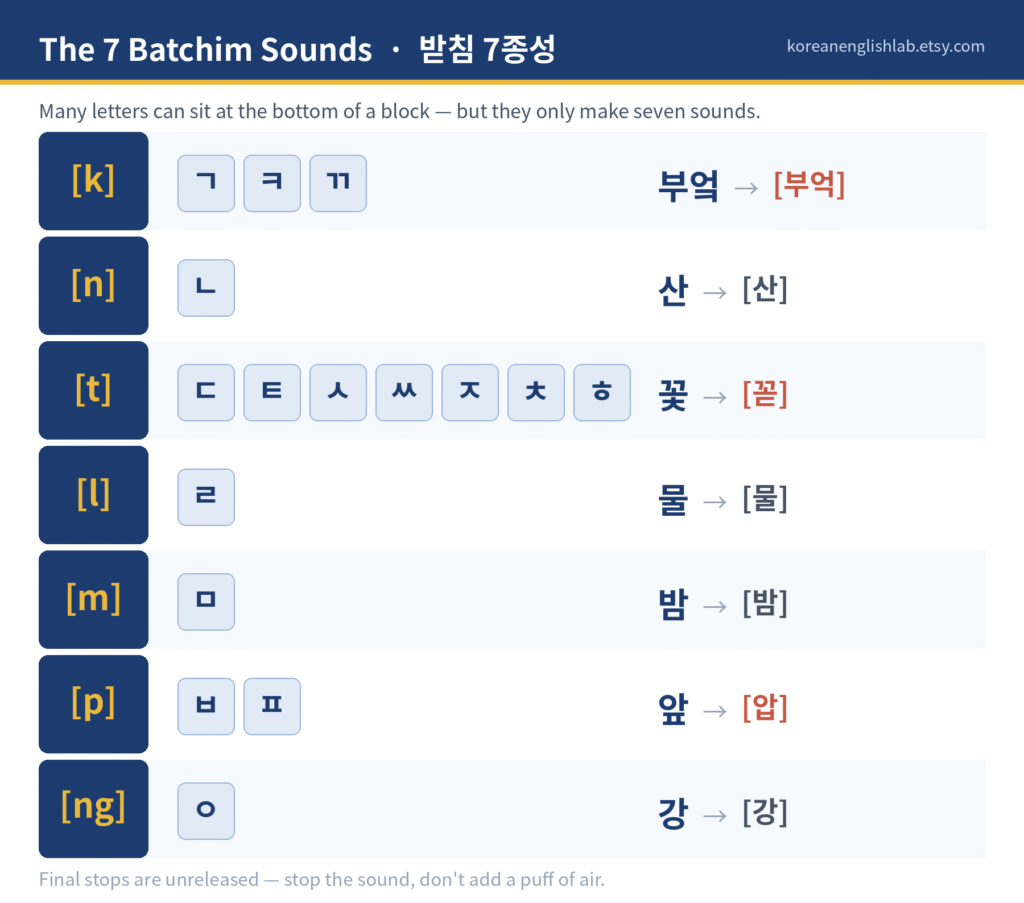
And these final consonants are unreleased — you stop the sound rather than finishing it. The batchim in 밥 (bap, rice) ends with your lips closed, without the small puff of air an English speaker would add at the end of “bop.”
Of everything in this guide, that puff of air is the thing that lasts longest. I worked with teachers who’d been in Korea five and six years, settled here, ordering lunch in Korean every day, and still said 김밥 as “kimbap-uh.” The students noticed every time. Fix it in week one and you save yourself a decade of it.
One more thing worth flagging: ㅇ is silent at the start of a block but sounds like “ng” at the bottom. Compare 아 (a) with 앙 (ang).
Practice: 밥, 물, 집, 강, 한국, 사랑, 김밥, 학생
Batchim is also where nearly every long-term pronunciation problem starts, which is why there’s a whole section on the specific words people get wrong further down.
Day 7: Sound change rules and reading in the wild
You have all the letters. Today is about the gap between how Korean is spelled and how it’s spoken. Three rules cover most of it.
1. Liaison (연음)
When a block ends in a consonant and the next block begins with the silent ㅇ, the consonant slides over into the next syllable.
- 한국어 is read as 한구거 (han-gu-geo), not han-guk-eo
- 음악 is read as 으막 (eu-mak)
- 있어요 is read as 이써요 (i-sseo-yo)
2. Nasalization
A ㄱ, ㄷ, or ㅂ sound followed by ㄴ or ㅁ turns into ng, n, or m.
- 학년 is read as 항년 (hang-nyeon)
- 입니다 is read as 임니다 (im-ni-da)
- 감사합니다 is read as 감사함니다 (gam-sa-ham-ni-da)
3. ㅎ weakening
ㅎ often softens or disappears between voiced sounds. 좋아요 comes out closer to 조아요 (jo-a-yo).
Don’t memorize these as a chart. Read the examples out loud enough times that the pattern feels natural, and let the rest come from listening.
Then go read something real. This is the most important half hour of the week. Open a Korean convenience store’s product page, a K-pop tracklist, a Korean map of Seoul, or a restaurant menu, and sound out everything you see. You won’t know what most of it means. That’s fine — you’re training decoding speed, not comprehension.
The advice I always gave was to go down to the convenience store on the ground floor and read every label in the drinks fridge before buying anything. Ten minutes, no comprehension required, and the same words keep coming back — 우유, 커피, 물, 이온음료, 아메리카노. Repetition attached to real objects builds decoding speed faster than any app I’ve seen, and the teachers who actually did it pulled ahead of the ones who kept buying textbooks. Fifteen minutes a day for the next month will do more for your reading than another week of charts.
The batchim words English speakers get wrong most often
Almost every pronunciation problem I heard from teachers traced back to a batchim. Not because the rules are hard, but because they’d learned the word by ear months earlier, locked in a wrong version, and nobody wanted to be rude enough to correct them.
Here are the ones that came up again and again. If you learn these twelve now, you skip years of quietly saying them wrong.
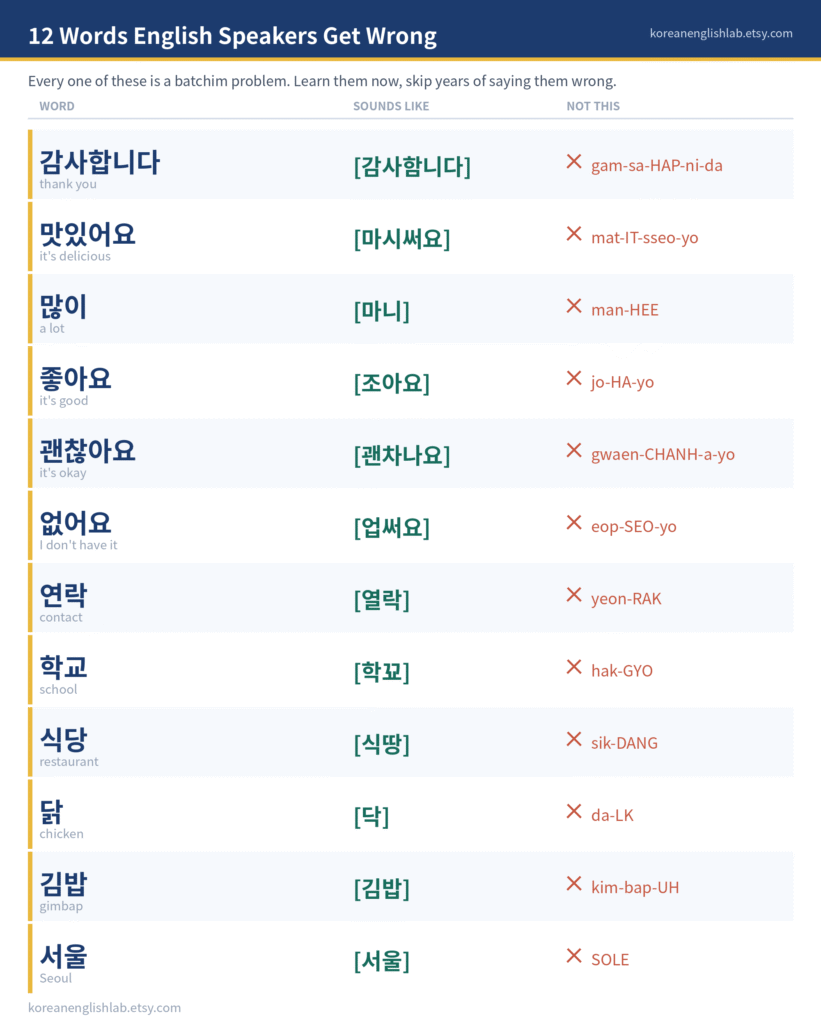
| Word | Written | Actually pronounced | What English speakers say |
|---|---|---|---|
| thank you | 감사합니다 | [감사함니다] | “gam-sa-hap-ni-da” |
| it’s delicious | 맛있어요 | [마시써요] | “mat-it-sseo-yo” |
| a lot | 많이 | [마니] | “man-hee“ |
| it’s good / I like it | 좋아요 | [조아요] | “jo-ha-yo” |
| it’s okay | 괜찮아요 | [괜차나요] | “gwaen-chanh-a-yo” |
| I don’t have it | 없어요 | [업써요] | “eop-seo-yo” |
| contact / to get in touch | 연락 | [열락] | “yeon-rak“ |
| school | 학교 | [학꾜] | “hak-gyo“ |
| restaurant | 식당 | [식땅] | “sik-dang“ |
| chicken | 닭 | [닥] | “da-lk“ |
| gimbap | 김밥 | [김밥] | “kim-bap-uh“ |
| Seoul | 서울 | [서울] | “Sole” (one syllable) |
Five patterns explain the whole table.
ㅂ and ㄱ turn nasal before ㄴ or ㅁ. 감사합니다 becomes [감사함니다]. Every -습니다 and -ㅂ니다 ending in the language works this way, so getting this one right upgrades your pronunciation across hundreds of verb forms at once. It’s the highest-return fix on this list.
A batchim slides into a following ㅇ. 맛있어요 → [마시써요], 없어요 → [업써요], 좋아요 → [조아요]. Teachers who pronounced these as written always sounded like they were reading rather than speaking, and this is why.
ㅎ mostly disappears. In 많이 and 좋아요 the ㅎ isn’t pronounced at all. “Man-hee” is one of the most common mistakes there is, partly because 많이 is such a frequent word — it comes up in 많이 드세요 at every meal.
A stop batchim tenses the next consonant. 학교 is [학꾜], 식당 is [식땅], 학생 is [학쌩]. Nobody writes this down; everybody does it.
Double batchim drops one consonant. 닭 is just [닥]. 값 is [갑]. 없다 is [업따]. Only one of the two survives, and which one survives depends on the pair — but when a vowel follows, the dropped consonant comes back: 닭이 is [달기].
Two habits, not rules
Beyond the rule-based errors, two physical habits mark a foreign accent instantly.
The extra puff at the end. English releases final stops; Korean doesn’t. 밥, 책, 집, 밑 all end with the mouth closed and the sound stopped. Adding “kimbap-uh” or “chaek-uh” is the single most recognizable non-native tell.
The dark L. English speakers pronounce ㄹ batchim like the L in “feel” — tongue pulled back, sound swallowed. Korean ㄹ is light and forward, tongue tip touching just behind the teeth. This is why 서울 comes out as “Sole” instead of two clean syllables, and why 얼굴, 달, and 물 sound off even when the rest of the sentence is fine.
Five mistakes that slow people down
Leaning on romanization past day three. Covered above, but it bears repeating. It’s the single most common reason people who “learned Hangul” still can’t read Korean six months later.
Confusing ㅓ/ㅗ and ㅡ/ㅜ. These four vowels cause more errors than anything else for English speakers, because English doesn’t distinguish them cleanly. Drill them in minimal pairs: 어/오, 으/우, 서/소, 그/구. One of our teachers spent the better part of a year calling out 요기요 in restaurants when they meant 여기요. Nobody ever corrected it, because everyone understood perfectly well — which is exactly how these errors set like concrete.
Trying to memorize batchim rules as a table. The seven-sound rule is worth knowing, but you’ll internalize it far faster by reading words aloud than by staring at a grid.
Skipping handwriting. Ten minutes a day with a pen is not optional if you want the letters to stick.
Cramming all 40 letters in one sitting. It’s technically possible and it rarely lasts. Spaced repetition across seven days produces dramatically better retention than one heroic afternoon.
What to do on day 8
Once you can read, the natural next step is vocabulary and basic grammar — not more alphabet study. A reasonable sequence:
- Keep reading daily. Signs, titles, subtitles, product packaging. Fifteen minutes.
- Learn 100 high-frequency words, written in Hangul only.
- Learn the sentence structure. Korean is subject–object–verb, with particles marking each part’s role. This is the first genuinely new concept for English speakers.
- Learn 요-form politeness, which covers most everyday conversation.
If you learned Hangul specifically because of Korean dramas or music, use that. Pull three or four lines from a song or a scene you already love, and read them aloud. Motivation you already have beats motivation you have to manufacture.
Frequently asked questions
Is Hangul really the easiest alphabet to learn? It’s among the easiest for adult learners, largely because it was deliberately designed for fast literacy rather than evolving haphazardly over centuries. Most learners can decode basic text within a week of light study.
How many Korean letters are there? 24 basic letters: 14 consonants and 10 vowels. Counting compound vowels and tense consonants, learners typically work with about 40 total forms.
Do I need to learn Chinese characters (Hanja) too? Not for reading modern Korean. Hanja appears occasionally in newspapers, academic writing, and to disambiguate names, but everyday Korean is written entirely in Hangul. Hanja is worth studying much later, for vocabulary depth, not for basic literacy.
Can I learn Hangul faster than a week? Yes — some people manage in a day or two. Whether it sticks is the real question. A week of shorter sessions gives your memory time to consolidate between them.
How long until I can actually speak Korean? That depends entirely on your study habits, but reading is a prerequisite, not a substitute. Think months for basic conversation, not weeks. The week you spend on Hangul makes every one of those months more efficient.
The bottom line
Seven days, roughly 30–40 minutes a day, and a notebook. That’s the real cost of Korean literacy. The alphabet was engineered to be learnable, and the plan above simply follows the structure its designers built in: vowels first, then simple consonants, then the systematic variations, then how the pieces stack and interact.
Start with the ten vowels today. By next week, that street sign will just be words.
I spent over fifteen years running an English language academy in Korea. The teachers who worked there came to teach English, but a lot of them wanted to read the country they were living in, and they kept asking me where to start — and getting stuck in the same six places. This is the answer I eventually settled on. Have a question about a specific letter or sound? Leave a comment; I read all of them.
Finished Hangul? Here is what to learn next, in order — the complete beginner’s roadmap, from the alphabet to your first conversation.
Leave a Reply