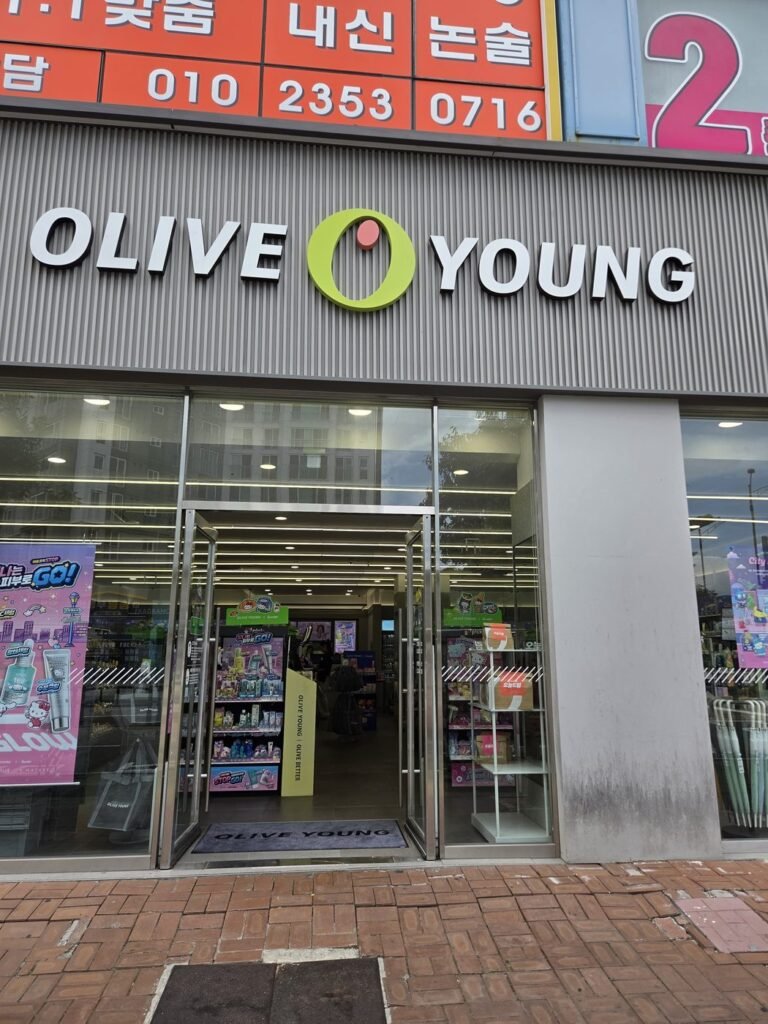
The doors slide open and the store hits you all at once. Mint green, hot pink, and cartoon characters on every surface. Signs shouting percentages. Rows of identical white tubes with Korean text you can’t parse. Somewhere in here is the cleanser everyone told you to buy, and you have no idea which shelf it’s on or whether the one in your hand is a good deal.
I live in Korea and I still stop to read the price tags carefully. Not because the Korean is hard, but because Olive Young puts four separate pieces of information on a label the size of a business card, and three of them are the ones that matter.
If you want to shop at Olive Young the way locals do, this guide is about reading the store, not reviewing products. Product recommendations go stale in a season. The words on the shelf strips, the gift tags, and the electronic price labels have been the same for years, and once you can read them you can walk into any branch in the country and shop with confidence. If you buy Korean skincare online instead, most of this vocabulary shows up on Korean retail sites too.
All photos were taken by the author in September 2026 at an Olive Young branch in the Busan area. Prices shown were current on the day of the visit.
Start at the door
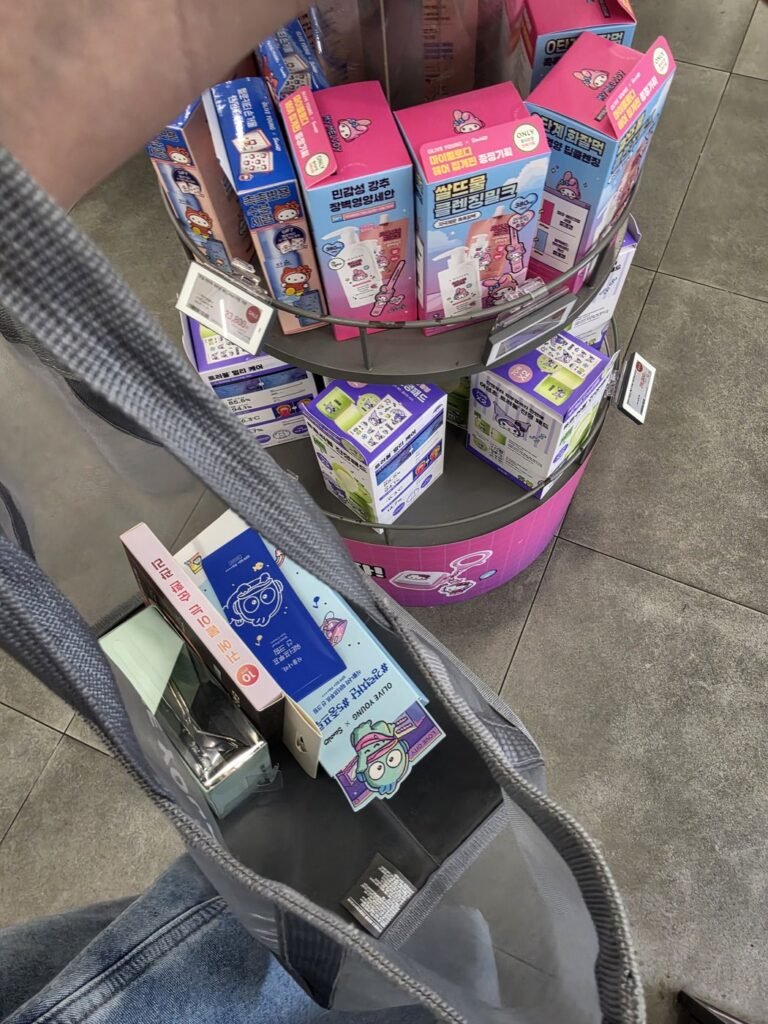
Just inside the entrance there’s a rack of gray mesh bags on a pole, with a small green sign on top:
바구니를 이용하여 편하게 쇼핑하세요
Please use a basket and shop comfortably
Underneath, two conditions in smaller print:
- 바구니는 매장 안에서만 사용 가능합니다 — Baskets may only be used inside the store
- 바구니는 판매 또는 대여 불가합니다 — Baskets are not for sale or rent
Take one. Olive Young doesn’t use shopping carts, and its baskets are soft-sided totes you carry on your shoulder, which means most shoppers fill them past the point they intended to. That’s the design working as planned.
Three words worth pocketing here:
| Korean | Reading | Meaning |
|---|---|---|
| 바구니 | ba-gu-ni | basket |
| 매장 | mae-jang | store, shop floor |
| 사용 가능 | sa-yong ga-neung | usable, permitted |
가능 (ga-neung, “possible”) and its opposite 불가 (bul-ga, “not possible”) are two of the most useful words in Korean public signage. You’ll see them on everything from parking signs to restaurant menus.
The price tag is a paragraph, not a number
This is the part almost no English-language guide explains, and it’s the part that saves you money.
Olive Young uses electronic shelf labels. A typical one carries up to four lines of pricing, and reading them in order tells you the whole story of that product’s discount.
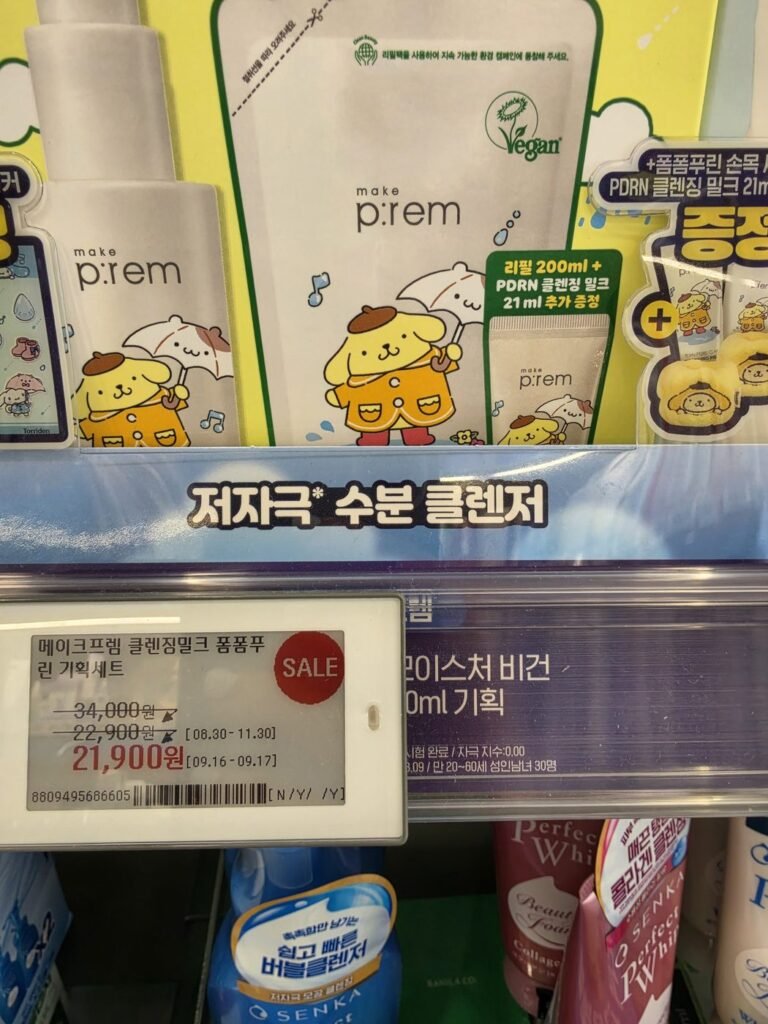
Here’s a real label from the cleanser aisle, for a Make p:rem cleansing milk set:
메이크프렘 클렌징밀크 폼폼푸린 기획세트   [SALE]
    34,000원
    22,900원  [08.30 - 11.30]
    21,900원  [09.16 - 09.17]
Read top to bottom:
- 34,000원 — the list price, struck through
- 22,900원 — the current promotional price, valid August 30 to November 30
- 21,900원 — a deeper price valid September 16 to 17 only
That bottom line is a two-day flash price. If you’re standing there on the 17th, you’re paying 21,900 won. On the 18th, the same tag will show 22,900. Nothing about the shelf display changes — only the number.
So: the dates in brackets are not decoration. When you see two discounted lines, check whether the bottom one is ending today.
The number that actually compares products
Look at the bottom-right corner of a label, in small print. On the Torriden tag right next to it, it read:
10ml당 607원
That’s the unit price: 607 won per 10 milliliters. 당 (dang) means “per.” This one field is the fastest way to compare cleansers that come in wildly different sizes and bundle configurations.
Four cleansers I photographed on the same shelf run, with their unit prices:
| Product | Sale price | Size | Per 10ml |
|---|---|---|---|
| Torriden Dive In cleansing foam (Sanrio set) | 18,200원 | — | 607원 |
| Anua Heartleaf cleansing oil | 21,900원 | 350ml | 626원 |
| S.Nature rice cleansing foam (double set) | 21,900원 | 160ml ×2 | 684원 |
| Chungmijung aloe cleansing gel foam (double set) | 30,400원 | 200ml ×2 | 760원 |
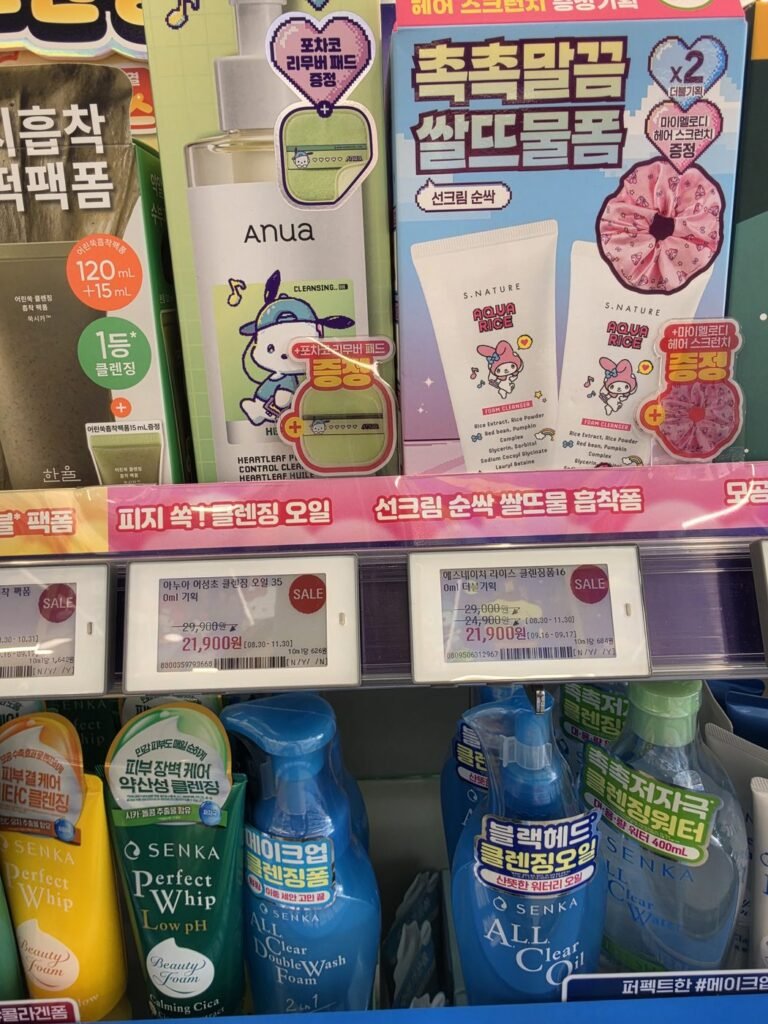
Two of the tags read 21,900 won each, yet their unit prices differ by 58 won per 10ml. The most expensive tag of the four is also the worst value per milliliter. You cannot see any of this from the sticker price, and you cannot see it at all from the product photos online.
If you learn one thing from this article, learn to glance at ~당 ~원.
Korean prices are read in units of 만 (ten thousand), which trips up almost every beginner — our guide to Korean numbers covers that system.
Two more fields
Barcode — runs along the bottom. Useful if you want to find the product again later — scan it with a shopping or translation app and it will usually come straight up.
가격표에 핸드폰을 태깅하여 상품정보를 확인하세요 — a sign above several counters: Tag your phone on the price label to check product information. The labels are NFC-enabled: tap an NFC-capable phone against the tag and the product page opens, with reviews and the ingredient list. The page is in Korean, but the photos and ratings are easy to follow, and a translation app handles the rest.
The words that change the price
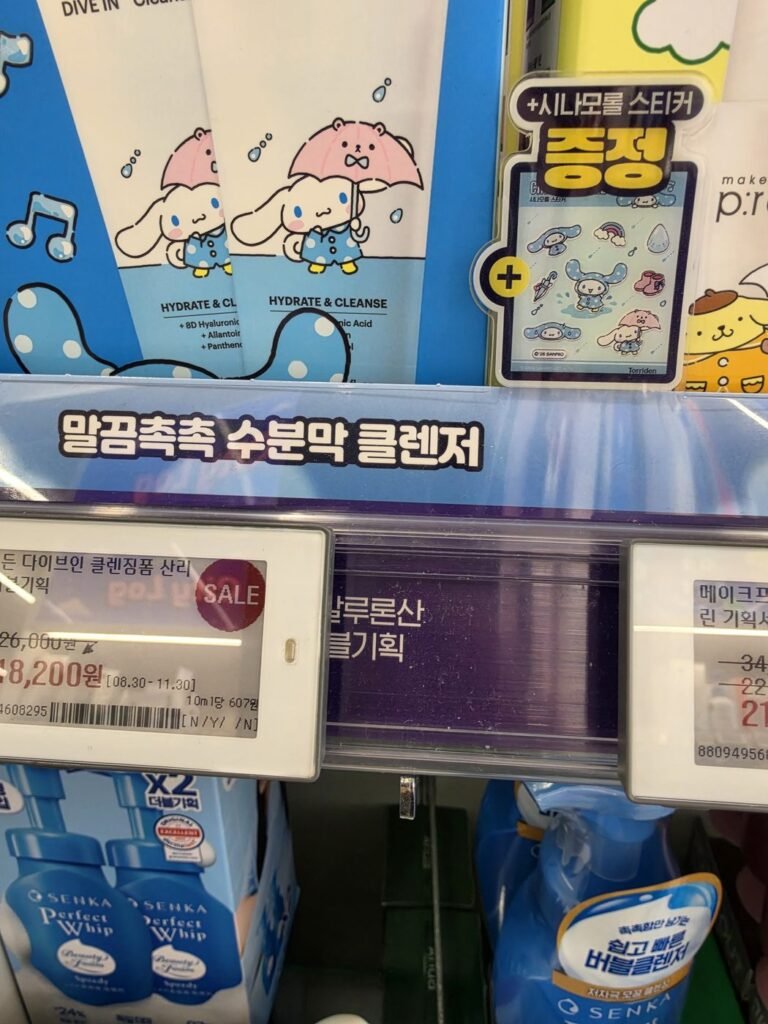
Scattered across the shelves are acrylic tags and box stickers in bold type. These are where Korean retail vocabulary gets specific in ways your dictionary won’t help with.
증정 (jeung-jeong) — free gift included. Almost always printed in yellow on black or red. Whatever is pictured next to it comes in the box at no extra cost. On the shelf I photographed, one tag read +시나모롤 스티커 증정 (free sticker) and another +폼폼푸린 손목 쿠션 증정 (free wrist cushion).
기획 (gi-hoek) — literally “plan” or “project,” but on a cosmetics shelf it means a special retail edition: a bundle, an oversized version, or a set with extras. You’ll see it three ways:
- 기획 — a promotional version of a single product
- 더블기획 or ×2 더블기획 — two units in one box
- 기획세트 — a gift set with multiple items
A 기획 box is often better value than the plain version — but not always, which is why the unit price matters: a 기획 can cost more at the register and less per milliliter.
ONLY 올리브영 — sold exclusively at Olive Young. Relevant if you’re planning to compare prices elsewhere; you can’t.
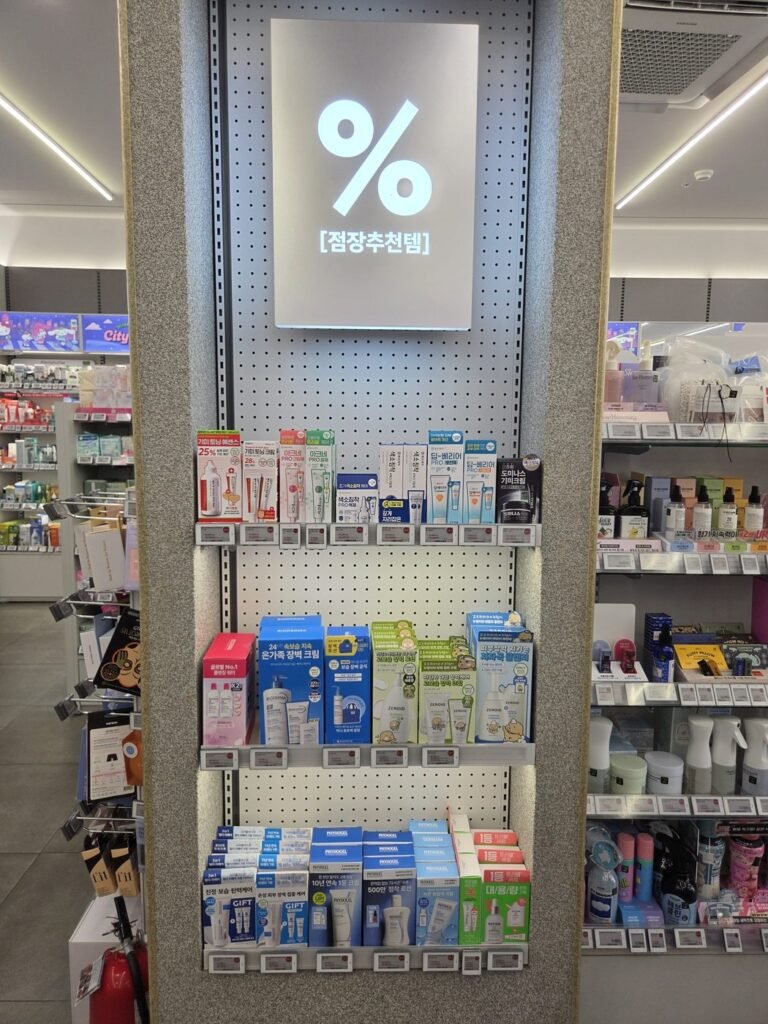
점장추천템 (jeom-jang chu-cheon-tem) — the store manager’s pick. A curated end-cap display. 점장 is the store manager, 추천 is a recommendation, and 템 is internet slang shortened from 아이템 (item). You’ll see 템 everywhere in Korean shopping language.
1등 / 1위 (il-deung / il-wi) — number one. Usually with an asterisk and unreadable fine print explaining the ranking criteria. Treat it the way you’d treat “America’s #1 brand.”
TRY ME — a tester you’re allowed to open. Printed in English, thankfully.
5+1, 7+2, 4+1 — buy-five-get-one, and so on. Extremely common on sheet masks.
대용량 (dae-yong-nyang) — large size. 리필 is refill.
Reading the shelf strip
Above each row of products runs a printed plastic strip. Olive Young uses these to state, in a compressed phrase, what problem the products below solve. They’re the fastest way to navigate the store, and they’re written in a punchy style you won’t find in a textbook.
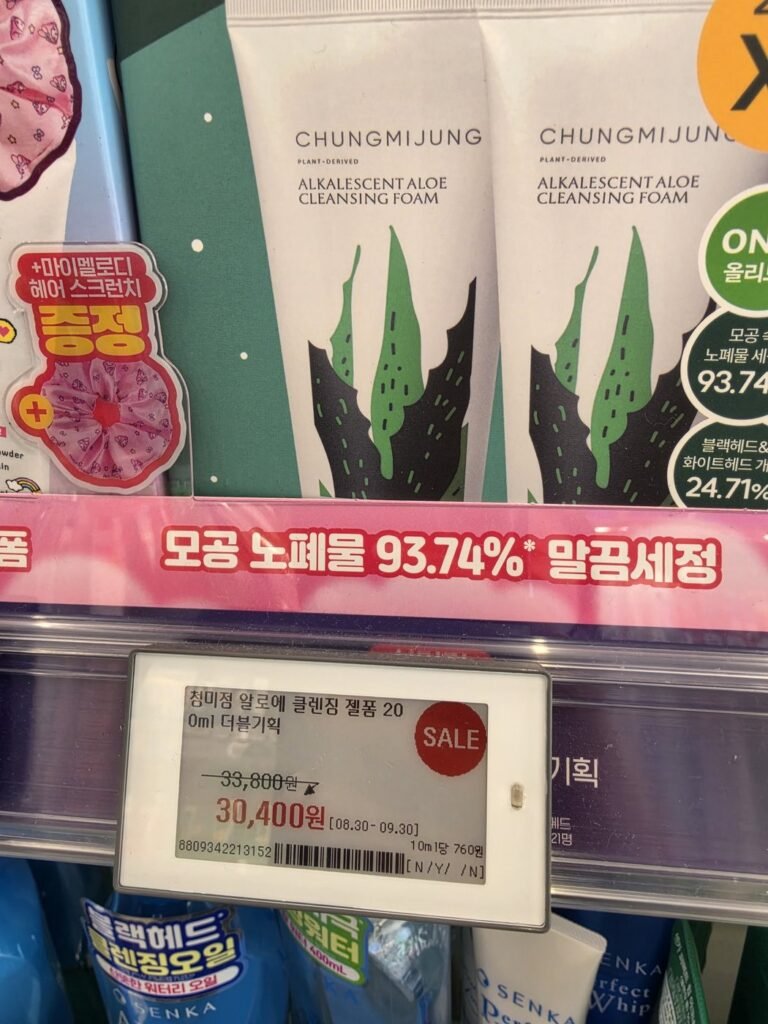
Four real examples from the cleansing wall:
말끔촉촉 수분막 클렌저
Squeaky-clean-and-dewy moisture-barrier cleanser저자극* 수분 클렌저
Low-irritation hydrating cleanser모공 노폐물 93.74%* 말끔세정
93.74% of pore impurities cleanly removed피지 쏙! 클렌징 오일
Sebum-sucking-out cleansing oil
Notice the asterisks. They always point to fine print somewhere on the shelf or box, usually a line like 시험 완료 / 만 20~60세 성인남녀 30명 — testing completed on 30 adults aged 20 to 60. A sample of thirty is a sample of thirty. The asterisk is your cue that a number is doing marketing work.
The concern vocabulary
Strip these phrases down and the same twelve or so words appear over and over. Learn these and you can identify what any Korean skincare product claims to do, in about two seconds:
| Korean | Reading | What it claims |
|---|---|---|
| 수분 | su-bun | hydration, water content |
| 보습 | bo-seup | moisturizing |
| 진정 | jin-jeong | soothing, calming |
| 저자극 | jeo-ja-geuk | low irritation, gentle |
| 모공 | mo-gong | pores |
| 피지 | pi-ji | sebum, oil |
| 각질 | gak-jil | dead skin, flaking |
| 장벽 | jang-byeok | skin barrier |
| 탄력 | tal-lyeok | elasticity, firmness |
| 톤업 | ton-eop | tone-up, brightening |
| 잡티 | jap-ti | blemishes, dark spots |
| 트러블 | teu-reo-beul | breakouts, “trouble” |
| 기미 | gi-mi | melasma |
| 미백 | mi-baek | whitening, brightening |
| 광채 | gwang-chae | radiance, glow |
A few of these deserve a note.
장벽 literally means “wall” or “barrier,” and it’s everywhere. Korean skincare treats the skin barrier as the central concept the way Western marketing treats “anti-aging.” A whole shelf section I photographed was labeled 바르는 습윤 장벽 케어 — applied moisture-retention barrier care.
미백 translates as “whitening,” which lands badly in English and often gets rendered as “brightening” on export packaging. In Korean regulatory language it refers specifically to reducing hyperpigmentation, not lightening overall skin tone. Same word, different cultural weight.
트러블 is the English word “trouble,” borrowed to mean acne and breakouts. If you say 여드름 (yeo-deu-reum, the actual Korean word for acne) you’ll be understood, but the shelves say 트러블.
Telling cleansers apart
The cleansing wall is the single most overwhelming aisle in the store, partly because Korean has more words for “cleanser” than English does. The pattern is simple once you see it: texture word + 클렌징 or 클렌저.
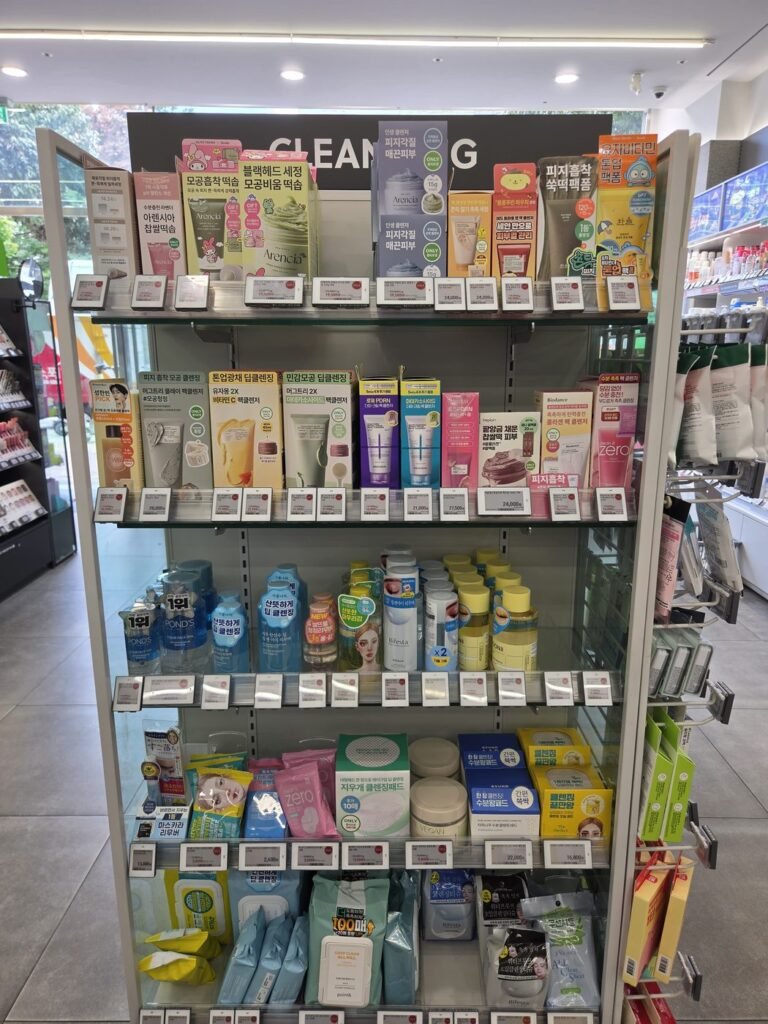
| Korean | Type |
|---|---|
| 클렌징폼 | foam cleanser |
| 클렌징오일 | cleansing oil |
| 클렌징워터 | micellar-style cleansing water |
| 클렌징밀크 | cleansing milk |
| 클렌징젤 / 젤폼 | gel cleanser |
| 팩폼 | a cleanser you leave on briefly, like a mask |
| 필링젤 | peeling gel, physical exfoliant |
| 클렌징패드 | pre-soaked cleansing pads |
| 클렌징티슈 | cleansing wipes |
Same logic runs through the rest of the store. 토너, 에센스, 세럼, 앰플, 크림, 로션, 미스트 are all loanwords. 앰플 (ampoule) is marketed as the most concentrated of the serum family, and it is a far bigger category in Korea than in most Western ranges.
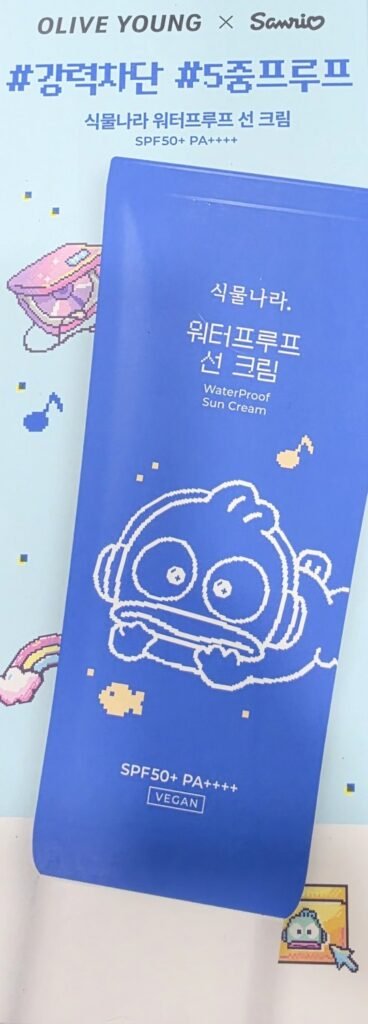
Sun care splits three ways: 선크림 (cream), 선스틱 (stick), 선스프레이 (spray). On a sunscreen box I picked up, the front read #강력차단 #5중프루프 — strong blocking, five-proof — a claim that it holds up against five things, such as sweat, water and sebum; the box lists which five. 차단 (cha-dan) is the standard word for UV blocking.
Two legal labels worth knowing
Look at the small gray text on a shelf tag and you’ll sometimes see one of these. They aren’t marketing. They’re regulatory categories under Korean law, and they tell you something real.
기능성화장품 (gi-neung-seong hwa-jang-pum) — functional cosmetic. To carry this label, a product must be registered with the Ministry of Food and Drug Safety for one of a defined set of claims: UV protection, wrinkle improvement, brightening, and a handful of others. The efficacy data has been submitted and reviewed. It doesn’t mean the product will work for you; it means the claim isn’t invented.
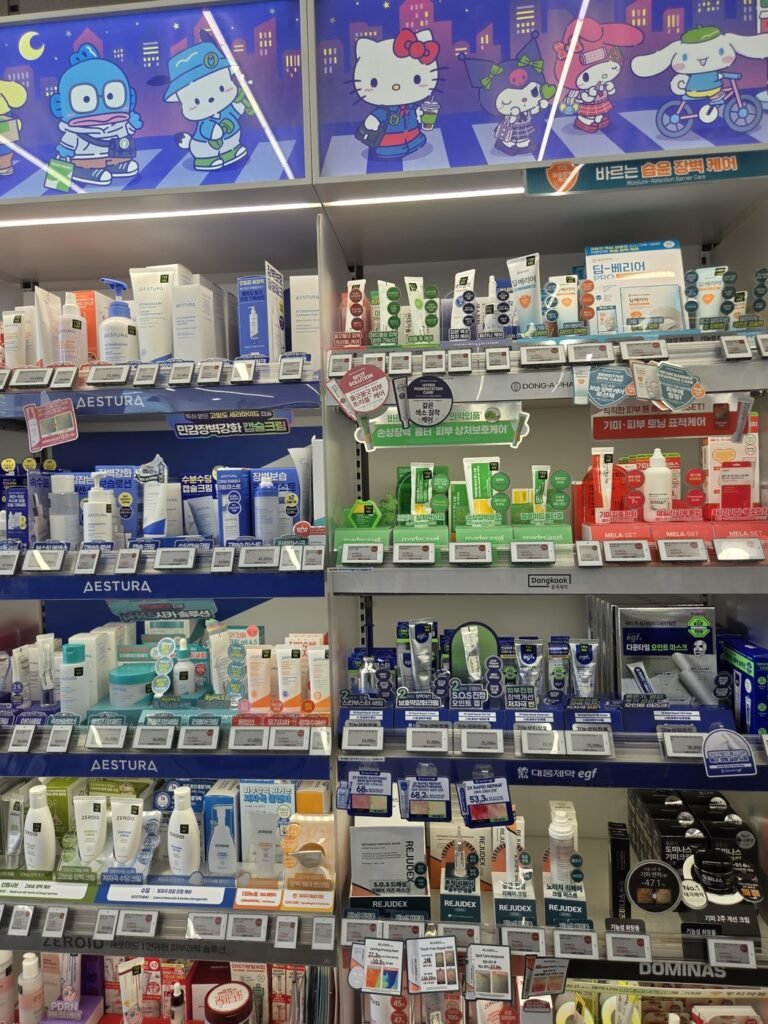
의약외품 (ui-ya-goe-pum) — quasi-drug. A step further. At Olive Young you’ll see it on some wound- and scar-care gels and patches — one shelf sign in the derma section pairs 의약외품 with 흉터 피부 상처보호케어, scar and wound protection — as well as on toothpaste and mouthwash. These sit between cosmetics and pharmaceuticals in Korean regulation.
Most products on the shelf carry neither label, and that’s normal. But when you’re choosing between two nearly identical tubes, 기능성화장품 on one of them is a genuine tiebreaker.
The back of the box
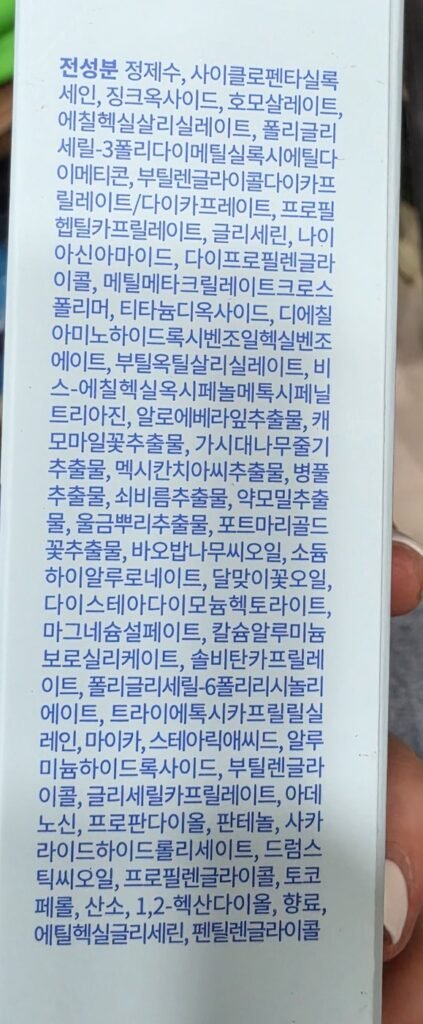
Turn any product around and you’ll find a dense block of Korean beginning with 전성분 (jeon-seong-bun) — full ingredients.
It’s intimidating, and you don’t need to read all of it. Three things are worth knowing.
The first ingredient is almost always 정제수 (jeong-je-su), purified water. Korean ingredient lists follow descending-concentration order, same as INCI lists elsewhere.
The actives keep their transliterated names. Once you can read and write Hangul, these decode themselves:
| Korean | Ingredient |
|---|---|
| 나이아신아마이드 | niacinamide |
| 소듐하이알루로네이트 | sodium hyaluronate |
| 아데노신 | adenosine |
| 판테놀 | panthenol |
| 병풀추출물 | centella asiatica extract |
| 징크옥사이드 | zinc oxide |
| 티타늄디옥사이드 | titanium dioxide |
| 향료 | fragrance |
아데노신 is worth flagging. It’s the ingredient Korea approves for wrinkle-improvement claims, so it shows up in a huge proportion of 기능성화장품 anti-aging products. If you see it, that’s usually why.
향료 at the end of the list means added fragrance. If you’re sensitive, this is the word to scan for. 무향 means fragrance-free.
Five sentences for the store
You can shop Olive Young in complete silence and nobody will mind. But these five come up.
They follow the same polite 해요 pattern I used in how to order food in Korean, so if you’ve learned those you already know the shape of these. More phrases for any shop are in shopping in Korean.
이거 테스터 있어요?
i-geo te-seu-teo i-sseo-yo
Do you have a tester for this?
이거 얼마예요?
i-geo eol-ma-ye-yo
How much is this?
면세 되나요?
myeon-se doe-na-yo
Is this tax-free eligible?
Foreign visitors can get the VAT back on purchases of ₩15,000 or more with a passport, and many branches refund it on the spot. Ask before paying, not after — our guide to how to pay in Korea covers tax refunds in full.
봉투 주세요.
bong-tu ju-se-yo
A bag, please. Bags cost extra and are not automatic.
적립 안 해요.
jeong-nip an hae-yo
No membership points. The cashier will ask about a points card. This ends the exchange politely.
One more sign to recognize, printed on the perfume and lip counters:
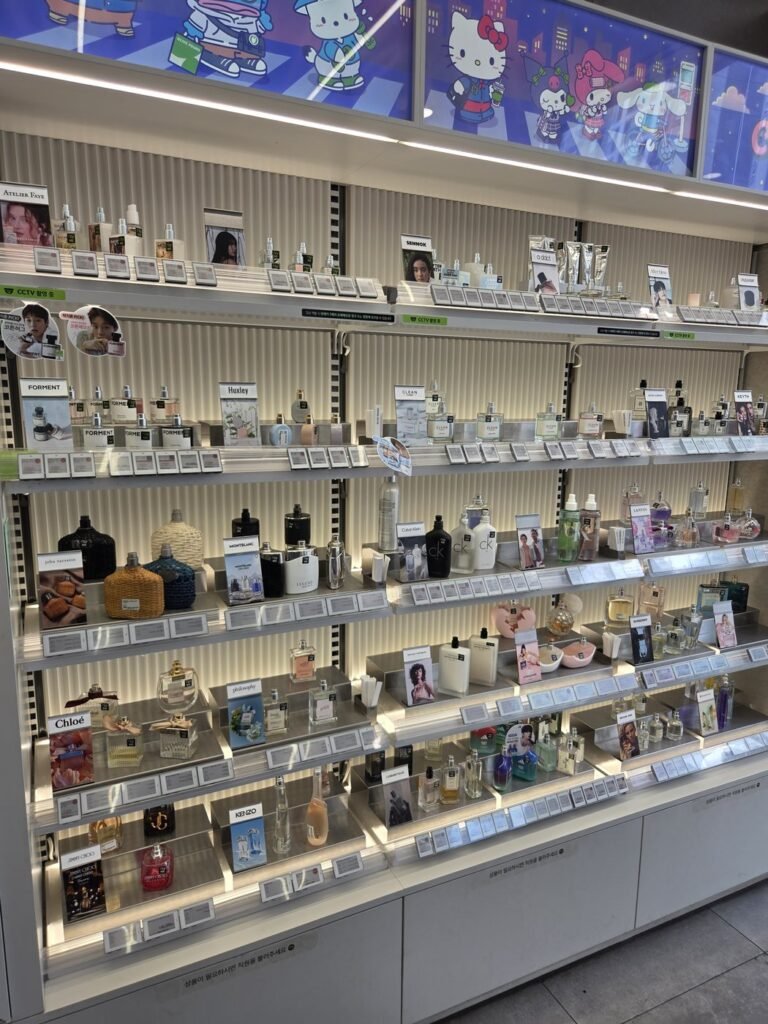
상품이 필요하시면 직원을 불러주세요
If you need the product, please call a staff member
Those displays are testers only. The sealed stock is in a cabinet behind the counter. If you put a display bottle in your basket, you’ll be redirected at the register.
A shopping checklist
Everything you need to shop at Olive Young without guessing fits on one list. Print it, screenshot it, or just remember the shape of it:
- Take a basket at the door.
- Find your aisle by the section sign — CLEANSING, SKIN CARE, MEN’S CARE, and so on are in English.
- Read the shelf strip above the row to confirm the products solve your problem — scan for 수분, 진정, 모공, 저자극.
- Check the price tag from the bottom up: is there a short-dated flash price ending today?
- Compare the unit price (~당 ~원), not the sticker price.
- Look for 증정 and 기획 — the free gift and bundle tags are where the value hides.
- Turn the box over if you’re sensitive, and scan the 전성분 for 향료.
- Ask about 면세 before you pay.
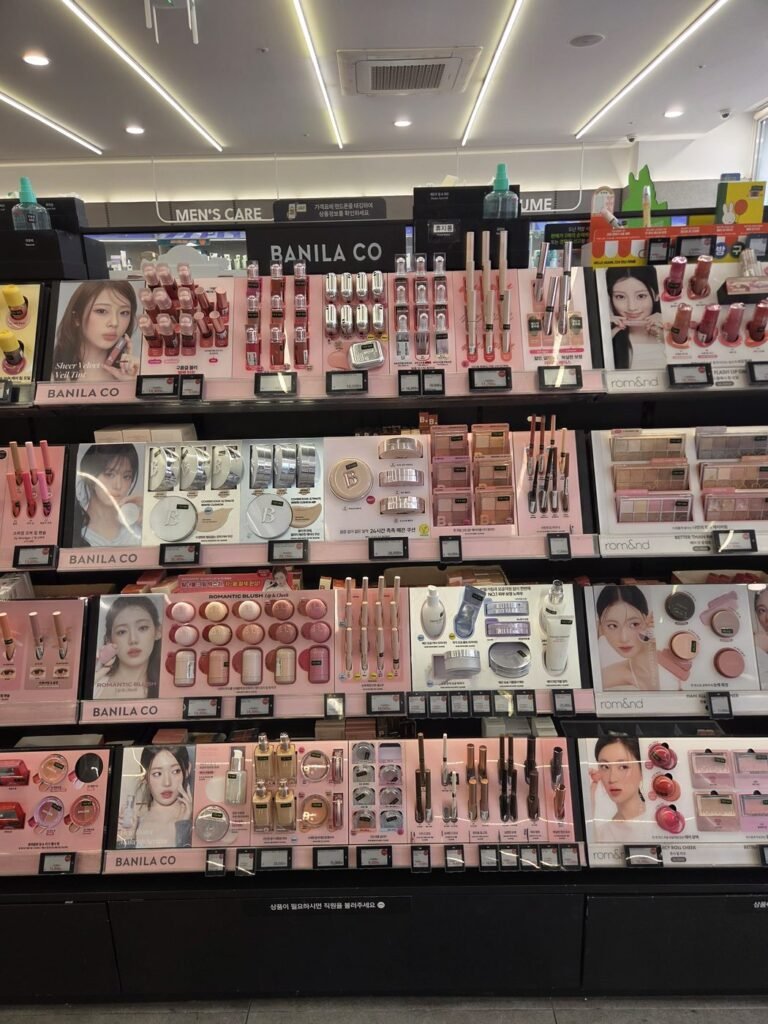
Olive Young is not a difficult store. It’s a loud one. The noise is deliberate — the characters, the percentages, the exclamation marks all exist to move product, and they work equally well on Korean shoppers.
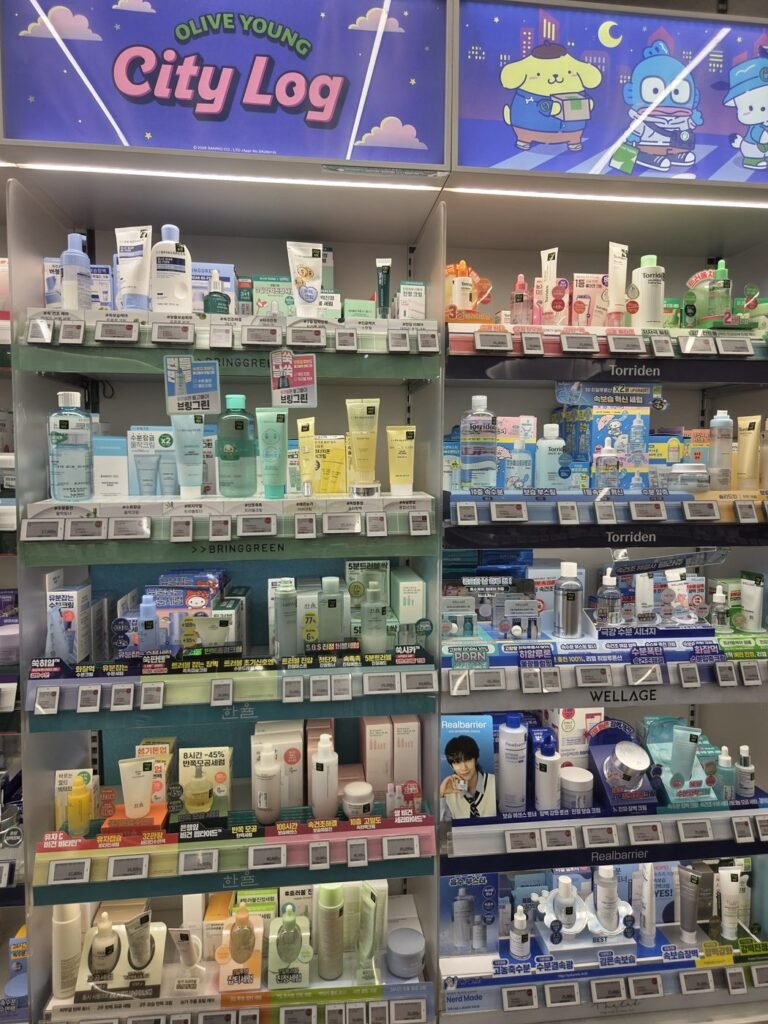
What cuts through the noise is a handful of small, unglamorous words: 당, 증정, 기획, 저자극, 전성분. None of them are in a beginner textbook. All of them are printed on every shelf in the country.
Learn those, and the store stops shouting at you and starts telling you things.
If you’re starting from zero and want a path rather than a word list, begin with my beginner roadmap for learning Korean.
Written by Minhyung Cha — 25 years teaching Korean, and 15+ years running an English academy in South Korea. I live and work in Busan, and every example on this site is checked as a native speaker. More about KEL.
Leave a Reply