
You push open the door of a small restaurant in Seoul. Someone calls out 어서 오세요. Then, before you have found your footing, comes a question you were not ready for: 몇 분이세요?
Two words. Perfectly ordinary. And if you have only studied greetings, it lands like a wall.
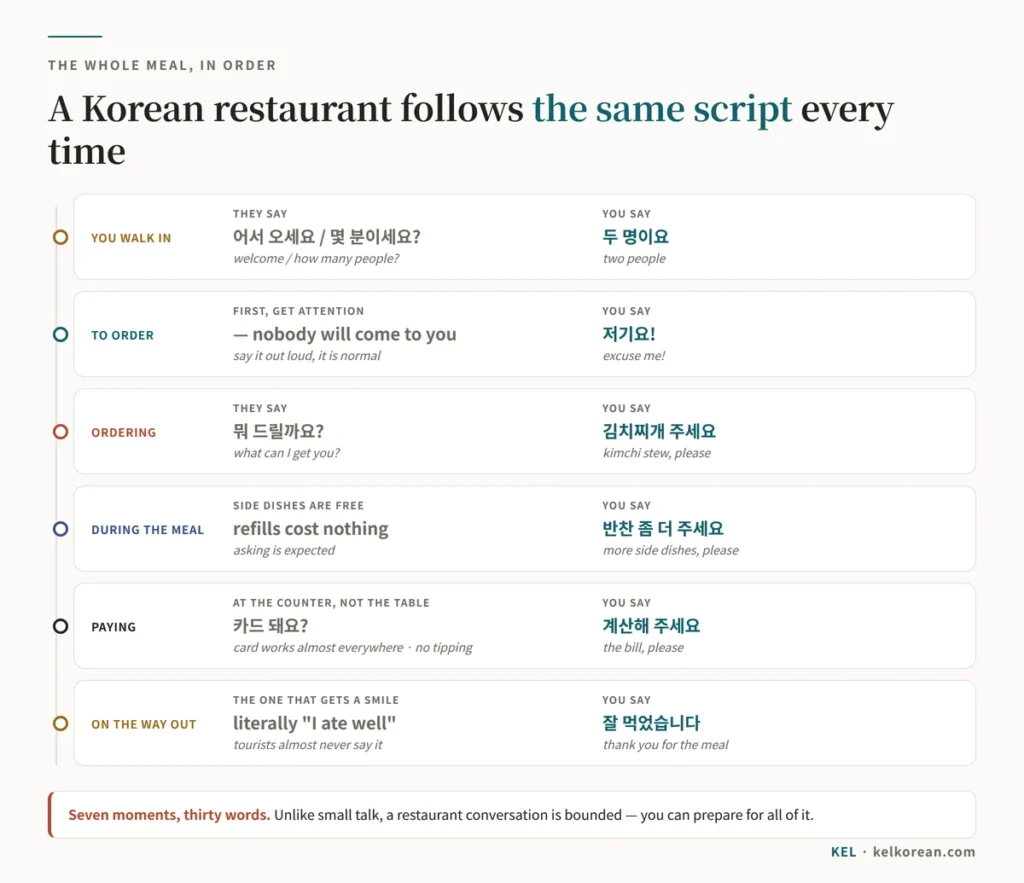
Here is the useful truth about eating in Korea: a restaurant conversation is one of the most predictable exchanges in the language. The same six or seven things happen in the same order, almost every time. Learn that script and you can eat comfortably anywhere in the country on a vocabulary of about thirty words.
This guide covers how to order food in Korean in the order it actually happens — walking in, being seated, calling the server, ordering, asking for more, and paying — plus how to decode a menu that has no pictures, and the handful of customs that catch first-timers off guard.
The Whole Script, In Order
Before the details, here is the entire interaction. Read it once and you will recognise every step when it happens.
| Moment | They say | You say |
|---|---|---|
| You walk in | 어서 오세요 (welcome) | — (a nod is fine) |
| Seating | 몇 분이세요? (how many?) | 두 명이요 (two) |
| Getting attention | — | 저기요! (excuse me!) |
| Ordering | 뭐 드릴까요? (what can I get you?) | 김치찌개 주세요 |
| Mid-meal | — | 물 좀 주세요 (water, please) |
| Finishing | — | 계산해 주세요 (the bill, please) |
| Paying | 카드요, 현금이요? | 카드요 (card) |
That is it. Seven moments. Everything below is filling in the variations.
The One Pattern That Orders Anything
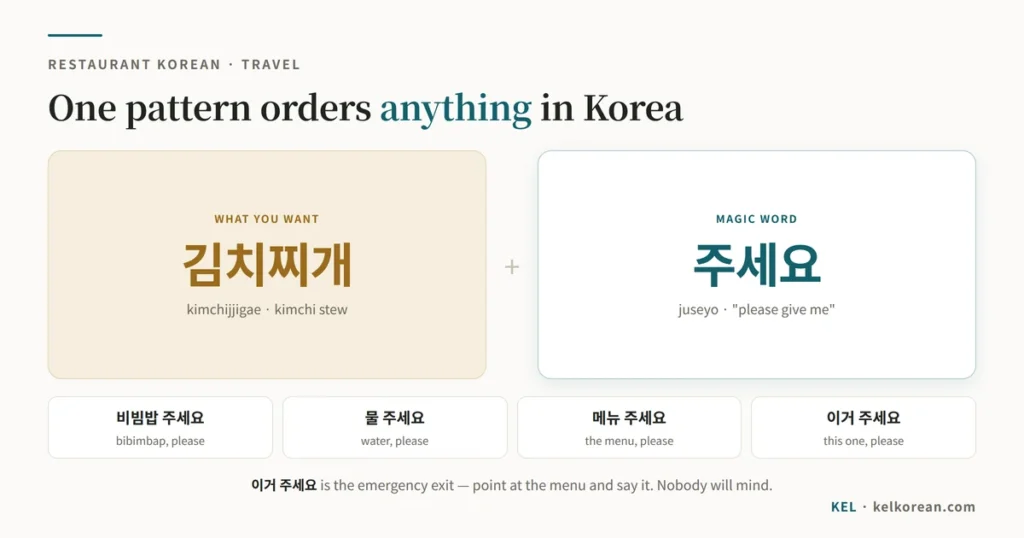
If you learn a single sentence from this article, learn this one:
[food] 주세요.
(juseyo) — “Please give me [food].”
주세요 is the polite request form of 주다 (to give), and it works for objects, food, favours, almost anything.
| Korean | Romanization | Meaning |
|---|---|---|
| 김치찌개 주세요 | kimchijjigae juseyo | Kimchi stew, please |
| 비빔밥 주세요 | bibimbap juseyo | Bibimbap, please |
| 물 주세요 | mul juseyo | Water, please |
| 메뉴 주세요 | menyu juseyo | The menu, please |
| 이거 주세요 | igeo juseyo | This one, please |
이거 주세요 is the emergency exit. Point at the menu, or at what the next table is eating, and say it. Nobody will think you are rude — pointing at a menu is completely normal in Korea, and this is how a large share of tourists order successfully.
Adding 좀 (jom) softens the request slightly: 물 좀 주세요 is a touch gentler than 물 주세요. Both are polite. Koreans use 좀 constantly.
Getting the Server’s Attention
This is the part that most surprises visitors from Western countries.
In Korea, you call the server. They do not check on you.
Waiting quietly with a hopeful expression can leave you waiting a long time — not from neglect, but because the norm is that customers signal when they need something.
| Phrase | Romanization | Notes |
|---|---|---|
| 저기요! | jeogiyo | The standard. Literally “over there” |
| 여기요! | yeogiyo | Also common. Literally “here” |
| 사장님! | sajangnim | “Boss” — friendly, used in small local places |
Say it clearly and with volume. It feels shockingly loud the first time. It is completely normal, and nobody in the room will look at you.
Many restaurants have a call button on the table — a small buzzer, often labelled 호출 (call). If there is one, press it instead.
Counting Your Order
Korean uses counting words, and food is where you meet them fastest. Which number system you use depends on the counter.
With 개, 병, 잔, 그릇, 명 → use native Korean numbers (하나, 둘, 셋…, which shorten to 한, 두, 세 before a counter).
| Korean | Meaning |
|---|---|
| 한 개 | one item |
| 두 개 | two items |
| 맥주 두 병 | two bottles of beer |
| 커피 한 잔 | one cup of coffee |
| 공기밥 두 개 | two bowls of rice |
| 두 명이요 | two people |
With 인분 (servings) → use Sino-Korean numbers (일, 이, 삼…).
인분 is how grilled meat and stews are ordered — you are buying portions, not plates.
| Korean | Romanization | Meaning |
|---|---|---|
| 삼겹살 2인분 | samgyeopsal i-inbun | pork belly for two |
| 갈비 3인분 | galbi sam-inbun | short ribs for three |
A rule that saves you trouble: most Korean barbecue and stew places have a 2인분 minimum. Solo diners are sometimes turned away from grill restaurants, which is not rudeness — the grill and side dishes are priced per two.
If the two number systems are still shaky, our guide to Korean numbers covers exactly which one goes where.
Reading a Menu With No Pictures
Many good restaurants have a menu that is a wall of Hangul. Once you know about fifteen words, most of it becomes readable — because Korean dish names are usually ingredient + cooking method.
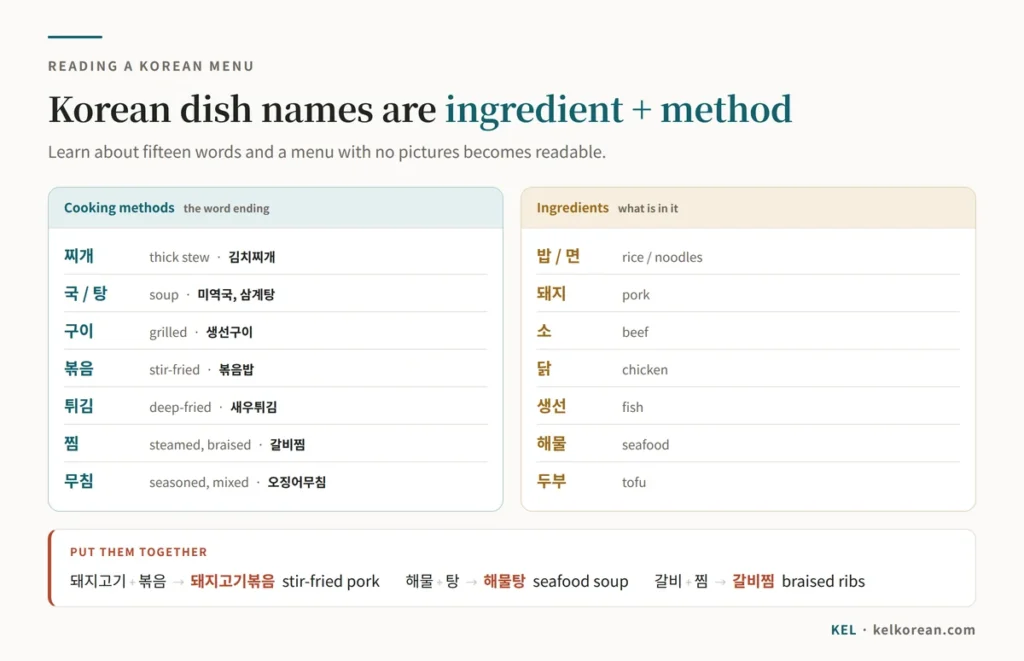
Cooking methods — the word endings
| Ending | Meaning | Example |
|---|---|---|
| 찌개 | thick stew | 김치찌개 |
| 국 / 탕 | soup | 미역국, 삼계탕 |
| 구이 | grilled | 생선구이 |
| 볶음 | stir-fried | 볶음밥 |
| 튀김 | deep-fried | 새우튀김 |
| 찜 | steamed / braised | 갈비찜 |
| 무침 | seasoned, mixed | 오징어무침 |
Core ingredients
| Korean | Meaning |
|---|---|
| 밥 | rice |
| 면 / 국수 | noodles |
| 고기 | meat |
| 돼지 | pork |
| 소 | beef |
| 닭 | chicken |
| 생선 | fish |
| 해물 | seafood |
| 야채 / 채소 | vegetables |
| 두부 | tofu |
| 계란 | egg |
Put them together and 돼지고기볶음 reads as pork + stir-fried. 해물탕 is seafood + soup. The system is consistent enough to guess with.
The four soup words are not interchangeable
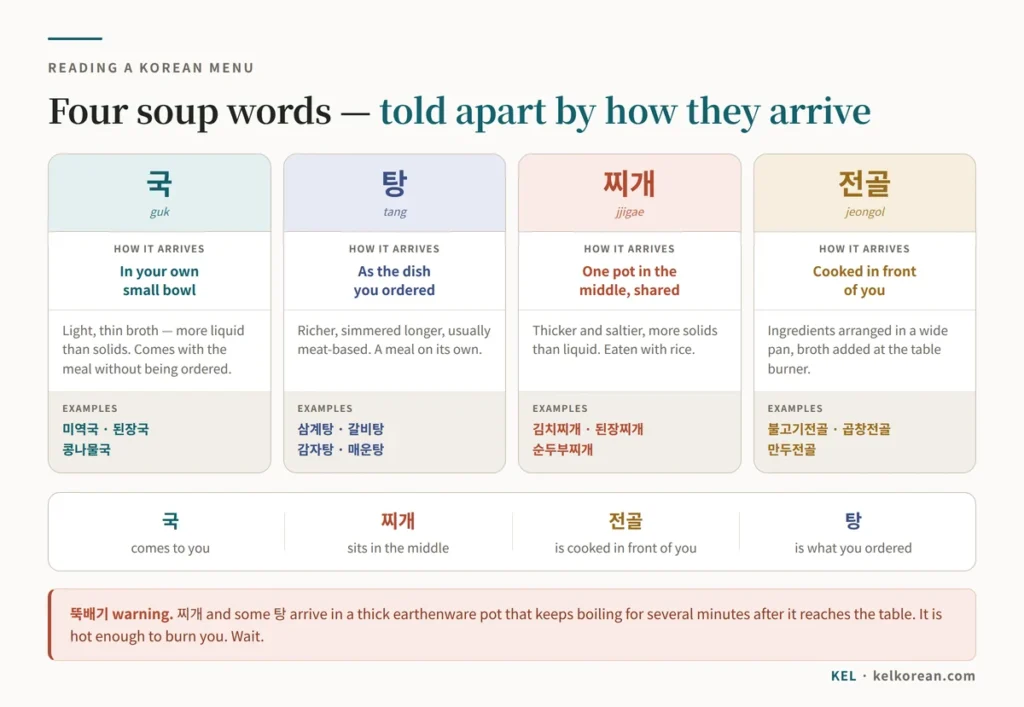
The table above puts 국 and 탕 in one row, which is enough to guess with — but four different words appear on menus and they tell you different things. The most useful difference is not what is in the bowl. It is how it arrives at your table.
| Word | What it is | How it arrives | Examples |
|---|---|---|---|
| 국 guk | light, thin broth — more liquid than solids | in your own small bowl, as part of the meal | 미역국, 된장국, 콩나물국 |
| 탕 tang | richer, simmered longer, usually meat-based | the dish you ordered — a meal on its own | 삼계탕, 갈비탕, 감자탕, 매운탕 |
| 찌개 jjigae | thicker and saltier, more solids than liquid | a shared pot in the middle of the table, eaten with rice | 김치찌개, 된장찌개, 순두부찌개 |
| 전골 jeongol | ingredients arranged in a wide pan, broth added | cooked in front of you on a table burner | 불고기전골, 곱창전골, 만두전골 |
The short version: 국 comes to you. 찌개 sits in the middle. 전골 gets cooked in front of you. 탕 is the thing you ordered.
One honest caveat about 국 and 탕. 탕 is the Sino-Korean word and 국 is the native Korean one, and they overlap far more than any chart suggests — 해장국 is a full meal, and some 탕 dishes are modest. The rule that actually holds is the serving one: if it came with your rice without being ordered, it is a 국.
And a practical warning. 찌개 and some 탕 arrive in a 뚝배기 (ttukbaegi) — a thick earthenware pot that keeps boiling for several minutes after it reaches the table. It is genuinely hot enough to burn you. Wait.
Three more endings worth knowing
| Ending | Meaning | Examples |
|---|---|---|
| 조림 | simmered in seasoned sauce until it reduces | 고등어조림, 감자조림, 장조림 |
| 전 | pan-fried in batter, like a savoury pancake | 김치전, 해물파전, 부추전 |
| 회 | raw | 생선회, 육회, 연어회 |
회 is the one to memorise first, because it is the only ending on this page that changes whether the food is cooked. 육회 is raw beef and 생선회 is raw fish, and neither will be flagged to you in English.
조림 and 찜 are easy to confuse. A 조림 is simmered in liquid until the sauce thickens around it; a 찜 is steamed or braised in a covered pot. 고등어조림 and 갈비찜 both arrive dark and glossy, and the difference is mostly in how much sauce is left.
Words that appear beside prices
| Korean | Meaning |
|---|---|
| 정식 | set meal (comes with sides) |
| 세트 | set / combo |
| 곱빼기 | extra-large portion |
| 사리 | extra noodles added to a stew |
| 공기밥 | a bowl of plain rice, ordered separately |
| 포장 | takeout |
The four soup words are not interchangeable
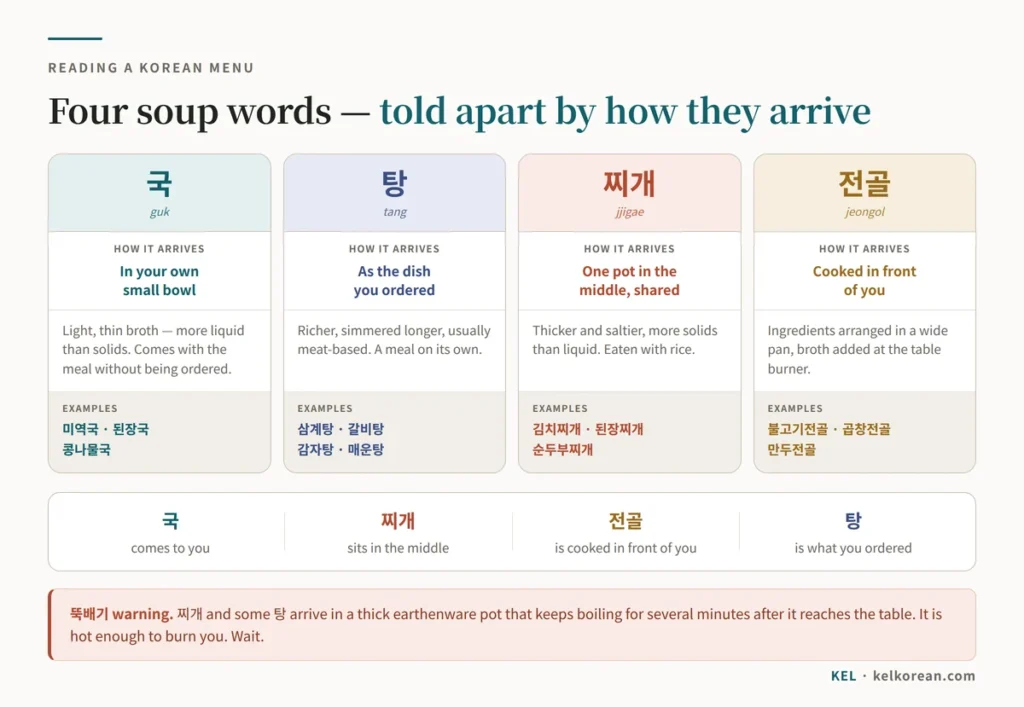
The table above puts 국 and 탕 in one row, which is enough to guess with — but four different words appear on menus and they tell you different things. The most useful difference is not what is in the bowl. It is how it arrives at your table.
| Word | What it is | How it arrives | Examples |
|---|---|---|---|
| 국 guk | light, thin broth — more liquid than solids | in your own small bowl, as part of the meal | 미역국, 된장국, 콩나물국 |
| 탕 tang | richer, simmered longer, usually meat-based | the dish you ordered — a meal on its own | 삼계탕, 갈비탕, 감자탕, 매운탕 |
| 찌개 jjigae | thicker and saltier, more solids than liquid | a shared pot in the middle of the table, eaten with rice | 김치찌개, 된장찌개, 순두부찌개 |
| 전골 jeongol | ingredients arranged in a wide pan, broth added | cooked in front of you on a table burner | 불고기전골, 곱창전골, 만두전골 |
The short version: 국 comes to you. 찌개 sits in the middle. 전골 gets cooked in front of you. 탕 is the thing you ordered.
One honest caveat about 국 and 탕. 탕 is the Sino-Korean word and 국 is the native Korean one, and they overlap far more than any chart suggests — 해장국 is a full meal, and some 탕 dishes are modest. The rule that actually holds is the serving one: if it came with your rice without being ordered, it is a 국.
And a practical warning. 찌개 and some 탕 arrive in a 뚝배기 (ttukbaegi) — a thick earthenware pot that keeps boiling for several minutes after it reaches the table. It is genuinely hot enough to burn you. Wait.
Three more endings worth knowing
| Ending | Meaning | Examples |
|---|---|---|
| 조림 | simmered in seasoned sauce until it reduces | 고등어조림, 감자조림, 장조림 |
| 전 | pan-fried in batter, like a savoury pancake | 김치전, 해물파전, 부추전 |
| 회 | raw | 생선회, 육회, 연어회 |
회 is the one to memorise first, because it is the only ending on this page that changes whether the food is cooked. 육회 is raw beef and 생선회 is raw fish, and neither will be flagged to you in English.
조림 and 찜 are easy to confuse. A 조림 is simmered in liquid until the sauce thickens around it; a 찜 is steamed or braised in a covered pot. 고등어조림 and 갈비찜 both arrive dark and glossy, and the difference is mostly in how much sauce is left.
Asking About the Food
| Korean | Romanization | Meaning |
|---|---|---|
| 이거 뭐예요? | igeo mwoyeyo | What is this? |
| 매워요? | maewoyo | Is it spicy? |
| 추천해 주세요 | chucheonhae juseyo | Please recommend something |
| 뭐가 제일 맛있어요? | mwoga jeil masisseoyo | What is the best here? |
| 얼마예요? | eolmayeyo | How much is it? |
추천해 주세요 is worth memorising. Asking a Korean restaurant owner what to order is a reliably good idea, and it is treated as a compliment rather than an inconvenience.
Spice, Allergies, and What You Cannot Eat
Korean food is often spicier than menus suggest, and 매워요? (“is it spicy?”) frequently gets a cheerful “조금” that means something else entirely.
| Korean | Romanization | Meaning |
|---|---|---|
| 안 맵게 해 주세요 | an maepge hae juseyo | Please make it not spicy |
| 덜 맵게 해 주세요 | deol maepge hae juseyo | Please make it less spicy |
| 고기 빼고 주세요 | gogi ppaego juseyo | Without meat, please |
| 저는 채식주의자예요 | jeoneun chaesikjuuijayeyo | I am a vegetarian |
| 저는 [X] 알레르기가 있어요 | …allereugiga isseoyo | I am allergic to [X] |
Be realistic about substitutions. Many Korean dishes are built on a base that already contains chilli paste, fish sauce, or anchovy stock, so “without meat” does not always mean vegetarian. In small restaurants the kitchen often cannot alter a recipe at all. Asking is still worth it — just have a backup dish in mind.
Useful vegetarian-friendly defaults: 비빔밥 (ask for it 고기 빼고), 김밥 without ham, 콩나물국밥, 파전, 두부김치.
Mid-Meal Requests
Side dishes — 반찬 (banchan) — arrive without being ordered and are free and refillable at almost every Korean restaurant. Asking for more is expected, not cheeky.
| Korean | Meaning |
|---|---|
| 반찬 좀 더 주세요 | More side dishes, please |
| 물 좀 주세요 | Water, please |
| 앞접시 주세요 | A small plate, please |
| 가위 주세요 | Scissors, please (for cutting meat or noodles) |
| 젓가락 주세요 | Chopsticks, please |
| 휴지 주세요 | Napkins, please |
Look under the table before asking for utensils. Many restaurants keep 수저 (spoon and chopsticks) in a shallow drawer built into the side of the table. Water is also often self-serve, from a dispenser marked 셀프 (self).
Paying
| Korean | Romanization | Meaning |
|---|---|---|
| 계산해 주세요 | gyesanhae juseyo | The bill, please |
| 얼마예요? | eolmayeyo | How much? |
| 카드 돼요? | kadeu dwaeyo | Do you take card? |
| 따로 계산해 주세요 | ttaro gyesanhae juseyo | Separate bills, please |
| 현금영수증 해 주세요 | hyeongeum yeongsujeung | Cash receipt, please |
Three things that differ from many countries:
1. You usually pay at the counter, not at the table. Stand up, walk to the register near the door, and pay there.
2. Card is accepted almost everywhere, including tiny old restaurants and street-food stalls. Korea is close to cashless.
3. There is no tipping. None. Leaving money on the table may get you chased down the street to have it returned. The price on the menu is the price you pay.
Splitting the bill is common among younger Koreans, though one person paying for the group is still the norm in many settings — especially when someone is older or senior.
Ordering at a Cafe
Cafes run on a slightly different script, and Korea has a lot of cafes.
| Korean | Meaning |
|---|---|
| 아이스 아메리카노 한 잔 주세요 | One iced americano, please |
| 따뜻한 걸로 주세요 | Hot, please |
| 차가운 걸로 주세요 | Iced, please |
| 여기서 마실게요 | I will drink it here |
| 포장해 주세요 | To go, please |
| 사이즈 업 해 주세요 | Make it a larger size |
They will almost certainly ask 드시고 가세요, 가져가세요? — “eating in, or taking away?” Answer 여기서 마실게요 or 포장해 주세요.
Iced americano is so dominant in Korea that it has a nickname, 아아 (a-a), short for 아이스 아메리카노. You will hear it constantly.
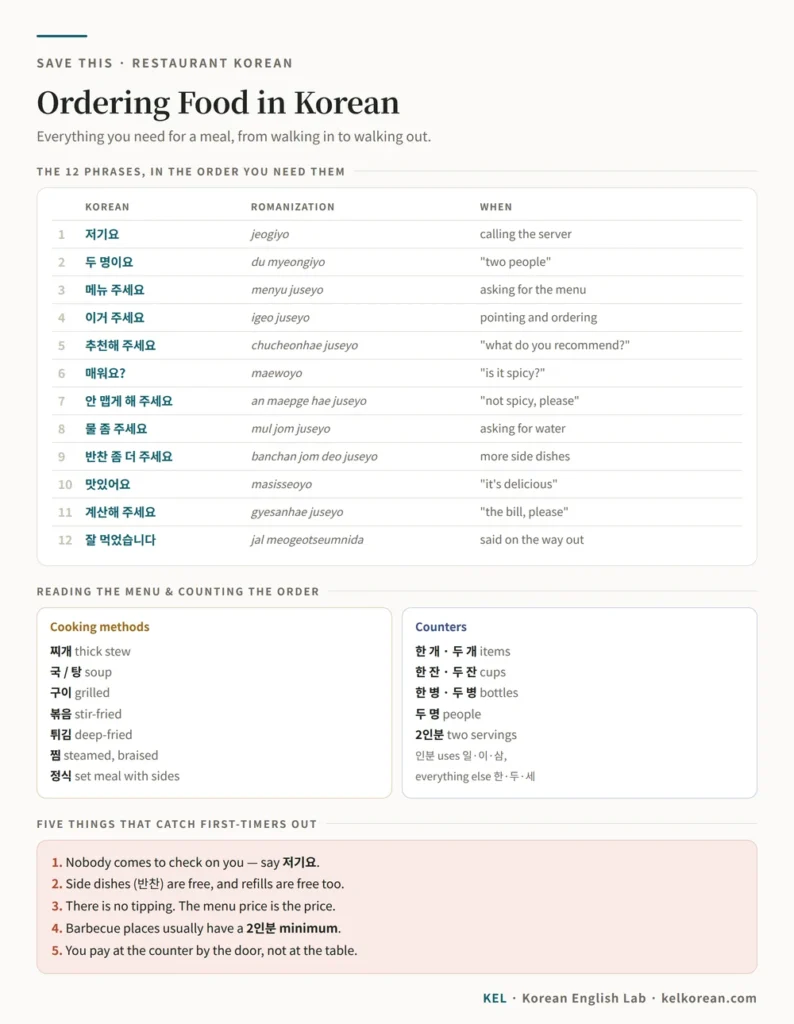
The 12 Phrases to Memorise
If you only bank a dozen, make it these.
| # | Korean | Romanization | When |
|---|---|---|---|
| 1 | 저기요 | jeogiyo | Calling the server |
| 2 | 두 명이요 | du myeongiyo | “Two people” |
| 3 | 메뉴 주세요 | menyu juseyo | Asking for the menu |
| 4 | 이거 주세요 | igeo juseyo | Pointing and ordering |
| 5 | 추천해 주세요 | chucheonhae juseyo | Asking for a recommendation |
| 6 | 매워요? | maewoyo | “Is it spicy?” |
| 7 | 안 맵게 해 주세요 | an maepge hae juseyo | “Not spicy, please” |
| 8 | 물 좀 주세요 | mul jom juseyo | Asking for water |
| 9 | 반찬 좀 더 주세요 | banchan jom deo juseyo | More side dishes |
| 10 | 맛있어요 | masisseoyo | “It’s delicious” |
| 11 | 계산해 주세요 | gyesanhae juseyo | “The bill, please” |
| 12 | 잘 먹었습니다 | jal meogeotseumnida | Said on leaving |
잘 먹었습니다 — literally “I ate well” — is what you say to the staff on the way out. It is the single phrase most likely to get a warm reaction, because it is what Koreans actually say and tourists almost never do.
Its partner, 잘 먹겠습니다 (jal meokgetseumnida), is said before eating — closer to “thank you for this food.”
Five Things That Catch First-Timers Out
1. Waiting to be checked on. Nobody is coming. Say 저기요.
2. Assuming the side dishes cost money. They do not, and refills are free. Ask.
3. Trying to tip. It is not done and can cause genuine confusion.
4. Ordering one portion at a barbecue place. 인분 usually starts at two.
5. Trusting “조금 매워요.” Korean calibration for “a little spicy” is not the same as most visitors’. If you are sensitive, ask for 안 맵게 rather than trusting the assessment.
A Full Conversation
Read this out loud. It is a complete meal.
Server: 어서 오세요! 몇 분이세요?
You: 두 명이요.
Server: 이쪽으로 앉으세요.
You: 저기요! 메뉴 주세요.
(later)
You: 김치찌개 하나랑 비빔밥 하나 주세요.
Server: 네, 잠시만요.
(during the meal)
You: 저기요, 반찬 좀 더 주세요.
(finishing)
You: 계산해 주세요. 카드 돼요?
Server: 네, 카드 돼요.
You: 잘 먹었습니다!
하나랑 (hanarang) means “one and” — 김치찌개 하나랑 비빔밥 하나 is “one kimchi stew and one bibimbap.” It is the simplest way to order two different things at once.
If the grammar in those sentences is unfamiliar, the pieces are covered in our guides to Korean particles and verb conjugation.
Frequently Asked Questions
Do I need Korean at all to eat in Seoul?
Not strictly. Tourist areas have English menus, and pointing works. But outside Myeongdong and Hongdae, English drops off sharply, and the best small restaurants tend to be the ones with no English at all. Thirty words of Korean opens up a very different set of meals.
Is 저기요 rude?
No. It is the standard way to get a server’s attention and carries no impatience. Not calling out is the thing that would confuse them.
Can I eat alone in Korea?
Yes, and it has a name — 혼밥 (honbap, eating alone), now completely normal. The exception is grill restaurants with a 2인분 minimum. Noodle shops, gimbap places, and 백반 restaurants are all easy solo.
Should I use 주세요 or something more polite?
주세요 is correct and polite for restaurants. There are more deferential forms, but they would sound oddly formal to a server. If you want to understand where 주세요 sits among Korean politeness levels, see our guide to Korean honorifics.
What if I cannot read the menu at all?
이거 뭐예요? while pointing, or 추천해 주세요. Both are normal, and staff are generally happy to help. Learning to read Hangul takes about a week and changes this problem completely — see how to learn Hangul in a week.
How do I order delivery?
Delivery apps dominate and most require a Korean phone number and address, which is difficult for short-term visitors. For a hotel stay, 포장 (takeout) from a nearby restaurant is usually the simpler route: say 포장해 주세요 when ordering.
What is the difference between 국 and 탕?
They overlap heavily — 탕 is the Sino-Korean word and 국 the native Korean one for much the same idea. The practical difference is how they are served: a 국 usually arrives in your own small bowl alongside rice as part of the meal, while a 탕 is normally the dish you ordered, richer and simmered longer. 미역국 comes with your meal; 삼계탕 is the meal.
What is the difference between 찌개 and 국?
A 찌개 is thicker and saltier with more solids than liquid, and it is shared — one pot in the middle of the table that everyone eats from with rice. A 국 is thinner and comes in an individual bowl. 김치찌개 sits in the middle; 콩나물국 sits in front of you.
What is 전골?
A dish cooked at your table on a portable burner — the ingredients arrive arranged in a wide shallow pan and broth is added in front of you. It is the most communal of the four soup types and is usually ordered for two or more people. 불고기전골 and 만두전골 are common versions.
What does 조림 mean on a Korean menu?
Simmered in a seasoned, usually soy-based sauce until the liquid reduces and coats the food. 고등어조림 is braised mackerel and 감자조림 is braised potato. It is close to 찜, which is steamed or braised in a covered pot — the difference is mostly how much sauce is left at the end.
How do I know if something on the menu is raw?
Look for 회. 생선회 is raw fish, 육회 is raw beef, 연어회 is raw salmon. It is the only common menu ending that changes whether the dish is cooked, and English menus do not always mark it.
Final Thoughts
Restaurant Korean is the best possible starting point for actually using the language, and the reason is structural: the conversation is bounded. There are only so many things a server will say to you, and only so many things you need to say back. Unlike small talk, you can genuinely prepare for all of it.
Learn 저기요, 이거 주세요, and 계산해 주세요 and you can eat anywhere in Korea today. Add the other nine phrases above and you will sound like someone who has been paying attention.
Then push slightly further than the tourist streets. The 5,000-won noodle shop with a handwritten menu and no English is where the food gets good — and it is exactly the place where thirty words of Korean stops being a party trick and starts being useful.
Heading to Korea soon? Pair this with our 10 essential Korean phrases for travelers and our guide to using the Korean subway. And if this is the trip that makes you want to learn the language properly, start with our complete beginner’s roadmap.
Keep learning with Korean English Lab. Our bilingual Korean–English worksheets and printable workbooks are designed for self-study learners who want structured practice, not just theory.
Leave a Reply