You’ve memorized 200 Korean words. You know the alphabet. But your sentences still sound “off” to native speakers. Nine times out of ten, the problem isn’t your vocabulary — it’s your particles.
Korean particles (조사, josa) are tiny attachments that tell the listener what job each word is doing in a sentence. Get them right, and your Korean instantly sounds natural. Get them wrong, and a perfectly good sentence turns into a puzzle. In this guide you’ll learn every essential particle, the batchim rule that decides which form to use, the famous 은/는 vs 이/가 problem explained in plain English, and a short quiz to test yourself.
What Is a Korean Particle?
English shows the role of a word through word order. Korean shows it through particles attached to the end of a noun.
Look at what happens in English when you move the words around:
- The dog bit the man.
- The man bit the dog. — completely different meaning!
In Korean, the particle stays glued to the noun, so the meaning survives even if the order shifts:
- 개가 남자를 물었어요. (gaega namjareul mureosseoyo) — The dog bit the man.
- 남자를 개가 물었어요. — Still: the dog bit the man.
That’s the whole idea. Particles are Korean’s built-in labeling system: this word is the subject, this one is the object, this one is the location.
The Batchim Rule: Why Particles Have Two Forms
Before anything else, you need this one rule, because it decides which version of a particle you use.
A batchim (받침) is a final consonant at the bottom of a Korean syllable block. 밥 has a batchim (ㅂ). 커피 does not — it ends in a vowel.
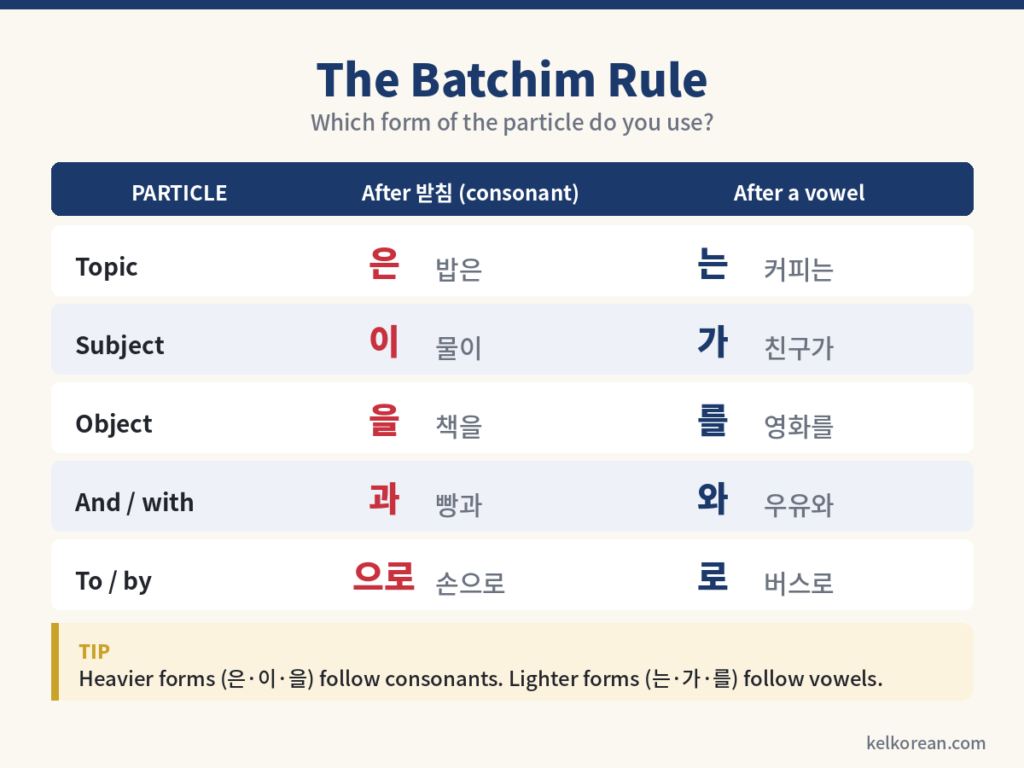
| Particle type | After a batchim (consonant) | After a vowel |
|---|---|---|
| Topic | 은 — 밥은 | 는 — 커피는 |
| Subject | 이 — 물이 | 가 — 친구가 |
| Object | 을 — 책을 | 를 — 영화를 |
| And / with | 과 — 빵과 | 와 — 우유와 |
| To / by means of | 으로 — 손으로 | 로 — 버스로 |
Memory trick: the consonant-heavy forms (은, 이, 을, 과, 으로) go after consonants. The lighter forms (는, 가, 를, 와, 로) go after vowels. Korean simply avoids awkward consonant pile-ups.
One exception worth noting: (으)로 uses the short form 로 after a ㄹ batchim too. So it’s 서울로, not 서울으로.
The Core Particles You’ll Use Every Day
1. 은 / 는 — the topic marker
Think of 은/는 as saying: “As for this…” It sets up what the sentence is about, and it often carries a hint of comparison.
- 저는 한국어를 배워요. (jeoneun hangugeoreul baewoyo) — As for me, I’m learning Korean.
- 김치는 매워요. (kimchineun maewoyo) — Kimchi is spicy (as opposed to other foods).
- 오늘은 바빠요. (oneureun bappayo) — Today I’m busy (implying: other days, maybe not).
2. 이 / 가 — the subject marker
이/가 points at who or what is doing the action, especially when that information is new or being identified for the first time.
- 친구가 왔어요. (chinguga wasseoyo) — A friend came.
- 날씨가 좋아요. (nalssiga joayo) — The weather is nice.
- 시간이 없어요. (sigani eopseoyo) — I don’t have time.
Note that 있다 (to exist / to have) and 없다 (to not exist) almost always pair with 이/가: 돈이 있어요, 문제가 없어요.
3. 을 / 를 — the object marker
This one marks the thing receiving the action. If you can ask “verb what?”, the answer takes 을/를.
- 밥을 먹어요. (babeul meogeoyo) — I eat rice/a meal.
- 영화를 봤어요. (yeonghwareul bwasseoyo) — I watched a movie.
- 한국어를 공부해요. (hangugeoreul gongbuhaeyo) — I study Korean.
4. 에 vs 에서 — the location pair that trips everyone up
Both translate as “at” or “in,” which is exactly why learners mix them up. The difference is simple once you see it:
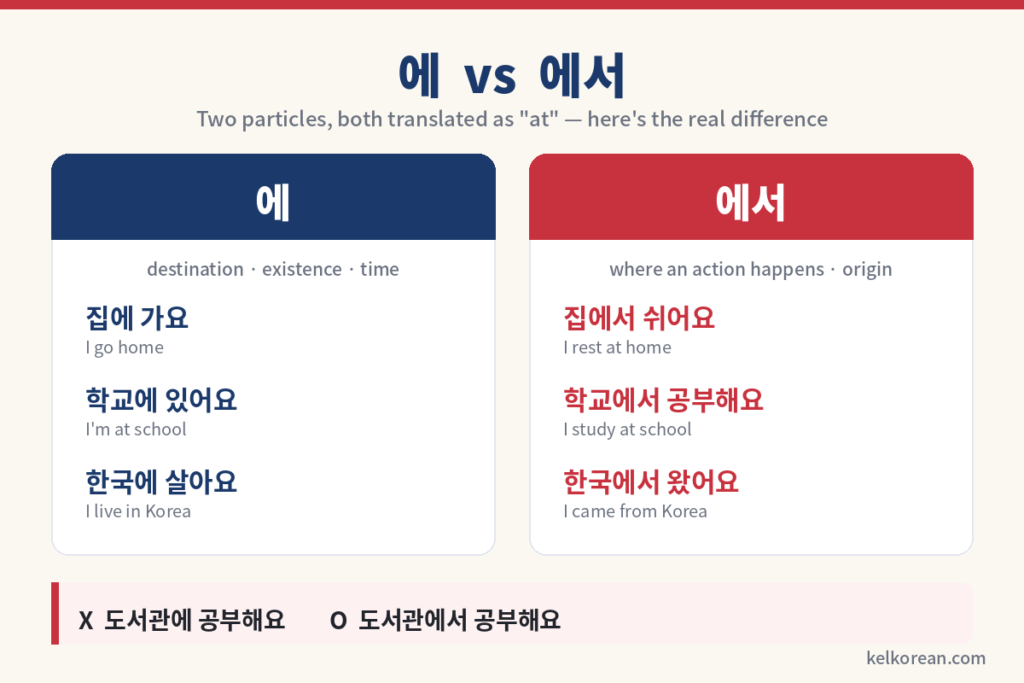
| 에 | 에서 |
|---|---|
| Destination, or a static location with 있다/없다 | Where an action happens, or a starting point |
| 집에 가요 — I go home | 집에서 쉬어요 — I rest at home |
| 학교에 있어요 — I’m at school | 학교에서 공부해요 — I study at school |
| 한국에 살아요 — I live in Korea | 한국에서 왔어요 — I came from Korea |
에 also marks time: 세 시에 만나요 (let’s meet at 3), 월요일에 시작해요 (it starts on Monday). Note that 오늘, 어제, 내일, 지금 never take 에.
5. (으)로 — direction, method, material
- 부산으로 가요 — I’m heading toward Busan (direction)
- 지하철로 왔어요 — I came by subway (means of transport)
- 젓가락으로 먹어요 — I eat with chopsticks (tool)
- 한국어로 말해요 — Speak in Korean (language)
You’ll hear 로 constantly in transit announcements — see it in context in our guide to using the Korean subway system.
6. 도 — “also / too”
도 is special: it replaces 은/는, 이/가, and 을/를 rather than stacking on top of them.
- 저도 학생이에요. — I’m a student too. (never 저는도)
- 커피도 마셔요. — I drink coffee as well. (never 커피를도)
It can stack onto location particles, though: 부산에도 갔어요 (I went to Busan too).
7. 만 — “only, just”
- 물만 마셔요. — I only drink water.
- 하나만 주세요. — Just one, please.
8. 와 / 과, 하고, (이)랑 — “and / with”
Three ways to say the same thing, differing in formality:
| Form | Register | Example |
|---|---|---|
| 와 / 과 | Formal, written | 빵과 우유 |
| 하고 | Neutral, safe anywhere | 빵하고 우유 |
| (이)랑 | Casual, spoken | 빵이랑 우유 |
All three also mean “with” a person: 친구하고 갔어요 — I went with a friend.
9. 의 — possession
Equivalent to English “‘s” or “of”: 친구의 책 (my friend’s book). Two things to know — it’s pronounced e rather than ui in this usage, and Koreans frequently drop it entirely in speech: 제 친구 책.
10. 부터 / 까지 and 에서 / 까지 — from and to
- 9시부터 6시까지 일해요. — I work from 9 to 6. (time)
- 서울에서 부산까지 세 시간 걸려요. — It takes three hours from Seoul to Busan. (place)
11. 에게 / 한테 / 께 — to a person
Use these for giving, sending, or telling something to someone. 한테 is conversational, 에게 is more written, and 께 is the honorific form for elders and superiors.
- 친구한테 전화했어요. — I called my friend.
- 선생님께 드렸어요. — I gave it to my teacher.
- 친구한테서 편지를 받았어요. — I received a letter from my friend.
For objects rather than people, use 에: 회사에 이메일을 보냈어요.
The choice between 한테, 에게, and 께 depends on who you’re speaking to — the same politeness logic that runs through the whole language. If that part is still fuzzy, start with our guide to Korean honorifics explained simply.
은/는 vs 이/가: The Real Explanation
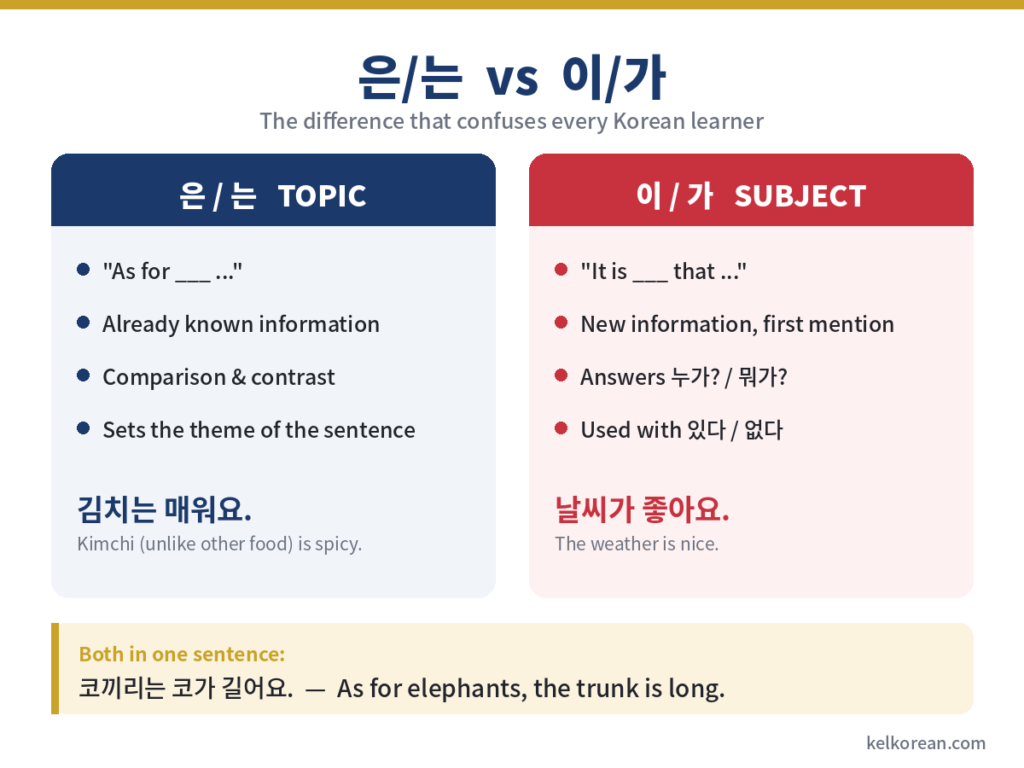
This is the single biggest source of confusion for learners, and textbook definitions (“topic” vs “subject”) rarely help. Here are four practical rules that actually work.
Rule 1: New information takes 이/가; known information takes 은/는
Think of how a story opens in English with “a” and continues with “the”:
옛날에 한 소녀가 살았어요. 그 소녀는 아주 착했어요.
Once upon a time, a girl lived here. The girl was very kind.
First mention → 이/가. Once she’s established → 은/는.
Rule 2: Comparison and contrast take 은/는
- 커피는 좋아하지만 차는 안 좋아해요. — I like coffee but not tea.
- 형은 키가 크고 저는 작아요. — My brother is tall and I’m short.
Rule 3: Answers to “who/what” questions take 이/가
If someone asks 누가 왔어요? (Who came?), the answer must be 동생이 왔어요 — because the whole point of your reply is to identify the new subject. Saying 동생은 왔어요 would sound like “well, my sibling came, at least” — a contrast you didn’t intend.
Rule 4: One sentence can use both
Korean happily takes a big topic and a smaller subject inside it:
- 코끼리는 코가 길어요. — As for elephants, the trunk is long.
- 저는 머리가 아파요. — As for me, my head hurts.
This double structure is extremely common in everyday Korean, and once it clicks, half the mystery disappears.
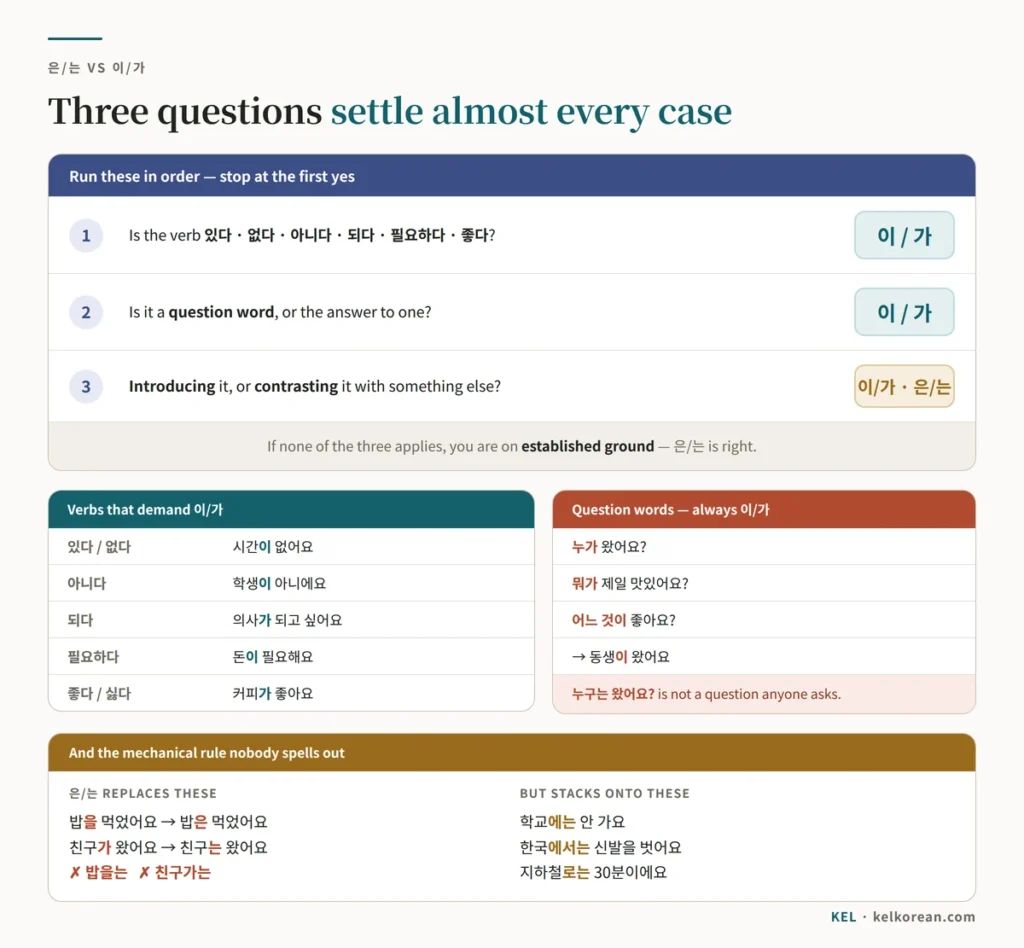
The verbs that demand 이/가
Some verbs do not give you a choice. With these, the thing in question takes 이/가 and nothing else will do — no matter how established the topic is.
| Verb | Example | Meaning |
|---|---|---|
| 있다 / 없다 | 시간이 없어요 | I don’t have time |
| 아니다 | 학생이 아니에요 | I’m not a student |
| 되다 | 의사가 되고 싶어요 | I want to become a doctor |
| 필요하다 | 돈이 필요해요 | I need money |
| 좋다 / 싫다 | 커피가 좋아요 | I like coffee |
That last one is worth stopping on. Korean has two ways to say you like something, and they take different particles:
커피가 좋아요. — 좋다 is an adjective. Literally “coffee is good [to me].”
커피를 좋아해요. — 좋아하다 is a verb. “I like coffee.”
Both are correct and both are common. 좋아요 is softer and more about how the thing strikes you; 좋아해요 is a statement about your preference. 커피를 좋아요 is simply wrong, and it is one of the most common particle mistakes learners make.
Question words always take 이/가
This one is a hard rule, and it falls straight out of what 이/가 does. A question word is asking for new, unidentified information — which is exactly the job of the subject marker.
- 누가 왔어요? — Who came? (누구 + 가, contracted)
- 뭐가 제일 맛있어요? — What is the tastiest?
- 어느 것이 좋아요? — Which one is good?
누구는 왔어요? is not a question anyone asks. And the answer follows the same logic — 동생이 왔어요, because you are identifying someone new.
은/는 replaces some particles and stacks onto others
Here is a mechanical rule that clears up a lot of confusion, and it is rarely spelled out.
은/는 replaces 이/가 and 을/를. You never see them together.
- 밥을 먹었어요 → 밥은 먹었어요 (I did eat — as for rice, at least)
- 친구가 왔어요 → 친구는 왔어요 (the friend, at least, came)
- ✗ 밥을는 · ✗ 친구가는 — these do not exist
But it attaches after 에, 에서 and (으)로. Those particles stay, and 는 lands on top of them.
| 학교에는 안 가요 | I don’t go to school (but I go elsewhere) |
| 한국에서는 신발을 벗어요 | In Korea, you take your shoes off |
| 지하철로는 30분이에요 | By subway, it’s 30 minutes |
Every one of those carries a comparison — an unspoken “but elsewhere / by another method, it is different.” That is 은/는 doing its usual job on top of a location or method.
Three questions that settle it
When you are stuck mid-sentence, run these in order.
- Is the verb 있다, 없다, 아니다, 되다, 필요하다 or 좋다? → 이/가. Stop here.
- Is it a question word, or the answer to one? → 이/가. Stop here.
- Am I introducing this, or contrasting it with something else? → introducing means 이/가; contrasting means 은/는.
If none of the three applies, you are almost certainly on established ground and 은/는 is right.
When Native Speakers Drop Particles Entirely
Here’s something textbooks rarely admit: in casual speech, Koreans leave particles out all the time when context makes the meaning obvious.
- 밥 먹었어? — Did you eat? (밥을 dropped)
- 어디 가? — Where are you going? (어디에 dropped)
- 나 학생이야. — I’m a student. (나는 dropped)
Two caveats. First, this happens mostly in informal spoken Korean — keep your particles in writing, in formal speech, and in exams like TOPIK. Second, 도 and 만 are essentially never dropped, because removing them would change the meaning.
5 Common Particle Mistakes to Avoid
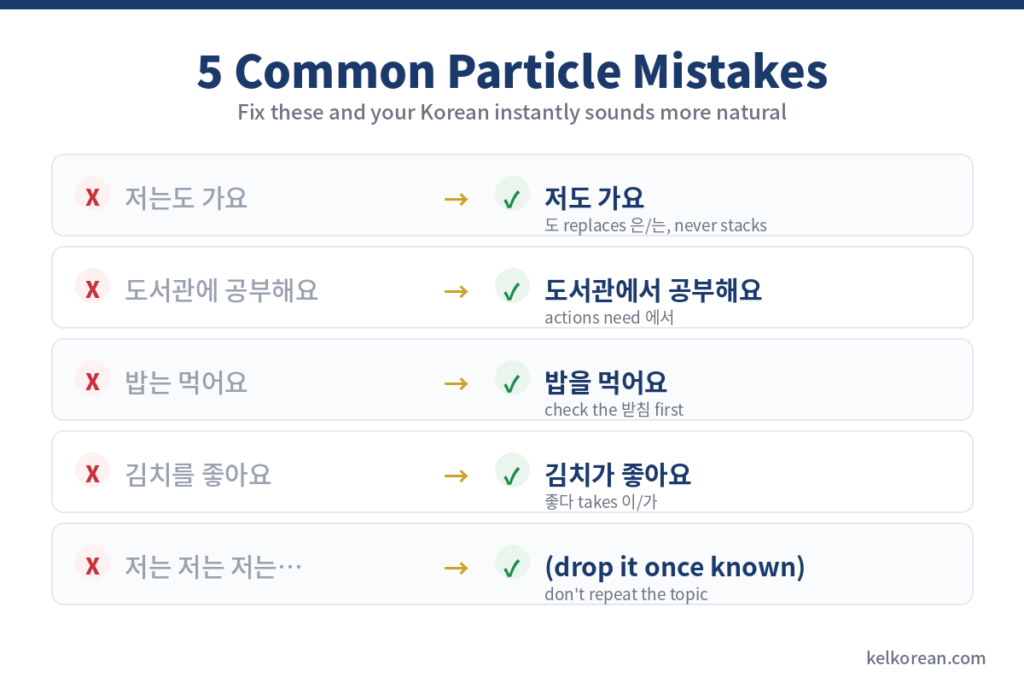
- Using 은/는 in every single sentence. Learners default to 저는… endlessly. Once your listener knows you’re talking about yourself, drop it.
- Saying 도서관에 공부해요. An action happening at a place needs 에서: 도서관에서 공부해요.
- Stacking 도 on another particle. 저는도 and 커피를도 are both wrong. Just 저도, 커피도.
- Mixing up 좋다 and 좋아하다. 좋다 is descriptive and takes 이/가 — 김치가 좋아요. 좋아하다 is an action verb and takes 을/를 — 김치를 좋아해요.
- Ignoring the batchim. 밥는 and 커피은 immediately mark you as a beginner. Check the last letter before you attach.
Quick Practice: Fill in the Particle
Cover the answers and try these ten. Choose from 은/는, 이/가, 을/를, 에, 에서, 도, 만, (으)로.
- 저___ 학생이에요.
- 친구___ 왔어요.
- 커피___ 마셔요.
- 학교___ 가요.
- 카페___ 공부해요.
- 시간___ 없어요.
- 저___ 가고 싶어요. (me too)
- 물___ 마셔요. (only water)
- 버스___ 왔어요. (by bus)
- 일곱 시___ 일어나요.
Answers: 1. 는 | 2. 가 | 3. 를 | 4. 에 | 5. 에서 | 6. 이 | 7. 도 | 8. 만 | 9. 로 | 10. 에
Frequently Asked Questions
How many Korean particles are there?
Korean has several dozen, but the twelve or so covered above account for the vast majority of everyday use. Master these first; the rest can wait until intermediate level.
Do I really need particles to be understood?
For short, obvious sentences, no — Koreans will understand 밥 먹었어. But as sentences grow longer, particles become the only thing keeping the meaning clear. They’re not optional decoration.
Why does the same word take different particles?
Because the particle reflects the word’s role in that sentence, not the word itself. 학교 can be 학교에 (to school), 학교에서 (at school), 학교가 (school as subject), or 학교를 (school as object).
What’s the fastest way to learn particles?
Not memorizing charts — using them. Write five sentences a day about your actual life, and read them out loud. Pattern recognition through repetition beats rules every time.
If you plan to take a proficiency test, particle accuracy is heavily weighted in the writing and grammar sections. You can check the official exam schedule on the TOPIK website.
What is the difference between 은/는 and 이/가?
은/는 marks the topic — what the sentence is about — and usually carries a quiet contrast with something else. 이/가 marks the subject and points at new or newly identified information. The quickest test: if you are introducing something, or answering “who?” or “what?”, use 이/가. If the thing is already established and you are saying something about it, use 은/는.
Why is it 커피가 좋아요 but 커피를 좋아해요?
Because they are two different words. 좋다 is an adjective meaning “is good,” so the coffee is the subject and takes 이/가. 좋아하다 is a verb meaning “to like,” so the coffee is the object and takes 을/를. 커피를 좋아요 mixes the two and is wrong.
Can 은/는 and 이/가 appear together?
No. 은/는 replaces 이/가 and 을/를 rather than stacking on them — 밥을는 and 친구가는 do not exist. It does stack onto 에, 에서 and (으)로, which is where 에는, 에서는 and 로는 come from.
Which particle goes with 있어요 and 없어요?
이/가, always — 시간이 없어요, 돈이 있어요. The same applies to 아니다, 되다, 필요하다 and 좋다. These verbs do not give you a choice, no matter how established the topic is.
What does 에는 mean?
It is 에 (location or time) with 는 attached on top, and it adds contrast: 학교에는 안 가요 means “I don’t go to school” with an unspoken “but I go elsewhere.” 에서는 and 로는 work the same way.
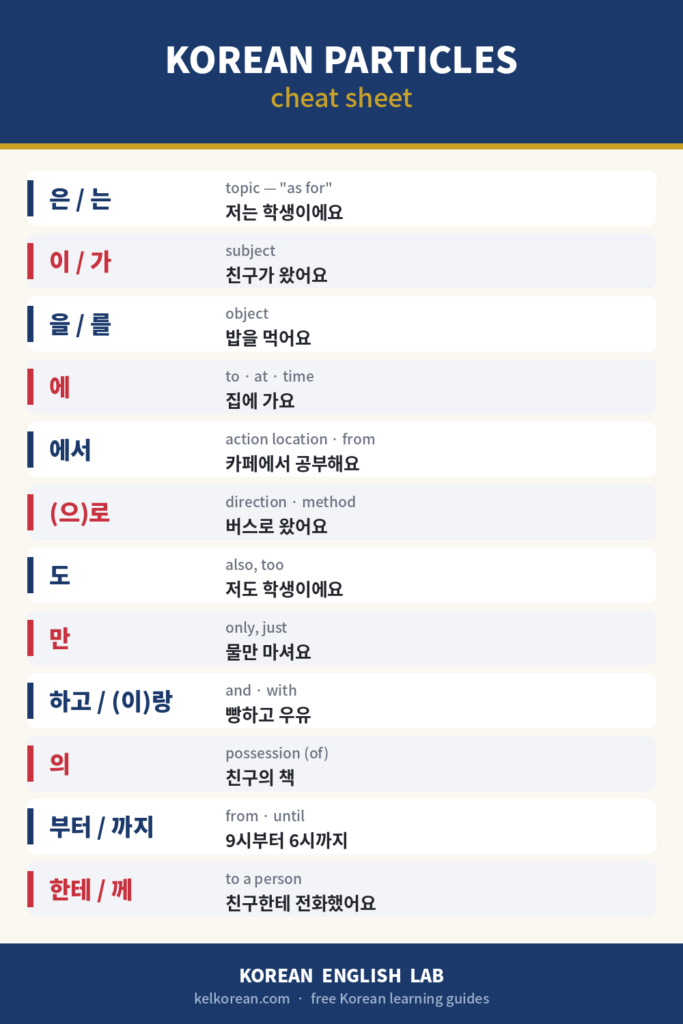
Save This: Korean Particles Cheat Sheet
Here is every particle from this guide in one printable summary. Pin it, screenshot it, or keep it beside your notebook while you practice.
Final Thoughts
Particles are the skeleton of Korean grammar. Vocabulary gives you words; particles turn those words into sentences that a Korean person can follow effortlessly. Don’t try to internalize all of them at once — start with 은/는, 이/가, 을/를, 에, and 에서, and let the rest come as you meet them in real sentences.
And be patient with 은/는 vs 이/가. Even advanced learners still pause on it occasionally. Exposure, not explanation, is what finally makes it feel automatic.
Keep learning with Korean English Lab. Our bilingual Korean–English worksheets and printable workbooks are designed for self-study learners who want structured practice, not just theory. Browse the Korean Beginner Starter Pack for guided grammar drills, vocabulary sheets, and writing practice you can print at home.
Particles are one of three parts of stage four. See the full learning order in our beginner roadmap.
Written by Minhyung Cha — 25 years teaching Korean, and 15+ years running an English academy in South Korea. Every example on this site is checked as a native speaker. More about KEL.
Leave a Reply