Here’s a moment every Korean learner has lived through. You walk into a café in Seoul, confidently order, and then the cashier says the price. You freeze. You heard numbers — you’re sure of it — but nothing you learned last week seems to fit.
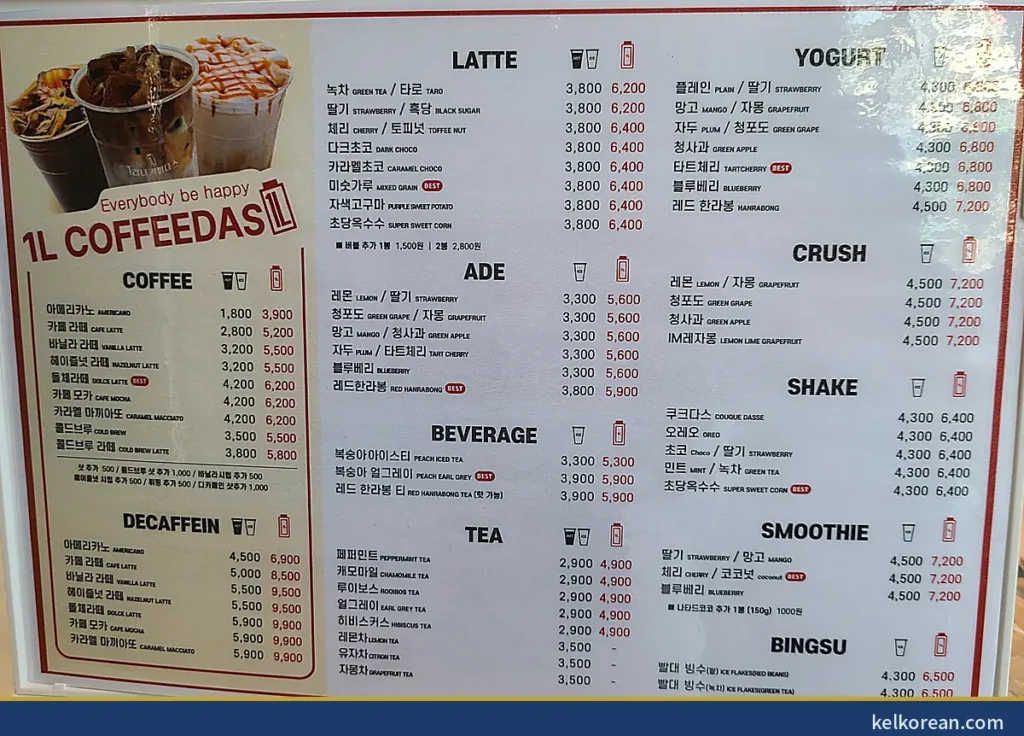
The reason isn’t your listening skills. It’s that Korean has two completely separate number systems, and they are not interchangeable. Use the wrong one and a native speaker will understand you, but you’ll sound like someone saying “I am the third years old.”
The good news: the rules for choosing between them are surprisingly consistent. In this guide you’ll learn both systems from 1 to 100 and beyond, the counter words that go with them, exactly which system to use for money, time, age, and dates, and the four mistakes that trip up almost every beginner. There’s a practice quiz at the end.
Why Korean Has Two Number Systems
Korean uses two sets of numbers because of history, not to make your life harder.
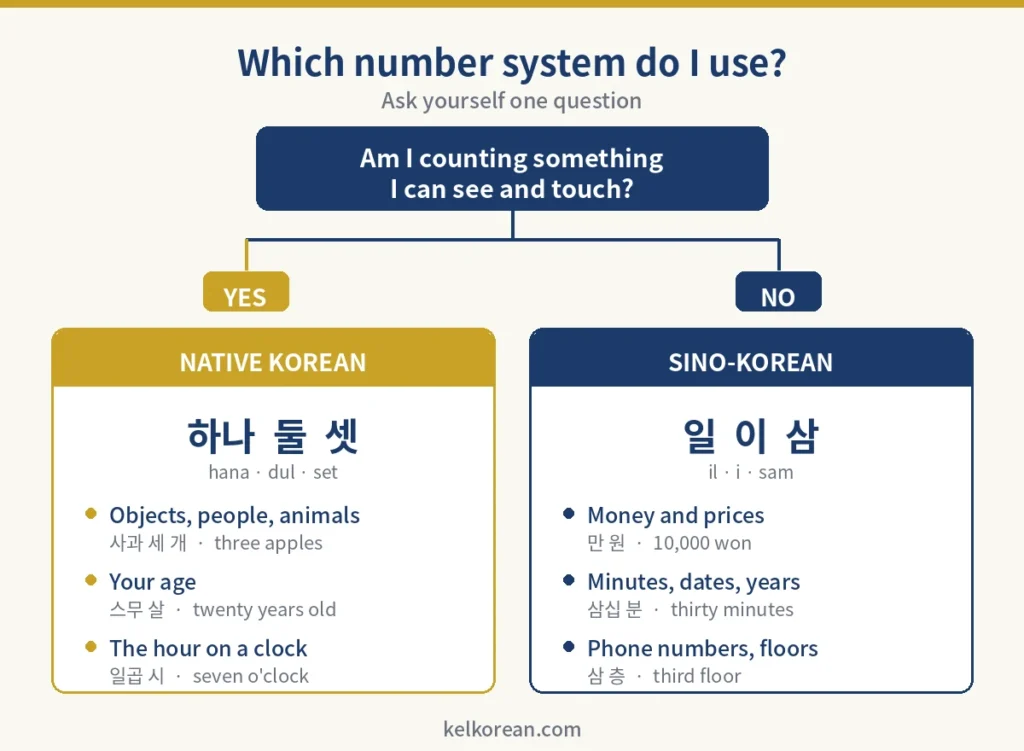
Native Korean numbers (고유어 수사, goyueo susa) are the original Korean words. They developed on the peninsula and are used for counting things you can see and touch.
Sino-Korean numbers (한자어 수사, hanjaeo susa) came from Chinese, absorbed into Korean over roughly two thousand years. They handle abstract and technical quantities: money, measurements, dates, phone numbers.
English actually does something similar, though we rarely notice. We say two but also second, duo, binary, and double — the same quantity, expressed through different historical layers of the language. Korean simply keeps its two layers more visibly separate.
Sino-Korean Numbers 1–10
Start here. Sino-Korean is the easier system because it’s fully regular — there are no irregular forms to memorize past ten.
| Number | Korean | Number | Korean |
|---|---|---|---|
| 0 | 영 / 공yeong / gong | 6 | 육yuk |
| 1 | 일il | 7 | 칠chil |
| 2 | 이i | 8 | 팔pal |
| 3 | 삼sam | 9 | 구gu |
| 4 | 사sa | 10 | 십sip |
| 5 | 오o |
Building 11 to 99
Sino-Korean numbers stack together exactly the way the digits look. There is no “eleven” or “twelve” to memorize separately.
| Number | Structure | Korean |
|---|---|---|
| 11 | 10 + 1 | 십일sibil |
| 15 | 10 + 5 | 십오sibo |
| 20 | 2 × 10 | 이십isip |
| 34 | 3 × 10 + 4 | 삼십사samsipsa |
| 70 | 7 × 10 | 칠십chilsip |
| 99 | 9 × 10 + 9 | 구십구gusipgu |
Hundreds, Thousands, and the 만 Problem
This is where Korean genuinely differs from English, and it’s worth slowing down for.
| Number | Korean | Note |
|---|---|---|
| 100 | 백baek | Not 일백 — just 백 |
| 1,000 | 천cheon | Not 일천 — just 천 |
| 10,000 | 만man | The key unit in Korean |
| 100,000 | 십만simman | Literally “ten 만” |
| 1,000,000 | 백만baengman | Literally “hundred 만” |
| 10,000,000 | 천만cheonman | Literally “thousand 만” |
| 100,000,000 | 억eok | Usually said 일억 |
To read a large number, split it from the right in groups of four:
250,000 → 25|0000 → 이십오만 (isibo-man)
1,500,000 → 150|0000 → 백오십만 (baek-osip-man)
32,000,000 → 3200|0000 → 삼천이백만 (samcheon-ibaek-man)
Native Korean Numbers 1–99
Native Korean numbers are less regular, and there are fewer of them — the system runs out at 99. Beyond that, everyone switches to Sino-Korean.
| Number | Korean | Number | Korean |
|---|---|---|---|
| 1 | 하나hana | 6 | 여섯yeoseot |
| 2 | 둘dul | 7 | 일곱ilgop |
| 3 | 셋set | 8 | 여덟yeodeol |
| 4 | 넷net | 9 | 아홉ahop |
| 5 | 다섯daseot | 10 | 열yeol |
The tens each have their own word, which is the part that takes real practice:
| Number | Korean | Number | Korean |
|---|---|---|---|
| 10 | 열yeol | 60 | 예순yesun |
| 20 | 스물seumul | 70 | 일흔ilheun |
| 30 | 서른seoreun | 80 | 여든yeodeun |
| 40 | 마흔maheun | 90 | 아흔aheun |
| 50 | 쉰swin |
Combining works the same way as Sino-Korean — tens word plus ones word, no connector: 열둘 (12), 스물셋 (23), 마흔일곱 (47), 아흔아홉 (99).
The Shortening Rule Nobody Warns You About
Here is the single most useful thing in this article, and it’s the reason your textbook numbers sound wrong in real conversation.
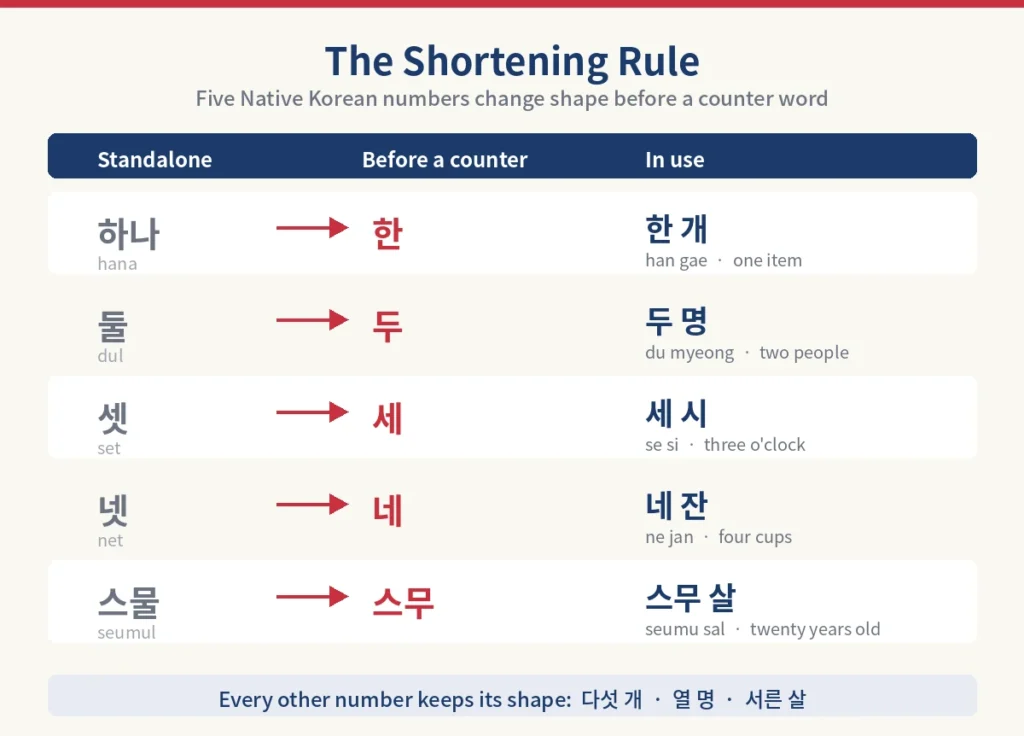
When a Native Korean number comes directly before a counter word, five of them change shape.
| Standalone form | Before a counter | Example |
|---|---|---|
| 하나hana | 한han | 한 개han gae — one item |
| 둘dul | 두du | 두 명du myeong — two people |
| 셋set | 세se | 세 시se si — three o’clock |
| 넷net | 네ne | 네 잔ne jan — four cups |
| 스물seumul | 스무seumu | 스무 살seumu sal — twenty years old |
Every other number keeps its shape: 다섯 개, 열 명, 서른 살, 아흔아홉 개. And note that in compound numbers, only the final digit shortens — 21 items is 스물한 개, not 스무한 개.
Counter Words: The Piece That Makes Numbers Usable
Korean can’t simply say “three cats.” It needs a classifier between the number and the thing being counted, similar to how English says “three sheets of paper” or “two loaves of bread” — except Korean does this for everything.
The standard word order is: noun + number + counter.
커피 두 잔 (keopi du jan) — two coffees
고양이 세 마리 (goyangi se mari) — three cats
책 다섯 권 (chaek daseot gwon) — five books
Counters that take Native Korean numbers
| Counter | Used for | Example |
|---|---|---|
| 개gae | General objects — the safe default | 사과 세 개three apples |
| 명myeong | People (casual) | 학생 네 명four students |
| 분bun | People (polite) | 손님 두 분two guests |
| 마리mari | Animals | 강아지 한 마리one dog |
| 잔jan | Cups, glasses | 물 한 잔one glass of water |
| 병byeong | Bottles | 맥주 두 병two beers |
| 권gwon | Books | 소설 세 권three novels |
| 장jang | Flat things — paper, tickets | 표 두 장two tickets |
| 살sal | Age in years | 스물다섯 살25 years old |
| 시si | Hour on the clock | 일곱 시seven o’clock |
| 시간sigan | Duration in hours | 두 시간for two hours |
Counters that take Sino-Korean numbers
| Counter | Used for | Example |
|---|---|---|
| 원won | Korean currency | 오천 원5,000 won |
| 분bun | Minutes | 삼십 분thirty minutes |
| 초cho | Seconds | 십 초ten seconds |
| 층cheung | Building floors | 삼 층third floor |
| 년nyeon | Years (calendar) | 이천이십육 년the year 2026 |
| 월wol | Months of the year | 삼월March |
| 일il | Days of the month | 이십일 일the 21st |
| 인분inbun | Food portions | 삼겹살 이 인분two servings of pork belly |
| 개월gaewol | Months (duration) | 육 개월six months |
Telling Time: Where Both Systems Meet
Korean clock time is the one place both systems appear inside a single phrase — and it catches nearly every learner off guard.
Hours use Native Korean. Minutes use Sino-Korean. Always. There are no exceptions.
| Time | Korean | Breakdown |
|---|---|---|
| 1:00 | 한 시han si | Native 한 + 시 |
| 3:15 | 세 시 십오 분se si sibo bun | Native 세 + Sino 십오 |
| 7:30 | 일곱 시 삼십 분ilgop si samsip bun | Native 일곱 + Sino 삼십 |
| 7:30 | 일곱 시 반ilgop si ban | 반 = half, very common |
| 12:45 | 열두 시 사십오 분yeoldu si sasibo bun | Note 열둘 → 열두 |
For AM and PM, Korean puts the marker first: 오전 (ojeon) for AM, 오후 (ohu) for PM. So 2 PM is 오후 두 시 (ohu du si).
Money, Age, Dates, and Phone Numbers
Money — always Sino-Korean
Korean prices are spoken in 만 units, which takes adjusting to when everything costs thousands of won.
3,000원 → 삼천 원 (samcheon won)
15,000원 → 만 오천 원 (man ocheon won)
48,000원 → 사만 팔천 원 (saman palcheon won)
250,000원 → 이십오만 원 (isibo-man won)
Notice that 10,000 is just 만, not 일만, in everyday speech. You’ll see 일만 written on bank forms and cheques, but nobody says it out loud at a shop counter.
Age — Native Korean with 살
스물세 살 (seumulse sal) — 23 years old
서른 살 (seoreun sal) — 30 years old
마흔여섯 살 (maheunyeoseot sal) — 46 years old
There is also a formal Sino-Korean version using 세 (se) — 이십삼 세 — but you’ll only meet it in documents, news reports, and hospital forms. In conversation, use 살.
Dates — Sino-Korean, with two irregulars
Korean dates run largest to smallest: year, then month, then day.
2026년 3월 15일 → 이천이십육 년 삼월 십오 일
Two months change their pronunciation for ease of speech, and they are not optional:
| Month | Expected | Correct |
|---|---|---|
| June | 육월 (yugwol) | 유월yuwol |
| October | 십월 (sibwol) | 시월siwol |
Phone numbers — Sino-Korean, digit by digit
Korean phone numbers are read one digit at a time, using 공 for zero. The dash is read as 에 (e) or simply paused over.
010-1234-5678 → 공일공 일이삼사 오륙칠팔
Four Mistakes Almost Every Learner Makes
1. Using Native Korean for money
Saying 다섯 원 instead of 오 원 is the classic slip. Money is always Sino-Korean — no exceptions, no matter how small the amount.
2. Forgetting the counter word
커피 둘 주세요 sounds incomplete, like saying “give me two coffee” and stopping mid-sentence. You need 커피 두 잔 주세요. When you can’t remember the right counter, 개 is an acceptable fallback for most objects.
3. Skipping the shortened forms
하나 개, 둘 명, 셋 시 — all wrong, and all extremely common. Before a counter, it’s 한 개, 두 명, 세 시.
4. Counting large numbers in thousands
Trying to say 1,000,000 as “일천천” doesn’t work. Regroup in fours first: 100|0000 → 백만.
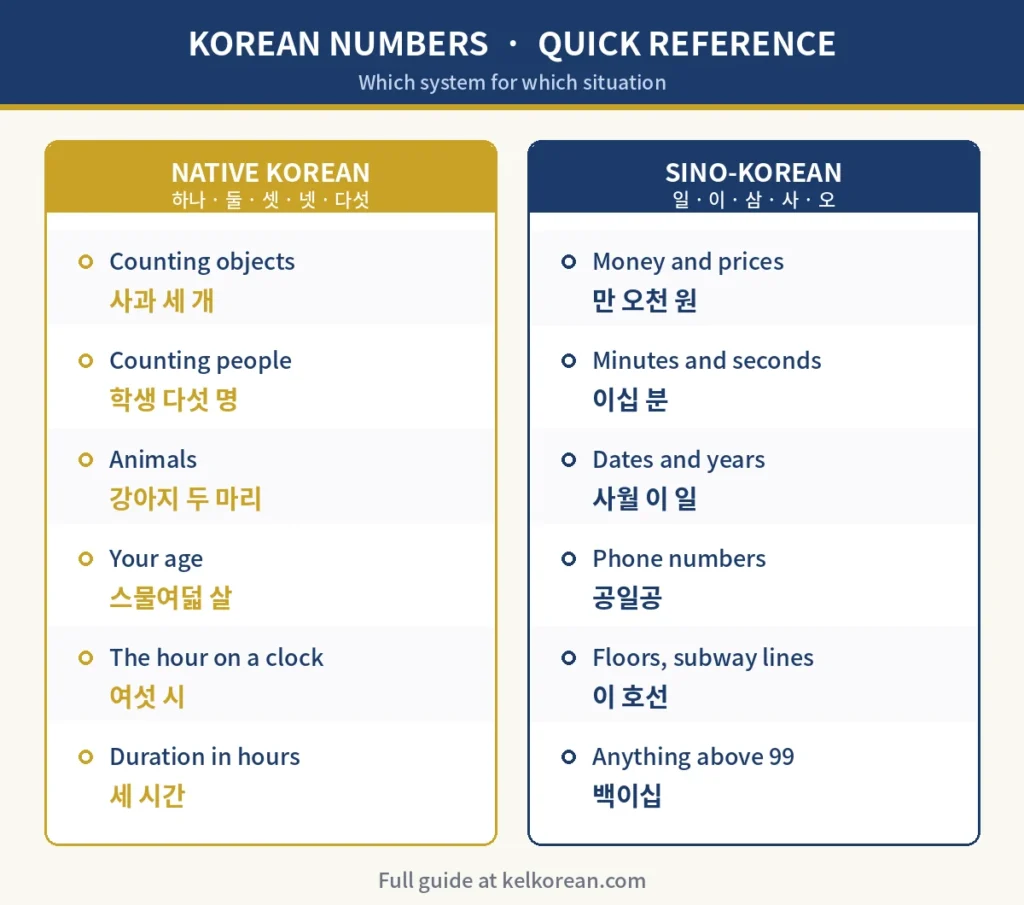
Quick Reference: Which System Do I Use?
| Situation | System | Example |
|---|---|---|
| Counting objects | Native | 사과 세 개 |
| Counting people | Native | 다섯 명 |
| Your age | Native | 스물여덟 살 |
| Hour on the clock | Native | 여섯 시 |
| Duration in hours | Native | 세 시간 |
| Money | Sino | 만 원 |
| Minutes and seconds | Sino | 이십 분 |
| Dates and years | Sino | 사월 이 일 |
| Phone numbers | Sino | 공일공 |
| Floors, subway lines, bus routes | Sino | 이 호선 |
| Anything above 99 | Sino | 백이십 |
If you’re heading to Korea and want to see these numbers in the wild, fares, line numbers, and exit numbers all use Sino-Korean — our guide to using the Korean subway system walks through the signs and phrases you’ll actually encounter.
Practice Quiz
Choose the correct Korean for each. Answers below.
- Three cups of coffee
- 9:20 in the morning
- 12,000 won
- Twenty years old
- Two dogs
- October 6th
- The fourth floor
- Forty-five minutes
Answers
1. 커피 세 잔 | 2. 오전 아홉 시 이십 분 | 3. 만 이천 원 | 4. 스무 살
5. 강아지 두 마리 | 6. 시월 육 일 | 7. 사 층 | 8. 사십오 분
Scored 6 or more? You’ve got the core distinction. Under 6? Focus on the Quick Reference table above — it covers roughly 90% of daily situations.
Frequently Asked Questions
Which number system should I learn first?
Sino-Korean. It’s fully regular, it covers money and dates (which you’ll need on day one in Korea), and it extends infinitely. Learn Native Korean second, focusing on 1 through 20 plus the tens — that range covers the overwhelming majority of real-world counting.
Do I really need to memorize all the counter words?
No. Start with six: 개 (objects), 명 (people), 잔 (drinks), 마리 (animals), 살 (age), 시 (hour). These will carry you through most everyday conversations, and 개 works as a substitute in a pinch.
Why does Korean stop Native numbers at 99?
Native Korean historically did have words for larger amounts — 온 for 100, 즈믄 for 1,000 — but they fell out of use centuries ago as Sino-Korean took over the higher ranges. Today they survive only in poetry and old texts.
How long does it take to get comfortable with both systems?
Most learners can recite both sets within a week. Choosing the right one automatically, without pausing to think, typically takes one to two months of regular practice. Ordering food and reading prices out loud accelerates this more than flashcards do.
Do Koreans ever mix the systems by mistake?
Rarely, and when it happens it’s usually in fixed phrases where usage has drifted. One you’ll hear often: at a restaurant, portions are technically 이 인분 (Sino), but people frequently say 두 개 when pointing at a menu. Native speakers navigate by habit rather than rule — which is exactly what you’re building toward.
Putting It Into Practice
Numbers are one of the few areas in Korean where you get instant, unavoidable feedback: order a coffee, and you’ll know within seconds whether you got it right. That makes them ideal for early practice.
Try this for one week. Every time you look at a clock, say the time in Korean. Every time you see a price, convert it. Every time you count anything — stairs, emails, people in a queue — attach a counter. Ten seconds at a time, several times a day, will do more than an hour of drilling on Sunday.
Once numbers feel automatic, the natural next step is sentence-level Korean. Our guides to Korean particles and Korean honorifics cover the two systems that turn vocabulary into real sentences.
Want the printable version?
Our Korean Beginner Starter Pack includes number charts, counter word references, Hangul practice sheets, and 100 essential vocabulary flashcards — 112 pages, ready to print.
Written by Minhyung Cha, founder of Korean English Lab, with over 25 years of experience teaching Korean and English.
Numbers belong to stage three of five. Our step-by-step plan for learning Korean lays out the whole path, week by week.
Leave a Reply