Korean has two number systems. You already knew that.
What nobody warns you about is that a single phrase can use both at once.
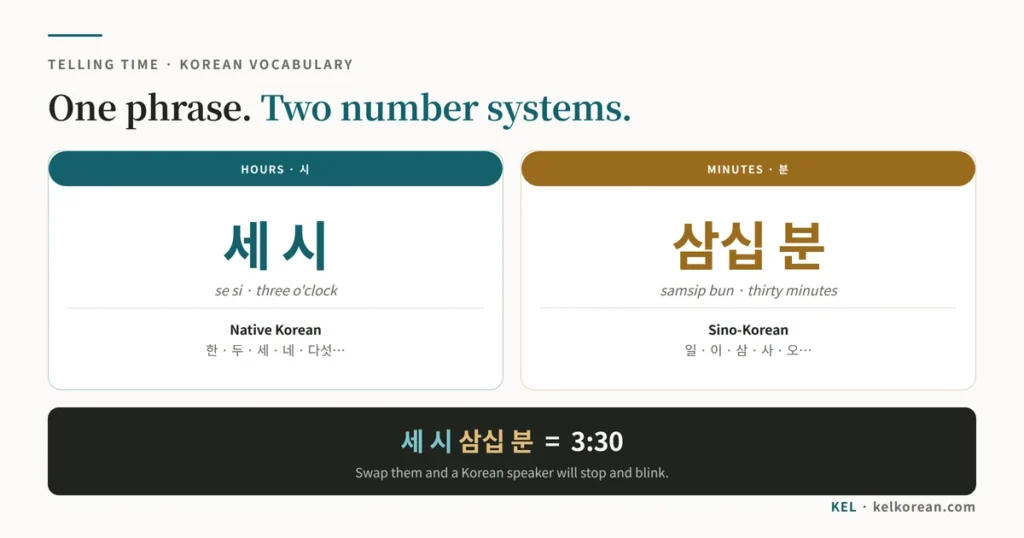
세 시 삼십 분
se si samsip bun — 3:30
세 is native Korean. 삼십 is Sino-Korean. Same phrase, four syllables apart, two entirely different counting systems — and if you swap them, a Korean speaker will stop and blink.
This is the moment where the two number systems stop being a chart in a textbook and start being a thing you have to get right in real time. Telling time in Korean is where they collide.
This guide covers the hours/minutes split, days of the week, months (including the two that are irregular), dates, and how to actually make an appointment with someone.
The One Rule
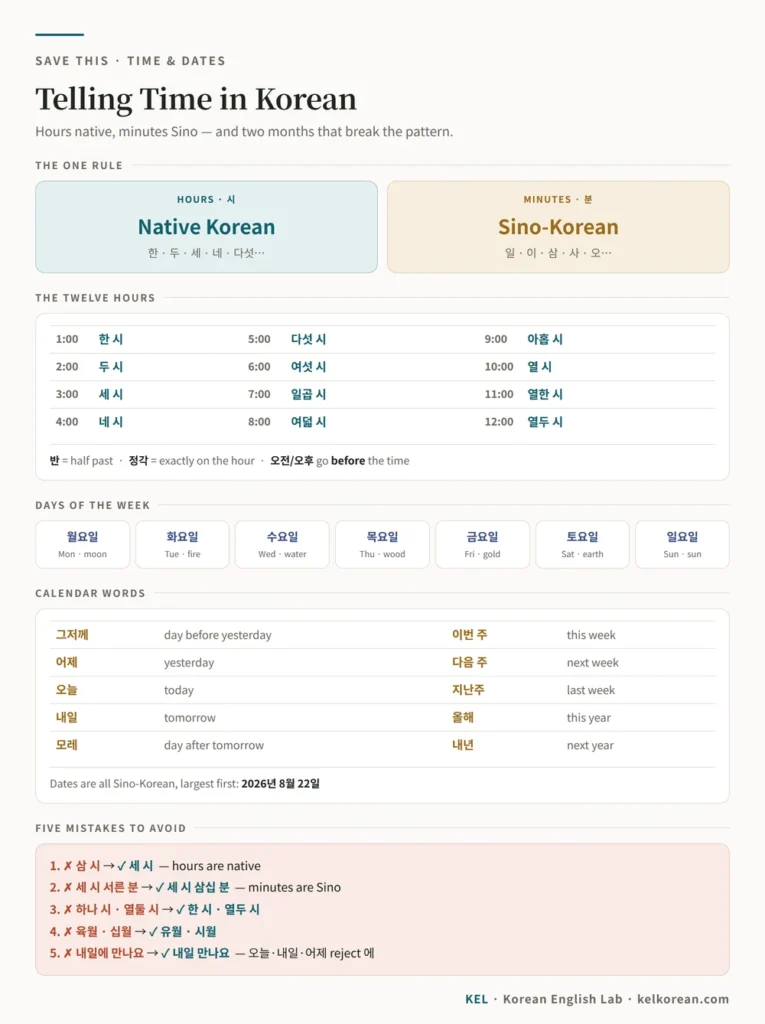
Hours use native Korean numbers.
Minutes use Sino-Korean numbers.
That is it. Everything else in this article is vocabulary.
| System | Numbers | |
|---|---|---|
| Hours 시 | Native Korean | 하나, 둘, 셋… → 한, 두, 세 |
| Minutes 분 | Sino-Korean | 일, 이, 삼, 사, 오… |
If the two systems are still shaky, our guide to Korean numbers covers which is which. This article assumes you can produce both.
Hours — 시
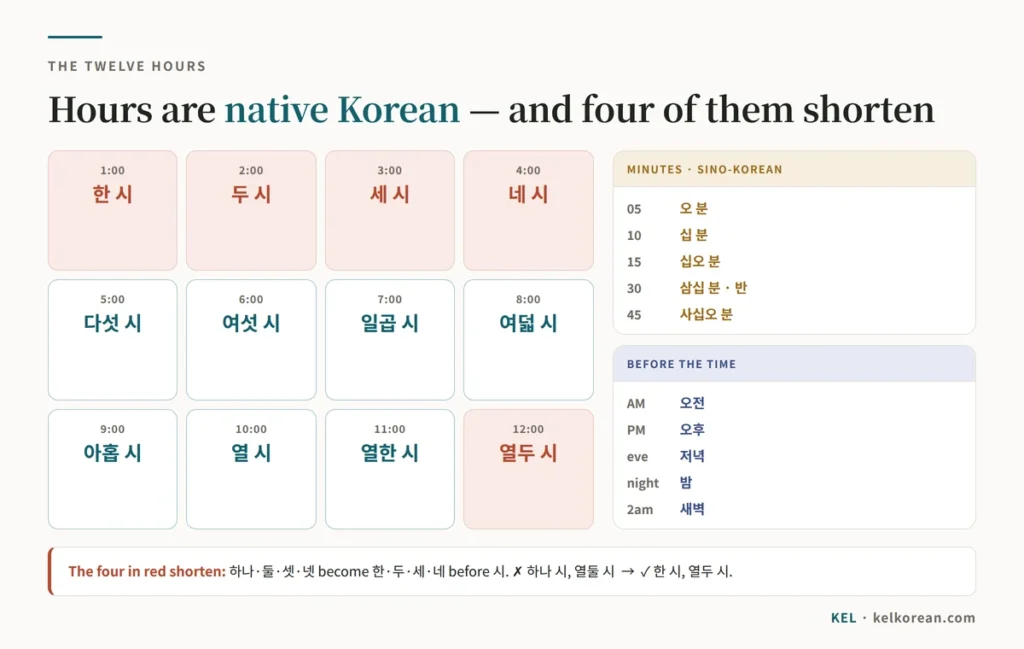
Native Korean numbers shorten before a counter: 하나 → 한, 둘 → 두, 셋 → 세, 넷 → 네.
| Time | Korean | Romanization |
|---|---|---|
| 1:00 | 한 시 | han si |
| 2:00 | 두 시 | du si |
| 3:00 | 세 시 | se si |
| 4:00 | 네 시 | ne si |
| 5:00 | 다섯 시 | daseot si |
| 6:00 | 여섯 시 | yeoseot si |
| 7:00 | 일곱 시 | ilgop si |
| 8:00 | 여덟 시 | yeodeol si |
| 9:00 | 아홉 시 | ahop si |
| 10:00 | 열 시 | yeol si |
| 11:00 | 열한 시 | yeolhan si |
| 12:00 | 열두 시 | yeoldu si |
Watch the shortened forms. ✗ 하나 시 · ✓ 한 시. ✗ 열둘 시 · ✓ 열두 시. This is the single most common error.
Korean uses a 12-hour clock in speech. The 24-hour clock appears on schedules and timetables, but nobody says “십팔 시” out loud.
Minutes — 분
Sino-Korean numbers, no shortening.
| Minutes | Korean |
|---|---|
| 5 | 오 분 |
| 10 | 십 분 |
| 15 | 십오 분 |
| 20 | 이십 분 |
| 25 | 이십오 분 |
| 30 | 삼십 분 or 반 |
| 40 | 사십 분 |
| 45 | 사십오 분 |
| 50 | 오십 분 |
반 (ban) means “half” and replaces 삼십 분 constantly in speech. 세 시 반 is more natural than 세 시 삼십 분 — like saying “half three” rather than “three thirty.”
Two more useful words:
| Korean | Meaning |
|---|---|
| 정각 | exactly on the hour — 세 시 정각 |
| 전 | before — 세 시 십 분 전 (ten to three) |
Morning and Afternoon
Korean puts 오전 (AM) and 오후 (PM) before the time, not after.
| Korean | Meaning |
|---|---|
| 오전 아홉 시 | 9 AM |
| 오후 세 시 | 3 PM |
| 아침 일곱 시 | 7 in the morning |
| 저녁 여덟 시 | 8 in the evening |
| 밤 열한 시 | 11 at night |
| 새벽 두 시 | 2 in the early morning |
새벽 is worth knowing — it covers roughly midnight to dawn, and Korean uses it constantly where English would just say “2 AM.”
Asking and Answering
| Korean | Meaning |
|---|---|
| 지금 몇 시예요? | What time is it now? |
| 몇 시에 만날까요? | What time shall we meet? |
| 세 시에 만나요 | Let’s meet at 3 |
| 아홉 시부터 여섯 시까지 | from 9 to 6 |
| 시간 있어요? | Do you have time? |
The particle 에 means “at.” 세 시에 만나요 — at three o’clock. Same particle you met in our guide to Korean particles.
부터 … 까지 is “from … to” and works for times, dates, and places alike.
Days of the Week
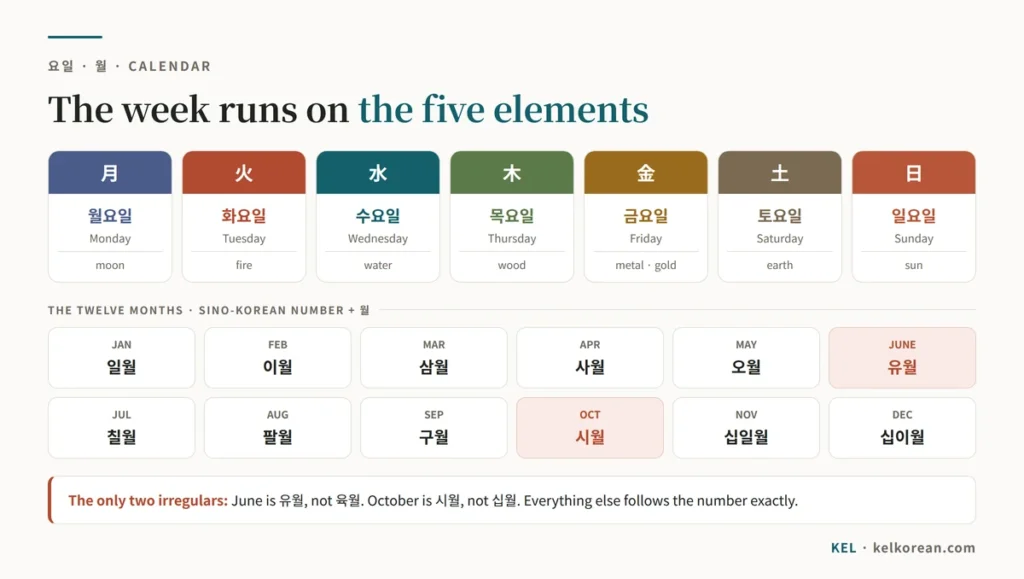
All seven end in 요일. The first syllable comes from the classical five elements plus sun and moon.
| Korean | Day | First syllable means |
|---|---|---|
| 월요일 | Monday | 月 moon |
| 화요일 | Tuesday | 火 fire |
| 수요일 | Wednesday | 水 water |
| 목요일 | Thursday | 木 wood |
| 금요일 | Friday | 金 metal / gold |
| 토요일 | Saturday | 土 earth |
| 일요일 | Sunday | 日 sun |
Memory hook: Monday is the moon, Sunday is the sun — the same logic English uses. The middle five follow the classical element order, and once you notice that, the list stops being seven random syllables.
In casual speech Koreans often drop 요일: 월, 화, 수 on a calendar or timetable.
| Korean | Meaning |
|---|---|
| 오늘 무슨 요일이에요? | What day is it today? |
| 주말 | weekend |
| 평일 | weekday |
| 이번 주 | this week |
| 다음 주 | next week |
| 지난주 | last week |
Months — and the Two Irregular Ones
Months are Sino-Korean number + 월. Simple, except twice.
| Month | Korean | Month | Korean |
|---|---|---|---|
| January | 일월 | July | 칠월 |
| February | 이월 | August | 팔월 |
| March | 삼월 | September | 구월 |
| April | 사월 | October | 시월 |
| May | 오월 | November | 십일월 |
| June | 유월 | December | 십이월 |
June is 유월, not 육월. October is 시월, not 십월.
The rule follows the number (육 = 6, 십 = 10) everywhere else, but these two dropped a consonant for ease of pronunciation centuries ago and the spelling followed. There is no logic to derive — they are simply memorised.
Everyone learning Korean gets these wrong once. Now you will get them wrong zero times.
Dates
Year, month and day are all Sino-Korean, and Korean orders them largest to smallest — the opposite of American date order.
2026년 8월 22일
이천이십육 년 팔월 이십이 일
| Korean | Meaning |
|---|---|
| 년 | year |
| 월 | month |
| 일 | day |
| 오늘 며칠이에요? | What’s the date today? |
| 생일이 언제예요? | When is your birthday? |
| 제 생일은 5월 3일이에요 | My birthday is May 3rd |
Note the difference: 며칠 asks the date (the number), 무슨 요일 asks the day of the week. English blurs these with “what day is it?” — Korean does not.
Today, Tomorrow, Yesterday
| Korean | Meaning |
|---|---|
| 그저께 | the day before yesterday |
| 어제 | yesterday |
| 오늘 | today |
| 내일 | tomorrow |
| 모레 | the day after tomorrow |
| 아침 | morning |
| 점심 | noon, lunchtime |
| 저녁 | evening |
| 밤 | night |
| 올해 | this year |
| 작년 | last year |
| 내년 | next year |
모레 and 그저께 have no single-word English equivalent and Koreans use them constantly. Worth learning early.
“What Time” vs “How Long”
Clock time and duration are different words, and mixing them is a common slip.
| Clock time | Duration |
|---|---|
| 세 시 — 3 o’clock | 세 시간 — 3 hours |
| 십 분 — 10 minutes past | 십 분 — for 10 minutes |
시 and 시간 look almost identical and mean completely different things. 세 시에 만나요 is “let’s meet at 3.” 세 시간 걸려요 is “it takes 3 hours.”
Duration words worth knowing:
| Korean | Meaning | Number system |
|---|---|---|
| 한 시간, 두 시간 | 1 hour, 2 hours | native |
| 삼십 분 동안 | for 30 minutes | Sino |
| 하루, 이틀, 사흘 | 1, 2, 3 days | native (special forms) |
| 일주일 | one week | Sino |
| 한 달, 두 달 | 1, 2 months | native |
| 일 년, 이 년 | 1, 2 years | Sino |
하루 · 이틀 · 사흘 are their own words, not number + counter. They are the older native counting forms and Koreans still use them for short spans: 이틀 걸려요 (“it takes two days”).
For months, both 한 달 (native) and 일 개월 (Sino) are correct. 한 달 is conversational; 일 개월 appears in contracts and official documents.
Reading Opening Hours
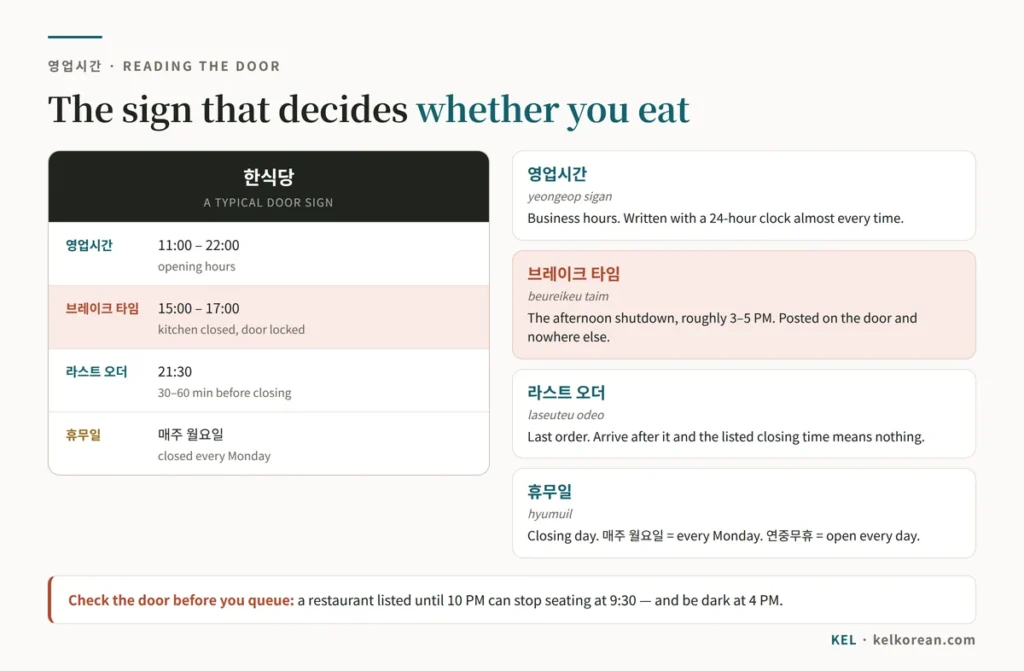
This is where time vocabulary becomes immediately practical in Korea.
| Korean | Meaning |
|---|---|
| 영업시간 | business hours |
| 오전 9시 ~ 오후 10시 | 9 AM – 10 PM |
| 휴무일 | closed day |
| 매주 월요일 휴무 | closed every Monday |
| 연중무휴 | open year-round, no closing day |
| 24시간 영업 | open 24 hours |
| 브레이크 타임 | break time |
| 라스트 오더 | last order |
브레이크 타임 will catch you out. Many Korean restaurants close between roughly 3 PM and 5 PM — the kitchen shuts, the staff rest, and the door is locked. It is written on the door and nowhere else. If you arrive at 4 PM hungry, this is why the place is dark.
라스트 오더 is typically 30–60 minutes before closing. A restaurant listed until 10 PM often stops taking orders at 9:30.
Making an Appointment
Here is everything above in one exchange.
A: 내일 시간 있어요?
B: 네, 있어요. 몇 시에 만날까요?
A: 오후 세 시 어때요?
B: 세 시는 좀 어려워요. 네 시 반은요?
A: 좋아요. 그럼 내일 네 시 반에 만나요.
B: 네, 내일 봐요!
내일 봐요 (“see you tomorrow”) is the standard sign-off. The 만날까요 pattern comes from our guide to essential Korean grammar patterns.
5 Mistakes Worth Avoiding
1. Using Sino-Korean for hours. ✗ 삼 시 · ✓ 세 시. This is the big one.
2. Using native numbers for minutes. ✗ 세 시 서른 분 · ✓ 세 시 삼십 분.
3. Forgetting the shortened forms. ✗ 하나 시, 열둘 시 · ✓ 한 시, 열두 시.
4. Saying 육월 and 십월. ✓ 유월, 시월.
5. Attaching 에 to 오늘, 내일, 어제. ✗ 내일에 만나요 · ✓ 내일 만나요. These three words already carry the time meaning and reject the particle. But 월요일에, 세 시에, 5월 3일에 all take it normally.
That last one catches almost everyone, because the rule looks inconsistent until you learn which words are exempt.
Quick Practice
Write these in Korean. Answers below.
- 2:00 → ?
- 7:30 → ?
- 11:15 → ?
- 4 PM → ?
- Wednesday → ?
- June → ?
- October 9th → ?
- Let’s meet at 6 → ?
Answers:
- 두 시
- 일곱 시 반 (or 일곱 시 삼십 분)
- 열한 시 십오 분
- 오후 네 시
- 수요일
- 유월 — not 육월
- 시월 구일 — not 십월
- 여섯 시에 만나요
Six or more correct and the two-system split has landed.
Frequently Asked Questions
Why do hours and minutes use different systems?
Historical layering. Native Korean numbers were used for counting concrete things — hours were counted, minutes were a later, more technical measurement that arrived with Sino-Korean vocabulary. The split is arbitrary now, but it is completely consistent.
Do Koreans really say 반 instead of 삼십 분?
Yes, constantly. Both are correct; 반 is more natural in conversation, 삼십 분 more common in announcements and formal contexts.
Is the 24-hour clock used?
In writing — timetables, tickets, digital displays. Almost never in speech. Say 오후 여섯 시, not 십팔 시.
How do I say “half past” for other numbers?
You don’t. 반 only means thirty minutes past. For anything else use the minute number: 세 시 이십 분.
What about 시간 vs 시?
시 is a clock hour (three o’clock = 세 시). 시간 is a duration (three hours = 세 시간). Both use native numbers, but they are not interchangeable.
Do I need to learn 그저께 and 모레?
Yes, earlier than you’d expect. English speakers reach for “the day after tomorrow” as a phrase; Korean has one short word and uses it in ordinary conversation.
Final Thoughts
Time and dates are the first place the two number systems stop being an abstract fact and become something you have to execute in real time — mid-sentence, while someone waits for an answer.
The good news is that the rule has no exceptions. Hours are native, minutes are Sino, dates are Sino, and the only genuine irregulars in the entire system are 유월 and 시월.
Practise by narrating your own day out loud: 아홉 시에 일어나요, 열두 시 반에 점심 먹어요, 여섯 시에 집에 가요. Ten sentences about a real day will fix the split faster than any table.
If you are working through the stages in order, this sits alongside Korean numbers in Stage 3 of our complete beginner’s roadmap — and it pairs directly with ordering food, where the same counters show up again.
Keep learning with Korean English Lab. Our bilingual Korean–English worksheets and printable workbooks are designed for self-study learners who want structured practice, not just theory.
Leave a Reply