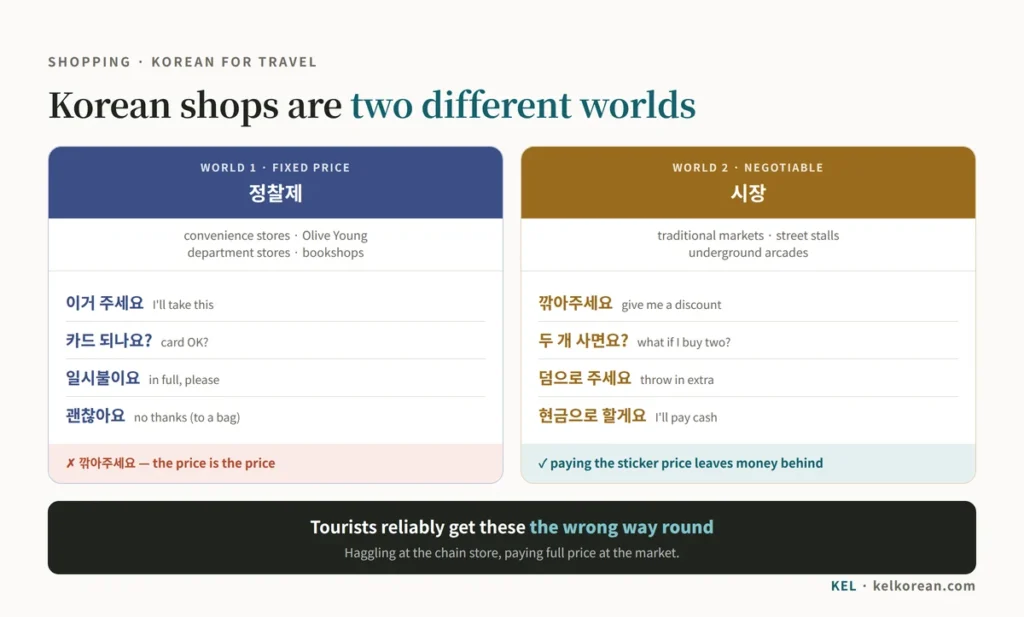
Korean shops are two different worlds, and most phrasebooks blur them into one.
In a convenience store, an Olive Young, or a department store, the price is the price. Asking for a discount there is not shrewd — it is slightly embarrassing, like haggling at a supermarket checkout.
In a traditional market or an underground shopping arcade, the opposite is true. The sticker is an opening position, and paying it without a word is leaving money on the table.
Shopping in Korean means knowing which world you are standing in, and switching scripts accordingly.
There is a second problem nobody prepares you for. You can memorise every phrase you need to say and still freeze at the counter — because the cashier says something back, and it is never the sentence from the textbook. This guide covers both directions.
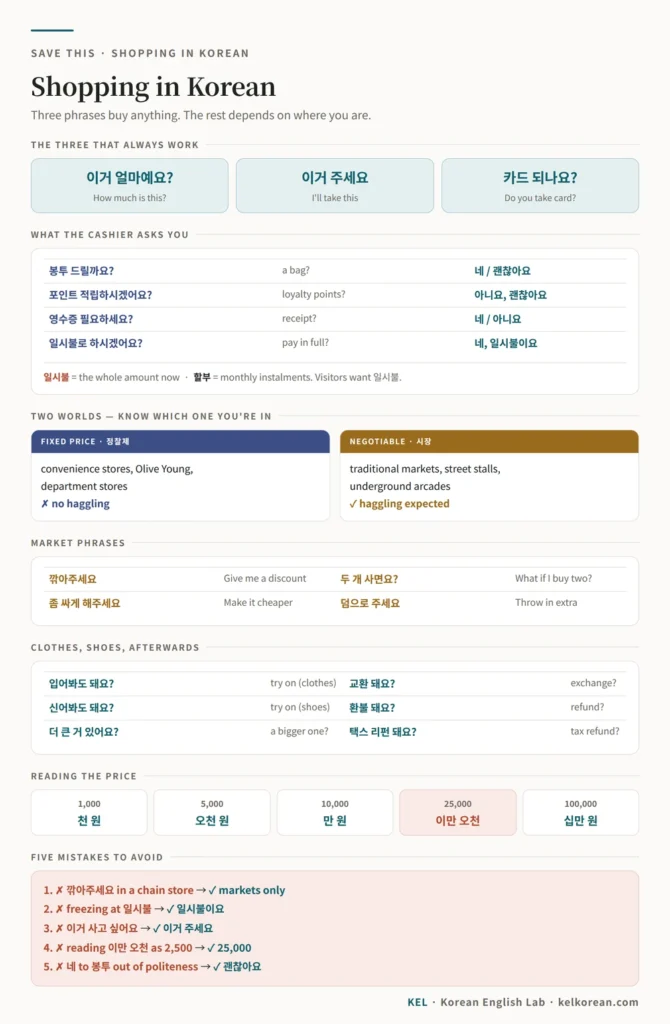
The Three That Always Work
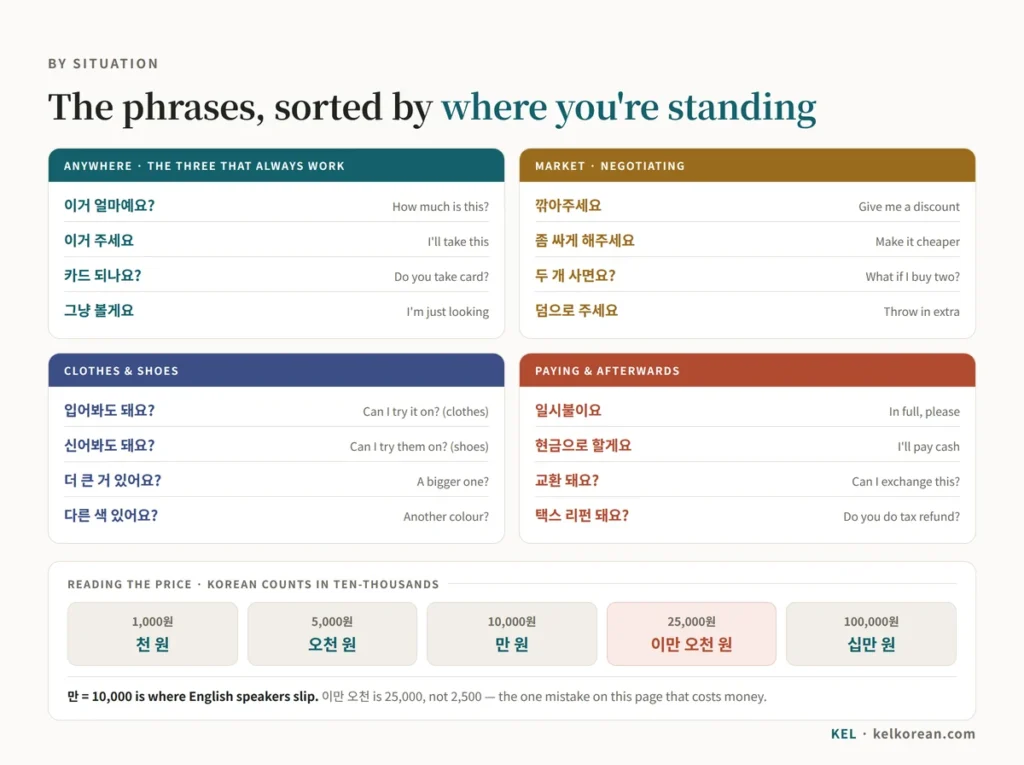
Whatever kind of shop you are in, these three carry you.
| Korean | Romanization | Meaning |
|---|---|---|
| 이거 얼마예요? | igeo eolmayeyo | How much is this? |
| 이거 주세요 | igeo juseyo | I’ll take this |
| 카드 되나요? | kadeu doenayo | Do you take card? |
이거 주세요 is how you buy something. Not 이거 사고 싶어요 (I want to buy this) — that is grammatically fine and sounds like a language exercise. Point, say 이거 주세요, done.
If 주세요 is new to you, it comes from 주다 (to give) and appears in our list of the 100 Korean words to learn first, where it earns its place as the single most useful word for a traveller.
Browsing Without Being Followed
Korean shop staff greet and often approach. Two phrases get you politely left alone.
| Korean | Meaning |
|---|---|
| 그냥 볼게요 | I’m just looking |
| 구경 좀 할게요 | I’ll just browse a bit |
| 다음에 올게요 | I’ll come back another time |
그냥 볼게요 is the one to memorise. It is friendly, complete, and it works everywhere. 다음에 올게요 is the graceful exit when you have been shown three things and want none of them.
In a Fixed-Price Shop
Convenience stores, cosmetics chains, department stores, bookshops. Here you mostly listen.
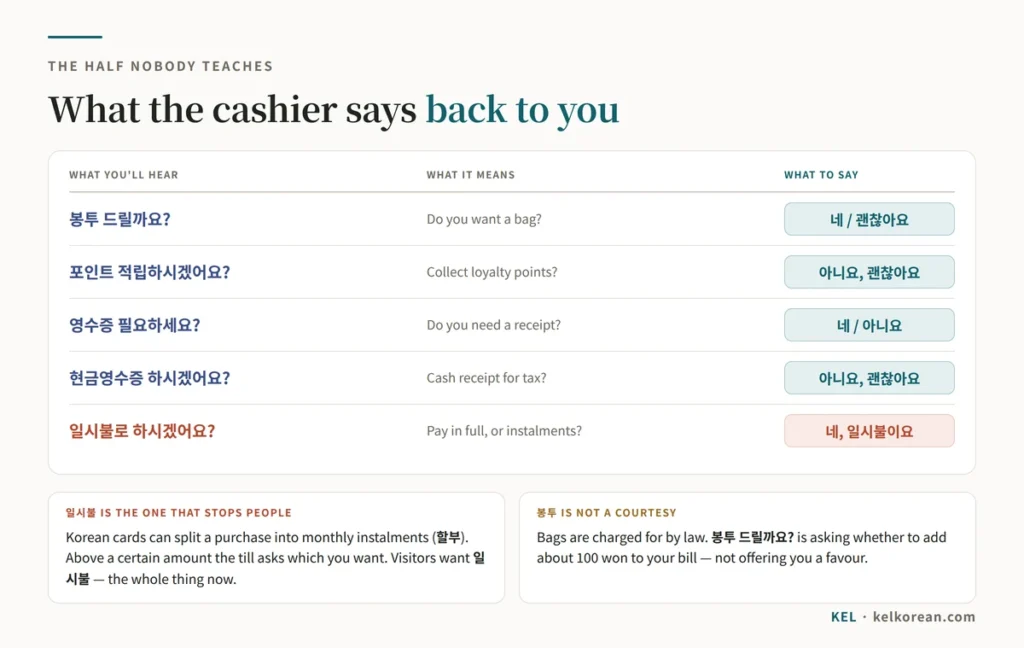
What the cashier says to you
This is the part that catches people out. These questions come fast, in a flat voice, and they expect a one-word answer.
| What you’ll hear | What it means | What to say |
|---|---|---|
| 봉투 드릴까요? | Do you want a bag? | 네 / 아니요 |
| 봉투 필요하세요? | Do you need a bag? | 네 / 괜찮아요 |
| 포인트 적립하시겠어요? | Collect loyalty points? | 아니요, 괜찮아요 |
| 영수증 필요하세요? | Do you need a receipt? | 네 / 아니요 |
| 현금영수증 하시겠어요? | Cash receipt (for tax)? | 아니요, 괜찮아요 |
| 일시불로 하시겠어요? | Pay in full? | 네, 일시불이요 |
일시불 is the one that stops everyone. Korean cards let you split a purchase into monthly instalments (할부), so above a certain amount the machine or the cashier asks which you want. 일시불 means paying the whole thing now, and it is what you want as a visitor. Just say 일시불이요 and the transaction continues.
Bags cost money. Korea charges for plastic bags by law, so 봉투 드릴까요? is a question about spending 100 won or so, not a courtesy. If you have your own bag, 괜찮아요.
What you say
| Korean | Meaning |
|---|---|
| 카드로 할게요 | I’ll pay by card |
| 현금으로 할게요 | I’ll pay cash |
| 일시불이요 | In full, please |
| 봉투 주세요 | A bag, please |
| 따로 담아주세요 | Please bag them separately |
| 포장해 주세요 | Please gift-wrap it |
In a Market
Traditional markets, underground arcades, street stalls. Now the script changes completely.
| Korean | Romanization | Meaning |
|---|---|---|
| 깎아주세요 | kkakka juseyo | Give me a discount |
| 좀 싸게 해주세요 | jom ssage haejuseyo | Make it a bit cheaper |
| 조금만 깎아주세요 | jogeumman kkakka juseyo | Just a little off, please |
| 많이 주세요 | mani juseyo | Give me a lot (of it) |
| 덤으로 주세요 | deomeuro juseyo | Throw in a little extra |
깎다 literally means “to shave.” You are asking them to shave the price down.
덤 has no clean English equivalent. It is the extra handful the vendor adds after you have agreed on a price — a few more tangerines, an extra piece of fish. Asking for 덤 is friendlier than asking for a discount, and often more effective, because the vendor keeps their price and still feels generous.
Two rules of thumb. Buying more than one thing improves your position enormously — 두 개 사면 얼마예요? is a stronger opening than 깎아주세요 on a single item. And cash beats card here; small vendors prefer it and will sometimes price accordingly.
Do not do this in a chain store. 깎아주세요 at an Olive Young counter gets you a confused smile and nothing else.
Clothes and Shoes
| Korean | Meaning |
|---|---|
| 입어봐도 돼요? | Can I try this on? (clothes) |
| 신어봐도 돼요? | Can I try these on? (shoes) |
| 사이즈 있어요? | Do you have my size? |
| 더 큰 거 있어요? | Do you have a bigger one? |
| 더 작은 거 있어요? | Do you have a smaller one? |
| 다른 색 있어요? | Do you have another colour? |
| 탈의실 어디예요? | Where’s the fitting room? |
입다 is for clothes, 신다 is for shoes. Korean uses a different verb depending on where on your body the thing goes — 쓰다 for hats and glasses, 끼다 for rings and gloves. The 봐도 돼요 pattern (may I try -ing) is one of the fifteen in our guide to essential Korean grammar patterns.
Some market clothing stalls do not allow trying on. If you hear 안 돼요, that is why — it is not personal.
Reading the Price
Korean prices are Sino-Korean numbers, and the unit that matters is 만 (10,000).
| Written | Korean | English |
|---|---|---|
| 1,000원 | 천 원 | 1,000 won |
| 5,000원 | 오천 원 | 5,000 won |
| 10,000원 | 만 원 | 10,000 won |
| 25,000원 | 이만 오천 원 | 25,000 won |
| 100,000원 | 십만 원 | 100,000 won |
The jump from 천 to 만 is where English speakers slip. English groups digits in thousands; Korean groups them in ten-thousands. 25,000 is not “twenty-five thousand” but two-man five-thousand — 이만 오천. Our guide to Korean numbers walks through the whole system.
Prices are often said without 원 — a vendor will just say 이만 오천, and the 원 is understood.
Exchanges, Refunds and Tax
| Korean | Meaning |
|---|---|
| 교환 돼요? | Can I exchange this? |
| 환불 돼요? | Can I get a refund? |
| 영수증 있어요 | I have the receipt |
| 사이즈가 안 맞아요 | It doesn’t fit |
| 택스 리펀 돼요? | Do you do tax refund? |
Keep the receipt — 영수증 — because most exchange and refund conversations begin and end with it.
Tax refund is real and worth using. Shops displaying a Tax Free sign will process refunds on qualifying purchases; you show your passport at the till and claim at the airport. The phrase you need is 택스 리펀 돼요? and carrying your passport while shopping is what makes it possible.
A Full Exchange
Two purchases, two worlds.
At a cosmetics shop:
A: 이거 얼마예요?
B: 만 오천 원이에요.
A: 이거 주세요. 카드 되나요?
B: 네. 일시불로 하시겠어요?
A: 네, 일시불이요.
B: 봉투 필요하세요?
A: 아니요, 괜찮아요.
At a market stall:
A: 이거 얼마예요?
B: 한 봉지에 오천 원이요.
A: 두 개 사면요?
B: 두 개에 구천 원 해드릴게요.
A: 조금만 깎아주세요.
B: 그럼 팔천 원. 대신 현금으로요.
A: 좋아요. 감사합니다!
Notice that the second conversation has no fixed script — it is a negotiation, and 두 개 사면요? (what if I buy two?) did more work than 깎아주세요 would have alone.
5 Mistakes Worth Avoiding
1. Haggling in a chain store. 깎아주세요 belongs in markets and arcades. In a convenience store or a department store it does not land.
2. Freezing at 일시불. It is not a difficult question. 일시불이요 and you are through.
3. Saying 이거 사고 싶어요 at the counter. Correct Korean, wrong moment. 이거 주세요.
4. Misreading 만. 이만 오천 is 25,000, not 2,500. Getting this wrong by a factor of ten is the expensive mistake on this list.
5. Saying 네 to 봉투 드릴까요? out of politeness. You just bought a bag. If you don’t need one, 괜찮아요.
Quick Practice
Say these in Korean. Answers below.
- How much is this? → ?
- I’ll take this. → ?
- Do you take card? → ?
- I’m just looking. → ?
- Can I try this on? → ?
- Give me a small discount. → ?
- In full, please. → ?
- Do you have a bigger one? → ?
Answers:
- 이거 얼마예요?
- 이거 주세요.
- 카드 되나요?
- 그냥 볼게요.
- 입어봐도 돼요?
- 조금만 깎아주세요.
- 일시불이요.
- 더 큰 거 있어요?
Frequently Asked Questions
Can I really haggle in Korea?
In traditional markets, underground arcades and street stalls, yes — it is normal and expected. In anything with a barcode scanner and a chain logo, no. When in doubt, look at whether prices are printed on tags by the shop or handwritten by the vendor.
How much of a discount is reasonable?
Ten percent or so on a single item, more if you are buying several. Vendors often prefer to give 덤 — extra product — rather than cut the price, and accepting that graciously is good form.
Do I need cash?
Card works almost everywhere in Korea, including many market stalls. But small vendors, older stalls and street food carts often prefer cash, and cash gives you more leverage when negotiating. Carry some.
What is 일시불 exactly?
Paying the full amount at once, as opposed to 할부 (monthly instalments). Korean credit cards offer instalments on larger purchases, so the till asks. Visitors want 일시불 every time.
Is tax refund worth the trouble?
For larger purchases, yes. Look for the Tax Free sign, bring your passport, and allow extra time at the airport. For a few thousand won it is not worth the queue.
What if I don’t understand what the cashier asked?
다시 말해 주세요 (please say that again) or 천천히 말해 주세요 (please say it slowly). Both are polite and both work. Cashiers deal with this daily.
Final Thoughts
Shopping is the situation where beginner Korean pays off fastest, because the exchanges are short, the vocabulary repeats, and the other person wants the transaction to succeed as much as you do.
Learn the three universal phrases first — 얼마예요, 이거 주세요, 카드 되나요 — and you can complete a purchase anywhere in the country today. Add 일시불이요 and 괜찮아요 and you will get through a Korean checkout without a pause.
The market phrases can wait until you are standing in a market. They are fun, and they are not survival.
If you are planning a trip, this sits alongside our guides to ordering food in Korean, using the Korean subway and 10 essential Korean phrases for travelers — and if you want to go beyond survival phrases, our complete beginner’s roadmap maps out the first year.
Keep learning with Korean English Lab. Our bilingual Korean–English worksheets and printable workbooks are designed for self-study learners who want structured practice, not just theory.
Leave a Reply