When I used to teach Korean to foreign students, I noticed something strange about most textbooks: the first vocabulary lists were full of words my students never actually used. Meanwhile, the words they desperately needed on day one — at the convenience store, in a taxi, ordering lunch — were buried in chapter seven.
So I made my own list. Over time, teaching student after student, I kept refining it: which words came up in their real lives that week? Which words unlocked the most sentences? Which words did they ask me about again and again?
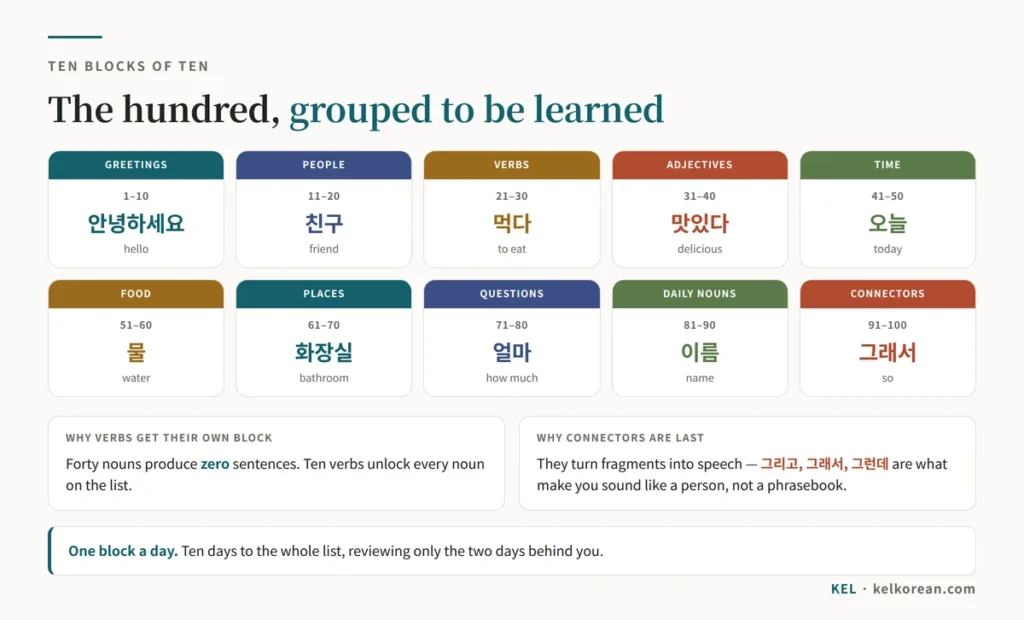
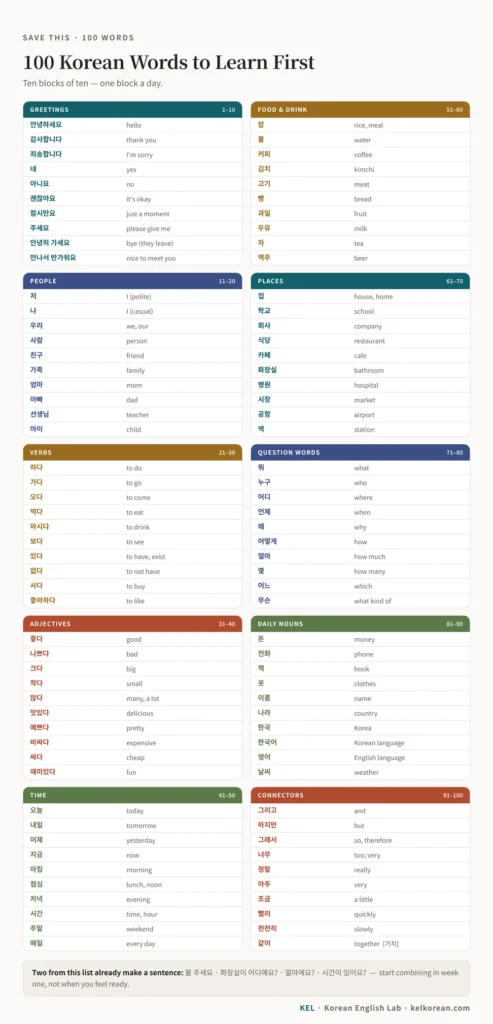
This post is that list — the 100 Korean words to learn first, organized into ten practical categories, exactly as I taught them to my students. If you’re just starting Korean, learn these before anything else. Ten words a day, and you’ll have all 100 in ten days.
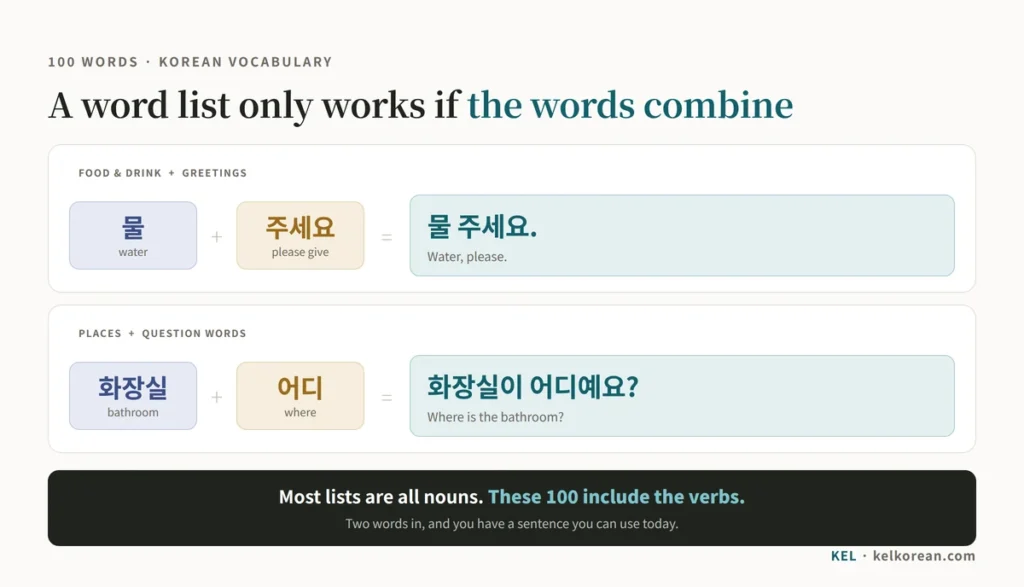
The reason this particular hundred works is that the words combine. Ten verbs sit next to ten nouns next to ten question words, so from the first week you can put them together:
물 (water) + 주세요 (please give) → 물 주세요. — Water, please.
화장실 (bathroom) + 어디 (where) → 화장실이 어디예요? — Where is the bathroom?
Two words from the list, one working sentence. That is what most beginner word lists — all nouns, no verbs — never let you do.
How to Use This List
- Each entry shows the Korean word, its romanization, and the English meaning.
- Verbs and adjectives are given in dictionary form (ending in 다). In real speech the ending changes — 가다 (to go) becomes 가요 (I go). That change is covered in our guide to Korean verb conjugation.
- Don’t just memorize — combine. Once you know the SOV sentence pattern from our guide to Korean sentence structure, every word here can go straight into a real sentence.
- Learn Hangul first. The romanization here is a crutch you should drop within two weeks — our guide to learning Hangul in a week covers the whole alphabet in seven days.
1. Survival Greetings & Expressions (1–10)
These were literally the first ten minutes of my first lesson, every time.
| # | Korean | Romanization | Meaning |
|---|---|---|---|
| 1 | 안녕하세요 | annyeonghaseyo | hello |
| 2 | 감사합니다 | gamsahamnida | thank you |
| 3 | 죄송합니다 | joesonghamnida | I’m sorry |
| 4 | 네 | ne | yes |
| 5 | 아니요 | aniyo | no |
| 6 | 괜찮아요 | gwaenchanayo | it’s okay / I’m fine |
| 7 | 잠시만요 | jamsimanyo | just a moment / excuse me |
| 8 | 주세요 | juseyo | please give me |
| 9 | 안녕히 가세요 | annyeonghi gaseyo | goodbye (to someone leaving) |
| 10 | 만나서 반가워요 | mannaseo bangawoyo | nice to meet you |
My students got the most mileage out of 주세요. Point at anything and add 주세요 — congratulations, you can now shop, order food, and survive in Korea.
One warning about number 9. 안녕히 가세요 is for the person leaving; if you are the one staying put, you say 안녕히 계세요. Getting these backwards is the most common goodbye mistake, and our guide to Korean greetings and self-introduction covers the full set.
2. People & Pronouns (11–20)
| # | Korean | Romanization | Meaning |
|---|---|---|---|
| 11 | 저 | jeo | I / me (polite) |
| 12 | 나 | na | I / me (casual) |
| 13 | 우리 | uri | we / our |
| 14 | 사람 | saram | person |
| 15 | 친구 | chingu | friend |
| 16 | 가족 | gajok | family |
| 17 | 엄마 | eomma | mom |
| 18 | 아빠 | appa | dad |
| 19 | 선생님 | seonsaengnim | teacher |
| 20 | 아이 | ai | child |
우리 means “our” far more loosely than English does. 우리 집 (our house), 우리 엄마 (our mom) — even when you have no siblings. Korean treats belonging as shared by default, which is also why the family words go much further than mom and dad. Our guide to Korean family terms covers 형, 오빠, 누나, 언니 and why strangers get called them too.
Korean drops pronouns constantly. 어디 가요? has no “you” in it and needs none. Beginners overuse 저 because English demands a subject; Korean does not.
3. Essential Verbs (21–30)
If vocabulary were real estate, these ten verbs would be Gangnam. They appear in almost every conversation.
| # | Korean | Romanization | Meaning |
|---|---|---|---|
| 21 | 하다 | hada | to do |
| 22 | 가다 | gada | to go |
| 23 | 오다 | oda | to come |
| 24 | 먹다 | meokda | to eat |
| 25 | 마시다 | masida | to drink |
| 26 | 보다 | boda | to see / to watch |
| 27 | 있다 | itda | to exist / to have |
| 28 | 없다 | eopda | to not exist / to not have |
| 29 | 사다 | sada | to buy |
| 30 | 좋아하다 | joahada | to like |
있다 and 없다 deserve special mention. My students used them constantly: 시간이 있어요? (Do you have time?) 와이파이 있어요? (Is there wifi?) 돈이 없어요. (I have no money.) Half of daily life fits into these two verbs.
하다 is a machine, not just a verb. Attach it to a noun and you get a verb: 공부 (study) → 공부하다, 일 (work) → 일하다, 요리 (cooking) → 요리하다. Hundreds of Korean verbs are built this way, which means 하다 quietly multiplies every noun you learn.
4. Essential Adjectives (31–40)
| # | Korean | Romanization | Meaning |
|---|---|---|---|
| 31 | 좋다 | jota | to be good |
| 32 | 나쁘다 | nappeuda | to be bad |
| 33 | 크다 | keuda | to be big |
| 34 | 작다 | jakda | to be small |
| 35 | 많다 | manta | to be many / a lot |
| 36 | 맛있다 | masitda | to be delicious |
| 37 | 예쁘다 | yeppeuda | to be pretty |
| 38 | 비싸다 | bissada | to be expensive |
| 39 | 싸다 | ssada | to be cheap |
| 40 | 재미있다 | jaemiitda | to be fun / interesting |
맛있어요! (It’s delicious!) was, without exception, every student’s favorite word. Say it in any Korean restaurant and watch the owner’s face light up.
Notice that these are listed as “to be good,” not “good.” Korean adjectives conjugate exactly like verbs — 좋다 → 좋아요 → 좋았어요 — and there is no separate is to add. That is why 맛있어요 is already a complete sentence.
5. Time Words (41–50)
| # | Korean | Romanization | Meaning |
|---|---|---|---|
| 41 | 오늘 | oneul | today |
| 42 | 내일 | naeil | tomorrow |
| 43 | 어제 | eoje | yesterday |
| 44 | 지금 | jigeum | now |
| 45 | 아침 | achim | morning |
| 46 | 점심 | jeomsim | lunch / noon |
| 47 | 저녁 | jeonyeok | evening / dinner |
| 48 | 시간 | sigan | time / hour |
| 49 | 주말 | jumal | weekend |
| 50 | 매일 | maeil | every day |
45, 46 and 47 mean both the time of day and the meal. 아침 먹었어요? is did you eat breakfast? — Korean does not need a separate word.
오늘, 내일 and 어제 refuse the particle 에. ✓ 내일 만나요, not 내일에 만나요. Other time words take it normally: 주말에 만나요. Clock times, days of the week and dates are all in our guide to telling time in Korean.
6. Food & Drink (51–60)
| # | Korean | Romanization | Meaning |
|---|---|---|---|
| 51 | 밥 | bap | rice / meal |
| 52 | 물 | mul | water |
| 53 | 커피 | keopi | coffee |
| 54 | 김치 | gimchi | kimchi |
| 55 | 고기 | gogi | meat |
| 56 | 빵 | ppang | bread |
| 57 | 과일 | gwail | fruit |
| 58 | 우유 | uyu | milk |
| 59 | 차 | cha | tea |
| 60 | 맥주 | maekju | beer |
Note that 밥 means “cooked rice” but also “meal” in general. 밥 먹었어요? (“Have you eaten?”) is one of the most common Korean greetings — it’s how Koreans say “how are you?” with food.
Put this block together with 주세요 and you can already order: 물 주세요, 커피 주세요, 맥주 주세요. Our guide to ordering food in Korean takes it from there.
7. Places (61–70)
| # | Korean | Romanization | Meaning |
|---|---|---|---|
| 61 | 집 | jip | house / home |
| 62 | 학교 | hakgyo | school |
| 63 | 회사 | hoesa | company / office |
| 64 | 식당 | sikdang | restaurant |
| 65 | 카페 | kape | cafe |
| 66 | 화장실 | hwajangsil | bathroom |
| 67 | 병원 | byeongwon | hospital |
| 68 | 시장 | sijang | market |
| 69 | 공항 | gonghang | airport |
| 70 | 역 | yeok | station |
화장실이 어디예요? (Where is the bathroom?) — I taught this sentence in lesson one, always. Trust me on this one.
역 attaches to station names: 서울역, 홍대입구역. You will meet it within an hour of landing, and our guide to using the Korean subway covers the rest of the signage.
8. Question Words (71–80)
These ten words turn everything you know into a conversation.
| # | Korean | Romanization | Meaning |
|---|---|---|---|
| 71 | 뭐 | mwo | what |
| 72 | 누구 | nugu | who |
| 73 | 어디 | eodi | where |
| 74 | 언제 | eonje | when |
| 75 | 왜 | wae | why |
| 76 | 어떻게 | eotteoke | how |
| 77 | 얼마 | eolma | how much |
| 78 | 몇 | myeot | how many |
| 79 | 어느 | eoneu | which |
| 80 | 무슨 | museun | what kind of |
얼마예요? (How much is it?) plus 주세요 (please give me) — with just these two phrases, one of my students successfully negotiated her way through Namdaemun Market on her second week in Korea. She came back to class very proud, and honestly, so was I.
Korean does not move question words to the front. 뭐 먹었어요? has the same word order as 김치 먹었어요? — you swap one word and nothing else changes. No inversion, no helper verb. Our guide to Korean question words covers the whole set and the pairs that get confused.
몇 always needs a counter behind it — 몇 개, 몇 명, 몇 시. Which counter goes with what is in our guide to Korean counters.
9. Daily Life Nouns (81–90)
| # | Korean | Romanization | Meaning |
|---|---|---|---|
| 81 | 돈 | don | money |
| 82 | 전화 | jeonhwa | phone / phone call |
| 83 | 책 | chaek | book |
| 84 | 옷 | ot | clothes |
| 85 | 이름 | ireum | name |
| 86 | 나라 | nara | country |
| 87 | 한국 | hanguk | Korea |
| 88 | 한국어 | hangugeo | Korean language |
| 89 | 영어 | yeongeo | English language |
| 90 | 날씨 | nalssi | weather |
87, 88 and 89 show you how Korean builds words. 한국 (Korea) + 어 (language) = 한국어. 영국 becomes 영어, 중국 becomes 중국어. One suffix, and every country name you learn turns into a language.
이름이 어떻게 되세요? is the polite way to ask someone’s name — literally “how does your name become.” 이름이 뭐예요? is correct but blunt with strangers.
10. Connectors & Adverbs (91–100)
These are the little words that make you sound natural instead of robotic.
| # | Korean | Romanization | Meaning |
|---|---|---|---|
| 91 | 그리고 | geurigo | and |
| 92 | 하지만 | hajiman | but |
| 93 | 그래서 | geuraeseo | so / therefore |
| 94 | 너무 | neomu | too / so (very) |
| 95 | 정말 | jeongmal | really |
| 96 | 아주 | aju | very |
| 97 | 조금 | jogeum | a little |
| 98 | 빨리 | ppalli | quickly |
| 99 | 천천히 | cheoncheonhi | slowly |
| 100 | 같이 | gachi | together |
천천히 말해 주세요 (Please speak slowly) saved my students more times than I can count. And 빨리 빨리 — well, spend one week in Korea and you’ll understand why Koreans are famous for it.
너무 officially means “excessively” — 너무 비싸요 is too expensive. In everyday speech it has drifted to simply mean very, and 너무 맛있어요 is a compliment, not a complaint.
같이 is not pronounced the way it is spelled. ㅌ before 이 becomes ㅊ, so it comes out as [가치] gachi. That sound change is one of the rules in our guide to Korean pronunciation rules.
Ten Days, Ten Words
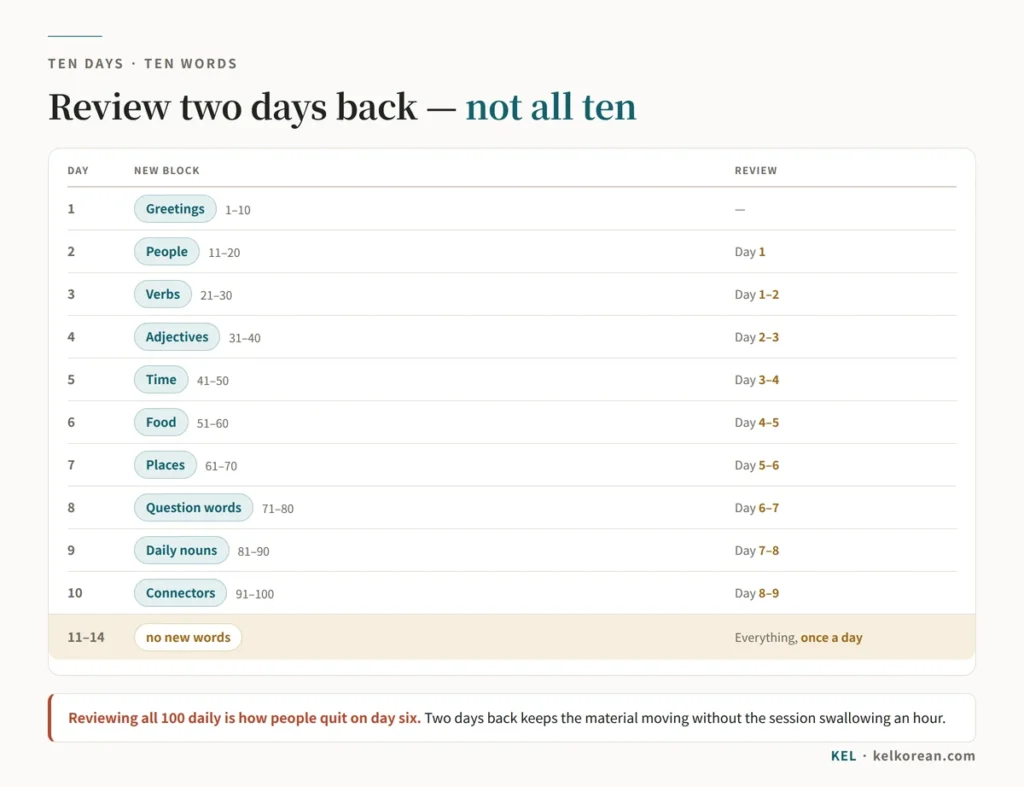
One block a day, with review folded in.
| Day | New block | Review |
|---|---|---|
| 1 | Greetings (1–10) | — |
| 2 | People (11–20) | Day 1 |
| 3 | Verbs (21–30) | Day 1–2 |
| 4 | Adjectives (31–40) | Day 2–3 |
| 5 | Time (41–50) | Day 3–4 |
| 6 | Food (51–60) | Day 4–5 |
| 7 | Places (61–70) | Day 5–6 |
| 8 | Question words (71–80) | Day 6–7 |
| 9 | Daily nouns (81–90) | Day 7–8 |
| 10 | Connectors (91–100) | Day 8–9 |
| 11–14 | — | Everything, once a day |
Review the last two days, not all ten. Trying to review a hundred words daily is how people quit on day six. Two days back is enough to move the material into long-term memory without the session swallowing an hour.
How My Students Actually Memorized These
After years of teaching, here’s what actually worked in my classroom:
Learn words inside sentences, not in isolation. Instead of memorizing 커피 = coffee, my students memorized 저는 커피를 마셔요 (I drink coffee). One sentence gave them a noun, a verb, two particles, and the SOV pattern — all at once. The particles in that sentence are covered in our guide to Korean particles.
Group by situation, not alphabet. That’s why this list is organized by category. Your brain stores words in networks: when you recall 식당 (restaurant), 먹다 (eat), 맛있다 (delicious), and 얼마예요 (how much) come along for free.
Use each word the same day you learn it. I gave my students one homework assignment every week: use three new words in real life — at a cafe, in a text message, anywhere. The words they used stuck; the words they only read did not.
Say them out loud. Silent reading builds recognition. Speaking builds recall. They are not the same skill, and only one of them helps in a conversation.
5 Mistakes Worth Avoiding
1. Learning nouns without verbs. Forty nouns and no verbs produce zero sentences. Block 3 is the one that unlocks the others.
2. Staying on romanization. It feels faster for a week and then permanently caps your reading speed and your pronunciation. Drop it by day fourteen.
3. Learning verbs in the 요 form only. If you memorize 가요 without knowing it comes from 가다, you cannot look it up, conjugate it, or recognize it in another tense.
4. Adding 에 to 오늘, 내일, 어제. ✓ 내일 만나요. These three carry their own time meaning and reject the particle.
5. Mixing up 안녕히 가세요 and 안녕히 계세요. The one who leaves gets 가세요; the one who stays gets 계세요. Work out which one you are first.
Quick Practice
Build these from words on the list. Answers below.
- Water, please. → ?
- Where is the bathroom? → ?
- How much is it? → ?
- It’s delicious. → ?
- Do you have time? → ?
- Please speak slowly. → ?
Answers:
- 물 주세요.
- 화장실이 어디예요?
- 얼마예요?
- 맛있어요.
- 시간이 있어요?
- 천천히 말해 주세요.
Every answer uses only words from the hundred.
Frequently Asked Questions
How many Korean words do I need for basic conversation?
With these 100 words plus basic sentence structure, you can handle simple daily interactions. Around 500 words covers most everyday conversation topics, and 2,000 words is generally enough to understand the majority of daily Korean speech.
Should I learn romanization or Hangul?
Hangul, as soon as possible. Romanization is training wheels — helpful for the first week, misleading after that, because Korean sounds don’t map cleanly onto English spelling. Our guide to the vowels ㅓ vs ㅗ shows exactly why romanization will betray you.
What order should I learn Korean in as a complete beginner?
Based on my teaching experience: Hangul first, then basic sentence structure, then these 100 words, then pronunciation fine-tuning. That’s the exact order our complete beginner’s roadmap follows.
Is ten words a day realistic?
For ten days, yes — especially with the review schedule above. Beyond about two weeks most people need to drop to five a day. Consistency beats volume: twenty words a day for four days and then nothing is worse than five a day for a month.
Do I need to learn the dictionary form of verbs?
Yes. 가다, not 가요. The dictionary form is what you look up, and every conjugation — present, past, future, formal, casual — is built from it.
What should I learn after these 100?
Numbers and counters, because they attach to everything, then verb conjugation so the verbs you know can move through tenses. Our guide to Korean numbers is the natural next step.
Final Thoughts
A hundred words is not much — roughly one page. What makes this particular hundred worth ten days is that they were chosen from watching real students: which words they reached for at the counter, which ones they asked me about twice, which ones let them say something instead of just recognizing something.
That’s why 물 주세요 and 화장실이 어디예요? come out of it in the first week. Not because the words are unusual, but because the set is closed enough that combinations fall out on their own.
Start with block one today. Say 안녕하세요 out loud, badly, several times. Then tomorrow do the next ten.
Korean English Lab (KEL) creates practical Korean learning materials based on real classroom experience — including printable workbooks and flashcards built around lists like this one.
Vocabulary is stage three of five. The full beginner roadmap shows what comes before it and what to build on top.
Leave a Reply