You meet someone in Seoul. You know from their profile that they were born in November 1999, which makes them twenty-six. They introduce themselves and say 스물여덟이에요 — twenty-eight.
Nobody is lying. Korean age is a different arithmetic, and for most of the last century Korea ran on it exclusively.
In June 2023 the government changed the law. Officially, Korea now uses international age like everywhere else. But a system that shaped how people speak to each other for hundreds of years does not disappear because a statute says so — and, more importantly, two of the old systems are still legally in force for specific things.
So there are still three ages floating around. This guide explains all three, shows you how to count yours, and — the part that actually matters in conversation — teaches you what to say when someone asks.
The Three Ages
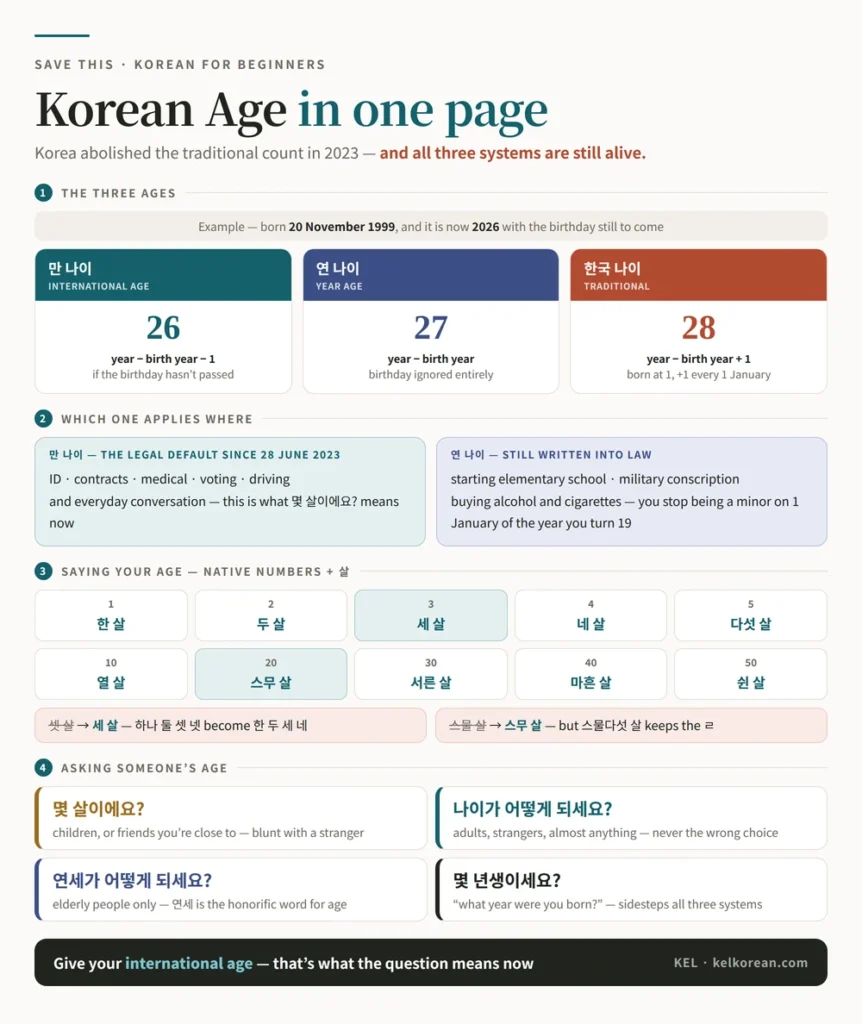
Korea has used three different ways of counting, and all three still exist in 2026.
1. 만 나이 — international age
This is the one you already know. You are born at zero and gain a year on your birthday.
만 나이 (man nai) — literally “full age”
만 is a Sino-Korean word meaning “complete” or “full.” When you see 만 19세 이상 on a sign, it means “nineteen full years or older” — the international reckoning.
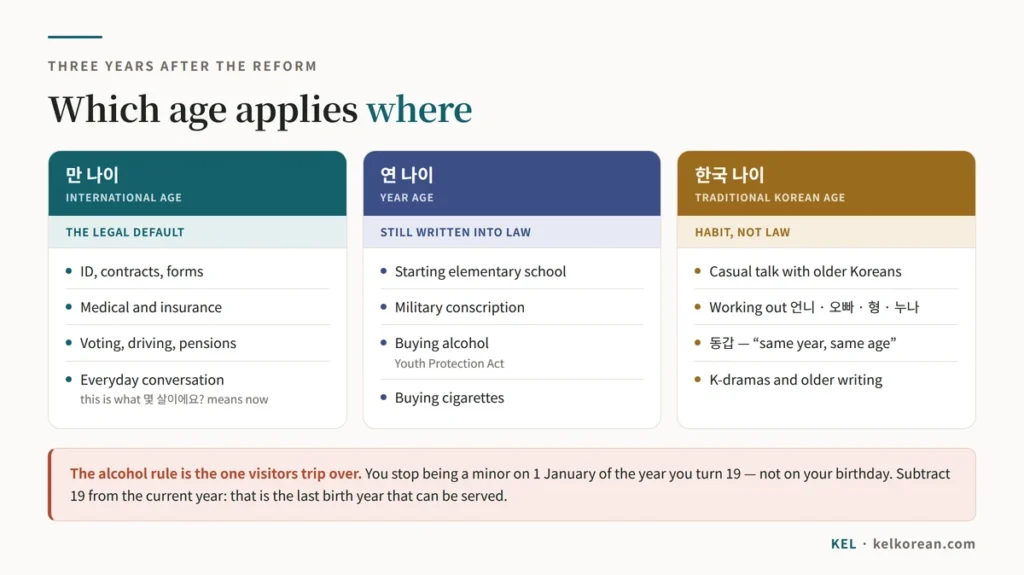
Since 28 June 2023, this is the legal default in Korea for contracts, administration, ID, pensions, driving licences and voting. If a document does not say otherwise, it means 만 나이.
2. 연 나이 — year age
Current year minus birth year. Your birthday is irrelevant; everyone born in the same calendar year has the same 연 나이.
연 나이 (yeon nai) — “year age”
This one survives in law for a small number of things, and we will come back to it, because it is the reason the drinking age in Korea works in a way that surprises visitors.
3. 한국 나이 / 세는 나이 — traditional Korean age
The old system, and the one that produces the strange numbers.
한국 나이 (hanguk nai) — “Korean age”
세는 나이 (seneun nai) — “counting age”
Two rules:
- You are one year old on the day you are born.
- Everyone gains a year on 1 January, not on their birthday.
That is it. Nobody in this system celebrates ageing on their birthday — the whole country ages together on New Year’s Day.
Why the Numbers Come Out So Far Apart
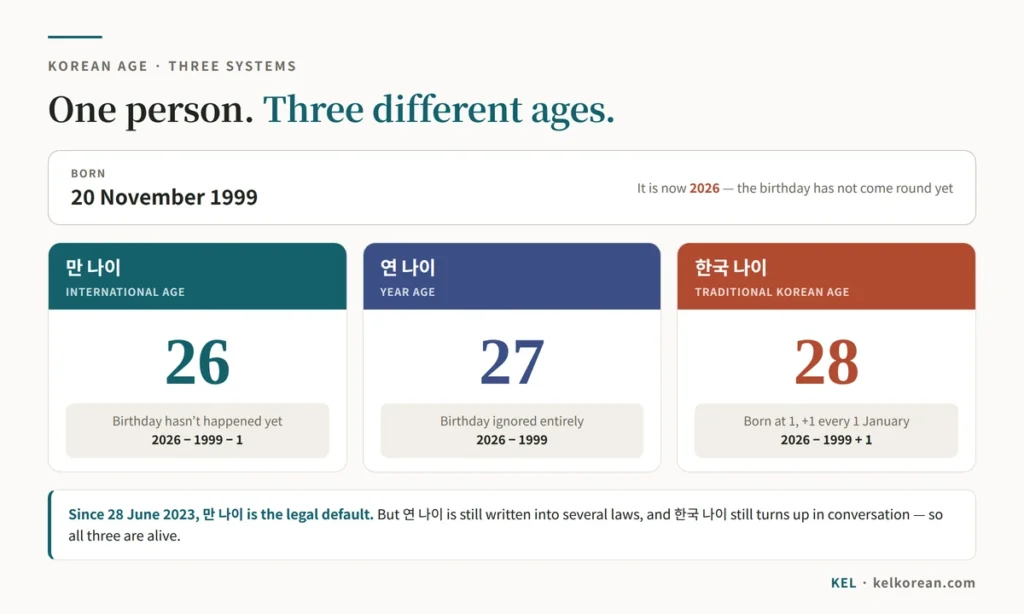
Take our example: born 20 November 1999, and it is now 2026, with the birthday still a few months away.
| System | How it counts | Result |
|---|---|---|
| 만 나이 | Birthday hasn’t happened yet this year | 26 |
| 연 나이 | 2026 − 1999 | 27 |
| 한국 나이 | 2026 − 1999 + 1 | 28 |
Three ages, two years apart, same person, same day.
The gap is at its widest between 1 January and your birthday. After your birthday passes, 만 나이 and 연 나이 match, and 한국 나이 sits exactly one year above.
The extreme case is a December baby. A child born on 31 December 2025 was one year old that day under the traditional system. The next morning — 1 January 2026 — they turned two. One day old, two years old.
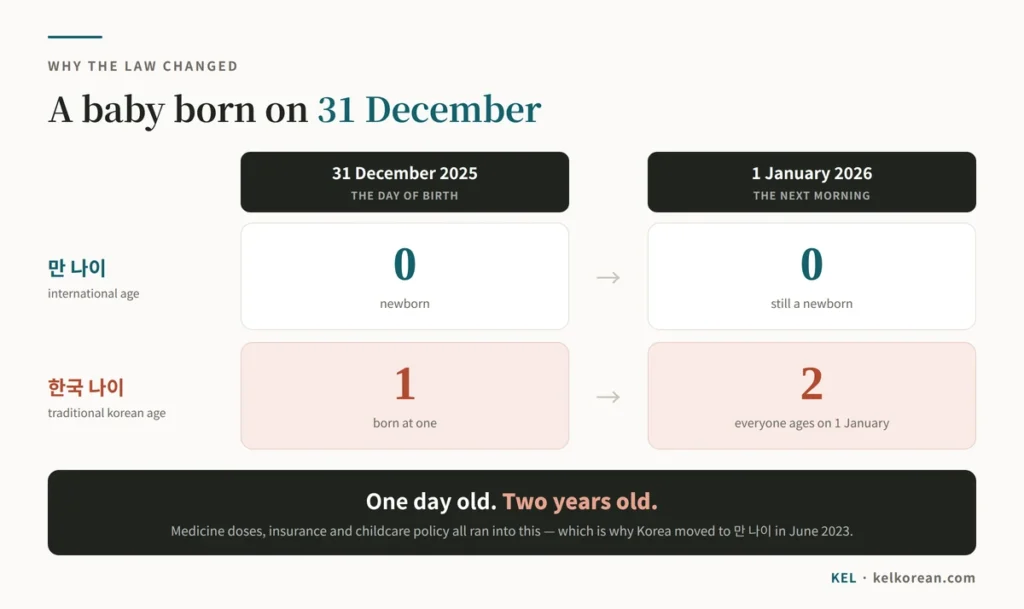
This is exactly why the law changed. Medicine dosages, insurance and childcare policy were all being confused by a system where a one-day-old could be described as two.
What Actually Changed in 2023
The law is called the 만 나이 통일법 — the “unification of full age” act. It took effect on 28 June 2023, and it did one thing: it made 만 나이 the default reading of the word “age” in every law and contract that does not explicitly say otherwise.
Overnight, most Koreans became one or two years younger on paper.
What the law did not do is delete the other two systems. Some laws had 연 나이 written into them explicitly, and those were left alone.
Where Each System Still Shows Up in 2026
This is the practical part. Three years on, here is the actual split.
| Situation | Which age applies |
|---|---|
| ID, contracts, medical, voting, driving | 만 나이 |
| Everyday conversation with most people | 만 나이 |
| Casual conversation with older Koreans | 한국 나이 often persists |
| Starting elementary school | 연 나이 |
| Military conscription | 연 나이 |
| Buying alcohol and cigarettes | 연 나이 |
The alcohol rule is the one visitors trip over. Korea’s Youth Protection Act was not rewritten in 2023, and it still uses the calendar-year rule: you stop being a minor on 1 January of the year you turn 19, not on your birthday.
In practical terms, throughout 2026 anyone born in 2007 or earlier can be served. Someone born on 31 December 2007 became eligible on 1 January 2026, weeks before their nineteenth birthday. Someone born on 1 January 2008 has to wait until January 2027 — an entire year, for one day of difference.
The cut-off moves forward every January: subtract 19 from the current year and that is the last eligible birth year.
And for conversation: when a Korean asks your age today, they almost always mean 만 나이. If you are talking with someone over about fifty, the old habit may still surface. If the number sounds a year or two off, that is what happened.
How to Say Your Age in Korean
Now the language. Age uses native Korean numbers plus the counter 살.
| Age | Korean | Romanization |
|---|---|---|
| 1 | 한 살 | han sal |
| 2 | 두 살 | du sal |
| 3 | 세 살 | se sal |
| 4 | 네 살 | ne sal |
| 5 | 다섯 살 | daseot sal |
| 10 | 열 살 | yeol sal |
| 15 | 열다섯 살 | yeoldaseot sal |
| 20 | 스무 살 | seumu sal |
| 25 | 스물다섯 살 | seumuldaseot sal |
| 30 | 서른 살 | seoreun sal |
| 40 | 마흔 살 | maheun sal |
| 50 | 쉰 살 | swin sal |
| 60 | 예순 살 | yesun sal |
Two shape changes worth memorising, because they catch everyone:
하나 · 둘 · 셋 · 넷 become 한 · 두 · 세 · 네 in front of 살. You say 세 살, never 셋 살.
스물 becomes 스무 in front of 살. Twenty is 스물, but twenty years old is 스무 살 — the ㄹ drops. Twenty-five keeps it: 스물다섯 살.
If that pattern looks familiar, it is the same one that governs every counted noun in Korean. Our guide to Korean counters covers the full system, and Korean numbers explained sets out when to use native numbers versus Sino-Korean ones.
The formal counter: 세
On official forms you will see 세 instead of 살, and it takes Sino-Korean numbers.
만 19세 이상 — nineteen full years or older
만 65세 이상 — sixty-five and over
You will never say 세 out loud in conversation about yourself. It belongs to signs, forms and news reports.
Asking Someone’s Age
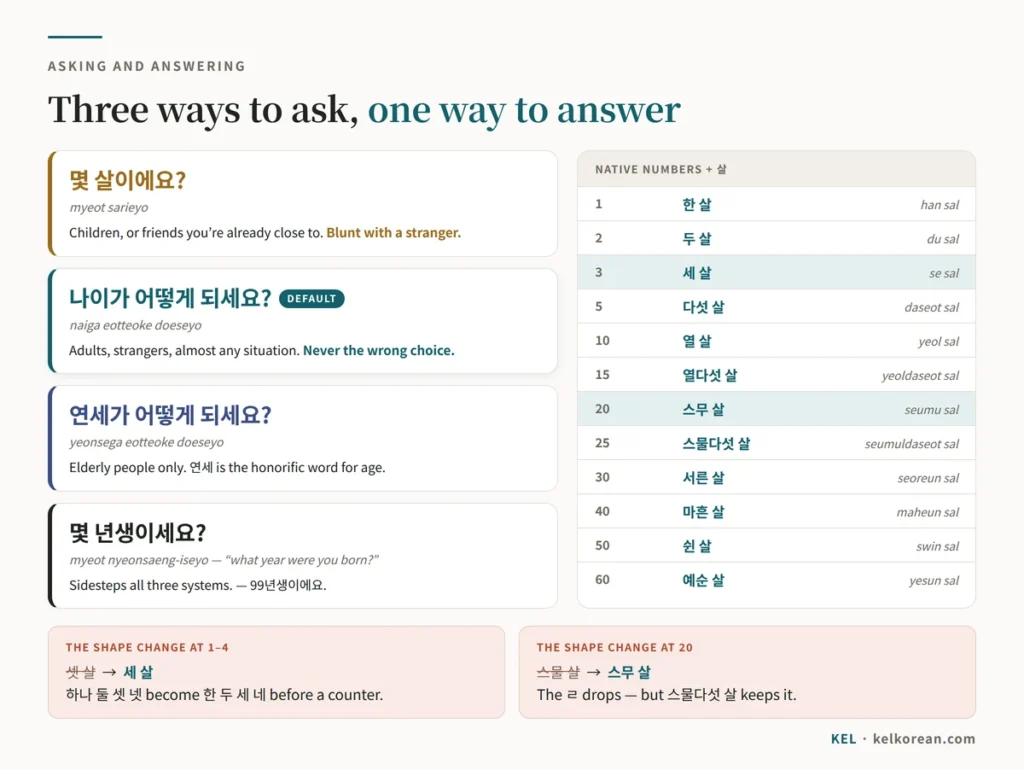
Korean has three levels of this question, and choosing wrong is a genuine mistake.
| Question | Use with |
|---|---|
| 몇 살이에요? | Someone clearly younger, or a peer you’re already comfortable with |
| 나이가 어떻게 되세요? | Adults, strangers, most situations — the safe one |
| 연세가 어떻게 되세요? | Elderly people |
몇 살이에요? (myeot sarieyo) is the plain version — “how many years old?” Fine for children, fine among friends. Slightly blunt for a stranger your own age.
나이가 어떻게 되세요? (naiga eotteoke doeseyo) literally asks “how does your age come to be?” — an indirect construction that Korean uses to soften personal questions. This is the one to default to. The same frame works for a name (성함이 어떻게 되세요?) or a phone number.
연세가 어떻게 되세요? (yeonsega eotteoke doeseyo) uses 연세, the honorific word for age, reserved for people noticeably older than you — a friend’s grandmother, an elderly neighbour.
Answering is simple:
스물다섯 살이에요. — I’m twenty-five.
서른두 살이에요. — I’m thirty-two.
If you want more on why Korean has three ways to ask one question, Korean honorifics explained simply covers the speech levels, and Korean question words covers 몇 and the rest.
Why Anyone Asks in the First Place
To an English speaker, asking a new acquaintance their age feels intrusive. In Korean it is closer to a practical necessity, because age decides how two people speak to each other.
Once ages are known, three things get settled at once:
What you call each other. An older woman becomes 언니 or 누나; an older man becomes 오빠 or 형 — which of the two depends on your own gender, not theirs. These are not only family words; they are how Koreans address older friends every day. Korean family terms lays out the whole map.
Which speech level you use. The younger person typically uses 존댓말 upward, and the older person may use 반말 downward — or both agree to keep it polite. That negotiation cannot happen until the ages are on the table.
Whether you are 동갑. 동갑 (donggap) means born in the same year, and it is a small social event. 동갑이에요? — “Are we the same age?” — usually leads straight to 말 놓을까요?, “shall we drop the formality?”
So the age question is not idle curiosity. It is the handshake that decides the grammar of everything that follows. Our guide to Korean greetings and self-introduction shows where it fits in a first conversation.
The Better Question: 몇 년생이세요?
Here is the move that experienced learners use.
Instead of asking someone’s age, ask their birth year:
몇 년생이세요? (myeot nyeonsaeng-iseyo) — “What year were you born?”
The answer sidesteps all three systems entirely:
99년생이에요. — I was born in ’99.
This is common among Koreans themselves, and it has become more common since 2023, precisely because “age” got ambiguous. Nobody has to specify which system they mean.
There is a related question you will hear:
무슨 띠예요? (museun ttiyeyo) — “What zodiac animal are you?”
Korea uses the twelve-year zodiac cycle, and the animal pins down your birth year to within twelve years — usually enough, combined with how you look, to place you exactly. 2026 is 말띠, the year of the horse.
5 Mistakes Worth Avoiding
1. Assuming the 2023 law ended Korean age. It ended it legally. Socially it lingers, and 연 나이 is still written into several laws.
2. Saying 셋 살. Native numbers change shape before counters: 세 살.
3. Saying 스물 살. Twenty years old is 스무 살. The ㄹ drops.
4. Using Sino numbers with 살. ✗ 이십오 살. ✓ 스물다섯 살. Sino numbers go with 세, and only in writing.
5. Opening with 몇 살이에요? to a stranger. Use 나이가 어떻게 되세요?. The blunt version is for children and close friends.
Quick Practice
Work these out before reading on. Assume the year is 2026.
- Born 3 March 2000, and it is already September — what are the three ages?
- How do you say “I’m twenty years old”?
- Which question do you use with a friend’s grandmother?
- Someone born on 1 January 2008 — can they buy beer in Korea in 2026?
Answers
- 만 26 (the birthday has passed), 연 26, 한국 27.
- 스무 살이에요.
- 연세가 어떻게 되세요?
- No. The Youth Protection Act uses the calendar-year rule, so they become eligible on 1 January 2027.
Frequently Asked Questions
Is Korean age still used in 2026?
Not legally — international age has been the default since 28 June 2023. But 한국 나이 still surfaces in casual conversation, particularly among older Koreans, and 연 나이 remains legally binding for school entry, military conscription and the purchase of alcohol and tobacco.
How do I calculate my Korean age?
Current year minus birth year, plus one. In 2026, someone born in 1999 has a Korean age of 28 — regardless of whether their birthday has passed.
Why does Korea use a different age system at all?
The counting system is shared with historical China, Japan and Vietnam, and is usually explained by two ideas: that time in the womb counts, and that age is tied to the calendar year rather than the individual. Korea was the last country in the region still using it in daily life.
Do Koreans celebrate birthdays then?
Yes — birthdays are celebrated on the actual date, with 미역국 (seaweed soup) in the morning. Under the traditional system that celebration simply did not change your number; the calendar did.
Which age should I give when someone asks?
Your international age. That is what the question means now. If you are talking with an older person and the number seems to confuse them, adding 만 나이로 스물여섯이에요 clears it up instantly.
What is 빠른 년생?
An older wrinkle. Children born in January or February used to be able to start school a year early, which put them permanently one social “year group” ahead of their birth year. The practice ended with school-entry reforms, so it only applies to Koreans born before the mid-2000s — but you will still hear it argued about.
Final Thoughts
The 2023 reform simplified the paperwork and left the culture where it was. In 2026 the honest summary is this: give your international age, expect it to be what people mean, and recognise the traditional number when an older person uses it.
The deeper point is the one underneath the arithmetic. Korean asks for your age early because the language cannot proceed politely without it — the pronouns, the titles and the verb endings all depend on the answer. Learning the counting systems takes ten minutes. Learning why the question gets asked at all tells you something real about how Korean works.
Start with 스무 살, 스물다섯 살, 서른 살 — the ones you will actually say — and with 나이가 어떻게 되세요?, the question that will never be the wrong one to ask.
Leave a Reply