
Everyone learns 안녕하세요 in the first five minutes. Almost nobody learns what to say next.
So the typical first conversation in Korea goes: a confident 안녕하세요, a warm response, and then silence — because “hello” was the whole vocabulary. And then, at the end, a second problem arrives: there are two ways to say goodbye in Korean, they are nearly identical, and using the wrong one is the most common mistake learners make.
This guide covers Korean greetings for every situation you will actually meet, the goodbye distinction that trips up everyone, and a self-introduction template you can fill in and use today. By the end you will be able to open a conversation, hold the first thirty seconds of it, and close it correctly.
The One That Does Most of the Work
안녕하세요 (annyeonghaseyo) is the polite, all-purpose greeting. Morning, afternoon, evening, first meeting, tenth meeting — it works everywhere.
Korean does not have separate “good morning / good afternoon / good evening” greetings the way English does. Textbooks sometimes teach 좋은 아침이에요 as “good morning,” but Koreans rarely say it. Use 안녕하세요 and you will always be correct.
| Level | Form | Use with |
|---|---|---|
| Formal | 안녕하십니까 (annyeonghasimnikka) | News, ceremonies, military, formal business |
| Polite | 안녕하세요 (annyeonghaseyo) | Default — almost everyone |
| Casual | 안녕 (annyeong) | Close friends, children, younger people |
안녕 is also used for casual goodbyes — it works both directions, like “hi” and “bye” in one word.
If you are unsure which level to use, use 안녕하세요. It is never rude. For the fuller picture of when Korean shifts register, see our guide to Korean honorifics.
The Goodbye Problem
Here is the distinction that catches every learner.
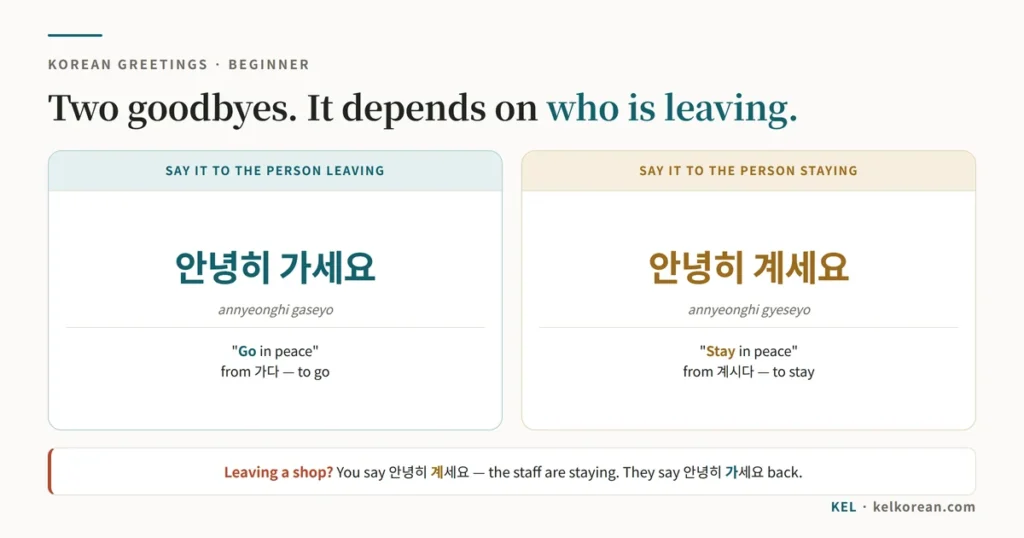
Korean has two goodbyes, and which one you use depends on who is leaving.
안녕히 가세요 — “Go in peace.” Said to the person who is leaving.
안녕히 계세요 — “Stay in peace.” Said to the person who is staying.
So when you leave a shop, you say 안녕히 계세요 (the staff are staying) and they say 안녕히 가세요 (you are going). You do not both say the same thing.
| Situation | You say |
|---|---|
| Leaving a restaurant or shop | 안녕히 계세요 |
| A guest leaves your home | 안녕히 가세요 |
| You both leave at the same time | 안녕히 가세요 (both of you) |
| Casual, close friend | 안녕 or 잘 가 |
Memory trick: 가 is in 가다 (to go) — so 가세요 goes to the person going. 계 is in 계시다 (to stay/be) — so 계세요 goes to the person staying.
Getting it backwards is not offensive, and Koreans will simply understand. But getting it right is one of those small things that visibly registers.
Greetings by Situation
| Korean | Romanization | When to use |
|---|---|---|
| 안녕하세요 | annyeonghaseyo | Hello — any time, any place |
| 안녕히 가세요 | annyeonghi gaseyo | Goodbye, to someone leaving |
| 안녕히 계세요 | annyeonghi gyeseyo | Goodbye, to someone staying |
| 여보세요 | yeoboseyo | Hello — on the phone only |
| 반갑습니다 | bangapseumnida | Nice to meet you |
| 처음 뵙겠습니다 | cheoeum boepgetseumnida | How do you do (formal first meeting) |
| 오랜만이에요 | oraenmanieyo | Long time no see |
| 잘 지냈어요? | jal jinaesseoyo | How have you been? |
| 안녕히 주무세요 | annyeonghi jumuseyo | Good night (to elders) |
| 잘 자요 | jal jayo | Sleep well (casual) |
| 수고하셨습니다 | sugohasyeotseumnida | “Thank you for your work” — leaving work |
| 잘 먹겠습니다 | jal meokgetseumnida | Said before eating |
| 잘 먹었습니다 | jal meogeotseumnida | Said after eating |
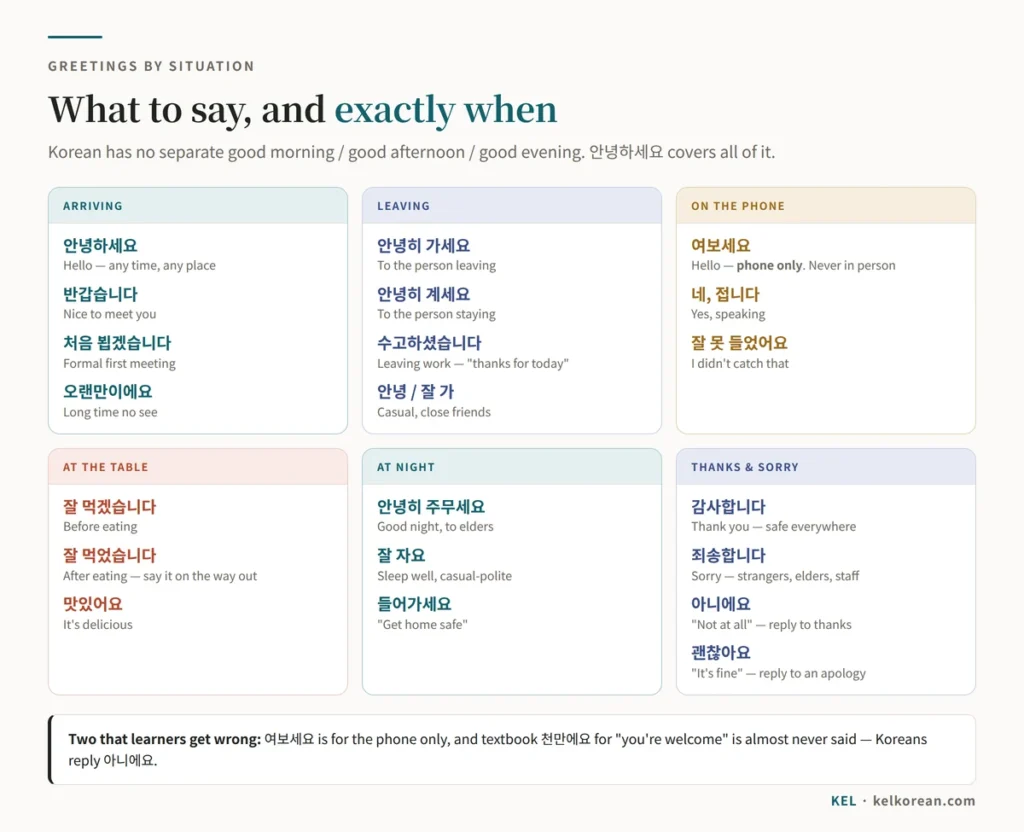
여보세요 is phone-only. Say it to someone standing in front of you and it will sound very strange. Answering the phone with 안녕하세요 is also fine, but 여보세요 is the default.
수고하셨습니다 is worth knowing if you will work in Korea. It is what you say to colleagues when leaving the office — closer to “thanks for your effort today” than to “goodbye.”
The two meal phrases appear in our guide to ordering food in Korean — 잘 먹었습니다 on the way out of a restaurant reliably earns a warm response.
Thank You, Sorry, and It’s Fine
These sit right beside greetings in daily use, and each has levels.
Thank you
| Korean | Level | Notes |
|---|---|---|
| 감사합니다 | formal | The safe default everywhere |
| 고맙습니다 | formal | Same meaning, native-Korean origin |
| 고마워요 | polite | Slightly warmer, for people you know |
| 고마워 | casual | Close friends only |
감사합니다 and 고맙습니다 are interchangeable in practice. Use 감사합니다 and you will never be wrong.
Sorry
| Korean | Level | Notes |
|---|---|---|
| 죄송합니다 | formal | More deferential — use with strangers, elders, staff |
| 죄송해요 | polite | Everyday apology |
| 미안해요 | polite | Slightly lighter, for people you know |
| 미안해 | casual | Close friends |
The difference is real: 죄송합니다 lowers yourself more than 미안해요. Apologising to a stranger or someone older calls for 죄송합니다.
Replying
| Korean | Meaning |
|---|---|
| 아니에요 | “Not at all” — the natural reply to thanks |
| 괜찮아요 | “It’s fine” — reply to an apology |
| 별말씀을요 | “Don’t mention it” — polite, a little formal |
Textbooks teach 천만에요 as “you’re welcome.” Koreans rarely say it. 아니에요 is what you will actually hear.
The First Thirty Seconds
Here is a complete first meeting. Read it out loud — you can already understand every line.
A: 안녕하세요!
B: 안녕하세요. 처음 뵙겠습니다.
A: 저는 사라예요. 미국에서 왔어요.
B: 아, 그래요? 저는 민준이에요. 만나서 반갑습니다.
A: 한국어를 배우고 있어요. 아직 잘 못해요.
B: 아니에요, 잘하시는데요!
A: 감사합니다. 잘 부탁드립니다.
B: 네, 잘 부탁드립니다.
Two things worth noticing.
아직 잘 못해요 (“I’m still not good at it”) is worth memorising as a set phrase. It heads off the expectation that you will understand everything, and Koreans respond to it warmly.
아니에요, 잘하시는데요 is the standard reply — a polite deflection of your modesty. It is a social ritual, not a genuine assessment, so the correct response is simply 감사합니다.
Building a Self-Introduction
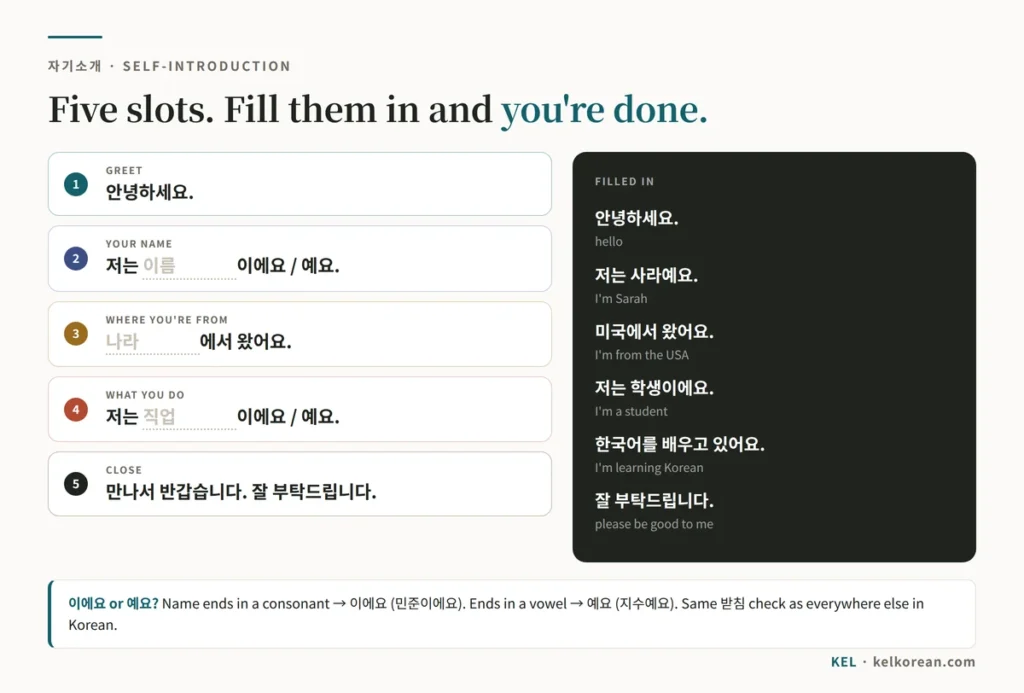
Korean self-introduction — 자기소개 (jagi sogae) — follows a predictable order. Fill in these five slots and you have a complete introduction.
Slot 1 — Greet
안녕하세요.
Slot 2 — Your name
Two ways, both correct:
| Korean | Notes |
|---|---|
| 저는 [이름]이에요 / 예요 | Polite, everyday |
| 저는 [이름]입니다 | Formal — interviews, presentations |
| 제 이름은 [이름]이에요 | “My name is…” |
이에요 vs 예요 depends on the last sound of the name:
- Ends in a consonant → 이에요 (민준이에요)
- Ends in a vowel → 예요 (지수예요)
This is the same 받침 logic used throughout Korean grammar — the same check that decides which Korean particle attaches to a noun.
Slot 3 — Where you are from
저는 [나라]에서 왔어요.     — I came from [country]
저는 [나라] 사람이에요.     — I am [country]-ish
| Country | Korean |
|---|---|
| USA | 미국 |
| UK | 영국 |
| Canada | 캐나다 |
| Australia | 호주 |
| Japan | 일본 |
| China | 중국 |
| France | 프랑스 |
| Germany | 독일 |
| Vietnam | 베트남 |
| India | 인도 |
Slot 4 — What you do
저는 [직업]이에요 / 예요.
| Job | Korean |
|---|---|
| student | 학생 |
| office worker | 회사원 |
| teacher | 선생님 |
| doctor | 의사 |
| nurse | 간호사 |
| engineer / developer | 개발자 |
| designer | 디자이너 |
| chef | 요리사 |
| freelancer | 프리랜서 |
You can also add why you are learning:
한국어를 배우고 있어요.        — I'm learning Korean
한국 드라마를 좋아해요.        — I like Korean dramas
That -고 있어요 form comes from our guide to Korean verb conjugation.
Slot 5 — Close
만나서 반갑습니다.            — Nice to meet you
잘 부탁드립니다.              — (see below)
잘 부탁드립니다 has no clean English translation. Literally “I ask you kindly,” it means something like “I look forward to working with you — please be good to me.” It closes almost every Korean self-introduction, in classrooms, offices, and first meetings alike.
Saying it marks you as someone who understands how Korean social introductions work. Leaving it out is not wrong, but including it lands well.
A Complete Self-Introduction
Here is the whole thing assembled. Read it out loud.
안녕하세요.
저는 사라예요.
미국에서 왔어요.
저는 학생이에요.
한국어를 배우고 있어요.
한국 음식을 정말 좋아해요.
취미는 요리예요.
한국에 온 지 3개월 됐어요.
만나서 반갑습니다.
잘 부탁드립니다.
Ten sentences. Every one is built from grammar covered in our beginner guides, and every one can be swapped for your own details.
Formal version — for interviews or presentations, swap the endings:
안녕하십니까. 저는 사라입니다. 미국에서 왔습니다. 학생입니다. 한국어를 배우고 있습니다. 만나서 반갑습니다. 잘 부탁드립니다.
Adding Your Age
Koreans ask age early and often, because the answer determines which speech level and which family terms people use with each other. It is a practical question, not a rude one.
저는 스물다섯 살이에요. — I'm 25
Age uses native Korean numbers with the counter 살: 한 살, 두 살, 스무 살, 스물다섯 살, 서른 살. If the two number systems are still shaky, our guide to Korean numbers covers which goes where.
To ask: 몇 살이에요? (myeot sarieyo) — casual-polite. To an older person, 나이가 어떻게 되세요? is more respectful.
Bowing and Body Language
A short, shallow nod accompanies most greetings — roughly 15 degrees, from the neck and upper back. You do not need a deep formal bow in daily life.
Three small things worth knowing:
- Two hands when giving or receiving anything — a business card, a drink, a payment. One hand reads as careless.
- Handshakes happen, often with the left hand lightly supporting the right forearm.
- Eye contact is briefer than in Western countries, especially with someone older. Not avoidance — just less sustained.
None of this needs to be perfect. Effort registers more than precision.
5 Common Mistakes
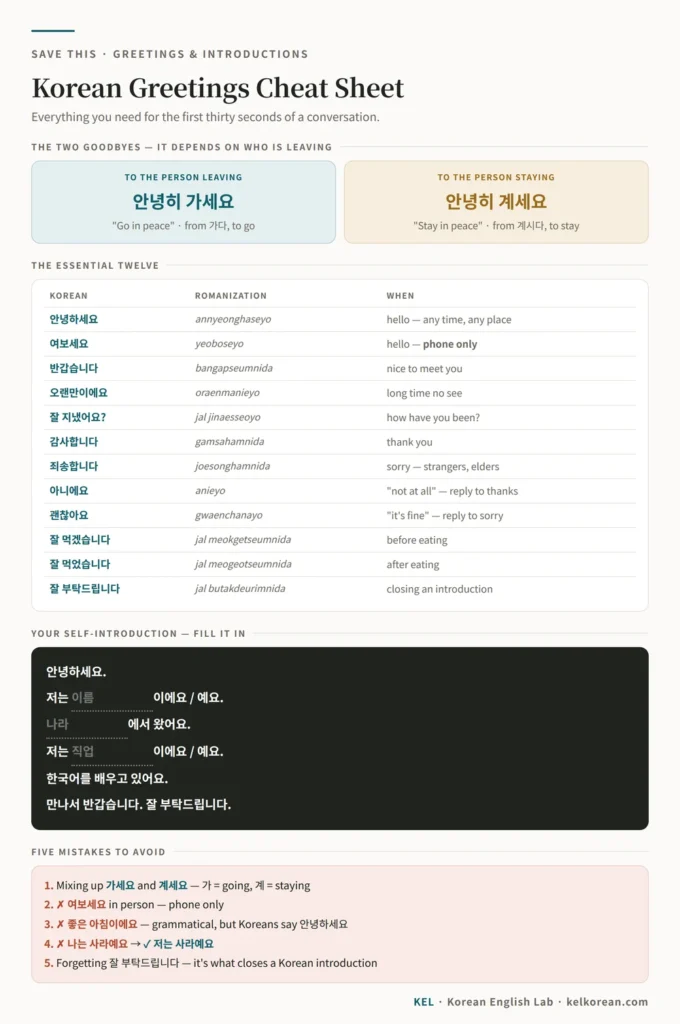
1. Mixing up 가세요 and 계세요. The single most common greeting error. Remember: 가 = going, 계 = staying.
2. Using 여보세요 in person. Phone only.
3. Saying 좋은 아침이에요 for “good morning.” Grammatically fine, rarely said. Use 안녕하세요.
4. Introducing yourself with 나는. ✗ 나는 사라예요. ✓ 저는 사라예요. 나 is the casual “I” and clashes with a polite ending. 저 is the humble form — use it whenever you use 요.
5. Skipping 잘 부탁드립니다. Not an error exactly, but its absence makes an introduction feel unfinished to Korean ears.
Quick Practice
Fill in the blanks for yourself, then say the whole thing out loud.
안녕하세요.
저는 __________이에요 / 예요.
__________에서 왔어요.
저는 __________이에요 / 예요.
한국어를 배우고 있어요.
만나서 반갑습니다.
잘 부탁드립니다.
Then test the goodbye:
- You are leaving a café. What do you say? → ?
- Your friend is leaving your apartment. What do you say? → ?
- Someone calls your phone. What do you answer? → ?
Answers: 1. 안녕히 계세요 · 2. 안녕히 가세요 · 3. 여보세요
Frequently Asked Questions
Is 안녕하세요 a question or a statement?
Grammatically it is a question — “are you at peace?” — but nobody treats it as one. Answer it with 안녕하세요.
Do I bow every time?
A small nod, yes. A full bow is reserved for formal occasions, apologies, and very senior people. When unsure, mirror what the other person does.
Can I use someone’s first name?
Generally no. Korean uses name + 씨 (민준 씨) with peers, or a title — 선생님, 사장님, 과장님. Using a bare first name with someone you have just met sounds abrupt. Wait to be invited.
What if someone greets me and I don’t understand the rest?
죄송해요, 잘 못 들었어요 (“sorry, I didn’t catch that”) or 천천히 말해 주세요 (“please speak slowly”). Both are polite and both work.
Is it rude that people ask my age immediately?
No, and it is not personal. Korean speech levels depend on relative age, so the question is closer to “which register should we use with each other?” than to curiosity.
When do I switch to 안녕 instead of 안녕하세요?
When the other person switches first, or when they invite it — 말 놓으세요 (“speak casually with me”). As a learner, wait to be invited rather than initiating.
Final Thoughts
Greetings are the smallest possible piece of a language and the one that determines the first impression entirely. Two minutes of preparation is the difference between a nod and an actual conversation.
The realistic goal is not fluency here. It is: open with 안녕하세요, deliver seven prepared sentences about yourself, close with 잘 부탁드립니다, and leave with the correct goodbye. That is a complete social interaction, and every piece of it is memorisable tonight.
Write your own version of the template above. Say it out loud twenty times until it comes without thinking. That single block of memorised text will carry you through every first meeting you have in Korean — and it is exactly the week-12 exercise in our complete beginner’s roadmap.
Keep learning with Korean English Lab. Our bilingual Korean–English worksheets and printable workbooks are designed for self-study learners who want structured practice, not just theory.
Written by Minhyung Cha — 25 years teaching Korean, and 15+ years running an English academy in South Korea. Every example on this site is checked as a native speaker. More about KEL.
Leave a Reply