You know the numbers. You know the word for cat.
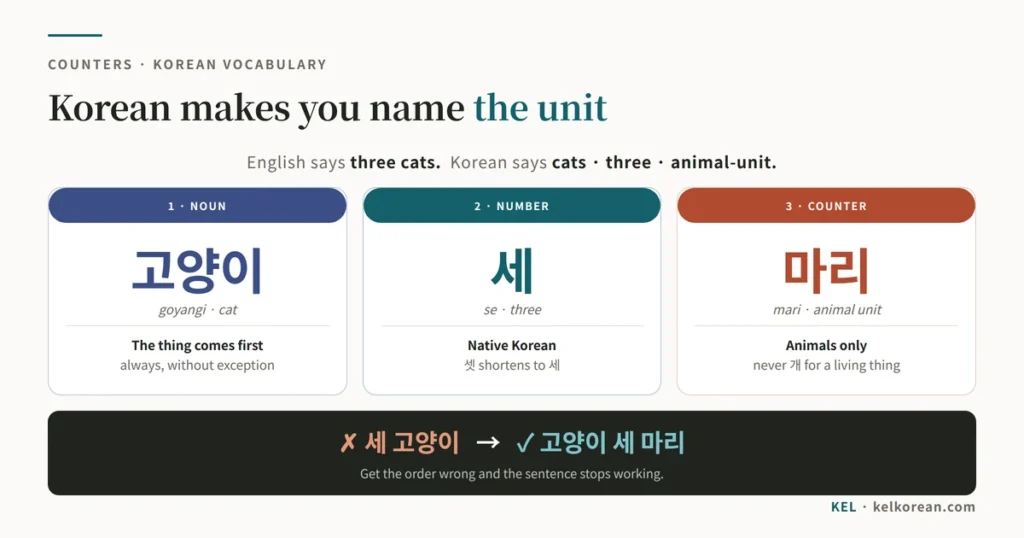
So you say 세 고양이 — three cat — and the Korean person in front of you pauses.
The sentence you needed was 고양이 세 마리. The noun comes first, the number comes second, and a third word you never asked for comes last.
That third word is a counter. Korean counters are mandatory — the language will not let you count anything without naming the unit it comes in.
English does this too, quietly: three sheets of paper, two loaves of bread, a pair of shoes. The difference is that English only demands it sometimes. Korean demands it every single time — and it has a different counter for books, animals, machines, flat things, and people you respect.
This guide covers the word order, which number system each counter takes, the fifteen counters worth memorising, and the one counter that will save you when you forget the rest.
The One Rule
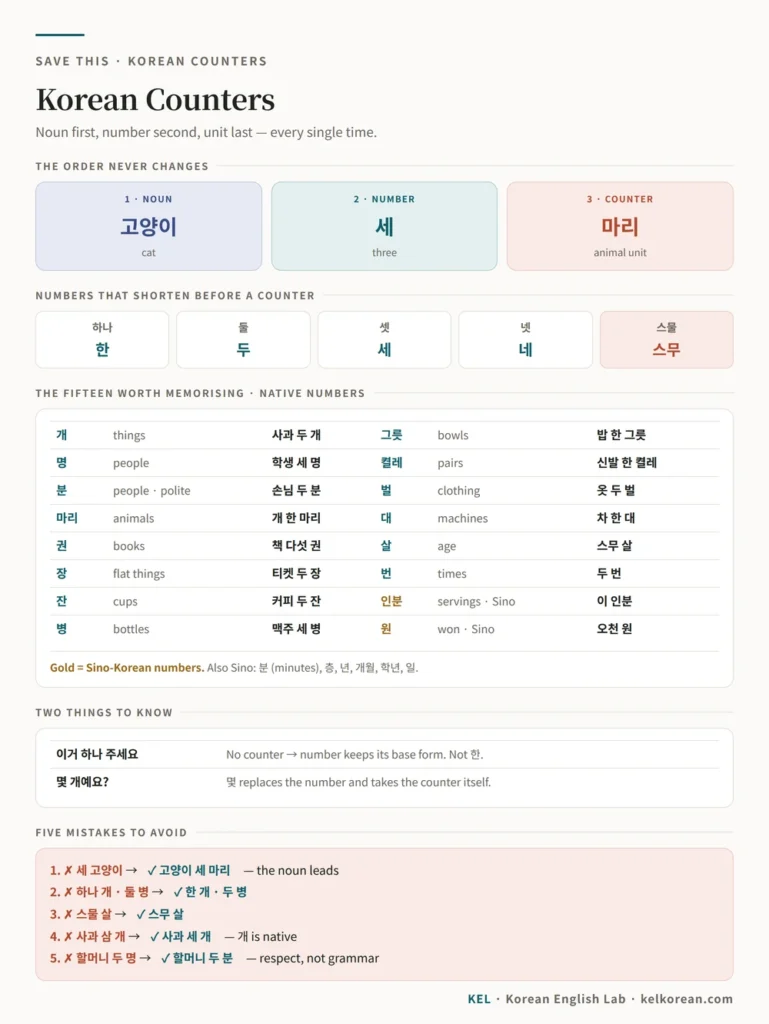
Noun + Number + Counter
고양이 세 마리 — three cats
Not three cats. Cats three animal-units.
| Korean | Literal | English |
|---|---|---|
| 사과 세 개 | apple three units | three apples |
| 사람 두 명 | person two people-units | two people |
| 책 한 권 | book one volume | one book |
| 커피 네 잔 | coffee four cups | four cups of coffee |
The noun leads. This feels backwards for the first week and then stops feeling like anything at all.
Which Number System?
Korean has two number systems, and counters split between them. If that split is new to you, our guide to Korean numbers covers both sets.
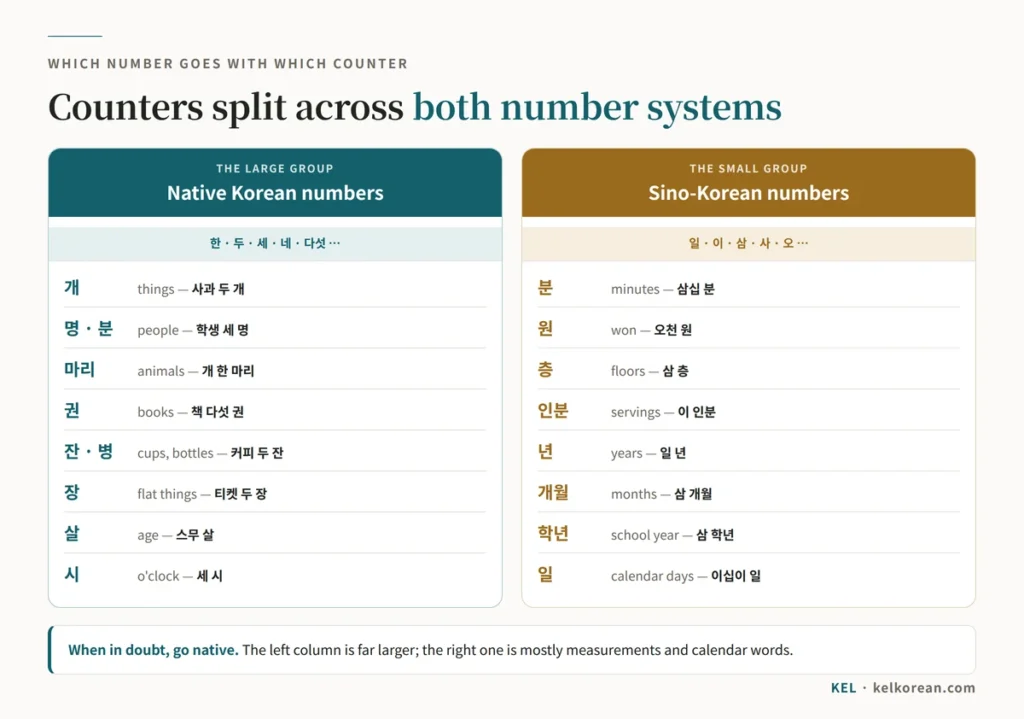
Most counters take native Korean numbers. 하나, 둘, 셋, 넷, 다섯…
A smaller group takes Sino-Korean. 일, 이, 삼, 사, 오…
| Native Korean | Sino-Korean |
|---|---|
| 개 (things) | 분 (minutes) |
| 명 · 분 (people) | 원 (won) |
| 마리 (animals) | 층 (floors) |
| 권 (books) | 인분 (servings) |
| 잔 (cups) | 년 (years) |
| 병 (bottles) | 개월 (months) |
| 살 (age) | 학년 (school year) |
| 시 (o’clock) | 일 (calendar days) |
When in doubt, use native. The native group is much larger, and the Sino group is mostly measurements and calendar words.
You have already met this split. In our guide to telling time in Korean, 시 takes native numbers and 분 takes Sino — 세 시 삼십 분. Those are counters doing exactly what counters do.
The Shortening — Again
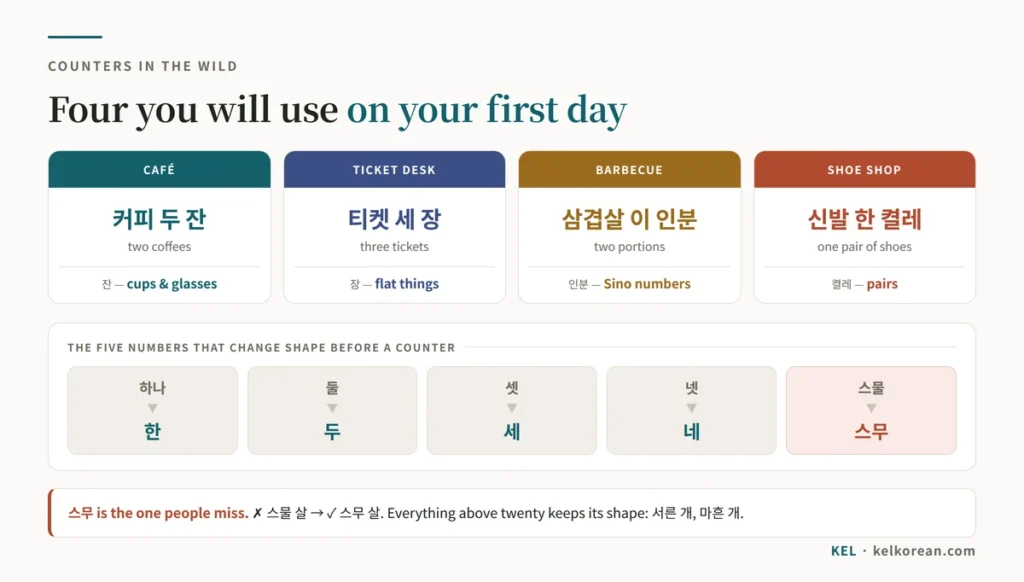
Native numbers change shape in front of a counter. Same four as before, plus one more.
| Standalone | Before a counter |
|---|---|
| 하나 | 한 |
| 둘 | 두 |
| 셋 | 세 |
| 넷 | 네 |
| 스물 | 스무 |
✗ 하나 개 · ✓ 한 개
✗ 스물 살 · ✓ 스무 살
Everything else stays as it is: 다섯 개, 열 개, 서른 개, 마흔 개. Only these five change, and 스물 → 스무 is the one people forget because it arrives later.
The Fifteen That Matter
There are dozens. You need about fifteen.
| Counter | For | Example |
|---|---|---|
| 개 | things, general | 사과 두 개 — two apples |
| 명 | people (plain) | 학생 세 명 — three students |
| 분 | people (polite) | 손님 두 분 — two guests |
| 마리 | animals, fish, insects | 개 한 마리 — one dog |
| 권 | books, notebooks | 책 다섯 권 — five books |
| 장 | flat things — paper, tickets, photos | 티켓 두 장 — two tickets |
| 대 | machines, cars, phones | 자동차 한 대 — one car |
| 병 | bottles | 맥주 세 병 — three beers |
| 잔 | cups, glasses | 커피 두 잔 — two coffees |
| 그릇 | bowls of food | 밥 한 그릇 — one bowl of rice |
| 켤레 | pairs of shoes, socks | 신발 한 켤레 — one pair of shoes |
| 벌 | sets of clothing | 옷 두 벌 — two outfits |
| 살 | age | 스무 살 — twenty years old |
| 번 | times, occurrences | 두 번 — twice |
| 인분 | servings of food | 삼겹살 이 인분 — two portions |
Note the last one. 인분 is Sino-Korean — 일 인분, 이 인분, 삼 인분. Everything above it on this list is native. This catches people at the barbecue table constantly, which is why it comes up in our guide to ordering food in Korean.
개 Is Your Safety Net
If you forget the right counter, use 개.
For inanimate objects it is either correct or close enough that nobody stops the conversation. 볼펜 두 개, 의자 세 개, 가방 한 개 — all fine.
It does not work for people or animals. ✗ 사람 두 개 is not a small slip; it is grammatically wrong and sounds like you are counting objects. Use 명 for people and 마리 for animals, always.
That is the whole survival strategy: learn 개, 명, 마리 properly, and let 개 cover the rest until the others arrive naturally.
Counting People: 명 · 분 · 사람
Three options, and the difference is respect.
| Korean | Register | Use for |
|---|---|---|
| 명 | neutral | friends, classmates, general counting |
| 분 | honorific | customers, elders, teachers, strangers |
| 사람 | plain | interchangeable with 명 in casual speech |
At a restaurant door you will be asked:
몇 분이세요?
myeot bun-iseyo — how many in your party? (polite)
The answer uses 명 about yourself — you do not honour your own group.
네 명이에요. — Four people.
Careful: 분 is also the counter for minutes, but that one is Sino-Korean. 한 분 = one person (polite). 일 분 = one minute. Same syllable, different number system, completely different meaning.
Word Order and Particles
The particle attaches to the counter, not the noun.
사과 세 개를 샀어요. — I bought three apples.
You can also front the noun with its own particle, and both are natural:
사과를 세 개 샀어요.
If particles are still slippery, our guide to Korean particles covers which one goes where.
The reversed form exists too. 세 개의 사과 — “three of apples” — is grammatical but literary. You will see it in writing and almost never hear it. Stick with 사과 세 개.
Asking How Many
몇 is “how many,” and it takes a counter just like a number does.
| Korean | Meaning |
|---|---|
| 몇 개예요? | How many (things)? |
| 몇 명이에요? | How many people? |
| 몇 분이세요? | How many people? (polite) |
| 몇 마리예요? | How many animals? |
| 몇 살이에요? | How old are you? |
| 몇 번 갔어요? | How many times did you go? |
몇 never takes a number in front of it. It replaces the number.
When the Number Stands Alone
Drop the counter and the number goes back to its base form.
이거 하나 주세요. — One of these, please.
Not 이거 한 주세요. Without a counter behind it, 하나 stays 하나. This is the phrase you will use most often while shopping, and it sidesteps the counter problem entirely.
Counting out loud works the same way: 하나, 둘, 셋 — no counters, base forms.
Duration vs Calendar
Two pairs that trip people up, because each has a native and a Sino version.
| Meaning | Native | Sino |
|---|---|---|
| months (duration) | 한 달, 두 달 | 일 개월, 이 개월 |
| age | 스무 살 | 이십 세 |
한 달 is conversational. 일 개월 appears in contracts, visas and medical instructions. 스무 살 is how anyone actually says their age; 이십 세 belongs on forms.
One older pattern worth recognising: for three and four months you will hear 석 달 and 넉 달 rather than 세 달 and 네 달. 셋 and 넷 have archaic forms — 석, 넉 — that survive in a handful of fixed phrases. You do not need to produce them. You do need to not be confused when someone says 석 달.
번 Does Two Jobs
번 counts occurrences with native numbers:
두 번 봤어요. — I saw it twice.
번 also labels numbers — bus routes, building entrances, question numbers — and there it takes Sino:
몇 번 버스예요? — Which bus number?
삼 번 출구 — Exit 3
Same syllable. Twice is 두 번. Number two is 이 번. The number system tells you which one is meant.
5 Mistakes Worth Avoiding
1. Putting the number first. ✗ 세 고양이 · ✓ 고양이 세 마리. The noun leads. This is the one that makes you unintelligible rather than merely wrong.
2. Forgetting the shortened forms. ✗ 하나 개, 둘 병 · ✓ 한 개, 두 병.
3. 스물 살. ✓ 스무 살. Twenty is the fifth shortening and the one nobody warns you about.
4. Using Sino numbers with native counters. ✗ 사과 삼 개 · ✓ 사과 세 개. 개 is native. So are 명, 마리, 권, 잔, 병.
5. Counting elders with 명. ✗ 할머니 두 명 · ✓ 할머니 두 분. Not a grammar error — a politeness error, which lands harder.
Quick Practice
Write these in Korean. Answers below.
- two apples → ?
- three people (plain) → ?
- one dog → ?
- four cups of coffee → ?
- twenty years old → ?
- two tickets → ?
- two portions of samgyeopsal → ?
- How many people? (polite) → ?
Answers:
- 사과 두 개
- 사람 세 명
- 개 한 마리
- 커피 네 잔
- 스무 살 — not 스물 살
- 티켓 두 장
- 삼겹살 이 인분 — Sino, not 두 인분
- 몇 분이세요?
Six or more and the pattern has landed.
Frequently Asked Questions
Do I really have to use a counter every time?
Whenever a number modifies a noun, yes. The exception is a number standing alone — 하나 주세요 — where there is no noun to count.
What happens if I use the wrong counter?
For objects, almost nothing. Say 책 두 개 and you will be understood, if gently corrected. For people and animals it is more noticeable, which is why 명 and 마리 are worth locking in first.
How many counters do Koreans actually use?
Everyday speech runs on about fifteen to twenty. Dictionaries list hundreds, most of them specialised — 척 for ships, 자루 for pencils, 송이 for flowers. Learn them when you meet them.
Why does 분 mean both “person” and “minute”?
They are different words that happen to share a sound and a spelling. The number system separates them: 한 분 (native) is a person, 일 분 (Sino) is a minute.
Is 세 개의 사과 wrong?
No, just literary. It shows up in written Korean and translated text. In speech, 사과 세 개 every time.
Do counters change with plurals?
No. Korean counters never take 들 and never change form for quantity. 개 한 마리 and 개 열 마리 use the same 마리.
Final Thoughts
Counters are the third leg of the number system. You learn the two sets of numbers, you learn where each one goes, and then you discover that neither works on its own — every count needs a unit attached.
The good news is the shape never varies. Noun, number, counter. Once that order is automatic, adding a new counter is just vocabulary.
Start with three: 개 for things, 명 for people, 마리 for animals. Those three cover most of a day. Add 잔, 병 and 장 the first time you order coffee, buy water, or take a ticket, and the rest will arrive on their own schedule.
If you are working through the stages in order, this belongs beside Korean numbers and telling time in Korean in Stage 3 of our complete beginner’s roadmap.
Keep learning with Korean English Lab. Our bilingual Korean–English worksheets and printable workbooks are designed for self-study learners who want structured practice, not just theory.
Leave a Reply