You spent a week learning Hangul. You can read a menu, a shop sign, a subway map.
Then someone sends you this:
ㅇㅇ ㄱㅅ ㅋㅋㅋㅋ
Not a single vowel. Nothing you can pronounce. Nothing in any textbook.
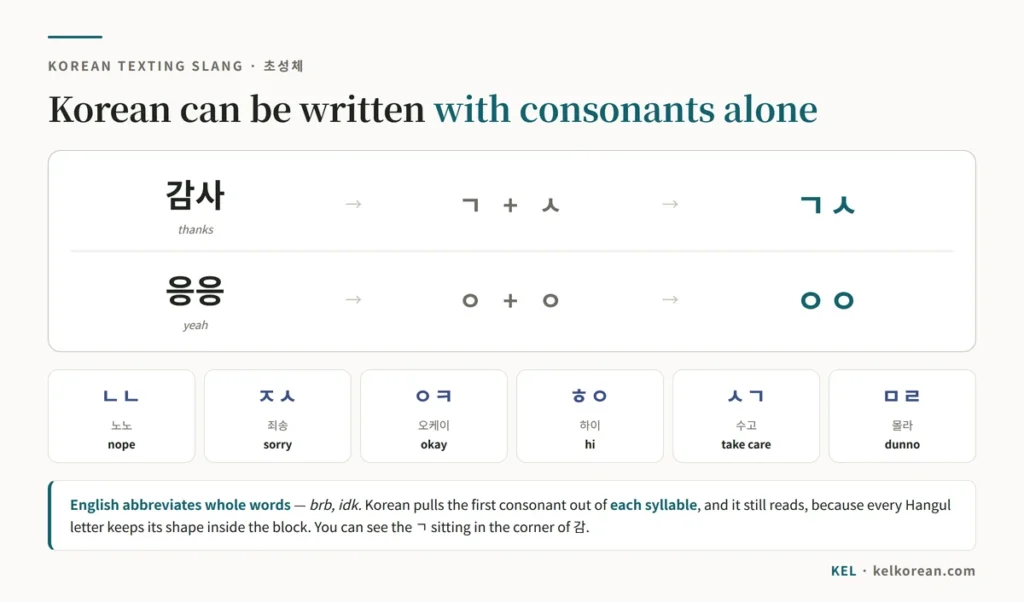
Korean texting slang runs on something no other language can quite do: you can write with consonants alone. Hangul letters are separate, nameable pieces, so a Korean can strip the vowels out of a word and the skeleton still reads. ㄱㅅ is 감사. ㅇㅇ is 응응.
This guide covers the consonant shorthand, the laughing and crying marks, the abbreviations Koreans actually use — and, importantly, when using any of it would be a mistake.
Why Korean Can Do This At All
English has abbreviations too — brb, idk, omw. But those are initials of separate words.
Korean does something different. It takes the initial consonant out of each syllable of a single word.
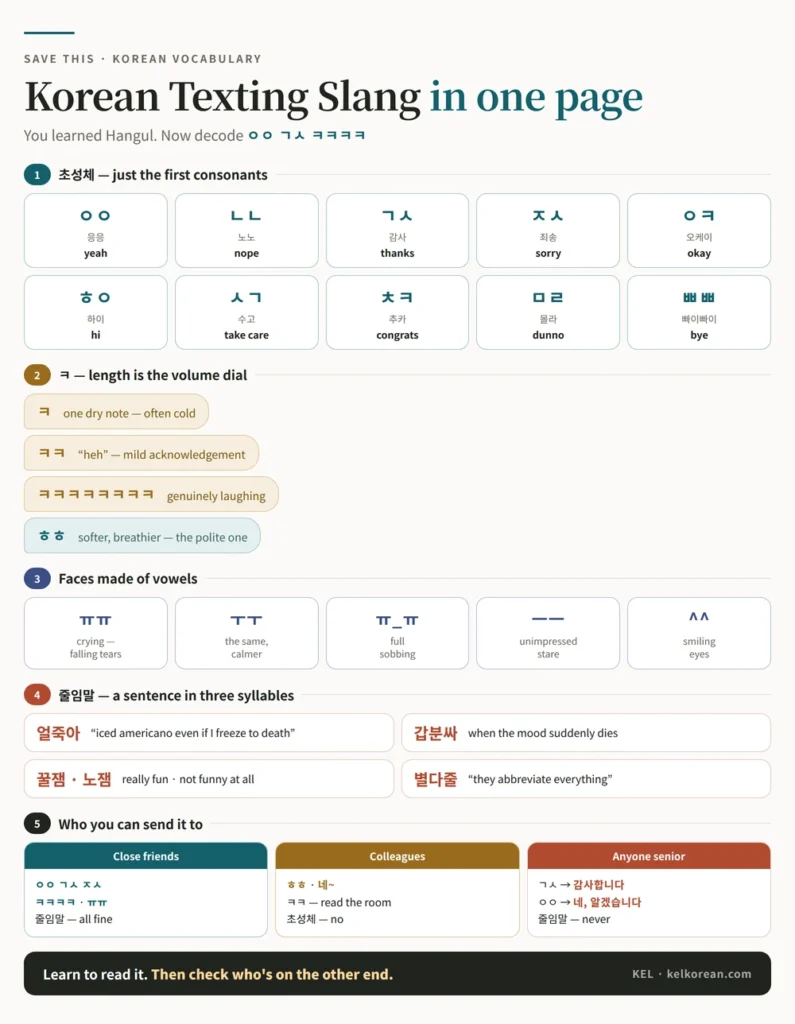
감사 → ㄱ + ㅅ → ㄱㅅ
죄송 → ㅈ + ㅅ → ㅈㅅ
몰라 → ㅁ + ㄹ → ㅁㄹ
This only works because Hangul is built from discrete letters that keep their identity inside a syllable block. You can see ㄱ sitting in the corner of 감. Pull it out and it is still ㄱ.
There is a nice wrinkle in one of them. “Congratulations” is written 축하, so you would expect ㅊㅎ — but the abbreviation everyone uses is ㅊㅋ. That is because 축하 is pronounced 추카: the ㄱ and the ㅎ fuse into a ㅋ. The shorthand follows the sound, not the spelling.
The system has a name — 초성체, “initial-consonant style.” If you can read Hangul, you already have everything you need to decode it. Our guide to learning Hangul in a week covers the alphabet itself, and Korean consonants covers how each one sounds.
ㅋㅋ — Laughter Has a Spelling
This is the single most common thing in Korean chat, and it is not an abbreviation of anything.
ㅋ is a sound. It is the k at the back of your throat — the noise of a short, dry laugh. Koreans write the sound directly.
| Written | What it means |
|---|---|
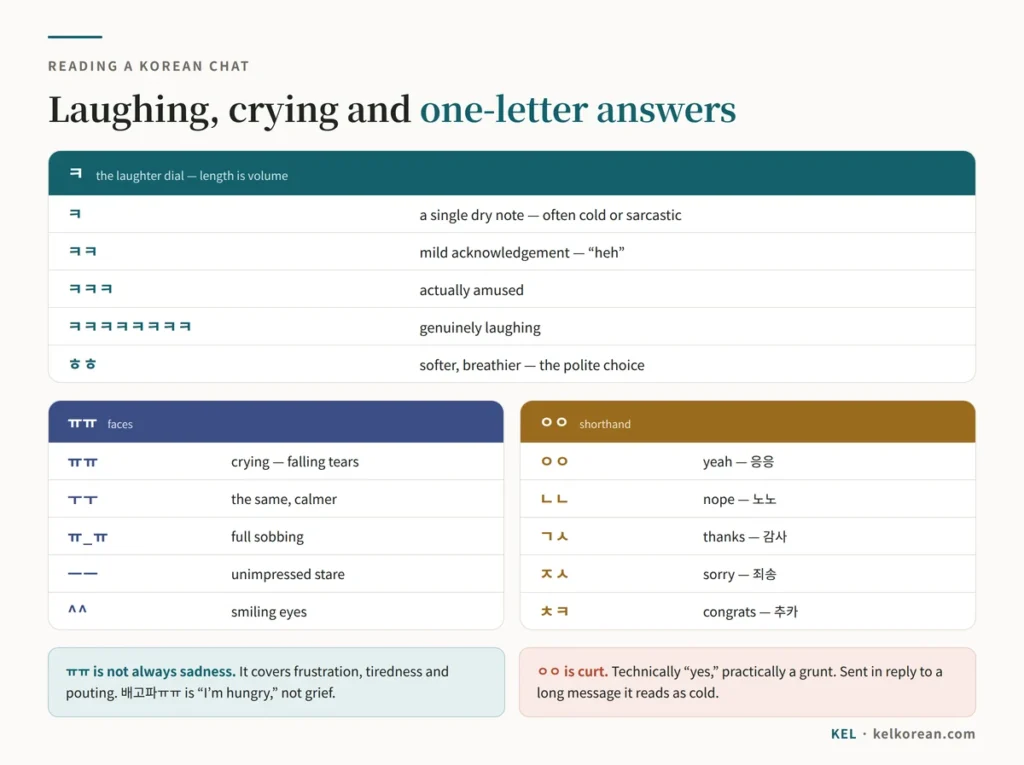
| ㅋ | a single dry note — often cold, or sarcastic |
| ㅋㅋ | mild acknowledgement — “heh” |
| ㅋㅋㅋ | actually amused |
| ㅋㅋㅋㅋㅋㅋㅋㅋ | genuinely laughing |
| ㅋㅋㅋㅋㅋㅋㅋㅋㅋㅋㅋㅋㅋㅋ | crying with laughter |
Length is the volume dial. This matters more than beginners expect. Replying to a friend’s joke with a single ㅋ reads as dismissive — the Korean equivalent of a flat “ha.” Two is polite. Four or more is real.
ㅎㅎ is the softer cousin. ㅎ is the h sound — a breathy laugh rather than a sharp one. It reads as gentler, warmer and slightly more polite, which makes it the safer choice with someone you do not know well.
ㅋㅋ — laughing with a friend
ㅎㅎ — smiling politely at a colleague
You will also see the fully spelled versions: 크크, 큭큭, 낄낄 — all written laughter, all a bit more deliberate than the bare consonants.
ㅠㅠ — Crying Has a Spelling Too
Korean emoticons are built from Hangul letters rather than punctuation, and the logic is visual.
| Written | What it means |
|---|---|
| ㅠㅠ | crying — the vowel looks like falling tears |
| ㅜㅜ | the same, slightly less dramatic |
| ㅠ_ㅠ | a full sobbing face |
| ㅡㅡ | a flat, unimpressed stare |
| ^^ | smiling eyes |
| ㅇㅅㅇ | a blank, wide-eyed face |
ㅠㅠ is not always sadness. It covers frustration, exhaustion, mild disappointment and apologetic whining. 배고파ㅠㅠ is “I’m hungry” with a pout, not grief.
ㅡㅡ is worth recognising because it looks harmless and is not. Two flat lines mean the sender is unimpressed with you.
The Consonant Shorthand You Will Actually Meet
| Short | Full form | Meaning |
|---|---|---|
| ㅇㅇ | 응응 | yeah, yes |
| ㄴㄴ | 노노 | no, nope |
| ㄱㅅ | 감사 | thanks |
| ㅈㅅ | 죄송 | sorry |
| ㅇㅋ | 오케이 | okay |
| ㅎㅇ | 하이 | hi |
| ㅃㅃ | 빠이빠이 | bye bye |
| ㅅㄱ | 수고 | good work, take care |
| ㅊㅋ | 축하 | congratulations |
| ㅁㄹ | 몰라 | dunno |
| ㅂㅂ | 바이바이 | bye |
ㅇㅇ deserves a warning. It technically means yes, but it is extremely curt — closer to a grunt than a word. Sent to a friend it is normal. Sent in reply to someone who wrote you a long message, it reads as cold.
Notice that several of these are borrowed English underneath: ㅇㅋ is 오케이, ㅎㅇ is 하이, ㅃㅃ is 빠이빠이. The borrowed vocabulary in Korean is covered in Konglish.
줄임말 — The Abbreviations
Korean also shortens whole phrases, and these change fast. These are the ones stable enough to be worth learning.
| Korean | From | Meaning |
|---|---|---|
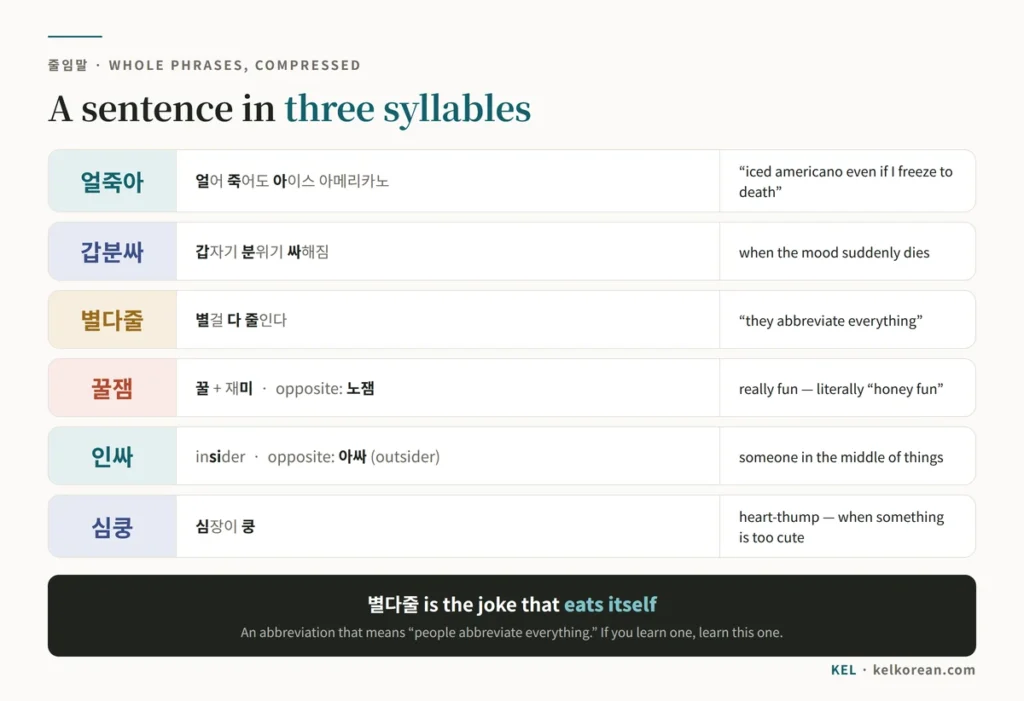
| 인싸 | insider | someone socially in the middle of things |
| 아싸 | outsider | someone who keeps to themselves |
| 꿀잼 | 꿀 + 재미 | really fun — “honey fun” |
| 노잼 | no + 재미 | not funny, boring |
| 최애 | 最愛 | your absolute favourite — bias, favourite member |
| 심쿵 | 심장 + 쿵 | heart-thump — when something is too cute |
| 갑분싸 | 갑자기 분위기 싸해짐 | when the mood suddenly dies |
| 얼죽아 | 얼어 죽어도 아이스 아메리카노 | “iced americano even if I freeze to death” |
| 별다줄 | 별걸 다 줄인다 | “they abbreviate everything” |
얼죽아 is the one Koreans find funniest about themselves. It describes the national habit of drinking iced americano through the winter, and it is a complete sentence compressed to three syllables.
별다줄 is the joke that eats itself — an abbreviation meaning “people abbreviate everything.” If you learn one, learn this one.
One to recognise but not use: 존맛 and its romanized form JMT mean “incredibly delicious,” but the first syllable comes from a vulgar intensifier. Koreans your own age will not blink; anyone older will. Understand it, do not type it.
KakaoTalk Specifics
Almost all Korean messaging happens on KakaoTalk, and it has its own vocabulary.
The number beside your message is how many people in the chat have not read it yet. When it disappears, everyone has read it. There is no way to turn this off — which produced two words:
- 읽씹 — read and ignored. From 읽다 (read) plus 씹다 (chew, here “blow off”). They saw it and did not reply.
- 안읽씹 — not-read and ignored. They have not even opened it.
The wave — ~ softens a message. 네~ is warmer than a bare 네, which can land flat. Koreans use it heavily, and adding one is an easy way to sound less abrupt.
Reply speed carries meaning. A fast reply signals interest; a slow one signals the opposite, and both sides know it.
When Not to Use Any of This
This matters more than the vocabulary.
Everything on this page is casual written 반말 territory. The rule is simple and strict:
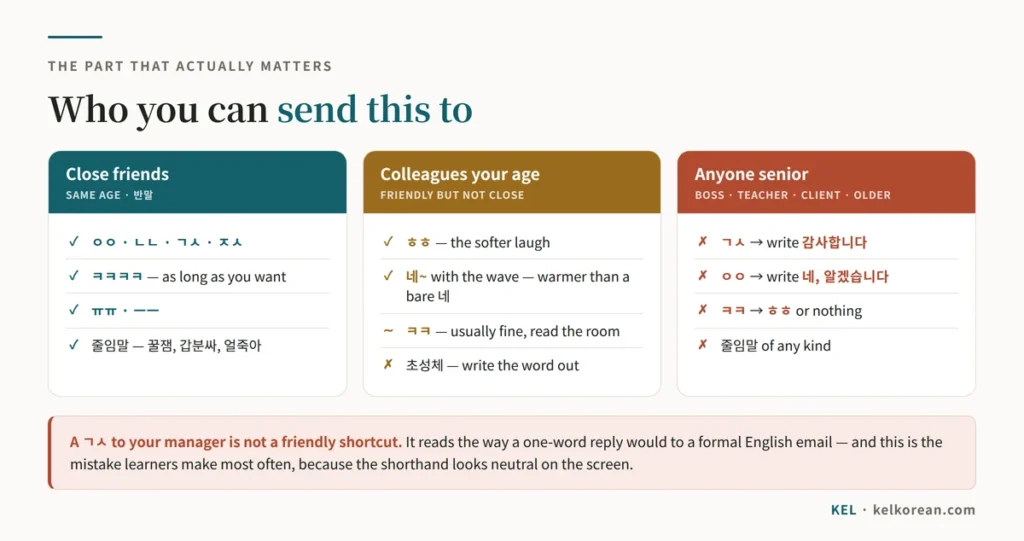
Never send 초성체 to someone above you. Not to a boss, not to a professor, not to an older person, not to a client.
A ㄱㅅ to your manager is not a friendly shortcut — it reads as disrespectful, the same way a one-word text would in a formal English email. Write 감사합니다.
ㅋㅋ is a softer case. Among colleagues of similar age it is normal; upward, use ㅎㅎ or nothing.
Why any of this matters is the same reason Korean has speech levels at all, which is covered in Korean honorifics explained simply.
5 Mistakes Worth Avoiding
1. Replying with a single ㅋ. It reads as cold. Use two at minimum.
2. Sending ㅇㅇ to a long message. Technically “yes,” practically a shrug.
3. Using 초성체 with anyone senior. The most common and most damaging mistake here.
4. Typing JMT or 존맛 in mixed company. The origin is vulgar even though the word feels harmless.
5. Chasing every new abbreviation. Korean slang turns over fast, and half of what you learn this year will sound dated next year. The consonant system in this guide does not change — the trend words do.
Quick Practice
Decode each message.
- ㅇㅇ ㄱㅅㄱㅅ ㅋㅋ
- ㅈㅅㅠㅠ 늦었어
- 오늘 진짜 꿀잼이었어 ㅋㅋㅋㅋㅋ
- ㅁㄹ ㅡㅡ
- 얼죽아라서 겨울에도 아아
Answers
- “Yeah, thanks thanks, haha.”
- “Sorry, I’m late” with a pout. ㅈㅅ is 죄송, ㅠㅠ is the crying face.
- “Today was so much fun, hahaha.” — 꿀잼, and a long ㅋ means it is sincere.
- “Dunno.” plus an unimpressed stare. Curt on both counts.
- “I’m an 얼죽아, so iced americano even in winter.” — 아아 is 아이스 아메리카노, shortened again.
Frequently Asked Questions
What does ㅋㅋ mean in Korean?
It is laughter written as sound. ㅋ is the k noise of a short laugh, so ㅋㅋ is roughly “haha.” The number of ㅋ works as a volume dial — one is cold, two is polite, six or more is real laughing.
What is the difference between ㅋㅋ and ㅎㅎ?
ㅋㅋ is a sharper, more amused laugh; ㅎㅎ is a softer, breathier one that reads closer to a smile. ㅎㅎ is the politer choice with someone you do not know well.
What does ㅇㅇ mean?
Yes — it is 응응 with the vowels removed. It is very curt, so it belongs between close friends rather than in a reply to anyone who wrote you a real message.
What does ㅠㅠ mean?
Crying. The vowel ㅠ looks like falling tears. In practice it covers frustration, tiredness and pouting as much as actual sadness.
Why do Koreans text with only consonants?
Because Hangul letters stay separable inside a syllable, so the initial consonants alone are still readable — 감사 reduces cleanly to ㄱㅅ. It is faster to type, and no other writing system in common use allows it in quite the same way.
Is it rude to use texting slang in Korean?
It depends entirely on who you are writing to. Between friends it is normal. To a boss, a teacher, a client or anyone noticeably older, consonant shorthand reads as disrespectful — write the full polite form instead.
Final Thoughts
There are two layers here, and they age very differently.
The consonant system is permanent. ㅋㅋ, ㅠㅠ, ㅇㅇ, ㄱㅅ, ㅈㅅ have been stable for two decades and will still be there in another two. Learn these properly.
The trend words are not. 갑분싸 and 얼죽아 are current now; some of them will sound dated in a few years, the way 인싸 already sounds slightly late to younger Koreans. Recognise them, enjoy them, and do not build your vocabulary on them.
And keep the register straight, which is the same lesson that runs through spoken Korean too — see K-drama Korean for how the casual forms sound out loud, and K-pop Korean for how they get written into lyrics.
Learn to read the chat. Then think about who is on the other end before you send one back.
Leave a Reply