
You have watched forty episodes. You know 헐 and 대박 by sound. You could pick 어떡해 out of any scene.
You also cannot find a single one of them in your textbook.
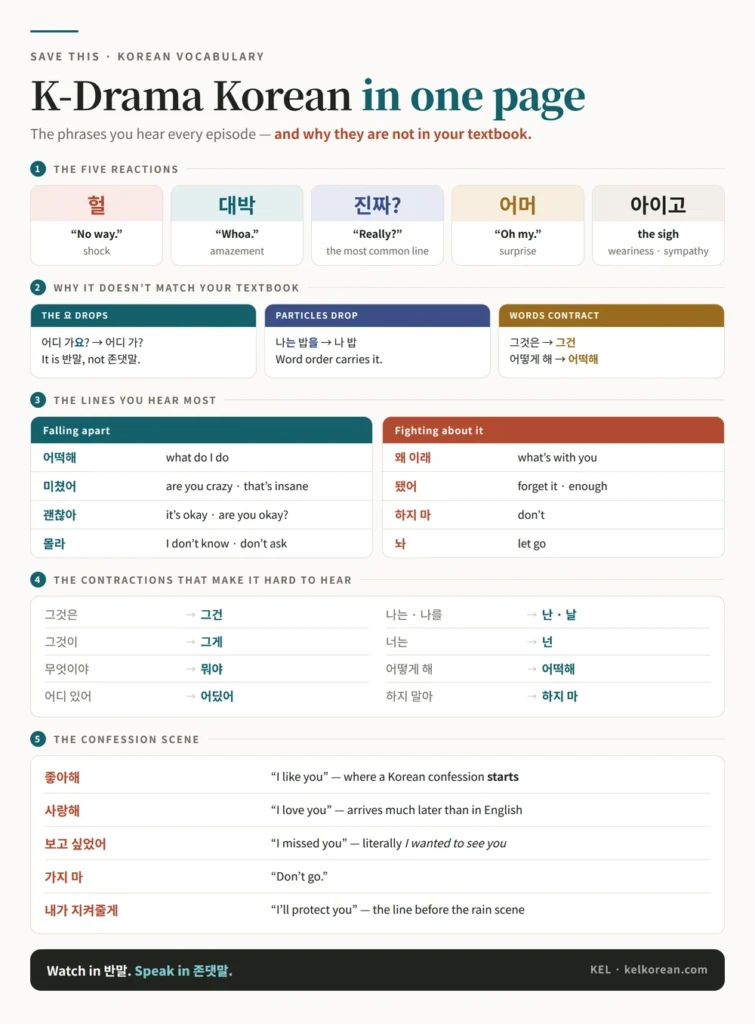
That gap is the whole problem with K-drama Korean. Textbooks teach 존댓말 — the polite form you use with strangers, shopkeepers and your boss. Dramas run almost entirely on 반말, the casual form, because dramas are about people who already know each other. Add contractions, dropped particles and a cast that talks over one another, and the language on screen stops matching the language on the page.
This guide covers the phrases that actually recur — the reactions, the arguments, the confessions — and the shortcuts that make them hard to catch.
Why Drama Korean Doesn’t Match Your Textbook
Three things are happening at once.
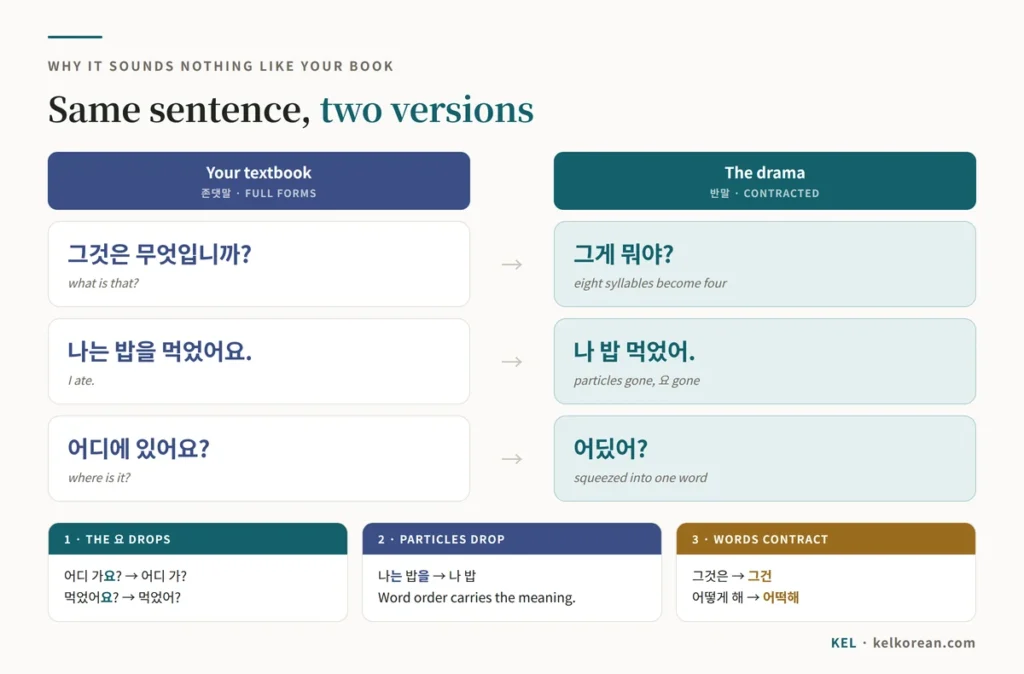
1. It is 반말, not 존댓말. The polite -요 ending is simply gone. 어디 가요? becomes 어디 가? and 먹었어요? becomes 먹었어?. Once you know that -요 is being chopped off the end, a surprising amount becomes recognisable.
2. Particles get dropped. Textbook Korean marks subjects and objects with 은/는 and 을/를. Spoken Korean drops them constantly. 나는 밥을 먹었어 becomes 나 밥 먹었어. Nothing is lost — Korean word order carries the meaning — but the sentence looks stripped down compared to what you studied. Our guide to Korean particles explains what is being left out.
3. Everything contracts. This is the one that catches people. 그것은 becomes 그건. 어디 있어 becomes 어딨어. 어떻게 해 becomes 어떡해. You know the words; you just have not heard them squeezed together before.
Textbook: 그것은 무엇입니까?
Drama: 그게 뭐야?
Same question. Both correct. One of them is what a person actually says.
The Reaction Sounds
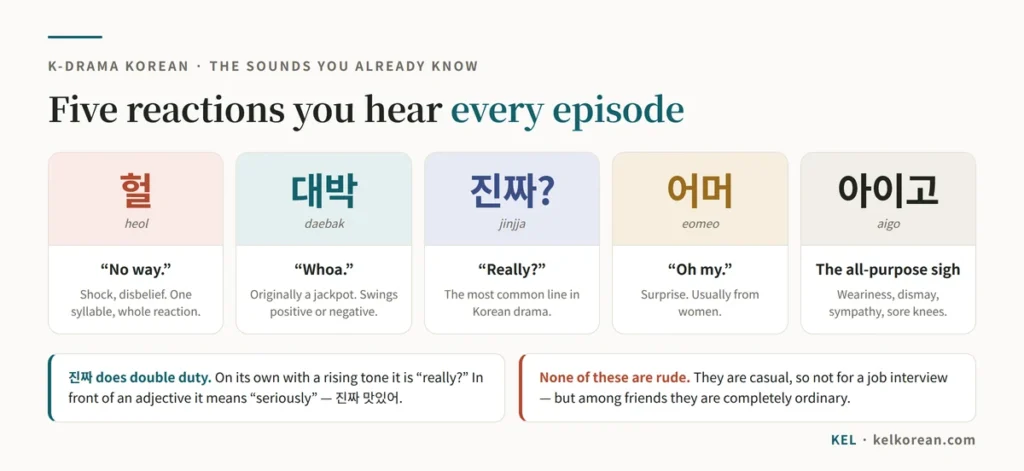
These are the ones you hear ten times an episode. None of them mean much on their own — they are pure reaction.
| Korean | Romanization | What it signals |
|---|---|---|
| 헐 | heol | Shock, disbelief. “No way.” |
| 대박 | daebak | Amazement. “Whoa.” Also just “amazing.” |
| 진짜? | jinjja | “Really?” The single most common line in Korean drama. |
| 정말? | jeongmal | Same as 진짜, slightly more formal in feel. |
| 어머 | eomeo | “Oh my.” Surprise, usually from women. |
| 아이고 | aigo | Weariness, dismay, sympathy. The all-purpose sigh. |
| 어쩐지 | eojjeonji | “No wonder.” Said when something suddenly makes sense. |
| 그러게 | geureoge | “Right?” Agreement, often with a shrug. |
대박 deserves a note. It originally meant a jackpot — a big hit — and it still does when talking about a film or a business. As an exclamation it just means whoa, and it can swing positive or negative depending on the face that comes with it. A drama character who has just been dumped can say 대박 too.
아이고 is worth learning properly because it is genuinely useful. It covers dropping your keys, hearing bad news, standing up with sore knees and comforting someone who is crying. Older characters use it constantly.
진짜 does double duty. On its own with a rising tone it is “really?” Placed in front of an adjective it means “seriously” — 진짜 맛있어, “this is seriously good.”
The Emotional Ones
| Korean | Romanization | Meaning |
|---|---|---|
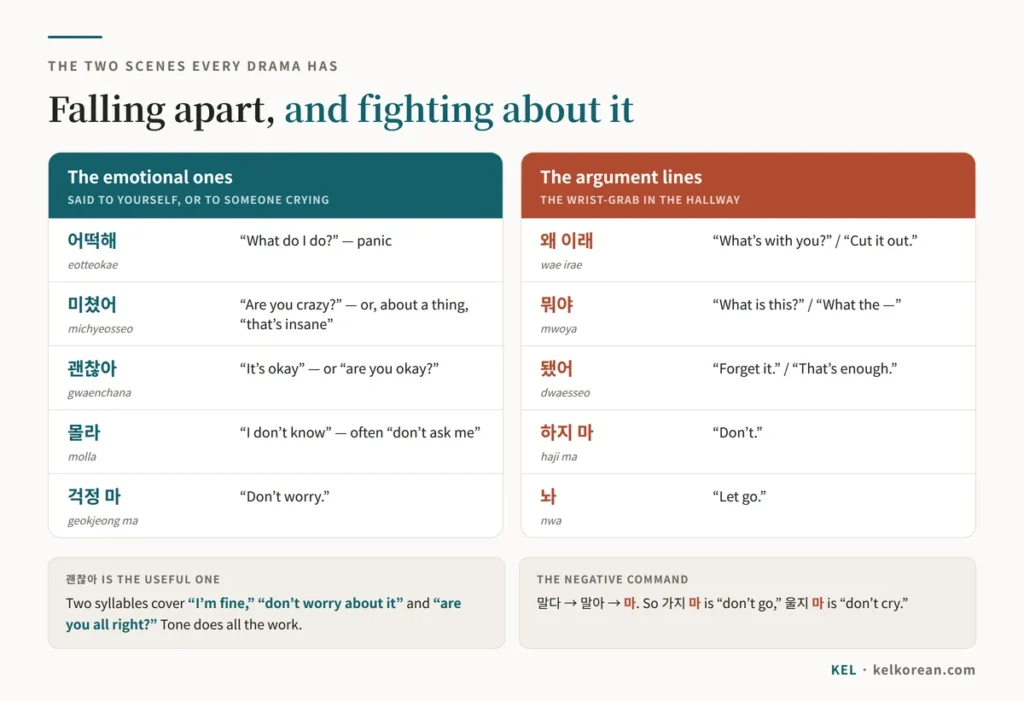
| 어떡해 | eotteokae | “What do I do?” Panic, distress. |
| 미쳤어 | michyeosseo | “Crazy” — see below. |
| 괜찮아 | gwaenchana | “It’s okay” — or, with a rising tone, “are you okay?” |
| 몰라 | molla | “I don’t know” — and often “I don’t want to talk about it.” |
| 짜증나 | jjajeungna | “That’s so annoying.” |
| 걱정 마 | geokjeong ma | “Don’t worry.” |
어떡해 is a contraction of 어떻게 해 — literally “how do I do.” It is the sound of a character realising they are in trouble. Note the spelling: as an exclamation it is 어떡해, not 어떻해.
미쳤어 splits by target. Aimed at a person — 너 미쳤어? — it means “have you lost your mind?” Aimed at a thing, it is praise: 이거 진짜 미쳤다 means “this is insane” in the good sense. Younger characters use the second one heavily.
괜찮아 is the most useful word in this section. Same two syllables cover “I’m fine,” “it’s fine, don’t worry about it,” and “are you all right?” Tone does all the work.
몰라 is technically just “I don’t know,” but dramas use it as a mood. A character who says 몰라, 몰라! and walks off is not reporting a gap in their knowledge.
The Argument Lines
Every drama has the scene where someone grabs a wrist in a hallway. This is the vocabulary of that scene.
| Korean | Romanization | Meaning |
|---|---|---|
| 왜 이래 | wae irae | “What’s with you?” / “Cut it out.” |
| 뭐야 | mwoya | “What is this?” / “What the —” |
| 됐어 | dwaesseo | “Forget it.” / “That’s enough.” |
| 하지 마 | haji ma | “Don’t.” |
| 놔 | nwa | “Let go.” |
| 저리 가 | jeori ga | “Go away.” |
| 아니 | ani | “No” — but see below. |
됐어 is a strange one to translate. It comes from 되다, “to become” or “to work out,” and the past tense means roughly “it’s done.” In an argument it means stop talking, I’m finished with this. Said gently to someone offering help, it means “no thanks, I’m fine.”
아니 literally means no, but in drama dialogue it very often opens a sentence as a discourse marker — closer to “hold on” or “wait, no —” than an actual denial. 아니, 그게 아니라… is “no, that’s not what I meant.”
하지 마 shows a small grammar point worth knowing: the negative command uses 말다, and 말아 contracts to 마. So 가지 마 is “don’t go,” 울지 마 is “don’t cry,” 걱정하지 마 is “don’t worry.”
The Confession Scene
| Korean | Romanization | Meaning |
|---|---|---|
| 좋아해 | joahae | “I like you.” |
| 사랑해 | saranghae | “I love you.” |
| 보고 싶었어 | bogo sipeosseo | “I missed you.” |
| 내가 지켜줄게 | naega jikyeojulge | “I’ll protect you.” |
| 가지 마 | gaji ma | “Don’t go.” |
좋아해 comes first. Korean confessions almost always start here, not at 사랑해. 좋아해 means “I like you” in the romantic sense — it is a declaration, not a mild preference. 사랑해 arrives much later in the relationship, and a drama that uses it in episode two is telling you something about that character.
보고 싶어 is worth unpacking. It is built from 보다, “to see,” plus -고 싶다, “want to.” So “I miss you” in Korean is literally I want to see you. The past form 보고 싶었어 — “I missed you” — is what you get at the airport arrivals gate.
Who Calls Whom What
In the first two minutes of any drama you can work out the entire social map from what people call each other.
- 오빠 · 언니 · 형 · 누나 — an older person, and which word depends on the speaker’s gender rather than the listener’s. These are not only for actual siblings. When a woman calls her boyfriend 오빠, that is the same word.
- 선배 — someone senior at school or work. 후배 is the junior.
- -씨 — attached to a name, a polite neutral marker between adults who are not close. 민수 씨.
- 야 — “hey.” Fine between close friends of the same age. Aimed at anyone older, it is an insult, and dramas use it that way deliberately.
- 너 — “you.” Casual. Korean avoids second-person pronouns with anyone senior; using 너 upward is a small act of aggression.
The full map of these terms is in Korean family terms, and the reason the whole system exists is covered in Korean honorifics explained simply.
There is one more piece. The moment two characters establish who is older, the speech level is settled — which is why Korean conversations open with the age question. That is unpacked in Korean age.
The Contractions That Make It Hard to Hear
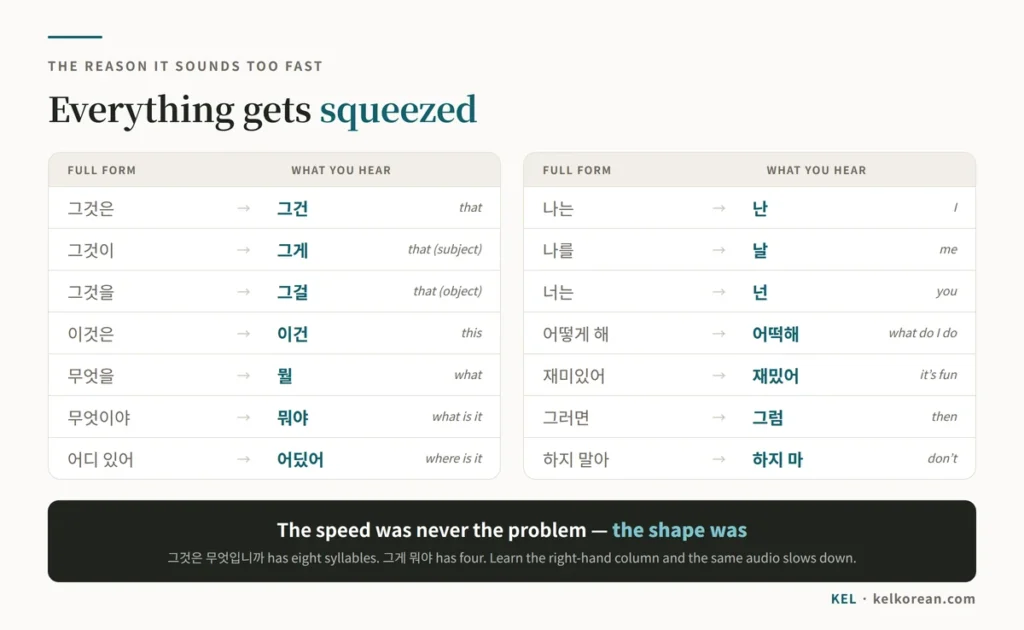
This table is the single most useful thing here. Every one of these appears constantly, and each is just a squeezed version of something you have already studied.
| Full form | Contracted | Meaning |
|---|---|---|
| 그것은 | 그건 | that (topic) |
| 그것이 | 그게 | that (subject) |
| 그것을 | 그걸 | that (object) |
| 이것은 | 이건 | this |
| 무엇을 | 뭘 | what (object) |
| 무엇이야 | 뭐야 | what is it |
| 어디 있어 | 어딨어 | where is it |
| 나는 | 난 | I (topic) |
| 나를 | 날 | me |
| 너는 | 넌 | you (topic) |
| 어떻게 해 | 어떡해 | what do I do |
| 재미있어 | 재밌어 | it’s fun |
| 그러면 | 그럼 | then / in that case |
| 하지 말아 | 하지 마 | don’t |
Read that column of contracted forms out loud once. Most learners find that several drama lines they had written off as “too fast” become legible immediately — the speed was never the problem.
5 Mistakes Worth Avoiding
1. Using drama lines on real people. Everything above is 반말. Said to a stranger, a shopkeeper or anyone older, it lands somewhere between rude and bizarre. Watch dramas to build your ear; use the polite forms to actually speak.
2. Calling someone 오빠 too early. It signals closeness. Aimed at a man you have just met, it reads as flirtation whether or not you meant it.
3. Saying 야 to anyone older. Even by one year. Dramas use it precisely because it is a shot fired.
4. Assuming 사랑해 is the everyday “I love you.” It carries far more weight than the English phrase. Korean families and friends use it much more sparingly.
5. Writing 어떻해. The exclamation is 어떡해. The full phrase 어떻게 해 is also correct; 어떻해 is not.
Quick Practice
What is each line saying?
- 그게 뭐야?
- 어딨어?
- 나 몰라.
- 하지 마, 제발.
- 진짜? 대박.
Answers
- “What is that?” — 그것이 contracted to 그게.
- “Where is it?” — 어디 있어 contracted.
- “I don’t know” / “I don’t want to deal with it.”
- “Don’t. Please.”
- “Really? Whoa.”
Frequently Asked Questions
Can I learn Korean from K-dramas?
For listening and vocabulary, yes — they are excellent, because you get the same high-frequency phrases repeated across hundreds of hours. For speaking, no, not on their own. Dramas are almost entirely 반말, and the polite forms you need with real strangers barely appear.
Why does drama Korean sound so much faster than my textbook audio?
Mostly because of contractions and dropped particles rather than raw speed. 그것은 무엇입니까 has eight syllables; 그게 뭐야 has four. Learn the contracted forms and the same audio suddenly slows down.
Is 대박 rude?
No. It is casual, so you would not use it in a job interview, but it carries no offence. Among friends it is completely ordinary.
What is the difference between 좋아해 and 사랑해?
좋아해 is “I like you” and is where a Korean confession normally begins. 사랑해 is “I love you” and arrives considerably later. Reversing the order is a real mistake, not a stylistic choice.
Why do characters keep saying 아니 when they are not disagreeing?
Because 아니 also works as a sentence opener meaning something like “hold on” or “wait.” Context tells you which one is meant.
Should I turn the subtitles off?
Not at first. A better method is to watch an episode with subtitles, then rewatch two or three short scenes without them. You already know what happens, so your ear can focus on the sound.
Final Thoughts
Drama Korean is not a separate language. It is the same Korean you have been studying with the polite ending removed, the particles dropped and the words squeezed together — three changes, applied everywhere.
Learn the reaction sounds first, because they cost nothing and appear immediately. Then work through the contraction table, which does more for your listening than any amount of new vocabulary. The confession lines you will absorb whether you try to or not.
And keep the two registers apart in your head. What you hear on screen is how Koreans talk to people they are close to. Getting there with an actual Korean person takes the polite forms first — the drama version is the reward, not the route.
If you want the vocabulary that comes free with the alphabet, Konglish covers the several hundred Korean words that are borrowed English — including 파이팅, which you have already heard a hundred times.
Leave a Reply