Pick three Koreans at random. There is a decent chance that one of them is a Kim.
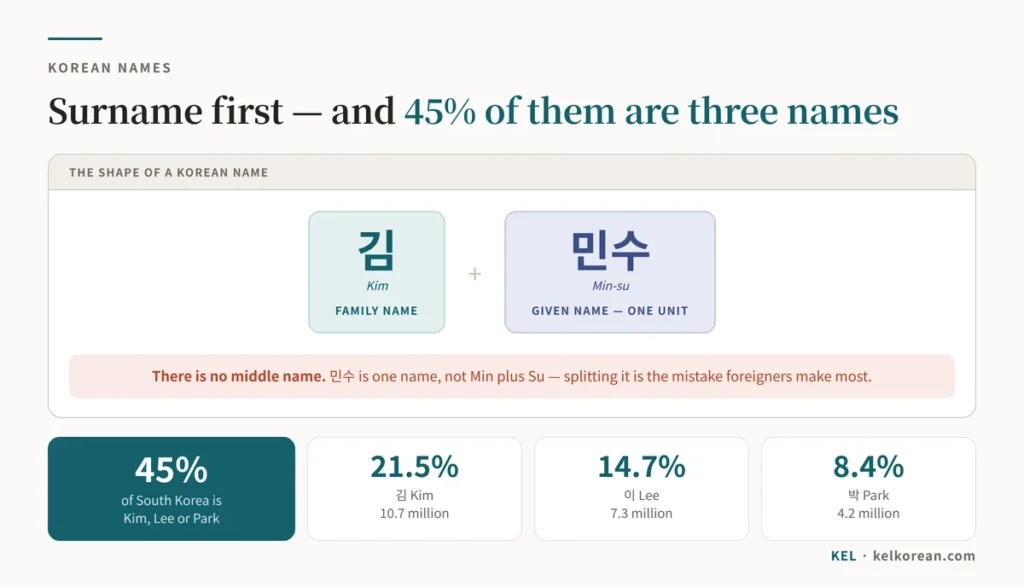
That is not a joke about a small country with a short list of names. In the 2015 census, Kim, Lee and Park together accounted for about 45% of the entire South Korean population — 10.7 million Kims, 7.3 million Lees, 4.2 million Parks.
Korean names run on a system that is genuinely different from the Western one, and once you see the shape of it, a lot of confusing things stop being confusing: why your Korean friend never calls you by your first name, why two Kims will tell you they are not related, and why the same surname is spelled Lee, Yi, Rhee and I depending on whose passport you are looking at.
The Shape of a Korean Name
Surname first. Always.
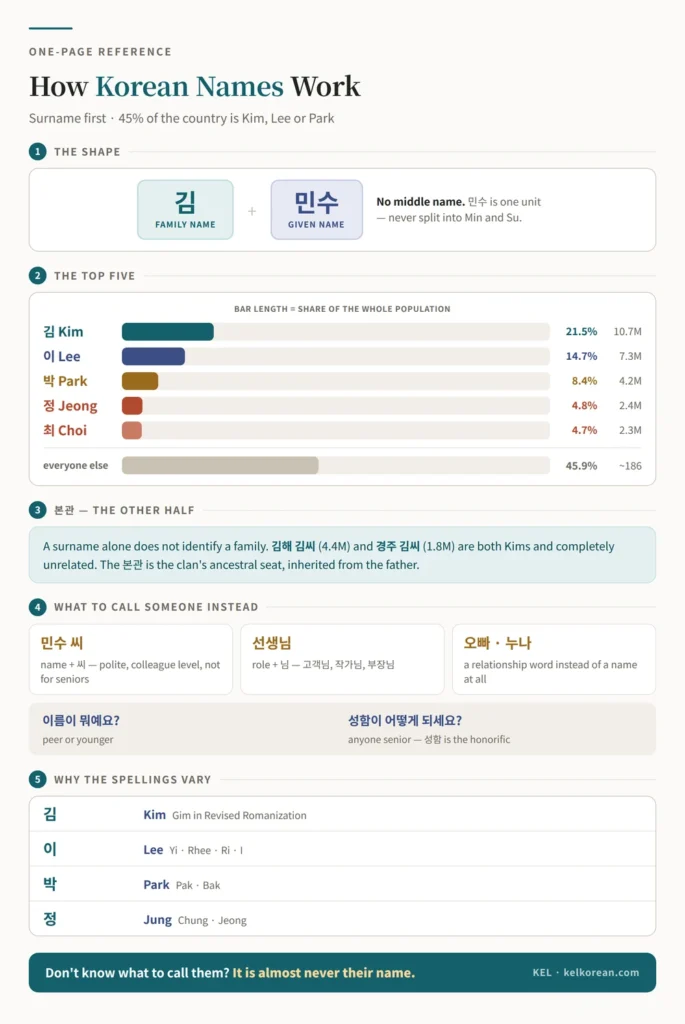
김민수 is Mr Kim, not Mr Minsu. The family name leads, and the given name follows — the opposite of English order, and the same as Chinese and Japanese.
The standard shape is one syllable of surname plus two syllables of given name. 김민수, 이서연, 박지훈. That three-syllable rhythm is so dominant that a name breaking it sounds notable to Korean ears.
The exceptions are worth knowing:
- A handful of surnames have two syllables: 남궁, 황보, 제갈, 선우, 독고. So 남궁민수 is Namgung Min-su, not Nam Gung-min-su.
- Given names are occasionally one syllable — 이현, 김솔 — or three, though three is rare.
- There is no middle name. The two syllables of a given name are one unit, not a first name plus a middle name, and splitting them is a mistake foreigners make constantly.
When Koreans write their names in English they often flip the order to match the local convention, which is why the same person can appear as Kim Min-su on one document and Min-su Kim on another. Both are correct in their own context.
Why There Are So Many Kims
This is the part with actual history in it.
For most of the Joseon period (1392–1910), surnames were a privilege of the 양반 aristocracy. Ordinary people simply did not have one.
Then the state ran out of money. After the Imjin War and the Qing invasions, the government began selling status — official positions, and with them yangban rank, which carried tax exemption and freedom from military service. Families who bought their way up needed a lineage to match, so fabricated genealogies became a small industry, and the sensible thing to fabricate was a connection to the most prestigious clans available.
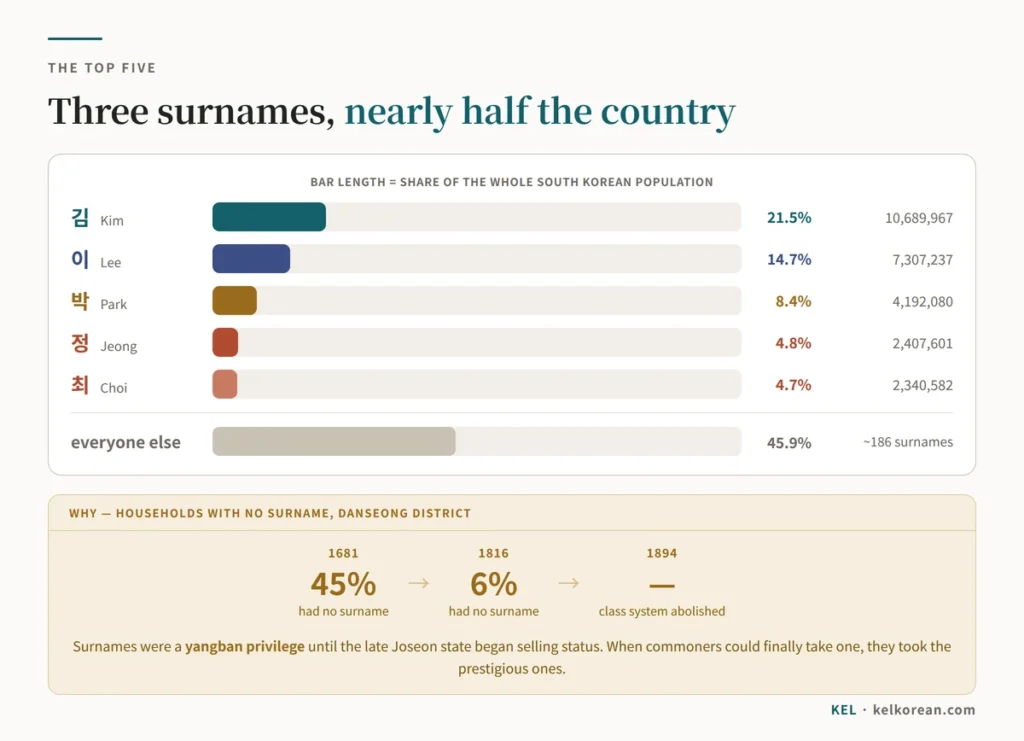
The scale of the shift is startling. In one district, Danseong, households with no surname fell from 45% in 1681 to 6% in 1816. By the time the class system was formally abolished in 1894, nearly everyone had a surname — and a very large number of them had chosen the same handful.
| Surname | Population (2015) | Share |
|---|---|---|
| 김 Kim | 10,689,967 | 21.5% |
| 이 Lee | 7,307,237 | 14.7% |
| 박 Park | 4,192,080 | 8.4% |
| 정 Jeong | 2,407,601 | 4.8% |
| 최 Choi | 2,340,582 | 4.7% |
Koreans usually recite the list as 김이박최정, though in the 2015 count 정 edges 최 by a hair. Below the top five the numbers fall away quickly: there are only about 191 surnames in everyday use, written with 514 distinct hanja.
본관 — The Part Nobody Tells Foreigners
Here is the piece that makes the Kim statistic much less strange.
A Korean surname is only half of a family identity. The other half is the 본관 (bon-gwan) — the clan’s ancestral seat, a place name that says which lineage you belong to.
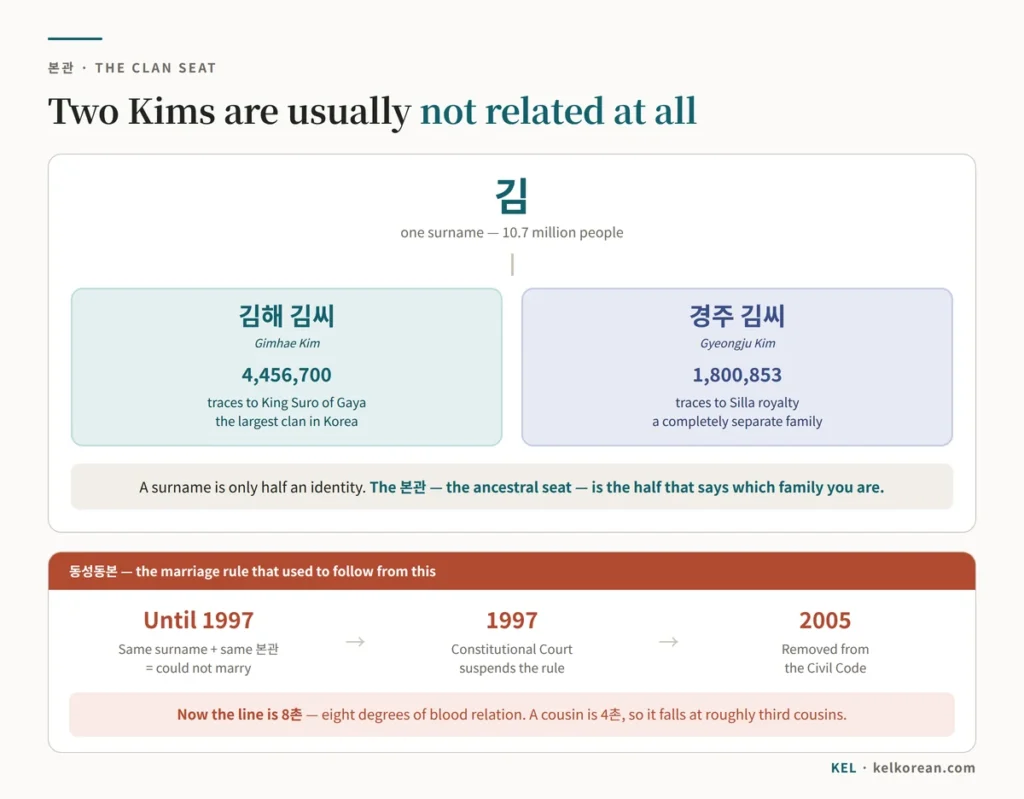
So a Kim is never just a Kim. They are a 김해 김씨 (Gimhae Kim) or a 경주 김씨 (Gyeongju Kim), and those are different families with different founding ancestors.
| Clan | Members (2015) |
|---|---|
| 김해 김씨 | 4,456,700 |
| 경주 김씨 | 1,800,853 |
김해 김씨 is the largest clan in the country, tracing itself to King Suro of the Gaya confederacy. 경주 김씨 traces to Silla royalty. Two Kims from different 본관 are not relatives in any sense — which is exactly what a Korean means when they wave off the coincidence of a shared surname.
And this used to determine who you could marry. Under the old 동성동본 rule, two people with the same surname and the same 본관 were barred from marrying, however distant the actual relationship. The Constitutional Court suspended the rule in 1997, and it was removed from the Civil Code in 2005.
What replaced it is narrower and, if you have read our Korean family terms guide, immediately readable: marriage is prohibited within 8촌 — eight degrees of blood relation. A cousin is 4촌, so the line now falls at roughly third cousins.
돌림자 — The Syllable Siblings Share
Look at a set of Korean siblings and you will often see a repeated syllable: 민준, 민서, 민호.
That shared syllable is the 돌림자 (also called 항렬자) — a generation marker. Traditionally a clan’s genealogy assigned one syllable to each generation, so every cousin born in the same generation carried it, and you could place a stranger on the family tree from their name alone.
It is fading. Modern parents mostly choose names for sound and meaning, and many families have dropped the practice entirely — but it is still common enough that a repeated syllable across siblings is a reasonable guess rather than a coincidence.
Why Nobody Uses Your First Name
This is the part that catches learners hardest, and it follows directly from how Korean honorifics work.
Bare given names are for close peers and people younger than you. For everyone else, Korean reaches for a title:
- -씨 after the full name or given name — 민수 씨. Polite, roughly colleague-level, and not for anyone clearly senior.
- -님 after a role — 선생님, 고객님, 작가님.
- A relationship word instead of a name entirely — 오빠, 형, 누나, 언니, 삼촌, 이모.
That last one is the big one. A Korean who is close to an older person will call them 오빠 or 누나 for thirty years and never once use their name. As covered in banmal, you can be on the most casual possible terms with someone and still not use the name on their ID card.
Asking for a name has two levels too:
이름이 뭐예요? — What’s your name? (peer or younger)
성함이 어떻게 되세요? — May I ask your name? (anyone senior)
성함 is the honorific word for “name,” and using it at the right moment makes a very good impression. More of these situational choices are in Korean greetings and self-introduction.
Why Lee Is Spelled Five Ways
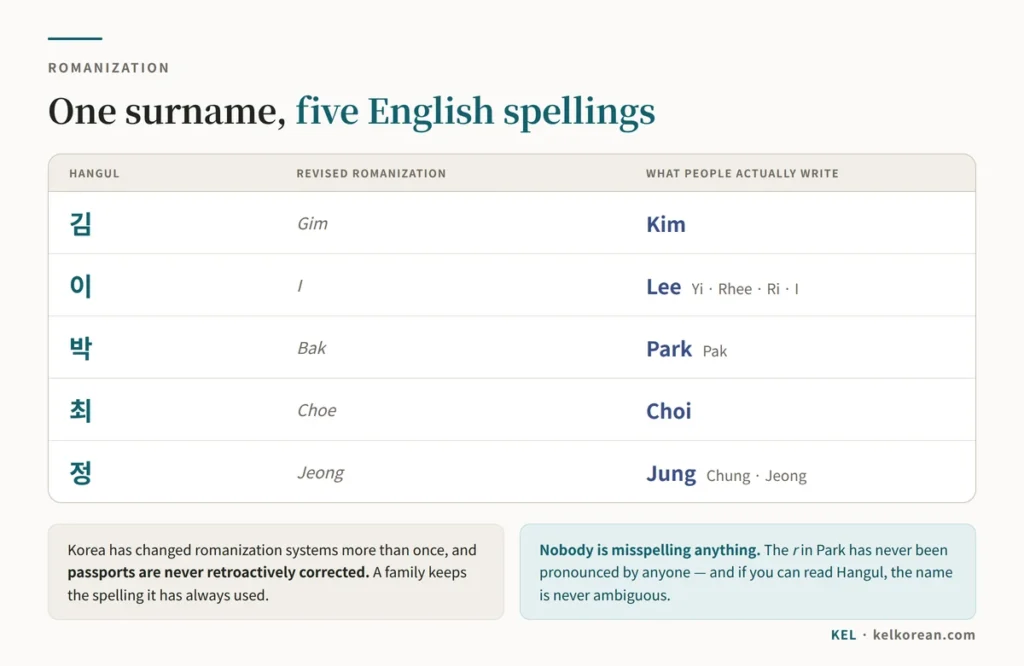
The surname 이 appears in English as Lee, Yi, Rhee, Ri and I. All the same syllable.
The reason is that Korea has changed romanization systems more than once, and passports do not get retroactively corrected. The Revised Romanization adopted in 2000 would spell these one way; almost nobody uses it for their own name.
| Hangul | Revised Romanization | What people actually write |
|---|---|---|
| 김 | Gim | Kim |
| 이 | I | Lee, Yi, Rhee |
| 박 | Bak | Park |
| 최 | Choe | Choi |
| 정 | Jeong | Jung, Chung |
Nobody is misspelling anything. A Korean chooses the spelling their family has used, or the one that looks least strange to English readers, and that spelling then follows them through every document for life. The letter r in Park has never been pronounced by anyone.
If you can read Hangul, the underlying name is always unambiguous — one more argument for learning the alphabet early.
What Modern Names Sound Like
Naming fashion moves fast in Korea, and the current direction is away from hanja.
The most popular names given to babies in 2025 were 도윤, 이준, 시우, 하준 for boys and 서윤, 서아, 아린, 이서 for girls — short, soft-sounding, and easy to say in English.
Two trends are driving this:
Names that travel. Parents increasingly check how a name will sound to a non-Korean before choosing it.
순우리말 names — names built from native Korean words rather than Chinese characters. 하늘 (sky), 한솔 (a great pine), 라온 (joyful), 이슬 (dew). These carry no hanja at all, which was almost unthinkable two generations ago.
The effect is that Korean given names have become noticeably shorter and softer than the 철수-and-영희 generation, which is why older drama characters and younger ones often sound like they come from different languages. Idol stage names lean the same way, and a few of the patterns show up in K-pop Korean.
Five Things Worth Knowing
1. Married women keep their own surname. 김 marrying 박 produces Mrs Kim and Mr Park, permanently. The children take the father’s surname. Nobody finds this remarkable except foreigners.
2. Never split the given name. 민수 is one name. “Min” is not a first name and “Su” is not a middle name.
3. Do not call someone older by their name alone. Even with permission to speak casually, the title stays.
4. A shared surname means almost nothing. Ask about the 본관 if you actually want to know whether two people are related — though asking a stranger is a slightly old-fashioned move.
5. Titles beat names at work. 김 부장님, not 민수 씨, and certainly not 민수.
Frequently Asked Questions
Why are so many Koreans named Kim?
Because surnames were originally restricted to the aristocracy, and when commoners gained the right to one — mostly through the status sales and social upheaval of the late Joseon period — large numbers chose the most prestigious clan names available. By 1894 nearly everyone had a surname, and a disproportionate share of them were Kim, Lee or Park.
What is a 본관?
A clan’s ancestral seat — a place name that identifies which lineage a surname belongs to. 김해 김씨 and 경주 김씨 are both Kims but different families entirely. It is inherited from the father.
Do Korean women change their name when they marry?
No. A Korean woman keeps her own surname for life. Children take the father’s surname, so a mother often has a different surname from her own children.
How do you ask someone’s name in Korean?
이름이 뭐예요? with a peer or someone younger. 성함이 어떻게 되세요? with anyone senior — 성함 is the honorific word for “name.”
Why is 이 written as Lee when it sounds like “ee”?
Historical spelling. The l reflects an older pronunciation still used in North Korea (Ri), and the spelling stuck in the South even after the sound dropped. Passport spellings are inherited, not standardised.
What is a 돌림자?
A syllable shared by everyone of the same generation in a clan — siblings and cousins alike. It let people place a relative on the family tree from the name alone. Still used by some families, but declining.
Can two Koreans with the same surname marry?
Yes. The old ban on marrying within the same surname and clan was suspended in 1997 and abolished in 2005. The current rule prohibits marriage within 8촌 — eight degrees of blood relation.
Final Thoughts
The strangeness of Korean names is mostly a story about who was allowed to have one. A system where surnames were scarce, then suddenly available, then chosen for prestige, produces exactly what Korea has: a country where 45% of people share three names and nobody thinks it is confusing, because the surname was never doing the work of identifying you in the first place.
What does that work instead is the title. 선생님, 부장님, 오빠, 이모 — the word that says who you are to each other. That is the piece worth carrying into your own conversations: when you do not know what to call a Korean person, the answer is almost never their name.
Sources: List of Korean surnames — Wikipedia · Kim surname — Wikipedia · How Koreans faked their way to Kim, Lee and Park — The Korea Herald · Korea’s favorite baby names of 2025 — The Korea Times · 동성동본 — 위키백과
Leave a Reply