
Someone hands you a business card. It says 김민수 / 과장. You now know their name and their rank, and you are about to discover that only one of those is usable.
Korean job titles are not decoration on a card. They are the word you say instead of a person’s name, every single time you speak to them — and getting them wrong is the fastest way to sound like you have never worked in Korea.
The system has two layers that English collapses into one, which is why most explanations of it are confusing. Separate the layers and it takes about ten minutes.
Rule Zero: You Do Not Use Their Name
This is the part that has to land first.
In a Korean office, the person’s name is not what you call them. You call them by their title with -님 attached. 부장님. 과장님. 팀장님.
Their name appears on documents and in the address book. It does not appear in the sentence you say to their face.
The one exception runs downward: you can use a junior or same-level colleague’s given name plus -씨 — 민수 씨. Even that is not automatic, and with anyone above you it is not available at all.
If this feels familiar, it is the same machinery described in how Korean names work — Korean reaches for a relationship word wherever English would reach for a name.
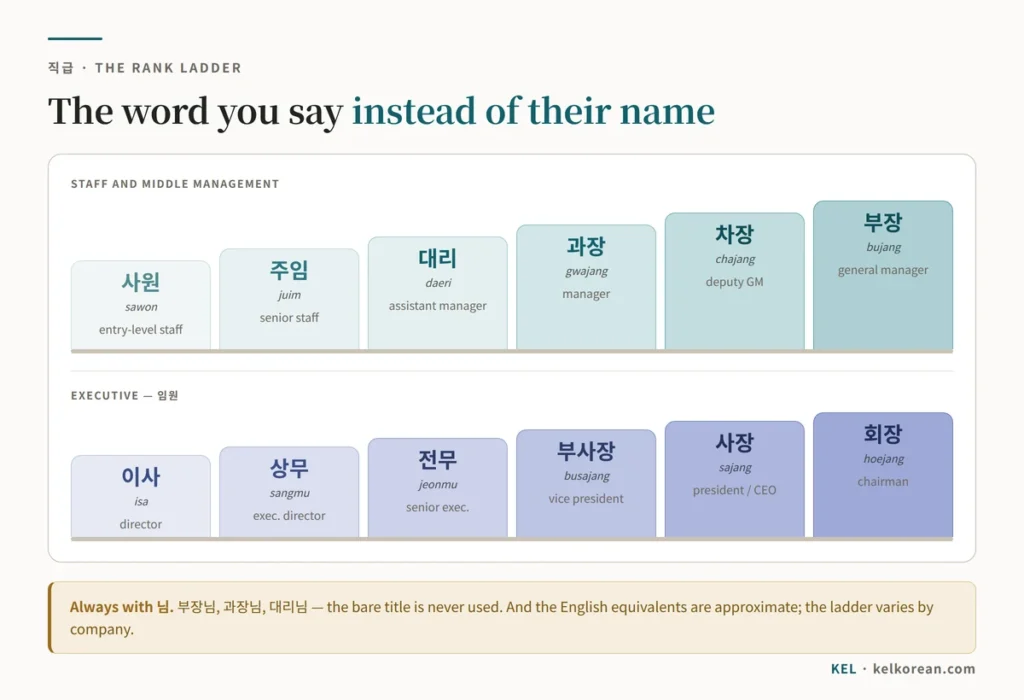
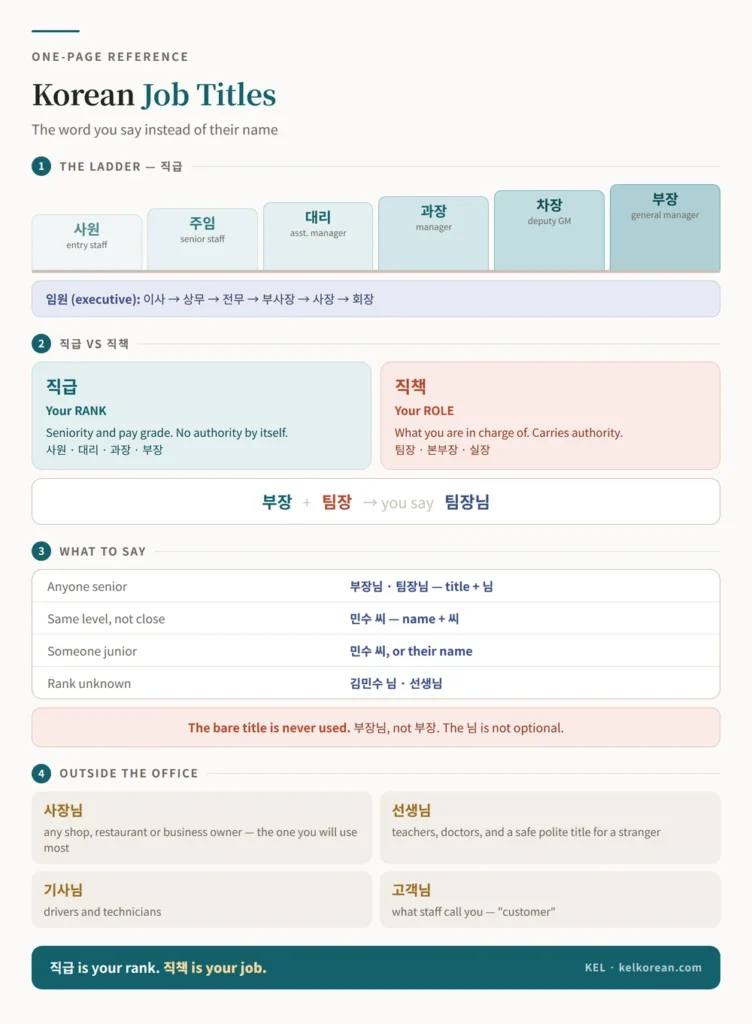
The Ladder — 직급
This is the seniority ranking, and it is what most people mean by “Korean job titles.”
| Korean | Romanization | Roughly |
|---|---|---|
| 사원 | sawon | entry-level staff |
| 주임 | juim | senior staff |
| 대리 | daeri | assistant manager |
| 과장 | gwajang | manager |
| 차장 | chajang | deputy general manager |
| 부장 | bujang | general manager / department head |
Above 부장 the ranks become executive (임원):
| Korean | Romanization | Roughly |
|---|---|---|
| 이사 | isa | director |
| 상무 | sangmu | executive director |
| 전무 | jeonmu | senior executive director |
| 부사장 | busajang | vice president |
| 사장 | sajang | president / CEO |
| 회장 | hoejang | chairman |
Two honest caveats. The English equivalents are approximate — a Korean 과장 is not the same job as an American “manager.” And the ladder varies by company; some skip 주임, some skip 차장 entirely.
직책 vs 직급 — The Distinction Nobody Explains
Here is the piece that makes everything else make sense, and it is missing from almost every English guide.
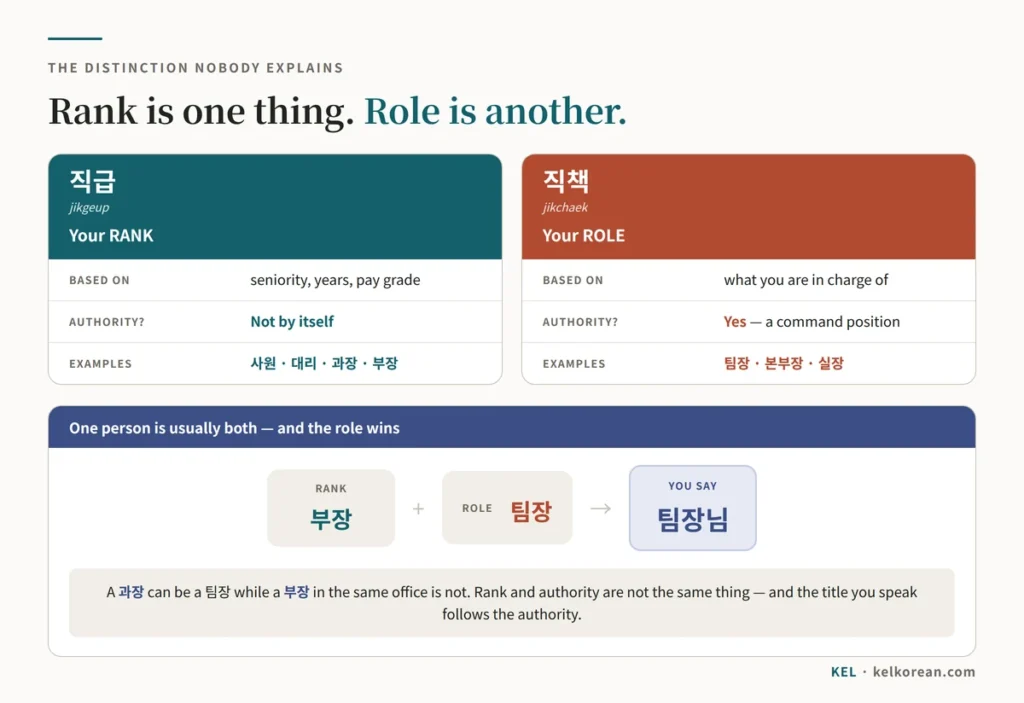
Korean separates what rank you are from what job you are doing.
| 직급 (jikgeup) | 직책 (jikchaek) | |
|---|---|---|
| What it is | your rank | your role |
| Based on | seniority, years, pay grade | what you are in charge of |
| Carries authority? | not by itself | yes — it is a command position |
| Examples | 사원, 대리, 과장, 부장 | 팀장, 본부장, 실장 |
팀장 is not a rank. It is a job. 팀장 (timjang) means “team leader” — the person running a team. 부장 is a rank on the pay ladder. One person is usually both: a 부장 by rank who holds the 팀장 role.
And this decides what you call them. When someone has a 직책, that is what you use.
A 부장 who leads a team → you say 팀장님, not 부장님.
This also explains something that confuses people: a 과장 can be a 팀장 while a 부장 in the same office is not. Rank and authority are not the same thing in Korean companies, and the title you speak reflects the authority.
What You Actually Say
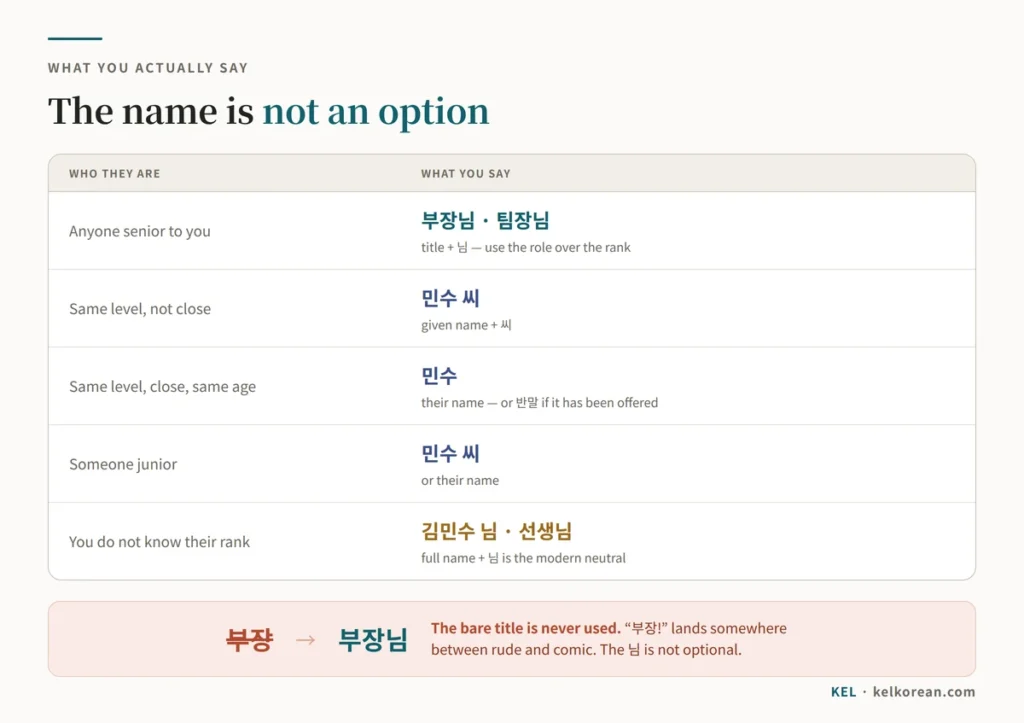
Title + 님. Always.
- 부장님, 과장님, 팀장님, 대리님
- Never the bare title. “부장!” is not a thing — it lands somewhere between rude and comic.
- 님 does the same work here that it does everywhere else in Korean, which is laid out in Korean honorifics.
Downward and sideways:
| Situation | What to say |
|---|---|
| Someone senior | 부장님 / 팀장님 — title + 님 |
| Same level, not close | 민수 씨 — given name + 씨 |
| Same level, close, same age | their name, or 반말 if it has been offered |
| Someone junior | 민수 씨, or their name |
| You do not know their rank | 선생님, or 님 after their full name |
김민수 님 — full name plus 님 — is the modern neutral option, and it is safe when you genuinely do not know where someone sits.
When 반말 shows up at work, it is offered downward and accepted carefully; the mechanics are in banmal.
선배 and 후배 Are a Separate Axis
Titles are about rank. 선배 and 후배 are about when you joined — and the two do not always line up.
They are covered properly in Korean family terms, so briefly: a 선배 entered the company before you, a 후배 after, and a 동기 in the same intake year. None of it is about age.
The practical point at work is that you can be someone’s 선배 and their junior in rank at the same time, and Korean handles that by using the title in formal contexts and 선배님 in warmer ones.
Where the Titles Relax
Titles do not switch off after hours, but they loosen.
회식 — the company dinner — is where it happens. Ranks stay in the words, but the distance shrinks, and it is often where a senior colleague offers 말 놓으세요. The etiquette that governs the evening, including how to decline a drink without causing offence, is in Korean drinking etiquette.
What is actually being tested there is not your drinking. It is whether you notice an empty glass before its owner does — which is 눈치, and which matters far more at a Korean workplace than any title you memorise.
The Modern Shift — and Why It Keeps Failing
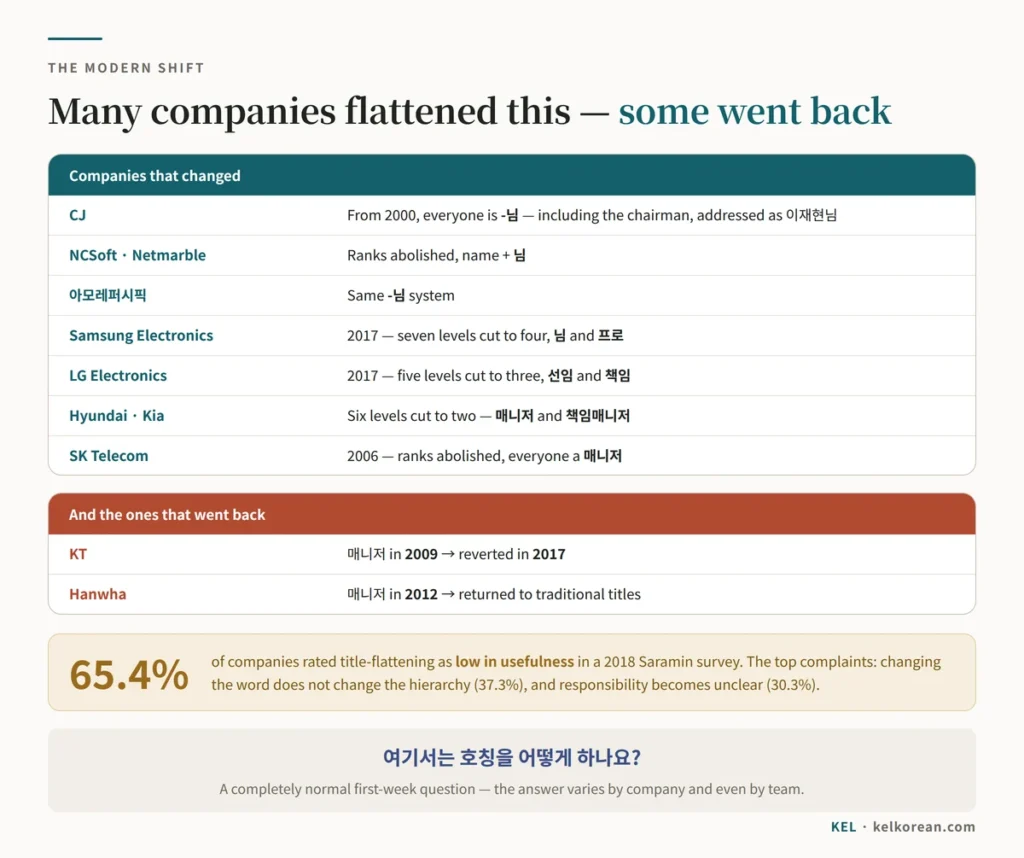
A lot of Korean companies have tried to flatten all of this. It is worth knowing about, because you may walk into one.
Companies that changed:
| Company | What they did |
|---|---|
| CJ | From 2000, everyone is -님 — including the chairman, addressed as 이재현님 |
| NCSoft · Netmarble | Ranks abolished, name + 님 |
| 아모레퍼시픽 | Same -님 system |
| Samsung Electronics | 2017 — seven levels cut to four, 님 and 프로 introduced |
| LG Electronics | 2017 — five levels cut to three, titles became 선임 and 책임 |
| Hyundai · Kia | Six levels cut to two — 매니저 and 책임매니저 |
| SK Telecom | 2006 — ranks abolished, everyone a 매니저 |
And the ones that went back:
KT switched to 매니저 in 2009 and reverted in 2017. Hanwha unified on 매니저 in 2012 and has since returned to traditional titles.
A 2018 survey by Saramin found 65.4% of companies rated title-flattening as low in usefulness, with the most common complaints being that changing the word does not change the hierarchy (37.3%) and that responsibility becomes unclear (30.3%).
What this means for you: ask. “여기서는 호칭을 어떻게 하나요?” is a completely normal first-week question, and the answer varies enormously by company and even by team.
Titles Outside Your Own Company
These matter more for travellers than the corporate ladder does.
| Korean | Used for |
|---|---|
| 사장님 | any shop owner, restaurant owner, taxi driver — extremely common |
| 선생님 | teachers, doctors, and as a general polite title for a stranger |
| 고객님 | what staff call you — “customer” |
| 기사님 | drivers, technicians |
| 여기요 / 저기요 | getting a stranger’s or server’s attention |
사장님 is the one to remember. Calling the owner of a small restaurant 사장님 is normal, warm and correct — and it is the title you will use most often in Korea without ever working in a Korean office. You will hear it constantly alongside the phrases in how to order food in Korean.
5 Mistakes Worth Avoiding
1. Using the bare title. 부장님, not 부장. The 님 is not optional.
2. Using their name. Even 민수 씨 is only for peers and juniors.
3. Saying 부장님 to someone whose 직책 is 팀장. If they lead a team, that is what you call them.
4. Assuming rank equals authority. A 과장 who is a 팀장 outranks a 부장 who is not, in every way that matters day to day.
5. Assuming your company uses ranks at all. Plenty do not any more. Ask in week one.
Frequently Asked Questions
What does 부장님 mean?
부장 is a rank roughly equivalent to a general manager or department head, and 님 is the honorific attached to it. You say 부장님 when speaking to them; you never say 부장 on its own.
What is the difference between 팀장 and 부장?
They are different kinds of thing. 부장 is a rank on the seniority ladder; 팀장 is a role — the person leading a team. One person is often both. When someone holds a role like 팀장, that is the title you use to address them.
Can I call a Korean colleague by their name?
Only downward or sideways, and even then with 씨 attached — 민수 씨. For anyone senior you use their title plus 님. Full name plus 님 (김민수 님) is a safe neutral option when you do not know their rank.
What is the order of Korean company ranks?
사원 → 주임 → 대리 → 과장 → 차장 → 부장, then the executive ranks 이사 → 상무 → 전무 → 부사장 → 사장. Companies vary — some skip 주임 or 차장 entirely.
Do Korean companies still use these titles?
Many do, but a significant number have flattened them. CJ, NCSoft and Amorepacific use name + 님; Samsung and LG cut their ladders down in 2017; Hyundai and SK use 매니저. Some, including KT and Hanwha, tried it and went back.
What do I call a shop owner or a taxi driver?
사장님 for an owner, 기사님 for a driver. 사장님 is used very broadly and is never wrong for someone running a small business.
What is 선배?
Someone who joined your company or school before you, regardless of age. It runs on a different axis from rank — you can be senior in rank to your own 선배.
Final Thoughts
Korean job titles look like a memorisation problem and are really a two-column problem. 직급 is your rank. 직책 is your job. Once those are separate in your head, the ladder is just vocabulary and the addressing rule is one line: title plus 님, and use the role over the rank.
And if you never set foot in a Korean office, one word still earns its keep: 사장님. The owner of every small restaurant, shop and taxi in Korea answers to it.
Sources: 직급 — 나무위키 · 재계, 직급·호칭파괴 열풍 — 투데이신문
Leave a Reply