At some point a Korean friend will tell you, half-joking, that you have no 눈치. You will look it up, get “sense” or “tact,” and feel none the wiser — because what they meant was something more specific and slightly more damning than either word.
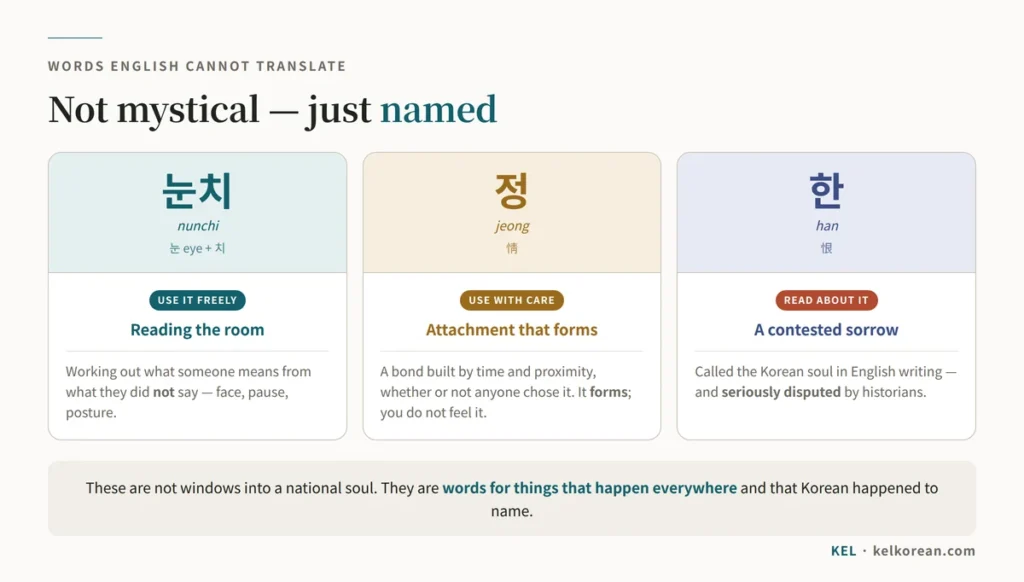
Nunchi is the most famous of a small set of Korean words that dictionaries handle badly. Not because Korean has mystical concepts English lacks, but because these words name things English speakers do all the time and never bothered to give a name to.
Three of them come up constantly: 눈치, 정 and 한. One of them is genuinely useful, one explains a lot of everyday Korean behaviour, and one comes with a complication that most English articles skip entirely.
눈치 — Reading the Room
눈치 is built from 눈 (eye) plus 치. Literally something like “eye-measure.” It is the skill of reading a situation from what people are not saying — their face, their posture, the pause before they answer.
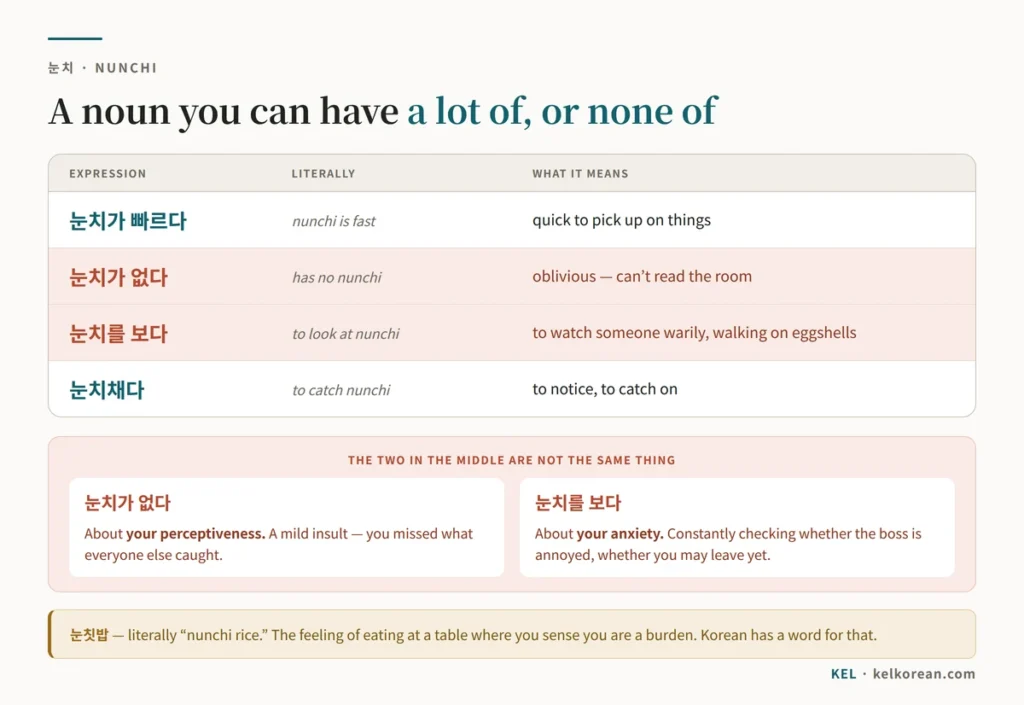
English has “reading the room,” but only as a phrase. Korean has it as a noun you can have a lot of, or none of, and it appears in four everyday expressions:
| Expression | Literally | What it means |
|---|---|---|
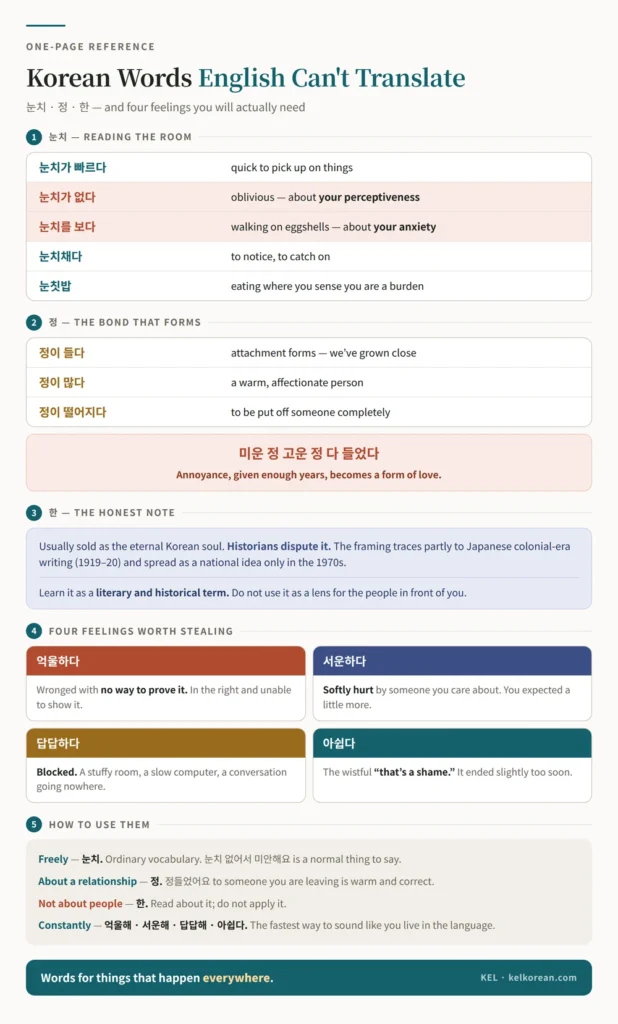
| 눈치가 빠르다 | nunchi is fast | quick to pick up on things |
| 눈치가 없다 | has no nunchi | oblivious, can’t read the room |
| 눈치를 보다 | to look at nunchi | to watch someone warily, walking on eggshells |
| 눈치채다 | to catch nunchi | to notice, to catch on |
The two in the middle are not the same thing, and this is where learners slip. 눈치가 없다 is a mild insult about your perceptiveness. 눈치를 보다 is about your own anxiety — it describes constantly checking whether the boss is annoyed, whether you are allowed to leave yet. One is a shortcoming; the other is a state of pressure.
Why Korean leans on this word so heavily is not mysterious. A great deal goes unsaid in Korean conversation — refusals are softened into 좀 어려울 것 같아요, disagreement arrives as silence, and the speech level you use depends on a hierarchy nobody announces out loud. When a language works that way, the ability to read what was not said stops being a personality trait and becomes a basic skill. The system it sits on top of is laid out in Korean honorifics.
Even the sentence endings carry this load. -잖아요 and -거든요 change nothing about the facts of a sentence and everything about the speaker’s stance toward the listener — the layer covered in Korean sentence endings. Reading those correctly is 눈치.
One more word worth knowing: 눈칫밥 — literally “nunchi rice.” It is the feeling of eating at a table where you sense you are a burden. Korean has a word for that.
The concept got a book in English — Euny Hong’s The Power of Nunchi (2019) — which is worth knowing about mainly because it means Koreans may assume you have already heard of it.
정 — The Bond That Accumulates
정 (情) is the one that explains the most everyday behaviour.
It is often glossed as “affection,” which undersells it. 정 is attachment that builds up over time through proximity and shared experience, whether or not anyone chose it. You develop 정 for a neighbour, a stubborn old dog, a terrible apartment you lived in for three years.
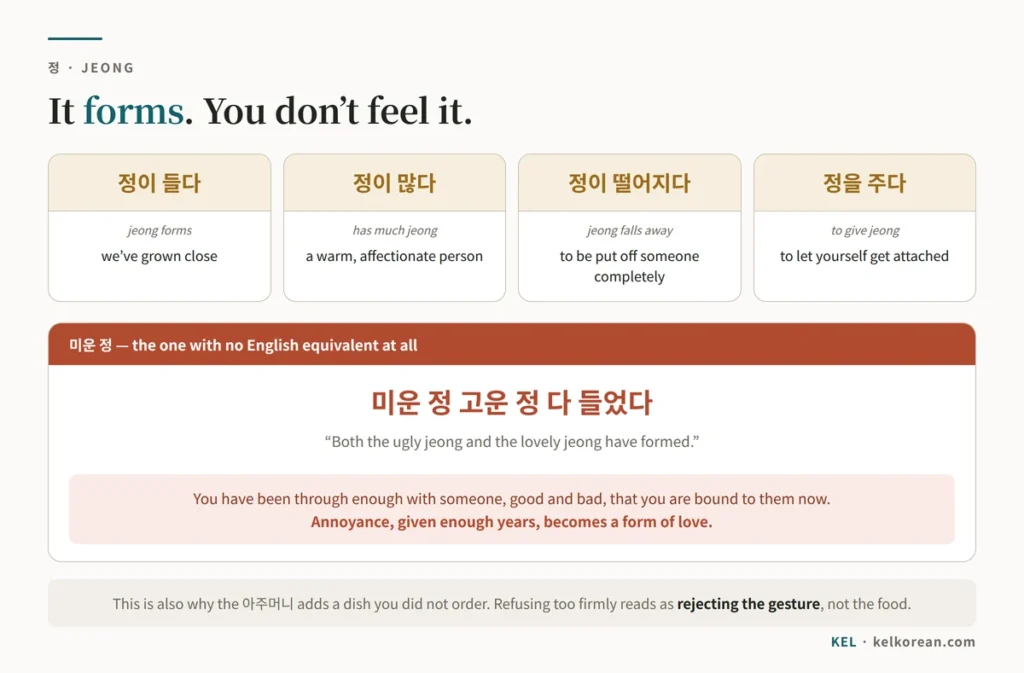
The grammar of the word tells you this. 정 is something that forms, not something you feel:
| 정이 들다 | attachment forms — “we’ve grown close” |
| 정이 많다 | to be a warm, affectionate person |
| 정이 떨어지다 | affection falls away — to be put off someone completely |
| 정을 주다 | to give your attachment to someone |
And then there is 미운 정. Ugly jeong — the attachment that builds through friction. The full phrase is 미운 정 고운 정 다 들었다: “both the ugly jeong and the lovely jeong have formed.” It means you have been through enough with someone, good and bad, that you are bound to them now.
There is no English equivalent for that at all, and it may be the single most Korean idea in the language: that annoyance, given enough years, becomes a form of love.
정 also explains small things foreigners notice and misread. The 아주머니 who adds a free dish you did not order, the shopkeeper who slips an extra into the bag — Koreans will often explain this as 정, and refusing it too firmly reads as rejecting the gesture rather than declining the food. It comes up constantly in restaurants, which is covered practically in how to order food in Korean.
한 — And the Problem Nobody Mentions
한 (恨) is usually presented to English readers as the defining Korean emotion: a deep collective sorrow and unresolved resentment, born of centuries of invasion and hardship, running through Korean art, music and film.
You will find that description everywhere. It is also seriously disputed by historians, and the dispute is more interesting than the cliché.
Where the argument comes from. The Japanese art critic Yanagi Sōetsu wrote in 1919–20 about the “beauty of sorrow” he claimed to find in Korean art — a framing produced during the colonial occupation, describing Koreans as an essentially melancholic people. The idea of 한 as a national characteristic became widespread much later, in the 1970s. Scholars including Sandra So Hee Chi Kim, Minsoo Kang and Joshua Pilzer have argued that what is now presented as an ancient Korean essence is largely a modern construction — Kang puts it bluntly, that the notion Koreans are essentially a people of han “was constructed entirely in the modern era.”
And the counter-argument. Michael D. Shin points out that classical Korean literature is full of joy, satire and humour, with han appearing rarely; he connects the modern feeling instead to the trauma of national division. The historian Mark Peterson has separately challenged the “constant invasions” story that han is usually said to rest on.
So what should you do with the word?
한 is a real Korean word and Koreans do use it — but far less than English-language articles suggest, and rarely about themselves. If you tell a Korean twenty-something that you find han in their national character, you are more likely to get a puzzled look than a nod.
Learn it as a literary and historical term, useful for understanding how Korea has been written about. Do not use it as a lens for the people in front of you.
Four Feelings English Needs a Sentence For
These four are less famous than the three above and far more useful, because you will actually need them.
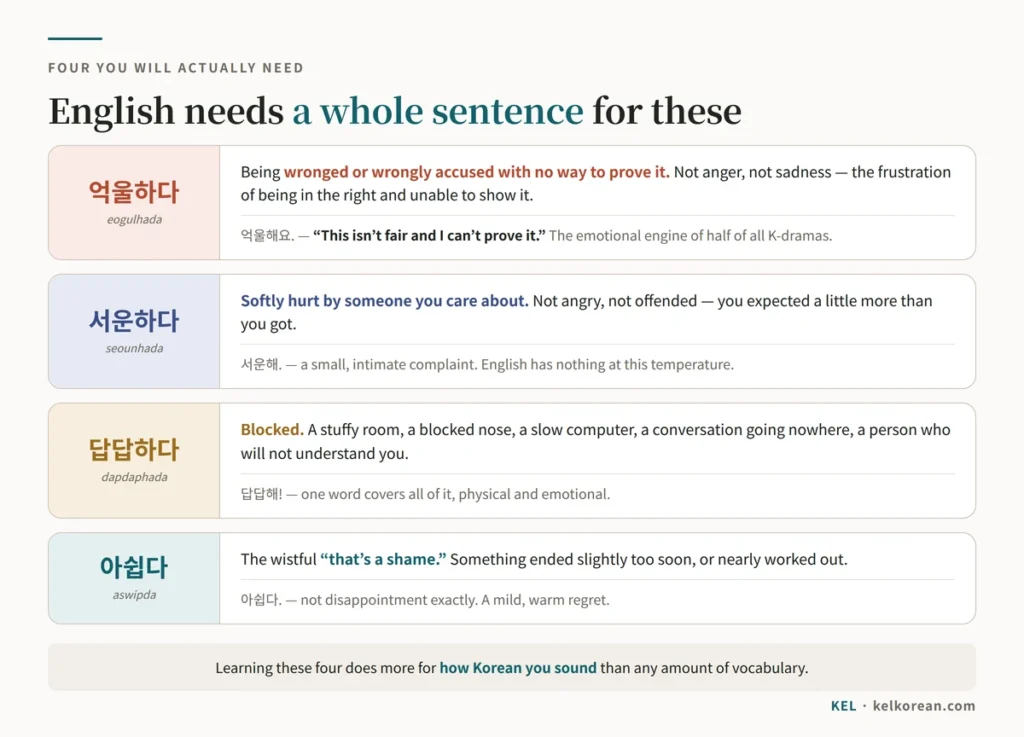
억울하다 — the feeling of being unjustly accused or wronged, with no way to prove otherwise. Not anger, not sadness — the specific frustration of being in the right and unable to show it. It is the emotional engine of roughly half of all Korean dramas, and English genuinely has no word for it.
억울해요. — This isn’t fair and I can’t prove it.
서운하다 — softly hurt by someone you care about. Not angry, not offended. The feeling of having expected a little more than you got. Saying 서운해 to a friend is a small, intimate complaint, and English has nothing at that exact temperature.
답답하다 — blocked. Used for a stuffy room, a blocked nose, a slow computer, a conversation going nowhere, and a person who will not understand what you are telling them. One word covers all of it.
아쉽다 — the wistful “that’s a shame.” Used when something ends slightly too soon, or nearly worked out. Not disappointment exactly — closer to a mild, warm regret.
Learning these four does more for how Korean you sound than any amount of vocabulary, and you will hear all of them in the first hour of any drama. More of that register is in K-drama Korean.
And One You Have Already Met: 우리
Korean says 우리 나라 (our country), 우리 엄마 (our mum), 우리 집 (our house) — even when speaking to a stranger who shares none of them.
This is not sloppiness. Korean marks things as belonging to a group by default rather than to an individual, and swapping in 내 엄마 sounds cold rather than precise. The 우리 habit runs through the whole family vocabulary, which is covered in Korean family terms.
How to Use These Without Sounding Like a Textbook
Use 눈치 freely. It is completely ordinary vocabulary. 눈치 없어서 미안해요 is a normal, slightly self-deprecating thing to say.
Use 정 sparingly and about relationships, not as a theory. 정들었어요 to someone you are leaving is warm and correct. Explaining 정 back to a Korean is not.
Do not use 한 about people. See above.
Use the four feelings constantly. 억울해, 서운해, 답답해, 아쉽다 are everyday words, and dropping the right one at the right moment is the fastest way to sound like you actually live in the language. They also take the casual endings covered in banmal — 억울해, not 억울합니다, among friends.
Frequently Asked Questions
What does nunchi mean?
The ability to read a situation from what people are not saying — their expression, tone and timing. It is built from 눈 (eye) plus 치, and Korean treats it as something you can have a lot of (눈치가 빠르다) or none of (눈치가 없다).
What is the difference between 눈치가 없다 and 눈치를 보다?
눈치가 없다 means you fail to read the room — a comment on your perceptiveness. 눈치를 보다 means you are constantly checking someone’s reaction because you feel you have to. The first is a shortcoming; the second is a state of pressure.
What does 정 mean in Korean?
Attachment that builds up over time through closeness and shared experience, rather than affection you choose to feel. It is why Korean says 정이 들다 — jeong forms — and why a long, difficult relationship can produce 미운 정, attachment built through friction.
Is han really a uniquely Korean emotion?
That claim is disputed. Several scholars argue the idea of han as a national characteristic is a modern construction, traceable in part to Japanese colonial-era writing about the “beauty of sorrow” and popularised in Korea in the 1970s. Han is a real word, but treating it as the Korean soul is a framing many Koreans and historians reject.
What does 억울하다 mean?
The feeling of being wronged or wrongly accused with no way to prove your case. It is not anger and not sadness but something in between, and English has no single word for it.
Are these words hard to use as a learner?
No. 눈치 and the four feelings are ordinary everyday vocabulary and safe to use immediately. 정 is fine when you are describing a specific relationship. 한 is the only one worth leaving alone.
Why do Koreans say 우리 instead of 내?
Korean marks belonging by group rather than by individual, so 우리 엄마 and 우리 나라 are the neutral forms. 내 엄마 is grammatically fine and sounds oddly cold.
Final Thoughts
The useful version of “untranslatable Korean words” is not the mystical one. These are not windows into a national soul — they are words for things that happen everywhere and that Korean happened to name.
Nunchi is the one to take away, because it is genuinely useful and because it explains why so much Korean conversation seems to be happening slightly to the side of what is being said. 정 is the one that explains the free side dish. And 한 is the one to read about rather than reach for.
If you learn only four of these, make it 억울해, 서운해, 답답해 and 아쉽다 — the ones you will need on a Tuesday.
Sources: Han, cultural concept — Wikipedia · Against ‘han’, or why Koreans are not defined by sadness — Aeon · The Power of Nunchi — Penguin Random House
Leave a Reply