Years ago, before I started Korean English Lab, I taught Korean to foreign students living in Korea. And no matter where my students came from — the United States, Canada, Japan, Vietnam — almost every single one asked me the same question in their very first lesson:
“Why is the verb at the end?”
It’s a fair question – Korean sentence structure really does work differently. If you grew up speaking English, Korean sentences can feel like they’re built backwards. But here’s what I always told my students: Korean word order is not backwards — it’s just built on a different logic. And once you understand that logic, Korean sentences suddenly stop feeling random and start feeling almost mathematical.
In this guide, I’ll walk you through Korean sentence structure exactly the way I taught it in my classroom, step by step.
Korean Is an SOV Language
English is an SVO language: Subject – Verb – Object.
“I eat apples.” → I (subject) + eat (verb) + apples (object).
Korean is an SOV language: Subject – Object – Verb.
저는 사과를 먹어요. → 저는 (I) + 사과를 (apples) + 먹어요 (eat).
Literally: “I apples eat.”
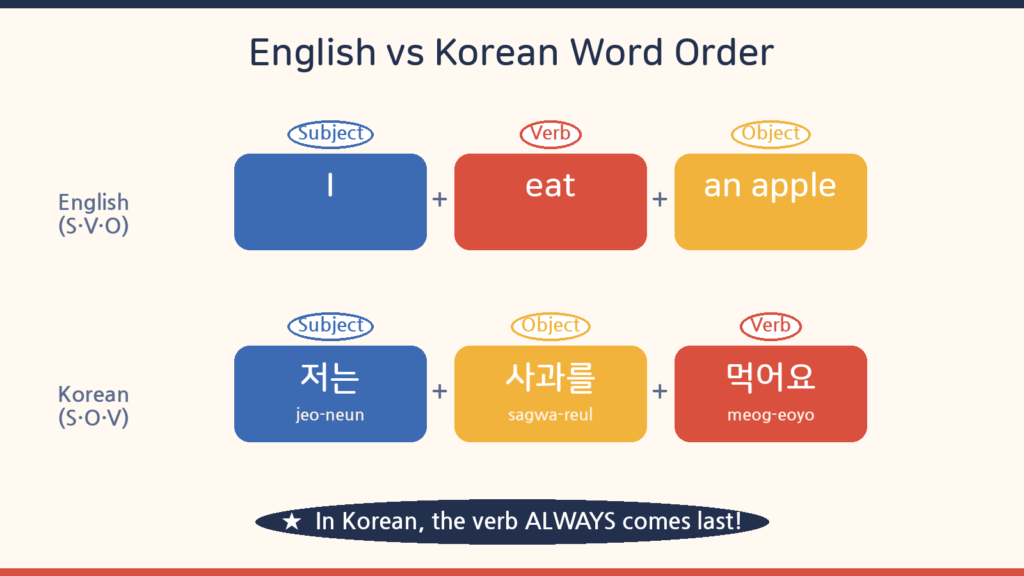
This is the single most important rule in Korean grammar: the verb always comes at the end of the sentence. Everything else — the subject, the object, the time, the place — comes before it. If you remember only one thing from this article, remember that.
The Verb Is the Anchor of Every Korean Sentence
When I taught Korean, I used to tell my students to think of the Korean verb as the anchor of a ship. The rest of the sentence can float around a little, but the verb stays fixed at the end, holding everything in place.
This is also why Koreans sometimes joke that you have to listen to the whole sentence before you know what’s happening. In English, you know the action almost immediately (“I ate…”). In Korean, the action arrives last:
저는 어제 친구하고 명동에서 저녁을 먹었어요.
(I yesterday with a friend in Myeongdong dinner ate.)
Until you hear 먹었어요 (ate), you don’t know if the speaker ate dinner, cooked dinner, or skipped dinner entirely. My students found this frustrating at first — and then, after a few weeks, they told me it actually made listening easier, because they always knew exactly where to find the most important word: at the end.
Particles: The Secret Engine of Korean Sentences
Here’s the part that surprises most English speakers. In English, word order tells you who does what. “The dog bit the man” and “The man bit the dog” mean completely different things, even though the words are identical.
Korean doesn’t rely on word order for this. Instead, it uses small markers called particles, attached to the end of nouns, to show each word’s role in the sentence. These are the core particles every beginner needs:
- 은/는 — topic marker (“as for…”): 저는 = “as for me”
- 이/가 — subject marker: 친구가 = “the friend (is the one who…)”
- 을/를 — object marker: 사과를 = “apple (as the thing being acted on)”
- 에 — “to / at” (destination or time): 학교에 = “to school”
- 에서 — “at / in” (place where an action happens): 카페에서 = “at the cafe”
Whether you use 은 or 는, 이 or 가, 을 or 를 simply depends on whether the noun ends in a consonant or a vowel — 은/이/을 after consonants, 는/가/를 after vowels.
In my classes, I called particles “name tags.” Each noun in a Korean sentence wears a little name tag that announces its job: “I’m the topic!” “I’m the object!” “I’m the location!” Once every word is wearing its name tag, the sentence can’t be misunderstood — no matter what order the words come in.
Building Your First Korean Sentence, Step by Step
This is the exact progression I used with my beginner students. We started with two words and grew the sentence one piece at a time:
Step 1 — Subject + Verb
저는 먹어요. (I eat.)
Step 2 — Add an object
저는 사과를 먹어요. (I eat an apple.)
Step 3 — Add a place
저는 집에서 사과를 먹어요. (I eat an apple at home.)
Step 4 — Add a time
저는 아침에 집에서 사과를 먹어요. (I eat an apple at home in the morning.)
Notice what never changed through all four steps: 먹어요 stayed at the end, every single time. New information simply slotted in before the verb. A useful default order for beginners is:
Subject → Time → Place → Object → Verb
Why Korean Word Order Is Surprisingly Flexible
Because particles mark each word’s role, Korean word order is much more flexible than English. All of these mean “I eat an apple at home”:
- 저는 집에서 사과를 먹어요.
- 집에서 저는 사과를 먹어요.
- 사과를 저는 집에서 먹어요.
The nuance and emphasis shift slightly, but the core meaning survives — because 는, 에서, and 를 keep doing their jobs no matter where the words move. The only rule you can’t break: the verb stays at the end.
Koreans Drop the Subject All the Time
One more thing that used to shock my students: in real conversation, Koreans constantly omit the subject when it’s obvious from context.
밥 먹었어요? (Did [you] eat?)
네, 먹었어요. (Yes, [I] ate.)
No “you,” no “I” — and it’s perfectly natural. In fact, saying 저는 in every sentence sounds stiff and textbook-like. I always told my students: if the listener already knows who you’re talking about, let the subject go.
The Mistakes My Students Actually Made
After teaching Korean to foreigners for years, I saw the same three mistakes over and over:
1. English word order with Korean words. One of my American students kept saying 저는 먹어요 사과 — “I eat apple,” in English order. It was completely understandable, and completely wrong. The fix that worked for him: before speaking, silently ask “what’s my verb?” and save it for last.
2. Dropping particles too early. Yes, native speakers drop particles in casual speech. But as a beginner, particles are your training wheels — they force you to understand each word’s role. I made my students use full particles for the first three months, and their grammar was noticeably stronger for it.
3. Translating word-for-word from English. Korean is not English wearing a different alphabet. The students who progressed fastest were the ones who stopped translating and started building sentences directly in the Korean pattern: subject, time, place, object, verb.
Practice: Try These Five Sentences
Cover the Korean side and try building each sentence yourself, verb last:
- I drink coffee. → 저는 커피를 마셔요.
- I study Korean at a cafe. → 저는 카페에서 한국어를 공부해요.
- My friend watches movies at home. → 친구는 집에서 영화를 봐요.
- I go to school in the morning. → 저는 아침에 학교에 가요.
- We eat Korean food at a restaurant. → 우리는 식당에서 한국 음식을 먹어요.
Frequently Asked Questions
Is Korean sentence structure hard for English speakers?
The order itself is different, but it’s extremely consistent. In my experience teaching foreigners, most students internalize the SOV pattern within a few weeks of regular practice — faster than they expect.
Do I really need to learn particles?
Yes. Particles are what make Korean word order work. You can survive simple conversations without them, but you cannot understand or build longer sentences without knowing what 은/는, 이/가, and 을/를 are doing.
What should I learn after sentence structure?
Core vocabulary. Once you know the SOV pattern, every new word you learn can immediately be dropped into a real sentence. That’s exactly why my next post covers the 100 Korean words I always taught my students first.
Korean English Lab (KEL) creates practical Korean learning materials based on real classroom experience. If you found this helpful, stick around — this series will take you from Hangul to real conversations, one clear step at a time.
Not sure where word order fits? See the complete beginner’s roadmap for the order these pieces are best learned in.
Leave a Reply