
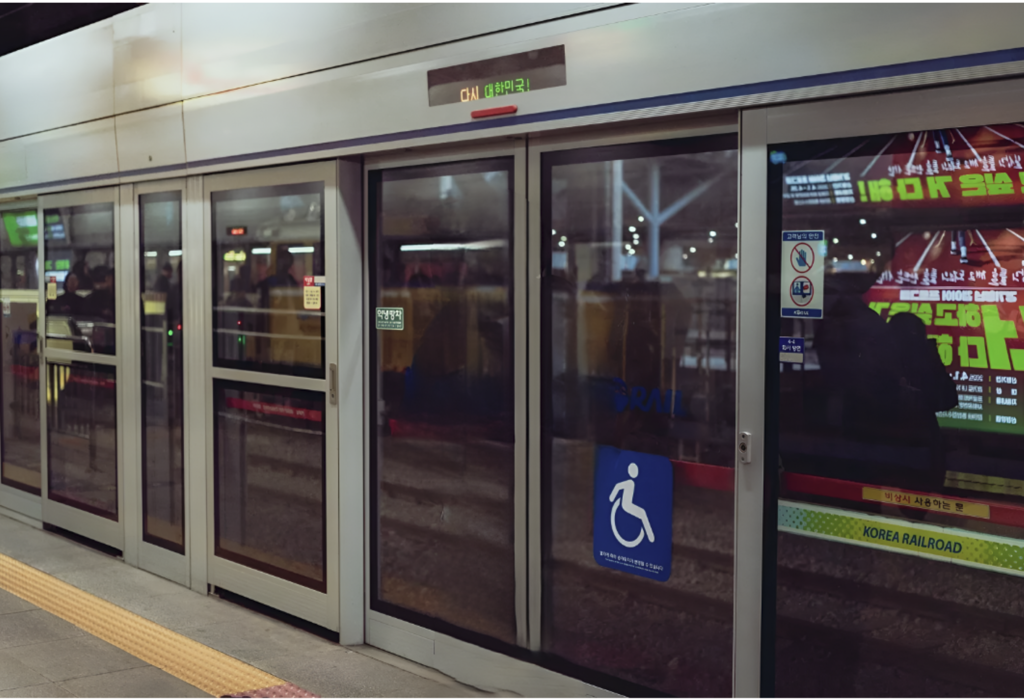
Learning how to use the Korean subway is the single most useful thing you can do before a trip to Korea. It’s clean, punctual, cheap, and — most importantly for a first-time visitor — every sign, map, and announcement comes in Korean and English. You genuinely do not need to speak Korean to get from Incheon Airport to your hotel in Hongdae.
But knowing a handful of Korean words turns a stressful ride into a smooth one. When a station attendant answers your question, when you need to ask which exit leads to the restaurant you booked, or when you accidentally board the wrong direction — that’s when a few phrases pay for themselves.
This guide walks you through the whole process, from buying a card to tapping out at your destination, and gives you the exact Korean expressions to use at each step.
Why the Subway Beats Everything Else in Korea
Taxis in Korea are cheaper than in most developed countries, but Seoul traffic is genuinely brutal at rush hour. Buses are excellent but require you to know your stop in advance. The subway wins because:
- It’s fast and predictable. Trains run every 2–6 minutes on major lines during the day.
- It’s fully bilingual. Station names, exit signs, ticket machines, and in-train announcements all appear in Korean, English, and often Chinese and Japanese.
- It’s cheap. Most trips inside Seoul cost less than $1.50 USD.
- It covers everything. Seoul’s network has over 600 stations across more than 20 lines, reaching Incheon, Suwon, and most satellite cities.
- It’s safe. Platform screen doors, security cameras, and staffed customer service offices at nearly every station.
Korea’s other major cities — Busan, Daegu, Daejeon, Gwangju — all have their own subway systems that work on the same basic principles.
Step 1: Get a Transit Card (Do This First)
You can buy a single-journey ticket for each ride, but almost nobody does. A rechargeable transit card is cheaper per ride, works on buses and taxis too, and saves you from queuing at a machine every time.
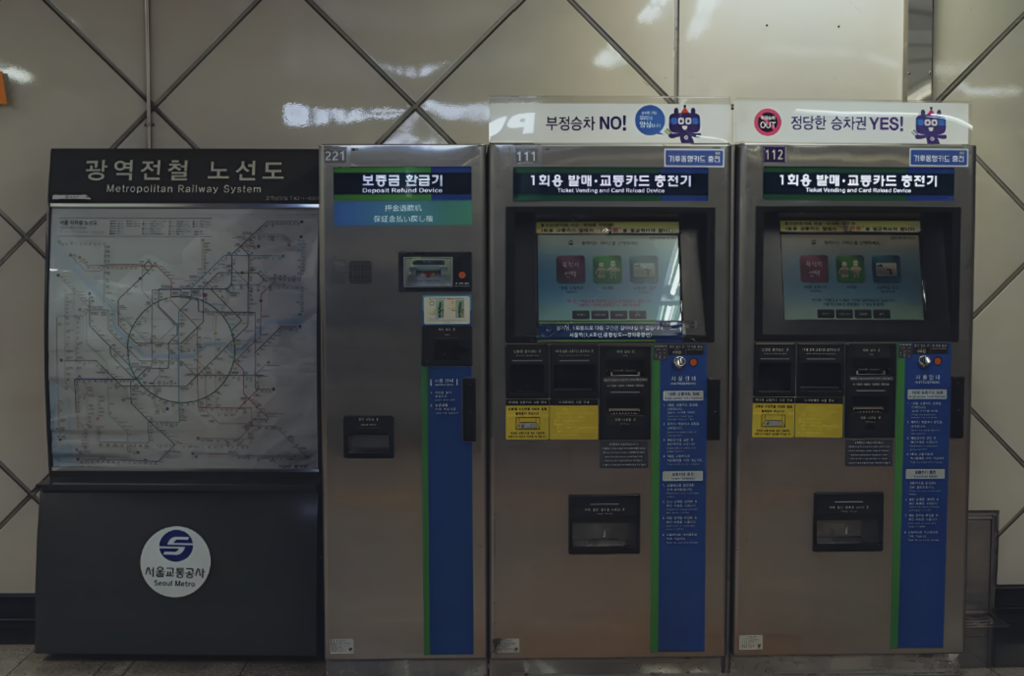
T-money — the standard choice
T-money is Korea’s universal transit card. It works on subways and buses nationwide, plus convenience stores, vending machines, and many taxis.
- Where to buy: Any convenience store (GS25, CU, 7-Eleven, Emart24) or a vending machine inside subway stations.
- Card cost: Around ₩2,500–4,000 depending on the design. This is non-refundable — it’s the card itself.
- Topping up: At convenience stores (cash) or the recharge machines in every station. Machines have an English menu button.
- Refunds: You can get your remaining balance back at convenience stores, minus a small fee.
A common alternative is Cashbee, which works nearly identically. Either is fine.
Climate Card (기후동행카드) — for heavy Seoul users
Seoul offers unlimited-ride passes aimed at tourists, in 1, 2, 3, 5, and 7-day versions. Prices start around ₩5,000 for a single day and run to roughly ₩20,000 for a week. These cover Seoul’s subway lines, Seoul city buses, and the Ttareungi public bike share.
The break-even point is roughly four rides per day. If you’re doing a packed sightseeing itinerary hopping between Gyeongbokgung, Insadong, Myeongdong, and Hongdae, it’s worth it. If you’re taking two rides a day, stick with T-money.
One caveat: the Climate Card program is being restructured in 2026, and the longer monthly pass is being merged into a different national scheme. The short-term tourist passes remain available, but check the official Seoul city transport page before you travel for current pricing and coverage.
Single-journey tickets
If you really only need one ride, buy a single-journey ticket (일회용 승차권) at a station machine. You’ll pay the fare plus a ₩500 deposit, which you get back by inserting the card into a “Deposit Refund Device” near the exit gates. Don’t skip this — that’s your ₩500.
Foreign credit cards
Some newer gates accept contactless foreign cards directly, and services like WOWPASS let you load Korean won onto a prepaid card using foreign currency. These are convenient but not universally supported. T-money remains the safest bet.
Step 2: Understand the Fares
Korean subway fares are distance-based, not flat. You pay a base fare, and longer trips add small increments.
Seoul Metropolitan Area (as of 2026)
| Rider | Transit card | Single ticket (cash) |
|---|---|---|
| Adult | ₩1,550 | ₩1,650 |
| Teen (13–18) | ₩900 | ₩1,650 |
| Child (6–12) | ₩550 | ₩550 |
The base fare covers the first 10 km, with small additions beyond that. There’s also an early bird discount — if you tap in before 6:30 a.m. on a weekday, adults pay about ₩1,240.
Busan (as of 2026)
Busan uses a two-zone system based on a 10 km boundary.
| Zone | Transit card (adult) | Single ticket (adult) |
|---|---|---|
| Zone 1 (under 10 km) | ₩1,600 | ₩1,700 |
| Zone 2 (over 10 km) | ₩1,800 | ₩1,900 |
Children in Busan ride free with a transit card — a nice perk for families.
Free transfers
This is the part travelers most often miss. If you use a transit card, transferring between the subway and buses is free within a time window (30 minutes in most cases, extended at night).
The catch: you must tap your card when you get off the bus. Subway gates force you to tap out, but buses rely on you remembering. Forget it, and you lose the transfer discount and may be charged the maximum fare. Miss it repeatedly and your card can be temporarily blocked.
Just make tapping out a reflex.
Step 3: Actually Ride the Thing
Finding the station
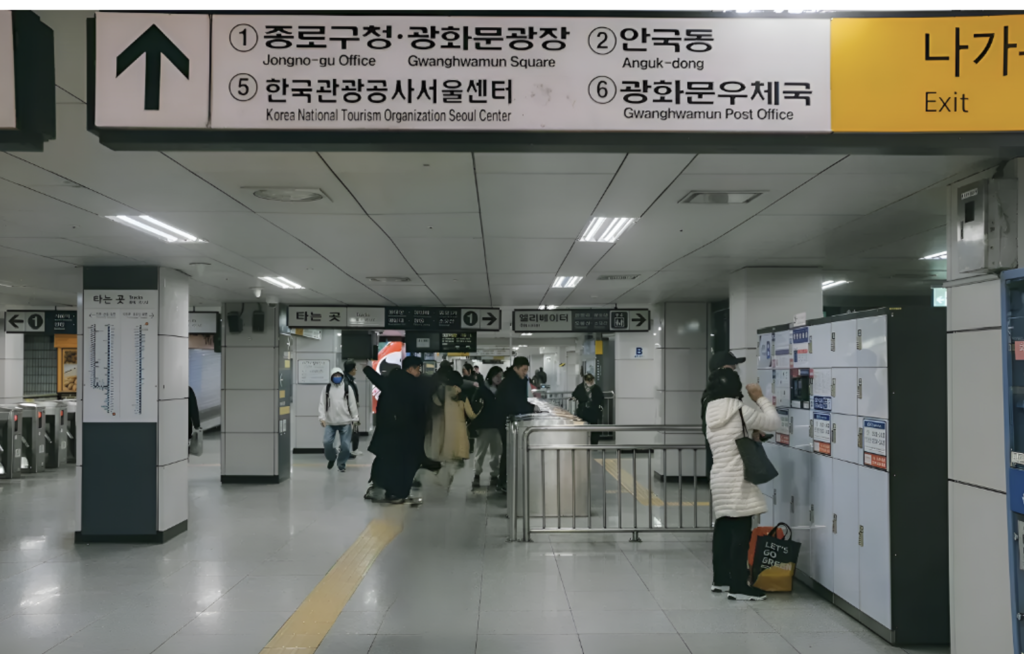
Look for the subway logo — a circled symbol color-coded to the line. Entrances are numbered (출구 1, 출구 2, and so on), and large stations can have fifteen or more exits spread over several blocks. The exit number matters more than the station name. A Korean friend giving you directions will say “Gangnam Station, Exit 11” — not “Gangnam Station.”
Reading station numbers
Every station has a number as well as a name. Gangnam is 222 — the first digit is the line (Line 2), the rest is the station position. If you can’t read or pronounce a station name, the number is a perfectly good substitute. Point at it on a map and any Korean will understand.
Tapping in
Place your card flat on the reader panel at the gate. Wait for the beep and the gate to open. Don’t tap and walk simultaneously — the gates close fast.
Finding the right platform
Signs list the terminal station of each direction, not the direction itself. So on Line 2 you might see “Toward Sindorim” and “Toward Konkuk University.” Check your route on a map app first and note the terminal station name. This is the single most common mistake first-timers make.
Line 2 in Seoul is a loop line, so you can technically reach any station going either way — one direction is just much longer.
On the train
Announcements come in Korean first, then English, then often Chinese and Japanese. Digital displays above each door show the current and next station. Doors open on the side the announcement indicates — listen for “the doors will open on the left/right.”
Transferring
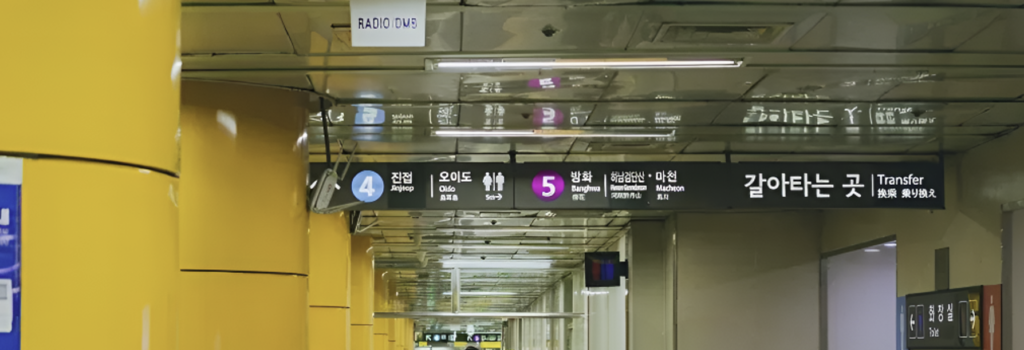
Follow signs marked 환승 (Transfer) with a line number and color. Some transfers are a 30-second walk; some, like Jongno 3-ga, are a genuine five-minute hike. Budget accordingly.
Tapping out
Tap again at the exit gates. This is how the system calculates your distance-based fare. If you don’t tap out, you’ll be charged the maximum fare next time.
Step 4: Download the Right App
Google Maps works poorly in Korea for walking and driving directions because of national mapping restrictions. Use these instead:
- Naver Map or KakaoMap — full English interface, accurate transit routing, exit numbers included.
- Subway Korea or KakaoMetro — dedicated subway apps showing exact train times, which car to board for the fastest transfer, and last train schedules.
- Seoul Subway — the city government’s own app, built for international visitors. It recommends routes from your current location, shows how crowded each train car is, and guides you to the right exit inside the station.
That “which car to board” feature is a genuine time-saver. It tells you to board car 4, door 2, so you exit right at the transfer corridor.
The crowding indicator is worth a mention. If you’re travelling with a suitcase, being able to see which car has space before the train arrives saves you from a very awkward ten minutes.
Subway Etiquette Koreans Actually Follow
- Priority seats at the ends of each car are for elderly, pregnant, and disabled passengers. Koreans leave these empty even when the train is packed. Follow suit.
- Keep calls short and quiet. People do take calls, but they speak very quietly and briefly.
- No eating. Drinks with lids are tolerated; a burger is not.
- Let people off first. Stand to the sides of the door.
- Backpacks come off in crowded cars and are held at your front or by your legs.
- Watch the pink seats. Bright pink seats are reserved for pregnant passengers, and they stay empty.
Essential Korean Subway Expressions
Here’s the practical part. These are the phrases that actually come up.
At the station
| Korean | Romanization | English |
|---|---|---|
| 지하철 | jihacheol | subway |
| 역 | yeok | station |
| 지하철역이 어디예요? | jihacheol-yeogi eodiyeyo? | Where is the subway station? |
| 표 사는 곳이 어디예요? | pyo saneun gosi eodiyeyo? | Where do I buy a ticket? |
| 일회용 승차권 주세요. | ilhoeyong seungchagwon juseyo. | One single-journey ticket, please. |
| 교통카드 충전해 주세요. | gyotongkadeu chungjeonhae juseyo. | Please top up my transit card. |
| 만 원 충전해 주세요. | man won chungjeonhae juseyo. | Please charge ₩10,000. |
| 몇 번 출구예요? | myeot beon chulguyeyo? | Which exit number is it? |
| 화장실이 어디예요? | hwajangsiri eodiyeyo? | Where is the restroom? |
Finding your way
| Korean | Romanization | English |
|---|---|---|
| 이 열차 서울역 가요? | i yeolcha Seoul-yeok gayo? | Does this train go to Seoul Station? |
| 어디서 갈아타요? | eodiseo garatayo? | Where do I transfer? |
| 몇 호선이에요? | myeot hoseonieyo? | Which line is it? |
| 명동역 어떻게 가요? | Myeongdong-yeok eotteoke gayo? | How do I get to Myeongdong Station? |
| 몇 정거장이에요? | myeot jeonggeojangieyo? | How many stops is it? |
| 시간이 얼마나 걸려요? | sigani eolmana geollyeoyo? | How long does it take? |
| 반대 방향으로 탔어요. | bandae banghyangeuro tasseoyo. | I got on going the wrong direction. |
Swap in any station name before 역 (yeok) — the pattern stays the same. 부산역 가요? (Busan-yeok gayo?) works exactly the same way.
On the train
| Korean | Romanization | English |
|---|---|---|
| 잠시만요. | jamsimanyo. | Excuse me. (to get past someone) |
| 지나갈게요. | jinagalgeyo. | I’m coming through. |
| 내릴게요. | naerilgeyo. | I’m getting off. |
| 여기 자리 있어요? | yeogi jari isseoyo? | Is this seat taken? |
| 다음 역이 어디예요? | da-eum yeogi eodiyeyo? | What’s the next station? |
Announcements you’ll hear
| Korean | Romanization | English |
|---|---|---|
| 이번 역은 강남역입니다. | ibeon yeogeun Gangnam-yeogimnida. | This stop is Gangnam Station. |
| 내리실 문은 오른쪽입니다. | naerisil muneun oreunjjogimnida. | The doors will open on the right. |
| 내리실 문은 왼쪽입니다. | naerisil muneun oenjjogimnida. | The doors will open on the left. |
| 갈아타실 분은 내리시기 바랍니다. | garatasil buneun naerisigi baramnida. | Passengers transferring, please get off here. |
Even if you catch nothing else, learning 오른쪽 (oreunjjok, right) and 왼쪽 (oenjjok, left) lets you position yourself before the train stops.
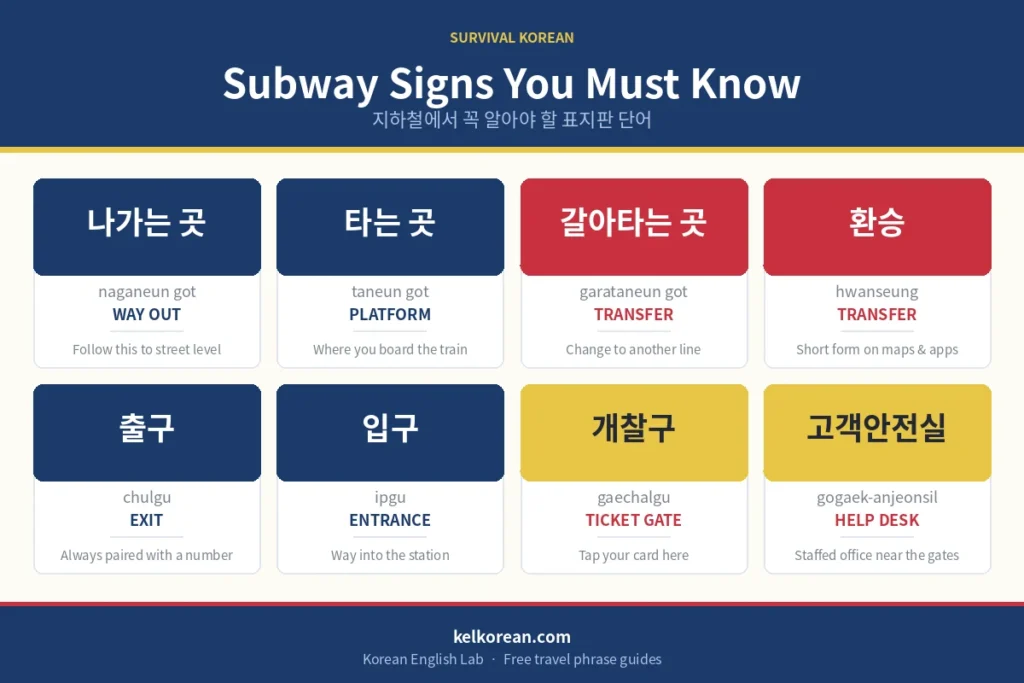
Signs to recognize
| Korean | Romanization | English |
|---|---|---|
| 나가는 곳 | naganeun got | Exit / Way out |
| 타는 곳 | taneun got | Platform / Boarding area |
| 갈아타는 곳 | garataneun got | Transfer |
| 환승 | hwanseung | Transfer |
| 출구 | chulgu | Exit |
| 입구 | ipgu | Entrance |
| 개찰구 | gaechalgu | Ticket gate |
If something goes wrong
| Korean | Romanization | English |
|---|---|---|
| 도와주세요. | dowajuseyo. | Please help me. |
| 길을 잃었어요. | gireul irheosseoyo. | I’m lost. |
| 카드를 잃어버렸어요. | kadeureul ireobeoryeosseoyo. | I lost my card. |
| 가방을 두고 내렸어요. | gabangeul dugo naeryeosseoyo. | I left my bag on the train. |
| 영어 하실 수 있어요? | yeongeo hasil su isseoyo? | Do you speak English? |
| 천천히 말해 주세요. | cheoncheonhi malhae juseyo. | Please speak slowly. |
Every station has a 고객안전실 (gogaek-anjeonsil) — a customer safety office near the gates. Staff there handle lost items, card problems, and directions, and many speak at least basic English.
Three Pronunciation Tips That Make a Real Difference
1. Say 역 as “yeok,” not “yuck.” The vowel ㅕ is closer to the “yu” in “young.” Gangnam-yeok, Hongdae-ipgu-yeok.
2. End requests with 주세요 (juseyo). It means roughly “please give me / please do.” Attach it to almost any noun and you have a polite request: 물 주세요 (water, please), 영수증 주세요 (receipt, please).
3. Rising intonation makes a question. Korean questions ending in -요 just go up in pitch. 가요? with a rising tone is a complete, polite question meaning “Does it go?”
Common Mistakes to Avoid
Getting on the wrong direction. Always check the terminal station name, not the compass direction.
Not tapping out on buses. Costs you the transfer discount every time.
Guessing at exits. Exiting Gangnam Station at the wrong number can mean a 15-minute detour with a road crossing. Check the exit number in your map app before you leave the platform.
Missing the last train. Last trains generally run between midnight and 1 a.m., earlier on some lines and on weekends. Check in your app — there is no night subway service.
Rush hour on Line 2 or Line 9. Between 8–9 a.m. and 6–7:30 p.m., Seoul’s busiest lines are genuinely packed. If you have luggage, avoid these windows entirely.
Forgetting the ₩500 deposit. If you bought single-journey tickets, refund each one before you leave the station.
Frequently Asked Questions
Do I need to speak Korean to use the subway? No. Every sign, machine, and announcement is available in English. The phrases above make things smoother and are appreciated, but they aren’t a requirement.
Can I use my phone’s contactless payment? Apple Pay and Google Pay have limited compatibility with Korean transit gates. Android users can add a mobile T-money card through the T-money app. iPhone users are generally better off with a physical card.
Is there Wi-Fi? Yes, free public Wi-Fi is available on trains and platforms across the network, though speeds vary with crowding.
Can I bring luggage? Yes, and many travelers do. Just avoid rush hour, use the elevators (marked on station maps), and stand near the door area rather than blocking the aisle.
Is the subway safe at night? Very. Korea has low street crime, stations are well lit and monitored, and there are emergency intercoms on every platform. The main risk is missing the last train.
Do children ride free? Under 6 rides free nationwide. In Busan, elementary-age children ride free with a transit card. In Seoul, children 6–12 pay a reduced fare.
Putting It All Together
Here’s the whole thing in one sequence:
- Buy a T-money card at a convenience store and load ₩20,000.
- Look up your route in Naver Map or KakaoMap. Write down the terminal station and the exit number.
- Tap in at the gate.
- Find the platform for your terminal station.
- Ride, watching the display above the door.
- Transfer if needed, following the 환승 signs.
- Tap out at your destination and take the exit number you noted.
That’s it. Once you’ve done it once, it’s automatic — and you’ll wonder why every city doesn’t work this way.
Learning Korean for your trip? Practical phrases like these are the fastest route to feeling confident on the ground. Explore our printable Korean travel phrase guides and beginner workbooks at Korean English Lab — designed for real situations, not textbook drills.
Related reading:
- Essential Korean Phrases Every Traveler Should Know
- A First-Timer’s Guide to Busan
- Learn to Read Hangul in 7 Days
Fares and pass details reflect information current as of 2026. Transit fares in Korea are reviewed periodically — check the Seoul Metro or Busan Transportation Corporation website before your trip for the latest figures.
Leave a Reply