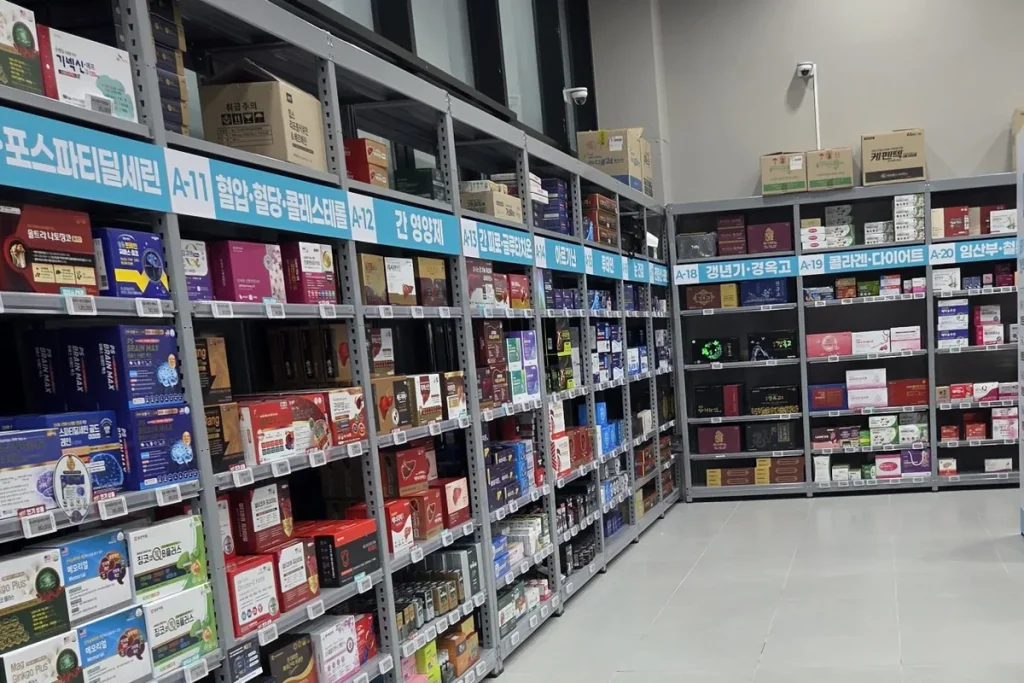
Korean pharmacy shopping has changed. For most of my life a 약국 (yakguk) was a small room with a counter: you said what was wrong, and the pharmacist handed you a box. Now there is a new kind, as big as a supermarket, where you walk the aisles and choose for yourself. Koreans call it a 창고형 약국 (changgohyeong yakguk), a “warehouse-style pharmacy,” and since the first one opened in 2025 they have spread across the country.
In late October 2026 I went to one, 양산메가약국 (Yangsan Mega Pharmacy) in Yangsan, the city just north of Busan, and I took photos of the shelves. This guide uses them to show you how such a pharmacy works, how to read the aisle signs and price tags, what you can and cannot simply pick up, and the Korean to use on the shop floor. It is a shopping and language guide, not medical advice. For what to take and how much, ask the pharmacist.
What Is a Warehouse Pharmacy?
The name is three small words. 창고 (changgo) is a warehouse, 형 (hyeong) means “type” or “style,” and 약국 is a pharmacy. The first one opened in June 2025 in Seongnam, just outside Seoul. A year later the Korean trade press was counting about 40 of them, and by September 2026 two of the chains alone were reported to have more than 20 branches each.
The idea is simple. Instead of a counter, there is a large floor with long shelves, sorted by what the medicine is for. You pick things up, read the boxes, compare prices, and pay at a checkout. Pharmacists are on the floor to answer questions. Supplements and vitamins take up a great deal of the space, next to the everyday medicine every home keeps.
Not everybody is pleased. Neighbourhood pharmacists say these shops take their customers, and both pharmacists and the government worry that people will start buying medicine the way they buy groceries, and take more than they need. In August 2026 the National Assembly passed a change to the Pharmaceutical Affairs Act, so that a pharmacy may not use a name such as 창고형 that could encourage people to buy too much. It takes effect three months after it is promulgated, and existing pharmacies then have six months to change. The rule is about what a pharmacy may call itself, so the signs may change even where the shelves stay the same.
My Visit: Stocking Up on 상비약
I went for 상비약 (sangbiyak). 상비 means “always kept ready,” and 약 is medicine, so 상비약 is the medicine a household keeps in a drawer for the day somebody needs it. Every Korean home has some. Here is what went home with me.
| Korean | Romanisation | Meaning |
|---|---|---|
| 감기약 | gamgiyak | Cold medicine |
| 두통약 | dutongnyak | Headache medicine |
| 진통제 | jintongje | Painkiller |
| 파스 | paseu | Medicated patch for sore muscles |
| 인공눈물 | in-gongnunmul | Artificial tears, literally “man-made tears” |
| 심장사상충약 | simjangsasangchungnyak | Heartworm medicine, for my dogs |
| 외부기생충약 | oebugisaengchungnyak | Medicine for external parasites, also for the dogs |
Three things stayed with me. The prices were a little lower than at an ordinary pharmacy. The place was so big that, although there were a lot of people, it never felt crowded or uncomfortable. And the range was wide, with many pharmacists around, which I liked very much.
I should be fair about the prices. “A little lower” is my own impression of what I bought. A Korean reporter who compared a Seoul warehouse pharmacy with nearby pharmacies in February 2026 found little difference on several well-known products. So go for the range and for the chance to look properly, and treat any saving as a bonus.
How to Read the Aisle Signs
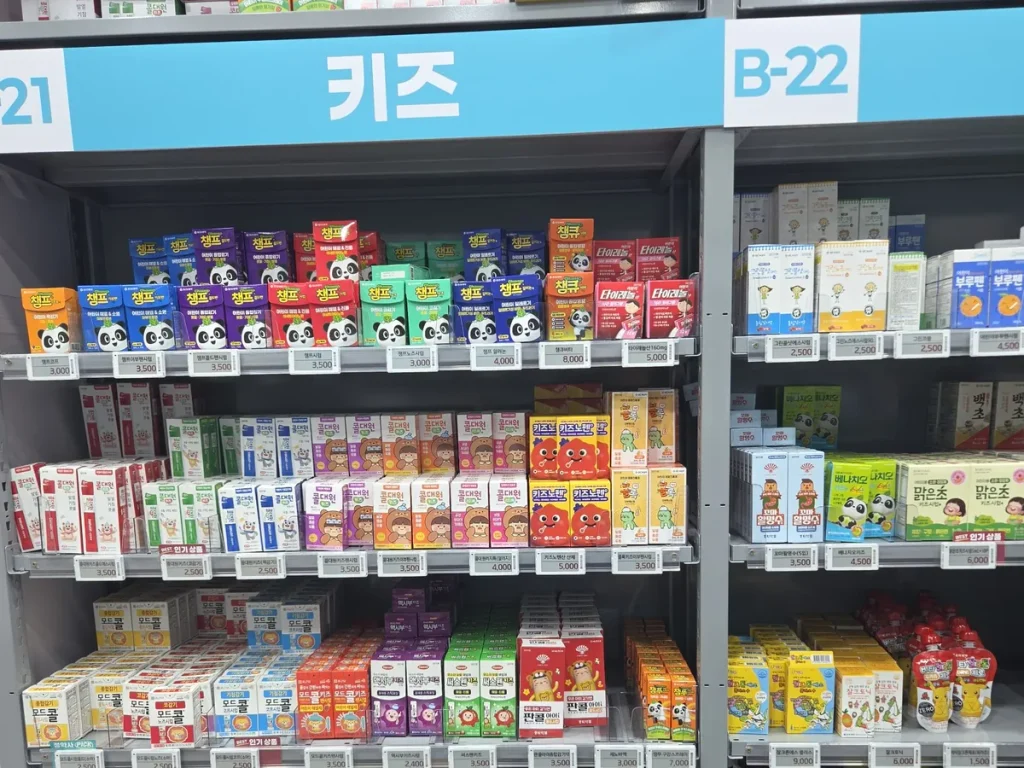
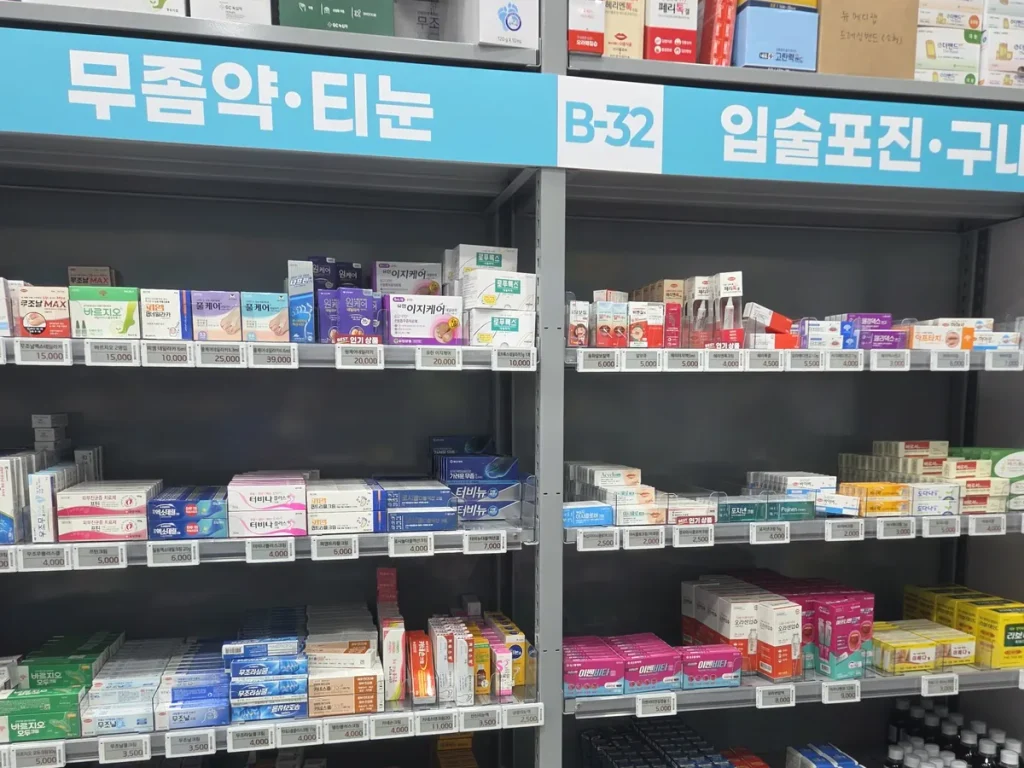
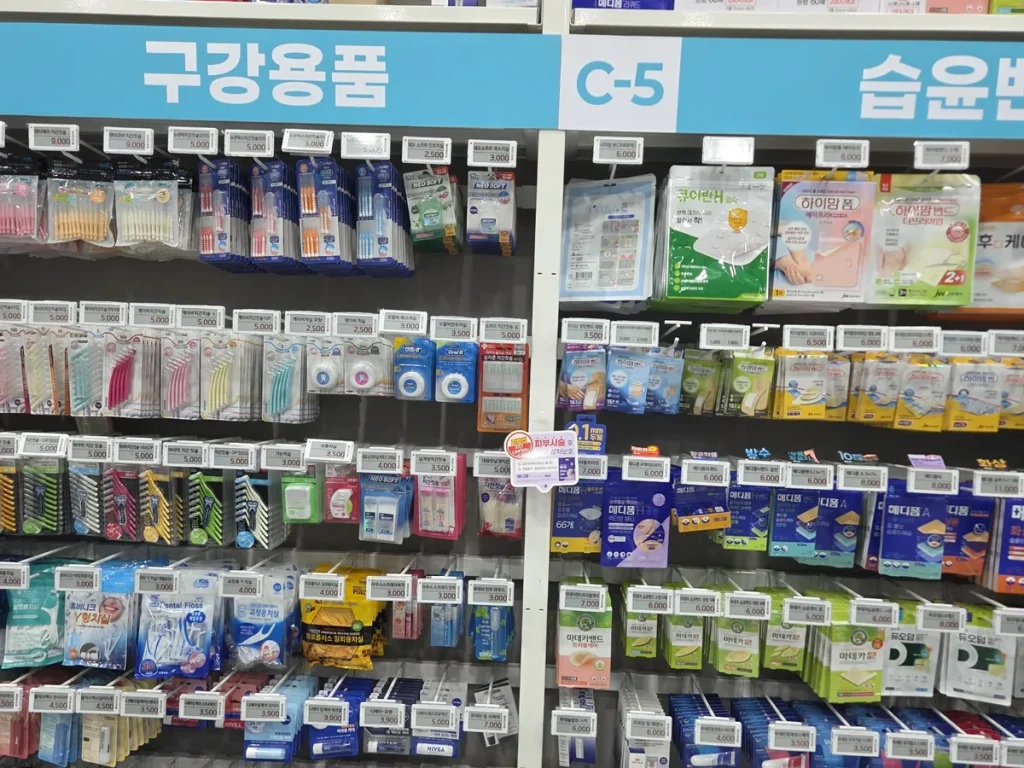
Each bay has a blue sign with a code, such as B-21 or C-10, and a word or two saying what is on the shelves below. These are the signs in my photos. Learn a handful and you can find your way around any large Korean pharmacy.
| Korean | Romanisation | Meaning |
|---|---|---|
| 키즈 | kijeu | Kids: children’s medicine |
| 무좀약 | mujomnyak | Athlete’s foot medicine |
| 티눈 | tinun | Corns on the feet |
| 입술포진 | ipsulpojin | Cold sores |
| 구내염 | gunaeyeom | Mouth ulcers |
| 구강용품 | gugang yongpum | Oral care: floss, toothbrushes |
| 습윤밴드 | seubyun baendeu | Hydrocolloid “moist” plasters |
| 영양제 | yeongyangje | Supplements |
| 혈압 · 혈당 | hyeorap · hyeoldang | Blood pressure · blood sugar |
| 갱년기 | gaengnyeongi | Menopause |
| 임산부 | imsanbu | Pregnant women |
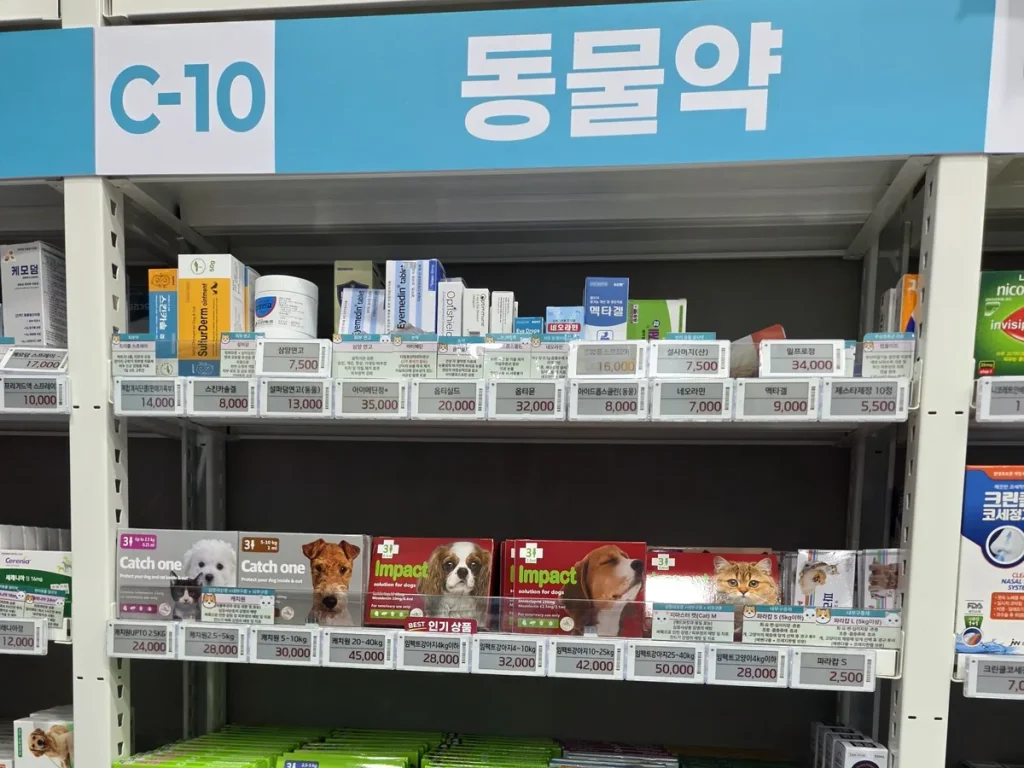
| 동물약 | dongmullyak | Medicine for animals |
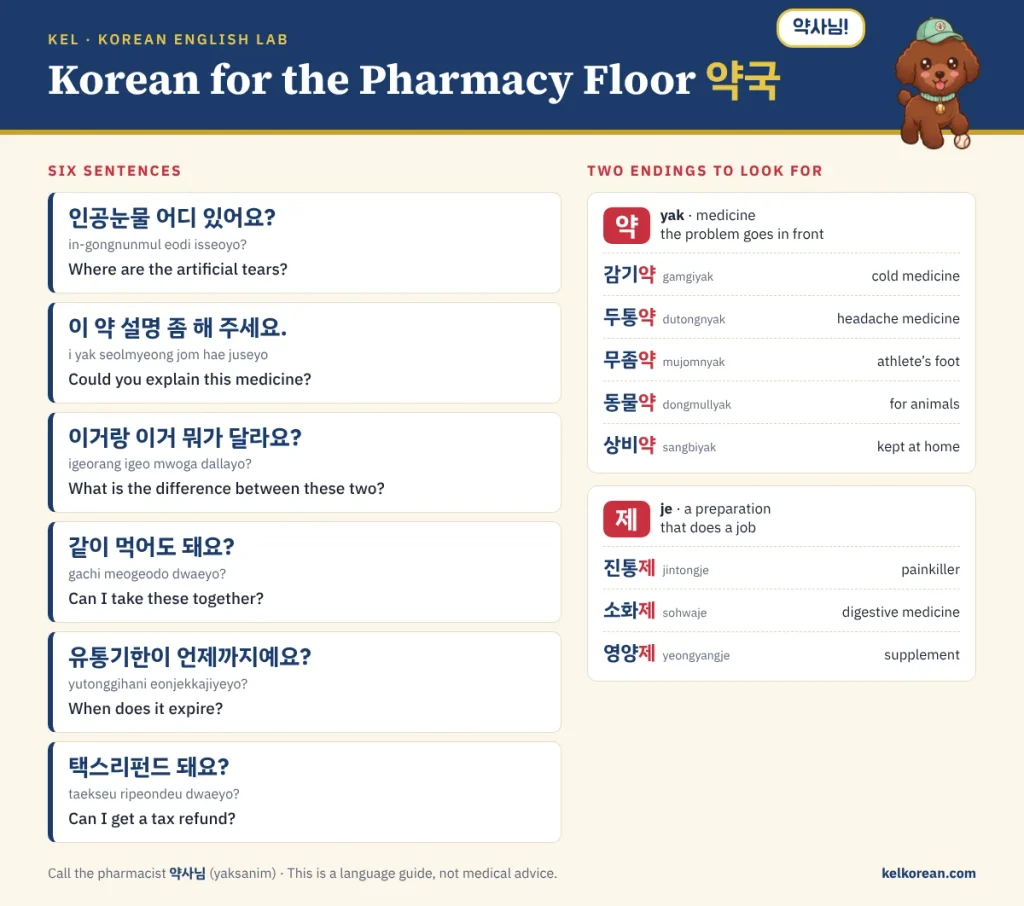
Two endings do most of the work. 약 (yak) is “medicine,” and you put the problem in front of it: 감기 (a cold) gives 감기약, 두통 (headache) gives 두통약, 무좀 (athlete’s foot) gives 무좀약, and 동물 (animal) gives 동물약. 제 (je) is a more formal ending meaning a preparation that does a job: 진통제 stops pain, 소화제 helps digestion, and 영양제 gives nutrition. When you see either ending on a sign, you already know half the word.
A small pronunciation point, because it explains the spellings above. After a consonant, 약 often picks up an extra sound, so 두통약 is said [두통냑] and 동물약 is said [동물략]. After a vowel nothing changes, and 감기약 sounds just as it looks.
Price Tags and the Red 인기 상품 Label
Under each product is a small electronic tag with the product name in Korean and the price. There is no ₩ sign, only a number such as 3,500, and that is the price in won for one box. On the children’s shelf I photographed, most of the cold syrups were tagged between 2,500 and 5,000 won. Prices are read with Sino-Korean numbers, so 3,500 is 삼천오백 원 (samcheon-obaek won), and our guide to Korean numbers covers the rest.
Here and there you will see a red label that says BEST 인기 상품. 인기 (ingi) is popularity and 상품 (sangpum) is a product, so it marks what sells well in that shop. It tells you what other people buy. It does not tell you what is right for you. If you enjoy decoding shelves, our guide to reading an Olive Young shelf does the same for cosmetics.
What You Can Pick Up, and What You Cannot
Open shelves do not mean everything is for sale to everyone. Korean law sorts what a pharmacy sells into groups, and the words are printed on the boxes.
- 일반의약품 (ilban-uiyakpum), general medicine. This is what you can buy without a prescription, and in Korea it is sold in pharmacies. The open shelves in a warehouse pharmacy are full of it.
- 전문의약품 (jeonmun-uiyakpum), prescription medicine. You need a 처방전 (cheobangjeon) from a clinic, and the pharmacist prepares it at the counter. No pharmacy, however large, puts this on a shelf for you to take.
- 건강기능식품 (geongang gineung sikpum), health functional food. This is the legal name for supplements such as vitamins, and it covers much of what fills the long aisles.
- 의약외품 (uiyagoepum), quasi-drugs. Plasters, toothpaste and similar goods, which you will also find in ordinary shops.
Convenience stores are a separate case. They may sell only a short official list of basic medicine: 13 products are on it, and 11 were actually on sale in August 2026, with the government working on extending the list. For anything else, you need a pharmacy.
Choosing for yourself is convenient, but it puts the checking in your hands. Before you pay, show the pharmacist what you have picked, say what else you are taking, and ask. If you need to describe how you feel, our guide to saying you are sick in Korean has the symptoms and the sentences for the counter.
Medicine for the Dog, Too: 동물약
One bay surprised me in a good way. The sign said 동물약, medicine for animals, and the shelves held boxes with dogs and cats on the front. Some Korean pharmacies sell medicine for pets, and this one had a whole bay of it. I have two dogs, so this is where I bought their 심장사상충 (simjangsasangchung, heartworm) medicine and their medicine for external parasites.
The boxes are sorted by the animal’s weight, which is printed on the front and on the price tag, so know your pet’s weight in kilograms before you go. As with your own medicine, your vet is the right person to say which product suits your pet.
Should a Traveller Go?
I will be honest: warehouse pharmacies are built for people who live here. They are large, and many are in suburbs or inside big supermarkets rather than in the tourist streets. Mine, in Yangsan, is not on a visitor’s route. If you are curious, search 창고형 약국 or 대형약국 (daehyeong yakguk, “large pharmacy”) in a Korean map app and see what is near you. Our list of Korea travel apps explains which map to use.
You do not need a warehouse to enjoy a Korean pharmacy, though. Visitors have discovered ordinary ones, especially around Myeong-dong and Namdaemun Market in Seoul, where they go for skin products that are sold only in pharmacies. According to Korea Tourism Organization figures reported in October 2026, pharmacies took about 14 percent of foreign visitors’ medical spending in September, around 31.8 billion won, up from about 8 percent in December 2025.
- Tax refund. Some pharmacies in tourist areas offer it and many do not. I cannot tell you whether mine did, so ask before you pay. Our guide to paying in Korea covers cards and cash.
- Taking medicine home. Every country has its own rules on what you may bring in and how much. Check yours before you fill a basket, and keep everything in its original box.
- Reading the box. Most packaging is in Korean only. A translation app helps with the name, but for how to take it, ask the pharmacist.
Korean for the Pharmacy Floor
Call the pharmacist 약사님 (yaksanim). 약사 is the job, and 님 is the polite ending you add when you speak to someone, so it works like “excuse me, pharmacist.”
| Korean | Romanisation | Meaning |
|---|---|---|
| 인공눈물 어디 있어요? | in-gongnunmul eodi isseoyo? | Where are the artificial tears? |
| 이 약 설명 좀 해 주세요. | i yak seolmyeong jom hae juseyo | Could you explain this medicine? |
| 이거랑 이거 뭐가 달라요? | igeorang igeo mwoga dallayo? | What is the difference between these two? |
| 같이 먹어도 돼요? | gachi meogeodo dwaeyo? | Can I take these together? |
| 아이가 먹어도 돼요? | aiga meogeodo dwaeyo? | Can a child take this? |
| 더 작은 거 있어요? | deo jageun geo isseoyo? | Do you have a smaller pack? |
| 유통기한이 언제까지예요? | yutonggihani eonjekkajiyeyo? | When does it expire? |
| 강아지 약 있어요? | gangaji yak isseoyo? | Do you have medicine for dogs? |
| 택스리펀드 돼요? | taekseu ripeondeu dwaeyo? | Can I get a tax refund? |
| 영수증 주세요. | yeongsujeung juseyo | A receipt, please. |
Notice the verb in the fourth and fifth lines. In Korean you eat medicine: 약을 먹어요, not “take.” So “can I take these together?” is literally “is it all right to eat them together?” For prices and what the cashier will say back, see shopping in Korean.
Bring a List, Ask the 약사님
A warehouse pharmacy is an easy place to spend more than you planned, so do what I did and go with a list: the few things your household really uses. Read the blue signs, look for 약 and 제 at the ends of the words, check the number on the tag, and take your basket to a pharmacist before you take it to the checkout. Whether the big sign still says 창고형 next year or not, the small 약국 on the corner and the giant one by the car park sell the same thing in the end, which is a little peace of mind in a drawer at home. That is what 상비약 means.
Written by Minhyung Cha — 25 years teaching Korean, and 15+ years running an English academy in South Korea. I live and work in Busan, and every example on this site is checked as a native speaker. More about KEL.
Leave a Reply