
It is ten at night. Your stomach has turned on you, and there is a green cross glowing on the corner because in Korea there is always a pharmacy on the corner.
You do not need conversational fluency for this. You need about eight sentences.
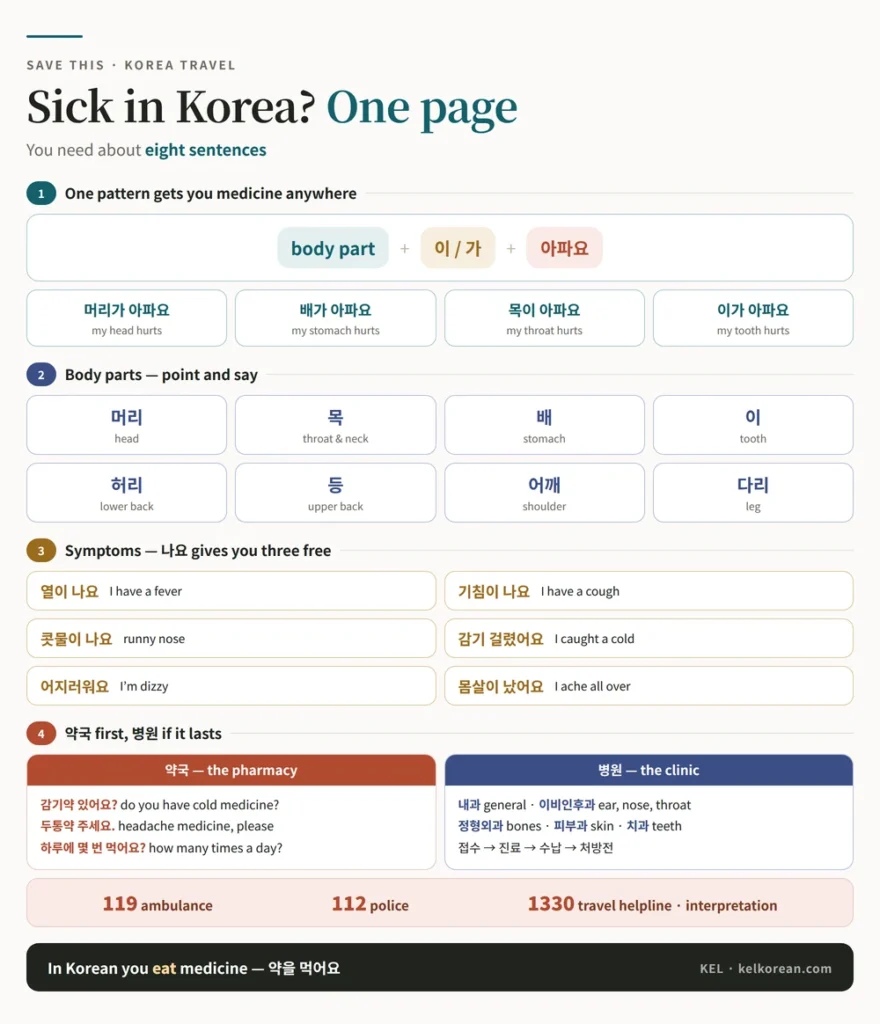
Saying you are sick in Korean runs on one adjective, a handful of body parts and a short list of symptoms. This guide gives you exactly those, plus what to say at a 약국, what the departments at a clinic are called, and the numbers to call if it turns serious.
This is a language guide, not medical advice. If something is worrying you, see a doctor — the phrases here are for making that easier.
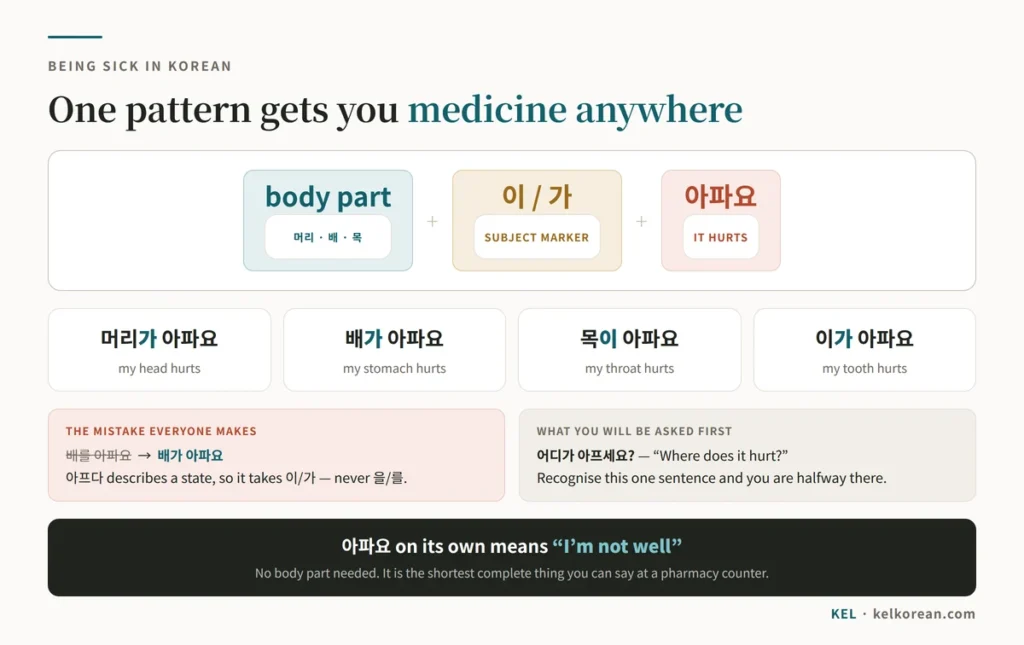
아파요 — The One Word That Does Most of the Work
If you learn nothing else here, learn this.
아파요 (apayo) — “it hurts”
The dictionary form is 아프다. In the polite everyday form it becomes 아파요, and it works two ways.
On its own it means “I’m sick” or “I don’t feel well.”
아파요. — I’m not well.
어제부터 아파요. — I’ve been sick since yesterday.
With a body part it means that part hurts.
[body part] + 이/가 + 아파요
The particle is 이 after a consonant and 가 after a vowel. This is the single most common mistake learners make here, so it is worth getting right — and the pattern is the same one covered in Korean particles.
Watch out for this one: it is 배가 아파요, never 배를 아파요. 아프다 describes a state rather than an action, so it takes the subject marker, not the object marker. Our guide to Korean verb conjugation explains why this class of word behaves the way it does.
What you will be asked:
어디가 아프세요? — “Where does it hurt?”
That is the first thing a pharmacist or a nurse will say. Recognise it and you are halfway there.
Keep the 요. Plain 아파 is the casual form you would use with a friend — with a pharmacist or a doctor, it is always 아파요.
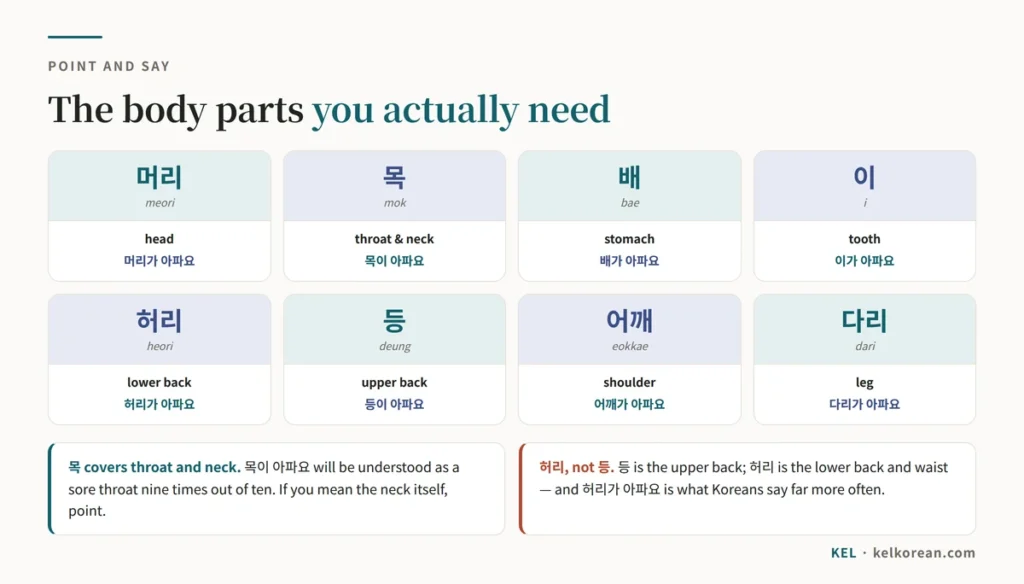
The Body Parts You Actually Need
| Korean | Romanization | English | Say it as |
|---|---|---|---|
| 머리 | meori | head | 머리가 아파요 |
| 배 | bae | stomach, belly | 배가 아파요 |
| 목 | mok | throat and neck | 목이 아파요 |
| 이 | i | tooth | 이가 아파요 |
| 귀 | gwi | ear | 귀가 아파요 |
| 눈 | nun | eye | 눈이 아파요 |
| 코 | ko | nose | 코가 아파요 |
| 등 | deung | back | 등이 아파요 |
| 허리 | heori | lower back, waist | 허리가 아파요 |
| 다리 | dari | leg | 다리가 아파요 |
| 팔 | pal | arm | 팔이 아파요 |
| 어깨 | eokkae | shoulder | 어깨가 아파요 |
목 covers both throat and neck. 목이 아파요 usually means a sore throat, which is what you want when you have a cold. If you mean the neck itself, point.
허리 is not the same as 등. 등 is the upper back; 허리 is the lower back and waist. Koreans say 허리가 아파요 far more often, because that is where the pain usually is.
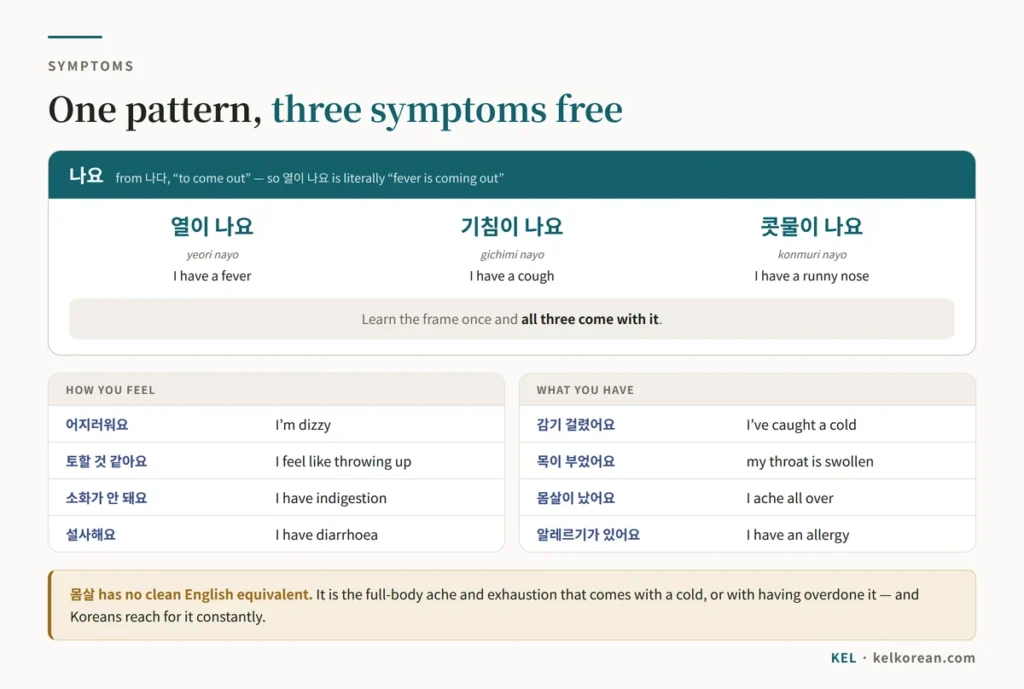
Symptoms
| Korean | Romanization | Meaning |
|---|---|---|
| 열이 나요 | yeori nayo | I have a fever |
| 기침이 나요 | gichimi nayo | I have a cough |
| 콧물이 나요 | konmuri nayo | I have a runny nose |
| 목이 부었어요 | mogi bueosseoyo | my throat is swollen |
| 어지러워요 | eojireowoyo | I’m dizzy |
| 토할 것 같아요 | tohal geot gatayo | I feel like throwing up |
| 설사해요 | seolsahaeyo | I have diarrhoea |
| 소화가 안 돼요 | sohwaga an dwaeyo | I have indigestion |
| 감기 걸렸어요 | gamgi geollyeosseoyo | I’ve caught a cold |
| 몸살이 났어요 | momsari nasseoyo | I ache all over |
| 알레르기가 있어요 | allereugiga isseoyo | I have an allergy |
나요 is doing a lot of work here. 나다 means “to come out” or “to occur,” so 열이 나요 is literally “fever is coming out.” The same frame gives you 기침이 나요 and 콧물이 나요. Learn the pattern once and you get three symptoms free.
몸살 has no clean English equivalent. It is the full-body ache and exhaustion that comes with a cold or with having overdone it — and Koreans use it constantly.
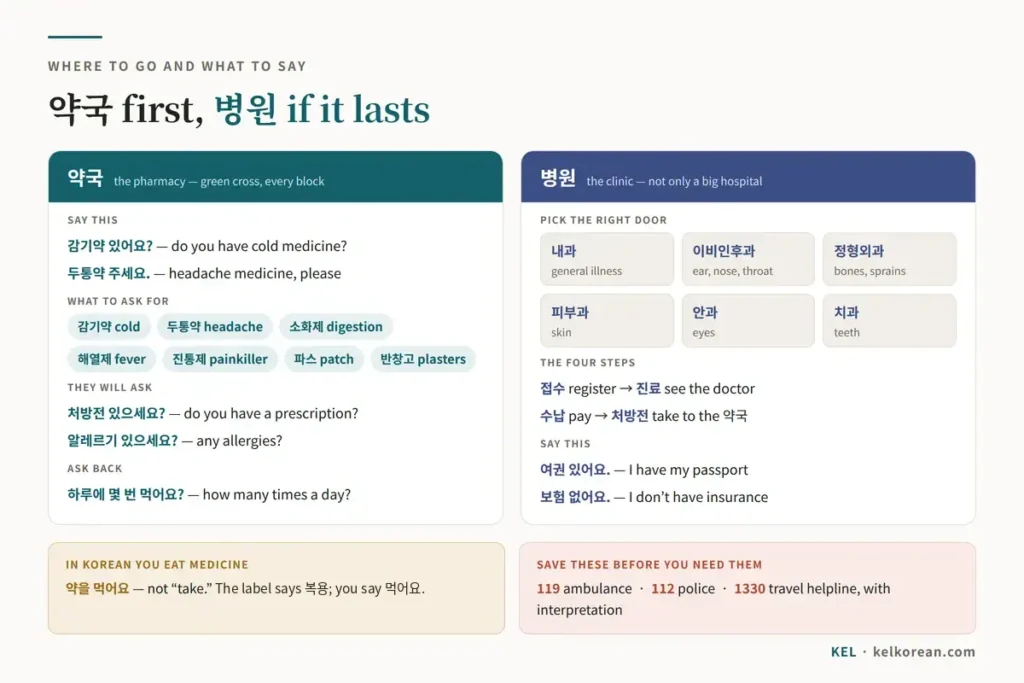
At the 약국 — The Pharmacy
Korea has pharmacies everywhere, marked with a green cross and the character 약. For anything minor, this is your first stop rather than a clinic — pharmacists are used to walk-ins and many understand basic English.
Opening the conversation:
감기약 있어요? — Do you have cold medicine?
두통약 주세요. — Headache medicine, please.
배가 아파요. 약 주세요. — My stomach hurts. Medicine, please.
What things are called:
| Korean | What it is |
|---|---|
| 감기약 | cold medicine |
| 두통약 | headache medicine |
| 소화제 | digestive medicine |
| 해열제 | fever reducer |
| 진통제 | painkiller |
| 소독약 | antiseptic |
| 반창고 · 밴드 | plasters, band-aids |
| 파스 | medicated patch |
| 마스크 | face mask |
파스 deserves a mention because it is far more common in Korea than in most Western countries. It is an adhesive patch for aching muscles, and every pharmacy sells a wall of them.
What they will ask you:
처방전 있으세요? — Do you have a prescription?
알레르기 있으세요? — Do you have any allergies?
What you will want to ask back:
하루에 몇 번 먹어요? — How many times a day do I take it?
언제 먹어요? — When do I take it?
The answer usually involves numbers and 식후 (after meals) or 식전 (before meals):
하루에 세 번, 식후 30분에 드세요. — Three times a day, thirty minutes after meals.
The counting there uses native Korean numbers — 한 번, 두 번, 세 번 — which is covered in Korean numbers explained.
One vocabulary quirk: in Korean you eat medicine. 약을 먹어요, not “take.” A pharmacist will say the polite 드세요, and the label may use the formal 복용, but in your own sentences the verb is 먹어요.
At the 병원 — The Clinic
병원 is not only a “hospital.” In Korean it covers everything from a two-room neighbourhood clinic to a major medical centre. The small ones are what you want, and they are usually on the second or third floor of an ordinary building.
Clinics are specialised, and the sign tells you which one it is.
| Korean | Romanization | What it treats |
|---|---|---|
| 내과 | naegwa | internal medicine — colds, stomach, general illness |
| 이비인후과 | ibiinhugwa | ear, nose and throat |
| 정형외과 | jeonghyeongoegwa | bones, joints, sprains |
| 피부과 | pibugwa | skin |
| 안과 | angwa | eyes |
| 치과 | chigwa | teeth |
| 산부인과 | sanbuingwa | obstetrics and gynaecology |
내과 is the default. If you are unwell and unsure, that is the door to walk through.
The process:
- 접수 (jeopsu) — registration. Say 접수할게요 and hand over your passport.
- 진료 (jillyo) — the consultation.
- 수납 (sunap) — payment on the way out.
- 처방전 (cheobangjeon) — the prescription, which you take to a 약국, usually the one on the ground floor.
여권 있어요. — I have my passport.
보험 없어요. — I don’t have insurance.
Without national insurance you pay the full cost, but for a simple clinic visit that is usually far less than visitors expect.
A Real Pharmacy Conversation
약사: 어서 오세요. 어디가 아프세요?
You: 목이 아파요. 그리고 기침이 나요.
약사: 열도 나세요?
You: 조금요.
약사: 감기약 드릴게요. 알레르기 있으세요?
You: 없어요.
약사: 하루에 세 번, 식후에 드세요.
You: 얼마예요?
약사: 육천 원이에요.
You: 감사합니다.
Ten lines, and you have what you came for. Notice how much of it is recognition rather than production — you say five short things, and the rest is understanding.
If you want more practice with the transaction half of this, shopping in Korean covers prices and paying.
If It Is Serious
Save these before you need them.
| Number | What it is |
|---|---|
| 119 | ambulance and fire — the number for a medical emergency |
| 112 | police |
| 1330 | Korea Travel Helpline — run by the Korea Tourism Organization, open 24 hours, with interpretation |
1330 is the one most visitors do not know about. It is a tourist helpline that offers interpretation, and it can bridge a conversation you cannot manage alone. If you are in a clinic and stuck, calling it is a genuine option.
Phrases for an emergency:
도와주세요! — Help!
구급차 불러 주세요. — Please call an ambulance.
응급실 어디예요? — Where is the emergency room?
영어 하시는 분 있어요? — Is there anyone who speaks English?
응급실 (eunggeupsil) is the emergency room, attached to larger hospitals rather than neighbourhood clinics.
Try It: Five Things You Might Need to Say
How would you say each of these?
- I have a headache.
- Do you have cold medicine?
- I have a fever and a cough.
- How many times a day do I take it?
- Please call an ambulance.
Answers
- 머리가 아파요.
- 감기약 있어요?
- 열이 나요. 그리고 기침이 나요.
- 하루에 몇 번 먹어요?
- 구급차 불러 주세요.
Frequently Asked Questions
How do you say “I’m sick” in Korean?
아파요. On its own it means you are unwell; with a body part in front of it — 배가 아파요 — it means that part hurts.
Do pharmacists in Korea speak English?
Many understand enough for a simple transaction, particularly in Seoul and in tourist areas, but do not count on it. The phrases in this guide are short precisely so that they work when English does not.
Do I need a prescription for cold medicine in Korea?
Common remedies for colds, headaches and indigestion are sold over the counter at any 약국. Anything stronger needs a 처방전 from a clinic.
Where can I buy medicine at night in Korea?
Many cities run public late-night pharmacies, 공공심야약국, usually open from 10 p.m. to 1 a.m. every night — Busan alone has eighteen. Search 심야약국 on Naver Map to find the nearest one. Around the clock, 24-hour convenience stores keep a small shelf of basic medicine: fever and pain relievers, cold medicine and digestive medicine. For anything more than that in the middle of the night, go to an 응급실.
One Sentence and Two Numbers
Nobody plans this vocabulary, which is exactly why it is worth twenty minutes before a trip rather than twenty minutes into a bad night.
The core of it is very small. 아파요, one body part, one symptom — that sentence alone will get you medicine at any pharmacy in Korea. Everything else in this guide is refinement.
Save 119 and 1330 in your phone now. And if you are putting a trip together, 10 essential Korean phrases for travellers covers the everyday ground, and how to use the Korean subway gets you to the pharmacy in the first place.
Written by Minhyung Cha — 25 years teaching Korean, and 15+ years running an English academy in South Korea. I live and work in Busan, and every example on this site is checked as a native speaker. More about KEL.
Leave a Reply