Let me start with a story from my Korean teaching days.
One of my foreign students — a lovely, hardworking beginner — walked into a cafe in Korea and confidently ordered what she thought was a coffee. The barista froze. A few nearby customers tried very hard not to laugh.
She had meant to say 커피 (keopi — coffee). What came out of her mouth was much closer to 코피 (kopi — a nosebleed).
She had, with a bright smile, asked for a nosebleed. To go.
The entire difference between those two words is a single pair of Korean vowels :ㅓ vs ㅗ. And if you’re learning Korean as an English speaker, I can almost guarantee this pair of Korean vowels is giving you trouble too — because it gave trouble to every single student I ever taught. The good news: it’s completely fixable, and in this post I’ll show you exactly how I fixed it in my classroom.
Why ㅓ and ㅗ Sound “the Same” to English Speakers
Here’s the honest truth: ㅓ and ㅗ don’t actually sound similar at all — to Korean ears. They sound as different as “bit” and “beat” do to you.
The problem is that English doesn’t have a clean equivalent of ㅓ, and romanization makes it worse. Both vowels get romanized with the letter “o” (ㅓ as “eo,” ㅗ as “o”), so learners see “eo” and “o” and assume they’re two flavors of the same sound. They are not. They differ in the two things your mouth controls most directly: lip shape and tongue position.
The Mouth Positions, Step by Step
ㅗ — the rounded vowel
- Sounds like the “o” in “go” or “so,” but pure and short — without the “w” glide English adds at the end.
- Lips: tightly rounded, pushed forward into a small circle, like you’re about to whistle or blow out a candle.
- Tongue: pulled back and raised toward the back of your mouth.
ㅓ — the relaxed vowel
- Sounds close to the “u” in “up” or the “o” in “son,” but with your mouth open wider.
- Lips: completely relaxed — no rounding at all. Your jaw drops and your mouth opens loosely.
- Tongue: low and slightly back, resting lazily in your mouth.
In my classes, I reduced all of this to one physical rule, and I want you to remember it the same way my students did:
ㅗ = kissing lips. ㅓ = lazy jaw.
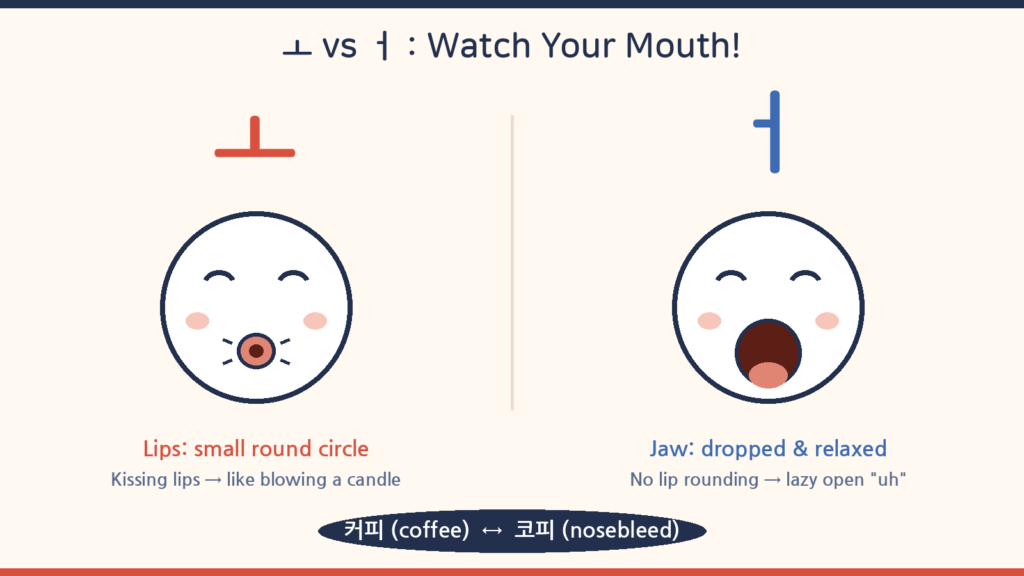
If your lips are rounded into a small circle, you physically cannot say ㅓ. If your lips are relaxed and your jaw is dropped, you physically cannot say ㅗ. This is why I always told my students: don’t try to hear the difference first — make the difference with your mouth, and your ears will catch up.
The Mirror Test
Here’s the exact drill I used in my classroom. You need a mirror (your phone’s front camera works perfectly).
- Watch your mouth and say 오, 오, 오. You should see a small round circle. If your lips aren’t visibly puckered, it’s not ㅗ.
- Now relax everything, drop your jaw, and say 어, 어, 어. Your mouth should look loosely open — taller than it is round. If you see any rounding creep in, shake out your lips and try again.
- Alternate: 오–어–오–어–오–어. Your lips should visibly move between “kiss” and “relaxed” every single time.
My students were always surprised by how visual this is. You can literally see the difference between ㅓ and ㅗ from across the room. When I taught, I could tell from the back of the classroom who was pronouncing 어 correctly — without hearing a single sound — just by watching mouths.
Minimal Pairs: Where the Difference Really Matters
A “minimal pair” is two words that differ by only one sound. These are the pairs I drilled with my students, because mixing them up changes the meaning completely:
| ㅓ word | Meaning | ㅗ word | Meaning |
|---|---|---|---|
| 커피 (keopi) | coffee | 코피 (kopi) | nosebleed |
| 거기 (geogi) | there (that place) | 고기 (gogi) | meat |
| 서리 (seori) | frost | 소리 (sori) | sound |
| 벌 (beol) | bee / punishment | 볼 (bol) | cheek |
| 거리 (geori) | street / distance | 고리 (gori) | ring / hook |
| 어이 (eoi) | hey! (exclamation) | 오이 (oi) | cucumber |
The 거기/고기 pair produced my second-favorite classroom story. A student at a barbecue restaurant wanted to point at a table and say 거기 (over there) — but said 고기 (meat). The staff, quite reasonably, brought him more meat. He told me later it was the most delicious pronunciation mistake he ever made, and he never confused the two vowels again. Sometimes the best teacher is a plate of extra samgyeopsal.
A Three-Step Practice Routine (5 Minutes a Day)
This is the routine I assigned as homework, and the students who actually did it fixed this vowel pair within two to three weeks:
Step 1 — Mouth drills (1 minute). In front of your mirror: 오–어–오–어, ten slow repetitions. Exaggerate. Kiss, relax, kiss, relax. It should feel almost silly — that means you’re doing it right.
Step 2 — Minimal pair reading (2 minutes). Read each pair from the table above out loud, three times: 커피–코피, 거기–고기, 서리–소리… Say them slowly enough that you feel your lips change shape between the two words.
Step 3 — Record and compare (2 minutes). Record yourself saying the pairs on your phone, then listen back. This step matters more than you think: what your mouth feels and what your voice actually produces are often different, and the recording doesn’t lie. My students hated this step for the first week — and thanked me for it afterward.
What About Listening?
Learners always asked me: “I can say them now, but I still can’t hear the difference in fast speech!” That’s normal, and here’s the reassuring part: production leads perception. Once your mouth reliably makes two different shapes, your brain starts categorizing the two sounds as genuinely different — and hearing improves on its own.
To speed it up, listen for the roundness. ㅗ has a deeper, darker, more “closed” quality because of the rounded lips. ㅓ sounds flatter and more open. When watching Korean dramas or videos, watch the speakers’ mouths — Korean lip rounding is visible, and your eyes will train your ears.
The Other Vowel Pairs That Trip People Up
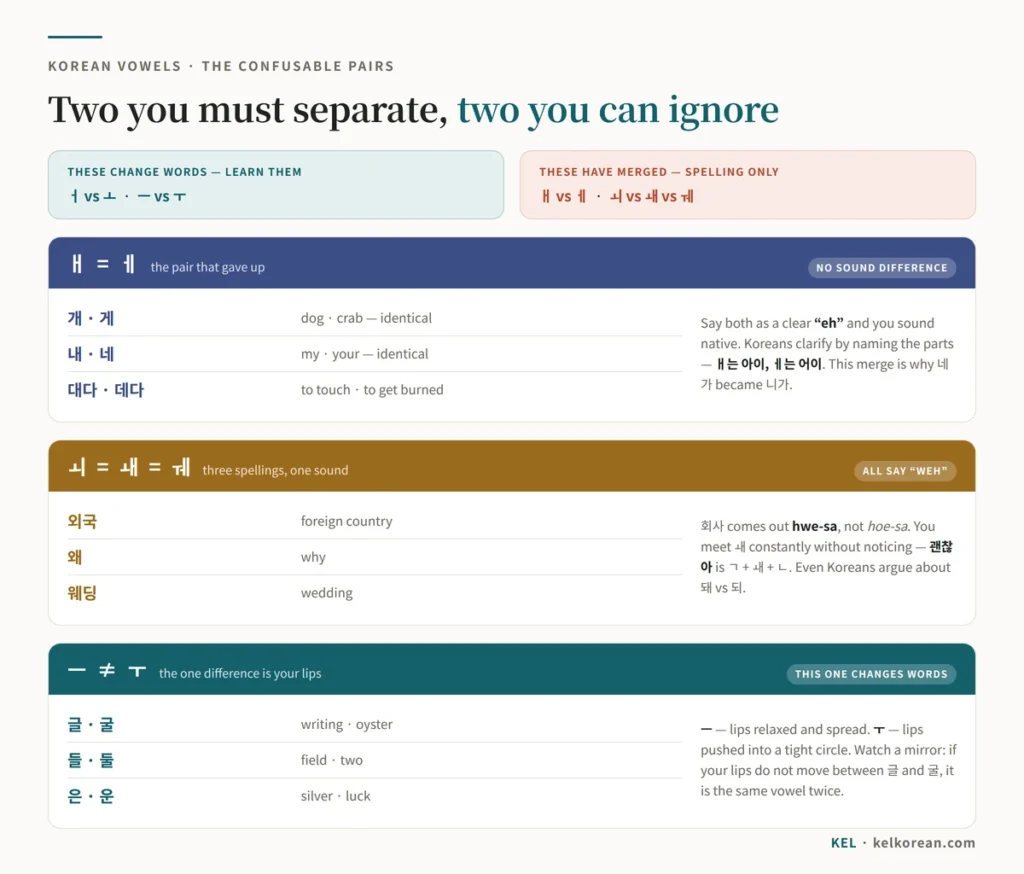
ㅓ and ㅗ are the pair that matters most, because mixing them up changes words. The three pairs below are different — with two of them, the good news is that you do not have to tell them apart at all.
ㅐ and ㅔ — the pair that gave up
These were once two distinct vowels: ㅐ open, ㅔ slightly closer. In modern Seoul Korean they have merged. Most speakers under fifty pronounce them identically, and younger speakers make no distinction whatsoever.
| Pair | Meaning | How they sound today |
|---|---|---|
| 개 · 게 | dog · crab | identical |
| 내 · 네 | my · your | identical |
| 대다 · 데다 | to touch · to get burned | identical |
The good news: you do not need to train your mouth for this one. Say both as a clear “eh” and you will sound like a Seoul native.
The bad news: you still have to spell them correctly, and there is no sound to guide you. The spelling has to be memorised word by word.
Koreans have a workaround for this in speech. When they need to clarify which one they mean, they spell it out by the parts: ㅐ is 아이 (ㅏ plus ㅣ) and ㅔ is 어이 (ㅓ plus ㅣ). If someone dictates a name over the phone, this is how they do it.
This merge has one famous consequence. Because 네 (“your,” “you”) now sounds exactly like 내 (“my,” “I”), Korean speakers began pronouncing 네가 as 니가 just to keep them apart — which is why every song sounds that way. That is covered in K-pop Korean.
ㅚ, ㅙ and ㅞ — three spellings, one sound
Three different vowels on the page. In modern speech, all three are pronounced roughly the same — close to English “weh.”
| Written | Example | Meaning |
|---|---|---|
| ㅚ | 외국 | foreign country |
| ㅙ | 왜 | why |
| ㅞ | 웨딩 | wedding |
ㅚ was historically a single rounded vowel, and the standard still permits that pronunciation — but almost no one uses it in ordinary speech. 회사 comes out as hwe-sa, not hoe-sa.
You will meet ㅙ constantly without noticing: 괜찮아 is ㄱ + ㅙ + ㄴ.
Again, the sound is free and the spelling is not. Koreans themselves mix these up in writing — 돼 and 되 are the most argued-about pair in the language, and 왠지 versus 웬일 trips up native speakers daily. The rule for that second one is small and worth having: 왠지 (“somehow”) is the only common word with 왠. Everything else is 웬 — 웬일, 웬만하면, 웬 사람.
ㅡ and ㅜ — the one difference is your lips
Unlike the two pairs above, this one is real and it does change words. Both vowels are made in the same place in the mouth. The only difference is rounding.
- ㅡ — lips relaxed and spread, almost as if you were about to say “uh” through a flat mouth
- ㅜ — lips pushed forward into a tight circle, like the “oo” in food
| Pair | Meaning |
|---|---|
| 글 · 굴 | writing · oyster |
| 들 · 둘 | field · two |
| 은 · 운 | silver · luck |
| 슬프다 · 술 | to be sad · alcohol |
The mirror test from earlier works here too. Say 글 and then 굴 while watching your mouth. If your lips do not visibly move, you are producing the same vowel twice.
ㅡ is the harder one for English speakers, because English has no equivalent. The instinct is to round it into “oo” or flatten it into “uh.” Neither is right — keep the lips wide and the tongue high.
Frequently Asked Questions
Is ㅓ the same as the English “uh” sound?
It’s close, and “uh” (as in “up”) is the best starting point — but ㅓ is longer and more open, with the jaw dropped further. Starting from “uh” and opening your mouth wider gets most learners 90% of the way there.
Do Koreans really notice if I mix up ㅓ and ㅗ?
Yes — instantly, the way you’d notice someone saying “ship” instead of “sheep.” Context usually rescues the meaning, but as the 커피/코피 story shows, not always. The good news is that Koreans are generally delighted when foreigners get this pair right, because they know how hard it is.
What about ㅡ and ㅜ? Those confuse me too.
That’s the other famous vowel pair for English speakers, and the same principle applies: ㅜ is rounded, ㅡ is not. Master ㅓ/ㅗ first — the “round vs. relaxed” awareness you build here transfers directly to ㅡ/ㅜ.
What is the difference between ㅐ and ㅔ?
In modern Seoul Korean, none in speech — they have merged, and most speakers pronounce 개 and 게 identically. The difference survives only in spelling, which has to be memorised word by word. Koreans clarify in speech by naming the parts: ㅐ is 아이, ㅔ is 어이.
Why do 외, 왜 and 웨 sound the same?
Because they have converged in modern pronunciation. All three come out close to English “weh.” ㅚ was historically a single rounded vowel and the standard still allows it, but almost no one uses that pronunciation now — 회사 sounds like hwe-sa.
What is the difference between ㅡ and ㅜ?
Lip rounding, and nothing else. ㅜ is made with the lips pushed into a tight circle; ㅡ with the lips relaxed and spread. It changes words — 글 is writing, 굴 is an oyster.
Which Korean vowels do I actually need to distinguish?
ㅓ and ㅗ, and ㅡ and ㅜ. Those two pairs change meaning. ㅐ versus ㅔ and ㅚ versus ㅙ versus ㅞ have merged in speech, so you only need them for spelling.
Korean English Lab (KEL) creates practical Korean learning materials based on real classroom experience. If this series is helping you, start from the beginning: Hangul, sentence structure, your first 100 words — and now, the vowels that make you sound like you’ve actually studied. Your future baristas thank you.
Pronunciation is stage two of five. See how the whole beginner path fits together, with a realistic 12-week schedule.
Written by Minhyung Cha — 25 years teaching Korean, and 15+ years running an English academy in South Korea. Every example on this site is checked as a native speaker. More about KEL.
Leave a Reply