Suneung day is the one Thursday a year when all of South Korea goes quiet for its students. Offices start late, extra trains run before dawn, police cars carry teenagers who are running late, and for about half an hour in the afternoon no plane in the country takes off or lands. In 2026 that day is Thursday 19 November, and about 550,000 people have applied to sit the exam.
I have seen this day from more than one side. I sat Korea’s university entrance exam myself, and I still remember how cold it was. Then, for more than fifteen years, I ran an English academy where many of our high school students took the Suneung, and every November we sent them off with sweets and quiet encouragement. This is what the day looks like from the inside, what changes for everyone else, and the Korean words you will hear all month.
What the Suneung Is
수능 (suneung) is short for 대학수학능력시험 (daehak suhak neungnyeok siheom), the College Scholastic Ability Test. It is the national exam that most Korean students take at the end of high school, and its scores decide, or heavily influence, which university they can enter. It is held once a year, on a single day, in every region at the same time. If it goes badly, the next chance is twelve months away.
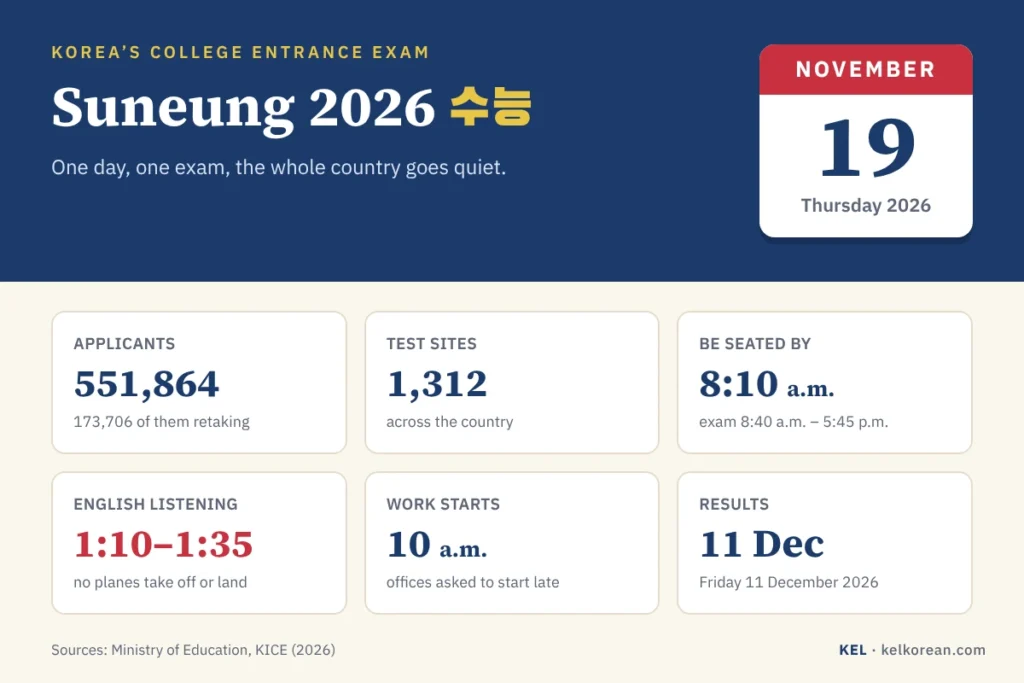
| What | 2026 details |
|---|---|
| Exam day | Thursday 19 November 2026 |
| Applicants | 551,864 |
| Test sites | 1,312 across the country |
| Be seated by | 8:10 a.m. |
| Exam hours | 8:40 a.m. to 5:45 p.m. |
| English listening | 1:10 to 1:35 p.m. |
| Results | Friday 11 December 2026 |
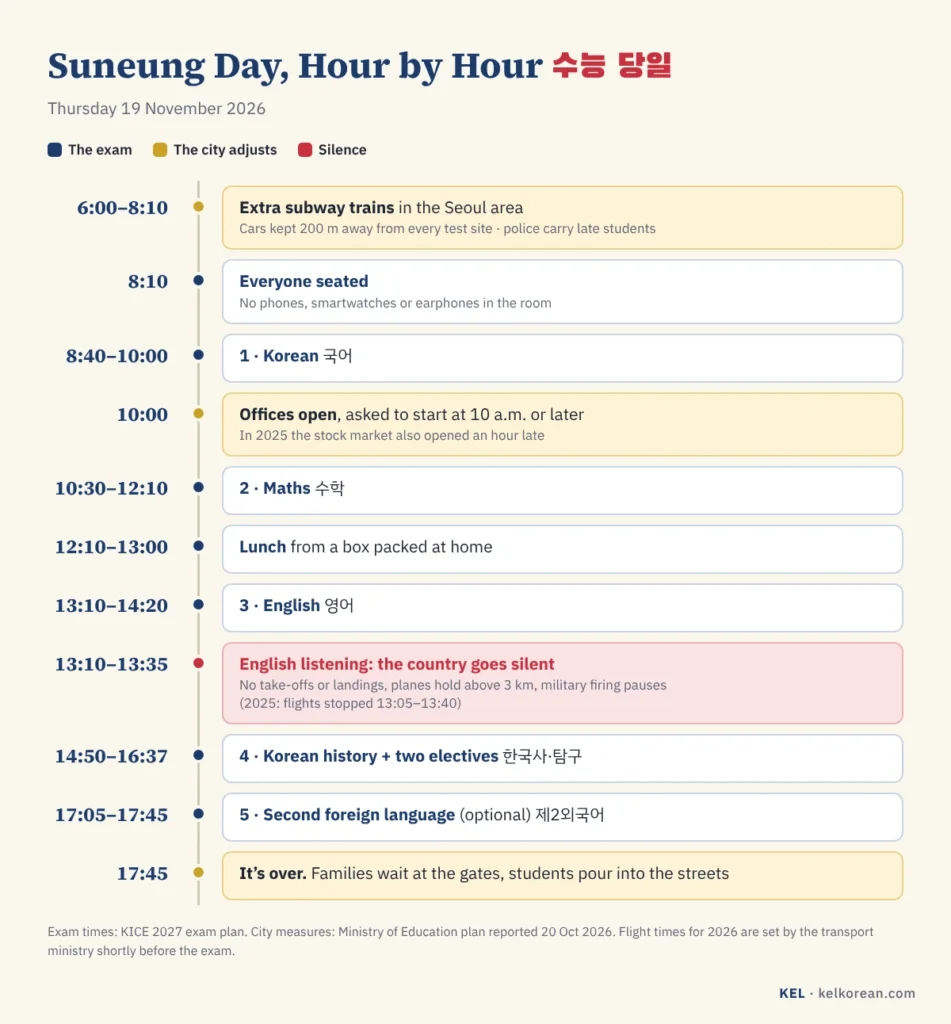
The day runs in five periods: Korean first, then maths, then English after lunch, then Korean history and two elective subjects, and finally an optional second foreign language or Chinese characters. Students who skip the last period finish at 4:37 p.m.; everyone else walks out at 5:45, usually into the dark.
Not everyone in the exam hall is eighteen. This year 173,706 applicants are graduates retaking the exam, the highest number in 23 years. A student who sits it again after a year of study is doing 재수 (jaesu); a third attempt is 삼수 (samsu). Together these repeat takers are called N수생 (en-susaeng), “N-th time students.”
How the Whole Country Adjusts
On Suneung day the exam comes first, and the rest of the country rearranges itself around it. This is what I see every year, and what the government has announced for 2026:
- Work starts late. Government offices and companies are asked to start at 10 a.m. or later, so that the morning roads and trains belong to students. In practice, most people who start work in the morning go in later. In 2025 the stock market opened an hour late as well.
- Extra trains before dawn. Subways in the Seoul area run more trains between 6 and 8:10 a.m., the window when students are travelling to their test sites.
- No cars at the gate. Vehicles are kept out of the last 200 metres before each test site. Parents who drive their children drop them off at that point and the students walk the rest.
- Police taxis. A student who has overslept or gone to the wrong school can call 112, and a police patrol car or motorbike takes them to the right gate. It is a common sight every year. In 2025, police in Incheon alone carried seven students this way, including one who had switched off an alarm and slept in.
- Silence for the listening test. During the English listening section, anything that makes a noise stops. Planes do not take off or land anywhere in the country, aircraft already in the air hold above 3 kilometres, and military firing and tank movements pause. In 2025 the flight ban ran from 1:05 to 1:40 p.m., and 140 flights had their times changed.
- Quiet streets all day. Buses and trains near test sites slow down and avoid using their horns, and construction sites and events nearby are asked to keep the noise down.
If You Are in Korea on 19 November
For a visitor, Suneung day is easy to miss until something on your plan moves by an hour. A few things to check:
- Flights in the early afternoon. If you are flying in or out that day, expect departure and arrival times around 1 p.m. to have been rescheduled. Airlines usually change them in advance, so check your booking the week before.
- A later rush hour. With offices starting at 10, the commuter crowd shifts later than usual. Early morning trains are full of students and parents instead. Our guide to using the Korean subway covers fares and transit cards.
- Schools are test sites. If your hotel is next to a high school, that street will be closed to cars in the morning. Do not plan a taxi pickup at the school gate.
- Keep the noise down. Near any school, speak quietly and skip the horn. Nobody will tell you off, but everyone around you is holding their breath for someone.
- The evening is the opposite. After 5:45 p.m., the exam is over and teenagers pour into the streets, restaurants and PC rooms with the relief of a whole year lifting at once.
The Last Weeks, Seen from an Academy
Many students go to a 학원 (hagwon), a private academy, after school, and in the final year the hours can be long. At my academy, though, the closer we got to the exam, the less we pushed. We stopped keeping students late, because being well rested on the day mattered more than one more evening of practice. The main job of the teachers in those last weeks was to keep the pressure off. The students already knew what was at stake; they did not need us to remind them.
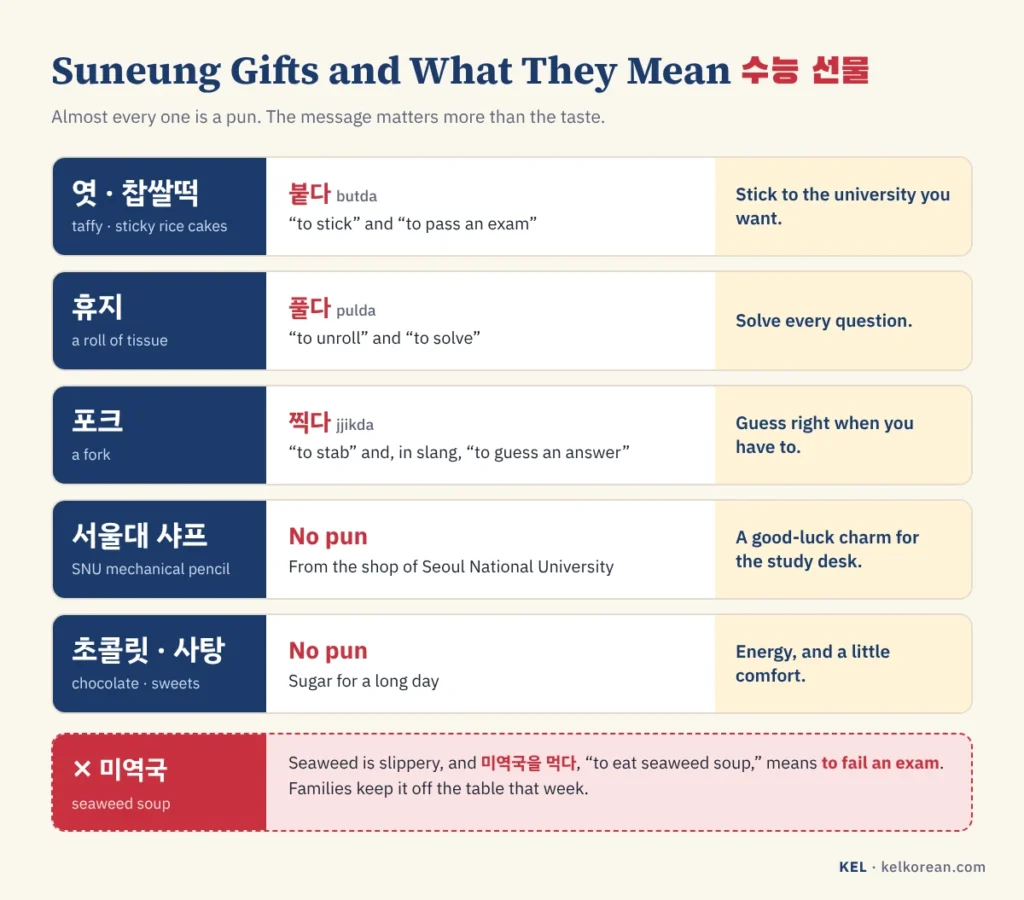
Then, in the final classes before the exam, came the gifts. We gave our students 엿 (yeot, a sticky taffy), 찹쌀떡 (chapssaltteok, sweet rice cakes), chocolate, sweets, rolls of tissue and mechanical pencils from Seoul National University. Almost every one of these is a pun, and so is one more gift you will see in the shops that month: a fork.
What the gifts mean
| Gift | The wordplay | The wish |
|---|---|---|
| 엿 and 찹쌀떡 | Both are sticky. 붙다 (butda) means “to stick” and also “to pass an exam.” | Stick to the university you want. |
| 휴지 (hyuji), tissue | You 풀다 (pulda), unroll, a roll of tissue. 풀다 also means “to solve.” | Solve every question. |
| 포크 (pokeu), a fork | A fork 찍다 (jjikda), “stabs.” 찍다 is also slang for guessing an answer. | Guess right when you have to. |
| 서울대 샤프 | A mechanical pencil from the shop of Seoul National University, Korea’s best-known university. | A good-luck charm for the desk. |
| Chocolate and sweets | No pun. Just sugar for a long day. | Energy, and a little comfort. |
The pencil is a charm for the weeks of study, not for the exam itself: on the day, students must use the mechanical pencil handed out in the exam room. The sticky gifts are also less popular with teenagers than they used to be; a 2021 survey of 200 high school students found 엿 and 찹쌀떡 at the top of the list of gifts they least wanted. They still get given, though, because the message matters more than the taste. If you have read about Pepero Day, you will recognise the habit: in Korea a small snack often carries a whole sentence.
There is also something nobody gives: seaweed soup. 미역 (miyeok), seaweed, is slippery, and slipping is the last thing you want before an exam. 미역국을 먹다, “to eat seaweed soup,” is an old way of saying “to fail an exam,” so families keep it off the table that week.
What I Remember from My Own Exam Day
Mostly, the cold. It was bitterly cold that morning, and Koreans will tell you it always is: the cold snap that seems to arrive every exam week even has a name, 수능 한파 (suneung hanpa), “Suneung cold wave.” My lunch box was packed with food that would be easy on my stomach, because nobody wants to spend the maths paper with a heavy lunch sitting in them. No experiments on exam day.
And when I came out, my parents and my grandmother were there waiting for me. That is still the picture of the Suneung for many Korean families: a crowd of parents and grandparents outside the school gate in the cold, waiting for one particular face to come through it.
After the Exam
For most students, the morning after the Suneung is the first free day in years. From watching my own students, this is what usually comes next:
- The exam ticket becomes a discount card. Plenty of businesses give discounts to anyone who shows their 수험표 (suheompyo), the exam admission ticket. Hair salons are the big one: after a year of not caring about their hair, a lot of students go straight for a new style.
- Double eyelid surgery. It surprises visitors, but many students book cosmetic double eyelid surgery in the months between the exam and the start of university.
- A first part-time job. Many start an 알바 (alba), short for 아르바이트, from the German word Arbeit. Our guide to Konglish explains how it reached Korean.
- A driving licence. With months to fill before university, it is the obvious time to get one.
Not everyone is finished, though. Some universities hold their own exams, essays and interviews, in the weeks after the Suneung. These are called 대학별고사 (daehakbyeol gosa), and the students who have them go back to their desks the very next day. Everyone also marks their answers against the published key in the evening, a self-check called 가채점 (gachaejeom), and from this year the space to write down your answers for it is printed on the back of the exam ticket. Official scores arrive on 11 December.
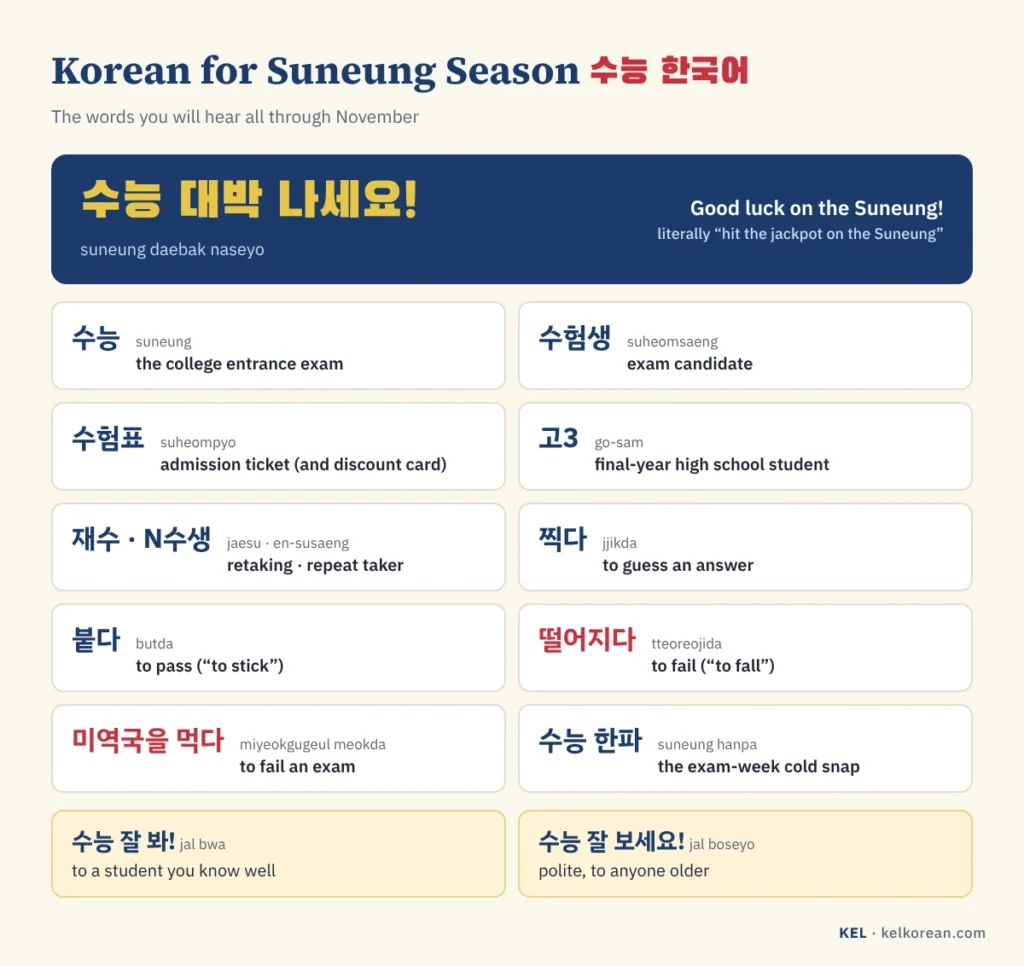
Korean Words for Suneung Season
You will hear these on the news, in shops and in every family with a student for the whole of November:
| Korean | Romanisation | Meaning |
|---|---|---|
| 수능 | suneung | The college entrance exam |
| 수험생 | suheomsaeng | Exam candidate |
| 수험표 | suheompyo | Exam admission ticket |
| 고3 | go-sam | Final-year high school student |
| 재수 / N수생 | jaesu / en-susaeng | Retaking the exam / repeat taker |
| 수능 대박 나세요! | suneung daebak naseyo | Good luck on the Suneung! (“Hit the jackpot!”) |
| 찍다 | jjikda | To guess an answer |
| 붙다 / 떨어지다 | butda / tteoreojida | To pass / to fail (literally “stick” / “fall”) |
| 미역국을 먹다 | miyeokgugeul meokda | To fail an exam (“eat seaweed soup”) |
| 수능 한파 | suneung hanpa | The cold snap on exam week |
The most useful one is the greeting. 수능 대박 나세요! is what you say to a student, or to their parents, in the days before the exam. 대박 means a jackpot or a huge hit, the same word you have probably heard as an exclamation in K-dramas. To a student you know well, a simple 수능 잘 봐! (suneung jal bwa), “do well on the Suneung,” works too; to anyone older, use the polite 잘 보세요 (jal boseyo), as our guide to Korean honorifics explains. And you can always add 파이팅!, the Korean cheer borrowed from English.
A Quiet Thursday Worth Noticing
If you are in Korea on 19 November, you will not see the exam, only its edges: a late rush hour, a police motorbike with a teenager on the back, a silent hour in the sky, and a crowd of parents at a school gate in the cold. Behind each of those is a student who has been preparing for years. If you meet one in the days before, tell them 수능 대박 나세요. It will mean more than you think.
Written by Minhyung Cha — 25 years teaching Korean, and 15+ years running an English academy in South Korea. I live and work in Busan, and every example on this site is checked as a native speaker. More about KEL.
Leave a Reply