You can conjugate 먹다 into 먹어요. You can say 저는 밥을 먹어요.
And then you want to say “I want to eat,” or “I can’t eat that,” or “you shouldn’t eat it” — and you discover that basic conjugation only gets you statements. Everything that makes speech feel human lives one layer above it.
That layer is Korean grammar patterns: small endings you attach to a verb stem to add meaning. Want to. Can. Have to. Please. Don’t. If. Because. Each is a fixed piece you learn once and reuse with every verb you know.
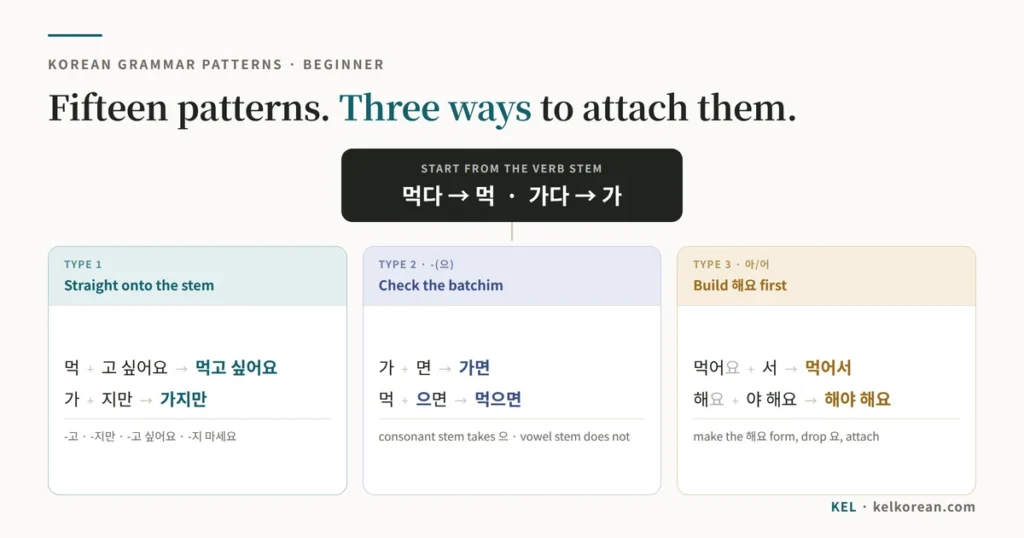
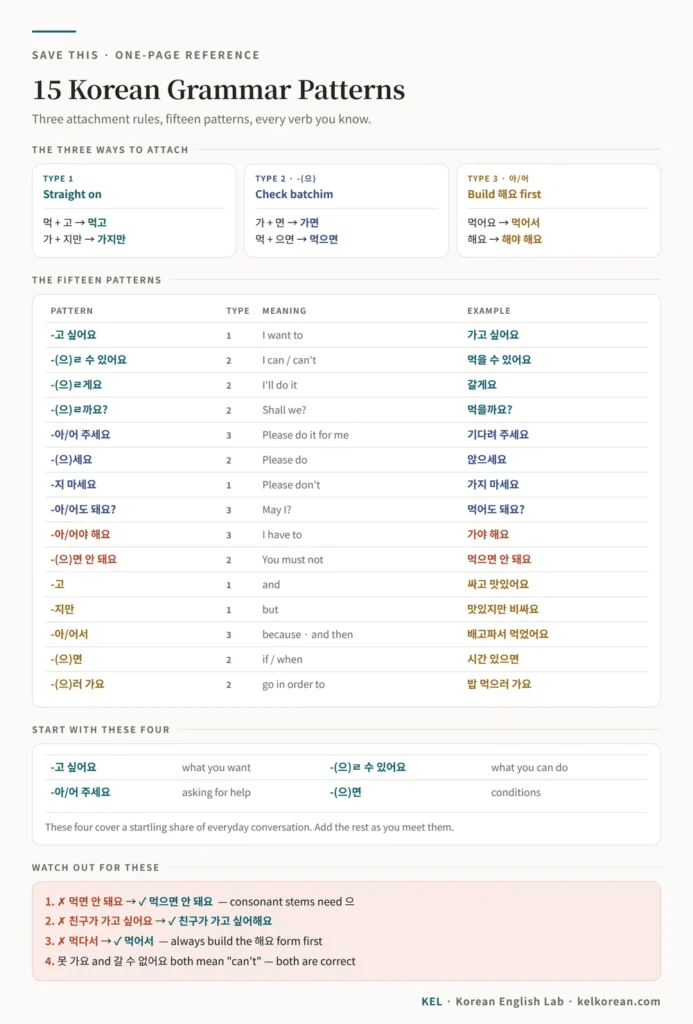
Here is the good news, and it is substantial: there are only three ways to attach anything in Korean. Learn those three, and the fifteen patterns below stop being fifteen things to memorise and become fifteen combinations of things you already understand.
First: The Three Ways to Attach
Every pattern in this guide connects to a verb stem in one of three ways. Once you can tell which type you are dealing with, the rest is assembly.
If “stem” is unfamiliar, it is just the dictionary form minus 다 — 먹다 → 먹, 가다 → 가. Our guide to Korean verb conjugation covers this in full.
Type 1 — Straight onto the stem
Nothing changes. Attach and go.
- 먹다 → 먹 + 고 → 먹고
- 가다 → 가 + 지만 → 가지만
Patterns of this type: -고, -지만, -고 싶어요, -지 마세요.
Type 2 — The -(으) type: check the batchim
If the stem ends in a consonant, insert 으. If it ends in a vowel, do not.
| Stem ends in | Add | Example |
|---|---|---|
| vowel (가) | -ㄹ 수 있어요 | 갈 수 있어요 |
| consonant (먹) | -을 수 있어요 | 먹을 수 있어요 |
| vowel (가) | -면 | 가면 |
| consonant (먹) | -으면 | 먹으면 |
This is the same 받침 logic that decides which Korean particle attaches to a noun. You already know it.
Type 3 — The 아/어 type: same rule as 해요
Make the 해요 form, drop the 요, then add the pattern.
- 먹다 → 먹어요 → 먹어서
- 가다 → 가요 → 가서
- 하다 → 해요 → 해서
Patterns of this type: -아/어서, -아/어야 해요, -아/어도 돼요, -아/어 주세요.
Shortcut worth memorising: for any Type 3 pattern, produce the 해요 form first, remove 요, and attach. It works every time, including irregular verbs.
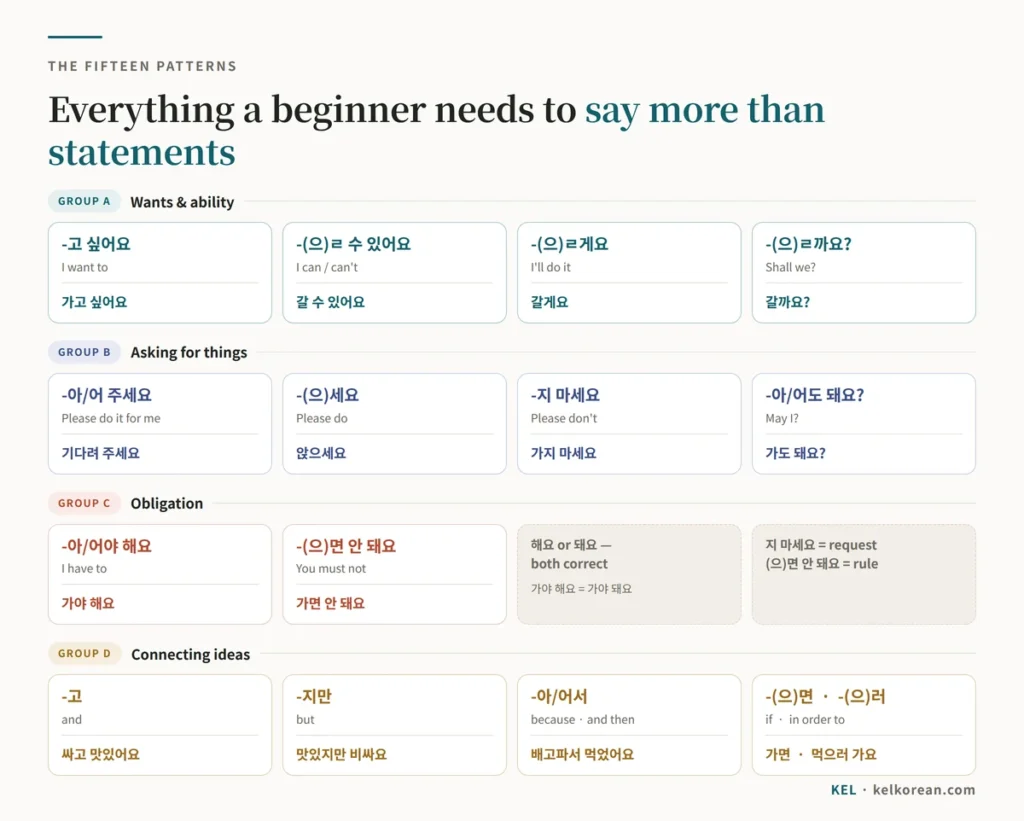
Group A — Saying What You Want and Can Do
1. -고 싶어요 — “I want to”
Type 1. Attach 고 싶어요 straight to the stem.
| Korean | Romanization | Meaning |
|---|---|---|
| 가고 싶어요 | gago sipeoyo | I want to go |
| 먹고 싶어요 | meokgo sipeoyo | I want to eat |
| 한국에 가고 싶어요 | hanguge gago sipeoyo | I want to go to Korea |
| 김치찌개 먹고 싶어요 | kimchijjigae meokgo sipeoyo | I want to eat kimchi stew |
One catch: this form is for you. To say what someone else wants, Korean uses 싶어하다 — 동생이 가고 싶어해요 (“my sibling wants to go”). Beginners can safely stick to the first-person form.
2. -(으)ㄹ 수 있어요 / 없어요 — “I can / I can’t”
Type 2. 있어요 for can, 없어요 for cannot.
| Korean | Meaning |
|---|---|
| 갈 수 있어요 | I can go |
| 갈 수 없어요 | I can’t go |
| 먹을 수 있어요 | I can eat it |
| 매운 거 먹을 수 없어요 | I can’t eat spicy food |
| 한국어 할 수 있어요 | I can speak Korean |
수 literally means “way” or “method,” so the phrase is closer to “there exists a way to go.” That is why 있어요/없어요 does the work.
3. -(으)ㄹ게요 — “I’ll do it”
Type 2. A decision or promise made in the moment.
| Korean | Meaning |
|---|---|
| 갈게요 | I’ll go |
| 먹을게요 | I’ll eat it |
| 나중에 전화할게요 | I’ll call you later |
| 여기서 기다릴게요 | I’ll wait here |
This is first-person only, and it carries a note of commitment to the listener — which is why 갈게요 sounds warmer than the plain future 갈 거예요.
4. -(으)ㄹ까요? — “Shall we? / Shall I?”
Type 2. A suggestion or an offer.
| Korean | Meaning |
|---|---|
| 갈까요? | Shall we go? |
| 먹을까요? | Shall we eat? |
| 커피 마실까요? | Shall we get coffee? |
| 제가 도와드릴까요? | Shall I help you? |
Enormously useful socially — it is the standard way to propose anything without sounding pushy.
Group B — Asking For Things
5. -아/어 주세요 — “Please do it for me”
Type 3. You met this in our guide to ordering food in Korean, where 주세요 asks for an object. Attached to a verb, it asks for an action.
| Korean | Meaning |
|---|---|
| 도와주세요 | Please help me |
| 기다려 주세요 | Please wait |
| 다시 말해 주세요 | Please say that again |
| 천천히 말해 주세요 | Please speak slowly |
천천히 말해 주세요 is arguably the single most useful sentence a Korean learner can carry.
6. -(으)세요 — “Please do”
Type 2. Polite instruction or invitation — softer than a command.
| Korean | Meaning |
|---|---|
| 앉으세요 | Please sit down |
| 오세요 | Please come |
| 여기 보세요 | Please look here |
| 조심하세요 | Please be careful |
You will hear this constantly: 어서 오세요 (welcome), 안녕히 가세요 (goodbye to someone leaving).
7. -지 마세요 — “Please don’t”
Type 1. The negative counterpart.
| Korean | Meaning |
|---|---|
| 가지 마세요 | Please don’t go |
| 먹지 마세요 | Please don’t eat that |
| 걱정하지 마세요 | Don’t worry |
| 만지지 마세요 | Please don’t touch |
걱정하지 마세요 is worth knowing as a set phrase — it is what a Korean friend will say to you constantly.
8. -아/어도 돼요? — “May I?”
Type 3. Asking permission.
| Korean | Meaning |
|---|---|
| 가도 돼요? | May I go? |
| 먹어도 돼요? | May I eat this? |
| 여기 앉아도 돼요? | May I sit here? |
| 사진 찍어도 돼요? | May I take a photo? |
Drop the question mark and it grants permission instead: 가도 돼요 (“you may go”).
Group C — Obligation
9. -아/어야 해요 — “I have to”
Type 3. Necessity or obligation. 돼요 can replace 해요 with no change in meaning — 해요 is slightly more formal, 돼요 more conversational.
| Korean | Meaning |
|---|---|
| 가야 해요 | I have to go |
| 먹어야 해요 | I have to eat |
| 지금 가야 돼요 | I have to go now |
| 열심히 공부해야 해요 | I have to study hard |
10. -(으)면 안 돼요 — “You must not”
Type 2. Prohibition, stated as “if you do it, it won’t do.”
| Korean | Meaning |
|---|---|
| 가면 안 돼요 | You must not go |
| 먹으면 안 돼요 | You must not eat that |
| 여기서 담배 피우면 안 돼요 | You can’t smoke here |
| 늦으면 안 돼요 | You must not be late |
Compare with #7: 가지 마세요 is a polite request not to go. 가면 안 돼요 states a rule.
Group D — Connecting Ideas
Everything above produces single clauses. These four join them into real sentences.
11. -고 — “and”
Type 1. Links two verbs or two descriptions.
| Korean | Meaning |
|---|---|
| 싸고 맛있어요 | It’s cheap and delicious |
| 밥 먹고 갈게요 | I’ll eat and then go |
| 저는 학생이고 동생은 회사원이에요 | I’m a student and my sibling is an office worker |
12. -지만 — “but”
Type 1.
| Korean | Meaning |
|---|---|
| 맛있지만 비싸요 | It’s delicious but expensive |
| 어렵지만 재미있어요 | It’s hard but fun |
| 한국어 공부하지만 아직 잘 못해요 | I study Korean but I’m still not good at it |
13. -아/어서 — “because” and “and then”
Type 3. This one carries two meanings, and context separates them.
Cause:
| Korean | Meaning |
|---|---|
| 배고파서 먹었어요 | I ate because I was hungry |
| 바빠서 못 갔어요 | I couldn’t go because I was busy |
Sequence:
| Korean | Meaning |
|---|---|
| 학교에 가서 공부했어요 | I went to school and studied there |
| 친구를 만나서 밥을 먹었어요 | I met a friend and we ate |
Important restriction: you cannot use -아/어서 with a command or suggestion. ✗ 배고파서 먹어요 as “eat because you’re hungry” does not work — you need -(으)니까 for that. Beginners can simply avoid the combination.
14. -(으)면 — “if / when”
Type 2.
| Korean | Meaning |
|---|---|
| 시간 있으면 전화하세요 | Call me if you have time |
| 한국에 가면 뭐 하고 싶어요? | What do you want to do when you go to Korea? |
| 비가 오면 안 갈 거예요 | If it rains, I won’t go |
15. -(으)러 가요 — “go in order to”
Type 2. Movement with a purpose. Pairs with 가다, 오다, 다니다.
| Korean | Meaning |
|---|---|
| 밥 먹으러 가요 | I’m going to eat |
| 공부하러 도서관에 가요 | I’m going to the library to study |
| 친구 만나러 왔어요 | I came to meet a friend |
One Verb, Fifteen Patterns
Here is 가다 (to go) run through all fifteen. This is the whole article in one table.
| Pattern | Result | Meaning |
|---|---|---|
| -고 싶어요 | 가고 싶어요 | I want to go |
| -(으)ㄹ 수 있어요 | 갈 수 있어요 | I can go |
| -(으)ㄹ게요 | 갈게요 | I’ll go |
| -(으)ㄹ까요? | 갈까요? | Shall we go? |
| -아/어 주세요 | 가 주세요 | Please go |
| -(으)세요 | 가세요 | Please go / go ahead |
| -지 마세요 | 가지 마세요 | Please don’t go |
| -아/어도 돼요? | 가도 돼요? | May I go? |
| -아/어야 해요 | 가야 해요 | I have to go |
| -(으)면 안 돼요 | 가면 안 돼요 | You must not go |
| -고 | 가고 | and go |
| -지만 | 가지만 | but goes |
| -아/어서 | 가서 | because / and then went |
| -(으)면 | 가면 | if you go |
| -(으)러 | 가러 | in order to go |
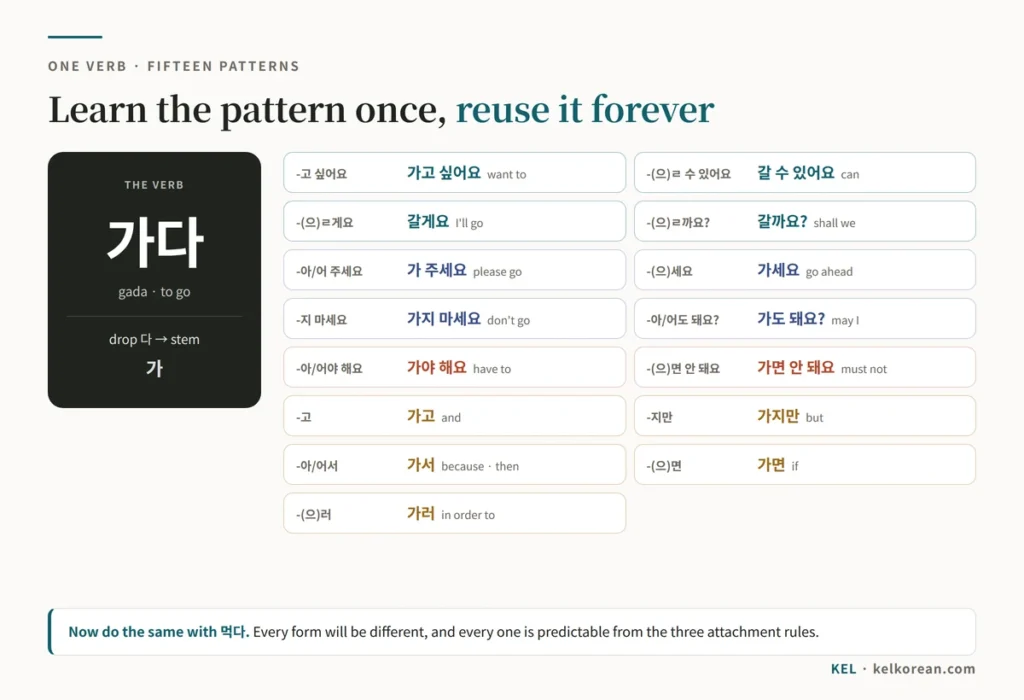
Now do the same with 먹다 on paper. Every form will be different, and every one is predictable from the three attachment rules.
4 Mistakes Worth Avoiding
1. Forgetting the 으 on consonant stems. ✗ 먹면 안 돼요. ✓ 먹으면 안 돼요. This is the most common error with Type 2 patterns.
2. Using -고 싶어요 for other people. ✗ 친구가 가고 싶어요. ✓ 친구가 가고 싶어해요.
3. Mixing up 못 and -(으)ㄹ 수 없어요. Both mean “cannot,” and both are correct. 못 가요 is shorter and more common in speech; 갈 수 없어요 is slightly more formal and emphasises impossibility.
4. Attaching Type 3 patterns to the dictionary form. ✗ 먹다서. ✓ 먹어서. Always build the 해요 form first.
Quick Practice
Turn each into the pattern shown. Answers below.
- 먹다 + want to → ?
- 자다 + can → ?
- 읽다 + please don’t → ?
- 하다 + have to → ?
- 듣다 + if → ?
- 오다 + shall we → ?
- 마시다 + may I → ?
- 사다 + in order to → ?
Answers:
- 먹고 싶어요 — Type 1
- 잘 수 있어요 — Type 2, vowel stem
- 읽지 마세요 — Type 1
- 해야 해요 — Type 3
- 들으면 — Type 2, ㄷ irregular (듣 → 들)
- 올까요? — Type 2, vowel stem
- 마셔도 돼요? — Type 3 (마셔요 → 마셔 + 도 돼요)
- 사러 — Type 2, vowel stem
Six or more correct means the attachment rules have landed. The individual patterns will follow from repetition.
Frequently Asked Questions
Do I need all fifteen at once?
No. Start with four: -고 싶어요, -(으)ㄹ 수 있어요, -아/어 주세요, and -(으)면. Those four cover a startling amount of daily conversation. Add the rest as you meet them.
Are these formal or casual?
All fifteen are shown in 해요체 — the everyday polite form that works in nearly every situation a learner encounters. They all have casual and formal variants, but you do not need them yet. See our guide to Korean honorifics for when to shift register.
How do irregular verbs behave with these patterns?
Exactly as they do elsewhere. 듣다 becomes 들 before a vowel, so 들으면 and 들을 수 있어요. Build the form using the rules you already know for that irregular and the pattern will follow.
Where do particles go in a sentence with a pattern?
Unchanged. Particles attach to nouns, patterns attach to verbs, and the two never interfere: 저는 김치를 먹고 싶어요.
What comes after these?
Patterns for reported speech (-다고 해요), intentions (-(으)려고), and conditions (-(으)니까). But those are intermediate territory. Fifteen patterns plus solid conjugation is a genuinely functional beginner Korean.
Should I memorise the patterns or the sentences?
Sentences. A pattern memorised in isolation stays inert; the same pattern inside 천천히 말해 주세요 becomes usable immediately. Learn one real sentence per pattern and generalise from there.
Final Thoughts
Conjugation lets you make statements. Patterns let you have conversations — because most of what people say is not “I eat rice” but “shall we eat,” “I can’t eat that,” “please don’t,” “if you want.”
The reason this stage feels easier than it looks is that the machinery does not grow. There is no new grammar engine here, only new endings bolted onto the stem you already know how to find. Three attachment rules cover all fifteen, and they cover the intermediate patterns waiting after them too.
Pick four patterns. Write one true sentence with each — about your day, not from a textbook. Say them out loud. Repeat tomorrow with four more. In two weeks you will have all fifteen, and your Korean will have crossed from correct to conversational.
If you are working through the stages in order, this is what sits just past Stage 5 of our complete beginner’s roadmap — and it pairs directly with verb conjugation, particles, and sentence structure.
Keep learning with Korean English Lab. Our bilingual Korean–English worksheets and printable workbooks are designed for self-study learners who want structured practice, not just theory.
Leave a Reply