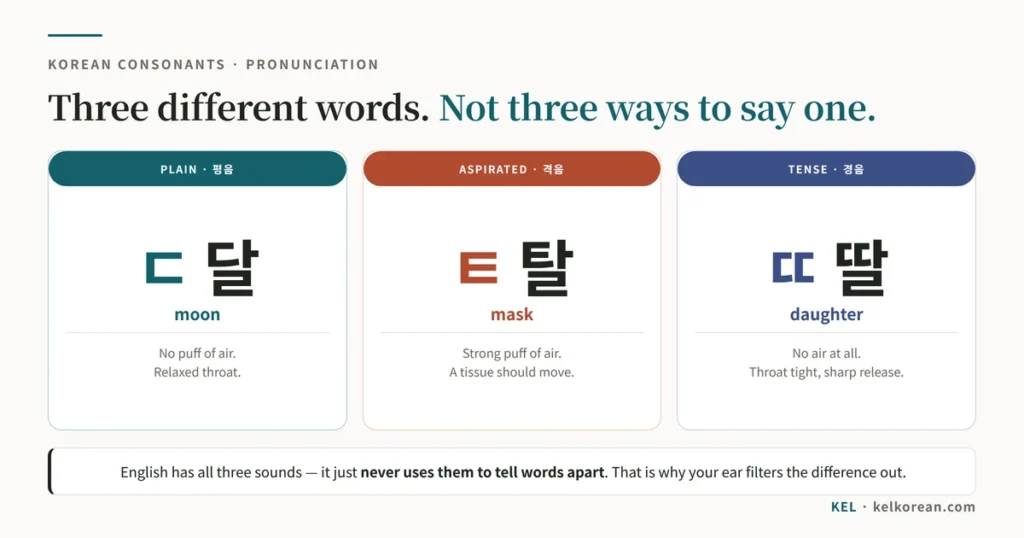
Say these three words to a Korean speaker: 달 (moon), 탈 (mask), 딸 (daughter).
To you they will probably sound like the same word said three times. To them they are as different as bat, cat and hat. And if you asked which one you just said, they would answer instantly and be a little puzzled that you had to ask.
This is the single hardest thing about Korean pronunciation for English speakers, and it is not a matter of practice hours. Your ear was trained in childhood to ignore exactly the distinction Korean uses. English has the same three sounds, but it treats them as one — so your brain filters the difference out before you consciously hear it.
Once you know what the difference actually is, the problem becomes solvable. This guide covers the three-way system in Korean consonants, why English hides it from you, and the physical tricks that let you produce and eventually hear all three.
The Three-Way System
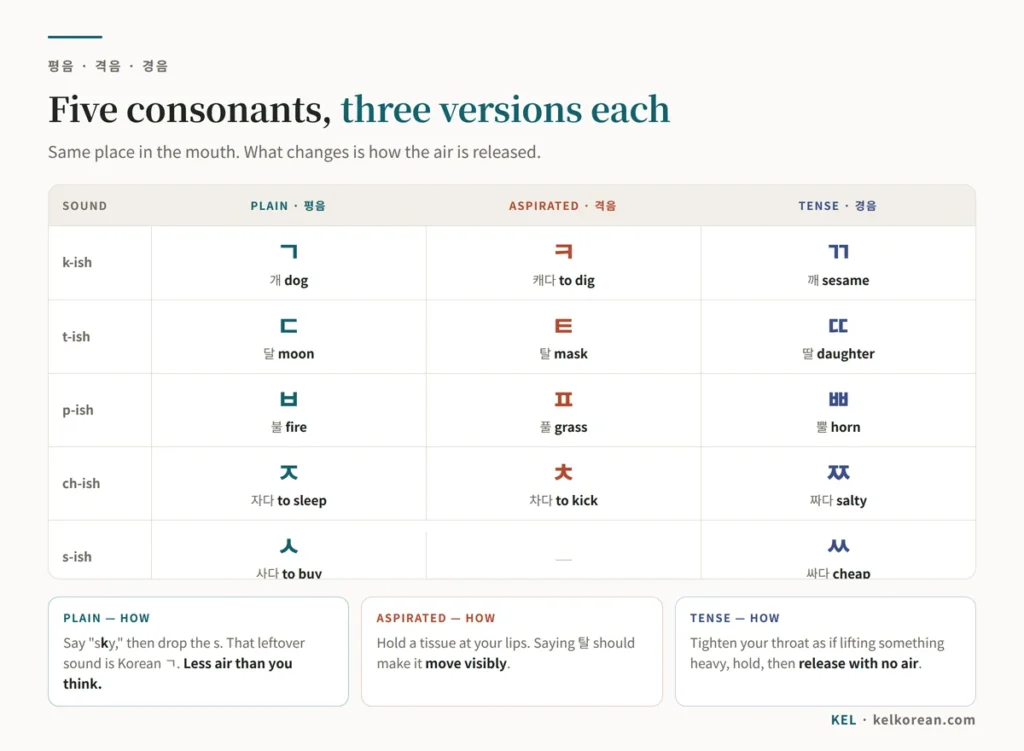
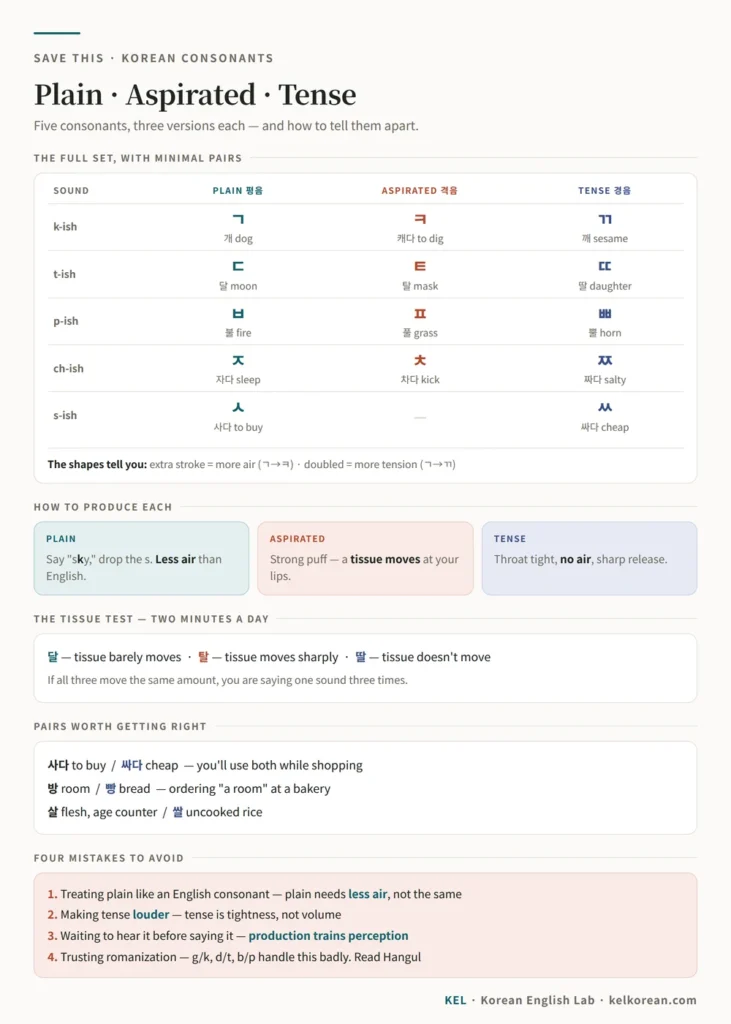
Five Korean consonants come in sets of three. Same place in the mouth, three different ways of releasing air.
| Plain (평음) | Aspirated (격음) | Tense (경음) | Sound |
|---|---|---|---|
| ㄱ | ㅋ | ㄲ | k-ish |
| ㄷ | ㅌ | ㄸ | t-ish |
| ㅂ | ㅍ | ㅃ | p-ish |
| ㅈ | ㅊ | ㅉ | ch-ish |
| ㅅ | — | ㅆ | s-ish |
Notice the shapes. Hangul encodes the relationship visually:
- Plain is the base letter — ㄱ, ㄷ, ㅂ
- Aspirated adds a stroke — ㅋ, ㅌ, ㅍ
- Tense doubles the letter — ㄲ, ㄸ, ㅃ
That is not decoration. The extra stroke means “more air,” and doubling means “more tension.” Hangul was designed in the 1440s with the mechanics of the mouth in mind, which is one reason it is learnable in a week.
Why English Hides This From You
Here is the part that explains everything.
English has all three sounds. It just doesn’t use them to distinguish words.
Say these two English words out loud with your hand in front of your mouth:
- top — you feel a puff of air on the t
- stop — no puff
That is the difference between aspirated ㅌ and plain-ish ㄷ. English speakers produce both every day and never notice, because in English the choice is automatic — determined by position in the word, not by meaning. Swapping them makes you sound slightly odd, never misunderstood.
In Korean the same difference changes the word. 탈 and 달 are not variants of one word; they are two words.
This is why the problem feels like a hearing problem. It is really a categorisation problem: your brain learned to sort both sounds into one bucket labelled “t,” and it is still doing that faithfully.
The consequence: you will produce the difference before you can hear it. That is normal and worth knowing in advance, because otherwise the lack of progress in listening feels like failure.
What Each One Actually Is
Plain — ㄱ ㄷ ㅂ ㅈ ㅅ
Light, relaxed, no puff of air. The vocal cords are loose.
The closest English equivalent is the consonant in stop, sky, spy — the sound right after an s, where English drops the aspiration.
Trick: say “sky,” then say it again without the s. That leftover k-sound is very close to Korean ㄱ.
| Word | Meaning |
|---|---|
| 가다 | to go |
| 달 | moon |
| 불 | fire |
| 자다 | to sleep |
Aspirated — ㅋ ㅌ ㅍ ㅊ
A strong puff of air. More breath than an English consonant, not less.
Trick: hold a tissue in front of your mouth. Saying 탈 should make it move visibly. If it does not, you are producing ㄷ.
| Word | Meaning |
|---|---|
| 크다 | to be big |
| 탈 | mask |
| 풀 | grass |
| 차 | tea, car |
Tense — ㄲ ㄸ ㅃ ㅉ ㅆ
No air at all, and the throat is tight. The sound is short, sharp and slightly higher in pitch.
This is the hardest of the three to produce, because English has no equivalent at all.
Trick: tighten your throat as if you were about to lift something heavy, hold your breath for a moment, then release the consonant. It should feel compressed and pop out.
| Word | Meaning |
|---|---|
| 까다 | to peel |
| 딸 | daughter |
| 뿔 | horn |
| 짜다 | salty |
Minimal Pairs to Practise
These sets differ only in the consonant. Say each set aloud, three times, with a tissue in front of your mouth.
| Plain | Aspirated | Tense |
|---|---|---|
| 달 moon | 탈 mask | 딸 daughter |
| 불 fire | 풀 grass | 뿔 horn |
| 개 dog | 캐다 to dig | 깨 sesame |
| 자다 to sleep | 차다 to kick | 짜다 salty |
| 방 room | — | 빵 bread |
| 사다 to buy | — | 싸다 cheap |
The pair that matters most in daily life: 사다 (to buy) and 싸다 (cheap). You will use both constantly when shopping, and mixing them up produces genuine confusion.
The one that gets learners into trouble: 방 (room) and 빵 (bread). Ordering “a room” at a bakery is a classic.
The Tissue Test
This is the single most useful exercise, and it takes two minutes.
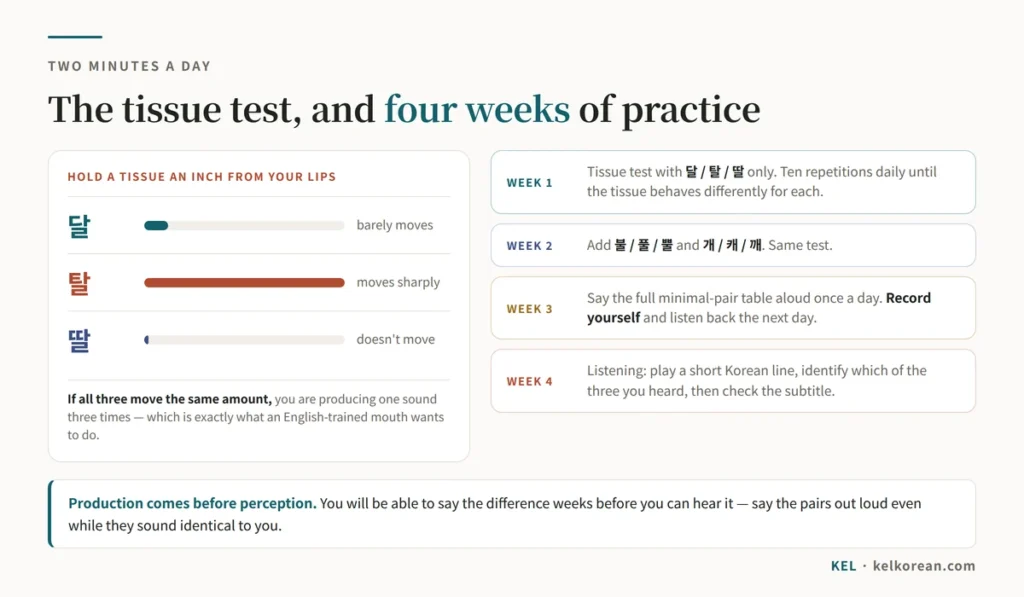
- Hold a thin piece of tissue paper an inch from your lips.
- Say 탈. The tissue should move sharply.
- Say 달. The tissue should barely move.
- Say 딸. The tissue should not move at all.
If all three move the same amount, you are producing one sound three times — which is exactly what your English-trained mouth wants to do.
Do this daily for a week with 달 / 탈 / 딸 and 불 / 풀 / 뿔. Production comes first; perception follows a few weeks later.
The Odd One Out: ㅅ and ㅆ
ㅅ is the exception in the system — it has a tense partner (ㅆ) but no aspirated one.
The usual explanation is that ㅅ already carries some breath, so an aspirated version would not be distinct enough. Whatever the reason, it leaves you with a two-way rather than three-way choice.
| Plain ㅅ | Tense ㅆ |
|---|---|
| 사다 to buy | 싸다 cheap |
| 살 flesh, age counter | 쌀 rice |
| 서다 to stand | 써다 → 쓰다 to write |
| 시다 sour | 씨 seed, Mr/Ms |
살 and 쌀 are worth special attention. 쌀 (uncooked rice) is a word you will meet constantly, and 살 is the counter used for age — 스무 살, 서른 살. Getting these confused is a common and slightly comic error.
For ㅆ, the same tension trick applies: tighten the throat, no puff, sharp release. The sound should feel like it is being squeezed out rather than breathed out.
The Shapes Are Telling You the Answer
One of the quietly brilliant things about Hangul is that the letter shapes encode the phonetics.
| Base | Add a stroke | Double it |
|---|---|---|
| ㄱ | ㅋ | ㄲ |
| ㄷ | ㅌ | ㄸ |
| ㅂ | ㅍ | ㅃ |
| ㅈ | ㅊ | ㅉ |
| ㅅ | — | ㅆ |
The added stroke means more air. The doubling means more tension. That is the whole system, visible on the page.
The base letters themselves are shaped after the mouth: ㄱ traces the back of the tongue rising toward the soft palate, ㄴ the tongue tip touching behind the teeth, ㅁ the shape of closed lips. Hangul was designed in 1443 by scholars who had analysed the articulation of every sound, and it shows.
Practical use: when you see an unfamiliar letter with an extra stroke, you already know it needs more breath. The alphabet is doing half the work for you — one more reason romanization is a poor substitute.
A Four-Week Practice Plan
Two minutes a day beats an hour on Sunday. Production first, perception later.
| Week | What to do |
|---|---|
| 1 | Tissue test with 달 / 탈 / 딸 only. Ten repetitions daily until the tissue behaves differently for each |
| 2 | Add 불 / 풀 / 뿔 and 개 / 캐 / 깨. Same test |
| 3 | Say the full minimal-pair table out loud once a day. Record yourself on your phone and listen back the next day |
| 4 | Listening: find a Korean audio clip, play a short line, and try to identify which of the three you heard before checking the subtitle |
Recording yourself matters more than it sounds. Hearing your own voice a day later bypasses the loop where your brain hears what it intended rather than what came out.
Do not expect week 4 to work reliably. Perception is the slow half, and it arrives on its own schedule.
Position Changes Things
Two complications worth knowing once the basics are in place.
1. Plain consonants soften between vowels.
At the start of a word, ㄱ sounds k-ish. Between two vowels it becomes closer to a soft g. 고기 (meat) is nearer gogi than koki — the first ㄱ is harder than the second.
This is why romanization looks inconsistent: 김치 is kimchi in the older system and gimchi in the official one. Both are attempts to write one Korean sound that shifts by position.
2. Plain consonants become tense after ㄱ, ㄷ, ㅂ.
학교 is pronounced [학꾜], 식당 is [식땅]. The ㄱ and ㄷ become tense automatically — nobody writes it, everybody does it. This and the other sound-change rules are covered in our guide to Korean pronunciation rules.
So tense consonants appear far more often in speech than in writing, which is another reason learners under-produce them.
4 Mistakes Worth Avoiding
1. Treating plain as the English default. English t at the start of a word is aspirated. If you read 달 with an English d-then-t instinct, you will land somewhere between ㄷ and ㅌ. Plain Korean consonants need less air than you think.
2. Trying to make tense consonants louder. Tense is not volume. It is tightness plus the absence of air. Shouting 딸 just produces a loud 달.
3. Waiting until you can hear the difference to start producing it. Production trains perception, not the other way round. Say the minimal pairs out loud even while they sound identical to you.
4. Relying on romanization to tell them apart. g/k, d/t, b/p, jj/kk — romanization systems handle this badly and inconsistently. Once you know Hangul, read Hangul.
Quick Practice
Which consonant type is each word using?
- 딸기 (strawberry) → ?
- 코 (nose) → ?
- 바다 (sea) → ?
- 싸요 (it’s cheap) → ?
- 치마 (skirt) → ?
- 자전거 (bicycle) → ?
Answers: 1. tense (ㄸ) · 2. aspirated (ㅋ) · 3. plain (ㅂ) · 4. tense (ㅆ) · 5. aspirated (ㅊ) · 6. plain (ㅈ)
Now say each one with the tissue test and check that the airflow matches.
Frequently Asked Questions
How long does it take to hear the difference?
Production usually comes within a few weeks of deliberate practice. Reliable perception often takes months, and many learners find it arrives suddenly rather than gradually. Context does a lot of the work in the meantime — 빵 in a bakery is not ambiguous.
Will Koreans understand me if I get it wrong?
Usually yes, from context. The exceptions are the minimal pairs above in situations where both are plausible — 사다 and 싸다 while shopping, 방 and 빵 in a café.
Is ㅅ plain or aspirated?
Neither exactly. ㅅ has no aspirated partner — only plain ㅅ and tense ㅆ. Some describe ㅅ as slightly aspirated already, which is why it has no third form.
Why does romanization write ㄱ as both g and k?
Because the sound genuinely shifts by position — harder at the start of a word, softer between vowels. Romanization has to pick one letter, and different systems pick differently. This is one of the strongest arguments for reading Hangul directly.
Are these the same as English b/p, d/t, g/k?
No, and this is the core trap. English pairs differ by voicing (whether the vocal cords vibrate). Korean triples differ by aspiration and tension. Mapping ㄱ→g and ㅋ→k gets you close but leaves ㄲ with nowhere to go.
What should I practise first?
The tissue test with 달 / 탈 / 딸. Two minutes a day. It trains the physical control that everything else depends on.
Final Thoughts
Every language teaches its speakers to ignore certain sound differences, and English happens to have trained you to ignore this one. That is not a defect in your ear — it is your first language doing its job efficiently, in a way that happens to be unhelpful here.
Which means the fix is not “listen harder.” It is: learn what the three categories physically are, produce them deliberately with the tissue test, and let perception follow production. Learners who accept that order make steady progress. Learners who wait to hear the difference before attempting it tend to stall for a year.
Start with one triplet — 달, 탈, 딸 — and two minutes a day. Then add 불, 풀, 뿔. That is the whole practice.
Pair this with our guides to Korean pronunciation rules and 어 vs 오 vowels, or start from the beginning with our complete beginner’s roadmap.
Keep learning with Korean English Lab. Our bilingual Korean–English worksheets and printable workbooks are designed for self-study learners who want structured practice, not just theory.
Leave a Reply