
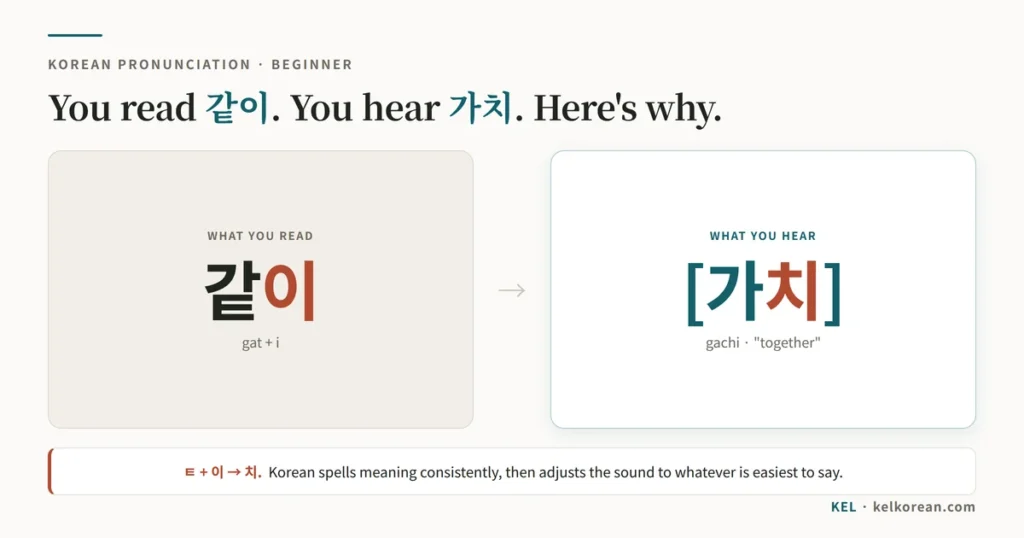
You learned Hangul in a week. You can read every letter. And then a Korean friend says 같이 가요 and you hear gachi gayo — but you are looking at letters that clearly spell gat-i.
You did not mishear. You are not bad at listening. Korean simply has a set of sound-change rules that operate between the spelling and the speech, and nobody warns beginners that they exist.
Here is the thing that makes this feel unfair: Korean is often advertised as a perfectly phonetic language. That is only half true. Hangul spells meaning units consistently, and then pronunciation adjusts to whatever is easiest to say. English does the same thing — nobody actually says “want to,” we say “wanna” — but English speakers absorbed those shortcuts as children.
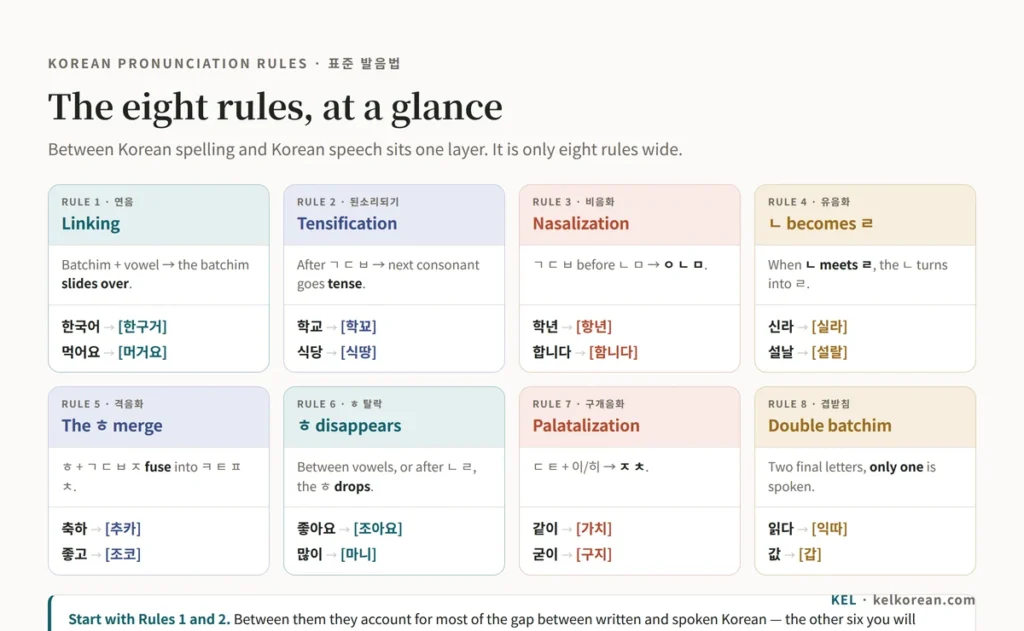
This guide covers the eight Korean pronunciation rules that account for nearly every gap between what you read and what you hear. Once you know them, Korean listening gets dramatically easier, because you stop being surprised.
First: The Seven Final Sounds
Before any rule makes sense, you need one fact about 받침 (batchim, the final consonant of a syllable).
Korean writes 27 different letters in the batchim position. Korean pronounces only seven sounds there: ㄱ, ㄴ, ㄷ, ㄹ, ㅁ, ㅂ, ㅇ.
Every other batchim collapses into one of those seven when nothing follows it.
| Written batchim | Pronounced as | Example |
|---|---|---|
| ㄱ, ㅋ, ㄲ | ㄱ | 부엌 → [부억] (bueok) |
| ㄴ | ㄴ | 산 → [산] (san) |
| ㄷ, ㅌ, ㅅ, ㅆ, ㅈ, ㅊ, ㅎ | ㄷ | 옷 → [옫], 꽃 → [꼳] |
| ㄹ | ㄹ | 물 → [물] (mul) |
| ㅁ | ㅁ | 밤 → [밤] (bam) |
| ㅂ, ㅍ | ㅂ | 앞 → [압] (ap) |
| ㅇ | ㅇ | 강 → [강] (gang) |
This is why 옷 (clothes), 낮 (daytime), 꽃 (flower), and 있 all end in the same [ㄷ] sound despite being spelled with four different letters.
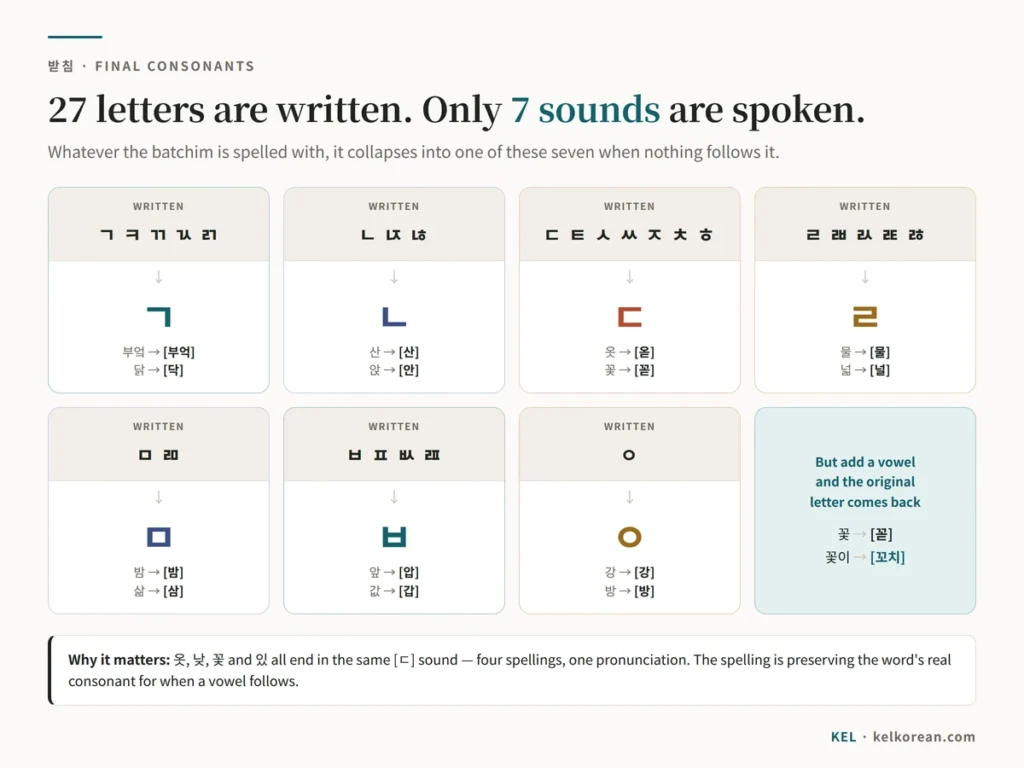
Important: this collapse only happens when the batchim is at the end of a word or followed by a consonant. The moment a vowel follows, the original letter comes back — which is our first rule.
Rule 1: Linking — 연음
When a batchim is followed by a vowel, the batchim slides over into the next syllable.
This is the single most important rule in Korean pronunciation, and it is responsible for more listening confusion than everything else combined.
| Written | Pronounced | Romanization |
|---|---|---|
| 한국어 | [한구거] | hangugeo |
| 음악 | [으막] | eumak |
| 옷이 | [오시] | osi |
| 꽃이 | [꼬치] | kkochi |
| 밥을 | [바블] | babeul |
| 책을 | [채글] | chaegeul |
| 먹어요 | [머거요] | meogeoyo |
| 앉아요 | [안자요] | anjayo |
Notice 꽃이 → [꼬치]. On its own, 꽃 is pronounced [꼳]. But add the particle 이 and the original ㅊ reappears and jumps over. The spelling was preserving the real consonant all along.
This is also why the verb endings you learned in our guide to Korean verb conjugation sound different from how they look — 먹어요 is written with a clean 먹 + 어요 but spoken as [머거요].
Practical takeaway: when you hear an unfamiliar word, mentally try moving a consonant back to the previous syllable. [머거요] becomes 먹어요, and suddenly you can look it up.
Rule 2: Tensification — 된소리되기
After a [ㄱ], [ㄷ], or [ㅂ] sound, a following ㄱ ㄷ ㅂ ㅅ ㅈ becomes tense: ㄲ ㄸ ㅃ ㅆ ㅉ.
Nobody writes this change, but every Korean speaker makes it, every time, without exception.
| Written | Pronounced | Meaning |
|---|---|---|
| 학교 | [학꾜] | school |
| 식당 | [식땅] | restaurant |
| 학생 | [학쌩] | student |
| 잡지 | [잡찌] | magazine |
| 국밥 | [국빱] | rice soup |
| 늦게 | [늗께] | late |
| 옷장 | [옫짱] | wardrobe |
| 숙제 | [숙쩨] | homework |
Say 학교 with a soft ㄱ and it will sound distinctly foreign. Say [학꾜] and it sounds native. This one change does a lot of work for your accent.
Why it happens: after the abrupt stop of a [ㄱ] [ㄷ] [ㅂ] sound, the vocal cords are already tight, so the next consonant comes out tense. Try it and you will feel it — the tense version is genuinely easier.
Rule 3: Nasalization — 비음화
A [ㄱ], [ㄷ], or [ㅂ] sound followed by ㄴ or ㅁ turns into the matching nasal sound.
- [ㄱ] → ㅇ
- [ㄷ] → ㄴ
- [ㅂ] → ㅁ
| Written | Pronounced | Meaning |
|---|---|---|
| 학년 | [항년] | school year |
| 국물 | [궁물] | broth |
| 작년 | [장년] | last year |
| 있는 | [인는] | that exists |
| 꽃만 | [꼰만] | only flowers |
| 십만 | [심만] | one hundred thousand |
| 앞문 | [암문] | front door |
| 감사합니다 | [감사함니다] | thank you |
That last one matters. 감사합니다 is never pronounced with a ㅂ. It is [감사함니다] — gamsahamnida, not gamsahapnida. Same for 습니다 in every verb: 합니다 is [함니다].
If you have been saying it with a hard ㅂ, this single fix will noticeably improve how native your Korean sounds.
Rule 4: ㄴ Becomes ㄹ — 유음화
When ㄴ and ㄹ meet, the ㄴ becomes ㄹ. It works in both directions.
| Written | Pronounced | Meaning |
|---|---|---|
| 신라 | [실라] | Silla (dynasty) |
| 설날 | [설랄] | Lunar New Year |
| 연락 | [열락] | contact |
| 편리 | [펼리] | convenient |
| 일 년 | [일련] | one year |
| 관리 | [괄리] | management |
This is why the ancient kingdom is romanized Silla and not “Sinra,” and why 설날 sounds like seollal.
Rule 5: The ㅎ Merge — 격음화
ㅎ combines with a neighbouring ㄱ, ㄷ, ㅂ, or ㅈ to form the aspirated ㅋ, ㅌ, ㅍ, ㅊ.
The two sounds fuse into one. It works whether the ㅎ comes first or second.
| Written | Pronounced | Meaning |
|---|---|---|
| 좋고 | [조코] | good and |
| 놓다 | [노타] | to put down |
| 많다 | [만타] | to be many |
| 축하 | [추카] | congratulations |
| 입학 | [이팍] | entering school |
| 백화점 | [배콰점] | department store |
| 급히 | [그피] | urgently |
축하해요 (congratulations) is [추카해요] — one of the first phrases learners mispronounce, because chukha looks so clear on the page.
Rule 6: ㅎ Disappears
Between a vowel and a vowel — or after ㄴ or ㄹ — the ㅎ simply drops out.
| Written | Pronounced | Romanization |
|---|---|---|
| 좋아요 | [조아요] | joayo |
| 싫어요 | [시러요] | sireoyo |
| 많이 | [마니] | mani |
| 괜찮아요 | [괜차나요] | gwaenchanayo |
| 넣어요 | [너어요] | neoeoyo |
| 놓으세요 | [노으세요] | noeuseyo |
This is why 좋아요 — a word you see constantly — sounds like [조아요] with no h anywhere in it. Learners who pronounce the ㅎ sound noticeably stiff.
Rule 7: Palatalization — 구개음화
ㄷ or ㅌ followed by 이 or 히 becomes ㅈ or ㅊ.
This is the rule behind the title of this article.
| Written | Pronounced | Meaning |
|---|---|---|
| 같이 | [가치] | together |
| 굳이 | [구지] | needlessly |
| 해돋이 | [해도지] | sunrise |
| 붙이다 | [부치다] | to attach |
| 닫히다 | [다치다] | to be closed |
| 밭이 | [바치] | the field (subject) |
같이 가요 (gachi gayo, “let’s go together”) is one of the most common phrases in daily Korean, and it is nearly unrecognisable from its spelling until you know this rule.
Note: this only applies when 이/히 is a grammatical ending, not part of the root. 잔디 (grass) stays [잔디], because 디 belongs to the word itself.
Rule 8: Double Batchim — 겹받침
Some syllables carry two final consonants: 읽, 앉, 값, 없, 닭. Korean pronounces only one of them when no vowel follows.
| Written | Pronounced | Which one survives |
|---|---|---|
| 값 | [갑] | first (ㅂ) |
| 없다 | [업따] | first (ㅂ) |
| 앉다 | [안따] | first (ㄴ) |
| 넓다 | [널따] | first (ㄹ) |
| 읽다 | [익따] | second (ㄱ) |
| 닭 | [닥] | second (ㄱ) |
| 삶 | [삼] | second (ㅁ) |
| 젊다 | [점따] | second (ㅁ) |
And when a vowel follows, both consonants get used — the first stays, the second slides over:
- 값이 → [갑씨]
- 앉아요 → [안자요]
- 읽어요 → [일거요]
- 닭이 → [달기]
One quirk worth knowing: 읽 is pronounced [익] in 읽다 [익따], but [일] in 읽고 [일꼬]. Before a ㄱ, the ㄹ wins instead. This is the kind of detail you absorb from listening rather than memorising.
Bonus Rule: ㄴ Insertion — ㄴ 첨가
When a compound word joins a consonant-final part to a part starting with 이, 야, 여, 요, or 유, an extra ㄴ appears out of nowhere.
| Written | Pronounced | Meaning |
|---|---|---|
| 한여름 | [한녀름] | midsummer |
| 색연필 | [생년필] | coloured pencil |
| 꽃잎 | [꼰닙] | flower petal |
| 서울역 | [서울력] | Seoul Station |
| 담요 | [담뇨] | blanket |
서울역 is the one you will meet first, and it stacks two rules: a ㄴ appears (서울녁), then Rule 4 turns that ㄴ into ㄹ (서울력). If you have used the Seoul subway, you have heard this announced hundreds of times.
When Rules Stack
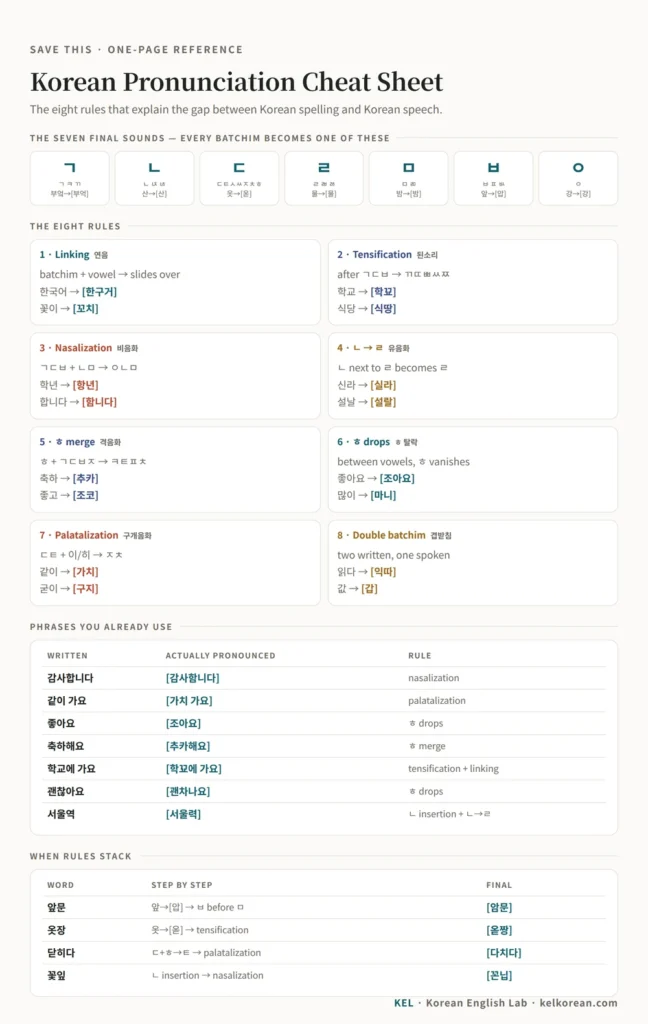
Real words often trigger two or three rules at once. The rules apply in sequence, each one feeding the next.
| Word | Step by step | Final |
|---|---|---|
| 앞문 | 앞 → [압] (seven sounds) → ㅂ before ㅁ → [ㅁ] | [암문] |
| 읽다 | 겹받침 → [익] → tensification | [익따] |
| 옷장 | 옷 → [옫] → tensification | [옫짱] |
| 서울역 | ㄴ insertion → [서울녁] → ㄴ→ㄹ | [서울력] |
| 닫히다 | ㄷ + ㅎ → ㅌ → palatalization | [다치다] |
| 꽃잎 | ㄴ insertion + seven sounds + nasalization | [꼰닙] |
You do not need to compute these consciously. Once each individual rule is familiar, the stacked versions stop sounding strange — which is the actual goal.
Where You Will Hear These First
These rules are not academic. They are hiding in the phrases you already use every day.
| Phrase | Actual pronunciation | Rules at work |
|---|---|---|
| 감사합니다 | [감사함니다] | nasalization |
| 같이 가요 | [가치 가요] | palatalization |
| 좋아요 | [조아요] | ㅎ drop |
| 축하해요 | [추카해요] | ㅎ merge |
| 학교에 가요 | [학꾜에 가요] | tensification + linking |
| 한국어 공부해요 | [한구거 공부해요] | linking |
| 괜찮아요 | [괜차나요] | ㅎ drop |
| 설날 | [설랄] | ㄴ→ㄹ |
Try reading the right column out loud. That is what you are actually hearing in Korean media — and once you have heard it as the right column, the left column stops being confusing.
Pair this with our list of 100 Korean words to learn first and read each word using the rules above rather than letter by letter.
5 Common Pronunciation Mistakes
1. Reading each syllable separately. Learners often say 한-국-어 with three clean blocks. Native speech links them: [한구거]. Blocking is the loudest marker of a foreign accent.
2. Pronouncing 감사합니다 with a ㅂ. It is [감사함니다]. Every 습니다 / 합니다 ending nasalizes.
3. Saying the ㅎ in 좋아요. It is [조아요]. The ㅎ is written for spelling consistency, not for speaking.
4. Using soft consonants after a batchim. 학교 is [학꾜], not hak-gyo with a gentle ㄱ. Tensification is not optional.
5. Trusting romanization. Romanization systems spell the letters, not the sounds. Sinla, hangukeo, and chukha are all technically defensible spellings and all pronounced differently from how they look. Once you know Hangul, read Hangul — see our guide on learning Hangul in a week.
Quick Practice: How Is It Pronounced?
Write the actual pronunciation for each. Answers below.
- 한국어 → ?
- 학생 → ?
- 십만 → ?
- 같이 → ?
- 좋아요 → ?
- 설날 → ?
- 축하 → ?
- 읽다 → ?
Answers:
- [한구거] — linking
- [학쌩] — tensification
- [심만] — nasalization (ㅂ → ㅁ before ㅁ)
- [가치] — palatalization
- [조아요] — ㅎ drop
- [설랄] — ㄴ becomes ㄹ
- [추카] — ㅎ merge
- [익따] — double batchim + tensification
Got six or more? You now understand most of what makes spoken Korean differ from written Korean.
Frequently Asked Questions
Do I need to memorise all eight rules?
No. Learn linking (Rule 1) and tensification (Rule 2) properly — those two cover the majority of cases. The rest you will absorb by listening, once you know they exist. Simply knowing that Korean has sound-change rules stops you from thinking you misheard.
Will Koreans understand me if I ignore these rules?
Usually yes, in context. But you will sound distinctly foreign, and more importantly, you will struggle to understand native speech — because you will be listening for sounds that nobody is producing.
Why doesn’t Korean just spell words the way they sound?
Because consistent spelling keeps meaning visible. 꽃 is always written 꽃 whether it is pronounced [꼳], [꼬치], or [꼰]. If Korean spelled phonetically, one word would have three spellings and reading would get harder, not easier. English makes the same trade-off with cats and dogs — both take an -s that is pronounced differently.
Is this the same as 표준 발음법?
Yes. These rules come from the Standard Korean Pronunciation Rules published by the National Institute of Korean Language. What we have done here is reduce the official document to the eight patterns that matter most for beginners.
How do I practise these?
Shadowing works better than drills. Take one sentence of Korean audio, play it, and repeat it immediately, copying the sound rather than reading the text. Do this for five minutes a day and these rules install themselves.
Does this affect how I should read the vowels too?
Vowels are separate — they do not change based on neighbours the way consonants do. But some of them are genuinely hard to tell apart, especially 어 versus 오.
Final Thoughts
Most learners hit this wall and quietly conclude that their listening is bad. It usually is not. You were taught that Hangul is phonetic, then handed speech that does not match the spelling, and nobody explained the layer in between.
That layer is only eight rules wide. And unlike vocabulary, these rules do not need memorising in the usual sense — they need recognising. Read the pronunciation column of any table above out loud a few times and your ear starts doing the conversion automatically.
Start with linking. Take ten words you already know that have a batchim followed by a vowel — 한국어, 음악, 먹어요, 앉아요, 책을 — and say them linked instead of blocked. It is a small change that immediately makes you sound less like a textbook.
Once your ear is comfortable, the grammar guides on particles and verb conjugation become much easier to use in real conversation, because you can finally hear where one word ends and the next begins.
Keep learning with Korean English Lab. Our bilingual Korean–English worksheets and printable workbooks are designed for self-study learners who want structured practice, not just theory.
These eight rules are stage two of five. Our beginner’s roadmap shows what to study before and after them.
Leave a Reply