You can say 가요. You can say 먹어요. You can say 해요.
Then somebody asks 어제 뭐 했어요? — what did you do yesterday? — and everything you know is stuck in the present.
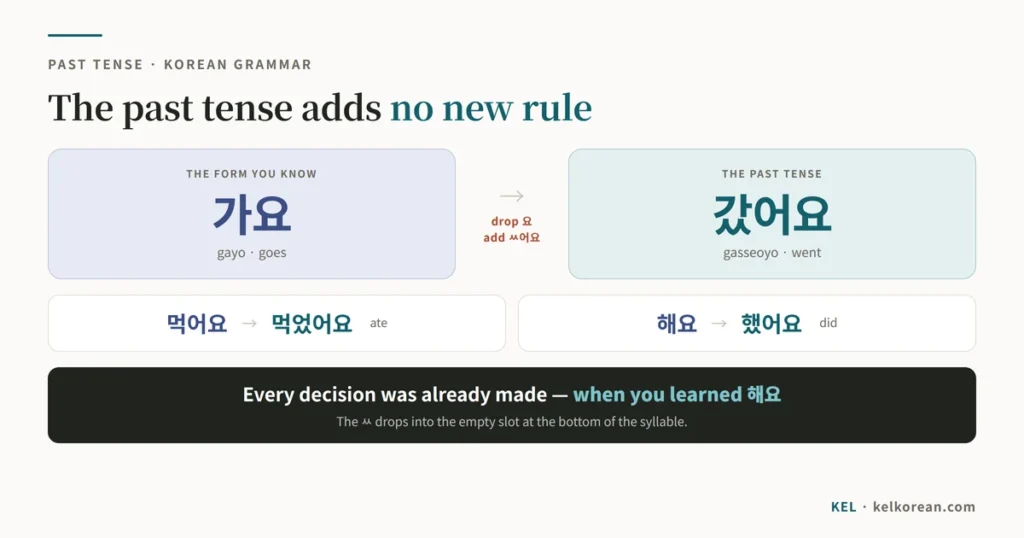
Here is the part nobody tells you early enough: the Korean past tense contains no new rule. Every decision has already been made. You made it when you learned the 해요 form.
가요 → 갔어요
먹어요 → 먹었어요
해요 → 했어요
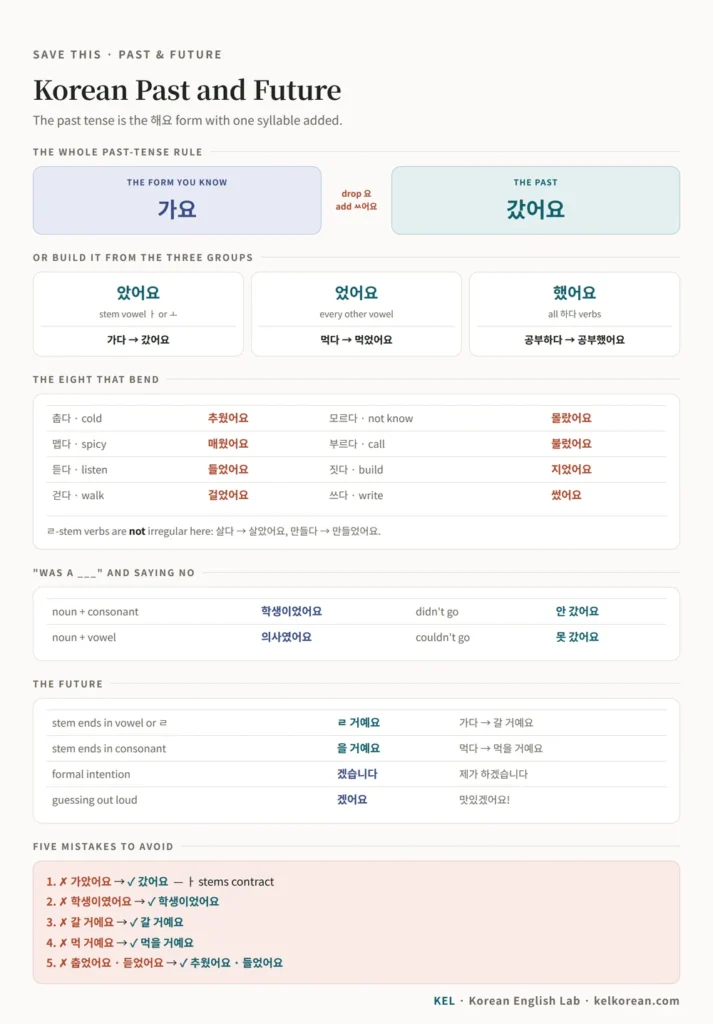
Take the polite present form. Drop 요. Add ㅆ어요. That is the entire mechanism.
This guide covers that rule, the handful of irregular verbs that bend it, the two ways Korean expresses the future, and the five mistakes that show up in every beginner’s first past-tense sentence.
The One Rule
해요 form → drop 요 → add ㅆ어요
| Present | Step | Past |
|---|---|---|
| 가요 | 가 + ㅆ어요 | 갔어요 — went |
| 먹어요 | 먹어 + ㅆ어요 | 먹었어요 — ate |
| 해요 | 해 + ㅆ어요 | 했어요 — did |
| 봐요 | 봐 + ㅆ어요 | 봤어요 — saw |
| 마셔요 | 마셔 + ㅆ어요 | 마셨어요 — drank |
| 배워요 | 배워 + ㅆ어요 | 배웠어요 — learned |
The ㅆ slots into the empty bottom of the last syllable. 가 has no batchim, so ㅆ moves in and 가 becomes 갔.
This is why the 해요 form matters so much. If you built it correctly, the past tense is free. If the vowel harmony behind 아요 and 어요 is still shaky, our guide to Korean verb conjugation covers the choice in full — everything here sits on top of it.
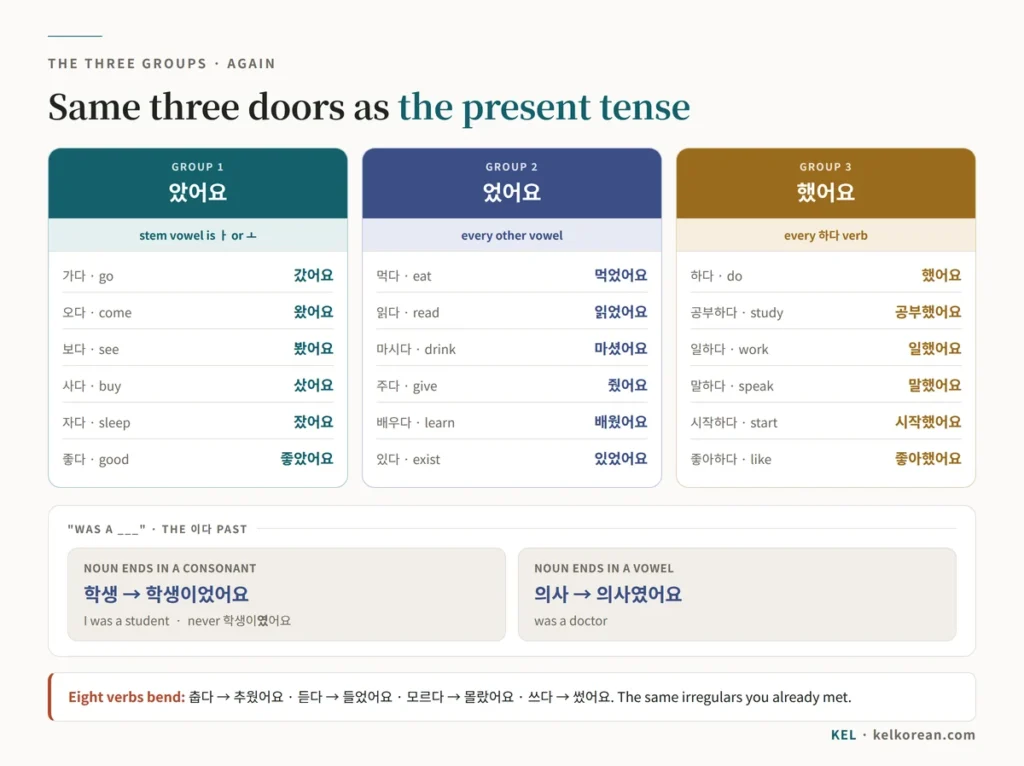
The Same Three Groups
If you would rather build from the dictionary form, the past tense splits exactly the way the present does.
| Stem vowel | Ending | Example |
|---|---|---|
| ㅏ or ㅗ | 았어요 | 살다 → 살았어요 |
| everything else | 었어요 | 먹다 → 먹었어요 |
| 하다 verbs | 했어요 | 공부하다 → 공부했어요 |
| Verb | Meaning | Past |
|---|---|---|
| 가다 | to go | 갔어요 |
| 오다 | to come | 왔어요 |
| 보다 | to see | 봤어요 |
| 사다 | to buy | 샀어요 |
| 자다 | to sleep | 잤어요 |
| 먹다 | to eat | 먹었어요 |
| 읽다 | to read | 읽었어요 |
| 마시다 | to drink | 마셨어요 |
| 기다리다 | to wait | 기다렸어요 |
| 주다 | to give | 줬어요 |
| 공부하다 | to study | 공부했어요 |
| 일하다 | to work | 일했어요 |
Same three doors as the present tense. You are walking through them a second time.
Adjectives Work Identically
Korean adjectives conjugate like verbs, so the past tense rule applies without modification.
| Adjective | Meaning | Past |
|---|---|---|
| 좋다 | good | 좋았어요 |
| 많다 | many | 많았어요 |
| 맛있다 | delicious | 맛있었어요 |
| 예쁘다 | pretty | 예뻤어요 |
| 바쁘다 | busy | 바빴어요 |
| 크다 | big | 컸어요 |
어제 정말 바빴어요. — I was really busy yesterday.
음식이 맛있었어요. — The food was delicious.
English needs was and were. Korean puts the tense inside the adjective itself.
“Was” — the 이다 Past
To say was a student or was a doctor, you conjugate 이다.
| Noun ends in | Form | Example |
|---|---|---|
| consonant | 이었어요 | 학생 → 학생이었어요 |
| vowel | 였어요 | 의사 → 의사였어요 |
저는 학생이었어요. — I was a student.
그 사람은 의사였어요. — That person was a doctor.
The negative is 아니었어요: 제 가방이 아니었어요 — it wasn’t my bag.
This one trips up Korean speakers too. ✗ 학생이였어요 is a very common misspelling. After a consonant it is 이었어요, with no ㅕ.
Saying No in the Past
Both negatives you already know simply move into the past tense.
| Korean | Meaning |
|---|---|
| 안 갔어요 | didn’t go |
| 가지 않았어요 | didn’t go (slightly more formal) |
| 못 갔어요 | couldn’t go |
| 가지 못했어요 | couldn’t go (more formal) |
어제 학교에 안 갔어요. — I didn’t go to school yesterday.
시간이 없어서 못 갔어요. — I couldn’t go because I had no time.
안 is choice. 못 is inability. The distinction matters more in Korean than the English translations suggest — 안 갔어요 says you decided not to, 못 갔어요 says something stopped you.
The Irregulars
Five patterns bend before 았/었. They are the same five that bend in the present tense, so if you have met them once, this is recognition rather than memorisation.
| Type | Verb | Past | What happened |
|---|---|---|---|
| ㅂ | 춥다 (cold) | 추웠어요 | ㅂ became 우 |
| ㅂ | 맵다 (spicy) | 매웠어요 | ㅂ became 우 |
| ㄷ | 듣다 (listen) | 들었어요 | ㄷ became ㄹ |
| ㄷ | 걷다 (walk) | 걸었어요 | ㄷ became ㄹ |
| 르 | 모르다 (not know) | 몰랐어요 | ㄹ doubled |
| 르 | 부르다 (call, sing) | 불렀어요 | ㄹ doubled |
| ㅅ | 짓다 (build) | 지었어요 | ㅅ dropped |
| 으 | 쓰다 (write) | 썼어요 | 으 dropped |
✗ 춥었어요 · ✓ 추웠어요
✗ 듣었어요 · ✓ 들었어요
Note that ㄹ-stem verbs are not irregular here. 살다 → 살았어요, 만들다 → 만들었어요. They behave.
The Future — Two Ways
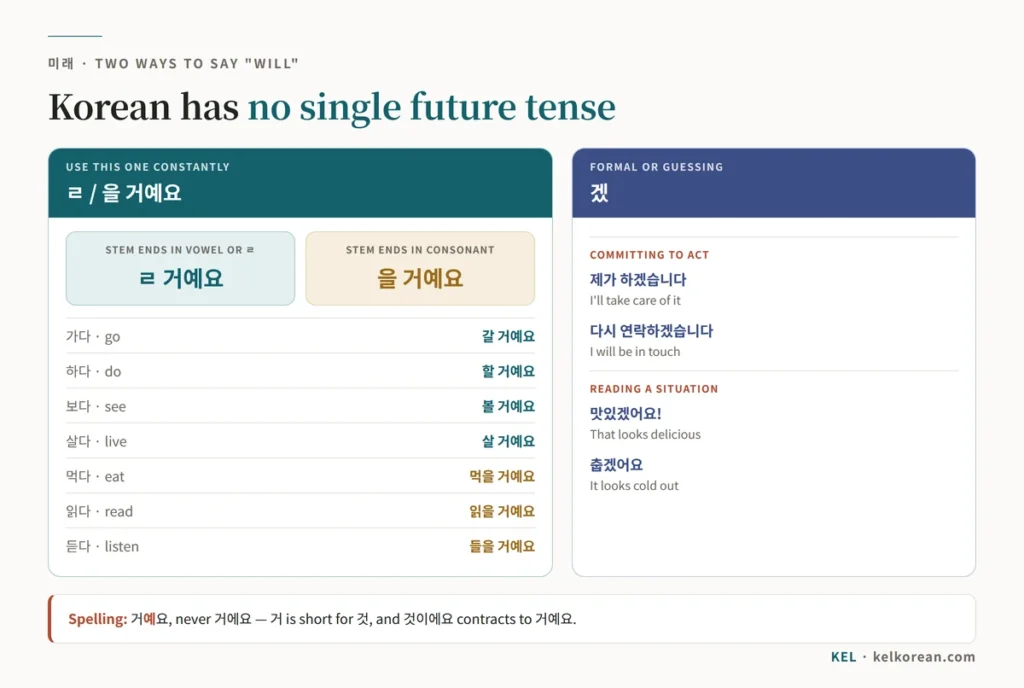
Korean has no single future tense. It has two constructions doing different jobs.
1. ㄹ / 을 거예요 — the everyday future
This is the one you will use constantly. It covers plans, intentions and expectations.
| Stem ends in | Form | Example |
|---|---|---|
| vowel or ㄹ | ㄹ 거예요 | 가다 → 갈 거예요 |
| consonant | 을 거예요 | 먹다 → 먹을 거예요 |
| Verb | Future |
|---|---|
| 가다 | 갈 거예요 — will go |
| 하다 | 할 거예요 — will do |
| 보다 | 볼 거예요 — will see |
| 먹다 | 먹을 거예요 — will eat |
| 읽다 | 읽을 거예요 — will read |
| 살다 | 살 거예요 — will live |
| 듣다 | 들을 거예요 — will listen (ㄷ irregular) |
내일 친구를 만날 거예요. — I’m going to meet a friend tomorrow.
주말에 뭐 할 거예요? — What are you going to do this weekend?
Spelling warning: it is 거예요, not 거에요. The wrong version is everywhere online, including on signs. 거예요 is correct.
2. 겠 — intention and guessing
겠 slots directly into the verb before the ending. It carries two meanings that feel unrelated but are not.
Strong intention, usually formal:
제가 하겠습니다. — I’ll do it.
다시 연락하겠습니다. — I will contact you again.
Guessing about something in front of you:
맛있겠어요! — That looks delicious.
춥겠어요. — It looks cold out.
Both are the speaker committing to something not yet confirmed — their own action, or their read of a situation.
Two 겠 forms are so common they function as single words: 알겠습니다 (understood) and 모르겠어요 (I don’t know). Neither is really future. 모르겠어요 is simply a softer 몰라요.
And sometimes: the present
For a scheduled near future, Korean often just uses the present tense, exactly as English does with I’m leaving tomorrow.
내일 서울에 가요. — I’m going to Seoul tomorrow.
Time Words That Signal Tense
Korean does not require a time word, but pairing one with the right ending locks the habit in.
| Past | Future |
|---|---|
| 어제 — yesterday | 내일 — tomorrow |
| 아까 — a little while ago | 이따가 — later today |
| 지난주 — last week | 다음 주 — next week |
| 작년 — last year | 내년 — next year |
| 그저께 — day before yesterday | 모레 — day after tomorrow |
These come straight from our guide to telling time in Korean, where the full calendar set lives.
Remember that 어제, 오늘 and 내일 reject the particle 에. ✓ 어제 갔어요, not 어제에 갔어요. But 지난주에 갔어요 is correct. If particles are still slippery, our guide to Korean particles covers which nouns take 에.
Both Tenses in One Conversation
Here is everything above in a single exchange — the shape most real conversations take.
A: 주말에 뭐 했어요?
B: 친구를 만났어요. 같이 영화를 봤어요.
A: 재미있었어요?
B: 네, 정말 재미있었어요. 그런데 좀 길었어요.
A: 다음 주에도 만날 거예요?
B: 아니요, 다음 주에는 바쁠 거예요. 시험이 있어요.
Six lines, and every past form in them came from the same rule: 하다 → 했어요, 만나다 → 만났어요, 보다 → 봤어요, 재미있다 → 재미있었어요, 길다 → 길었어요.
Notice the last two lines. 만날 거예요 is a plan; 바쁠 거예요 is an expectation about a state. The same ㄹ 거예요 handles both, which is why it does so much work in ordinary speech.
5 Mistakes Worth Avoiding
1. Not contracting. ✗ 가았어요 · ✓ 갔어요. When the stem ends in ㅏ, the 아 merges in. Same for 오: ✗ 오았어요 · ✓ 왔어요.
2. 학생이였어요. ✓ 학생이었어요. Consonant → 이었어요. Vowel → 였어요. Korean speakers get this wrong in writing too, which is why you see both online.
3. 거에요. ✓ 거예요. Always 예.
4. Dropping 을. ✗ 먹 거예요 · ✓ 먹을 거예요. A consonant-final stem needs 을 to bridge to 거예요.
5. Regularising the irregulars. ✗ 춥었어요, 듣었어요 · ✓ 추웠어요, 들었어요. These eight verbs are worth drilling separately from everything else.
Quick Practice
Convert to the past tense. Answers below.
- 가요 → ?
- 먹어요 → ?
- 공부해요 → ?
- 마셔요 → ?
- 추워요 → ?
- 저는 학생이에요 → ?
Convert to the future.
- 가다 → ?
- 읽다 → ?
Answers:
- 갔어요
- 먹었어요
- 공부했어요
- 마셨어요
- 추웠어요
- 저는 학생이었어요 — not 학생이였어요
- 갈 거예요
- 읽을 거예요
Six or more and both tenses have landed.
Frequently Asked Questions
Is 했어요 different from 했었어요?
Yes. 했었어요 is a past-in-the-past — something finished and no longer relevant, closer to English had done. Beginners often reach for it thinking it sounds more properly past. For ordinary yesterday-events, 했어요 is what you want.
Do I need a time word for the tense to be clear?
No. 갔어요 is already unambiguously past. Time words add detail, not grammar.
When do I use 겠 instead of ㄹ 거예요?
Use ㄹ 거예요 for your plans in conversation. Use 겠 when committing formally (제가 하겠습니다) or guessing about something you can see (맛있겠어요). In casual speech about your own weekend, ㄹ 거예요 every time.
Why is it 거예요 and not 거에요?
거 is a shortened 것 (thing), and it takes 이에요 — 것이에요 → 거예요. The 에 version is a spelling error that spread because the two sound nearly identical.
Is there a past tense in the formal 습니다 style?
Yes — 갔습니다, 먹었습니다, 했습니다. Same ㅆ, different ending. The rule you learned above still does the work.
What about the plain form used in writing?
갔다, 먹었다, 했다 — books, news and diaries use this. Once you can produce 갔어요, 갔다 is a swap, not a new conjugation.
Final Thoughts
Most learners treat the past tense as a second mountain after the present tense. It isn’t. It is the same mountain with one syllable added at the top.
Build the 해요 form. Drop 요. Add ㅆ어요. Every regular verb in the language obeys, and the eight irregulars bend in ways you have already met.
The future is smaller still: ㄹ 거예요 for almost everything, 겠 when you are being formal or guessing out loud.
Practise by narrating your actual day in both directions — 아침에 커피를 마셨어요, 이따가 친구를 만날 거예요. Ten real sentences will do more than a hundred conjugation drills, because you have to choose the tense before you choose the verb.
If you are working through the stages in order, this follows directly from Korean verb conjugation and sits alongside our essential Korean grammar patterns in Stage 4 of the complete beginner’s roadmap.
Keep learning with Korean English Lab. Our bilingual Korean–English worksheets and printable workbooks are designed for self-study learners who want structured practice, not just theory.
Leave a Reply