The first thing almost everyone does after learning Hangul is try to write their own name. And the first thing almost everyone discovers is that it comes out longer than it went in.
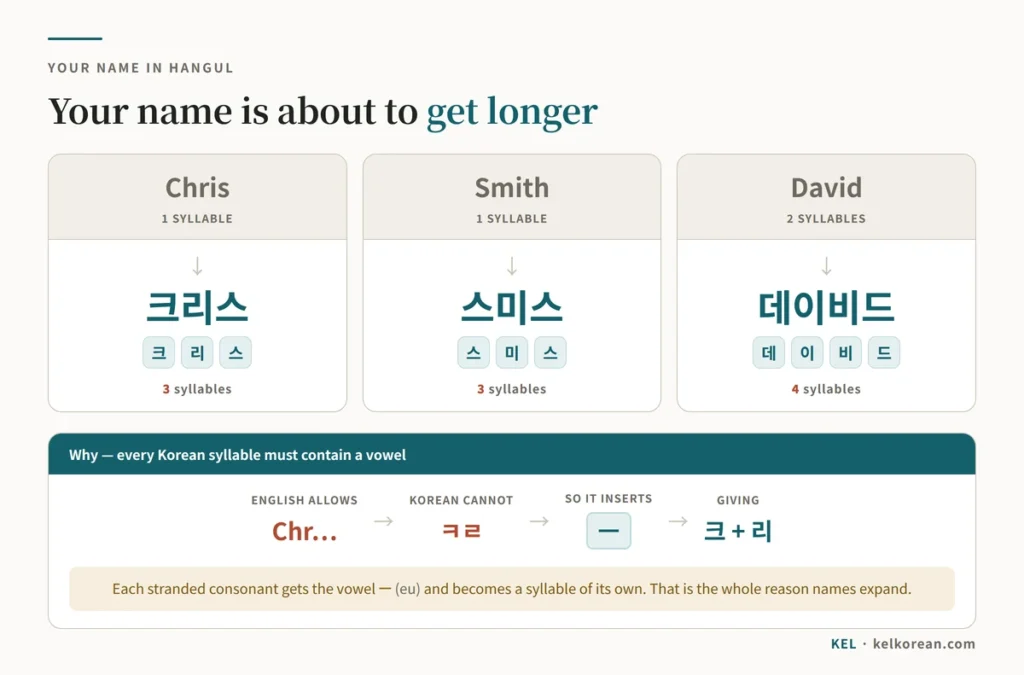
Chris is one syllable in English. In Korean it is 크리스 — three. Smith is one syllable and becomes 스미스. David is two and becomes 데이비드, which is four.
Learning to write your name in Korean takes about ten minutes once you understand why that happens. It is not random, and it is not Korean struggling with your name — it is a rule about how Korean syllables are allowed to be built.
Rule Zero: You Are Writing the Sound
Before anything else, throw the spelling away.
Korean transliteration follows how a name is pronounced, not how it is written. English spelling is famously unreliable, and none of that unreliability transfers.
- The silent gh in Hugh disappears entirely → 휴
- Sean is not S-E-A-N, it is “Shawn” → 션
- Stephen is “Steven” → 스티븐
- Knight loses its k → 나이트
So the first step is always the same: say your name out loud and listen to it. What you hear is what gets written.
If you have not fully settled the letters yet, learning Hangul in a week covers the alphabet, and how to write Hangul covers the stroke order for drawing them by hand.
Why Your Name Gets Longer
Here is the actual mechanism.
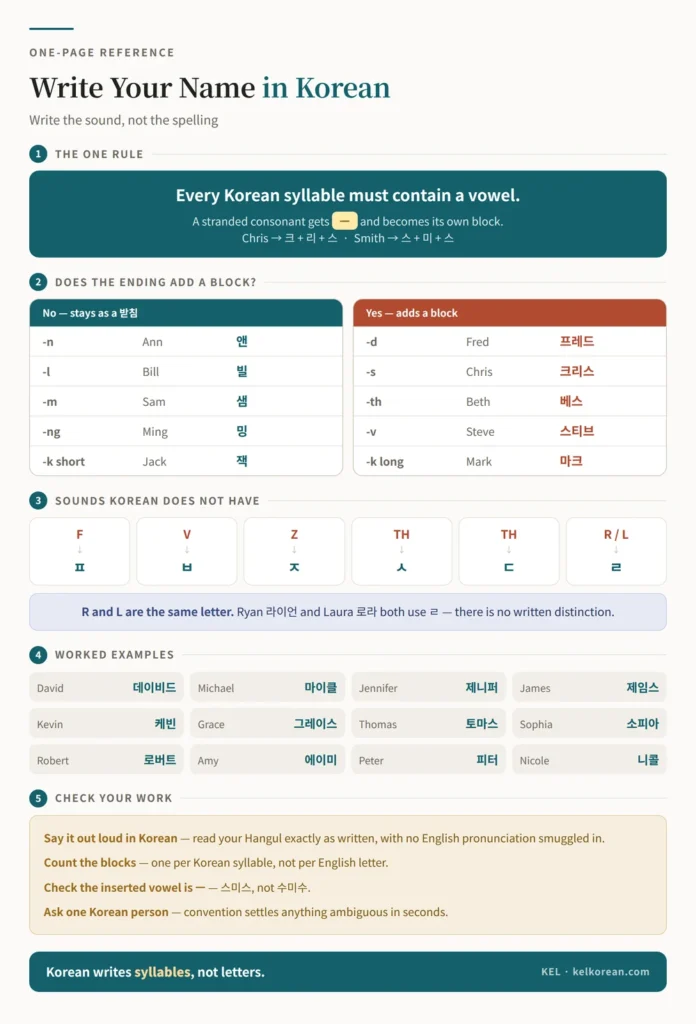
Every Korean syllable must contain a vowel. There is no way around it — a Hangul block is built as consonant + vowel, optionally plus a final consonant. English happily strings consonants together (Chr- in Chris, Sm- in Smith), and Korean simply cannot write that.
The solution is to insert the vowel ㅡ (eu) — the most neutral vowel in the language — wherever a stranded consonant needs one.
| Name | The problem | Result |
|---|---|---|
| Chris | Chr is three consonants | 크 + 리 + 스 = 크리스 |
| Smith | Sm has no vowel | 스 + 미 + 스 = 스미스 |
| Frank | Fr has no vowel | 프 + 랭 + 크 = 프랭크 |
| Grace | Gr has no vowel | 그 + 레 + 이 + 스 = 그레이스 |
This is the whole reason names expand. Each stranded consonant becomes its own syllable, and 스 and 크 and 프 are syllables in their own right.
The same mechanism explains why loanwords behave the way they do — 스트레스 for “stress,” 크리스마스 for “Christmas” — which is covered in full in Konglish.
Which Endings Add a Syllable, and Which Don’t
Not every final consonant needs the extra vowel. Korean syllables can end in a consonant — that is what a 받침 is — so some names stay short.
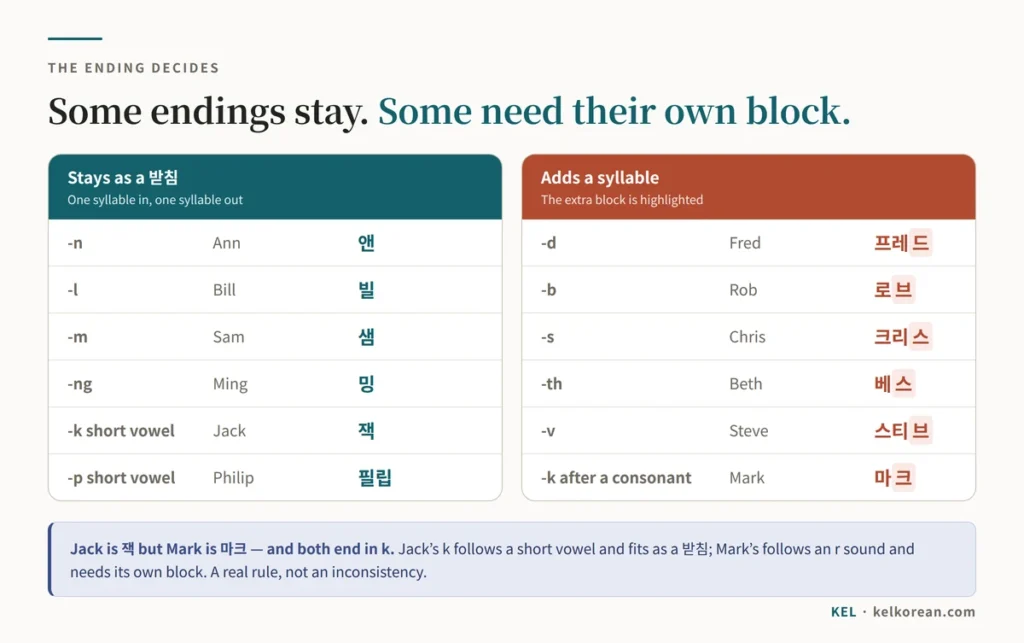
These endings stay put as a 받침:
| Ending | Example | Korean |
|---|---|---|
| -n | Ann | 앤 |
| -l | Bill | 빌 |
| -m | Sam | 샘 |
| -ng | Ming | 밍 |
| -k after a short vowel | Jack | 잭 |
| -p after a short vowel | Philip | 필립 |
One syllable in, one syllable out.
These endings add a syllable:
| Ending | Example | Korean |
|---|---|---|
| -d | Fred | 프레드 |
| -b | Rob | 로브 |
| -g | Greg | 그레그 |
| -s | Chris | 크리스 |
| -sh | Josh | 조시 |
| -th | Beth | 베스 |
| -f | Jeff | 제프 |
| -v | Steve | 스티브 |
| -ch | Rich | 리치 |
| -k after a long vowel or consonant | Mark | 마크 |
The pattern underneath it: voiced endings and fricatives cannot sit in a Korean final position the way n, l, m and ng can, so they get their own block.
Note the difference between Jack → 잭 and Mark → 마크. Both end in k. Jack’s k follows a short vowel and becomes a 받침; Mark’s follows an r sound and needs its own syllable. This is a real rule and not an inconsistency.
The Sounds Korean Does Not Have
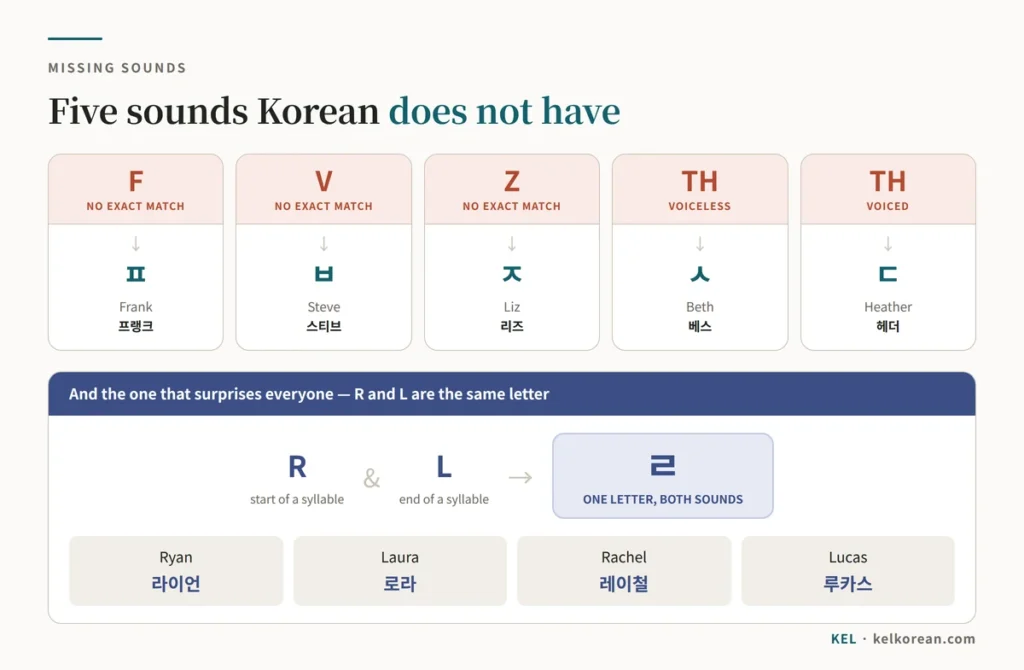
Five English sounds have no exact Korean equivalent, and every one of them shows up in names.
| English | Korean uses | In a name |
|---|---|---|
| F | ㅍ | Frank → 프랭크 |
| V | ㅂ | Steve → 스티브 |
| Z | ㅈ | Liz → 리즈 |
| TH (voiceless) | ㅅ | Beth → 베스 |
| TH (voiced) | ㄷ | Heather → 헤더 |
And then the one that surprises people most: R and L are the same letter.
Korean has a single ㄹ that covers both. Which sound it makes depends on where it sits in the syllable — closer to r at the start of a syllable, closer to l at the end. There is no way to distinguish Ryan from Lion in writing, and no Korean feels the loss.
- Ryan → 라이언
- Laura → 로라
- Rachel → 레이철
- Lucas → 루카스
If ㄹ and the aspirated consonants are still unclear, Korean consonants explains the families they belong to.
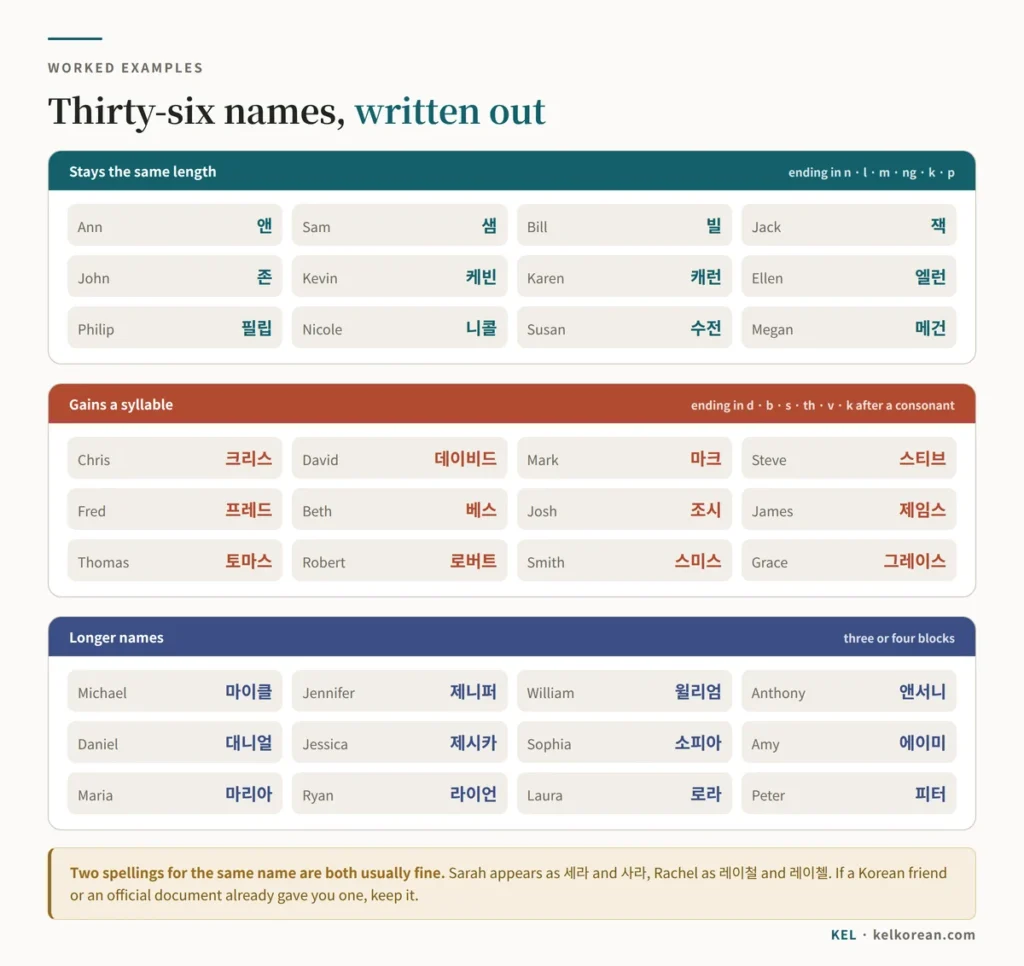
Forty Names, Worked Out
Names ending in a consonant that stays:
| Ann → 앤 | Sam → 샘 | Bill → 빌 | Jack → 잭 |
| John → 존 | Kevin → 케빈 | Karen → 캐런 | Ellen → 엘런 |
| Philip → 필립 | Nicole → 니콜 | Susan → 수전 | Megan → 메건 |
Names that grow:
| Chris → 크리스 | David → 데이비드 | Mark → 마크 | Steve → 스티브 |
| Fred → 프레드 | Beth → 베스 | Josh → 조시 | James → 제임스 |
| Thomas → 토마스 | Robert → 로버트 | Smith → 스미스 | Grace → 그레이스 |
Longer names:
| Michael → 마이클 | Jennifer → 제니퍼 | William → 윌리엄 | Elizabeth → 엘리자베스 |
| Christopher → 크리스토퍼 | Anthony → 앤서니 | Daniel → 대니얼 | Jessica → 제시카 |
| Sophia → 소피아 | Amy → 에이미 | Maria → 마리아 | Julia → 줄리아 |
| Ryan → 라이언 | Laura → 로라 | Emma → 엠마 | Peter → 피터 |
A note on variation. Korea has an official transliteration standard, and everyday usage does not always follow it. Sarah appears as both 세라 and 사라; Rachel as both 레이철 and 레이첼. Neither is wrong — if you have already been given a spelling by a Korean friend or an official document, keep it.
What Koreans Will Actually Call You
Writing the name is the easy half. Being called by it is a separate question.
Long names get shortened. Four syllables is long by Korean standards, so 크리스토퍼 becomes 크리스 and 제니퍼 often becomes 제니 in practice. This is friendliness, not rudeness.
And the name usually comes with something attached. As covered in how Korean names work, Koreans rarely use a bare given name — you are far more likely to be 크리스 씨 at work, or 선생님 if you teach, than plain 크리스.
Your surname will probably get skipped. Korean surnames are one syllable and lead the name; a three-syllable foreign surname does not fit that slot comfortably, so most Koreans will simply use your given name and add 씨.
When you introduce yourself, the pattern is 저는 [name]이에요 or the fuller version in Korean greetings and self-introduction.
Should You Get a Korean Name Instead?
Two different things get called “your Korean name,” and it is worth separating them.
Transliteration is what this article has been describing — your own name, written in Hangul. It stays yours, it is what appears on forms, and it is what nearly everyone should use.
A given Korean name is a genuine Korean name chosen for you — usually three syllables, often with hanja meanings. Some long-term residents acquire one, usually from a Korean friend, a partner’s family, or a teacher.
Be careful with the second. A Korean name chosen at random from a website can land badly — sounding dated, sounding like a celebrity, or carrying a meaning nobody would give a child. Names go in and out of fashion in Korea quickly, and a name that sounds normal to a translation tool can sound like a great-grandmother to an actual Korean.
The practical advice: use the transliteration. If someone Korean offers to give you a name, that is a nice thing and worth accepting. Do not generate one for yourself.
How to Check Your Work
Say it out loud in Korean. Read your Hangul back exactly as written, with no English pronunciation smuggled in. If it sounds close to your name, it is right.
Count the syllables. One block per Korean syllable. If your name has three consonants in a row somewhere and your version has no extra blocks, something is missing.
Watch the vowel you inserted. It should be ㅡ, not ㅜ or ㅗ. 크리스, not 쿠리스.
Ask one Korean person. Transliteration has enough convention in it that a single native check settles anything ambiguous in seconds.
5 Mistakes Worth Avoiding
1. Transliterating the spelling instead of the sound. Sean is 션, not 세안.
2. Using ㅜ instead of ㅡ for the inserted vowel. ㅡ is the neutral one. It is 스미스, not 수미수.
3. Forcing an R–L distinction. It does not exist. Pick ㄹ and move on.
4. Adding a syllable that is not needed. Ann is 앤, not 앤느. If the ending is n, l, m or ng, leave it as a 받침.
5. Choosing a Korean name from a random generator. See above. The transliteration is the safe answer.
Quick Practice
Write these in Hangul. Answers underneath.
- Tom
- Ben
- Kate
- Frank
- Olivia
Answers
- 톰 — the m stays as a 받침
- 벤 — the n stays too
- 케이트 — t after a long vowel needs its own syllable
- 프랭크 — Fr needs ㅡ, and the k after n needs its own block
- 올리비아 — the v becomes ㅂ
Frequently Asked Questions
How do I write my name in Korean?
Say it out loud, then write the sounds in Hangul rather than the letters. Insert the vowel ㅡ wherever a consonant has no vowel of its own — this is why Chris becomes 크리스. Endings in n, l, m or ng stay as a final consonant; most other endings need an extra syllable.
Why does my name have more syllables in Korean?
Because every Korean syllable needs a vowel, and English allows consonant clusters that Korean cannot write. Each stranded consonant gets ㅡ attached and becomes its own block.
Is there a Korean letter for F, V or Z?
No. F becomes ㅍ, V becomes ㅂ and Z becomes ㅈ. These are the closest available sounds and every Korean speaker reads them as the foreign sound they stand for.
How do you write R and L differently in Korean?
You do not — ㄹ covers both. Its sound shifts depending on its position in the syllable, but there is no written distinction, so Ryan and Lion cannot be told apart on paper.
Should I choose a Korean name?
Only if a Korean person gives you one. A transliteration of your own name is what belongs on forms and what people will use, and it is what almost every foreigner in Korea goes by. Names generated by websites often sound dated or odd.
Which spelling is correct if I find two versions?
Both, usually. Korea has an official standard that everyday usage does not always follow — Sarah appears as 세라 and 사라. If a Korean friend or an official document has already given you a spelling, keep that one.
Do I write my surname first, like Koreans do?
Not necessarily. Koreans understand that foreign names run given-name-first, and in practice most people will use your given name plus 씨 and skip the surname entirely.
Final Thoughts
To write your name in Korean, there is really only one thing to internalise: Korean writes syllables, not letters. Every block needs a vowel, so anything English leaves stranded gets ㅡ and becomes a syllable of its own.
That single rule explains 크리스, 스미스, 데이비드 and every other name that came out longer than expected.
Write it, say it out loud, and check it with one Korean person. Then get used to hearing it with 씨 attached — because from that point on, it is the name you actually have.
Leave a Reply