You learned to read Hangul in a week. Then you picked up a pen, and it turned out that recognising ㄹ and drawing ㄹ are not the same skill at all.
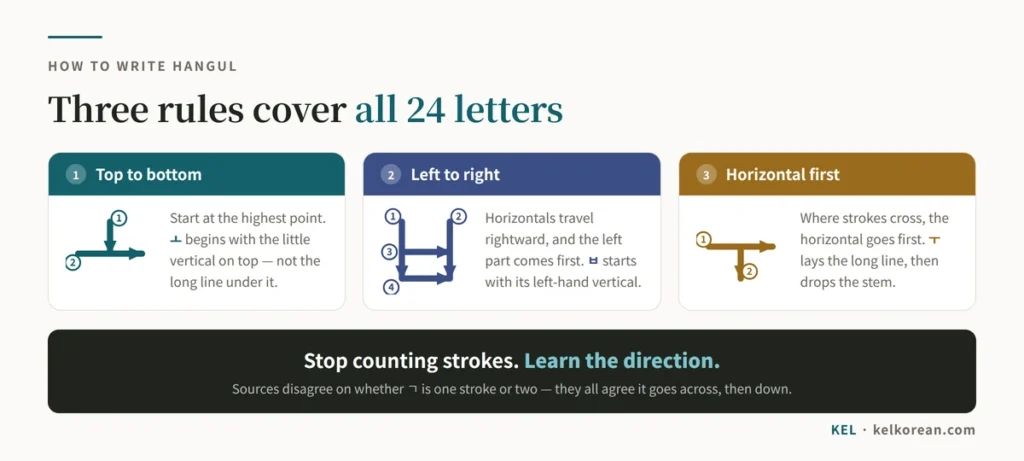
Learning how to write Hangul takes far less time than learning to read it, because the whole system runs on three rules. Not fourteen rules, not one per letter — three, and they apply to every character on the page.
There is one honest complication to get out of the way first, and knowing it will save you a lot of confusion.
Nobody Agrees on the Stroke Count
Look up Hangul stroke order in English and you will find ㄱ described as one stroke on one site and two on another. ㄹ gets counted as three, four or five depending on where you look. ㅁ is three or four.
This is not a mistake anybody is making. It depends on whether you count pen lifts or direction changes. Writing ㄱ in one continuous movement — across, then down — is one stroke by the first definition and two by the second. Both descriptions are of the same pen movement.
So here is the useful version:
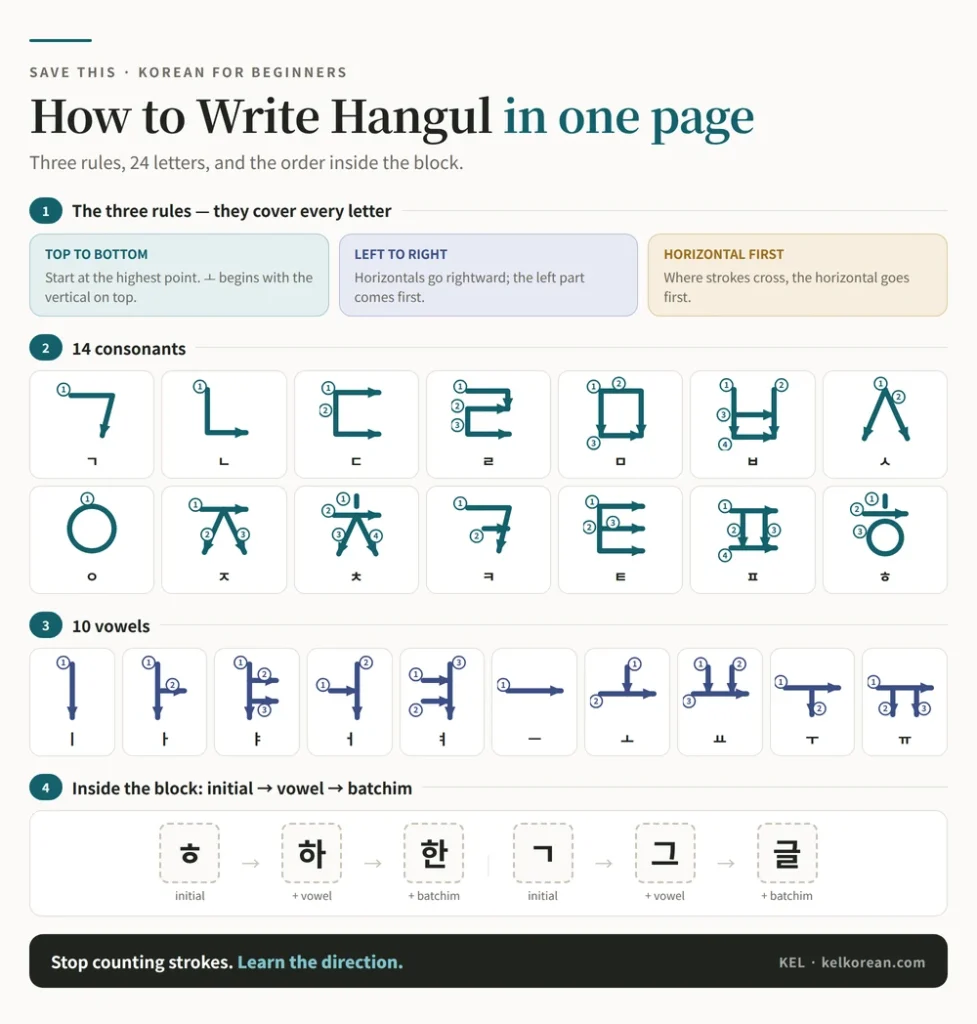
Stop counting strokes. Learn the direction.
Direction is what every source agrees on, and direction is what makes your handwriting legible. A Korean reading your notes will not notice whether you lifted the pen. They will notice immediately if you drew ㄴ from the bottom up.
The Three Rules
These cover every letter in the alphabet.
1. Top to bottom. Always start at the highest point of the letter and work down. ㅗ starts with the little vertical at the top, not the long line under it.
2. Left to right. Horizontal strokes travel rightward, and when a letter has a left part and a right part, the left one comes first. ㅂ starts with its left-hand vertical.
3. Horizontal before vertical. Where two strokes cross, the horizontal one usually goes first. This is why ㅜ starts with the long line across the top and then drops the stem.
That is the entire system. Every letter below is just these three rules applied to a different shape.
The 14 Consonants
The consonants divide neatly into families, and the families share their movements — which means you learn far fewer shapes than fourteen.
The base shapes
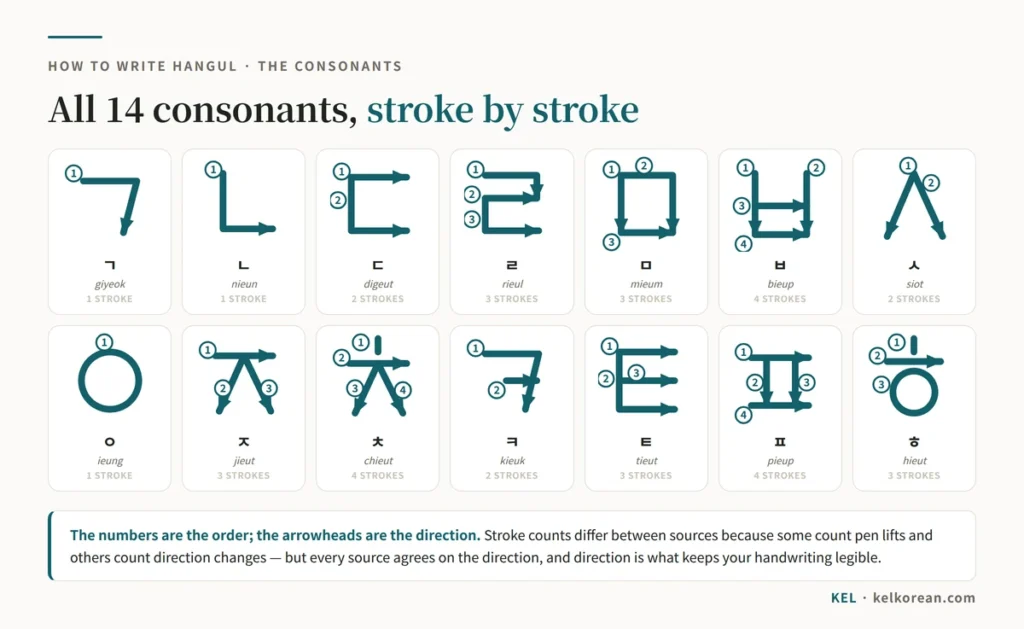
- ㄱ — across, then down. One movement.
- ㄴ — down, then across. The mirror of ㄱ.
- ㅁ — left side down, then across the top and down the right, then close the bottom.
- ㅅ — from the peak, down to the left; from the peak, down to the right.
- ㅇ — one circle, starting at the top.
The ones built by adding a line
- ㄷ is ㄴ with a lid on top. The lid goes first.
- ㄹ is ㄱ stacked on ㄷ — top shape first, middle line, then the bottom.
- ㅋ is ㄱ with a line through it. The ㄱ first, the crossbar second.
- ㅌ is ㄷ with a middle line, and the middle line goes in last.
- ㅈ is ㅅ with a roof. Roof first, then the two diagonals.
- ㅊ is ㅈ with a tick on top. The tick is stroke one.
- ㅎ is a tick, a line, and a circle — in that order, top to bottom.
- ㅂ — both verticals, then the middle line, then the base.
- ㅍ — the top line, then the two verticals, then the base.
Notice how much of this is rule 1 doing the work: ㅊ, ㅎ, ㄷ, ㅌ and ㅍ all begin with whatever is highest.
If the family relationships between these are new to you, Korean consonants explains why ㄱ, ㅋ and ㄲ look related — the shapes encode the sounds.
The 10 Vowels
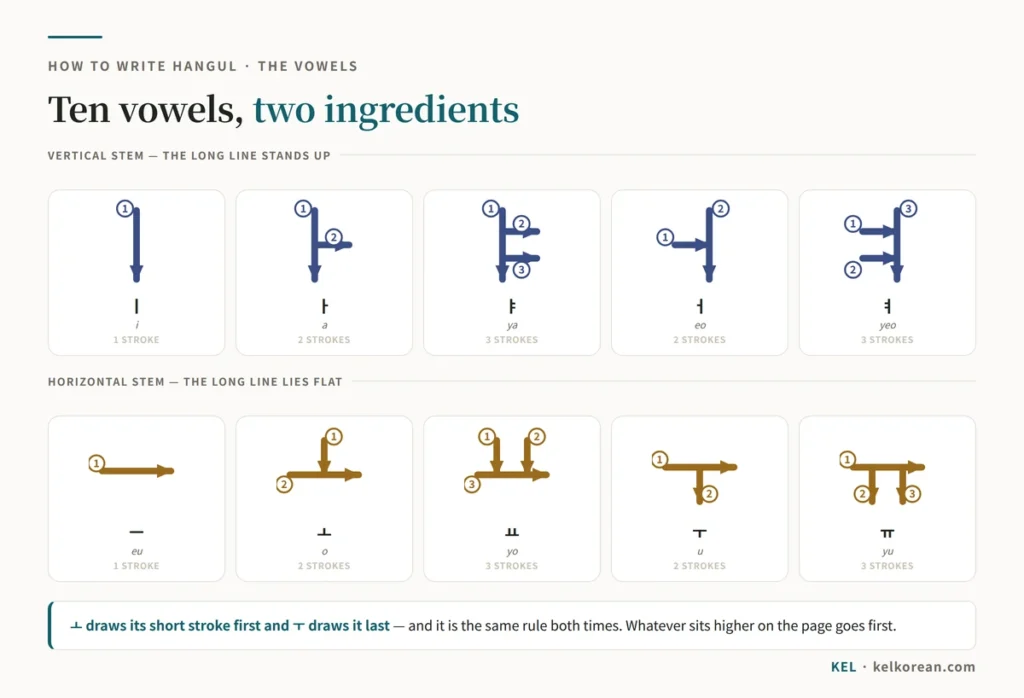
The vowels are easier, because they are all made of two ingredients: a long line and a short one.
Vertical-stem vowels — the long line stands upright.
- ㅣ — one stroke, downward.
- ㅏ — the stem first, then the short line out to the right.
- ㅑ — the stem, then the upper short line, then the lower one.
- ㅓ — the short line first, because it is on the left. Then the stem.
- ㅕ — upper short line, lower short line, then the stem.
Horizontal-stem vowels — the long line lies flat.
- ㅡ — one stroke, rightward.
- ㅗ — the short vertical on top first, then the long line beneath it.
- ㅛ — left short line, right short line, then the long line.
- ㅜ — the long line first this time, because it is on top. Then the stem drops.
- ㅠ — the long line, then the left stem, then the right.
The pattern is worth seeing clearly. ㅗ draws its short stroke first and ㅜ draws it last — and the reason is the same rule in both cases. Whatever sits higher on the page goes first.
The two vowels English speakers most often confuse are covered separately in ㅓ vs ㅗ pronunciation.
Writing a Whole Syllable
Individual letters are only half of it. Hangul stacks its letters into square blocks, and the block has its own order.
The rule is the same three rules, applied to the block.
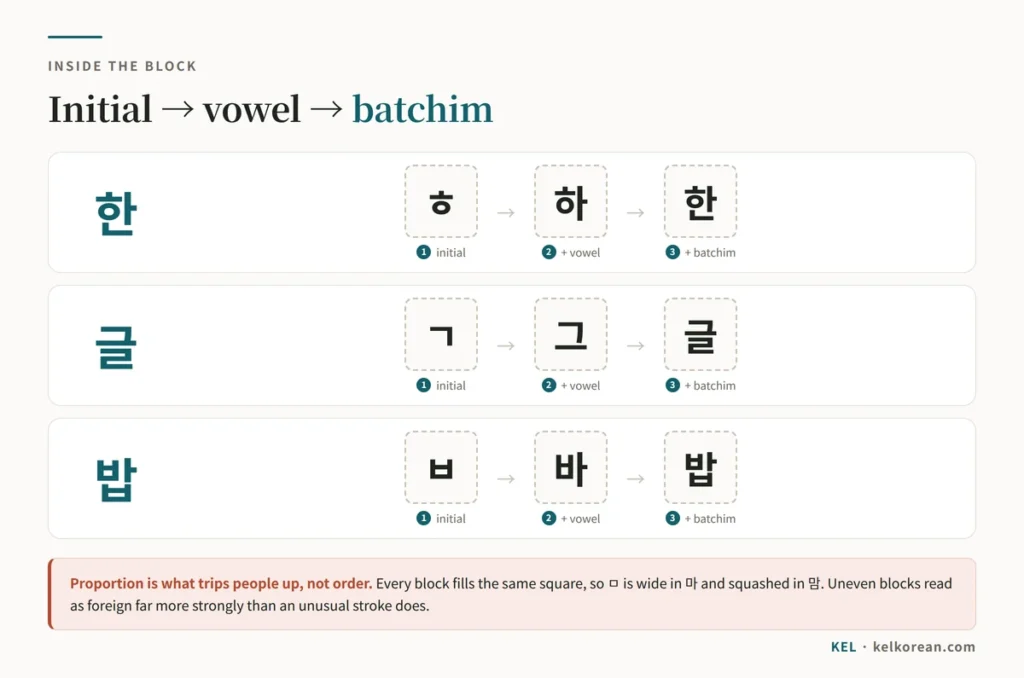
initial consonant → vowel → final consonant
Which is simply top-to-bottom and left-to-right again.
- 한 — ㅎ first (top left), then ㅏ (right), then ㄴ (bottom).
- 글 — ㄱ, then ㅡ, then ㄹ.
- 밥 — ㅂ, then ㅏ, then ㅂ.
When the vowel sits to the right — as in 가, 나, 하 — you write the consonant and then move right. When the vowel sits underneath — 고, 노, 수 — you write the consonant and then move down. The batchim, if there is one, is always last.
The one thing that trips people up is proportion rather than order. Each block occupies the same square regardless of how many letters are inside it, so ㅁ in 마 is wide and ㅁ in 맘 is squashed. Korean handwriting looks wrong to a native reader mostly when the blocks are uneven, not when a stroke went the wrong way.
Why It Is Worth Doing At All
You can type Korean without ever writing it by hand, so this is a fair question.
Writing fixes the shapes in memory. Recognition and recall are different skills. Most learners can pick ㅈ out of a line of text long before they can produce it from nothing, and writing closes that gap faster than reading does.
It makes other people’s handwriting readable. Korean handwriting compresses and connects, and the compressions follow the stroke order. If you know that ㄹ is written top shape, middle, bottom, you can decode a hurried ㄹ that looks like a squiggle.
It slows you down usefully. Copying out the hundred words you are trying to learn is a better use of ten minutes than reading them twenty times — and our list of 100 Korean words to learn first is a good place to start.
How to Practise
Use squared paper. Korean children learn on 원고지, a grid of squares, precisely because block proportion is the hard part. Any squared notebook works.
One letter, one line, then stop. Ten repetitions of ㄹ teaches more than a hundred, because after ten your hand is repeating a habit rather than forming one.
Then write words, not letters. Letters in isolation never teach you proportion. 한국, 사랑, 학교 — real blocks, with real squeezing.
Ten minutes is enough. This is a motor skill. It responds to short daily practice and barely responds to long sessions.
Say the letters as you write them. Attaching the sound to the movement is free, and it doubles what the practice is worth. If the sounds are still shaky, Korean pronunciation rules covers what changes when letters meet.
5 Mistakes Worth Avoiding
1. Drawing ㄴ from the bottom up. It produces the right shape and the wrong habit, and it will show once you write quickly.
2. Starting ㅇ at the bottom. Circles start at the top, like everything else.
3. Writing the batchim before the vowel. The final consonant is always last, even though it is directly under the first letter.
4. Making every letter the same size. A block with a batchim has to squeeze the letters above it. Even sizing is the most common thing that makes foreign handwriting look foreign.
5. Worrying about the stroke count. Sources disagree. Direction is what matters.
Frequently Asked Questions
Does Hangul stroke order actually matter?
Less than in Chinese or Japanese, where stroke order affects dictionary lookup and character recognition. In Korean it matters for two practical reasons: your writing stays legible at speed, and you can read other people’s handwriting. Nobody will correct you for it, but it shows.
How many strokes is ㄱ?
One or two, depending on which convention you are reading. It is a single continuous movement — across, then down — and whether that counts as one stroke or two is a matter of definition, not of correctness.
Do Koreans still write by hand?
Less than they used to, like everyone. But handwriting still appears constantly — forms, notes, whiteboards, cards — and being unable to read it is a real limitation.
Should I learn to write before I can read?
No. Learn to read first — it is faster and immediately useful. Writing is best added once the letters are already familiar, which is what learning Hangul in a week is for.
What is 원고지?
Squared manuscript paper, used in Korean schools for handwriting practice and composition. The grid enforces the even block sizing that makes Hangul look right.
Why does my handwriting look wrong even when the letters are correct?
Almost always proportion. Every syllable block should occupy the same square, so letters shrink when there are more of them. Uneven blocks read as foreign much more strongly than an unusual stroke does.
Final Thoughts
Hangul was designed to be learnable, and that shows in the writing as much as in the reading. Three rules — top to bottom, left to right, horizontal before vertical — cover all twenty-four letters with no exceptions worth memorising.
Learn the direction and ignore the counting arguments. Write on squared paper, write words rather than letters, and stop after ten minutes.
And once the shapes are automatic, there is a strange reward waiting: you will be able to read Korean handwriting, including the consonant-only shorthand people type at each other all day. That system is covered in Korean texting slang — and it only works because every Hangul letter keeps its own shape, which is the same fact that makes the alphabet so quick to write.
Leave a Reply