
Someone picks up the bottle and holds it toward you. What you do in the next three seconds is the whole thing.
Korean drinking etiquette is one of the few areas where the rules are genuinely strict, genuinely unspoken, and genuinely noticed. Nobody will correct you. Everyone will register it.
The good news is that there are about five rules, they all follow from one idea, and you can be completely fluent in them by the end of this page — including the part most guides skip, which is how to not drink.
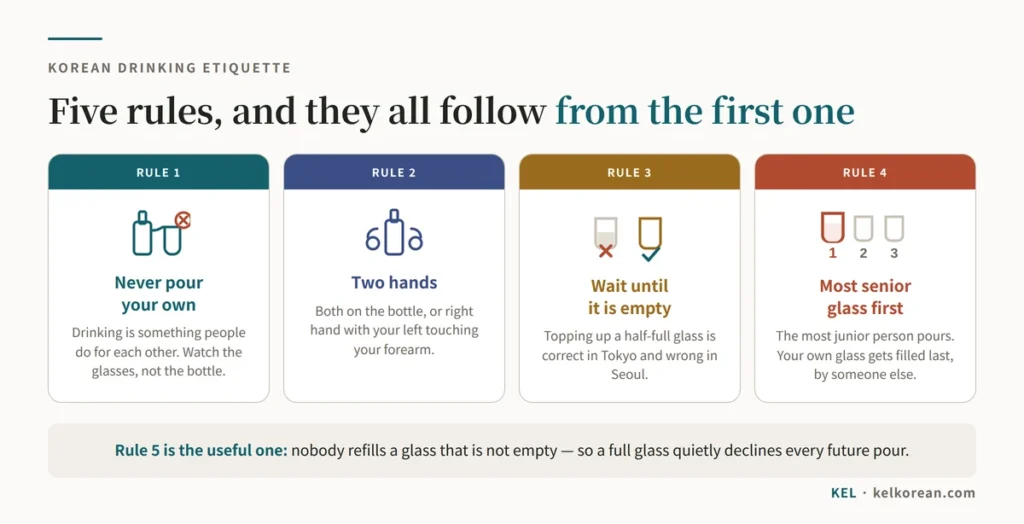
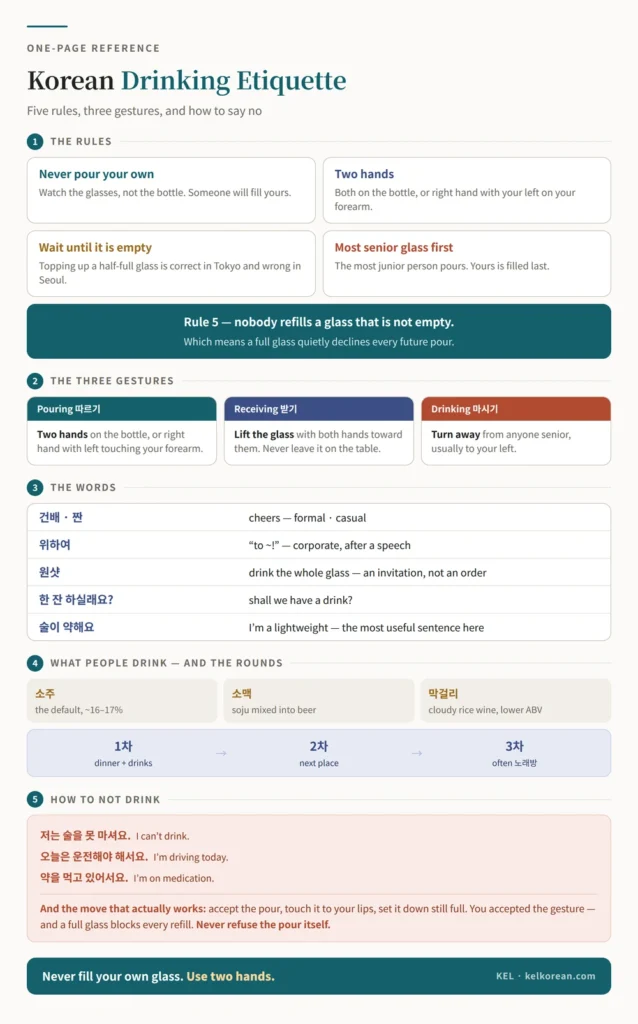
Rule One: You Never Pour Your Own Drink
Everything else follows from this.
In Korea, drinking is something people do for each other. You keep an eye on the glasses around you; someone keeps an eye on yours. Filling your own glass is the one move that reads as genuinely odd — not rude exactly, but the social equivalent of eating off your own plate at a shared table.
So the habit to build is simple: watch the glasses, not the bottle.
And here is the part that catches people from other drinking cultures. In Japan or China, topping up a half-full glass is normal courtesy. In Korea it is not — you wait until the glass is empty. Pouring into a glass that still has something in it looks like you are rushing the other person.
That single fact is also the basis of the most useful trick in this article, which we will come back to.
Two Hands — and the Versions of It
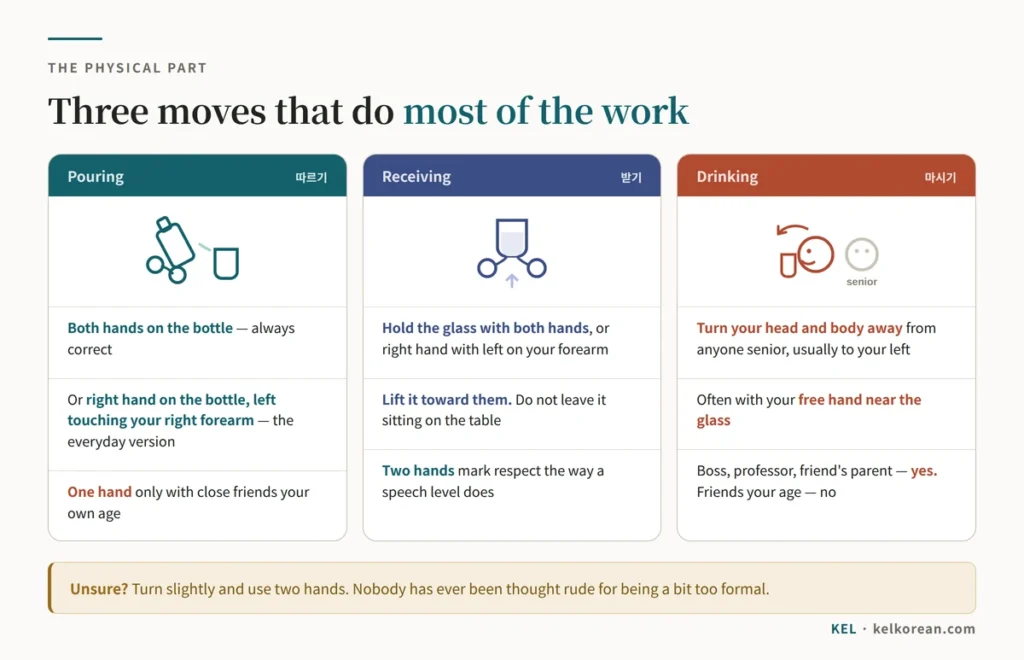
Pouring and receiving are done with two hands when there is any age or rank gap at all.
Pouring:
- Both hands on the bottle — the safest version, always correct.
- Right hand on the bottle, left hand touching your right forearm or wrist — the everyday version, and what you will see most.
- One hand — fine only with close friends your own age.
Receiving:
- Hold the glass with both hands, or with your right hand while your left touches your right forearm.
- Lift the glass slightly toward the person pouring. Do not leave it sitting on the table.
The underlying logic is the same one that runs the whole language. Two hands mark respect in Korean the way a speech level does — and if the hierarchy behind it is still fuzzy, Korean honorifics sets out how it is worked out.
The One That Surprises Everyone: Turning Away
When you drink in front of someone clearly senior to you, you turn your head and upper body away from them, usually to your left, and often bring your free hand up near the glass.
It looks strange the first time. It is completely automatic for Koreans, and it is one of the fastest ways to signal that you know what you are doing.
Do you have to? With a boss, a professor, a friend’s parent — yes, and it is noticed. With friends your own age, no. If you are unsure, turn slightly. Nobody has ever been thought rude for being a bit too formal.
Who Pours, and in What Order
The most junior person pours. If you are the youngest at the table, the bottle is effectively yours to manage.
The most senior glass gets filled first, then down the table by age or rank.
Your own glass gets filled last, by someone else. If it has been empty a while and nobody has noticed, you can hold it up slightly — that is a normal, silent request. What you do not do is reach for the bottle.
Reading the table well enough to catch an empty glass before its owner does is, more or less exactly, 눈치.
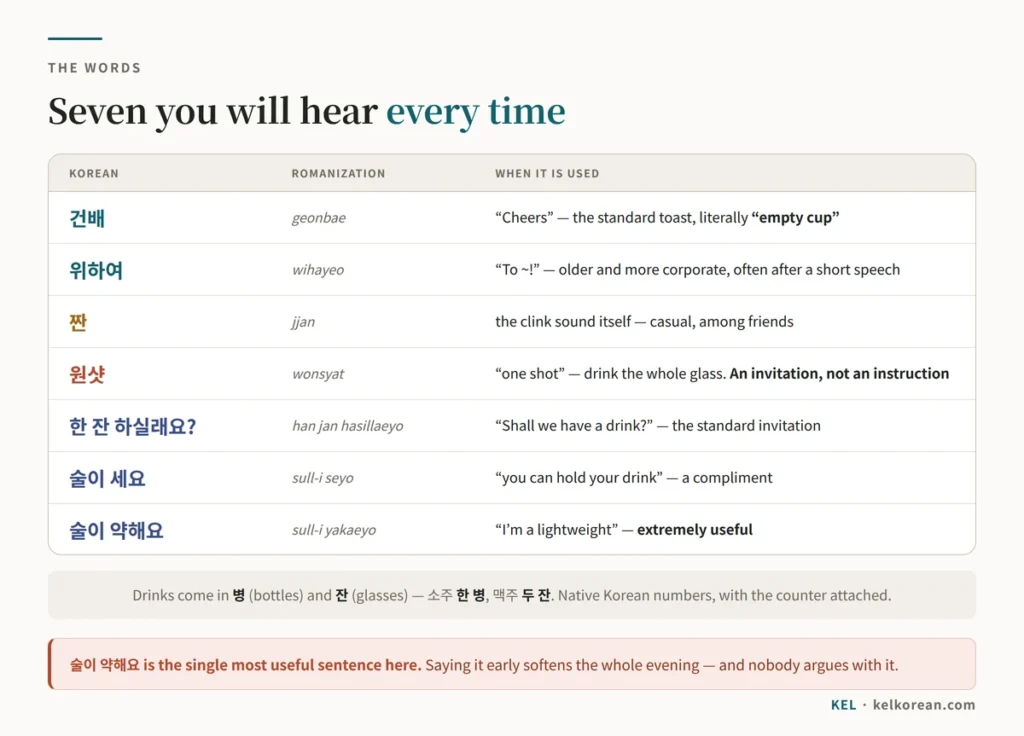
The Words
| Korean | Romanization | When it is used |
|---|---|---|
| 건배 | geonbae | “Cheers” — the standard toast, literally “empty cup” |
| 위하여 | wihayeo | “To ~!” — older and more corporate, often after a short speech |
| 짠 | jjan | the clink sound itself; casual, among friends |
| 원샷 | wonsyat | “one shot” — drink the whole glass |
| 한 잔 하실래요? | han jan hasillaeyo | “Shall we have a drink?” — the standard invitation |
| 술이 세요 | sull-i seyo | “you can hold your drink” — a compliment |
| 술이 약해요 | sull-i yakaeyo | “I’m a lightweight” — extremely useful |
Counting matters here, because drinks come in 병 (bottles) and 잔 (glasses): 소주 한 병, 맥주 두 잔. Those are native Korean numbers with counters attached — the system is in Korean counters.
A note on 원샷. It is a real word and you will hear it, but it is an invitation, not an instruction. Nobody is entitled to make you finish a glass.
What People Actually Drink
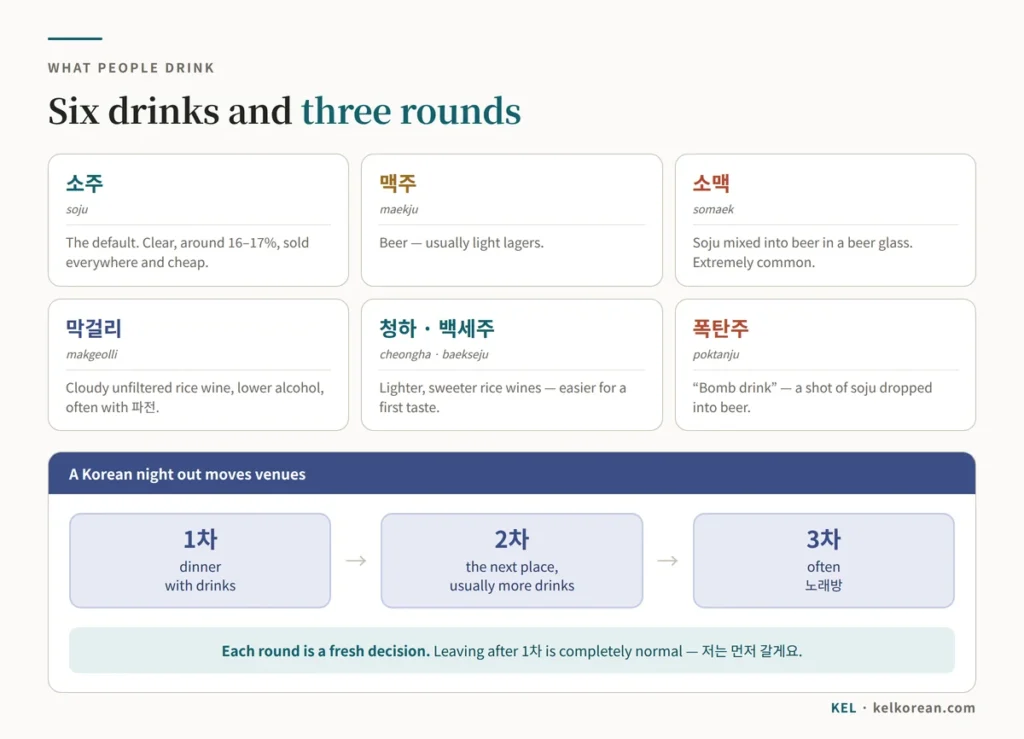
| 소주 | the default — clear, around 16–17% now, sold everywhere and cheap |
| 맥주 | beer, usually light lagers |
| 소맥 | soju and beer mixed in a beer glass. Extremely common |
| 막걸리 | cloudy unfiltered rice wine, lower alcohol, often with 파전 |
| 청하 · 백세주 | lighter, sweeter rice wines, easier for a first taste |
| 폭탄주 | “bomb drink” — a shot glass of soju dropped into beer |
And the counting that catches travellers out: 1차, 2차, 3차.
A Korean night out moves venues. 1차 (ilcha) is dinner with drinks; 2차 is the next place, usually more drinks; 3차 is often noraebang. Each round is a fresh decision, and leaving after 1차 is completely normal.
You say 저는 먼저 갈게요 — one of a small set of exit phrases worth having ready, alongside the ones in 10 essential Korean phrases for travellers. And if you are ordering the food that goes with all this, how to order food in Korean has the rest.
How to Not Drink — Properly
This is the section most guides leave out, and it is the one people actually need.
First, the reassurance: Korea has changed a lot on this. The image of relentless forced drinking is dated. Younger Koreans drink noticeably less than their parents did, workplaces have pulled back, and “I don’t drink” is a normal sentence now rather than a scandal.
The phrases that work:
저는 술을 못 마셔요. — I can’t drink. Direct and completely acceptable.
오늘은 운전해야 해서요. — I’m driving today. Unanswerable — Korea has near-zero tolerance for drink driving.
약을 먹고 있어서요. — I’m on medication. Also unanswerable.
술이 약해요. — I’m a lightweight. Softens the whole evening in advance.
Notice that three of these end in -서요 — “because…”. Trailing off instead of finishing the sentence is the polite Korean way to decline, and it works far better than a flat no.
And then the trick. Remember that nobody refills a glass that is not empty.
So accept the first pour, touch it to your lips, and set it down still full. You have accepted the gesture — which is the part that actually mattered — and your glass now quietly blocks every future pour. This is what a lot of Koreans who do not drink much actually do.
Do not turn the glass upside down or refuse the pour outright. Refusing the pour rejects the person, not the alcohol. Accepting it and not drinking it rejects neither.
회식 — The Work Dinner
회식 (hoesik) is the company dinner: team, boss, food, drinks, usually on a weeknight, usually not optional in spirit even when it is in theory.
It has genuinely shifted. Many companies now do lunch 회식, or one round and home, and the expectation that juniors stay until the boss leaves has weakened a lot. It still exists, and it is still where a great deal of workplace relationship-building happens.
Two things worth knowing if you end up at one:
You will be watched for 눈치, not for drinking capacity — noticing an empty glass matters more than filling yours.
It is often where 반말 gets offered. A senior colleague saying 말 놓으세요 over drinks is a real moment, and the rules for what to do next are in banmal.
5 Mistakes Worth Avoiding
1. Filling your own glass. The single most visible one.
2. Topping up a glass that isn’t empty. Correct in Tokyo, wrong in Seoul.
3. Pouring one-handed to someone older. Two hands, or right hand with left touching your forearm.
4. Drinking face-on in front of a senior. Turn away. It costs nothing.
5. Refusing the pour instead of the drink. Take the glass. Nobody is counting what happens after that.
Frequently Asked Questions
What is the legal drinking age in Korea?
You can legally buy and drink alcohol from 1 January of the year you turn 19, regardless of your birthday — the Youth Protection Act (청소년보호법) is written this way deliberately. So everyone born in the same year becomes eligible on the same day. Carry ID; convenience stores check.
Why do Koreans turn away when they drink?
It is a gesture of deference toward someone senior — you turn your head and body to the side rather than drinking face-on. It is automatic rather than thought about, and it is expected with bosses, teachers and elders. Among friends of the same age, nobody bothers.
Can I pour my own drink in Korea?
You can, and nothing will happen, but it reads as slightly odd — pouring is something people do for each other. If your glass is empty and unnoticed, lift it slightly instead.
Is it rude to refuse a drink in Korea?
Refusing the pour can be, because it declines the gesture. Not drinking is fine. The workable move is to accept the pour, touch the glass to your lips and leave it full — since nobody refills a glass that is not empty, this quietly ends the issue.
What is 소맥?
Soju mixed into beer, usually in a beer glass. It is the most common mixed drink in Korea by a wide margin and is often made for the table by one person.
What does 1차 and 2차 mean?
The rounds of a night out — 1차 is the first venue (usually dinner and drinks), 2차 the second, 3차 often noraebang. Each is a separate decision and leaving after 1차 is completely normal.
Do I have to go to 회식?
Formally no, and increasingly no in practice. Attending occasionally does help relationships at Korean workplaces, but the expectation to stay to the end has weakened considerably in recent years.
Final Thoughts
Korean drinking etiquette is not really about alcohol. It is the same hierarchy that runs the speech levels, expressed with hands and bottles instead of verb endings — which is why getting it right registers so strongly, and why it is worth ten minutes of your attention.
If you remember two things, make them these: never fill your own glass, and use two hands. Those two cover most situations you will be in.
And if you would rather not drink, you are not stuck. Take the glass with both hands, touch it to your lips, set it down full, and enjoy the evening. That is a completely fluent thing to do — and if the next morning is rough anyway, the word you want is 해장국.
Sources: 만 나이 시행 — 술·담배 구매 연령 (대한민국 정책브리핑)
Leave a Reply