You are standing at a crossing in Seoul. The light changes to green, and the person beside you says 파란불이야 — “it’s blue.”
Nobody is colour-blind. Korean colors carry a history that English does not, and that one traffic light is the loose thread that unravels the whole system.
Colour vocabulary looks like the easiest thing in any language: memorise ten words, done. Korean does not work that way, because a single colour comes in four different shapes depending on where it sits in the sentence — and picking the wrong shape is what makes a sentence sound built rather than spoken.
Start With the String: 빨주노초파남보
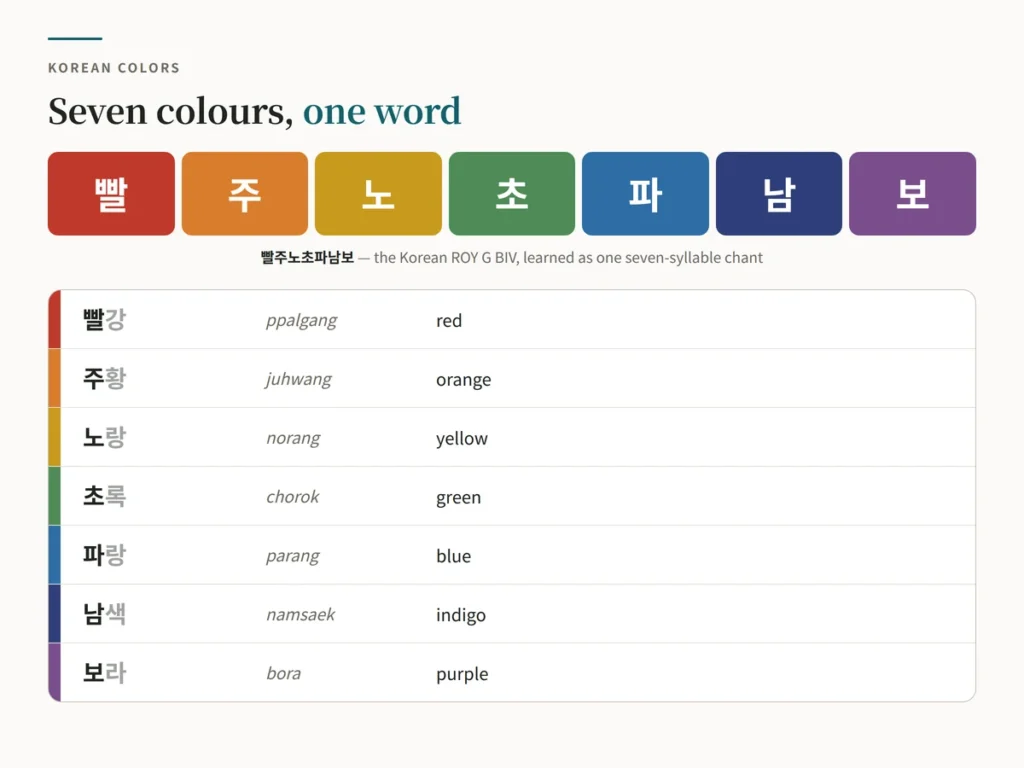
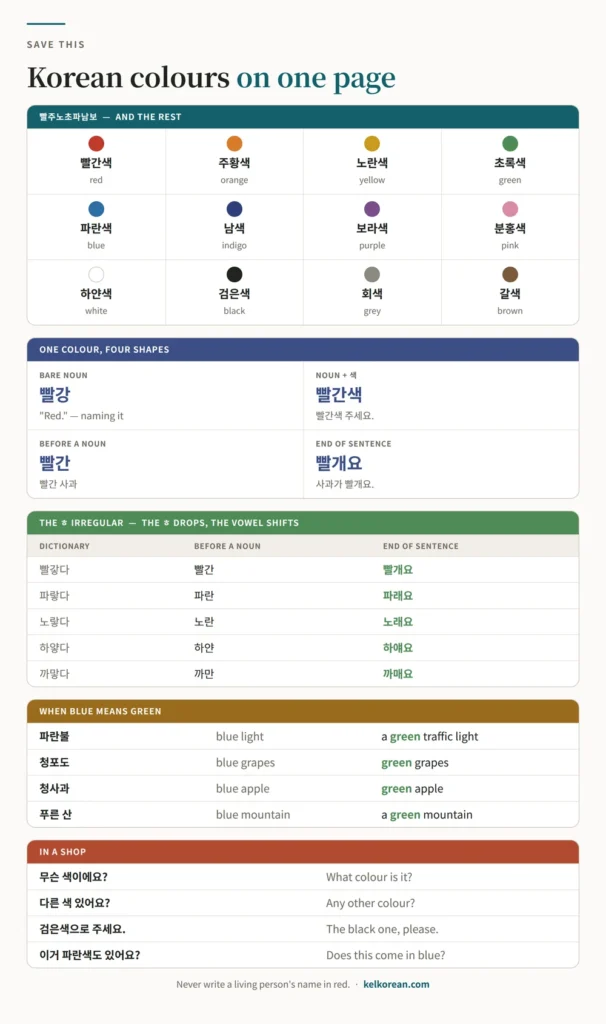
English has ROY G BIV. Korean has 빨주노초파남보 — the first syllable of each rainbow colour, said as one word.
| Korean | Romanization | English |
|---|---|---|
| 빨강 | ppalgang | red |
| 주황 | juhwang | orange |
| 노랑 | norang | yellow |
| 초록 | chorok | green |
| 파랑 | parang | blue |
| 남색 | namsaek | indigo |
| 보라 | bora | purple |
Korean schoolchildren learn it as a single seven-syllable chant, and it is genuinely the fastest way in. Say 빨주노초파남보 ten times and you have five of the six colours you will actually use.
Note the odd ones out. 빨강, 노랑, 파랑 end in -ㅇ. 초록, 남색, 보라 do not. There is no rule — they come from different layers of the language, which is the theme of this entire article.
One Colour, Four Shapes
This is the part that colour word-lists skip, and it is the part that matters.
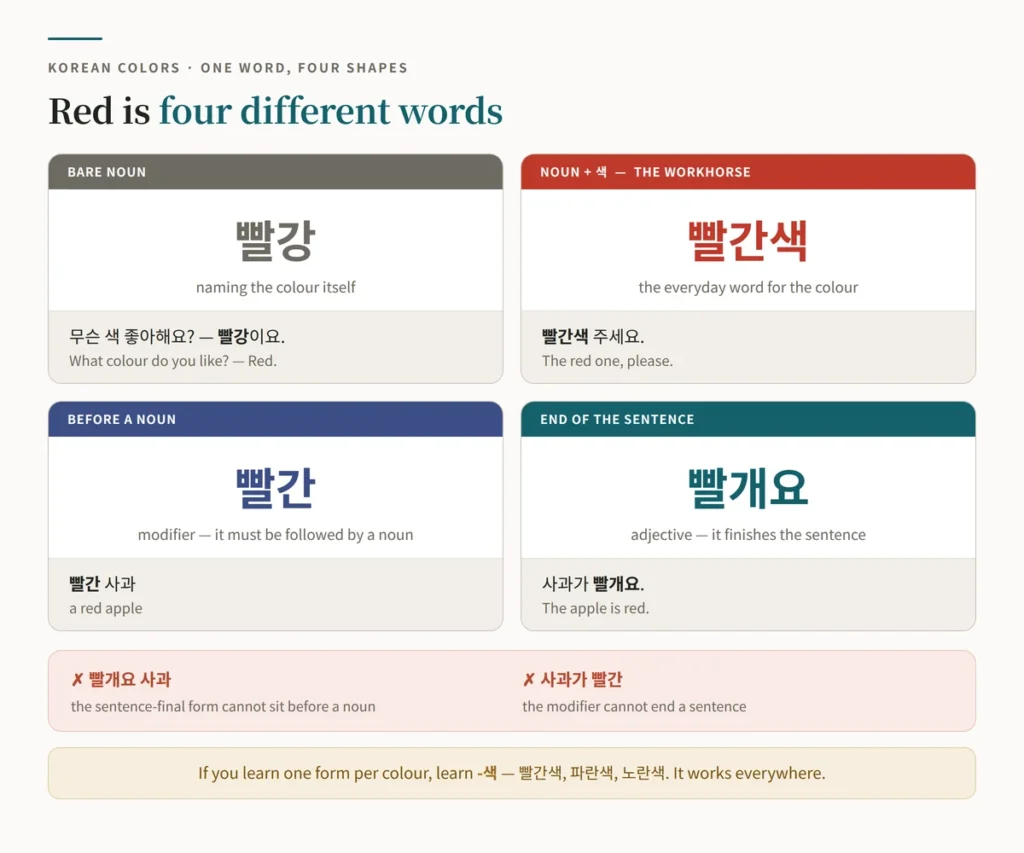
Take red. Korean gives you four forms, and they are not interchangeable.
| Form | Korean | Use it when |
|---|---|---|
| Bare noun | 빨강 | naming the colour itself |
| Noun + 색 | 빨간색 | naming the colour, more common in speech |
| Modifier | 빨간 | it sits before a noun |
| Adjective | 빨개요 | it is the end of the sentence |
Watch them work:
무슨 색 좋아해요? — 빨강이요. (What colour do you like? — Red.)
빨간색 주세요. (The red one, please.)
빨간 사과 (a red apple)
사과가 빨개요. (The apple is red.)
The trap is the last two. 빨간 사과 is correct; ✗ 빨개요 사과 is not. And 사과가 빨간 is not a finished sentence. Korean puts descriptions before the noun and verbs at the end, exactly as laid out in Korean sentence structure.
In practice, 빨간색 does most of the work. If you learn one form per colour, learn the -색 noun: 빨간색, 파란색, 노란색. It is safe everywhere — 빨간색 사과 is also fine.
Why 빨갛다 Becomes 빨개요
If you have met Korean verb conjugation, 빨개요 looks wrong. The dictionary form is 빨갛다, so where did the ㅎ go?
This is the ㅎ irregular, and the core colour adjectives are its most famous members.
| Dictionary | Before a noun | Sentence-final |
|---|---|---|
| 빨갛다 | 빨간 | 빨개요 |
| 파랗다 | 파란 | 파래요 |
| 노랗다 | 노란 | 노래요 |
| 하얗다 | 하얀 | 하얘요 |
| 까맣다 | 까만 | 까매요 |
The ㅎ drops out, and the vowel changes. 빨갛 + 아요 does not give 빨가요 — it gives 빨개요. Every one of these five behaves the same way, so learning the pattern once covers all of them.
One warning. 좋다 also ends in ㅎ and is not irregular — 좋아요, exactly as written. The ㅎ irregular is a small closed club, and the colours are most of it.
The Rest of the Palette
Beyond the rainbow string, these are the ones you will actually need:
| Korean | Romanization | English |
|---|---|---|
| 하얀색 / 흰색 | hayansaek / huinsaek | white |
| 검은색 / 까만색 | geomeunsaek / kkamansaek | black |
| 회색 | hoesaek | grey |
| 갈색 | galsaek | brown |
| 분홍색 | bunhongsaek | pink |
| 하늘색 | haneulsaek | sky blue |
| 연두색 | yeondusaek | light yellow-green |
하늘색 is worth noticing — it is literally “sky colour,” and Korean builds several colours this way. 살구색 is apricot, 카키색 is khaki.
And English is in here too. 핑크 is at least as common as 분홍색 in daily speech, especially among younger speakers. So are 오렌지색, 그레이, 베이지 and 와인색. This is the same borrowing habit that produced everything in Konglish — and with colours, the borrowed word and the Korean word usually coexist rather than one replacing the other.
Why the Green Light Is Blue
Back to the crossing.
Korean historically did not split blue from green. One word, 푸르다, covered both — and it still does in the places the language has not updated.
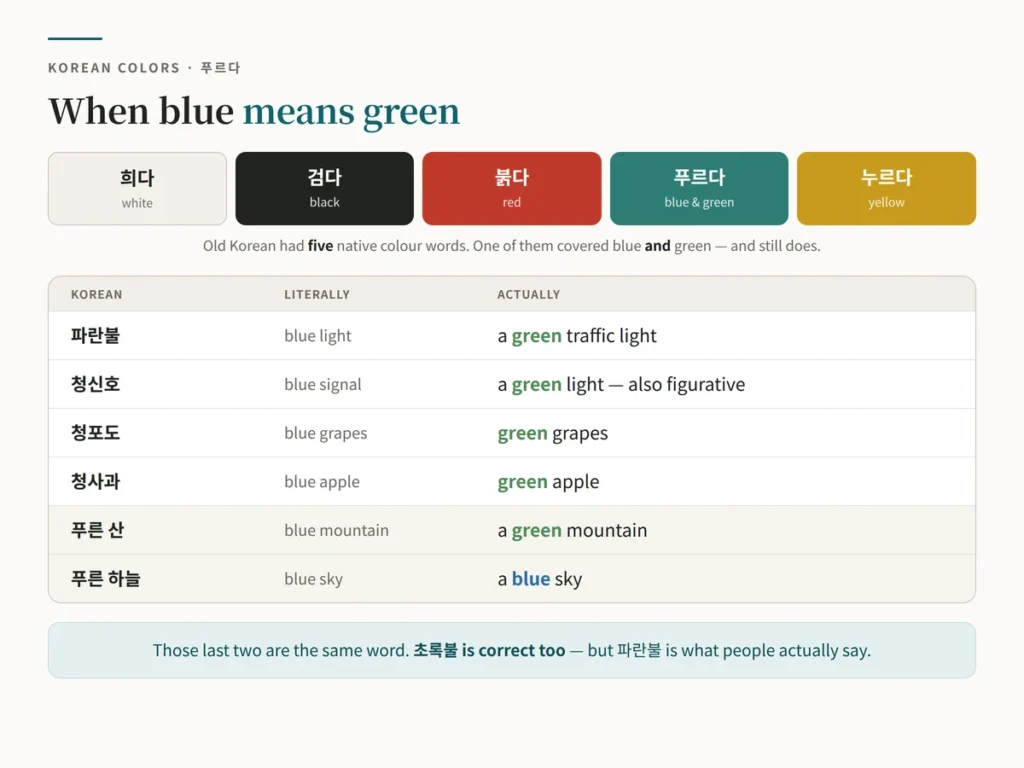
Old Korean had exactly five native colour adjectives: 희다 (white), 검다 (black), 붉다 (red), 푸르다 (blue-green) and 누르다 (yellow). That is the entire original palette. Everything else — 초록, 보라, 주황, 회색 — arrived later, borrowed or built.
| Korean | Literally | Actually |
|---|---|---|
| 파란불 | blue light | a green traffic light |
| 청신호 | blue signal | a green light (also figurative — “the project got the green light”) |
| 청포도 | blue grapes | green grapes |
| 청사과 | blue apple | green apple |
| 푸른 산 | blue mountain | a green mountain |
| 푸른 하늘 | blue sky | a blue sky |
Look at that last pair. 푸르다 is blue in one and green in the other, and Koreans do not experience that as a contradiction any more than English speakers stumble over “red hair,” which is orange.
초록불 is also correct, and you will see it in textbooks and official signage. But 파란불 is what comes out of people’s mouths, and pretending otherwise will leave you confused at your first crossing.
The modern language does distinguish them. 파란색 is blue and 초록색 is green, cleanly, in any new sentence. The blue-green overlap survives only in older fixed expressions — which is exactly where you meet it as a learner.
The Sino-Korean Layer
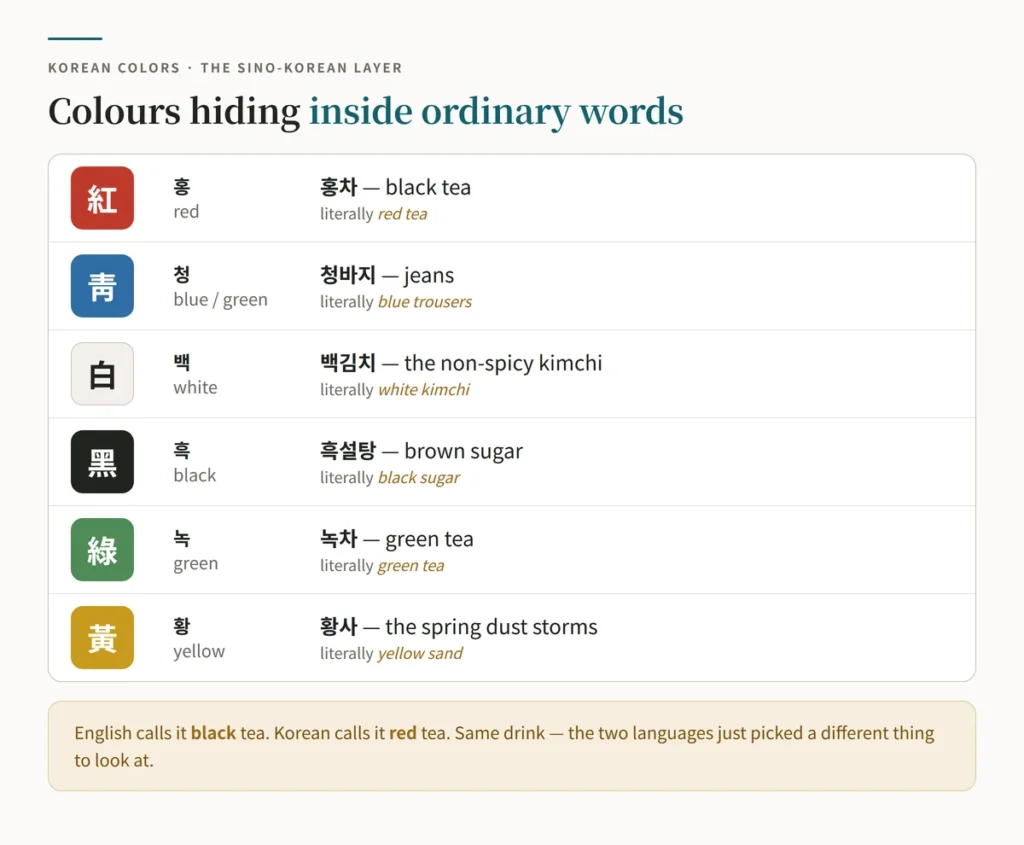
Korean has a second complete set of colour words borrowed from Chinese, and they hide inside ordinary vocabulary. You do not use them alone — you meet them stuck to other words.
| Character | Colour | Shows up in |
|---|---|---|
| 홍 (紅) | red | 홍차 — black tea, literally red tea |
| 청 (靑) | blue/green | 청바지 — jeans, literally blue trousers |
| 백 (白) | white | 백김치 — the non-spicy white kimchi |
| 흑 (黑) | black | 흑설탕 — brown sugar, literally black sugar |
| 녹 (綠) | green | 녹차 — green tea |
| 황 (黃) | yellow | 황사 — the yellow dust that blows in each spring |
홍차 is the good one. English calls it black tea; Korean and Chinese call it red tea — and both are describing the same drink, just picking a different thing to look at. Korean’s colour vocabulary is full of these small disagreements with English.
You do not need to study this layer. You need to recognise it, so that 청바지 does not look like a word you have to memorise whole.
Colours That Mean Something
A handful of colours carry weight in Korea beyond the shade.
빨간 이름 — never write a living person’s name in red. Red ink was traditionally reserved for the names of the dead in family registers and funeral records. Writing a friend’s name in red is a real faux pas, and Korean schoolchildren are told about it explicitly. If you are signing a card, use any other colour.
백의민족 — “the people in white.” Koreans were called this for centuries because ordinary people wore undyed white hemp and cotton. It still turns up in patriotic writing and in history class.
흑역사 — “black history.” Your cringeworthy past. The photo you would delete, the phase you do not talk about. It is everyday slang now, and it sits alongside the vocabulary in Korean texting slang.
청춘 — “blue-green spring,” meaning youth. It is the title of roughly a third of all Korean dramas, and it means the period of life, not the season — one of many words that make more sense once you have met them in K-drama Korean.
오방색 — the five cardinal colours. 청 (blue-green), 백 (white), 적 (red), 흑 (black) and 황 (yellow), each tied to a direction and an element. You can see them in temple eaves, in 한복, and in the striped sleeves of 색동 children’s clothing. When Korean design looks unmistakably Korean, this is usually why.
And look at that list again. 오방색 is the same five as the old native adjectives — 푸르다, 희다, 붉다, 검다, 누르다. The philosophy and the vocabulary were built out of the same five colours, which is why the blue-green fusion runs so deep.
Using Colours in a Shop
This is where colour words earn their keep as a traveller.
| Korean | English |
|---|---|
| 무슨 색이에요? | What colour is it? |
| 무슨 색 좋아해요? | What colour do you like? |
| 다른 색 있어요? | Do you have another colour? |
| 검은색으로 주세요. | The black one, please. |
| 이거 파란색도 있어요? | Does this come in blue too? |
Note 검은색으로 주세요. The particle -으로 means “by way of / in the form of,” and it is the standard way to specify which version of something you want. The rest of the shop vocabulary is in shopping in Korean.
무슨 vs 어떤: 무슨 색 asks what colour something is, out of all colours. 어떤 색 asks you to pick from the ones in front of you — the distinction is covered in Korean question words.
5 Mistakes Worth Avoiding
1. Using the sentence-final form before a noun. 빨개요 사과 is not a thing. Before a noun you need 빨간 or 빨간색.
2. Expecting 빨갛다 to conjugate normally. 빨개요, not 빨가요. The ㅎ drops and the vowel shifts.
3. Assuming 파란 always means blue. In 파란불, 청포도 and 푸른 산 it means green. Context decides.
4. Writing a Korean person’s name in red. Genuinely uncomfortable for many Koreans, and easy to avoid.
5. Learning only the bare nouns. 빨강 is correct but narrow — it answers “which colour?” and little else. 빨간색 is the workhorse.
Frequently Asked Questions
How do you say colours in Korean?
The seven rainbow colours are 빨강, 주황, 노랑, 초록, 파랑, 남색 and 보라, learned as one string: 빨주노초파남보. For everyday use, add 색 to most of them — 빨간색, 파란색, 노란색 — which is the form Koreans use most in speech.
Why do Koreans call a green light 파란불?
Because Korean historically used one word, 푸르다, for both blue and green, and the traffic light kept the old name. The same thing happens in 청포도 (“blue grapes” = green grapes) and 청사과 (“blue apple” = green apple). 초록불 is also correct, but 파란불 is what you will hear.
What is the difference between 빨강, 빨간색 and 빨개요?
빨강 is the bare noun “red.” 빨간색 is the everyday noun, and 빨간 is the form that goes before a noun — 빨간 사과. 빨개요 is the adjective that ends a sentence — 사과가 빨개요.
Why is it 빨개요 and not 빨가요?
빨갛다 is a ㅎ irregular verb. The ㅎ drops out and the vowel changes when an ending is attached. 파랗다 → 파래요, 노랗다 → 노래요, 하얗다 → 하얘요 all behave the same way.
Is it rude to write a name in red in Korea?
Yes, for a living person. Red ink was traditionally used for the names of the dead, so writing someone’s name in red carries an unpleasant association. It is a real taboo, though a fading one among younger people.
How do you ask for a different colour when shopping?
다른 색 있어요? — “Do you have another colour?” To ask for a specific one, use the colour plus -으로: 검은색으로 주세요, “the black one, please.”
What does 흑역사 mean?
Literally “black history” — the embarrassing part of your past that you would rather not discuss. It is common slang, used affectionately about yourself as much as about anyone else.
Final Thoughts
Korean colors are not a vocabulary list with ten entries. They are three layers stacked on top of each other — the native words that conjugate irregularly, the Chinese characters hiding inside 홍차 and 청바지, and the English borrowings that arrived last and never displaced anything.
Learn the string 빨주노초파남보, learn that -색 is the safe form, and learn that 빨갛다 becomes 빨개요. That is the working set — and it belongs alongside the 100 Korean words to learn first.
And the next time someone tells you the light is blue, you will know they are looking at exactly the same green you are.
Sources: 신호등 ‘초록불’, 우리는 왜 ‘파란불’이라고 할까 — YTN · 파란색 — 나무위키
Leave a Reply