Yes and no in Korean look like the easiest words in the language. Try this before reading anything else.
A Korean friend looks at your untouched plate and asks, 안 먹었어요? — “You didn’t eat?” You didn’t. You answer with one word. Is it 네 or 아니요?
Most English speakers pick 아니요. It feels obvious: you didn’t eat, so “no.” In Korean, that answer means you did eat. The correct reply is 네 — the word every phrasebook translates as “yes” — because 네 was never “yes” in the English sense. It means what you just said is right.
That one idea explains almost everything in this guide: why Koreans say 네 while you are still in the middle of a sentence, why 네 with a rising tone means “pardon?”, and why the politest way to refuse something in Korean usually contains no word for “no” at all. The words take a minute to learn. How they behave is the rest of the article.
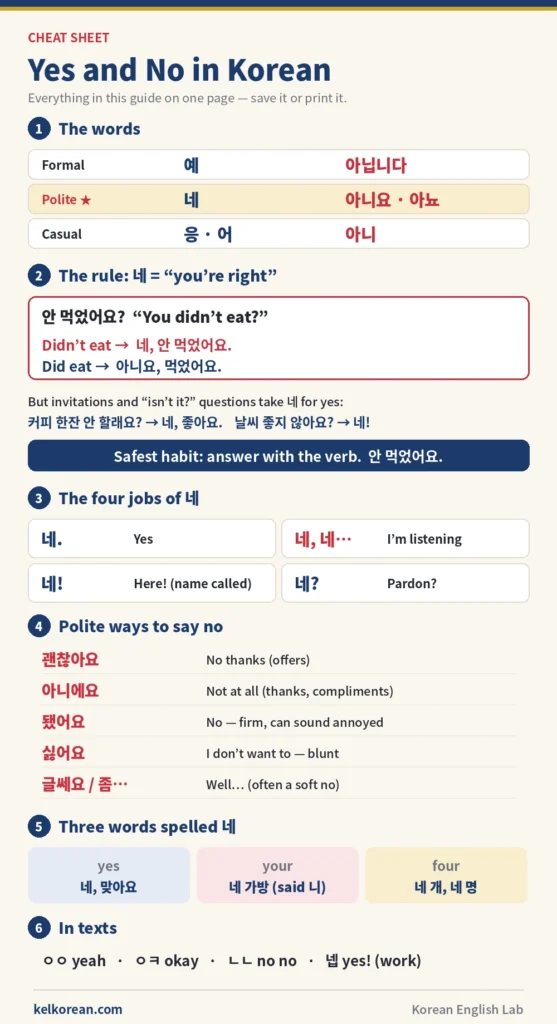
The Words: Three Levels of Yes and No
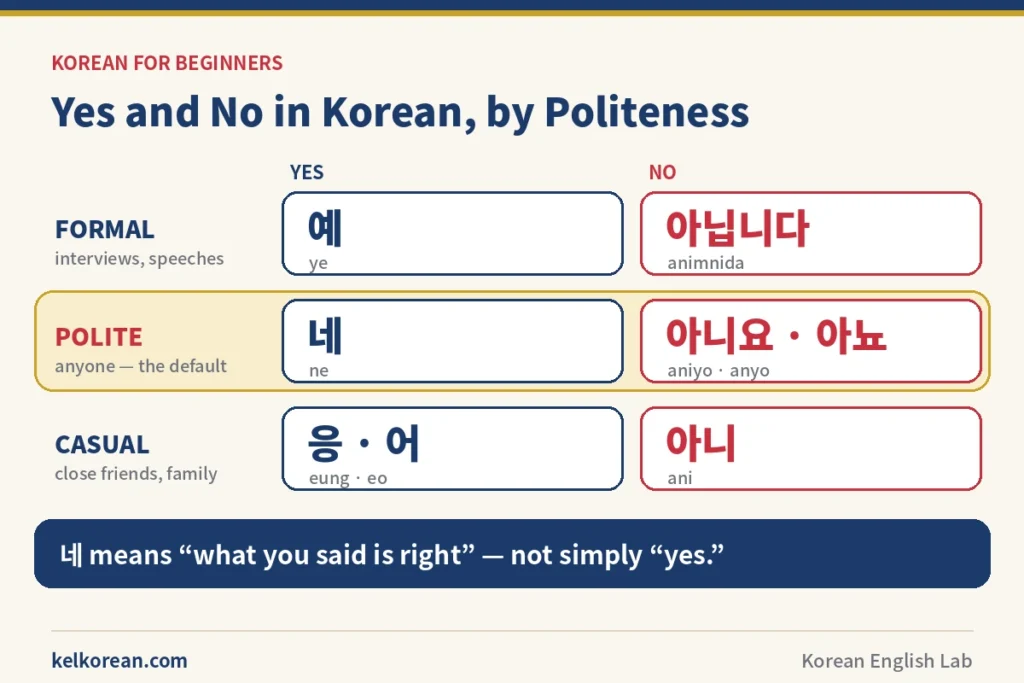
Korean has a yes and a no for each level of politeness, and the pairs line up neatly.
If the levels themselves are new to you, our guide to Korean honorifics explains how they work.
| Level | Yes | No | Use it with |
|---|---|---|---|
| Formal | 예 ye | 아닙니다 animnida | Job interviews, speeches, very formal settings |
| Polite | 네 ne | 아니요 aniyo · 아뇨 anyo | Anyone you don’t know well — the safe default |
| Casual | 응 eung · 어 eo | 아니 ani | Close friends, family, people younger than you |
If you learn one pair, learn 네 and 아니요. They are polite without being stiff, and they are correct with a shopkeeper, a teacher, a colleague or a stranger’s grandmother. A polite 네 never gives offence.
네 and 예 mean the same thing. Both are standard Korean — the 1988 standard-language rules list them as an approved pair. 예 sounds a shade more formal and a little more old-fashioned, and you will hear it more from older speakers and in formal settings. You never need to say it, but you should recognise it.
The spelling is 아니요, not 아니오. 아니오 does exist, but it is a sentence ending in an old formal style — roughly “it is not so” — not the answer word. You will still see “예 / 아니오” printed on plenty of forms and surveys, which makes it one of the most common spelling slips in the country. In speech, 아니요 is usually squeezed down to 아뇨.
응 and 어 are both a casual “yeah.” Textbooks teach 응; in fast speech between friends you will hear 어 at least as often. Use either with the wrong person and it lands roughly like answering your boss with “yup.” When in doubt, add the 요 and stay polite — which is exactly why our beginner’s roadmap makes 해요체, the polite everyday style, the one you need to master.
That little 요 is doing more work than it looks — our guide to Korean sentence endings shows what it changes.
네 Means “You’re Right,” Not “Yes”
Here is the rule. Once it clicks, it stays clicked.
English yes and no describe the facts. Korean 네 and 아니요 judge the question. 네 says “what you asked is correct.” 아니요 says “what you asked is not correct.”
With an ordinary question, the two systems give the same answer, which is why beginners can go weeks without noticing any difference:
| Question | The truth | English | Korean |
|---|---|---|---|
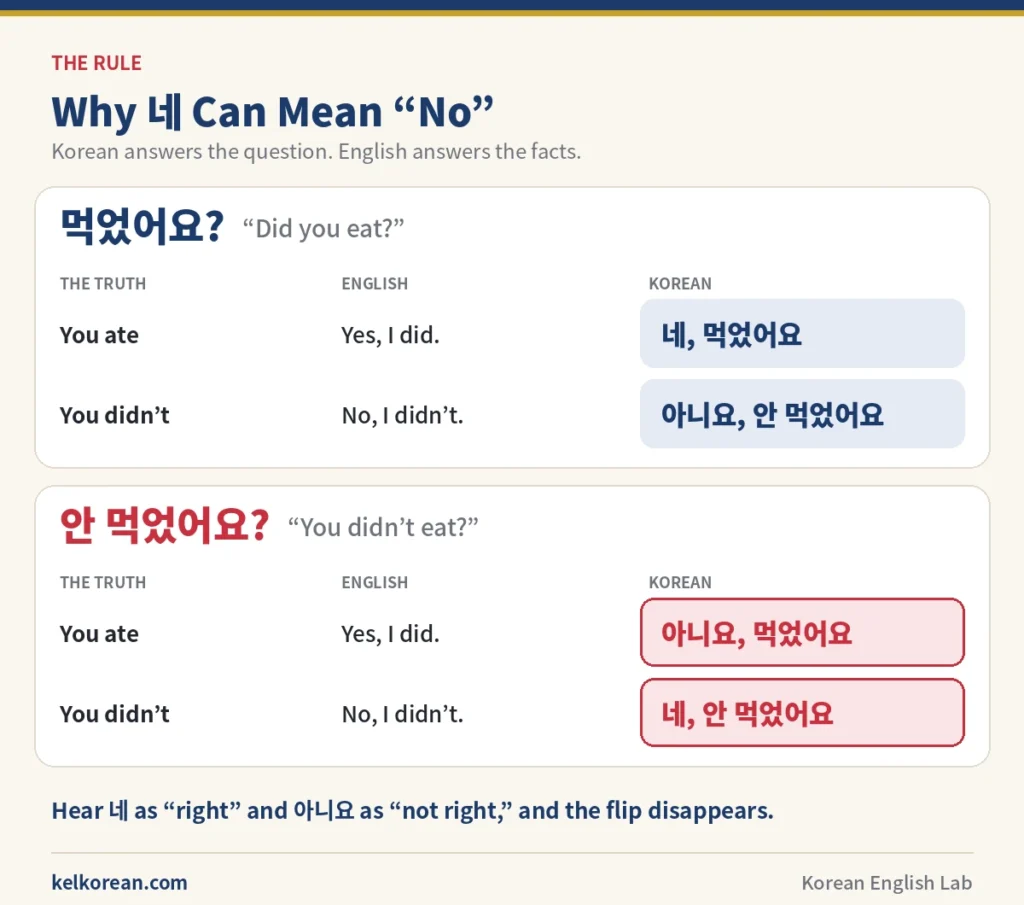
| 먹었어요? “Did you eat?” | You ate | Yes, I did | 네, 먹었어요 |
| 먹었어요? | You didn’t | No, I didn’t | 아니요, 안 먹었어요 |
| 안 먹었어요? “You didn’t eat?” | You ate | Yes, I did | 아니요, 먹었어요 |
| 안 먹었어요? | You didn’t | No, I didn’t | 네, 안 먹었어요 |
The bottom two rows are where every learner trips. Take the last one: “You didn’t eat?” — “That’s right, I didn’t.” 네. The Korean answer confirms the question; the English one reports the fact. Neither system is illogical. They are simply answering different things.
If you speak Japanese, you already know this system — はい and いいえ behave the same way, which is why Japanese learners of Korean barely notice there is anything to learn. For English speakers, the fix is to hear 네 in your head as right and 아니요 as not right. “You’re not tired?” “Not right — I’m exhausted”: 아니요, 피곤해요.
When a Negative Question Isn’t Really Negative
Most guides stop at the table above. The trouble is that Korean is full of questions that are negative in grammar but not in meaning, and if you apply the flip rule to them you will get them backwards all over again.
Invitations: “Won’t you…?”
Koreans often make offers in the negative, much as English says “Why don’t we…?”
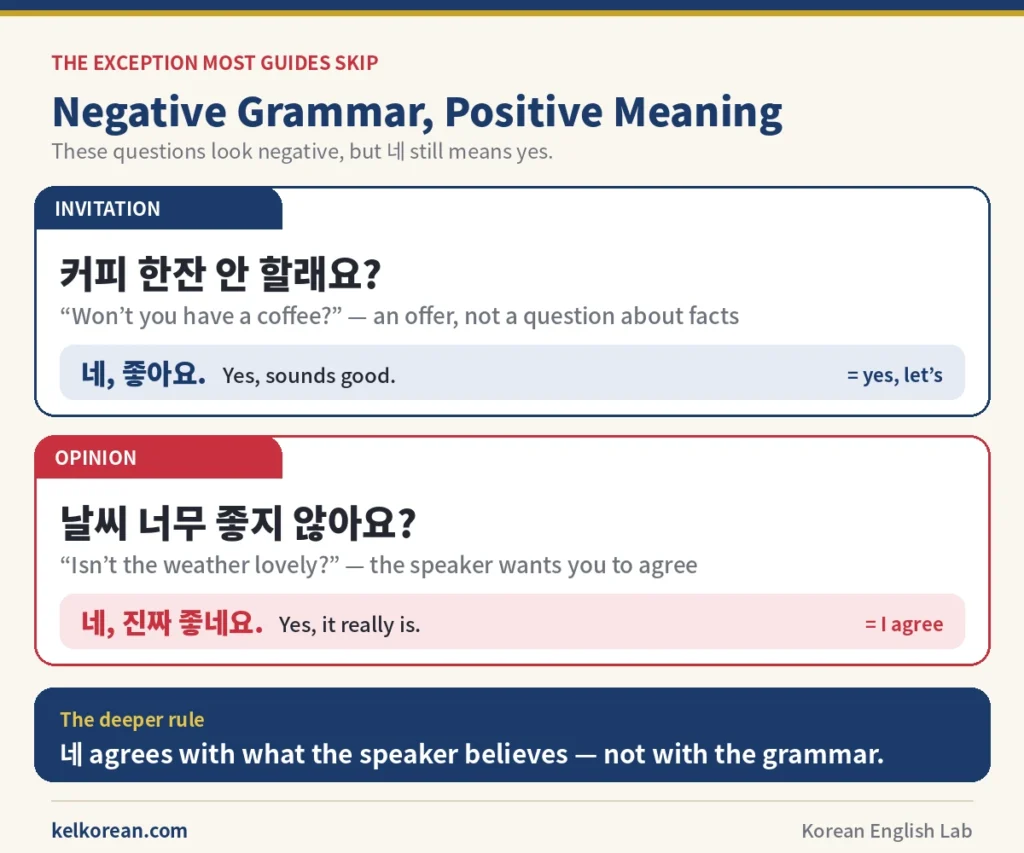
커피 한잔 안 할래요? — “Won’t you have a coffee?” / “Fancy a coffee?”
This is not a question about whether you are currently avoiding coffee. It is an invitation, and it gets answered like one: 네, 좋아요 — “Yes, sounds good.” Reply 아니요 and you have turned the coffee down. The same goes for 같이 안 갈래요? — “Want to come with us?” 네 means you are coming.
Opinions: “Isn’t it…?”
The longer negative form, -지 않아요?, is often not asking about facts at all. It is a request for agreement, like an English “isn’t it?”
날씨 너무 좋지 않아요? — “Isn’t the weather lovely?”
The speaker thinks the weather is lovely and wants you to agree. If you do, the natural reply is 네, 진짜 좋네요 — “Yes, it really is.” Nobody answers 아니요 to agree with that.
So the real rule sits one level below the grammar: 네 agrees with what the speaker believes. “You didn’t eat?” — the speaker believes you didn’t, and 네 confirms it. “Isn’t the weather lovely?” — the speaker believes it is, and 네 agrees. The grammar only tells you which kind you are probably hearing. A short 안 in a question about you is usually a genuine negative question; -지 않아요? about the world around you is usually fishing for agreement. Tone and context settle the rest.
That is a tendency, not a law. Which is why the next section matters more than any rule.
The Habit That Makes the Problem Disappear
Say the verb.
Koreans answer yes-no questions by repeating the verb all the time, often with no 네 or 아니요 in front of it at all:
| Question | Answer | Meaning |
|---|---|---|
| 안 먹었어요? You didn’t eat? | 안 먹었어요. | I didn’t. |
| 시간 있어요? Do you have time? | 있어요. | I do. |
| 매워요? Is it spicy? | 조금 매워요. | A little. |
| 피곤하지 않아요? Aren’t you tired? | 괜찮아요. | I’m fine. |
An answer like that cannot be misread, whatever the grammar of the question was. And if you do start with 네 or 아니요, follow it with the verb. If the first word comes out wrong, most listeners will quietly go with the verb, because the verb is the part that carries the facts.
This is also simply good Korean. Echoing the verb is how native speakers sound natural, and a bare 네 to every single question starts to sound flat — like answering “yes” to everything in a job interview.
네 Has Four Jobs, and Only One of Them Is “Yes”
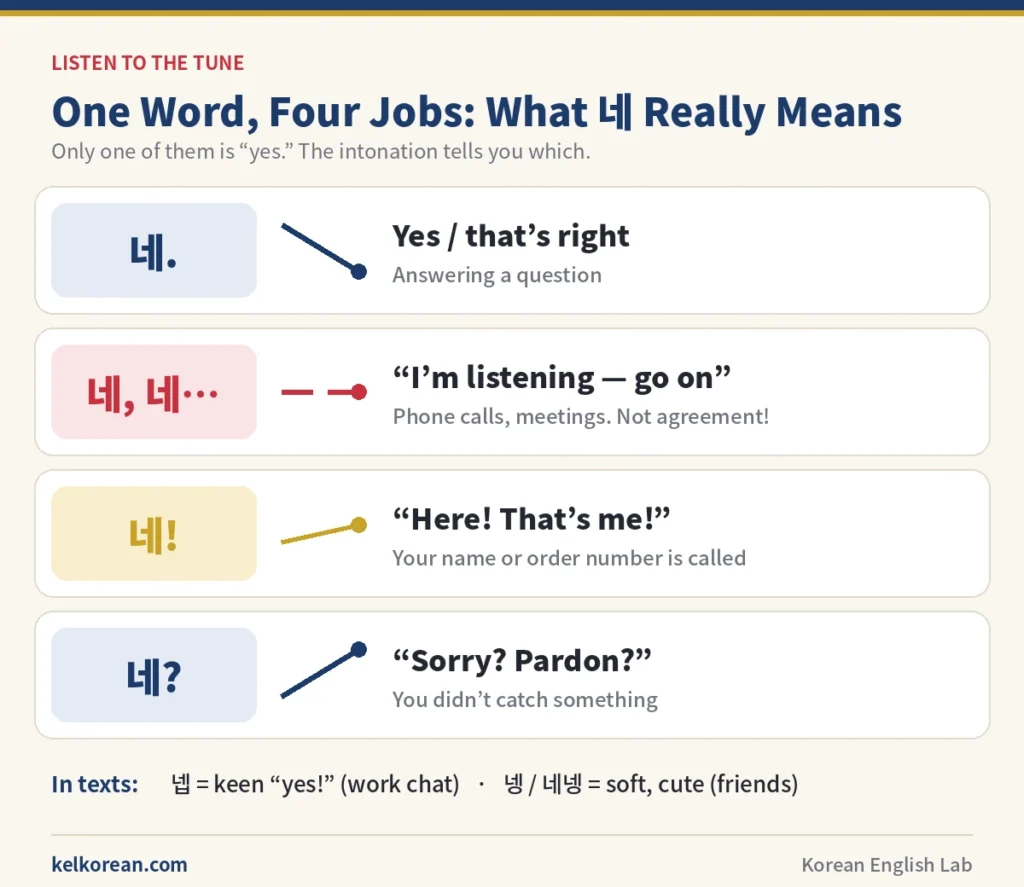
Spend a day in Korea and you will hear 네 hundreds of times, mostly from people who are not agreeing with anything. The word does at least four jobs, and the intonation tells you which one.
| How it sounds | What it means | Where you hear it |
|---|---|---|
| 네. — short, falling | Yes / that’s right | Answering a question |
| 네, 네… — soft, repeated | “I’m listening, go on” | Phone calls, meetings, anyone hearing a story |
| 네! — bright, a little loud | “Here!” / “That’s me!” | When your name or order number is called |
| 네? — rising | “Sorry?” / “Pardon?” | When you didn’t catch something |
The listening 네 is the one that causes real misunderstandings. On the phone, Koreans say 네 every few seconds simply to show the line is alive. In a meeting, a Korean colleague saying 네, 네 while you explain your proposal is telling you they are following — not that they have agreed to it. Wait for a verb, such as 좋아요, 할게요 or 알겠습니다, before you count it as a yes. For anyone who works with Koreans, this is the most useful paragraph in this article.
네? is the easiest way to ask someone to repeat themselves, and it is perfectly polite. A shop assistant says something too fast; you say 네? with a rising tone, and they say it again, usually slower. It works far better than a full sentence you have to assemble in a panic.
The called-out 네 is what you say when a café calls your order number, or a teacher reads out the register. Bright and short — the Korean equivalent of putting your hand up.
Two more you will meet in writing. 넵 is a crisp, keen “yes!” and it is everywhere in Korean workplace messaging, where a plain 네 can read as slightly cool. 넹 and 네넹 are softer and cuter, for friends. And a quick, clipped 네네 out loud can mean “yes, yes, fine” — the same impatience as an English “yeah, yeah” — so mind your tone when you double it.
How Koreans Actually Say No
아니요 is correct, but in daily life Koreans often avoid it, the way English speakers say “I’m okay, thanks” rather than a flat “no.” These are the ones worth knowing.
| Phrase | Literally | Use it to |
|---|---|---|
| 괜찮아요 | “It’s fine” | Turn down an offer politely — a bag at the till, a second helping, a refill |
| 아니에요 | “It isn’t so” | Brush off thanks or a compliment |
| 됐어요 | “That’s enough” | Refuse firmly — can sound annoyed |
| 싫어요 | “I don’t want to” | A flat, personal no — fine with friends, blunt with strangers |
| 글쎄요 | “Well…” | Hesitate — often a polite no in disguise |
괜찮아요 is the traveller’s no. At a convenience store till: 봉투 필요하세요? — “Do you need a bag?” 괜찮아요, with a small wave of the hand, and you have declined without saying “no.” The catch is that 괜찮아요 also means “it’s fine” in the positive sense — “Is this seat okay?” “괜찮아요!” — so let the hand gesture do some of the work when you mean no thanks.
아니에요 is the modest no. When someone says 한국어 잘하시네요! — “Your Korean is so good!” — the humble Korean response is 아니에요, “Oh, not at all.” It is also a common reply to 감사합니다, where it means “don’t mention it.”
글쎄요 deserves special attention, because it is a no that does not look like one. If you suggest something and a Korean replies 글쎄요… with a pause, you have most likely been turned down, gently. The same goes for a sentence that trails off after 좀: 오늘은 좀… — “Today is a bit…” — is a complete refusal. Nobody is going to finish it for you.
Three Different Words Spelled 네
One last trap, and it is a fun one. 네 is three separate words.
| Word | Meaning | Example |
|---|---|---|
| 네 | yes | 네, 맞아요 — Yes, that’s right |
| 네 | your (casual) | 네 가방 — your bag |
| 네 | four (before a counter) | 네 개 — four of them |
The “your” 네 is the casual short form of 너의, used only with friends and people younger than you. In speech it sounds almost exactly like 내, “my” — ㅔ and ㅐ have merged for most speakers — so out loud Koreans usually switch to 니 instead: 니 가방. You will see 네 in writing and hear 니 in conversation, and the reason is purely to stop “your bag” and “my bag” sounding identical.
The “four” 네 comes from 넷, which drops its final ㅅ in front of a counting word: 네 개, 네 명, 네 시. So “몇 개요?” — “How many?” — “네 개요” is a perfectly real exchange, and it means four, not yes.
Yes and No in Korean Texts
Korean chat squeezes all of this into consonant initials, typed straight off the keyboard with no vowels at all:
| Text | Short for | Meaning |
|---|---|---|
| ㅇㅇ | 응응 | yeah |
| ㅇㅋ | 오케이 | okay |
| ㄴㄴ | 노노 | no, no |
| 넵 | 네 | yes! (keen, often at work) |
All of these are casual, and none of them belongs in a message to your boss except 넵. ㅇㅇ is two taps of the D key, which is part of why it is everywhere — our guide to typing in Korean explains the layout, and Korean texting slang covers the rest of the initials Koreans live on.
Frequently Asked Questions
How do you say yes in Korean?
네 (ne) is the polite, all-purpose yes and the one to use by default. 예 (ye) means the same and sounds slightly more formal. With close friends, 응 or 어.
How do you say no in Korean?
아니요 (aniyo), usually shortened to 아뇨 in speech. With friends, 아니; in very formal situations, 아닙니다. To decline an offer politely, 괜찮아요 is often more natural than any of them.
Is it 아니요 or 아니오?
아니요 is the correct spelling for the answer “no.” 아니오 is a sentence ending, not a reply word — even though you will see it on a lot of printed forms.
Why do Koreans answer “yes” to a negative question?
Because 네 means “what you said is right,” not “the fact is positive.” To “You didn’t eat?”, 네 means “Right, I didn’t.” Japanese works the same way; English is the odd one out.
Three Things to Remember
Yes and no look like the first two words anyone learns, and in a sense they are. But they are also the first place Korean quietly asks you to think differently: to answer the question rather than the facts, to hear 네 as “right” and “go on” and “pardon?” depending on the tune, and to say no with 괜찮아요 and a wave of the hand.
If you remember three things, make them these. 네 means “you’re right.” When in doubt, say the verb. And a 네 without a verb after it is not yet a yes. From there, the rest of your first vocabulary is waiting in our first 100 Korean words — and you now know exactly how to answer when someone asks if you’ve learned them.
Written by Minhyung Cha — 25 years teaching Korean, and 15+ years running an English academy in South Korea. I live and work in Busan, and every example on this site is checked as a native speaker. More about KEL.
Leave a Reply