You know 비가 와요 means “it’s raining.” Then a drama character looks out of a window and says 비가 오네요, and someone else says 비가 오잖아요, and a third says 비가 오거든요 — and all three are apparently still just saying it’s raining.
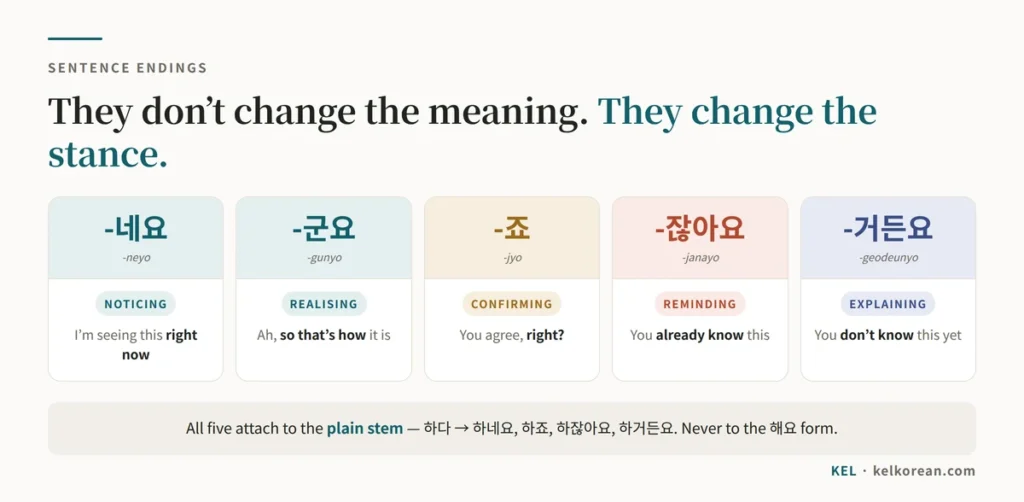
They are not. Korean sentence endings like these do not change what the sentence is about. They change what the speaker is doing with it: noticing it, reminding you of it, or explaining it to you.
This is the layer that makes Korean sound Korean, and it is almost entirely missing from beginner textbooks — because it is attitude rather than information, and attitude is hard to put in a grammar table.
Why Textbooks Skip These
A textbook pattern usually earns its place by adding meaning. -고 싶어요 adds want. -(으)ㄹ 수 있어요 adds can. You can put them in a two-column table and the table is honest.
The endings in this article add none of that. Every sentence below means “it’s raining.” What changes is whether the speaker is discovering it, assuming you already know it, or offering it as the reason for something else.
That makes them hard to test and easy to skip — and it is also why learners who have finished a whole textbook still sound stiff. The fifteen core grammar patterns build sentences. These five decide how the sentence lands.
Good news first: they are mechanically simple. All five attach to the plain verb stem, and once you have one, you have all of them.
-네요 — “Oh, I see that now”
-네요 is for something you are noticing as you speak. Fresh information, arriving through your own eyes, ears or tongue.
- 비가 오네요. — Oh, it’s raining. (You just looked outside.)
- 맛있네요! — Hey, this is good. (You just took a bite.)
- 한국어 잘하시네요. — You speak Korean well. (You just heard them.)
The last one matters more than it looks: -네요 is the default ending for compliments in Korean. 한국어 잘해요 is a flat evaluation. 한국어 잘하시네요 says you just noticed, which is warmer and much more natural.
The rule that keeps you out of trouble is that -네요 has to be new to you. You cannot say 서울은 크네요 about a city you have lived in for three years. Saying it on your first evening there is perfect.
How to attach it: stem + 네요.
| Dictionary form | -네요 |
|---|---|
| 오다 | 오네요 |
| 좋다 | 좋네요 |
| 하다 | 하네요 |
| 먹다 | 먹네요 |
Past tense goes underneath it: 했네요, 왔네요, 좋았네요.
One irregularity worth knowing: stems ending in ㄹ drop it. 길다 → 기네요, 멀다 → 머네요, 만들다 → 만드네요. If ㄹ-dropping is new, Korean verb conjugation covers where else it happens.
Casual form: drop the 요. 비가 오네.
-군요 / -구나 — “Ah, so that’s how it is”
-군요 is also realisation, but the information arrived through understanding rather than through your senses. Someone told you, or you worked it out.
- 아, 한국 사람이 아니시군요. — Ah, so you’re not Korean. (They just said so.)
- 그래서 안 왔구나. — Ohhh, so that’s why he didn’t come. (You just put it together.)
Compare directly:
- 맛있네요 — you tasted it.
- 맛있군요 — someone told you it was good, and you are acknowledging that.
-구나 is the casual form, and it is everywhere in drama. It is the sound of a character realising something a beat before the audience does. -군요 in speech sounds a little formal or bookish; if you want the natural spoken version among friends, use -구나. You will hear plenty of both in K-drama Korean.
How to attach it — this is the one ending in the article with a shape change:
| Ending | Example | |
|---|---|---|
| Action verb, present | -는군요 / -는구나 | 가는군요, 먹는구나 |
| Descriptive verb | -군요 / -구나 | 좋군요, 예쁘구나 |
| Past, any verb | -았/었군요 | 갔군요, 좋았구나 |
| Noun + 이다 | -(이)군요 | 학생이군요 |
-죠 / -지요 — “…right?”
-죠 is what you use when you and the listener both already know something. It is the contraction of -지요, and almost nobody says the long form in conversation.
Three jobs, all from the same core idea:
1. Asking for agreement. 맛있죠? — Good, isn’t it? You already think so and expect them to agree. This is the most common use by a wide margin.
2. Stating shared knowledge softly. 한국은 겨울에 춥죠. — Korea’s cold in winter, as you know. Saying 추워요 to someone who lives in Korea sounds like you are informing them. 춥죠 includes them.
3. Answering with easy confidence. 그럼요, 알죠. — Of course I know. And with a first-person verb it becomes a relaxed offer: 제가 하죠. — I’ll do it, then.
How to attach it: stem + 죠. 하죠, 좋죠, 먹죠, past 했죠, 갔죠.
-죠 is also the single most useful softener in polite conversation, which is why it turns up constantly alongside the speech levels covered in Korean honorifics.
-잖아요 — “You know this already”
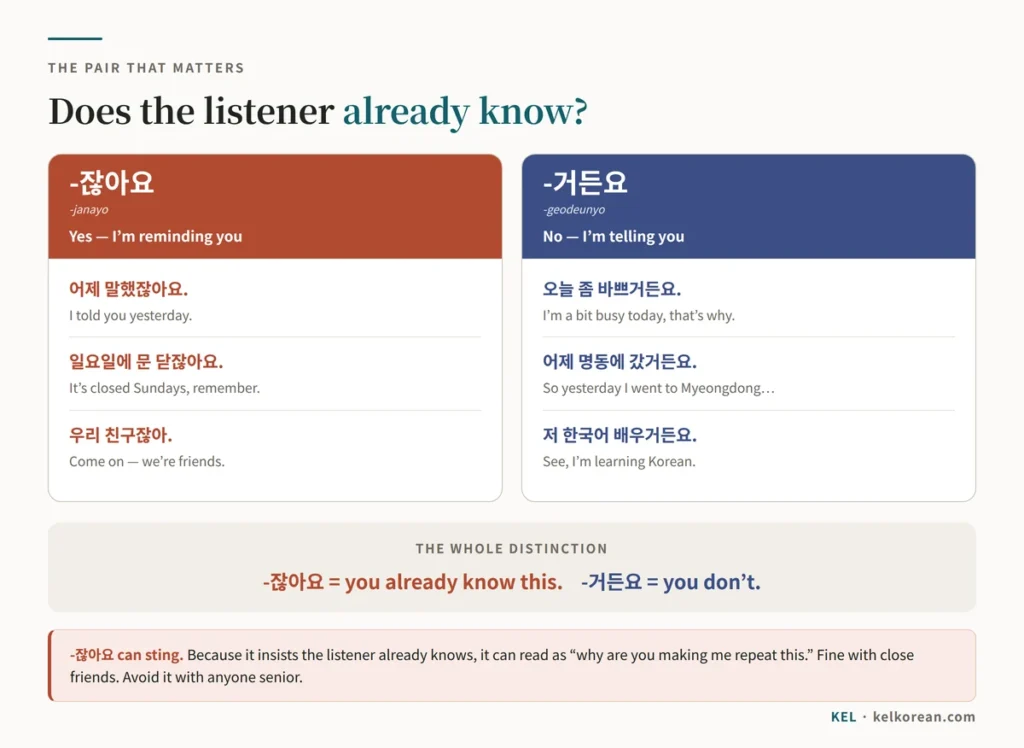
Now the interesting pair. -잖아요 flags information you believe the listener already has.
- 어제 말했잖아요. — I told you yesterday.
- 그 가게 일요일에 문 닫잖아요. — That shop’s closed on Sundays, remember.
- 우리 친구잖아. — Come on, we’re friends.
English does not have a single word for this. The closest is a tone of voice: “but you know that.”
This is the ending that can sting. Because -잖아요 asserts that the listener already knows, using it can carry the message why are you making me repeat this. 어제 말했잖아요 is close to “I already told you” — which is a complaint in any language.
Practical guidance:
- Safe when the shared knowledge is neutral and pleasant: 여기 진짜 맛있잖아요.
- Risky with anyone senior to you, and especially in the past tense about something they forgot.
- Warm between close friends, where 우리 친구잖아 is genuinely affectionate.
How to attach it: stem + 잖아요. 하잖아요, 좋잖아요, 먹잖아요, past 했잖아요. Noun + 이다 → 학생이잖아요. Casual: -잖아.
-거든요 — “Here’s something you don’t know”
-거든요 is the exact opposite of -잖아요. It marks information as new to the listener — background you are supplying.
- 왜 안 가요? — 오늘 좀 바쁘거든요. — Why aren’t you going? — I’m a bit busy today, that’s why.
- 저 한국어 배우거든요. — So, I’m learning Korean. (Explaining why you asked.)
Its second job is the one worth stealing, because it is how Koreans start stories:
어제 명동에 갔거든요. 근데… — So yesterday I went to Myeongdong. And then…
-거든요 at the start of a story is a promise that more is coming. It sets the scene and holds the listener’s attention. Once you notice this, you will hear it opening half the anecdotes in any Korean conversation.
How to attach it: stem + 거든요. 하거든요, 좋거든요, 먹거든요, past 갔거든요. Noun + 이다 → 학생이거든요. Casual: -거든.
One caution. Used alone as a flat pushback — 아니거든요 for “no it isn’t, actually” — it comes out curt. As a reason or a story opener it is completely neutral.
The Same Sentence, Five Ways
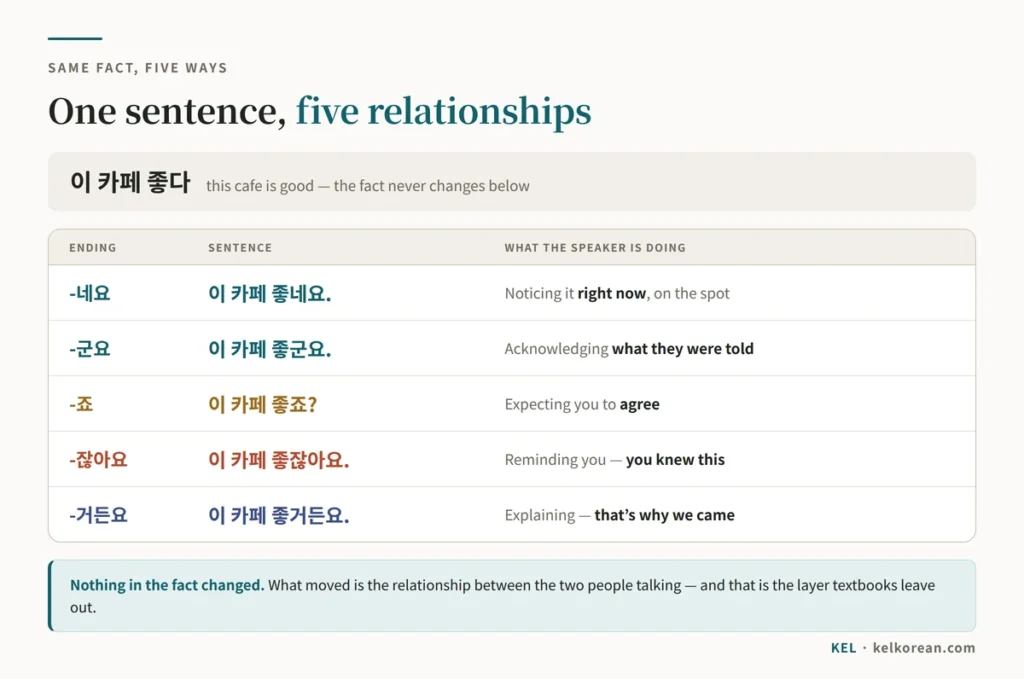
Take 이 카페 좋다 — this cafe is good.
| Ending | Sentence | What the speaker is doing |
|---|---|---|
| -네요 | 이 카페 좋네요. | Noticing it right now, on the spot |
| -군요 | 이 카페 좋군요. | Acknowledging what they were told |
| -죠 | 이 카페 좋죠? | Expecting you to agree |
| -잖아요 | 이 카페 좋잖아요. | Reminding you — you knew this |
| -거든요 | 이 카페 좋거든요. | Explaining — that’s why we came |
Five identical facts, five different relationships between the two people talking.
The Attachment Rule That Saves You
Here is the part that makes all five easy, and it is a single sentence:
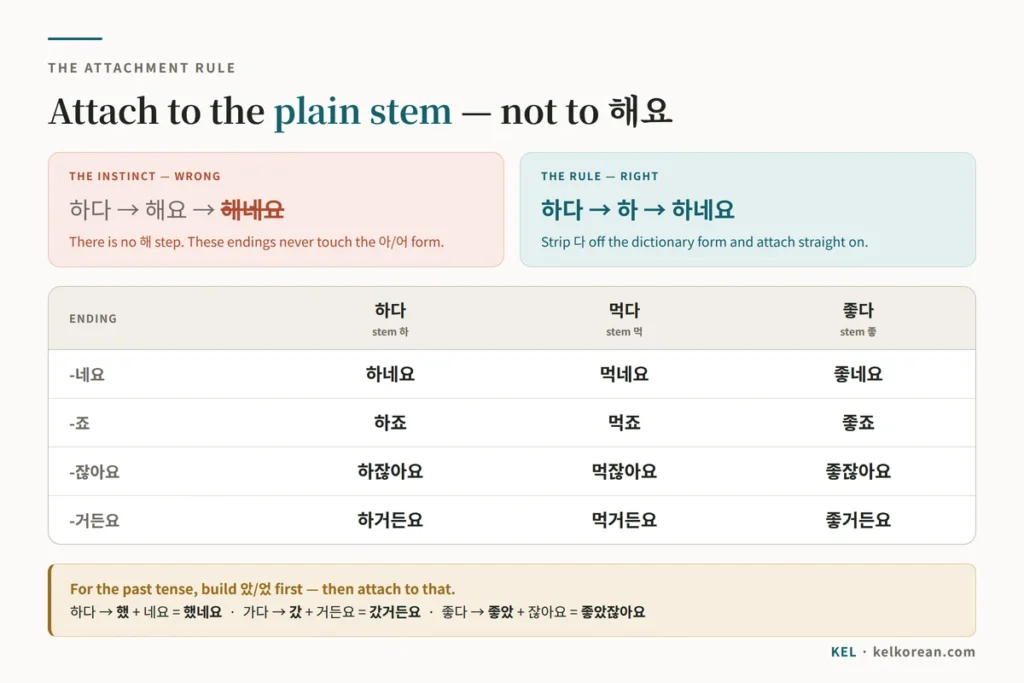
They attach to the plain stem, not to the 해요 form.
This is where most learners slip. 하다 becomes 해요 in the present tense, so the instinct is to build 해네요. It is wrong. Strip 다 off the dictionary form and attach directly:
| 하다 | 먹다 | 좋다 | |
|---|---|---|---|
| -네요 | 하네요 | 먹네요 | 좋네요 |
| -죠 | 하죠 | 먹죠 | 좋죠 |
| -잖아요 | 하잖아요 | 먹잖아요 | 좋잖아요 |
| -거든요 | 하거든요 | 먹거든요 | 좋거든요 |
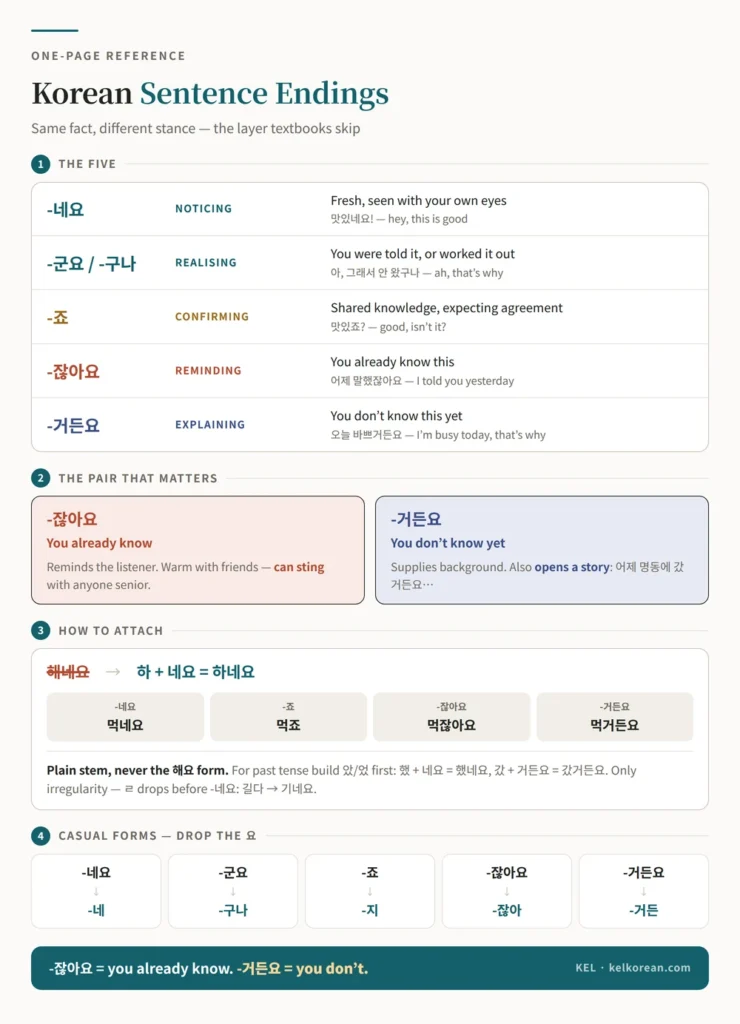
No 아/어 vowel harmony, no irregular stems to worry about except the ㄹ-drop before -네요. For the past tense, build 았/었 first and then attach to that: 했 + 네요 = 했네요, 갔 + 거든요 = 갔거든요.
Quick Practice
Which ending fits? Answers underneath.
- You bite into tteokbokki for the first time and it’s delicious.
- Your friend asks why you’re carrying an umbrella. It’s going to rain later and they don’t know.
- You’re pointing at a restaurant you have both eaten at, and you want them to agree it’s good.
- Your friend forgot that the museum is closed on Mondays. You told them yesterday.
- Someone tells you they’re from Busan and it explains their accent.
Answers
- 맛있네요! — noticed right now
- 이따 비 오거든요 — new information, given as the reason
- 여기 맛있죠? — asking for agreement
- 월요일에 문 닫잖아요 — they already knew (use gently)
- 아, 부산 분이시군요 — realisation from being told
Frequently Asked Questions
Are these formal or informal?
All five as written here are 해요체 — polite but not formal, which is the level you want for almost every situation. Drop the 요 for the casual forms: -네, -구나, -지, -잖아, -거든. In the very formal 합니다체 they mostly disappear; -네요 has no formal equivalent at all, and you would use a plain -습니다 sentence instead.
What is the difference between -네요 and -군요?
Source of the information. -네요 is what you discovered yourself — you saw, heard or tasted it. -군요 is what you understood — someone told you, or you worked it out. In everyday speech -네요 is much more common, and -구나 covers most of what -군요 does.
Is -잖아요 rude?
Not by itself, but it can be. It asserts that the listener already knows something, so it can imply I shouldn’t have to say this. With close friends it is affectionate. With someone senior, or in the past tense about something they forgot, choose a different sentence.
Can I use -거든요 on its own as an answer?
Yes, and it’s very common — 왜요? — 바쁘거든요. Just be aware that using it to contradict someone flatly (아니거든요) sounds sharp, closer to “actually, no” than to a neutral correction.
Why do I hear -죠 so much more than -지요?
Because -죠 is simply the contracted form, and contraction has won. -지요 survives in writing, in song lyrics and in older or very careful speech, but in conversation it is -죠 almost every time.
Do these appear in K-pop lyrics?
Constantly — especially -잖아 and -구나, because both compress a whole emotional situation into two syllables, which is exactly what a lyric needs. K-pop Korean covers more of the grammar that gets used because it fits the beat.
Final Thoughts
These five endings are the difference between correct Korean and Korean that sounds like a person said it.
If you take only one thing, take the pair: -잖아요 means you already know this, -거든요 means you don’t. Getting that contrast right will do more for how natural you sound than another twenty vocabulary words.
Start with -네요 and -죠 — they are the friendliest, they are almost impossible to use offensively, and -네요 in particular turns any compliment into a warmer one. Add -거든요 when you start telling stories, and let -잖아요 wait until you have a Korean friend close enough that reminding them of things is safe.
And when you get to typing rather than speaking, the same attitudes get compressed even further, into consonants — which is a system of its own, covered in Korean texting slang.
Leave a Reply