
Korea has a reputation as one of the most cashless countries on earth, and for Koreans it is. A 2,000-won coffee goes on a card. So does a single bottle of water at a convenience store. Nobody blinks, and nobody asks for a minimum.
So visitors arrive expecting to leave their wallet at home — and within an hour of landing, a good number of them are standing in front of a subway machine that will not take their card.
Both things are true. Korea is cashless on Korean rails. Your Visa or Mastercard works almost anywhere a person hands you a card terminal across a counter. It gets into trouble in the places where Korean payments run through something a visitor does not have: a Korean phone number, a Korean bank account, or a transit network that was built as its own closed world.
Once you can see that line, working out how to pay in Korea stops being confusing. This guide draws it for you. It was checked in September 2026, which matters more than usual — the rules for visitors changed three times this year, and a lot of advice written before spring is now wrong.
The Short Version
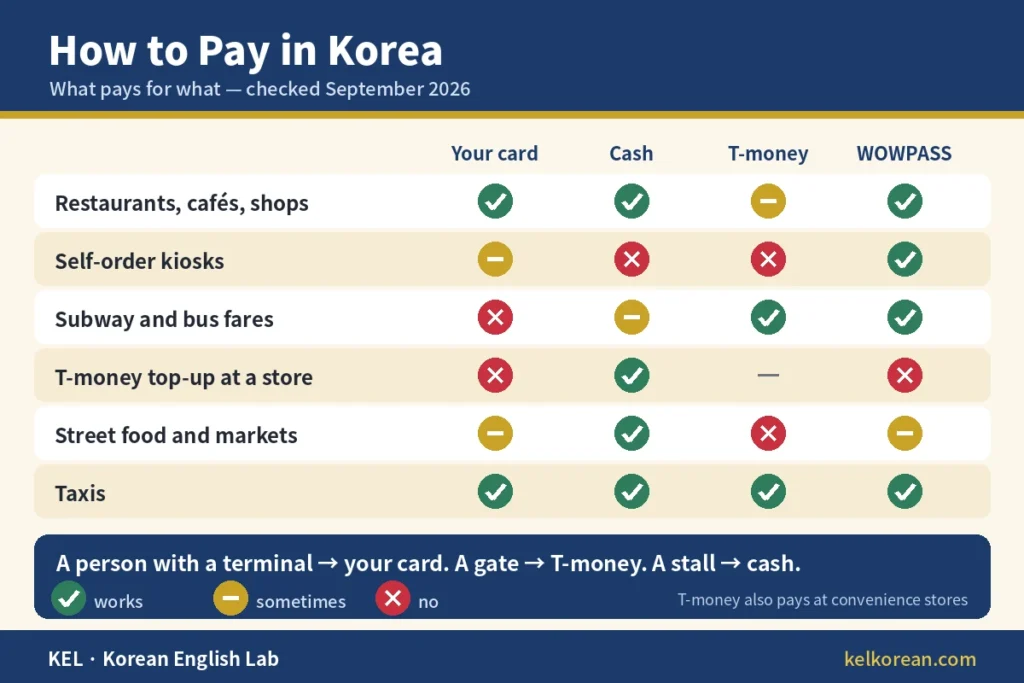
If you read nothing else, read this table.
| Situation | What works | Watch out for |
|---|---|---|
| Restaurants, cafés, shops, convenience stores | Your overseas card | Some self-order kiosks take Korean cards only |
| Taxis | Card, paid in the car | Paying inside an app depends on which app |
| Subway and bus | A T-money card | Topping it up at a convenience store is cash only |
| Street food and markets | Cash, in small notes | Some stalls ask for a bank transfer instead |
| Korean websites and apps | Often nothing foreign | Identity checks need a Korean phone number |
| Tax-free shopping | Card plus passport | ₩15,000 minimum on a single receipt |
The pattern is the one from the opening. Where there is a person and a terminal, your card is fine. Where there is a machine, an app or a transit gate, check first.
Where Your Card Works — and the Five Places It Doesn’t
At an ordinary counter, paying by card in Korea is uneventful. The terminal will usually want the chip — the screen says 카드를 꽂아 주세요, “please insert your card” — though tapping works at a growing number of places, especially the big chains. For larger amounts you may be asked to sign on the screen. Koreans sign with a quick squiggle, and nobody checks it against anything.
If the cashier asks 일시불로 하시겠어요?, they are asking whether to charge the whole amount now or split it into monthly instalments. Say 일시불이요. Our guide to shopping in Korean covers the rest of what a cashier says to you.
Apple Pay and Google Pay with an overseas card work wherever the terminal takes contactless payment — common at the big chains, rarer at small independent shops. And if a card that works everywhere else is suddenly declined, it is usually the machine, not the card: try a staffed counter, a different ATM, or your second card before you call your bank.
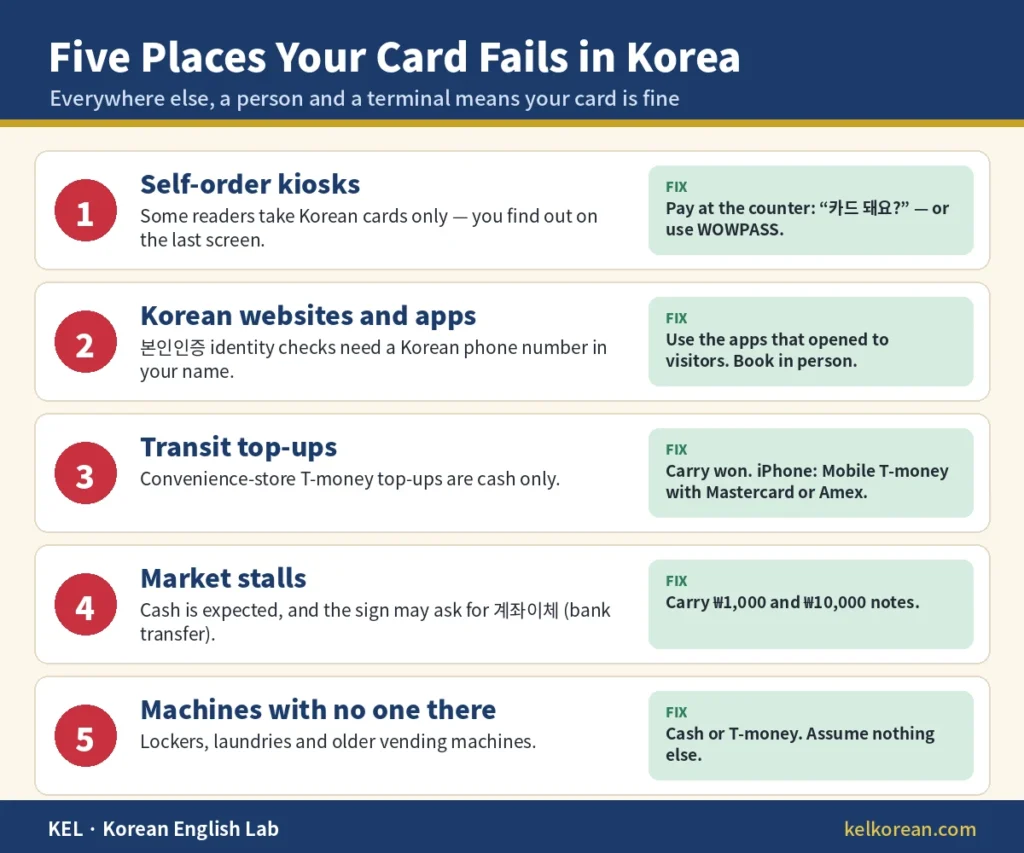
Now the five places that catch visitors out.
1. Self-order kiosks
Korea has gone all in on the ordering kiosk — burger chains, cafés, and more and more small noodle and 분식 shops where nobody takes your order at all. Many kiosks take overseas cards. Some take only Korean ones, and you find out on the final screen after you have built your whole order. If a member of staff is behind the counter, you can almost always pay there instead: point at the kiosk, hold up your card, and say 카드 돼요?
2. Korean websites and apps
Korean online payments usually sit behind an identity check called 본인인증, which confirms that a phone number is registered to you with a Korean carrier. A tourist SIM or an overseas number does not pass. That is why Korea’s own pay apps, Kakao Pay and Naver Pay, are effectively closed to short-term visitors — Naver began allowing passport verification for some features in June 2026, but not enough to rely on. Even sites that do accept overseas cards can fail at the extra security step your bank adds, and whether yours goes through depends on the card issuer. The apps that have genuinely opened up to visitors are covered in our Korea travel apps guide.
3. Transit top-ups
The biggest one, and the one that changed most in 2026. It gets its own section below.
4. Market stalls and street food
Plenty of stalls take cards now, but cash is still what they expect, and you will be quicker and more welcome with it. You will also start to notice something new: a small sign with a bank name and an account number. That is an invitation to pay by 계좌이체, an instant bank transfer, which is how many Koreans pay small vendors now. It is useless to you without a Korean bank account — which is exactly why cash still matters here.
5. Machines with nobody behind them
Coin lockers, self-service laundries, parking machines and older vending machines often take cash or T-money and nothing else. If there is no person to hand your card to, assume you will need one of those two.
Transit Runs on Its Own System
Korean buses and subways do not take your bank card at the gate. They take a transit card — almost always T-money — which you buy for a few thousand won at any convenience store and load with money in advance. Our guide to the Korean subway covers buying and using one. What matters here is how you put money on it, because that is where the 2026 changes landed, and where a lot of English-language guides have got the details wrong.
At a convenience store, T-money top-ups are cash. Hand over the card and a note and say 티머니 충전해 주세요. This is the single most common reason a visitor with a wallet full of cards needs Korean won on day one.
Seoul’s new subway machines take overseas cards — but not for T-money. Since 17 March 2026, 440 new ticket machines across 273 stations on Seoul Lines 1 to 8 accept overseas Visa and Mastercard cards. Read the small print, though. They let you buy single-journey tickets and Seoul’s short-term Climate Card passes, the one- to seven-day unlimited-ride cards, with an average service charge of about 3.7%. They do not let you top up an ordinary T-money card with a foreign card. If a guide tells you otherwise, it has summarised the headline and skipped the detail.
On an iPhone, there is now a card route — unless you carry Visa. T-money has been available in Apple Wallet since July 2025, and since March 2026 the Mobile T-money app has let visitors top it up with an overseas Mastercard, American Express or UnionPay card, using a dedicated foreigner option that skips the Korean identity check. Visa is not on that list. If Visa is all you have, a physical T-money card and cash remain the answer.
More and more buses take no cash at all. Seoul took the cash boxes out of about a quarter of its city buses in 2023, and Gyeonggi and Incheon have done the same on many routes. Busan starts its own three-month trial on 1 October 2026, on 35 routes — roughly one bus in five. I live and work in Busan, so I will be watching how it goes. The fallback on those buses is a bank transfer after you board, which, once again, needs a Korean account. The practical rule is simple: never board a bus with an empty card. Keep ₩10,000 or so on it at all times.
WOWPASS Is Useful — With One Trap
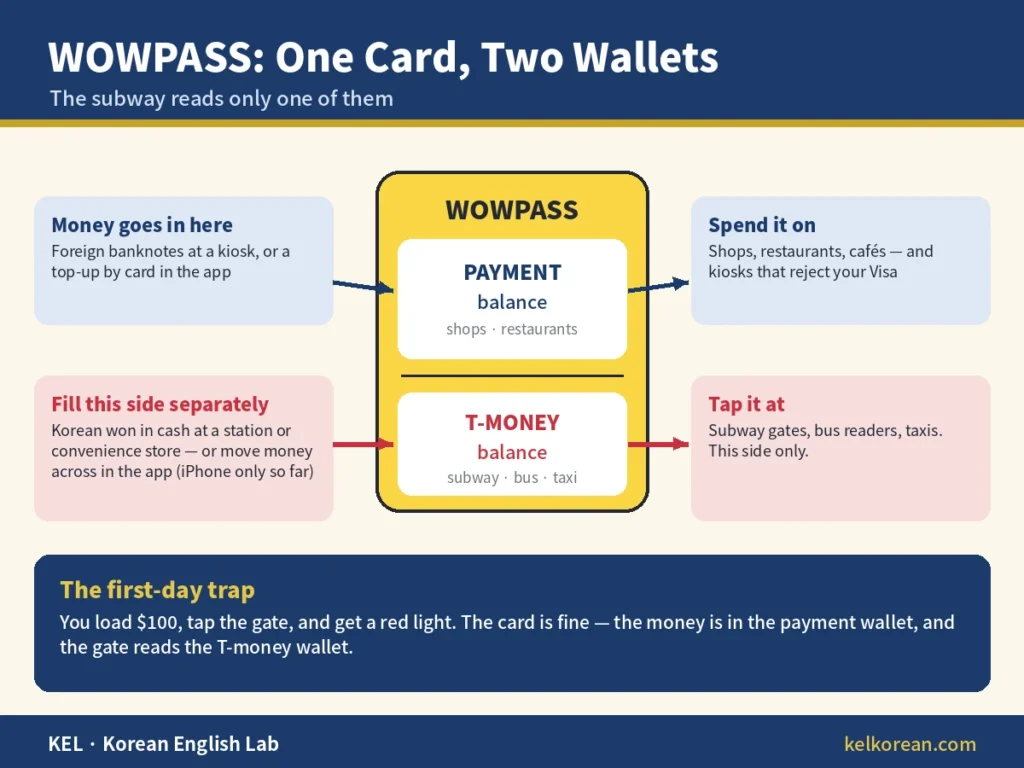
WOWPASS is a prepaid card made for foreign visitors, sold from yellow kiosks at the airports and in tourist areas. You feed it foreign banknotes, or top it up by card, and it holds Korean won.
Its real advantage is not the exchange rate, though that is usually decent. It is that Korean payment terminals treat it like a Korean card. A kiosk that rejects your Visa will often accept a WOWPASS without complaint. If you plan to eat at a lot of kiosk-order places, that alone can justify it.
Now the trap. A WOWPASS has two separate balances on one piece of plastic. The money you exchange goes into the payment balance, which you use in shops and restaurants. The subway gate reads a different balance — the built-in T-money side — and that one has to be loaded separately, with won in cash at a station or convenience store, or by moving money across in the app, a feature that has so far been iPhone-only.
Which produces the classic first-day scene: a traveller who has just loaded a hundred dollars onto a brand-new card, tapping it at the gate and getting a red light. The card is not broken. The money is on the wrong side.
Card fees and withdrawal charges have changed more than once, so check the amount on the kiosk screen before you pay. For a short trip where you will mostly eat at places with staff, you may not need one at all.
Cash: How Much, Which Notes, Where From
How much. For a trip of a few days, ₩50,000 to ₩100,000 in cash covers transit top-ups, street food and the odd cash-only moment. Most of it should be in ₩10,000 and ₩1,000 notes. A ₩50,000 note is perfectly normal money, but handing one to a street vendor for a ₩3,000 snack in the morning, before they have any change, will not make you friends.
What it looks like. Four notes and four coins do all the work.
| Note | Said as | Whose face |
|---|---|---|
| ₩1,000 | 천 원 | Yi Hwang, Confucian scholar |
| ₩5,000 | 오천 원 | Yi I, Confucian scholar |
| ₩10,000 | 만 원 | King Sejong, who created Hangul |
| ₩50,000 | 오만 원 | Shin Saimdang, artist — and Yi I’s mother |
Coins come in 10, 50, 100 and 500 won. The man on the 10,000-won note is the same King Sejong our Hangul Day article is about, and the mother on the 50,000 is the mother of the man on the 5,000 — a family arrangement that is rare on any country’s money.
Here is a layer you will only hear in Korea. People often call the ₩50,000 note simply 신사임당, by the name of the woman on it — “신사임당 한 장” means one fifty-thousand note. The green ₩10,000 was nicknamed 배춧잎, “cabbage leaf,” for its colour; you will mostly hear that from older speakers now. And when you hear a price, remember that Korean counts in ten-thousands: 25,000 won is 이만 오천, “two ten-thousands and five thousand.” Our guide to Korean numbers makes that painless.
Where from — ATMs. Not every Korean ATM takes overseas cards. Look for one labelled Global ATM, or showing the Visa, Mastercard, Plus or Cirrus logos; bank branches and many convenience stores have them. The Korean side charges a withdrawal fee of a few thousand won, shown on screen before you confirm, and your own bank may add its own.
One screen matters more than the rest. Some ATMs, and some shop terminals, offer to charge you in your home currency instead of won. It sounds helpful. It is a worse exchange rate, chosen by the machine. Always pick KRW.
Where from — exchange. Airport exchange counters are convenient and usually the worst rate you will see. Private money changers in the city, famously around Myeongdong, and WOWPASS kiosks generally beat them. The easy approach is to change or withdraw a small amount at the airport, enough for a T-money card and your first day, and do the rest in town.
Korea Went Cashless on Purpose
It helps to know why Korea works this way, because it explains a few things you will see.
After the 1997 financial crisis, the government set out to move shop income onto the tax records, and card payments were the tool. From 1999, Koreans could deduct part of their card spending from their income tax, and the habit took hold fast. The law also works in your favour. Under Article 19 of Korea’s Specialized Credit Finance Business Act, a shop that is registered to take cards may not refuse a card because it is a card, and may not charge card users more.
So a handwritten sign reading “cards only over ₩10,000” is, strictly speaking, not allowed. In practice, you will occasionally see one anyway, or be offered a small discount for paying cash. As a visitor it is not worth an argument — and a stall that was never registered for cards can legitimately be cash only.
The same history explains the question 현금영수증 해 드릴까요?, “shall I do a cash receipt?” A cash receipt is for Korean taxpayers to claim the same deduction on cash spending. You do not need one. 괜찮아요 is the whole answer.
Tax Refunds, in One Section
Shops showing a Tax Free or Tax Refund sign can give visitors back the VAT on qualifying goods. You need your physical passport, and a purchase of at least ₩15,000 on one receipt — two ₩10,000 purchases on separate receipts do not add up, so buy in one go.
Many shops can take the tax off at the till, an immediate refund, for purchases under ₩1,000,000 each and up to ₩5,000,000 across your trip. Otherwise you get a refund slip and claim at the airport’s kiosks or refund counters before you check your bag. The phrase is 택스 리펀 돼요? — and if you are shopping for cosmetics, our guide to shopping at Olive Young covers the labels as well.
The Korean on the Payment Screen
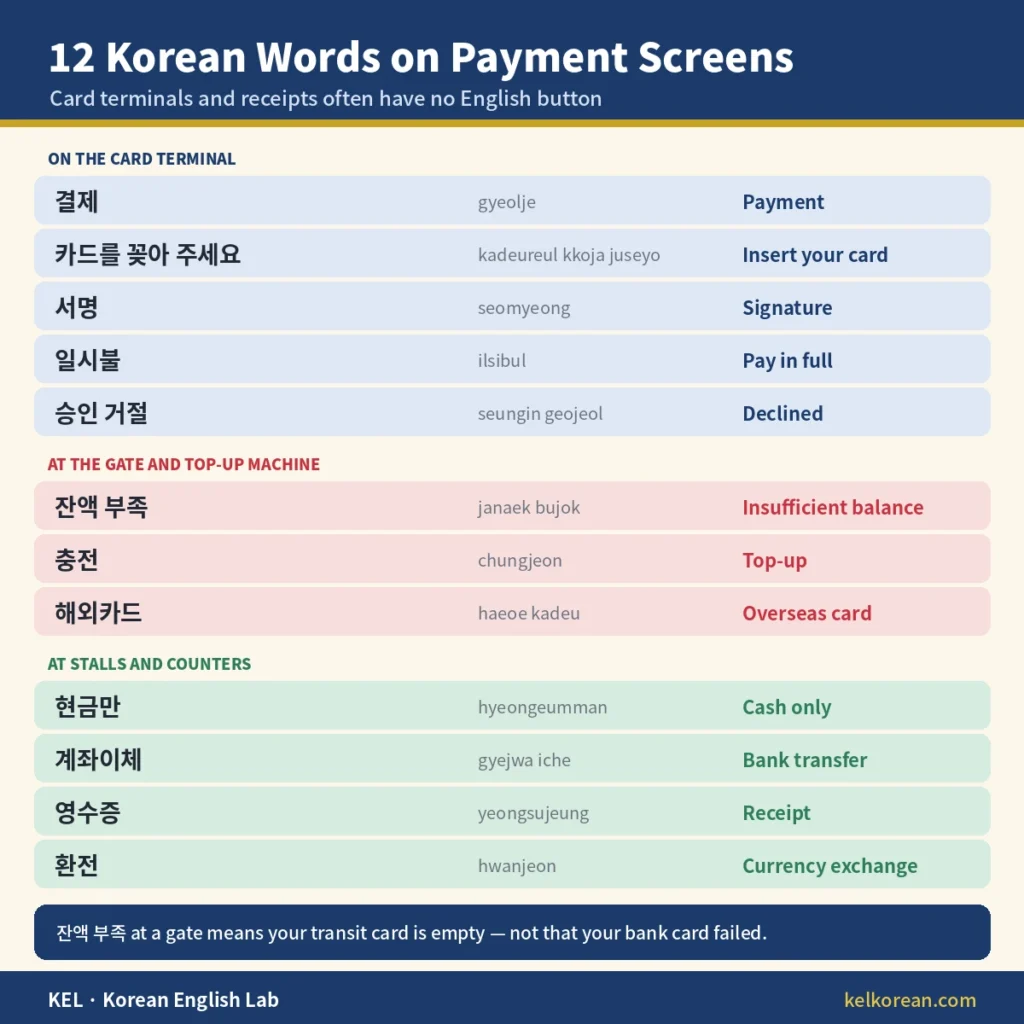
Kiosks, terminals and transit machines usually have an English button. Card terminals and receipts often do not. These twelve words cover almost every screen you will meet.
| Korean | Romanisation | Meaning |
|---|---|---|
| 결제 | gyeolje | Payment |
| 카드를 꽂아 주세요 | kadeureul kkoja juseyo | Please insert your card |
| 서명 | seomyeong | Signature |
| 일시불 | ilsibul | Pay in full (not instalments) |
| 승인 거절 | seungin geojeol | Declined |
| 잔액 부족 | janaek bujok | Insufficient balance |
| 충전 | chungjeon | Top-up |
| 현금만 | hyeongeumman | Cash only |
| 계좌이체 | gyejwa iche | Bank transfer |
| 영수증 | yeongsujeung | Receipt |
| 해외카드 | haeoe kadeu | Overseas card |
| 환전 | hwanjeon | Currency exchange |
잔액 부족 is the one you will most likely see in real life, flashing at a subway gate or on a bus reader. It means your transit card is empty, not that your bank card has failed.
And four sentences that solve most problems at a counter:
| Korean | Romanisation | Meaning |
|---|---|---|
| 카드 돼요? | kadeu dwaeyo? | Do you take card? |
| 해외카드 돼요? | haeoe kadeu dwaeyo? | Do you take overseas cards? |
| 현금으로 할게요 | hyeongeumeuro halgeyo | I’ll pay in cash |
| 티머니 충전해 주세요 | timeoni chungjeonhae juseyo | Please top up my T-money |
The 돼요? ending — “does it work?” — is worth borrowing for everything. 카드 돼요, 택스 리펀 돼요, 포장 돼요. It is the most useful two syllables in Korean shopping. For the rest of the trip — calling staff, paying at the counter, saying goodbye — see our Korean phrases for travelers.
Before You Land
Almost every payment problem I hear about from visitors could have been solved before the plane took off. Five things to sort out at home:
- Plan to get a little won at the airport. Your first purchase is very often a T-money card and your second a top-up, and both want cash.
- Decide now that you will always choose KRW. When an ATM or terminal offers to charge you in dollars, euros or pounds, the answer is no.
- If you buy a WOWPASS, plan to fill both sides. Exchanged money goes to the payment balance; the subway reads the T-money balance.
- Pack two cards, on different networks. A Mastercard and a Visa behave differently at the same machine more often than you would think — and tell your bank you are travelling, so the first Korean transaction is not frozen as fraud.
- Ask for small notes. ₩1,000 and ₩10,000 notes are for markets and street food; spend the ₩50,000s at convenience stores and restaurants.
And one thing you do not need to plan for: tipping. Korea has no tipping culture, in restaurants, taxis or hotels, and money left on the table usually comes back to you. Our guide to ordering food in Korean explains how paying at a restaurant actually works.
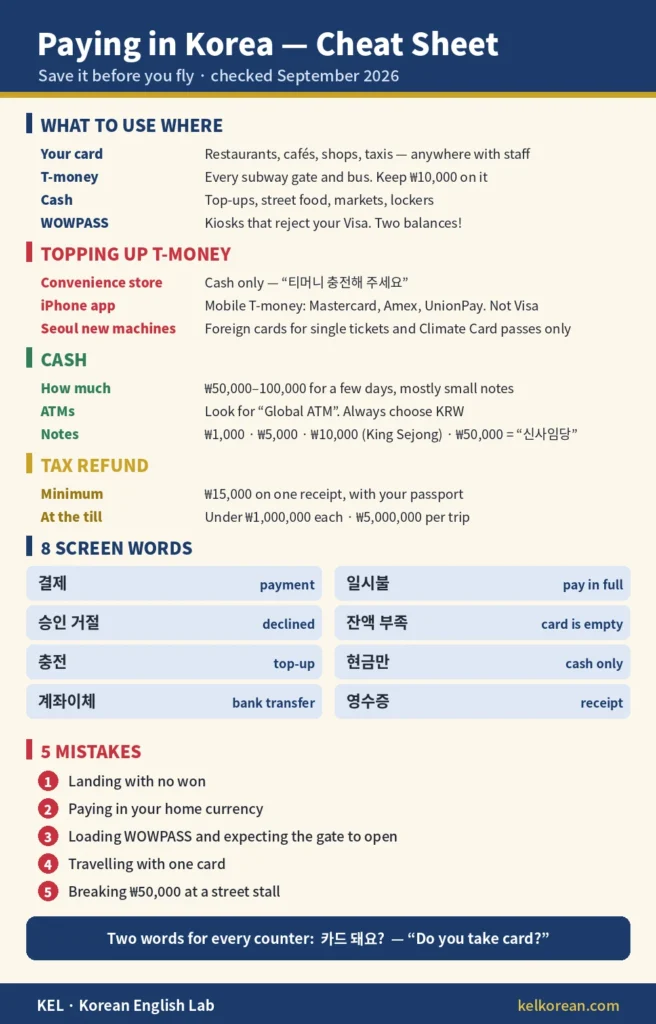
Three Tools, Three Jobs
Paying in Korea is easy once you stop expecting one card to do everything. Use your own card wherever someone hands you a terminal. Keep a T-money card with money on it for every bus and train. Carry a small stack of ₩1,000 and ₩10,000 notes for the places Korea’s card system was never built to reach. That is how to pay in Korea: three tools, three jobs.
Before you fly, set up the apps worth installing, read through how the subway works, and if Busan is on the list, check the best time to visit. Then learn 카드 돼요? — two words that will get you through more counters than anything else in this guide.
Written by Minhyung Cha — 25 years teaching Korean, and 15+ years running an English academy in South Korea. I live and work in Busan, and every example on this site is checked as a native speaker. More about KEL.
Leave a Reply