Almost every alphabet on earth is an accident.
The one you are reading drifted out of Phoenician traders’ marks, through Greek, through Etruscan, into Latin, over something like a thousand years. Nobody designed it. Nobody decided that A should look like that. There is no author, no date, and no explanation — the shapes are just what survived.
Hangul has all four. It has a named creator, a year, a stated purpose — and, uniquely, a manual. A book published in 1446 sets out, letter by letter, why each one is shaped the way it is.
A few other scripts have an inventor and a date: the Armenian alphabet has Mesrop Mashtots and roughly 405, and Cherokee has Sequoyah and the 1820s. What no other widely used writing system has is the design document.
That is what Hangul Day is for. On 9 October South Korea takes a day off to mark the publication of a document about an alphabet — which sounds like a strange thing to do until you know what is in the document.
What 9 October Actually Marks
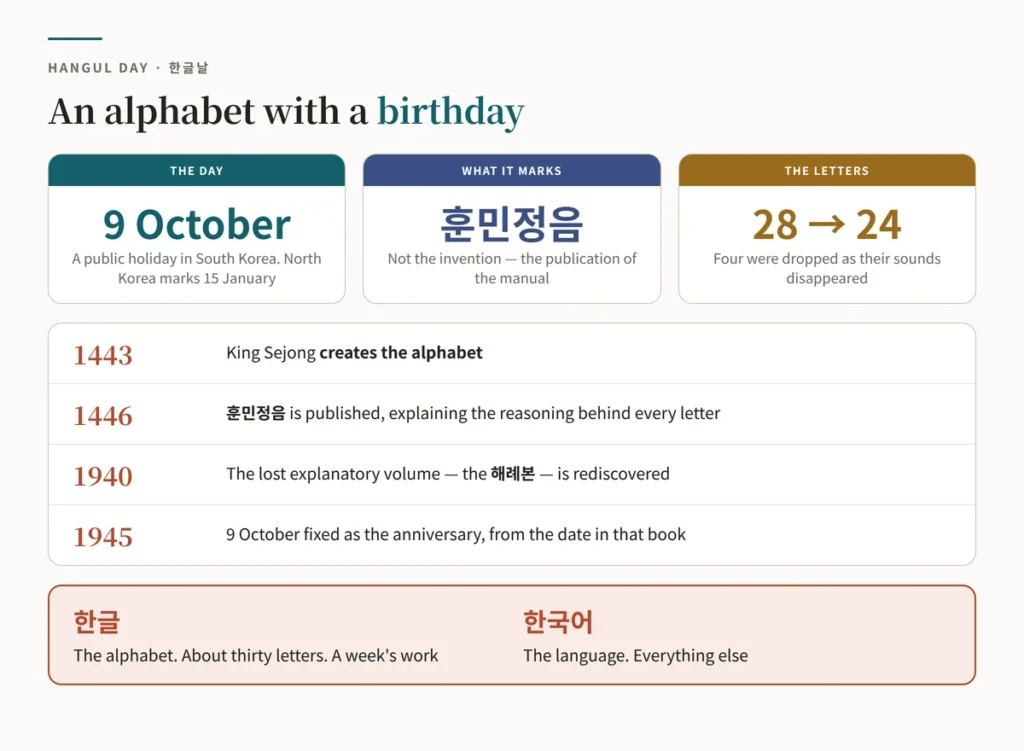
It is not the day Hangul was invented. It is the day the manual was published.
| Year | What happened |
|---|---|
| 1443 | The alphabet is created |
| 1446 | 훈민정음 is published, explaining it |
| 1940 | A complete copy — the 해례 included — is rediscovered |
| 1945 | 9 October is fixed as the anniversary |
훈민정음 (Hunminjeongeum) means “the correct sounds for the instruction of the people.” The name is the mission statement.
The book comes in two parts. The first, the 예의, is short: King Sejong’s own preface and a bare list of the letters. The second, the 해례 — “explanation and examples” — is the extraordinary one. It sets out, letter by letter, the reasoning behind every shape.
The 예의 was never lost; it survives inside the Sejong annals. The 해례 was. For centuries nobody knew what it said, and scholars genuinely debated whether Hangul had been copied from Mongolian script, from Sanskrit, or from the pattern of a window lattice.
Then a complete copy of the book turned up in 1940, in a house in Andong — which household exactly is still argued over. It answered the question directly, in the designers’ own words. That copy, the 간송본, is the one every reproduction comes from.
The date comes from that book’s closing line, dated to the first ten days of the ninth lunar month of 1446. The original never names a day, so the convention is to take the last day of that span — the tenth of the ninth lunar month — which converts to 9 October. That is how an alphabet ended up with a birthday.
The book was designated a National Treasure in 1962 — long listed as No. 70, though Korea abolished cultural-property numbers in 2021 — and was inscribed on the UNESCO Memory of the World register in 1997.
Sejong Wrote Down Why
The preface is fifty-four Chinese characters — three sentences. It is the part every Korean schoolchild memorises, and it explains the whole project:
나랏말이 중국과 달라 문자와 서로 통하지 아니하니, 이런 까닭으로 어리석은 백성이 이르고자 하는 바가 있어도 끝내 제 뜻을 펴지 못하는 사람이 많다. 내가 이를 딱하게 여겨 새로 스물여덟 자를 만드노니, 사람마다 쉽게 익혀 날마다 쓰기에 편하게 하고자 할 따름이다.
Our country’s speech differs from that of China, and does not match its characters. So among the ignorant people, there are many who have something they wish to say and who in the end cannot express their meaning. I feel pity for this, and have newly made twenty-eight letters — wishing only that everyone may learn them easily and use them comfortably every day.
Read it once more and notice what is missing. There is no claim about beauty, no appeal to tradition, no divine authority. It is a usability argument: people cannot say what they mean, so I made a tool.
Korea had a language. What it did not have was a way to write it. Educated men wrote in Classical Chinese — a foreign language with thousands of characters, which took years to learn and which almost nobody outside the aristocracy could read. A farmer with a grievance could not write it down. That is the problem the preface describes.
Twenty-eight letters were made. Twenty-four survive. The four that fell away — ㆍ ㆆ ㅿ ㆁ — recorded sounds that the language later lost.
The Consonants Are Drawings of Your Mouth
This is the part that makes people sit up, and it is the reason Hangul can be learned in days rather than years.
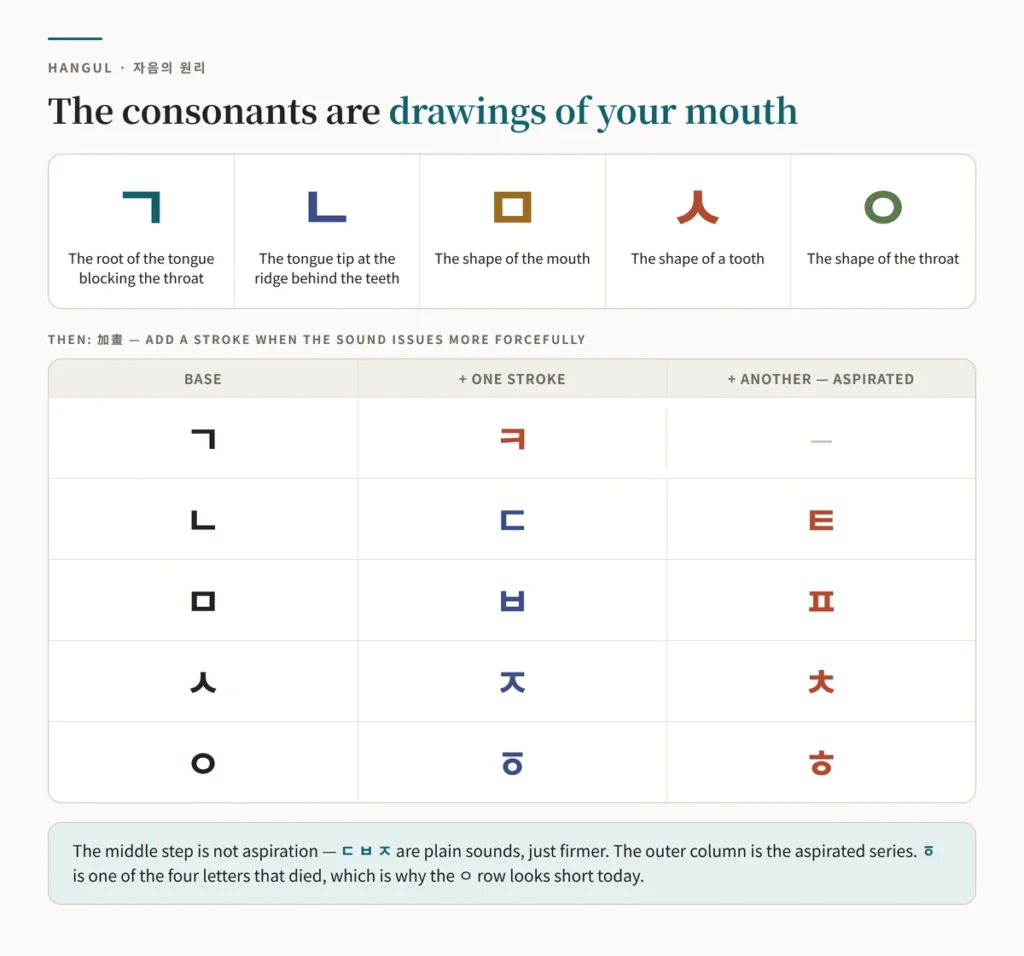
Five basic consonants were drawn as pictures of the organ that makes the sound.
| Letter | What it depicts |
|---|---|
| ㄱ | The root of the tongue blocking the throat |
| ㄴ | The tip of the tongue touching the ridge behind the upper teeth |
| ㅁ | The shape of the mouth |
| ㅅ | The shape of a tooth |
| ㅇ | The shape of the throat |
Say ㄱ and feel where the back of your tongue goes. Say ㄴ and feel the tip rise. The letters are diagrams of what your own mouth is already doing.
Several more consonants were built by adding strokes to the basic shapes. The 해례 calls this 加畫 — adding a stroke — and links the extra strokes to sounds described as more forceful.
There are exceptions. ㄹ, ㅿ and ㆁ are classified separately as 이체자, or variant letters. They do not follow the same pattern of an added stroke marking a stronger sound. The table below shows the stroke-addition families; it is not a formula for every consonant.
| Base | + a stroke | + another |
|---|---|---|
| ㄱ | ㅋ | — |
| ㄴ | ㄷ | ㅌ |
| ㅁ | ㅂ | ㅍ |
| ㅅ | ㅈ | ㅊ |
| ㅇ | ㆆ | ㅎ |
Read each row from left to right to follow the added strokes. The familiar aspirated consonants are ㅋ, ㅌ, ㅍ and ㅊ — the ones pronounced with a noticeable puff of air. They do not all sit in the same column: ㄱ reaches ㅋ with one added stroke, while the other three families shown here have an intermediate letter.
ㄷ, ㅂ and ㅈ are plain consonants, not aspirated ones. The chart shows how the letters were designed; it is not an instruction to make each sound simply by blowing harder. The final row also includes ㆆ, a historical letter no longer used in standard modern Korean.
This is not an aesthetic choice. It is an encoding. No alphabet in wide use does this — in English, nothing about the shape of p tells you it is b with more breath. Our guide to Korean consonants covers what those stroke-added sounds actually feel like in the mouth, which is the hard half.
The Vowels Are Three Strokes
The vowels are built on a different principle, and it is even tidier.
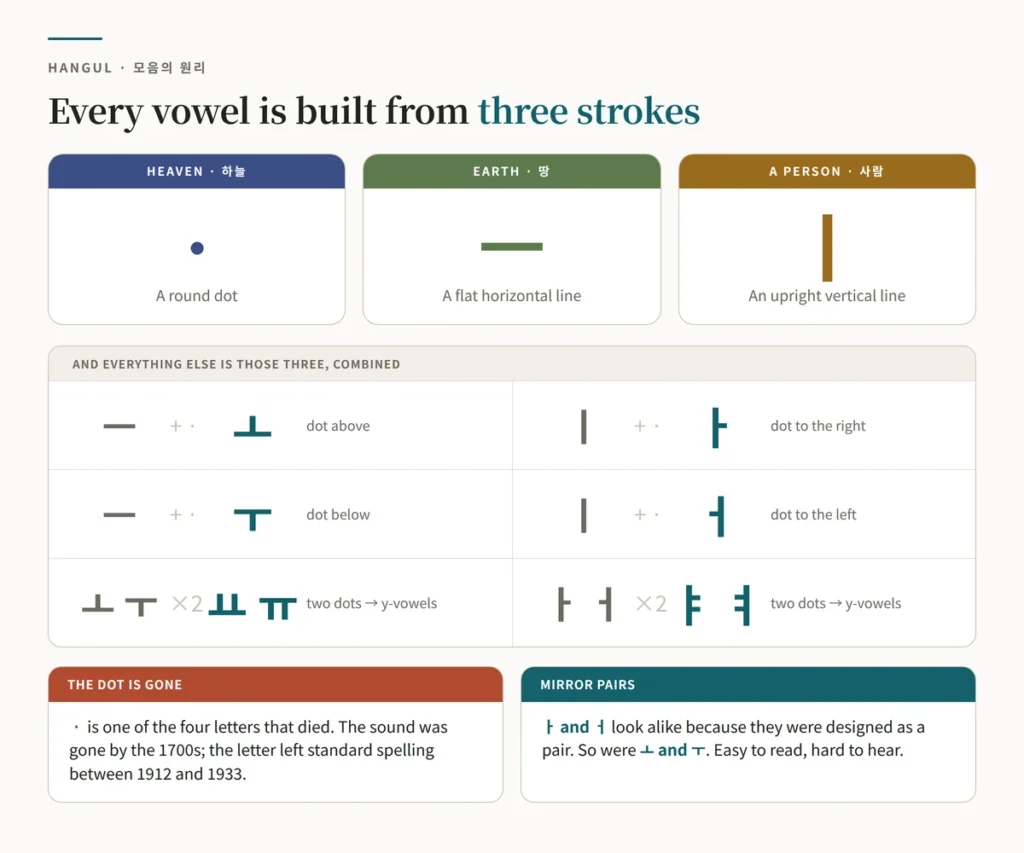
There are three basic marks:
| Mark | Stands for | Shape |
|---|---|---|
| ㆍ | Heaven | A round dot |
| ㅡ | Earth | A flat horizontal line |
| ㅣ | A person | An upright vertical line |
Every other vowel is a combination of those three.
| Built from | Result |
|---|---|
| ㅡ with the dot above | ㅗ |
| ㅡ with the dot below | ㅜ |
| ㅣ with the dot to the right | ㅏ |
| ㅣ with the dot to the left | ㅓ |
Add a second dot and you get the y-vowels: ㅛ, ㅠ, ㅑ, ㅕ.
The round dot itself is one of the four letters that died. The sound it recorded had gone by the 1700s, and the letter was removed from standard spelling between 1912 and 1933. Separately — and much earlier — the dot inside ㅗ ㅜ ㅏ ㅓ shortened into a stroke as brush and woodblock writing took over from the 1500s on, which is why you see a tick rather than a circle today.
This also explains a pairing that trips up every beginner. ㅏ and ㅓ are mirror images because they were designed as a pair, and so are ㅗ and ㅜ. That is a help for reading and a trap for listening — our guide to ㅓ vs ㅗ deals with the trap.
“A Wise Man by Morning, a Fool in Ten Days”
The 해례본 closes with a postface by the scholar Jeong In-ji, and it contains a claim about the alphabet’s learnability:
슬기로운 사람은 아침나절이 지나기 전에 깨치고, 어리석은 이라도 열흘이면 배울 수 있다.
A clever man will grasp it before the morning is out; a slow one can learn it in ten days.
That is a design specification, written in 1446, and it still holds. Adults with no exposure to Korean routinely read Hangul aloud within a week, and can start attaching meaning to it immediately afterwards — our first 100 Korean words is the usual next step. It is not because learners are gifted. It is because the system has about thirty pieces, nothing like the English -ough problem, and shapes that encode their own sounds.
Our seven-day plan for learning Hangul is, in effect, taking Jeong In-ji at his word — and once you can read the letters, stroke order is the short second step.
One honest caveat. Reading Hangul is genuinely fast. Pronouncing Korean correctly is not, because letters change sound depending on what sits next to them — 같이 is read 가치, 신라 is read 실라. Those are separate rules, covered in our guide to Korean pronunciation. Anyone who tells you Korean is easy because the alphabet is easy has stopped at day three.
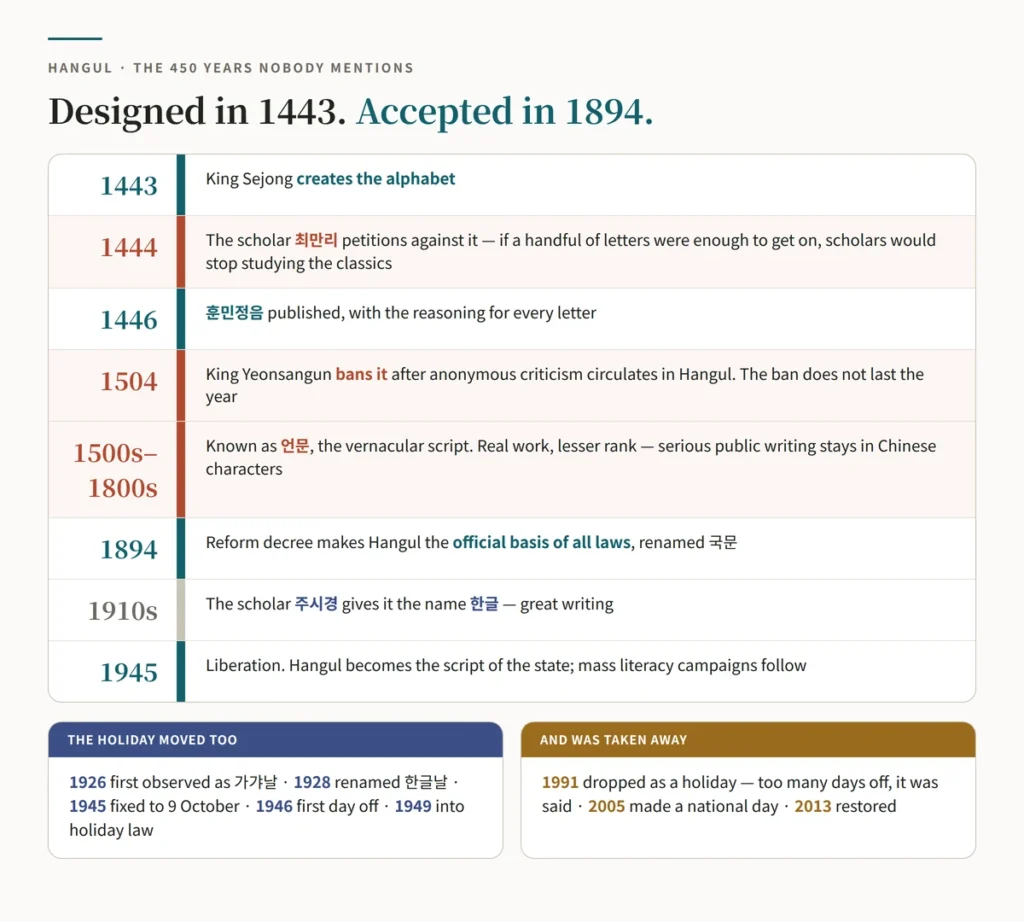
The 450 Years Nobody Mentions
Here is the part that gets left out of the celebratory version, and it is the part that makes the holiday mean something.
Hangul was not welcomed. It was resented, mocked, and at one point banned.
Within months of its creation, the senior scholar 최만리 submitted a memorial opposing it. His objections were not that the letters were badly made. They were that a script unlike China’s would make Korea look like a barbarian state — and that if twenty-seven letters were enough to get on in the world, scholars would stop studying the Confucian classics. He was, in his way, right about the second part.
The name it went by was 언문 — “vernacular script.” That word was neutral in origin; the court itself used it from the first announcement. But it marked a rank. Serious, public writing meant Chinese characters. Hangul did real work for four centuries — kings issued decrees in it, yangban men wrote family letters in it, the state published 언해 translations of the classics in it — but it was the lesser script, the one for household use, women’s correspondence and popular fiction.
In 1504 it was banned outright. Anonymous posters written in Hangul appeared criticising King Yeonsangun, and he responded by prohibiting the teaching and use of the script and ordering books annotated in it burned.
The ban was real but short. It did not cover Hangul translations published under earlier kings, and within the same year Yeonsangun was having almanacs rendered into 언문 himself. It is remembered as the low point rather than as a lasting policy.
The turn came very late:
| Year | What changed |
|---|---|
| 1894 | Reform decree makes Hangul the official basis of all laws, renamed 국문 — the national writing |
| 1910s | The scholar 주시경 gives it the name 한글 |
| 1930s–40s | Japanese colonial policy suppresses Korean; scholars compile a dictionary in secret |
| 1945 | Liberation. Hangul becomes the script of the state, and mass literacy campaigns follow |
The name we use is modern. Before 1894 the everyday word was 언문; the 1894 decree made it 국문. 한글 — 한 meaning great, or one, plus 글, writing — was coined by Ju Si-gyeong in the 1910s, and that is the name that stuck.
And literacy came later than people assume. At liberation in 1945, something like three-quarters of adults could not read. The alphabet was easy; getting it to everybody took another decade of state campaigns.
So Hangul spent four and a half centuries as the second script. The holiday is not really celebrating an invention. It is celebrating an argument that took 450 years to win.
The Holiday Has Had a Rough Time Too
The date has moved, the name has changed, and the day off has been taken away and given back.
| Year | The holiday itself |
|---|---|
| 1926 | First observed, under the name 가갸날 |
| 1928 | Renamed 한글날 |
| 1945 | Fixed to 9 October, using the date in the newly found book |
| 1946 | First designated a day off, at the 500th anniversary |
| 1949 | Written into the Republic of Korea’s holiday law |
| 1991 | Removed as a public holiday — too many holidays were said to be hurting the economy |
| 2005 | Made a 국경일, a national day — but still no day off |
| 2013 | Restored as a public holiday |
Between 1991 and 2012, Korea celebrated its alphabet by going to work. Campaigners spent two decades getting the day back, and the argument that finally worked was that a country that does not take a day for its own writing system is saying something about how much it values it.
North Korea marks it too, on a different day. 조선글날 falls on 15 January, taken from the creation of the alphabet in 1443 rather than the publication of the manual in 1446. The records give only a lunar month, not a day, so the 15th is a choice rather than a date — but the logic is clear enough: the South commemorates the book, the North commemorates the invention.
What Koreans Actually Do
Honestly? Most people enjoy a day off in nice autumn weather. It is not a holiday with rituals attached — nothing like the family obligations of Chuseok.
Around the edges, though:
- Flowers appear at the Sejong statue in Gwanghwamun Square, where he sits in bronze in front of the palace
- The 세종이야기 exhibition underneath the statue runs events. (The National Hangul Museum, which normally leads them, has been closed since a fire in February 2025 and is not due to reopen until 2028)
- Calligraphy and typography competitions — Hangul type design is a serious field, and new typefaces are often released to coincide
- A round of newspaper columns complaining that young people use too many English loanwords and internet abbreviations
That last one is an annual fixture. It is also, if you think about it, an argument about exactly what Sejong was arguing about: who gets to decide how ordinary people write.
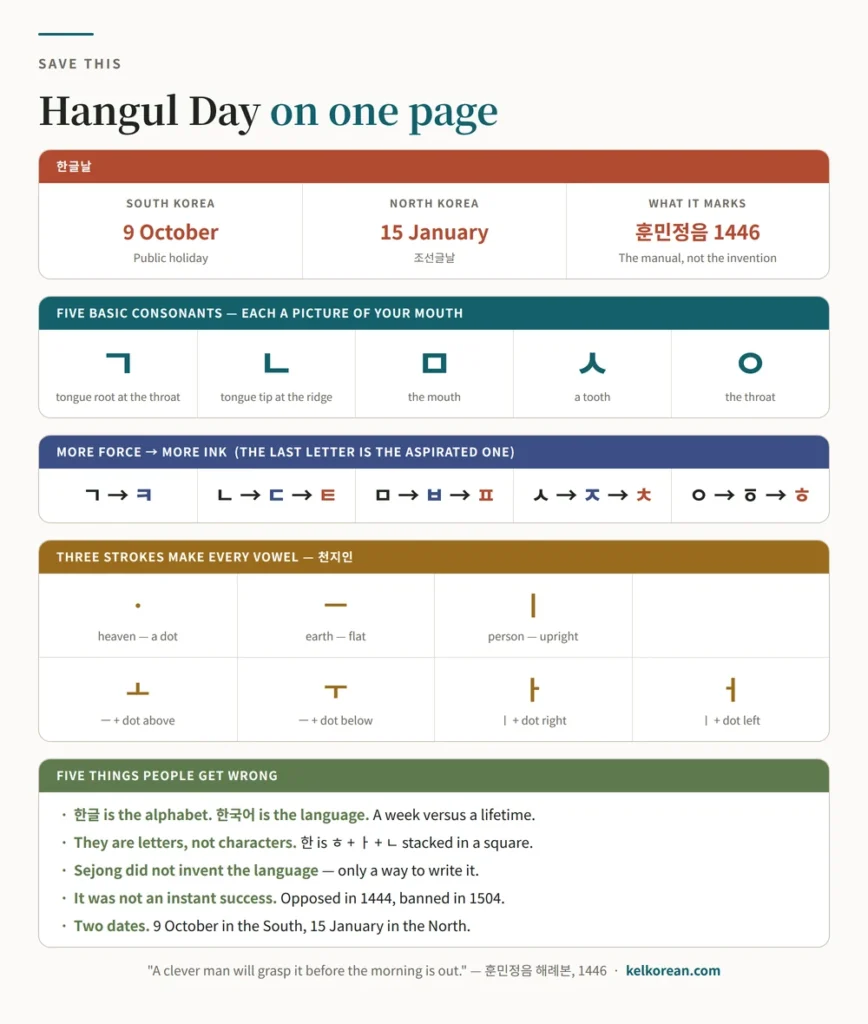
Five Things People Get Wrong
1. Hangul is not the Korean language. This is the big one. 한글 is the alphabet; 한국어 is the language. “I’m learning Hangul” means you are learning to read about thirty letters, which takes a week. “I’m learning Korean” is the other thing — and our beginner’s roadmap lays out what that actually involves.
2. They are not characters. Hangul letters are an alphabet, not a syllabary and not logographs like Chinese. They are simply stacked into syllable blocks — 한 is ㅎ + ㅏ + ㄴ arranged in a square, not one symbol. Our guide to writing your name in Korean shows the stacking in action.
3. Sejong did not invent the Korean language. Korean had existed for as long as there had been Koreans. What it lacked was a script of its own.
4. It was not an instant success. Scholars petitioned against it within a year, a king banned it within sixty, and for four centuries it stayed the second script behind Chinese characters.
5. Hangul Day is 9 October in the South and 15 January in the North. If a source gives you only one date, it is only telling you half the story.
Frequently Asked Questions
When is Hangul Day?
9 October in South Korea, where it is a public holiday. North Korea observes 조선글날 on 15 January. The two dates come from two different milestones — the publication of the 훈민정음 in 1446 and the creation of the alphabet in 1443.
Why does Korea have a holiday for an alphabet?
Because Hangul is the only widely used writing system whose designers left a manual explaining the shape of every letter. The holiday marks the publication of that book, the 훈민정음, in 1446. Korea is not alone in celebrating a script — Bulgaria’s 24 May honours the Slavonic alphabet — but it is alone in being able to celebrate a documented act of design.
Who invented Hangul?
King Sejong the Great, in 1443. The court records credit Sejong personally with the creation, while the scholars of the 집현전 academy wrote the explanatory volume that followed. Some historians argue for more collaborative authorship, but the primary sources name Sejong.
What is the difference between 한글 and 한국어?
한글 is the alphabet — the letters. 한국어 is the Korean language. You can learn 한글 in about a week and still not understand a single sentence, which is exactly what happens to most beginners.
How many letters does Hangul have?
24 today — 14 consonants and 10 vowels. The original 1446 set had 28; four letters were dropped as the sounds they recorded disappeared from the language.
Is Hangul really easy to learn?
The alphabet genuinely is — the 해례본 claimed a slow learner could manage it in ten days, and that has held up. Korean pronunciation and grammar are a separate and much longer project.
Why do Korean letters stack into blocks?
Because the syllable is the unit Korean thinks in. 한 is three letters — ㅎ, ㅏ, ㄴ — written in one square. The alphabet is linear; the presentation is syllabic.
Was Hangul ever banned?
Yes, briefly. King Yeonsangun prohibited its teaching and use in 1504 after anonymous criticism of him circulated in the script, and ordered books annotated in it burned. The ban did not last the year — he was commissioning 언문 translations again within months. It had also been opposed from the start by scholars who thought abandoning Chinese characters would diminish Korea.
Final Thoughts
The thing worth taking from Hangul Day is not that Hangul is the best alphabet in the world. That claim gets made every 9 October and it is not really a claim anyone can settle.
The interesting thing is narrower and stranger: somebody sat down and designed this, on purpose, for people who could not read — and then wrote down their reasoning so clearly that we can still check the work six hundred years later. Almost nothing else in the history of writing can be inspected that way.
And if you have been putting off learning the alphabet — the manual says ten days for a slow learner. It has been right for six centuries.
One last note for the 9th. Hangul Day has no widely established everyday greeting comparable to the familiar wishes exchanged at Chuseok or Seollal. You may see “Happy Hangul Day” in posts or celebratory messages, but there is no set phrase you need to learn. If you want to mark the occasion yourself, try writing your name in Hangul or learning a few letters. It is a small way to take part in the idea behind the day.
Written by Minhyung Cha — 25 years teaching Korean, and 15+ years running an English academy in South Korea. Every example on this site is checked as a native speaker. More about KEL.
Leave a Reply