
The Busan Fireworks Festival is the one night of the year when a whole city walks to the same beach. In 2023 my husband and I went to Gwangalli about half a day before the show to get a good place on the sand. By the time the first rocket went up, there was no space left anywhere to put a foot down. Two years later, in 2025, we watched it from a yacht in the middle of the bay. Both nights were worth it, but they were very different, and the difference was decided weeks in advance.
I live just outside Busan, and this is the guide I would give a friend coming for the festival on Saturday 7 November 2026: what is already fixed, what is not announced yet, where to watch, and how to get in and, more importantly, out again.
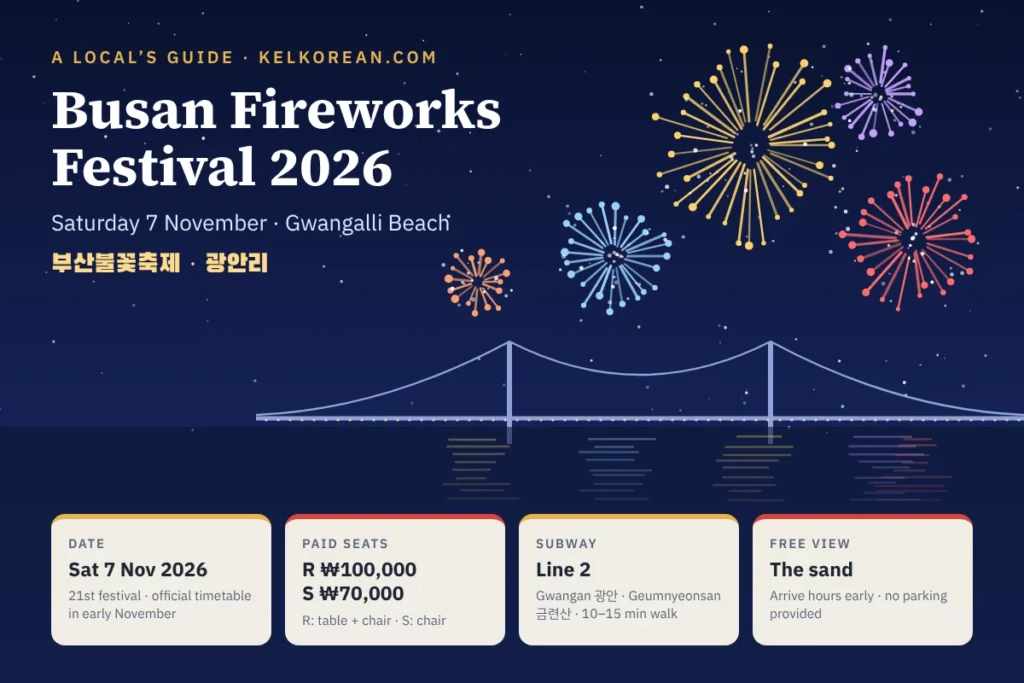
The 2026 Festival in One Table
This is the 21st festival. It began in 2005 to mark the APEC summit held in Busan that year, and it has grown into one of the largest fireworks shows in Korea. The show is launched from barges in the bay and from Gwangan Bridge (광안대교), the long suspension bridge behind every photo of Gwangalli Beach.
| What | 2026 details |
|---|---|
| Date | Saturday 7 November 2026 |
| Official venues | Gwangalli Beach, Igidae and Dongbaek Island |
| Times | Official timetable not out yet (see below) |
| Free viewing | The beach and the waterfront, first come, first served |
| Paid seats | R seat ₩100,000 (table and chair), S seat ₩70,000 (chair) |
| Ticket sales end | 6 November, 5 p.m. (NOL Ticket) |
| Nearest subway | Line 2: Gwangan (광안) and Geumnyeonsan (금련산) |
| Parking | None provided; the organisers ask everyone to use public transport |
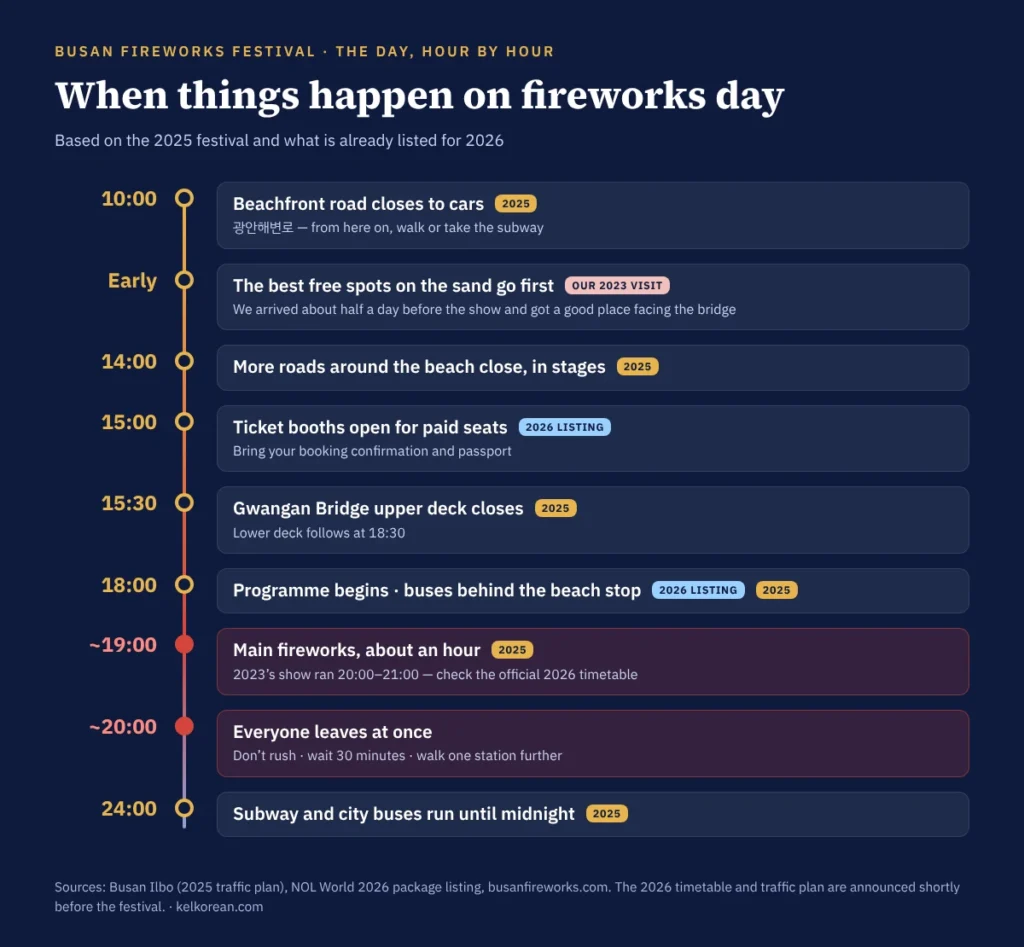
About the times. The organisers post the timetable shortly before the day; in 2025 it went up five days before the festival. Recent years give a good idea, though. In 2025 the opening ceremony began at 6:50 p.m. and the fireworks ran for about an hour from 7 p.m. In 2023 the main show was 8 to 9 p.m. The 2026 package sold to international visitors on NOL World lists a programme from 6 to 8 p.m. Plan around an early-evening show, and check the official site in the first week of November for the exact times.
It is the same week as Pepero Day on 11 November, which also started in Busan, so the convenience stores will be stacked with Pepero while you are in town.
Two Nights, Two Views
2023: on the sand
The free way to watch is the beach itself, and it works if you are willing to spend the day there. We went by subway and arrived about half a day before the show. That was early enough to get one of the best spots on the beach, facing Gwangan Bridge head-on. Over the afternoon the beach filled up behind us until there was literally nowhere to step. Once you have a place, you stay in it, because you will not get it back.
The show itself is extraordinary from the sand: the bridge lights up end to end, and the fireworks fill the whole sky in front of you. The part nobody warns you about is afterwards. Everyone leaves at the same moment and walks to the same few subway stations. We walked to the station inside a crowd so dense that running was impossible, and nobody tried. You move at the speed of the people around you, carefully, all the way to the station. That is not a complaint, just a fact to plan for, and it is the reason the rest of this guide spends so much time on getting out.
2025: from the water
Two years later we booked a yacht. Several operators sail from the marina at Suyeong Bay (수영만), on the Haeundae side of the water, and on festival night they run fireworks trips. Each trip lasts two hours on the water. I booked online about two months ahead, which is not overcautious: fireworks-night trips sell out early.
Seeing the fireworks from the sea was, quite simply, magical. You are facing the bridge with nothing in front of you, the bursts reflect on the water all around the boat, and you never have to fight for your view. It costs far more than a spot on the sand, and you should dress for a November night on open water.
Where to Watch
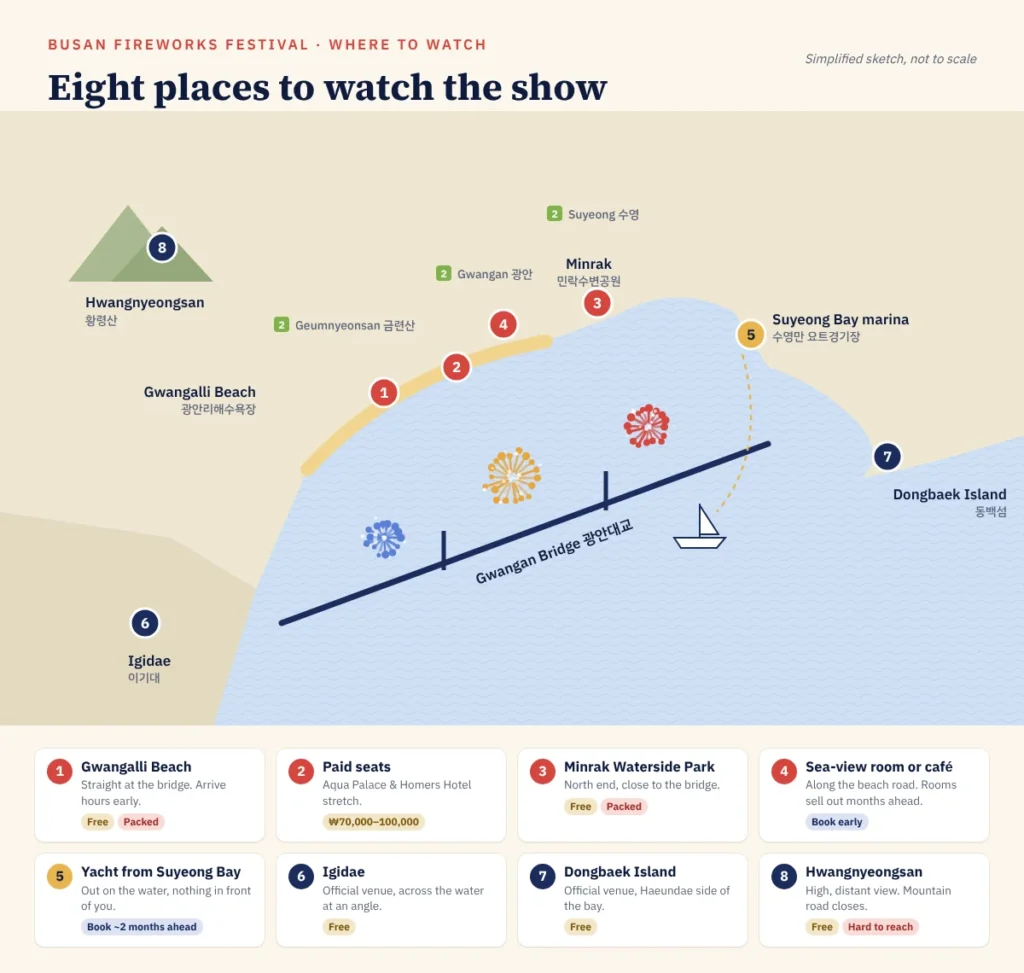
Everything depends on how you feel about crowds and how early you can commit. Roughly from closest to farthest:
- Gwangalli Beach, free. The classic view, straight at the bridge. Costs nothing but time: arrive hours early and plan to stay put.
- Paid seats on the beach. A fenced area of the sand in front of Hotel Aqua Palace and Homers Hotel, in the middle of Gwangalli. You still queue to get in, but you do not have to guard a patch of sand all day.
- Minrak Waterside Park (민락수변공원), at the northern end of the beach. Close to the bridge and just as crowded.
- A sea-view room, café or restaurant along Gwangalli. Rooms facing the bridge sell out months ahead. Some cafés and restaurants sell reserved window seats for the night, usually at a steep price, so ask exactly what is included before you pay.
- A yacht from Suyeong Bay. The best view and the easiest night, at the highest price. Book as early as you can.
- Igidae and Dongbaek Island. The two other official venues, on the far ends of the bay. You see the show across the water at an angle, with fewer people than on the beach.
- Hwangnyeongsan (황령산), the mountain behind the city. A high, distant view of the whole bay. Getting there is the problem: the mountain road is among the roads closed on festival day, and in 2025 the city warned it might close earlier than planned.
Paid Seats: What You Get and How to Buy
Paid seats are called 유료석 (yuryoseok), from 유료, “for a fee,” and 석, “seat.” There are two kinds:
- R seat, ₩100,000: a chair with a table.
- S seat, ₩70,000: a chair only.
Both are in the same area of the beach. The table is the main difference, not a better view. In 2025 there were about 14,000 paid seats in total. Early-bird tickets for 2026 sold out within a minute in August, and the regular sale has been running since 4 September.
Where to buy. Seats are sold on NOL Ticket until 5 p.m. on 6 November, and through the Busan Bank app and branches. The Korean sites may ask for a Korean phone number or payment method, which is where many visitors get stuck. The easier route is NOL World, the international version of the same service, which has listed a 2026 festival package for overseas visitors with ticket pickup by passport. When I checked in mid-October it was not open for booking, so look early and keep the Korean sites as a fallback.
On the day. Tickets are paper, collected at a booth near the seating area. NOL buyers collect at the NOL booth and Busan Bank buyers at the bank’s booth. Bring the booking confirmation and your passport. Busan residents get 10% off this year, but only with ID showing a Busan address, so that discount is not for visitors.
Getting There: Subway and Your Own Two Feet
On festival day the subway and walking are the only sensible options. The streets around Gwangalli close to cars in stages through the day, and taxis simply cannot get close. The 2026 traffic plan has not been published yet, but 2025 shows what to expect:
- 10 a.m. The beachfront road, 광안해변로, closed to vehicles.
- From 2 p.m. More roads around the beach closed, in stages through the afternoon.
- 3:30 p.m. The upper deck of Gwangan Bridge closed to traffic. The lower deck followed at 6:30 p.m.
- 6 p.m. Bus routes along the main road behind the beach were halted.
Gwangan Bridge is normally a motorway; our guide to the best time to visit Busan explains the rare days it closes to cars.
Which station. Take Busan Metro Line 2 to Gwangan (광안역) or Geumnyeonsan (금련산역). Both are about 10 to 15 minutes on foot from the sand on a normal day; on festival day, add time for the crowd. Suyeong (수영역), where Line 2 meets Line 3, is a longer walk but a useful escape route later. Our guide to using the Korean subway covers cards and fares. Load your transit card before you set off, because the ticket machines at Gwangan will have queues.
Trains that do not stop. When stations near the beach get dangerously full, the operator adds empty trains and can have trains pass through a station without stopping. The announcement you will hear is 무정차 통과 (mujeongcha tonggwa), “passing through without stopping.” If that happens at your station, stay on and get off at the next one.
If you were planning to use a taxi, our guide to taking a taxi in Korea is still useful later in the evening, once you are well away from the beach. Near Gwangalli that night, it is not an option.
Getting Out: The Part to Plan Most Carefully
The organisers plan for the crowd seriously. In 2025 the city set a limit of about 200,000 people for the beachfront road and stopped people entering once it was reached, with about 7,000 safety staff on duty. Subways and city buses ran until midnight. For 2023, the organisers had expected more than a million people across the whole festival area. Those numbers are why leaving takes time, whatever you do.
What helps:
- Do not hurry. The crowd sets the pace. Keep children close, follow the barriers and the staff with light sticks, and never push.
- Wait it out. Staying on the sand for half an hour after the finale, or sitting in a café you booked, costs you nothing and lets the first wave clear.
- Walk one station further. Gwangan and Geumnyeonsan take the brunt of it. Walking towards Suyeong, or along the road away from the beach, is often quicker than queuing.
- Agree a meeting point. Phone signal can be poor with that many people in one place. Choose a landmark away from the beach in case you get separated.
What to Bring
- Warm layers. November evenings by the sea are cold, and you will sit still for hours. On a boat, add a windproof jacket.
- Something to sit on. A mat for the sand if you are watching for free.
- Food and water. Convenience stores near the beach have long queues by the afternoon.
- A full battery. You will film more than you expect, and you need your phone for the trip home.
- A plan for the toilet. There are extra portable toilets, but the queues are long. Go before the show starts.
Cards work almost everywhere, as our guide to how to pay in Korea explains. Leave the sparklers at home, though: Busan’s beaches have signs that read 불꽃놀이금지, “no fireworks,” which our guide to Korean signs breaks down. On festival night, the fireworks are left to the professionals.
Korean for Fireworks Night
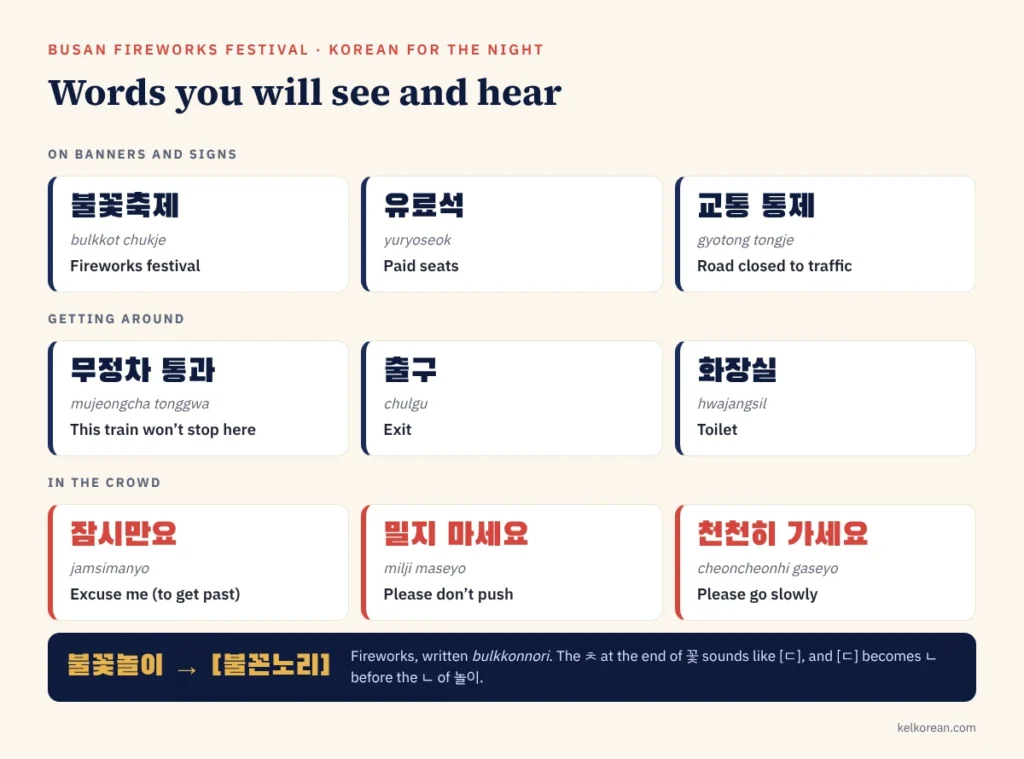
The words you will see on banners and hear in announcements all day:
| Korean | Romanisation | Meaning |
|---|---|---|
| 불꽃축제 | bulkkot chukje | Fireworks festival |
| 불꽃놀이 | bulkkonnori | Fireworks (literally “flame play”) |
| 광안대교 | Gwangan Daegyo | Gwangan Bridge |
| 유료석 | yuryoseok | Paid seats |
| 교통 통제 | gyotong tongje | Traffic control, road closed |
| 무정차 통과 | mujeongcha tonggwa | The train will not stop here |
| 출구 | chulgu | Exit |
| 잠시만요 | jamsimanyo | Excuse me (to get past) |
| 밀지 마세요 | milji maseyo | Please don’t push |
| 천천히 가세요 | cheoncheonhi gaseyo | Please go slowly |
Notice the romanisation of 불꽃놀이: it is written bulkkonnori, not bulkkotnori, because the ㅊ at the end of 꽃 is pronounced as a [ㄷ] sound, and [ㄷ] turns into ㄴ before the ㄴ of 놀이. That change, nasalisation, is one of the rules in our guide to Korean pronunciation. You will hear 천천히 가세요 from staff with megaphones all the way to the station, and 잠시만요 is the polite way to ask people to let you through.
Choose Your View Before You Choose Your Hotel
Everything about this night is decided early: the yacht two months ahead, the room months ahead, the spot on the sand half a day ahead. If you are coming to Busan for 7 November, decide where you want to watch first and build the rest of the trip around it. And when the last burst fades over Gwangan Bridge, take your time leaving. The whole city is going home with you.
Written by Minhyung Cha — 25 years teaching Korean, and 15+ years running an English academy in South Korea. I live and work in Busan, and every example on this site is checked as a native speaker. More about KEL.
Leave a Reply