
Spend a day in Seoul and you will hear one word more than any other: 귀여워.
It is aimed at babies, puppies, phone cases, a friend who just did something slightly clumsy, and a 30-year-old man eating too fast. Cute in Korean is not a narrow compliment — it is a reflex.
But the moment you try to say it back, three problems appear at once. There are two different words for “pretty” and they are not interchangeable. The word for “handsome” looks like it is in the past tense. And every one of these words changes shape before it comes out of your mouth.
None of that is difficult. It is just never explained.
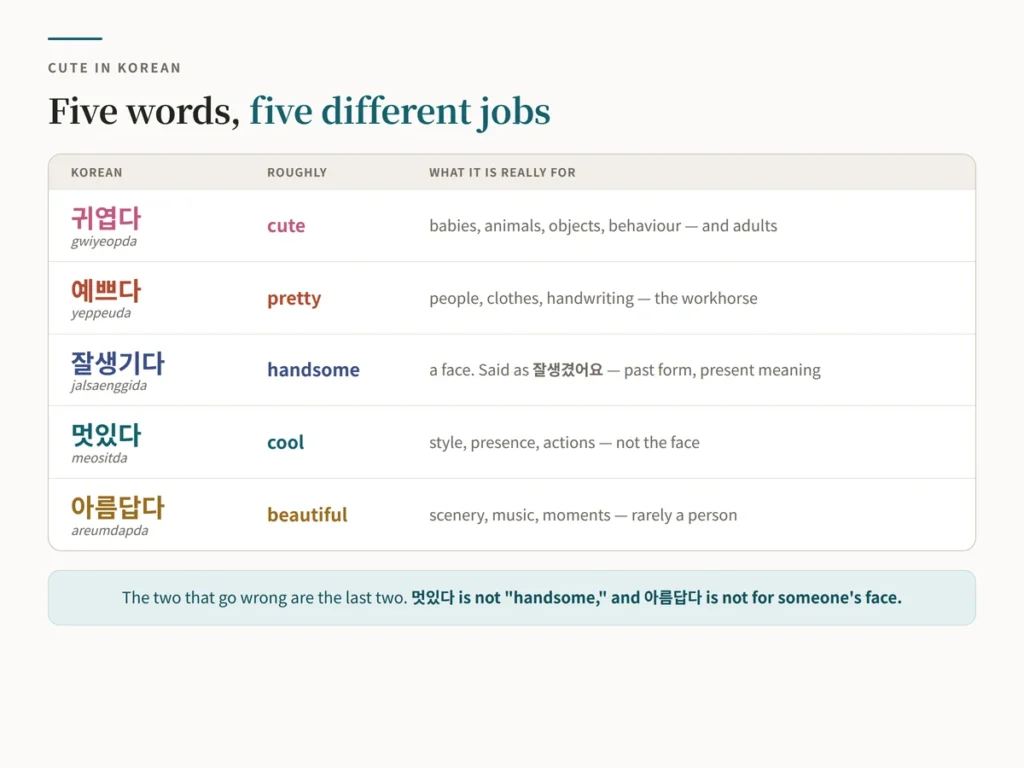
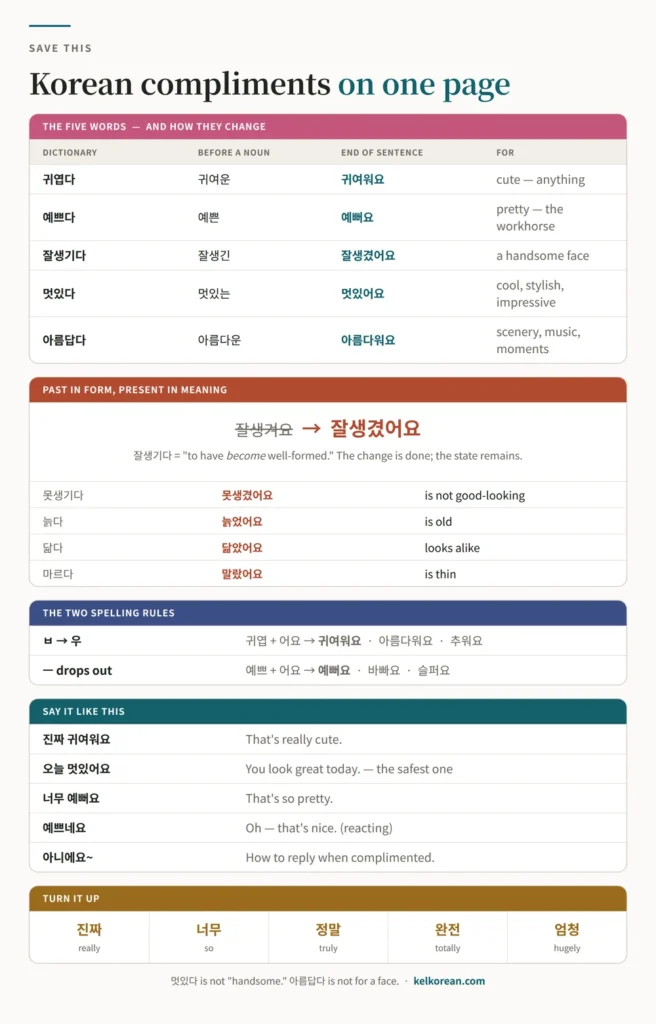
The Five Words
| Korean | Romanization | Roughly | Used for |
|---|---|---|---|
| 귀엽다 | gwiyeopda | cute | babies, animals, people, objects, behaviour |
| 예쁘다 | yeppeuda | pretty | people, clothes, handwriting, almost anything |
| 잘생기다 | jalsaenggida | handsome | a face, usually a man’s |
| 멋있다 | meositda | cool, impressive | a person, an outfit, an action |
| 아름답다 | areumdapda | beautiful | scenery, music, moments — rarely a person |
Those last two are the ones learners get wrong, and both mistakes are the same mistake: assuming the English word maps one-to-one.
귀엽다 — Cuteness Is a Much Bigger Category
In English, calling a grown adult “cute” is a specific kind of remark. In Korean it is not.
귀엽다 covers a baby, a cat, a keyring, a badly drawn doodle, a friend who fell asleep on the subway, and a senior colleague who cannot work the coffee machine. It is warm, extremely common, and mostly harmless.
귀여워요. — It’s cute. / You’re cute. (polite)
귀여워! — Cute! (casual — what you will actually hear)
너무 귀여워요. — So cute.
A caution, though. Said by a younger person to a much older one, 귀엽다 can land as patronising. Aim it downward and sideways, or at things and animals, and you are safe. This is the same social gradient that governs banmal.
Two words you will meet alongside it:
- 귀요미 (gwiyomi) — “a cutie.” A noun, affectionate, slightly playful.
- 애교 (aegyo) — deliberately acting cute. Not the same thing at all. 애교 is a performance — the voice, the pout, the sing-song. Koreans talk about someone “having 애교” (애교가 많다), and it is something you do, not something you are.
예쁘다 vs 아름답다
Both translate as some flavour of “beautiful,” and they are not swappable.
| 예쁘다 | 아름답다 | |
|---|---|---|
| Register | everyday | elevated, literary |
| Say it about | a person, an outfit, a cup, handwriting | scenery, music, a moment, a life |
| Say it to someone’s face | yes, constantly | almost never |
예쁘다 is the workhorse. 예쁜 옷 (pretty clothes), 글씨가 예뻐요 (your handwriting is nice), 오늘 예뻐요 (you look nice today).
아름답다 is what you would find in a song lyric. 아름다운 밤이에요 — “it’s a beautiful night.” Say 아름다우세요 to a woman you have just met and it does not sound like a compliment so much as a line from a period drama.
And 예쁘다 is not only for women. It gets used about men — particularly about a delicate or well-kept look — though 잘생겼다 and 멋있다 are far more common.
⭐ 잘생기다 — The Word That Looks Like the Past Tense
Here is the one that confuses everybody.
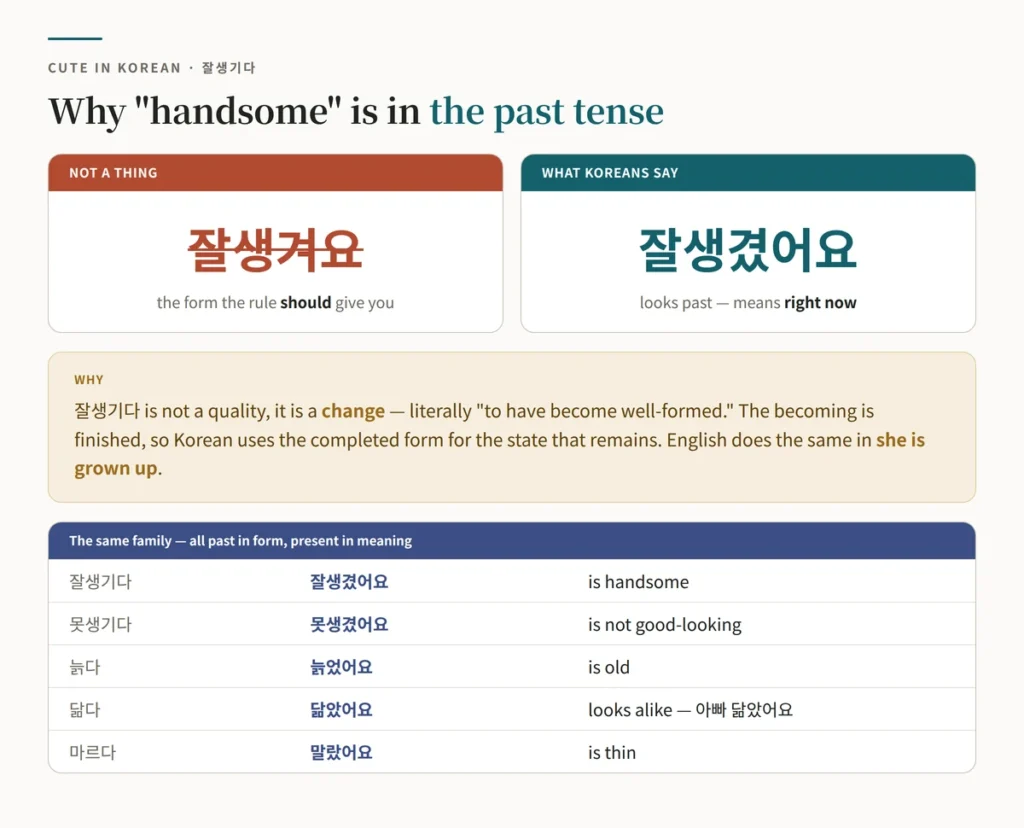
✗ 잘생겨요
✓ 잘생겼어요 — He’s handsome.
That second form is built exactly like a past tense, and it means right now. Every English guide lists 잘생기다 as “to be handsome” and then quietly uses the past form in the examples without saying why.
The reason: 잘생기다 is not a description, it is a change. It literally means “to have become well-formed.” The becoming already happened, so Korean uses the completed form to describe the current state. English does something similar with she is grown up — the growing is over, the state remains.
It is not alone. A small family of Korean verbs behaves this way:
| Dictionary form | You actually say | Meaning |
|---|---|---|
| 잘생기다 | 잘생겼어요 | is handsome |
| 못생기다 | 못생겼어요 | is not good-looking |
| 늙다 | 늙었어요 | is old |
| 닮다 | 닮았어요 | looks alike |
| 마르다 | 말랐어요 | is thin |
닮았어요 is worth memorising on its own — 아빠 닮았어요, “you look like your dad,” is a sentence you will hear in every Korean family gathering, alongside all the terms in Korean family terms.
Before a noun it behaves normally: 잘생긴 남자 — a handsome man.
멋있다 — Not the Same as Handsome
잘생기다 is about a face. 멋있다 is about everything else.
멋있다 means cool, sharp, impressive — and it applies to an outfit, a performance, a decision, a way of carrying yourself. It works for men and women equally.
오늘 진짜 멋있어요. — You look really sharp today.
그 사람 정말 멋있어. — He/she is genuinely cool.
멋지다 (meotjida) is a close cousin — slightly warmer, often used about a thing or a moment. 멋진 밤 — a great night.
The distinction that matters: you can be 멋있다 without being 잘생기다, and Koreans say so out loud. A person who is not conventionally handsome but has presence is 멋있어요, and it is a real compliment, not a consolation prize.
How These Words Change Shape
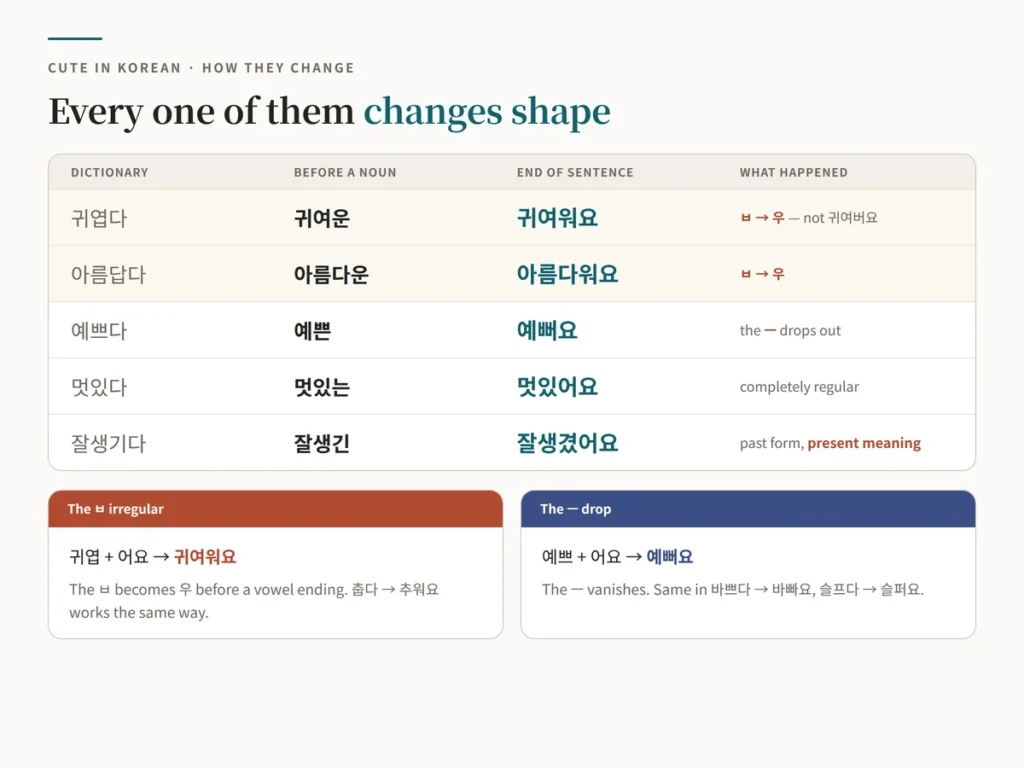
Every word above changes before you use it, and two different rules are at work.
| Dictionary | Before a noun | End of sentence |
|---|---|---|
| 귀엽다 | 귀여운 | 귀여워요 |
| 아름답다 | 아름다운 | 아름다워요 |
| 예쁘다 | 예쁜 | 예뻐요 |
| 멋있다 | 멋있는 | 멋있어요 |
| 잘생기다 | 잘생긴 | 잘생겼어요 |
귀엽다 and 아름답다 are ㅂ irregulars. The ㅂ turns into 우 before an ending — 귀엽 + 어요 becomes 귀여워요, not 귀여버요. The full rule is in Korean verb conjugation.
예쁘다 drops its ㅡ. 예쁘 + 어요 → 예뻐요. The same thing happens to 바쁘다 → 바빠요 and 슬프다 → 슬퍼요.
멋있다 is completely regular — it is literally 멋 (“style”) plus 있다 (“to have”). “To have style.”
Actually Paying Someone a Compliment
Vocabulary is the easy half. Here is the usable half.
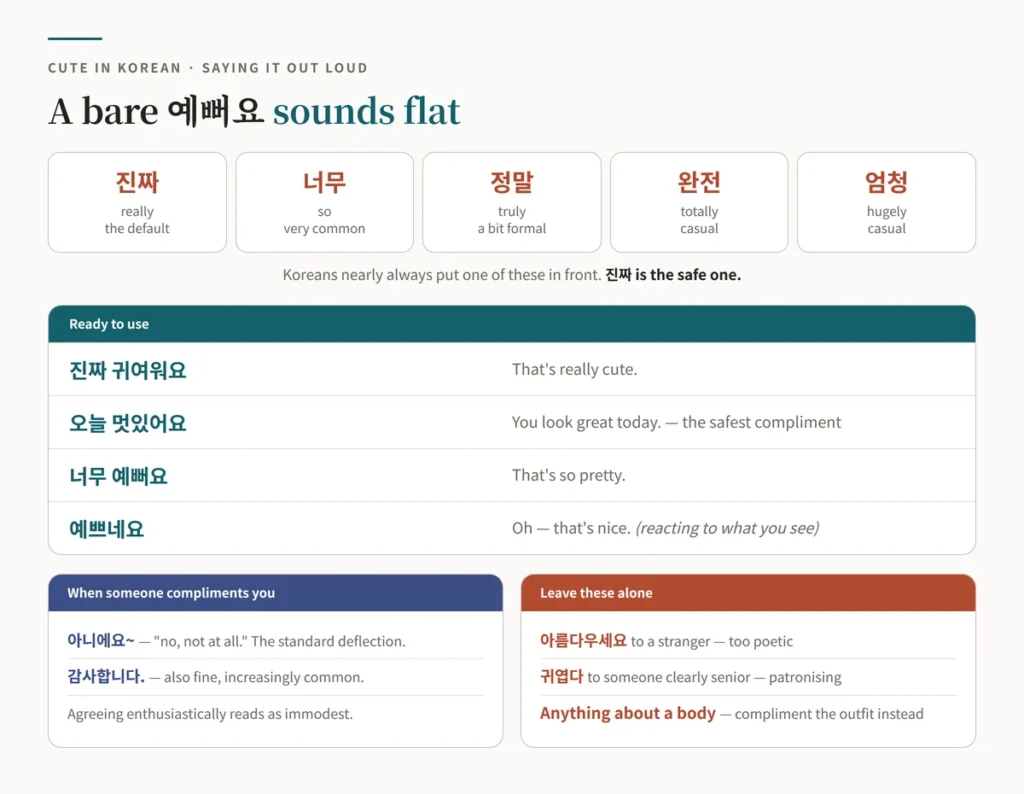
Turn it up with an intensifier. A bare 예뻐요 sounds flat; Koreans almost always add something.
| Korean | Strength |
|---|---|
| 진짜 | really — the everyday default |
| 너무 | so / too much — very common, positive despite the literal meaning |
| 정말 | truly — slightly more formal |
| 완전 | totally — casual, young |
| 엄청 | hugely — casual |
진짜 귀여워요 · 너무 예뻐요 · 완전 멋있어 · 정말 아름다워요
Use -네요 when you are reacting to something in front of you. 예쁘네요 carries “oh — that’s nice,” which plain 예뻐요 does not. It is one of the most useful endings in the language, and it is covered in Korean sentence endings.
And know how to receive one. A Korean compliment is usually deflected, not accepted:
아니에요~ — “No, no.” The standard reply.
감사합니다. — Thank you. Also fine, and increasingly common.
Agreeing enthusiastically with a compliment reads as immodest. A light 아니에요 followed by 감사합니다 is the safe combination, and it fits the same politeness system described in Korean honorifics.
What Not to Say
Comments on appearance are more freely exchanged in Korea than in most English-speaking countries. Remarks about weight, skin and whether someone looks tired are common among friends and family, and 살 빠졌어요? — “have you lost weight?” — is usually meant warmly.
That does not make it safe for you to say. Coming from someone who is not close, the same sentence can land badly, and it lands worse across cultures. Compliment the outfit, the haircut, the effort — not the body.
Two more to avoid:
- 아름다우세요 to a stranger. Too poetic. It sounds like a script.
- 귀엽다 to someone clearly senior to you. Warm downward, awkward upward.
The safest compliment in Korean is not about a face at all: 오늘 멋있어요 — “you look great today.”
The K-Pop Vocabulary
If you arrived at Korean through music or drama, these are the words in the comment sections.
| Korean | Meaning |
|---|---|
| 비주얼 | “visual” — the best-looking member of a group |
| 훈남 | a warm, wholesome-looking guy |
| 심쿵 | heart-thump — when something is too cute to handle |
| 얼짱 | “best face” — a 2000s word, now dated |
| 미모 | good looks, as a noun — 미모가 대단해요 |
비주얼 is a borrowed English word doing a job English never gave it, which is the whole subject of Konglish. 심쿵 belongs to the abbreviation family in Korean texting slang, and the rest turn up constantly in K-pop Korean.
5 Mistakes Worth Avoiding
1. 잘생겨요. It has to be 잘생겼어요. The past form is the present meaning.
2. 귀여버요. 귀엽다 is a ㅂ irregular — 귀여워요.
3. Using 아름답다 about a person you have just met. Use 예쁘다.
4. Assuming 멋있다 means handsome. It means cool, and it applies to what someone does as much as how they look.
5. Firmly agreeing when complimented. 아니에요 first. Then 감사합니다.
Frequently Asked Questions
How do you say cute in Korean?
귀엽다 is the dictionary form; what you actually say is 귀여워요 (polite) or 귀여워 (casual). It applies far more widely than English “cute” — to animals, objects, behaviour and adults alike.
What is the difference between 예쁘다 and 아름답다?
예쁘다 is everyday “pretty” and works for people and things. 아름답다 is elevated and literary, used for scenery, music and moments rather than for the person standing in front of you.
Why is it 잘생겼어요 and not 잘생겨요?
Because 잘생기다 describes a completed change — “to have become well-formed” — so the completed form expresses the present state. 못생기다, 늙다, 닮다 and 마르다 all behave the same way.
What is the difference between 잘생기다 and 멋있다?
잘생기다 is about the face. 멋있다 means cool or impressive and covers style, actions and presence. Someone can be 멋있다 without being 잘생기다, and that is a genuine compliment.
Can you call a man 예쁘다?
Yes, and it happens — usually about a delicate or very well-kept look. 잘생겼어요 and 멋있어요 are the more common choices.
What does 애교 mean?
Acting cute on purpose — the voice, the expressions, the exaggerated charm. It is a behaviour, not an appearance, and Koreans describe someone as having a lot of it: 애교가 많아요.
How do I reply when a Korean compliments me?
아니에요 (“no, not at all”) is the standard deflection, and 감사합니다 is perfectly acceptable too. Enthusiastically agreeing sounds immodest.
What does 심쿵 mean?
심장 (heart) + 쿵 (thud) — the jolt you feel when something is unbearably cute or attractive. Internet slang, extremely common in fan comments.
Final Thoughts
Cute in Korean is a bigger, warmer, more frequently used idea than its English translation, and it is the word you will end up saying most.
The rest sorts into a short list. 예쁘다 for everyday pretty. 아름답다 for the poetic kind. 잘생겼어요 for a handsome face — past tense, present meaning. 멋있다 for everything cool that is not a face.
Add 진짜 in front of any of them and you sound like someone who has actually spoken to Koreans.
Written by Minhyung Cha — 25 years teaching Korean, and 15+ years running an English academy in South Korea. Every example on this site is checked as a native speaker. More about KEL.
Leave a Reply