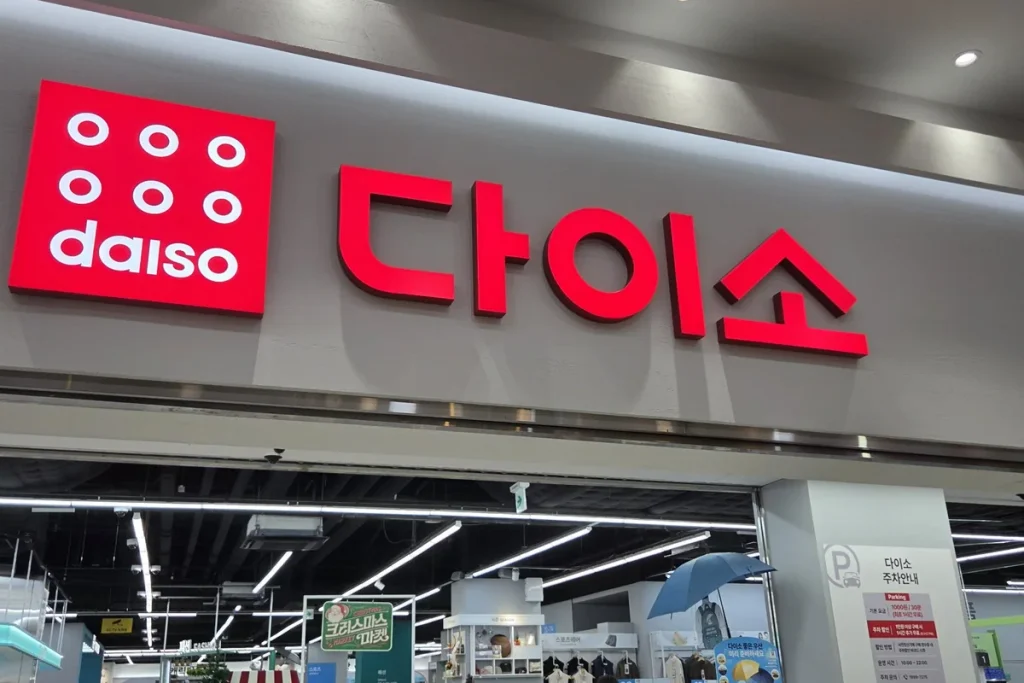
Daiso Korea is where Koreans go when they need something small and do not want to think about the price. Batteries, a notebook, a hair clip, warm socks, a lip tint, a treat for the dog: it is all under one roof, and nothing costs more than 5,000 won. I have shopped there for years, and it is the shop I would send a visitor to before any souvenir street.
On 14 November 2026 I went with my husband to a large branch, 다이소 양산증산점 (Daiso Yangsan Jeungsan) in Yangsan, just north of Busan, and I took photos as we walked round. This guide uses them to show you how a Korean Daiso is laid out, how the prices work, what is worth buying, what happens at the checkout, and the Korean to use on the way.
Is Daiso in Korea Japanese?
Many visitors assume so, because Japan has a Daiso too. The Korean one is a separate company called 아성다이소 (Aseong Daiso). Its founder opened his first fixed-price shop in Seoul in 1997. In 2001 the Japanese Daiso invested in the business and the shops took the Daiso name. In December 2023 the Korean side bought back the whole Japanese stake, about 34 percent, so today it is a fully Korean-owned company with its own products and its own prices.
Koreans enjoy the name for another reason. 다 있소 (da itso) is an old-fashioned way of saying “we have everything,” and it sounds almost the same as 다이소. People really do say it as a joke when the thing they need turns out to be there.
The company calls itself a 균일가 (gyunilga) shop, a “uniform price” shop. By 2025 it had about 1,600 branches across the country and sales of around 4.5 trillion won a year, and the newest branches are getting bigger. Many of the largest sit inside supermarkets and shopping centres, which is where mine was.
The Six Prices
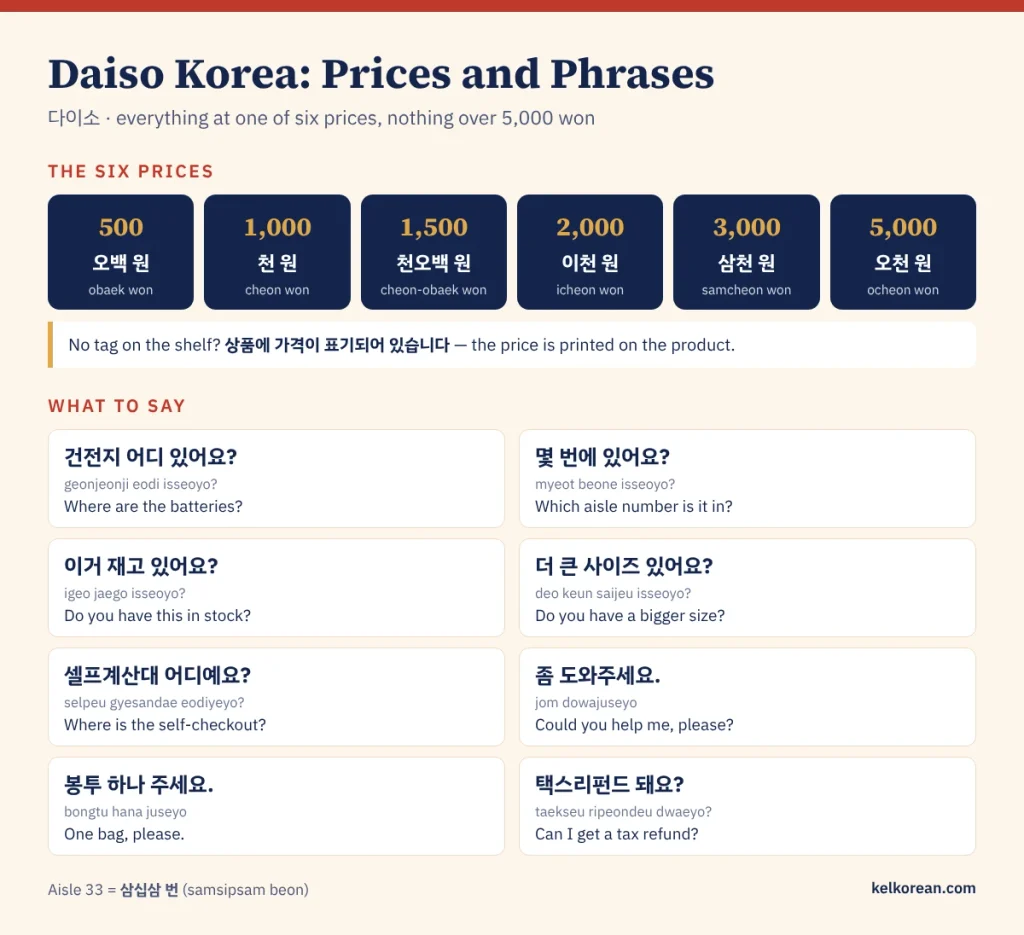
Everything in a Korean Daiso is sold at one of six prices, and the top one is 5,000 won. The company has kept this system since its first shop. According to Korean press reports, items at 1,000 and 2,000 won make up about 80 percent of the range.
| Price | Korean | Romanisation |
|---|---|---|
| 500 | 오백 원 | obaek won |
| 1,000 | 천 원 | cheon won |
| 1,500 | 천오백 원 | cheon-obaek won |
| 2,000 | 이천 원 | icheon won |
| 3,000 | 삼천 원 | samcheon won |
| 5,000 | 오천 원 | ocheon won |
Notice that 1,000 is simply 천 원, not “one thousand.” Korean leaves out the “one.” Our guide to Korean numbers explains why prices always use this set of numbers.
Here is the part that confuses first-time visitors. Many shelves have no price tag. In my branch there were small signs on the shelves saying 가격 확인: 상품에 가격이 표기되어 있습니다, “Price check: the price is marked on the product.” So turn the item over and look for a small ₩ mark with the number printed on the packaging itself. That number is the price.
My Visit: About 40,000 Won of Small Things
My branch is in the basement of a shopping centre, next to a Hanaro Mart supermarket and across the road from Jeungsan Station on Busan Metro Line 2. It opened in autumn 2025. The Christmas shelves were already up at the entrance in mid-November.
We bought a lot of small things. These are the ones I remember.
| Korean | Romanisation | Meaning |
|---|---|---|
| 헤드셋 | hedeuset | A headset |
| 방한 잠옷 | banghan jamot | Warm winter pyjamas |
| 수면양말 | sumyeon yangmal | Fluffy “sleep socks” |
| 건전지 | geonjeonji | Batteries |
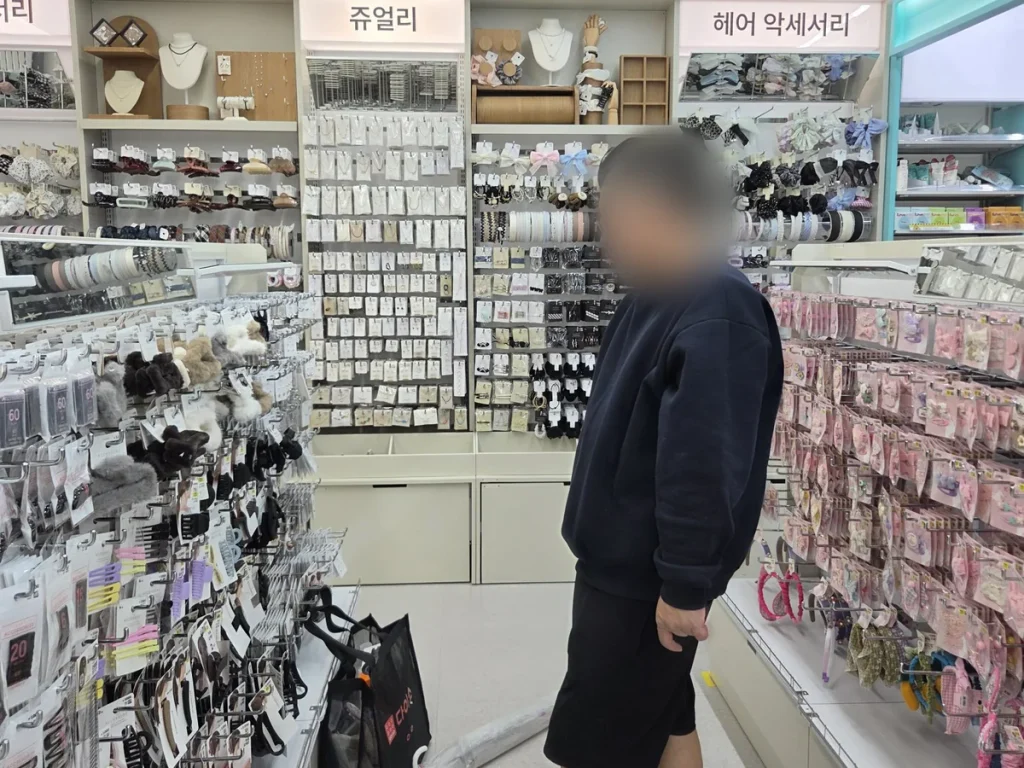
| 머리핀 | meoripin | Hair clips |
The total came to about 40,000 won. That is the honest warning about Daiso: no single item is expensive, so you keep putting things in the basket, and the small numbers add up. Forty thousand won is still a modest bill for a headset, winter nightwear for the house and a bag full of everyday bits.
How to Read the Store
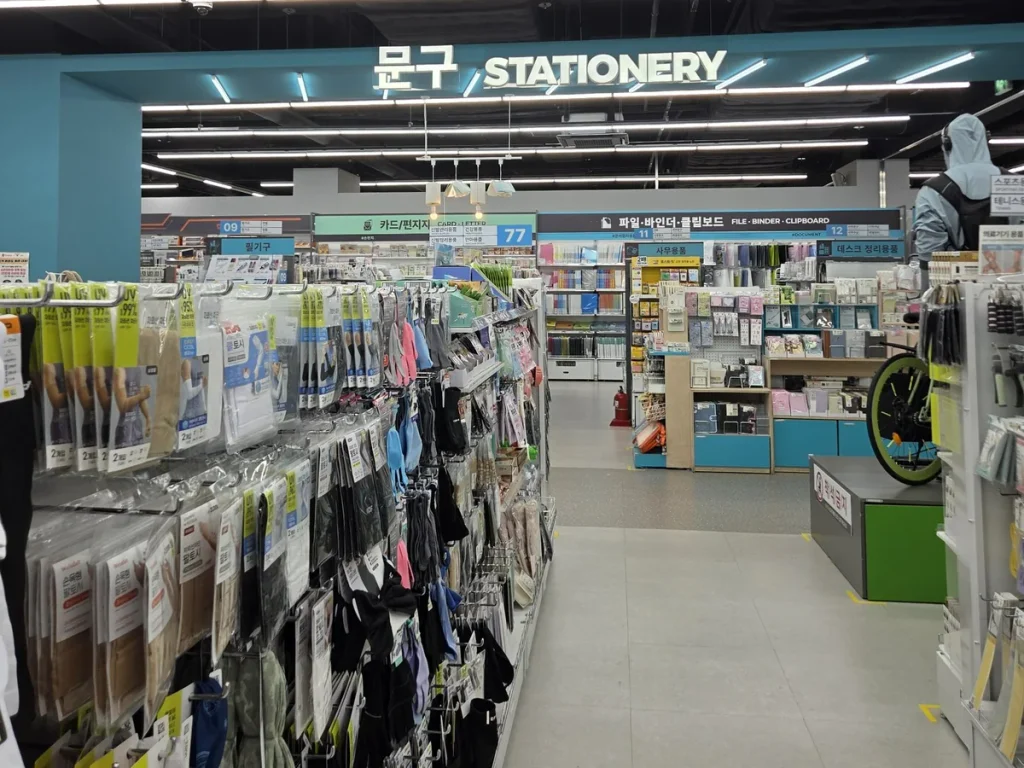
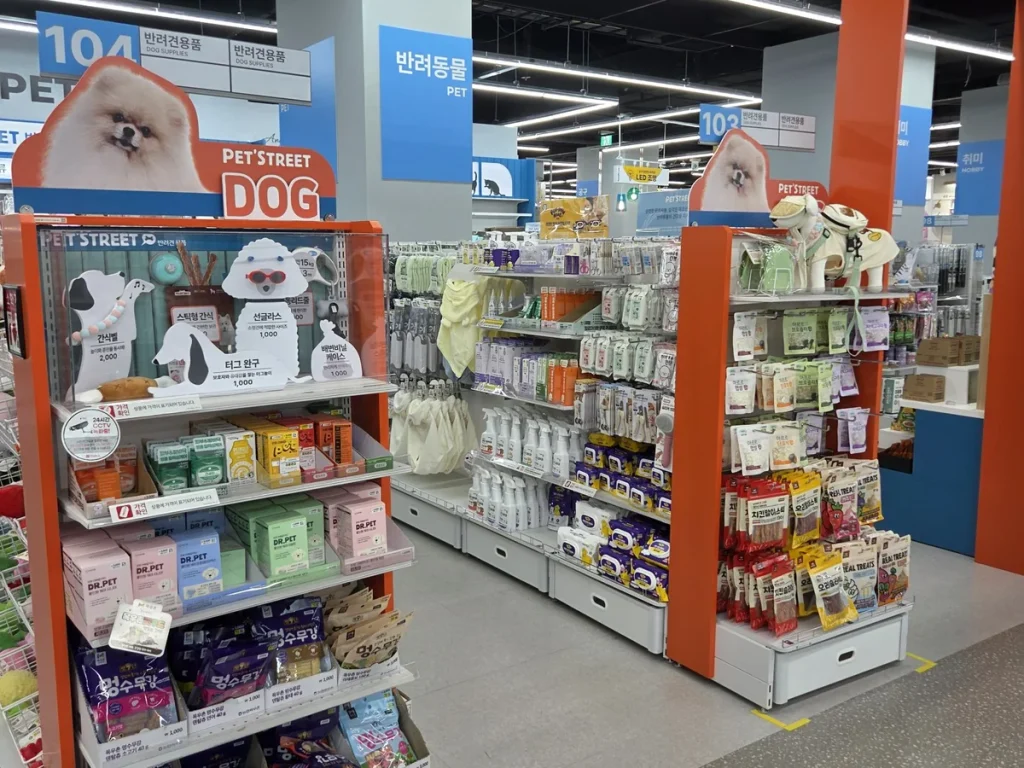
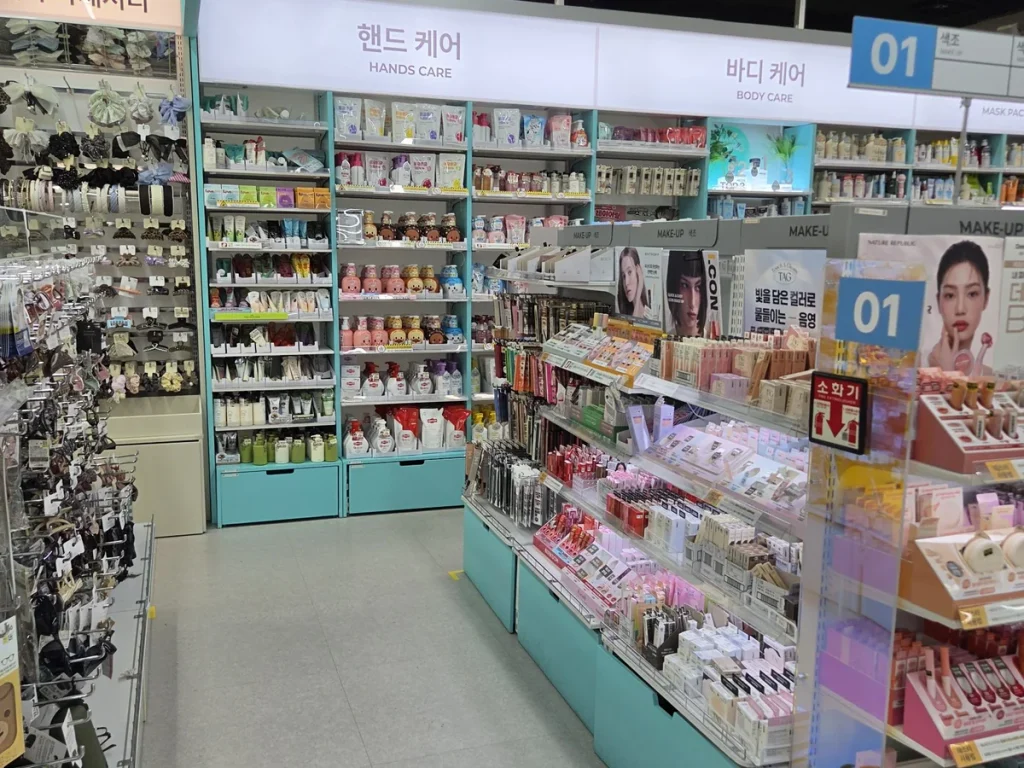
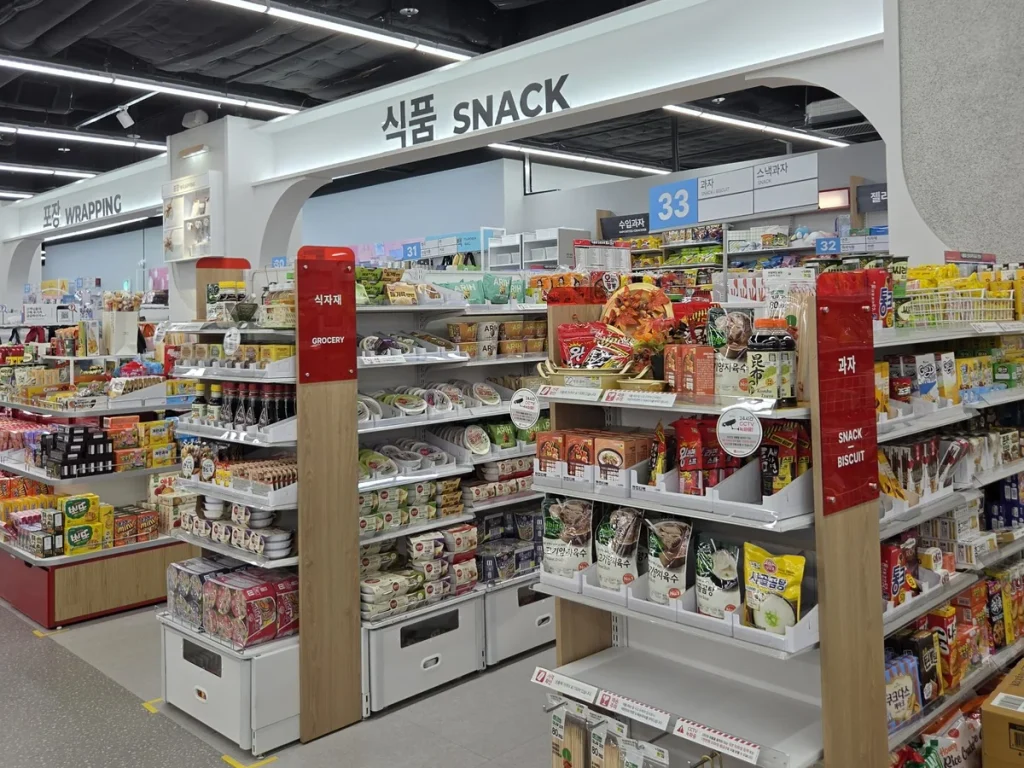
A large Daiso is divided into sections, and each one has a big sign overhead in Korean, usually with English beside it. Smaller blue signs carry an aisle number and the two or three things on that aisle. In my photos, aisle 01 is make-up, 33 is snacks, 41 to 48 are kitchen goods and 103 and 104 are dog supplies. If you ask a member of staff where something is, the answer is often just a number.
| Korean | Romanisation | Meaning |
|---|---|---|
| 화장품 | hwajangpum | Cosmetics (the sign also says BEAUTY) |
| 문구 | mun-gu | Stationery |
| 식품 | sikpum | Food and snacks |
| 주방 | jubang | Kitchen |
| 수납 | sunap | Storage boxes and organisers |
| 패션 | paesyeon | Clothes, socks, bags and hats |
| 반려동물 | ballyeodongmul | Pets |
| 여행코너 | yeohaeng koneo | Travel corner |
| 캠핑코너 | kaemping koneo | Camping corner |
| 포장 | pojang | Gift wrapping |
| 취미 | chwimi | Hobbies and crafts |
| 건강기능식품 | geongang gineung sikpum | Health supplements |
Several of these are English words in Korean spelling: 패션 is “fashion,” 캠핑 is “camping,” and 코너 is “corner,” which Korean shops use for a section. If you like spotting them, our guide to Konglish has many more, and reading Korean signs covers the signs outside the shop.
Three small labels on the shelves are worth knowing. 베스트 (beseuteu, BEST) marks a good seller. 신상품 (sinsangpum) means a new product. And 다이소 추천템 (chucheontem) means “Daiso’s recommended items,” where 템 is a short, casual form of 아이템, “item.”
What to Buy at Daiso
These are the things I buy there again and again, and I would point a visitor to the same shelves, with one addition at the end.
방한용품: Things That Keep You Warm
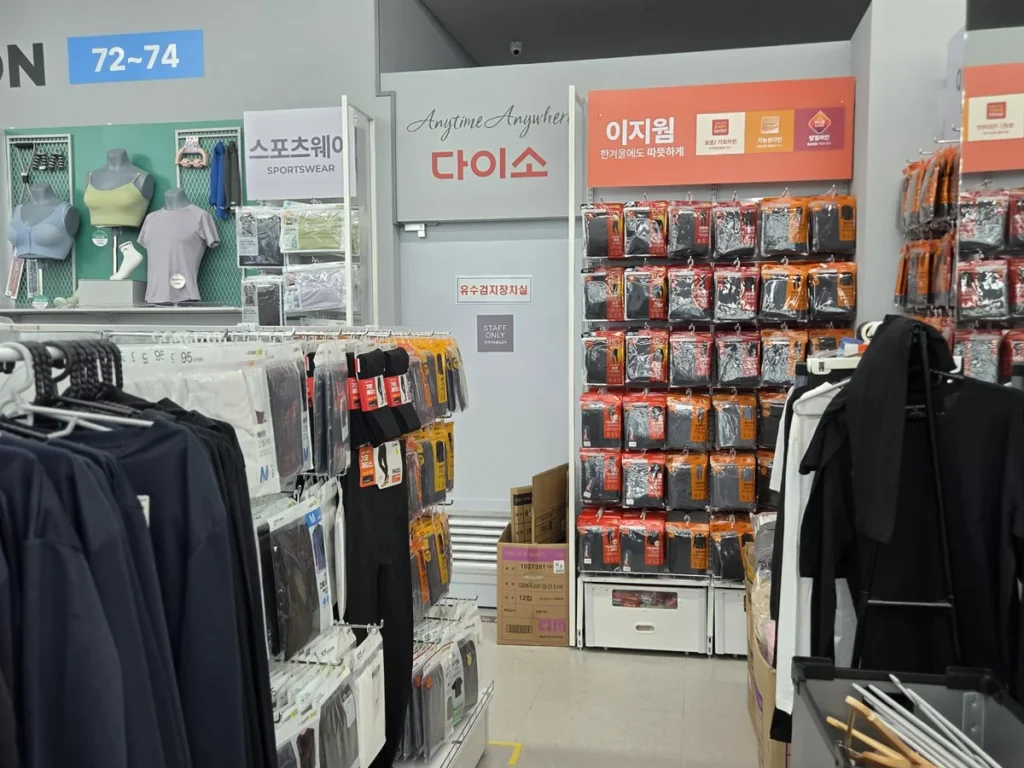
방한용품 (banghan yongpum) are goods for keeping out the cold. In November the fashion section had a whole wall of 이지웜 (Easy Warm), Daiso’s own thermal underwear, under the line 한겨울에도 따뜻하게, “warm even in midwinter.” The packs in my photo are marked 3,000 and 5,000 won. Sizes follow the Korean system, with numbers such as 90, 95 and 100, and the word 여성용 (yeoseongyong, for women) or 남성용 (namseongyong, for men). Nearby you will find 수면양말, gloves, scarves and hand warmers. If you are visiting in the cold months, our guide to winter in Korea explains what Koreans wear and why.
학용품: Stationery
학용품 (hagyongpum) means school supplies, and the 문구 section is one of the biggest in the store: pens, notebooks, files, stickers, cards and letter paper. I buy school supplies here regularly. For a visitor, Korean notebooks and sticker sheets are light, flat and easy to take home.
소모품: Everyday Things That Run Out
소모품 (somopum) are consumables, the things you use up: batteries, tape, wet wipes, sponges, zip bags. Travellers often need exactly these. A phone cable, a travel bottle, a luggage tag or an umbrella on a wet day is a Daiso purchase, and the 여행코너 puts the travel items in one place.
애견용품: For the Dog
I have two toy poodles, so I never skip the pet section. The sign says 반려동물, and the dog aisles are labelled 반려견용품 (ballyeogyeon yongpum); in everyday speech people also say 애견용품 (aegyeon yongpum). There are treats, toys, poop bags, grooming wipes and small clothes. In my photo the display cards show toys and accessories at 1,000 and 2,000 won.
화장품: The One I Would Add for Visitors
Cosmetics are the big Daiso story of the last few years. Well-known Korean beauty companies now make lines only for Daiso, in smaller sizes, so that every product fits under the 5,000-won ceiling. In August 2026 the company opened its first beauty-only branch, near Konkuk University in Seoul, with around 1,800 beauty products.
The shelves are sorted by use: 색조 (saekjo, colour make-up), 스킨케어, 마스크팩 (sheet masks), 핸드 케어 and so on. At the make-up table there was a notice about testers: 테스터는 얼굴이 아닌 손등에 사용해주세요, “please use testers on the back of your hand, not on your face.” 손등 (sondeung) is the back of the hand. For reading the words on Korean skincare and choosing between products, our guide to shopping at Olive Young goes into detail, and the same vocabulary works here.
One more shelf deserves a look before you leave: 식품. Korean snacks, instant noodles, tea and sweets are sold at the same fixed prices, and they make easy gifts.
At the Checkout
Take a red basket at the entrance. At my branch a notice at the door asked shoppers to use the store’s baskets while shopping rather than their own bags, and a line on the floor said the supermarket’s trolleys may not come in.
Most of the paying at a big Daiso is done at a 셀프계산대 (selpeu gyesandae), a self-checkout. 계산 is “paying the bill” and 대 is a stand or counter. You scan each barcode yourself and pay at the machine. When we were ready, every self-checkout was taken, so a member of staff called us over and rang everything up at a separate desk. If the machines look confusing or the queue is long, it is perfectly normal to ask for help.
- Bags. A bag is not included. We bought one. The word is 봉투 (bongtu), and you will be asked 봉투 필요하세요?, “do you need a bag?” If you carry a tote, say 아니요, 괜찮아요.
- Paying. Cards are the normal way to pay in Korea. Our guide to paying in Korea explains where overseas cards work smoothly and where they do not.
- Tax refund. Daiso offers tax refunds for foreign visitors only at selected branches. I did not ask at mine, which is a neighbourhood store. Ask before you pay, and have your passport with you.
Korean for Daiso
You can shop at Daiso without saying a word. These sentences are for the moments when you cannot find something, or when someone asks you a question at the till.
| Korean | Romanisation | Meaning |
|---|---|---|
| 건전지 어디 있어요? | geonjeonji eodi isseoyo? | Where are the batteries? |
| 몇 번에 있어요? | myeot beone isseoyo? | Which aisle number is it in? |
| 이거 재고 있어요? | igeo jaego isseoyo? | Do you have this in stock? |
| 더 큰 사이즈 있어요? | deo keun saijeu isseoyo? | Do you have a bigger size? |
| 테스터 써 봐도 돼요? | teseuteo sseo bwado dwaeyo? | May I try the tester? |
| 셀프계산대 어디예요? | selpeu gyesandae eodiyeyo? | Where is the self-checkout? |
| 좀 도와주세요. | jom dowajuseyo | Could you help me, please? |
| 봉투 하나 주세요. | bongtu hana juseyo | One bag, please. |
| 택스리펀드 돼요? | taekseu ripeondeu dwaeyo? | Can I get a tax refund? |
Aisle numbers are said with the same numbers as prices, followed by 번 (beon), “number.” So aisle 33 is 삼십삼 번 (samsipsam beon), and the answer to your question may be just 삼십삼 번이요. For what the cashier says back and how to answer, see shopping in Korean.
Before You Go
- Finding one. Type 다이소 into a Korean map app and one will be within walking distance in almost any town. The branch name ends in 점 (jeom), “branch,” as in 양산증산점.
- Size matters. A small station branch carries the basics. For clothes, a full beauty section and seasonal displays, choose a large one. The Myeong-dong branch in Seoul fills twelve floors.
- Hours. Mine is open from 10:00 to 22:00. Hours differ by branch, so check the map listing.
- Popular items sell out. Beauty products that go viral can vanish from the shelf quickly. If you want one in particular, ask 이거 재고 있어요? and try another branch.
- Seasons change the front of the store. In mid-November mine had a 크리스마스 마켓 at the entrance with trees, cards and ornaments. Our guide to Christmas in Korea explains how the day is spent here.
다 있소: It Really Is All There
Daiso is not a tourist attraction, and that is why I recommend it. It shows you what Korean homes are actually full of: the socks people sleep in, the boxes they tidy with, the snacks in the cupboard and the little things they buy for their dogs. Take a basket, check the number printed on each packet, and stop when the basket feels heavy. Mine was about 40,000 won heavy, and I regret none of it.
Written by Minhyung Cha — 25 years teaching Korean, and 15+ years running an English academy in South Korea. I live and work in Busan, and every example on this site is checked as a native speaker. More about KEL.
Leave a Reply