Christmas in Korea looks familiar at first: trees in every shopping street, carols in every café, Santa hats on shop staff and a public holiday on 25 December. Spend one December here, though, and the differences show. Korean Christmas is not mainly a family holiday. It is a night out, a date, a cake you had to reserve weeks ahead, and a city full of lights that everyone wants a photo with.
I have celebrated Christmas here in every way Koreans do: out with friends before I married, running Christmas events for a whole English academy as a teacher, and now mostly at home as a married Busan resident. This guide explains how Koreans actually celebrate, what the Christmas cake is all about, where to see the lights in Busan, and the Korean you need to say “Merry Christmas” properly.
A Public Holiday in a Mostly Non-Christian Country
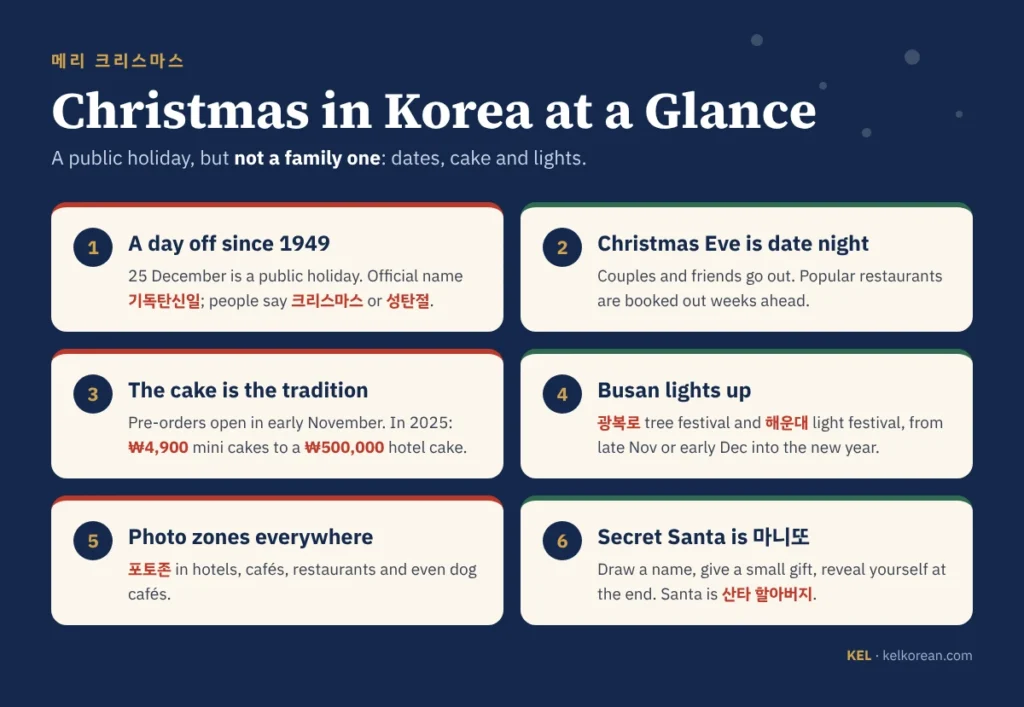
Korea is one of the few countries in East Asia where Christmas is a public holiday. In Japan and China, 25 December is an ordinary working day. In Korea, it has been a day off since 1949, when a presidential decree on public holidays listed it as 기독탄신일 (gidok tansinil), “the birthday of Christ.” That is still the official name on the calendar, but nobody says it in conversation. People say 크리스마스 (keuriseumaseu) or, a little more formally, 성탄절 (seongtanjeol).
Religion is part of the story, but only part. In the 2015 census, about 28 percent of Koreans said they were Christian, Protestant or Catholic, and for them Christmas Eve and Christmas morning mean church. Churches put up lights, choirs rehearse for weeks, and midnight Mass draws big congregations. For everyone else, Christmas is a secular winter festival, and it has been for a long time. For decades after the war, Korea had a night-time curfew, and Christmas Eve was one of the very few nights it was lifted. Young people poured into the streets, and Christmas Eve became the night to be out.
That history still shapes the day. Korea’s big family holidays are Seollal, the Lunar New Year, and Chuseok, when people travel home, cook together and honour their ancestors. Christmas has none of that weight. There is no traditional Christmas dinner, no turkey and no family obligation, which leaves the day free for whoever you most want to spend it with.
A Holiday for Couples, Friends and Families
Couples and friends: dinner and a night out
Ask a Korean in their twenties what Christmas is for and the answer will be a date. Christmas Eve is the busiest night of the year for restaurants, and popular places are fully booked weeks in advance. Couples exchange gifts, take photos in front of the biggest tree they can find, and go to a film or a concert. Single people joke about spending a “solo Christmas,” and plenty of them simply go out with friends instead.
That was exactly how I spent Christmas before I married. I went out with friends, or with the man who is now my husband, for dinner and then a performance. If you are in a new relationship in Korea, expect Christmas to matter, and if you want the vocabulary for it, our guide to saying I love you in Korean has the words Korean couples actually use.
Married life: a quieter Christmas at home
Since I married, most of our Christmases have been at home. That is common. Once the dating years are over, many Korean couples happily skip the crowds and the fully booked restaurants. Every so often we make an exception. One year my husband and I spent Christmas on Jeju Island, and the hotel had set up a Christmas photo zone with a tree, a white mantelpiece and a little tent.
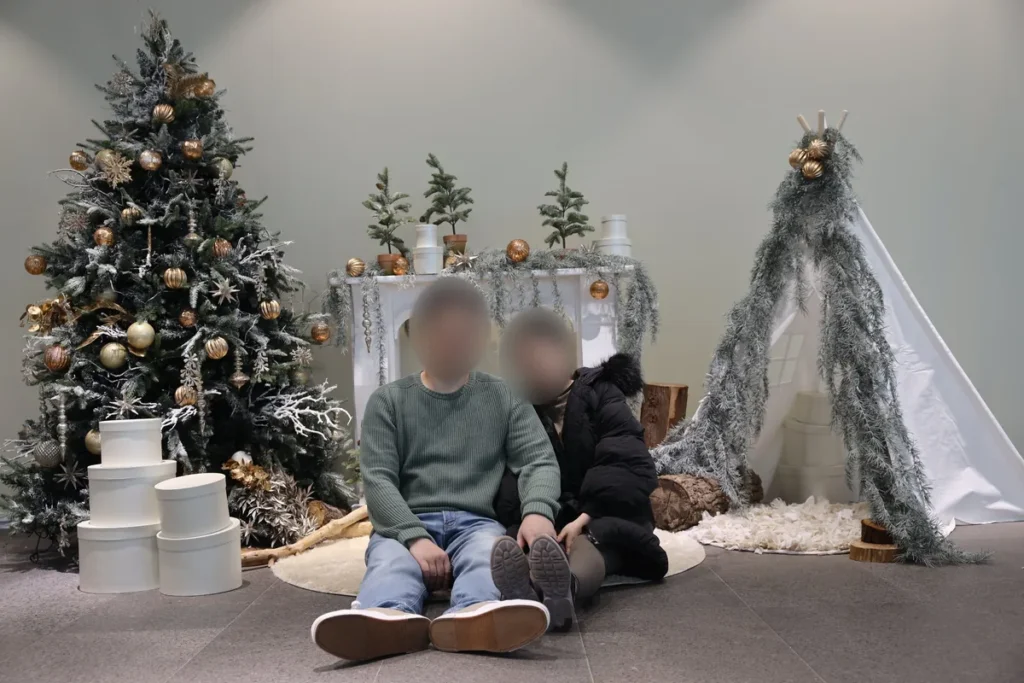
Photo zones, 포토존 (potojon), are everywhere in December. Hotels, department stores, cafés and restaurants all build one, and taking a picture in front of each is half the fun of going out.
Families: eating out, and Santa at kindergarten
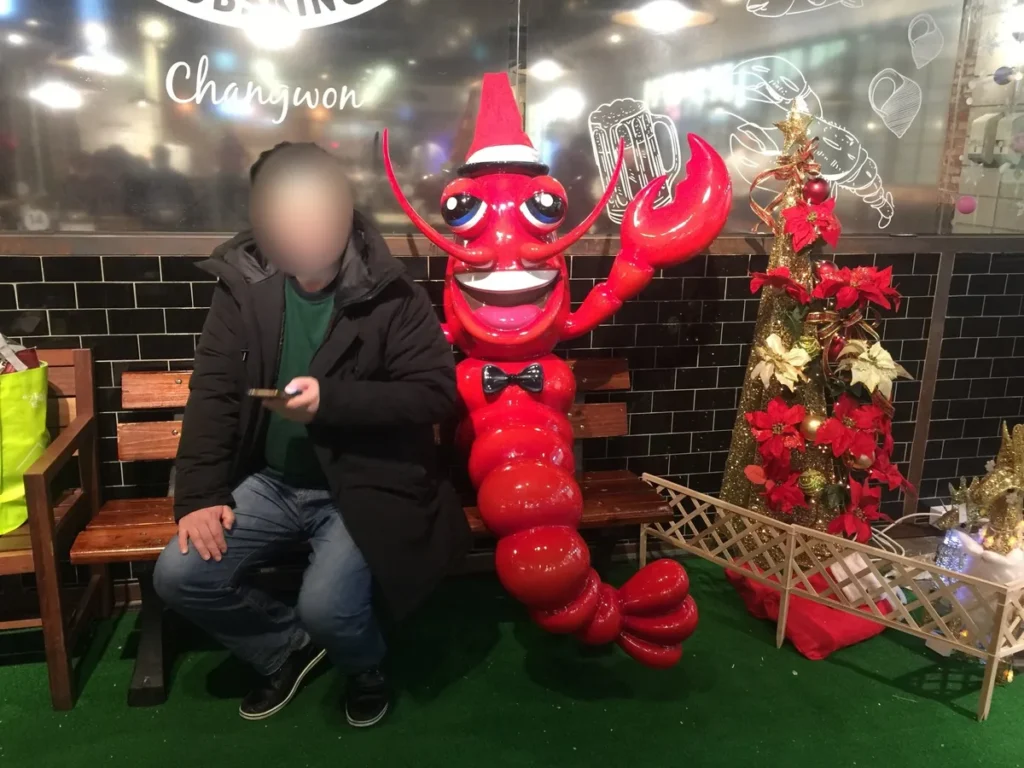
Families celebrate too, just not with a big meal at home. Eating out is the usual choice. My husband and I once went out for a lobster dinner with my parents, and the restaurant had gone all in, right down to a giant red lobster statue wearing a Santa hat at the door.
For small children, Christmas is about 산타 할아버지 (santa harabeoji), literally “Grandpa Santa.” Many kindergartens hold a Christmas party where Santa visits and hands each child a present, and the presents are wrapped and quietly dropped off by the parents beforehand. Children are also told that Santa does not bring presents to children who cry, a line every Korean knows from the Korean version of “Santa Claus Is Coming to Town.”
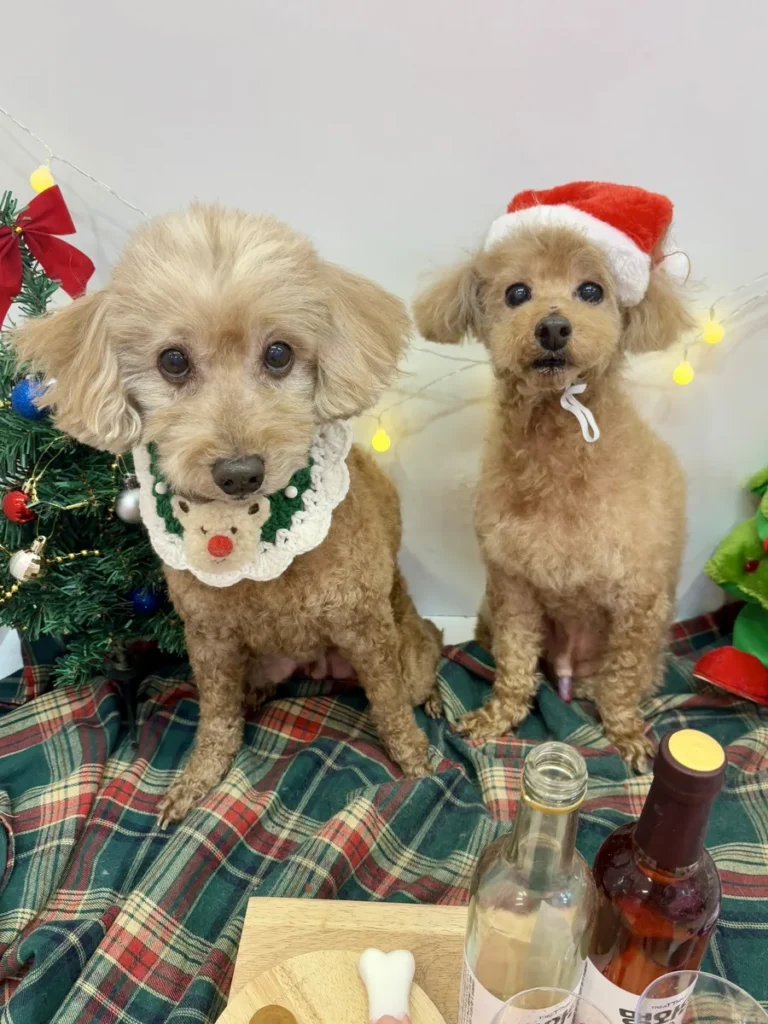
Pets join in as well. Korea has a huge pet culture, and on Christmas Day dog cafés are busy with owners in search of a festive photo. We took our two toy poodles, 삐삐 and 공이, to a dog café on Christmas Day, and took their Christmas photo in the café’s photo zone.
The Christmas Cake
If Korean Christmas has one fixed tradition, it is the cake. Christmas is the busiest time of the year for Korean bakeries, and on 24 December the queues outside them stretch down the street. A typical Korean Christmas cake is a light sponge with whipped cream and fresh strawberries, decorated with a little Santa, a tree or a snowman, and a great many households buy one.
Because demand is so high, Koreans reserve their cake. Bakery and café chains start taking pre-orders in early November, and the earlier you book, the bigger the discount. In 2025, one café chain opened pre-orders on 3 November with up to 40 percent off. You choose a pickup date and time, collect it from your nearest branch, and skip the queue. I have done both, bought one on the day and reserved one in advance, and reserving is far less stressful.
Prices have a range you will not believe. For Christmas 2025, a convenience-store chain sold a one-person mini cake for ₩4,900 and whole cakes from ₩18,800, while a luxury hotel in Seoul sold a truffle cake for ₩500,000, about a hundred times more. Hotel Christmas cakes are a small craze of their own. They sell out, and people post them online like trophies. Most families sit comfortably in between, with a bakery-chain cake.
- Reserve in November if you want a particular cake or a pickup time on the 24th.
- Go early on the day if you have not reserved. Popular cakes sell out by the evening.
- Ask for candles. Korean bakeries include candles and a plastic knife, and they will ask how many candles you want: 초 몇 개 드릴까요?
Christmas Lights in Busan
Korean cities compete to be the brightest in December, and Busan has two winter light festivals that I would recommend to anyone. I have been to both, and both are beautiful. Be ready for crowds, though. Both are packed with couples and families, and there are photo zones everywhere you look.
Gwangbok-ro Winter Light Tree Festival
광복로 겨울빛 트리축제 fills Gwangbok-ro, the shopping street in Nampo-dong in the old centre of Busan, with a giant main tree, light tunnels and illuminated sculptures. In the 2025–26 season it ran from 5 December to 22 February. Take Line 1 to Nampo Station and walk up. BIFF Square, home of Busan’s seed hotteok, is a short walk away, so you can warm up with one of our Korean winter street food favourites on the way.
Haeundae Light Festival
해운대 빛축제 lights up Gunam-ro, the street that runs from Haeundae Station on Line 2 down to the beach, and the sand itself. The 2025–26 festival, the 12th, ran from 29 November to 18 January, with the lights on from 6 to 11 p.m. and free entry. Walking towards the sea under the lights and arriving at a beach full of glowing sculptures is quite something. Our Haeundae Beach guide covers the area in daylight.
Both festivals announce their new dates each autumn, so check the 2026 dates before you go. Go on a weekday if you can, and dress for the wind. A white Christmas is rare in most of Korea and almost unknown in Busan, but the sea wind is properly cold, as our Busan season-by-season guide explains.
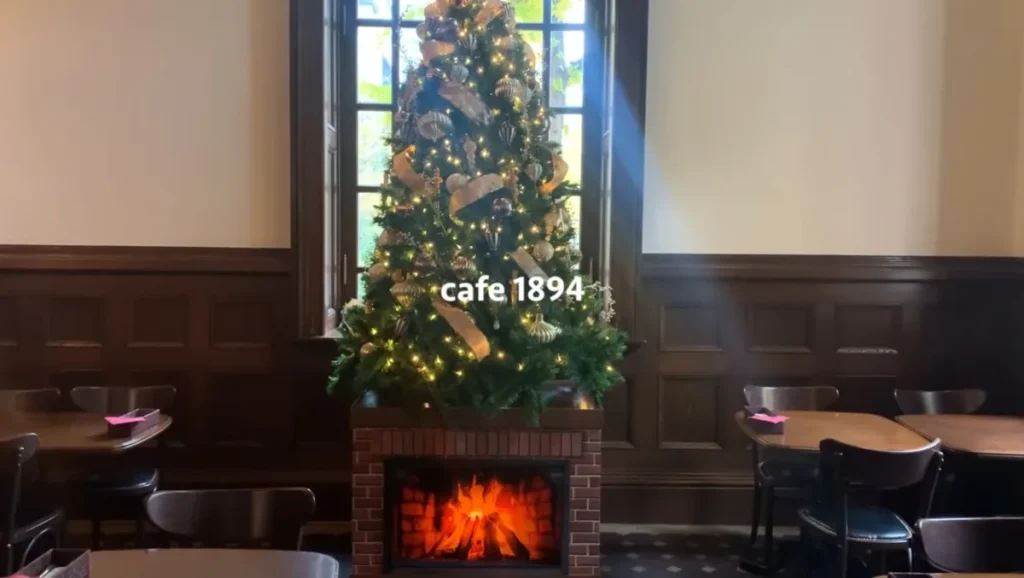
You do not need a festival to see Christmas decorations, either. Cafés start decorating in November, and some go all out, with a full tree, ribbons and even a fireplace.
Christmas at a Korean Academy
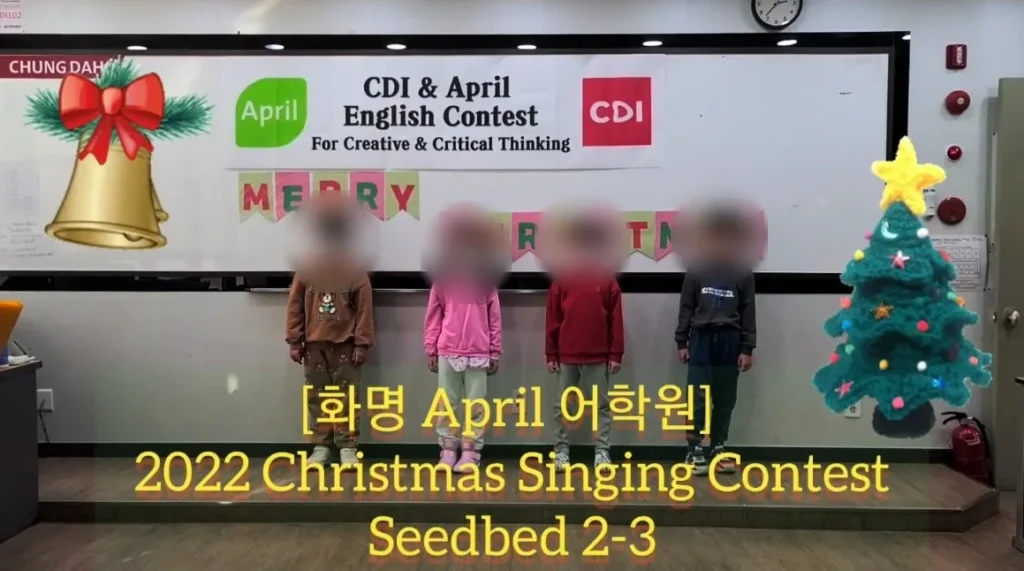
Korean schools and private academies, 학원 (hagwon), mark Christmas too, and English academies more than most, because Christmas is a perfect excuse for English. At my academy, December meant a Christmas singing contest. Each class practised an English carol and performed it in front of a decorated wall, and we filmed every performance.
We also gave the students small presents, and some years we played 마니또 (manitto). It is the Korean version of Secret Santa: everyone draws a name, secretly does kind things for that person and buys them a small gift, and on the last day everyone reveals who their 마니또 was. The guessing is the best part. You will hear the game in offices, clubs and university classes as well.
One spelling note for learners: the standard Korean spelling of “carol” is 캐럴 (kaereol), but you will see 캐롤 on signs and song lists all the time. Both are understood. Loanwords like this follow their own rules in Korean, which our guide to Konglish explains.
Korean Words and Phrases for Christmas
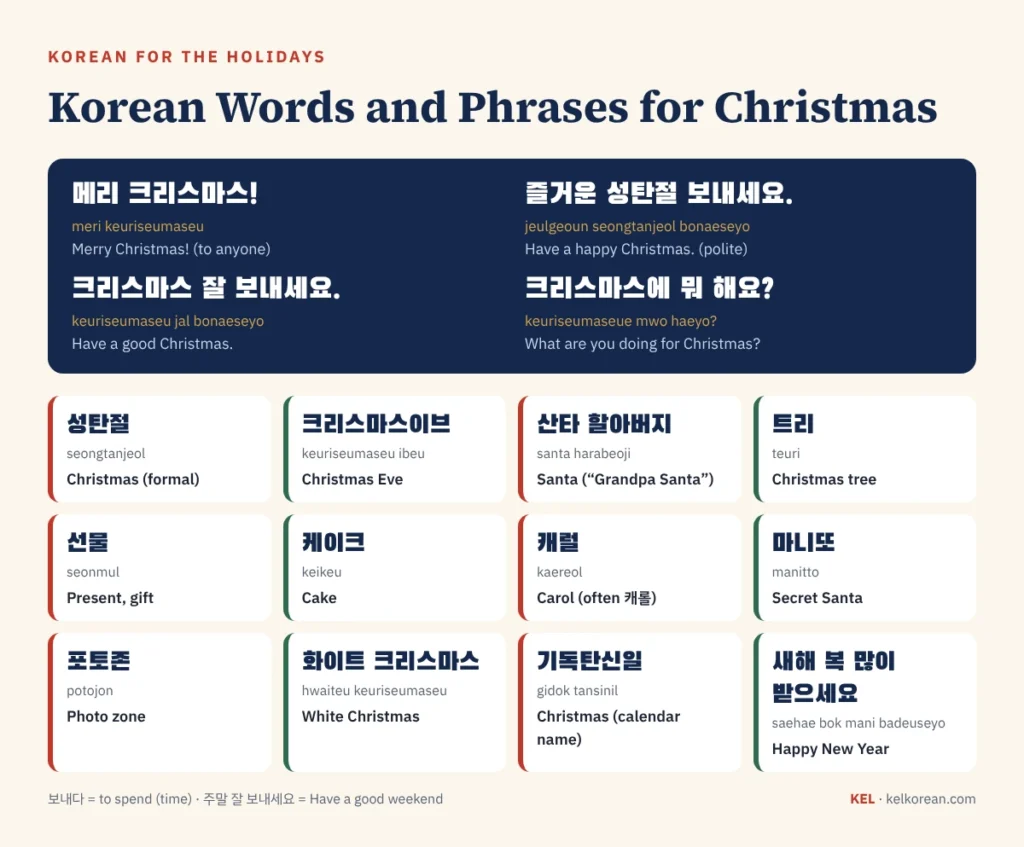
The simplest greeting is 메리 크리스마스 (meri keuriseumaseu), and it works with anyone. If you want something warmer or more polite, for a teacher, a colleague or a message to someone older, use 즐거운 성탄절 보내세요, “Have a happy Christmas.”
| Korean | Romanisation | Meaning |
|---|---|---|
| 메리 크리스마스! | meri keuriseumaseu | Merry Christmas! |
| 즐거운 성탄절 보내세요. | jeulgeoun seongtanjeol bonaeseyo | Have a happy Christmas. (polite) |
| 크리스마스 잘 보내세요. | keuriseumaseu jal bonaeseyo | Have a good Christmas. |
| 크리스마스에 뭐 해요? | keuriseumaseue mwo haeyo? | What are you doing for Christmas? |
| 성탄절 | seongtanjeol | Christmas (formal) |
| 크리스마스이브 | keuriseumaseu ibeu | Christmas Eve |
| 산타 할아버지 | santa harabeoji | Santa Claus (“Grandpa Santa”) |
| 트리 | teuri | Christmas tree |
| 선물 | seonmul | Present, gift |
| 케이크 | keikeu | Cake |
| 캐럴 | kaereol | Carol (often written 캐롤) |
| 마니또 | manitto | Secret Santa |
| 포토존 | potojon | Photo zone |
| 화이트 크리스마스 | hwaiteu keuriseumaseu | White Christmas |
Notice how many of these are English words written in Hangul: 트리, 케이크, 포토존. When you are not sure of a Christmas word, try saying the English word with Korean sounds. It works more often than you would expect. The one to learn properly is 보내세요, from 보내다, “to spend (time).” The same pattern gives you 주말 잘 보내세요, “Have a good weekend,” and 새해 복 많이 받으세요 is the greeting you will need a week later, for the New Year.
Tips for Spending Christmas in Korea
- Book dinner early. Restaurants are fullest on Christmas Eve, not Christmas Day. If you want a particular place on the 24th, book in early December.
- Shops stay open. 25 December is a public holiday, so banks and government offices close, but department stores, cafés, restaurants and cinemas are open and busy.
- Reserve your cake. Pre-orders open in November. A reserved cake means no queue on the 24th.
- Expect crowds at the lights. Weekday evenings are calmer than weekends, and the photo zones are quieter early in the evening.
- Do not expect a family feast. If a Korean friend invites you for Christmas, it will probably be dinner out, cake and a walk under the lights, not a turkey.
Lights, Cake and Someone to Share Them With
Christmas in Korea is less about tradition than about company. For some people it is a date and a concert, for others a quiet cake at home, a dinner out with parents, two dogs in Santa hats, or a classroom full of children singing carols in English. What everyone shares is the lights, the cake and the feeling that the year is nearly over. If you are here in December, reserve your cake, find a tree to stand in front of, and wish someone 메리 크리스마스.
Written by Minhyung Cha — 25 years teaching Korean, and 15+ years running an English academy in South Korea. I live and work in Busan, and every example on this site is checked as a native speaker. More about KEL.
Leave a Reply