
Winter in Korea is really two winters. In Seoul and the mountains of Gangwon it is dry, bright and seriously cold, with snow that settles. Where I live, in the Busan area on the south-east coast, it is cold enough for a long padded coat but snow is so rare that people stop what they are doing to look at it. A visitor who lands in Seoul in January and takes the train south two days later will feel both.
This guide covers when winter starts and when it is coldest, how different Seoul and Busan really are, what Koreans wear, how a Korean home is heated (and how to read the boiler panel in your room), what there is to do, and the Korean words you will hear all season. The parts about daily life are my own, from winters spent in the warm corner of the country.
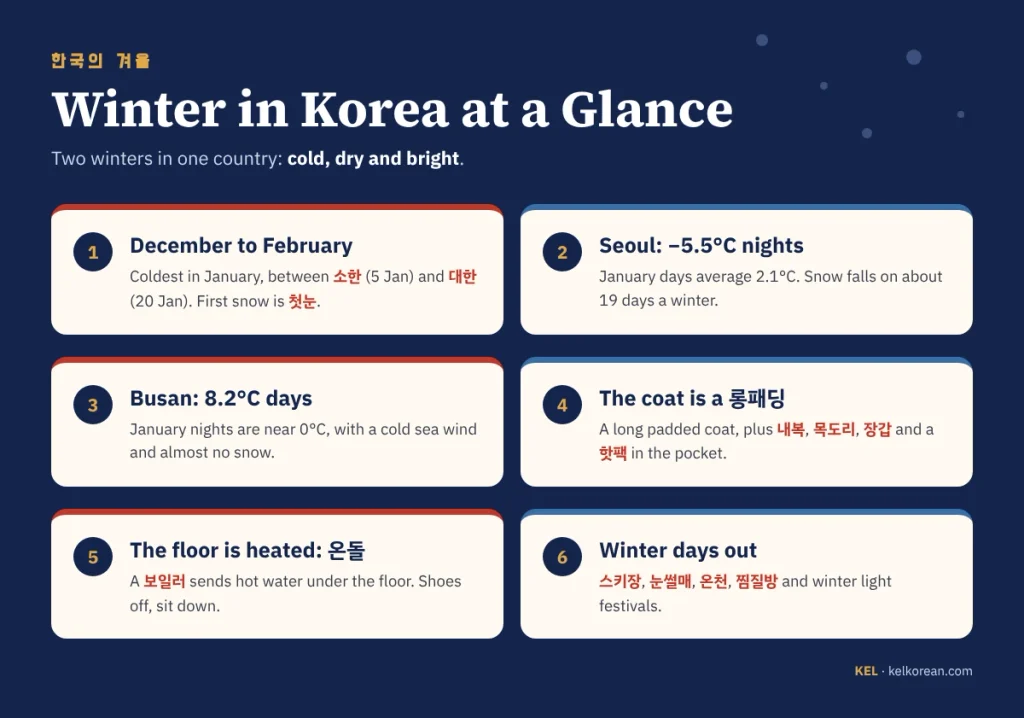
When Is Winter in Korea?
For weather forecasters, 겨울 (gyeoul, winter) is December, January and February. The traditional calendar starts earlier. It divides the year into 24 solar terms, and winter opens with 입동 (ipdong), “the entry of winter,” in early November. These are the dates for this winter.
| Korean | Meaning | Date this winter |
|---|---|---|
| 입동 (ipdong) | Winter begins | 7 November 2026 |
| 동지 (dongji) | Winter solstice, the longest night | 22 December 2026 |
| 소한 (sohan) | “Small cold” | 5 January 2027 |
| 대한 (daehan) | “Great cold” | 20 January 2027 |
| 입춘 (ipchun) | Spring begins, on paper | 4 February 2027 |
The coldest weeks usually fall between 소한 and 대한, in January. On 동지 Koreans traditionally eat 팥죽 (patjuk), red bean porridge. And do not trust 입춘: early February is still deep winter, whatever the calendar says.
The first snow, 첫눈 (cheonnun), has its own place in Korean life. People message each other when it falls, and couples like to be together for it. In Seoul the first snow normally comes around 20 November. This year it was recorded on 8 November 2026, twelve days early.
Two more words explain the rhythm of the season. 삼한사온 (samhansaon) is the old saying “three cold days, four warm days”: cold air comes down from Siberia, stays a few days, and lets go again. It is less regular than the saying suggests, but the pattern is real. A 한파 (hanpa) is a cold wave. The weather agency issues a 한파주의보, a cold wave advisory, when morning lows of −12°C or below are expected for two days or more.
What about this year?In its winter outlook released on 23 November, the Korea Meteorological Administration gave a 50 percent chance that December and February will be warmer than normal, with a strong El Niño in the background, but expects bigger swings in January, when Arctic air can push in for a few days at a time. So pack for the cold snap, not for the average. A cold snap that arrives on exam day in November even has its own name, 수능 한파, which we explain in our guide to Suneung.
Two Winters: Seoul and Busan
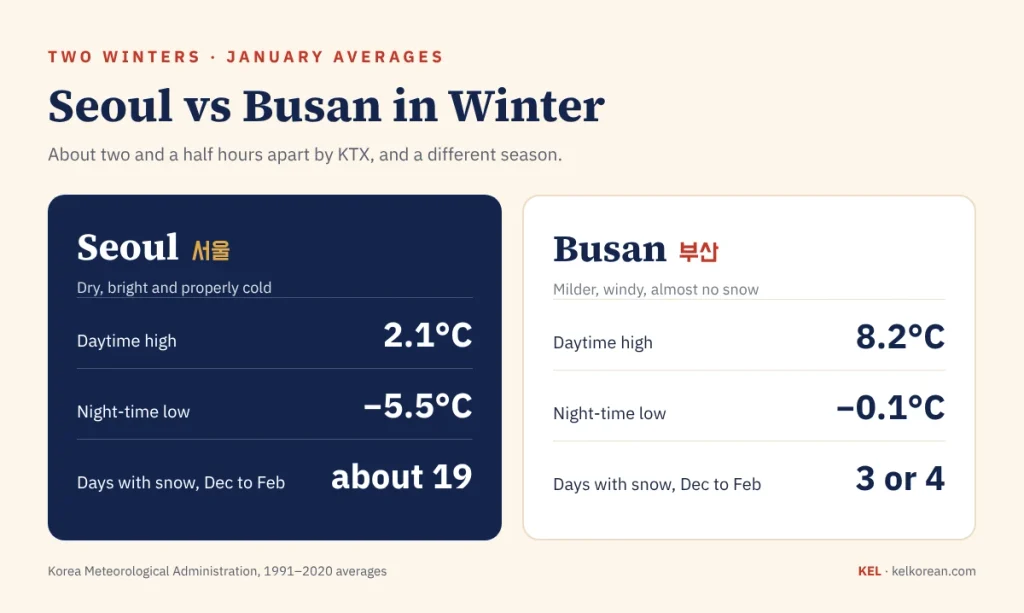
Seoul and Busan are about two and a half hours apart by KTX, and in January they are different seasons. These are the official 30-year averages (1991 to 2020) from the Korea Meteorological Administration.
| January average | Seoul | Busan |
|---|---|---|
| Daytime high | 2.1°C | 8.2°C |
| Night-time low | −5.5°C | −0.1°C |
| Days with snow, December to February | About 19 | 3 or 4 |
Those are averages. In a cold wave Seoul mornings drop well below −10°C, and Gangwon, the mountain province to the east where the ski resorts are, is colder again. I have felt both, and for someone from the south the cold up there is on another level. Heavy snow is also a normal part of winter in Seoul and Gangwon.
Down here, snow hardly comes. On the very coldest days a few flakes blow about for a short while, and that is all. Real, deep snow is a once-in-decades event: I have seen it about twice in my life. The record for Busan is 37.2 centimetres on 5 and 6 March 2005, the most since records began in 1904. Because snow is so rare, we are delighted when it comes. There are snowball fights, 눈싸움 (nunssaum), and we even build a snowman, 눈사람 (nunsaram).
Do not read “8°C” as mild, though. Busan’s cold comes with a sea wind, and it gets through a thin coat quickly. Our season-by-season guide to Busan explains the wind and why winter is still a good time to visit. Wherever you are, a Korean winter is dry and often sunny, with blue skies after a cold night.
What Koreans Wear: 롱패딩 and Friends
Look down any Korean street in January and you will see the same coat again and again: the 롱패딩 (rongpaeding), a padded coat that reaches the knee or lower. 패딩 is the Korean word for any padded jacket, and the long version became the national winter uniform around the 2018 PyeongChang Winter Olympics. It looks like a sleeping bag with sleeves, and it works like one.
I use everything in this table, even in the warm south.
| Korean | Romanisation | Meaning |
|---|---|---|
| 롱패딩 | rongpaeding | Long padded coat |
| 내복 | naebok | Thermal underwear |
| 히트텍 | hiteutek | Thin thermal layer, from a brand name that people use for all of them |
| 핫팩 | hatpaek | Disposable hand warmer |
| 목도리 | mokdori | Scarf |
| 장갑 | janggap | Gloves |
The 핫팩 deserves a sentence of its own. It is a small pouch that heats up when you shake it and stays warm for hours. Some go in a pocket and some stick to your clothes. You will find them at convenience stores and supermarkets all winter.
One piece of advice: dress in layers you can take off. Korean buildings, trains and buses are heated generously, and the walk from a −5°C street into a warm underground station is a shock in a heavy jumper. A thin thermal layer, something light over it, and a big coat on top is what most people here do.
How a Korean Home Stays Warm: 온돌
Korean homes are heated from below. 온돌 (ondol) is underfloor heating: in a traditional house, heat from the kitchen fire passed under stone floors, and in a modern flat a 보일러 (boilleo, boiler) sends hot water through pipes under the floor. This is why Koreans take their shoes off, sit on the floor, and happily sleep on it. In winter the floor is the warmest place in the house.
At home I run the boiler, and on top of the bed I add an 온수매트 (onsu maeteu), a thin mat with warm water running through it. Many families use an electric version, the 전기장판 (jeongi jangpan). Then come the winter foods. We eat a lot of 귤 (gyul), the small sweet mandarins from Jeju that arrive by the box, and 군고구마 (gungoguma), roasted sweet potato. The sweet potato has its own section in our guide to Korean winter street food, along with the fish-shaped buns sold outside.
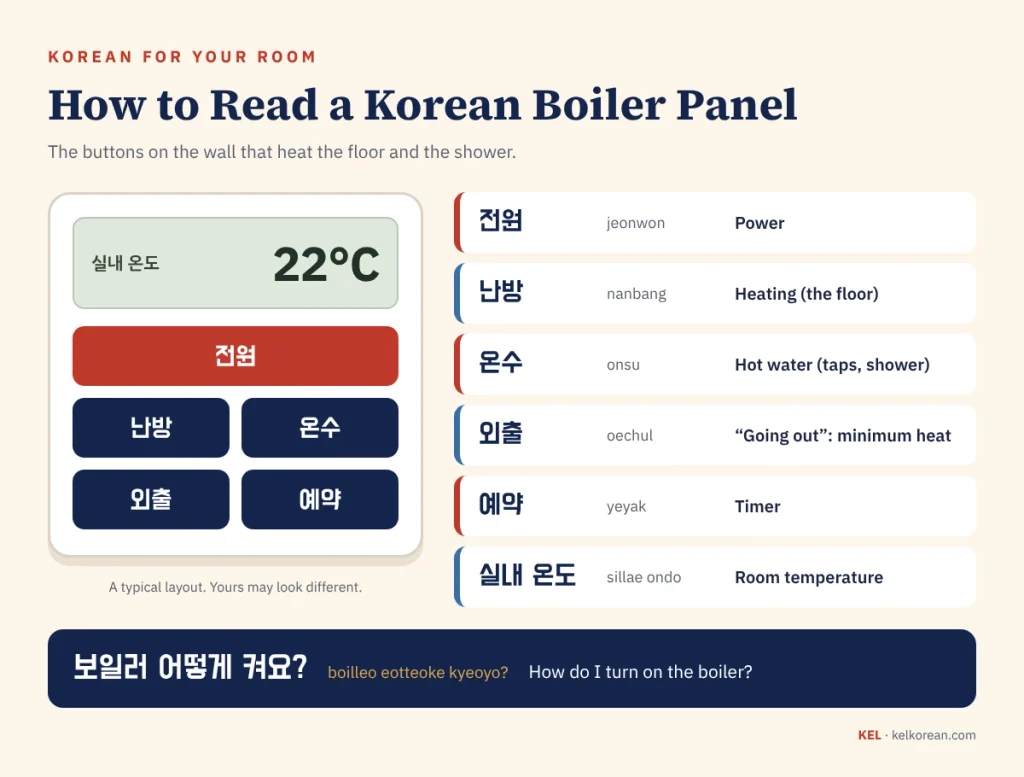
If you stay in a guesthouse, a rented flat or a 한옥 (hanok, traditional house), you will meet a small control panel on the wall with Korean-only buttons. These are the words on almost every one.
| Korean | Romanisation | Meaning |
|---|---|---|
| 전원 | jeonwon | Power |
| 난방 | nanbang | Heating (the floor) |
| 온수 | onsu | Hot water (taps and shower) |
| 외출 | oechul | “Going out”: keeps the heating at a minimum while you are away |
| 예약 | yeyak | Timer |
| 실내 온도 | sillae ondo | Room temperature |
Two tips. The floor takes time to warm up and stays warm for a long time, so small changes work better than turning it up high. And in a cold wave, hosts usually ask you to leave the boiler on 외출 when you go out rather than switching it off, so that the pipes do not freeze. If you are not sure, ask: 보일러 어떻게 켜요? (boilleo eotteoke kyeoyo?), “How do I turn on the boiler?”
What to Do in a Korean Winter
Winter is the quiet season for visitors, and that is part of its charm. These are the things Koreans actually do.
- Ski and sled. A ski resort is a 스키장 (seukijang), and most are in Gangwon. They open from late November as soon as it is cold enough to make snow: Alpensia in Pyeongchang, for example, was aiming for 28 November this year, weather permitting. For children, and for adults who do not ski, there is the 눈썰매 (nunsseolmae), a snow sled. I did both years ago.
- Fish through the ice. The best-known winter festival is the Hwacheon Sancheoneo Ice Festival in Gangwon, where thousands of people fish for mountain trout through holes in a frozen river. The 2027 festival is scheduled for 9 to 31 January. Ice festivals depend on the weather, so check before you travel.
- Soak in a hot spring. An 온천 (oncheon) is a hot spring, and this is my own winter habit. I often go to the hot springs near 작천정 (Jakcheonjeong) in Ulju, at the foot of the Yeongnam Alps, the mountains I wrote about in our guide to autumn foliage in Korea. Sitting in hot water on a cold day needs no explanation.
- Spend a day in a jjimjilbang. If there is no hot spring nearby, the Korean sauna does the same job in any city. Our jjimjilbang guide walks you through a visit.
- See the lights. Cities put up winter light festivals from late November or early December. Busan has two, and both are in our guide to Christmas in Korea.
- Watch the first sunrise. On 1 January Koreans go to the coast or up a mountain before dawn to see the year’s first sunrise. That, and the Lunar New Year that follows in February, are covered in Happy New Year in Korean.
Winter also begins with a job. Late November and early December are the season for making the winter’s kimchi, which we describe in our guide to kimjang.
Even the Dogs Wear 패딩
You will notice something else on a winter walk in Korea: the dogs are dressed. Small dogs are popular here, and in winter many of them go out in a jacket. I have two toy poodles, 공이 (Gongi) and 삐삐 (Bbibbi), and I put clothes on them for every winter walk. On very cold days they wear a padded jacket or a 무스탕 (museutang), which is what Koreans call a shearling-style coat. Dog clothes are 강아지 옷 (gangaji ot).
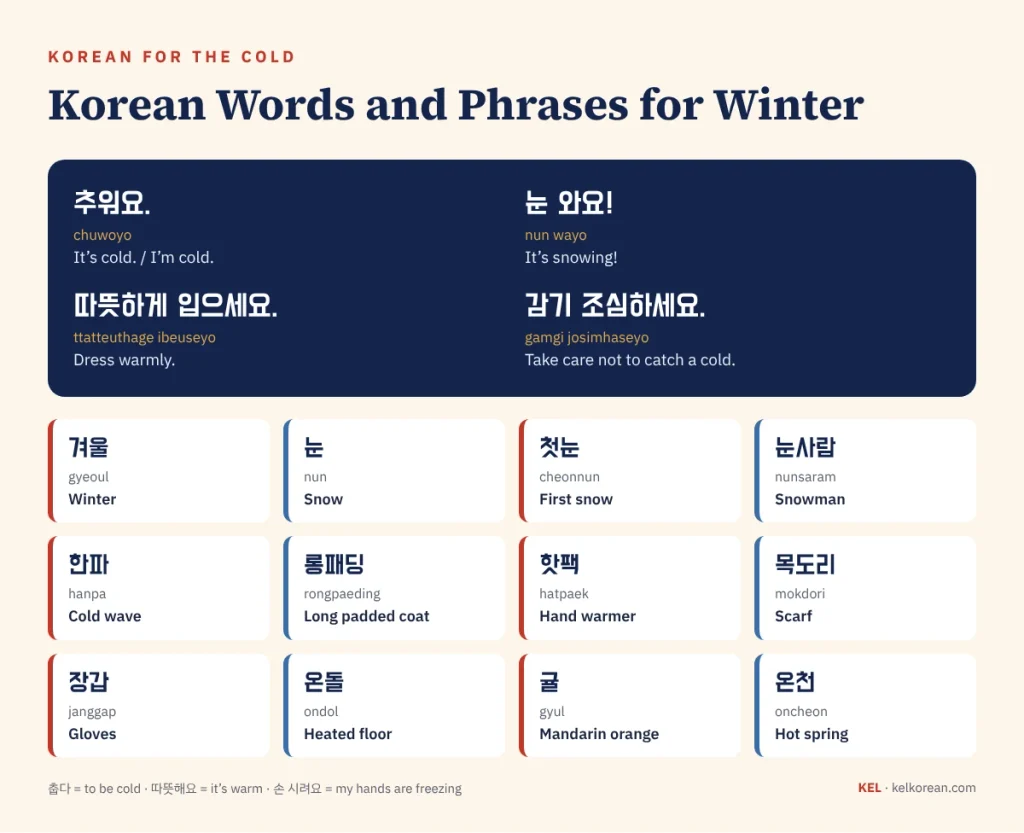
Korean Words and Phrases for Winter
Koreans talk about the cold the way the British talk about rain. These sentences will carry you through most of it.
| Korean | Romanisation | Meaning |
|---|---|---|
| 추워요. | chuwoyo | It’s cold. / I’m cold. |
| 너무 추워요! | neomu chuwoyo | It’s so cold! |
| 눈 와요! | nun wayo | It’s snowing! |
| 손 시려요. | son siryeoyo | My hands are freezing. |
| 길이 미끄러워요. | giri mikkeureowoyo | The road is slippery. |
| 따뜻하게 입으세요. | ttatteuthage ibeuseyo | Dress warmly. |
| 감기 조심하세요. | gamgi josimhaseyo | Take care not to catch a cold. |
| 핫팩 있어요? | hatpaek isseoyo? | Do you have hand warmers? |
추워요 comes from 춥다 (chupda), “to be cold,” and it covers both the weather and how you feel. Its opposite indoors is 따뜻해요 (ttatteuthaeyo), “it’s warm.” 손 시려요 uses a different word, 시리다, for the sharp cold you feel in your hands, feet or ears. And 감기 조심하세요 is what Koreans say to each other all winter, at the end of a phone call or a message, the way English speakers say “take care.” If you do catch that cold, our guide to saying you are sick in Korean has the next sentences you need.
One pronunciation note. 눈 (nun) is snow, and 첫눈, first snow, is written with ㅅ but said [천눈], cheonnun, because the ㅅ becomes an ㄴ sound before another ㄴ. Our guide to Korean pronunciation rules explains why. 눈 also means “eye,” so 눈사람, a snowman, is a “snow person,” not an eye person.
Before You Go
- Pack for two climates. If your trip includes both Seoul and Busan, the Seoul coat will be too much in Busan at midday and just right at night by the sea.
- Expect dry air. Winter is the dry season, indoors and out. Lip balm and hand cream are in every convenience store.
- Watch your step after snow. An icy road is a 빙판길 (bingpan-gil). Side streets and stairs stay slippery longer than main roads.
- Check the holiday dates. Lunar New Year closes many shops and restaurants and fills every train. In 2027 the holiday runs from 6 to 9 February.
- Buy a 핫팩 on day one. It costs very little and you will not regret it.
Cold Outside, Warm Floor
That is a Korean winter in four words. Outside, the air is sharp and the sky is blue, and everybody is wrapped in a 롱패딩 with a 핫팩 in each pocket. Inside, the floor is warm, there is a bowl of 귤 within reach, and nobody is in a hurry to go anywhere. Come in January if you want snow and ice in Seoul and Gangwon, or come south if you would rather have the winter sun. And if you are in Busan on one of the rare mornings when it snows, go outside with everyone else. We will be the ones building the snowman.
Written by Minhyung Cha — 25 years teaching Korean, and 15+ years running an English academy in South Korea. I live and work in Busan, and every example on this site is checked as a native speaker. More about KEL.
Leave a Reply