
Haeundae Beach is the most famous beach in Korea, and most of what is written about it is about summer: the parasols, the lifeguards, the crowds. But for nine months of the year it is a different place — wide, calm, and full of people walking rather than swimming. My husband and I spent Hangul Day there this year, a Friday holiday in early October, and every photo in this guide comes from that one day.
I live just outside Busan, so Haeundae is somewhere I go rather than somewhere I visit. This is the guide I would give a friend arriving outside the swimming season: how to get there, what is still open, where the toilets and lockers are, and an easy walk from one end of the sand to the yachts on the other side of Dongbaek Island.
Haeundae at a Glance
The beach is about 1.5 km of pale sand on Busan’s eastern side, facing open sea. At the western end sits the Westin Josun hotel and, beyond it, Dongbaek Island, which is no longer an island but a wooded headland with a walking path around it. At the eastern end, the three glass towers of LCT dominate the skyline, the tallest building in Busan. A line of old pine trees runs behind the sand for much of its length, and between the trees and the beach is a wide paved promenade that is the real reason to come out of season.
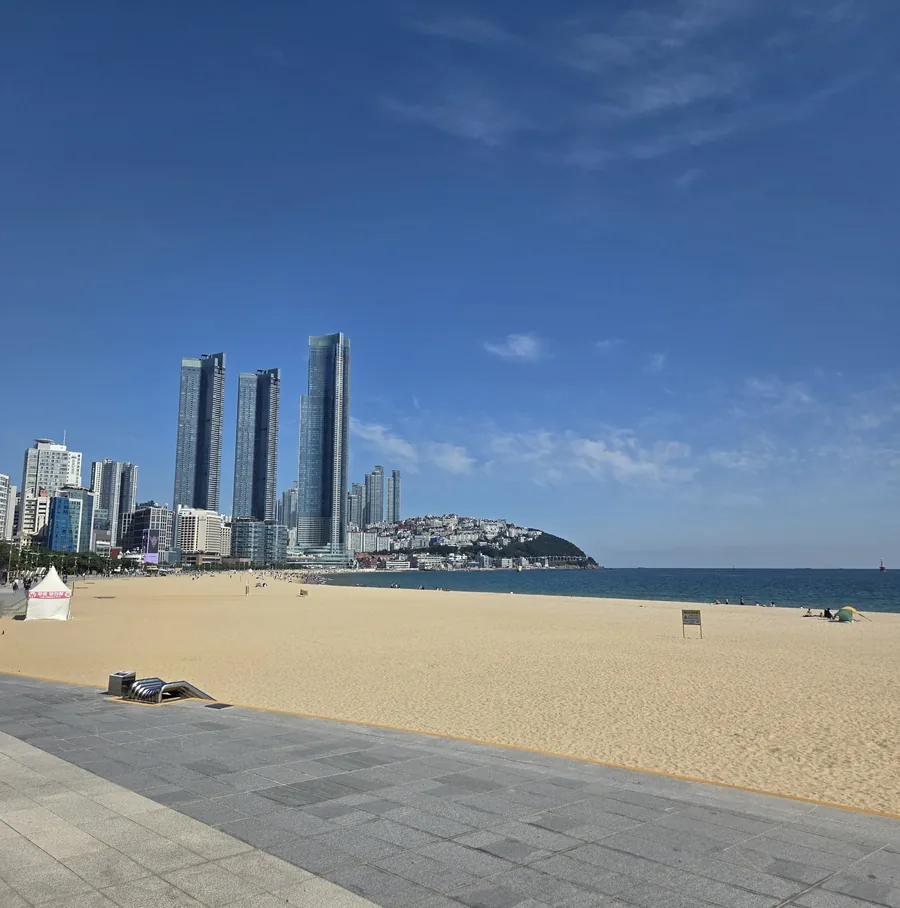
The Korean name is 해운대해수욕장 (Haeundae haesuyokjang). 해수욕장 means a swimming beach — literally a “sea-water-bathing place,” which our guide to reading Korean signs takes apart syllable by syllable.
Getting There
By subway. Take Busan Metro Line 2 to Haeundae Station (해운대역) and use Exit 5; the walk down to the sand takes about eight minutes and brings you to the middle of the beach, where the tourist information centre and the big HAEUNDAE letters are. For the western end — the Westin Josun, Dongbaek Island and The Bay 101 — Dongbaek Station (동백역), one stop earlier on the same line, is closer. Our guide to using the Korean subway covers fares and transit cards.
By KTX. If you arrive by high-speed train, Busan Station is on the other side of the city, and the subway ride to Haeundae is the best part of an hour. Our guide to booking the KTX explains the stations.
By taxi. Say 해운대해수욕장으로 가 주세요, or simply 해운대로 가 주세요. From Gimhae Airport it is a long ride across Busan; our guide to taking a taxi in Korea has the fares.
What Changes After the Swimming Season
Korean beaches open officially, with lifeguards and buoys, for a fixed period. In 2026 Haeundae opened on 26 June and closed on 15 September, the longest season of any Busan beach. Outside those dates:
- There are no lifeguards on duty in the water, and the parasol and tube rentals are gone. People still paddle at the edge on warm days, but this is not the time for a swim.
- The sand is empty enough to walk. In August you pick your way between parasols. In October the beach is wide open.
- The rules still apply. Banners on the sand warn against swimming after drinking, and barriers at the promenade keep bicycles and electric scooters off the beach, with a fine of up to ₩50,000.
- October has its own crowds. The Busan International Film Festival runs in early to mid-October, centred on Haeundae and Centum City, and public holidays fill the promenade. On Hangul Day it was busy, but nothing like summer.
For the weather month by month, and the festivals worth timing a trip around, see the best time to visit Busan.
Toilets, Lockers and Help
The building to know is the Haeundae Tourist Information Centre, 해운대관광안내소, in the middle of the beach near the Exit 5 approach. It is hard to miss: a brick tower with a huge blue panel that says 해운대 진짜 좋다, “Haeundae is really great.” Inside and around it:
- Information. Staff can usually help in English with maps and directions, and the Korea Travel Hotline, 1330, works by phone from anywhere.
- Lockers, signed 물품보관함, for a small fee — useful if you are carrying luggage between check-out and a train.
- Toilets. A yellow board outside points the way: 화장실은 옆으로 20M, “the toilet is 20 metres to the side.” There are numbered public toilet blocks, 공중화장실, along the beach as well.
- Free changing tents, 무료 탈의장, were still standing at the edge of the sand on our visit in October, one for men and one for women.
The same building houses the Haeundae Summer Police Station, 해운대여름경찰서. The Korean on all of these signs is explained in our guide to Korean signs, which uses this very stretch of beach as its classroom.
An Easy Walk: The Middle of the Beach to The Bay 101
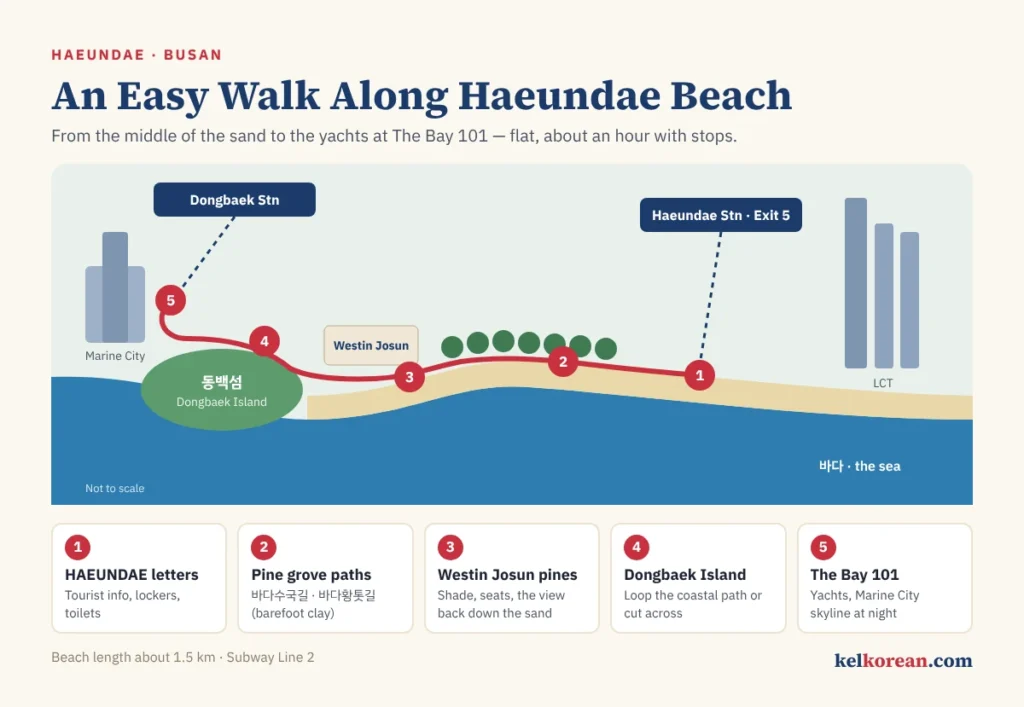
This is the walk our photos follow, from the centre of the beach westwards to the marina. Flat all the way, it takes about an hour at a gentle pace with stops, and you can do it in reverse just as easily.
1. The HAEUNDAE letters
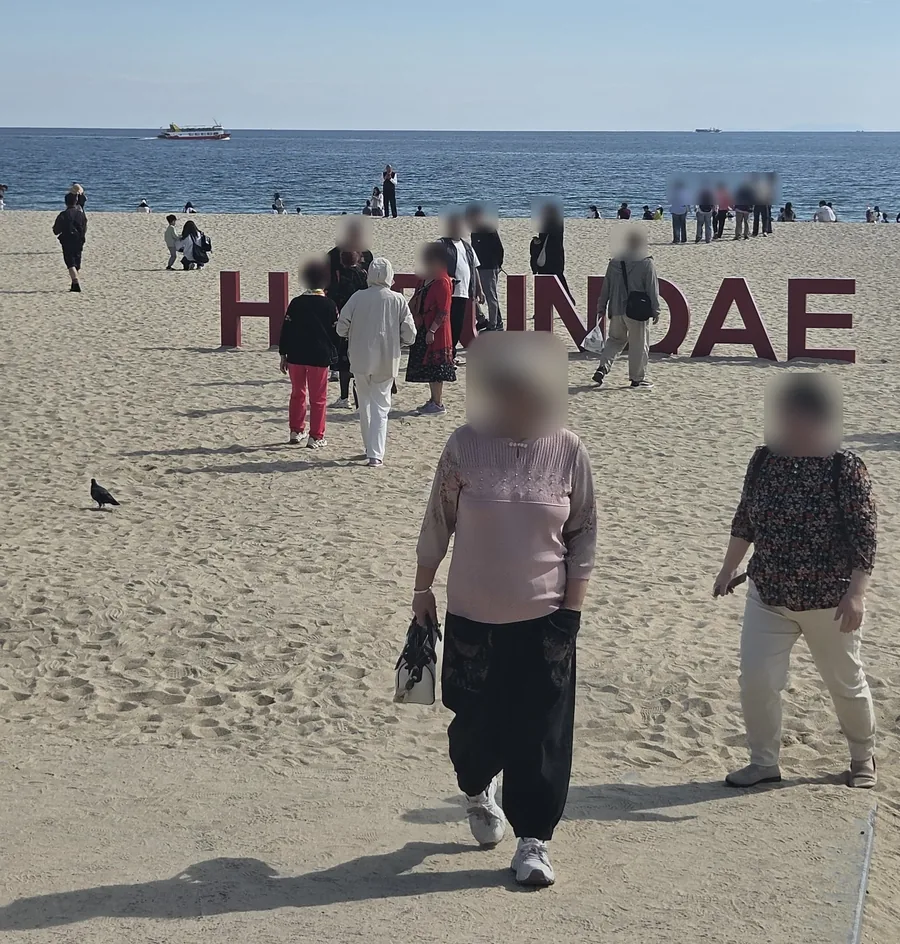
Start at the giant red letters standing on the sand below the tourist information centre. Everyone takes a photo here, and on a holiday there is a small queue for it. From here, the LCT towers fill the view to the east and the Westin Josun closes the view to the west.
2. The pine grove: 바다수국길 and 바다황톳길
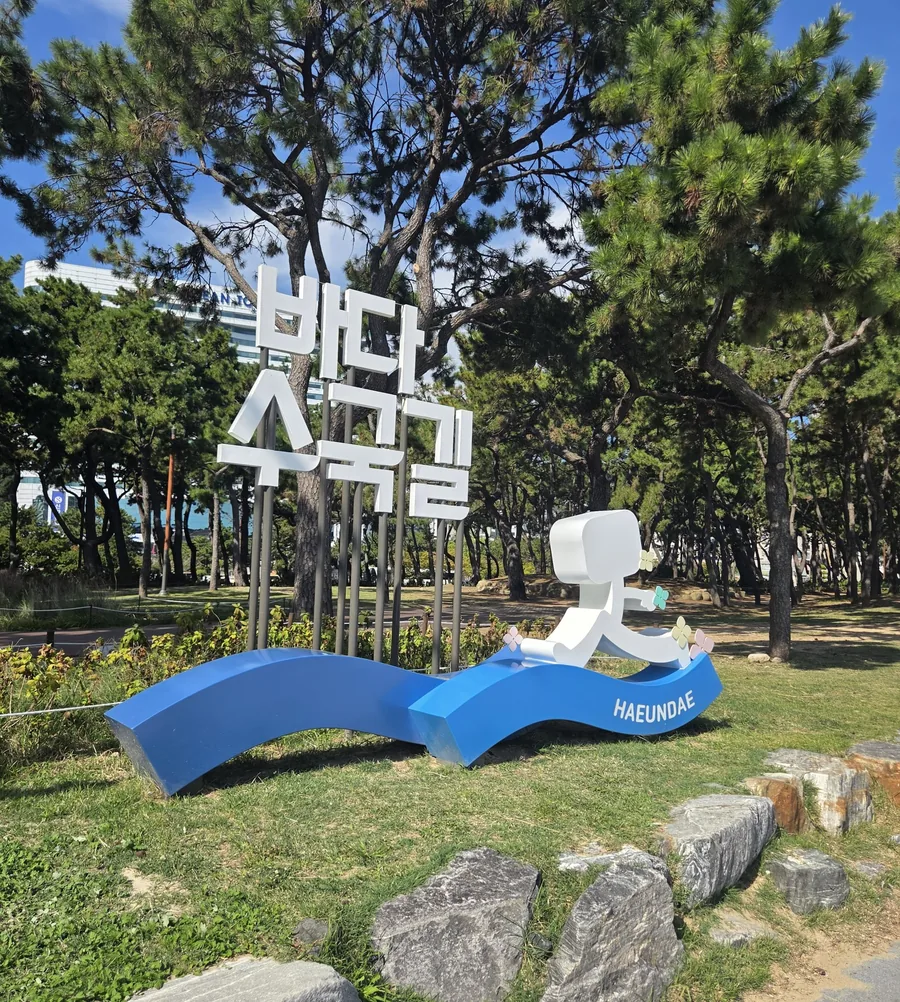
Walk west and step off the promenade into the pine trees behind the beach. Here the district has laid out two paths, each marked by a big white sculpture: 바다수국길, the seaside hydrangea path, planted with thousands of hydrangeas that flower in early summer, and 바다황톳길, the seaside clay path, a strip of packed yellow earth for walking barefoot. The district built it in 2024, planned at about 650 metres, with places to wash your feet afterwards. Barefoot walking on clay, 맨발 걷기, has become a national enthusiasm in Korea over the past few years. You will see people of every age doing it.
3. The pines by the Westin Josun
As you near the western end, the pines lean out over the promenade, bent by decades of sea wind. This is the prettiest stretch of the walk and the best place to sit: there are stone seats under the trees and a clear view down the whole length of the sand. The Westin Josun stands right at the end of the beach, built where the sand meets the rocks.
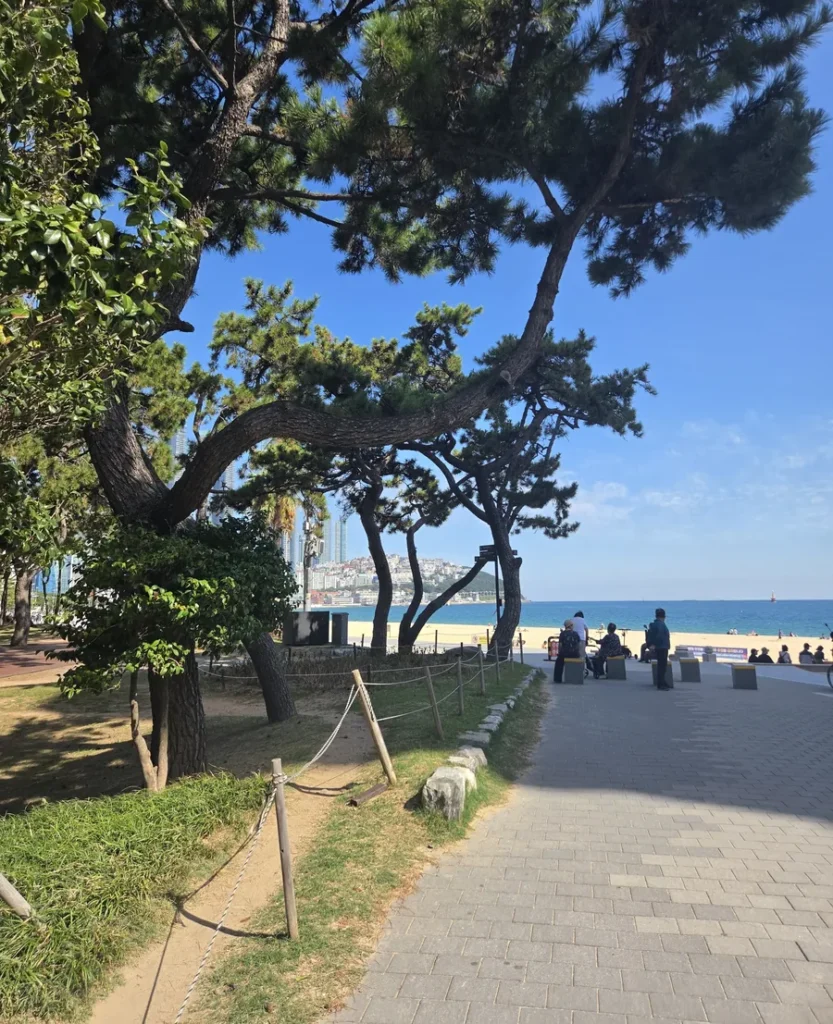
Look out to sea from here and you will probably spot a sightseeing boat crossing the bay, and on a clear day a cluster of rocky islets far off on the horizon.
4. Around Dongbaek Island to The Bay 101
Past the hotel, the path continues around Dongbaek Island (동백섬) — named for the camellias, 동백, that grow on it. You can loop around the headland on the coastal path or cut across its base. On the far side is The Bay 101, a yacht club and dining complex on the water, with sailboats and catamarans moored in front of the apartment towers of Marine City. In the daytime it is a quiet place to finish the walk; after dark it is one of the classic spots for Busan’s night skyline, with the towers reflected in the marina.
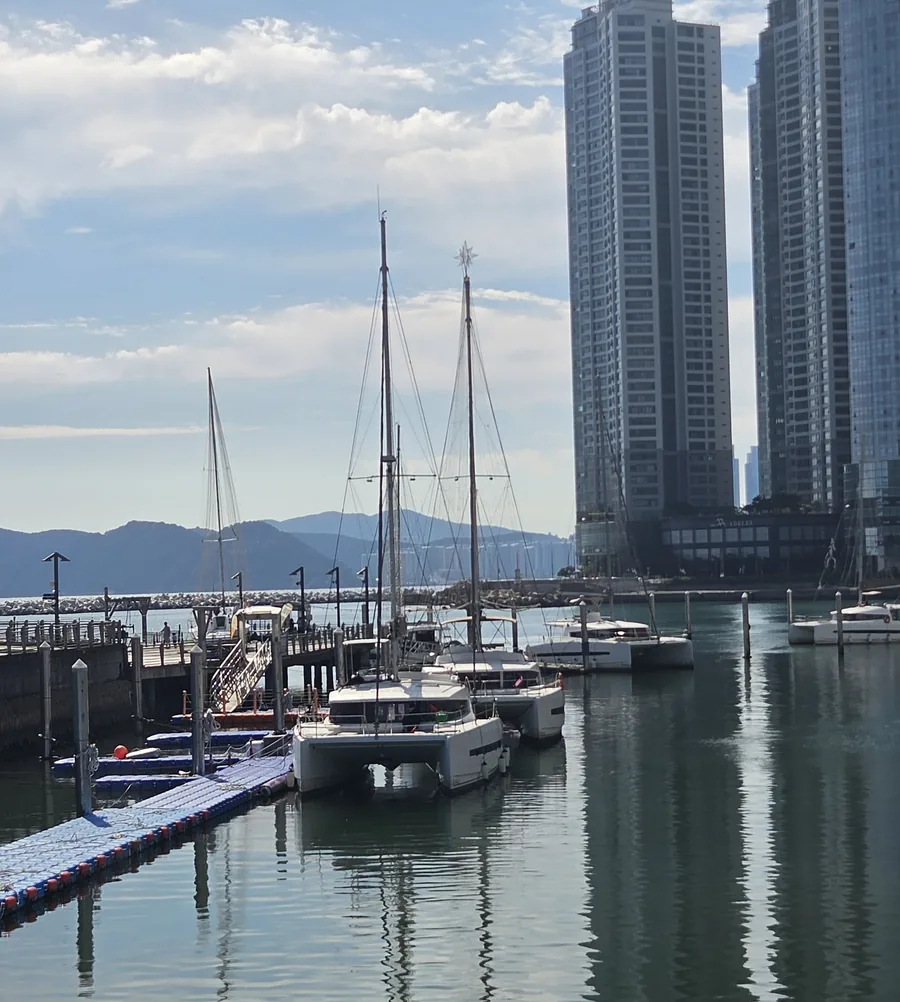
From here, Dongbaek Station is a short walk away, or you can turn into Marine City for dinner. If you are going for a meal with a queue, register first and walk second; our guide to CatchTable explains how, and the gomtang restaurant we waited two hours for is in our guide to Geodae Gomtang in Haeundae.
Small Things Worth Knowing
- The wind. Even on a warm October day, the breeze off the sea is stronger than in the city. Bring a layer.
- Sun with no shade on the sand. The promenade under the pines is shaded; the beach is not. A hat helps even in autumn.
- Bicycles and scooters stay on the road. The barriers at the beach entrances mean it, and the fine is real.
- Toilets are free. Public toilets in Korea do not charge, and the beach has plenty of them.
- Pay by card. Cafés, convenience stores and restaurants along the beach take overseas cards; our guide to how to pay in Korea covers the exceptions.
A few Korean words for the beach
| Korean | Romanisation | Meaning |
|---|---|---|
| 바다 | bada | Sea |
| 해변 / 백사장 | haebyeon / baeksajang | Beach / sandy beach |
| 모래 | morae | Sand |
| 소나무 | sonamu | Pine tree |
| 산책 | sanchaek | A walk, a stroll |
| 파도 | pado | Waves |
| 화장실 어디예요? | hwajangsil eodiyeyo? | Where is the toilet? |
| 사진 좀 찍어 주세요 | sajin jom jjigeo juseyo | Could you take a photo for us? |
The last one gets plenty of use at the HAEUNDAE letters. For the rest of the trip, our Korean phrases for travelers cover the basics, including a few words of Busan dialect.
Come for the Walk, Not the Swim
Haeundae in summer is a spectacle. Haeundae the rest of the year is simply a very good place to walk: a long curve of sand, old pines, a clay path for bare feet, a headland of camellias and a marina full of yachts, all on one subway line. Get off at Haeundae Station, walk west, and finish at The Bay 101 as the lights come on across the water.
Written by Minhyung Cha — 25 years teaching Korean, and 15+ years running an English academy in South Korea. I live and work in Busan, and every example on this site is checked as a native speaker. More about KEL.
Leave a Reply