
How to book KTX tickets is a five-minute job on a phone — and almost every guide in English that explains it is now out of date. Between August and October 2026, Korea merged its two high-speed rail companies, cut fares, replaced the booking app and doubled how far ahead you can buy. If you read a guide written before September, at least three of its instructions are wrong.
I live in Yangsan, just north of Busan, and I take the KTX to Seoul often — usually not from Busan Station but from Mulgeum or Gupo, which are closer to home. The screenshots in this guide are from my own phone, taken in October 2026 with the app switched to English. They show something the official instructions leave out: even in English mode, a good part of the screen is still in Korean. This guide walks through every step, and teaches you the Korean you will meet on the way.
What Changed in Autumn 2026
Four changes landed in the space of two months. Each one affects how you book.
| What | Before | Now |
|---|---|---|
| The app | Korail Talk for KTX, a separate SRT app for SRT | Korail+ for everything (since 3 August) |
| The trains | KTX from Seoul Station, SRT from Suseo | All KTX — former SRT trains are now called KTX-Sancheon (since 1 September) |
| The fare | Seoul–Busan ₩59,800 | Seoul–Busan ₩54,400, about 10% less on average (since 1 September) |
| When tickets open | One month before departure | Two months before, at 7 a.m. (since 1 October) |
The merger is the one that simplifies things most. Seoul Station in the north of the city and Suseo station in Gangnam used to belong to two rival companies, so you had to search two apps to compare trains. Now a single search shows both. If you are staying south of the river, a train from Suseo can save you a long subway ride before you even start.
Book on Your Phone: Korail+ in Six Screens
Korail+ is free on the App Store and Google Play, and it supports English, Japanese, Simplified and Traditional Chinese, Vietnamese and Thai. You do not need a Korean phone number or an account to buy a ticket. Here is the whole process, screen by screen.
1. Switch the language — then expect some Korean anyway
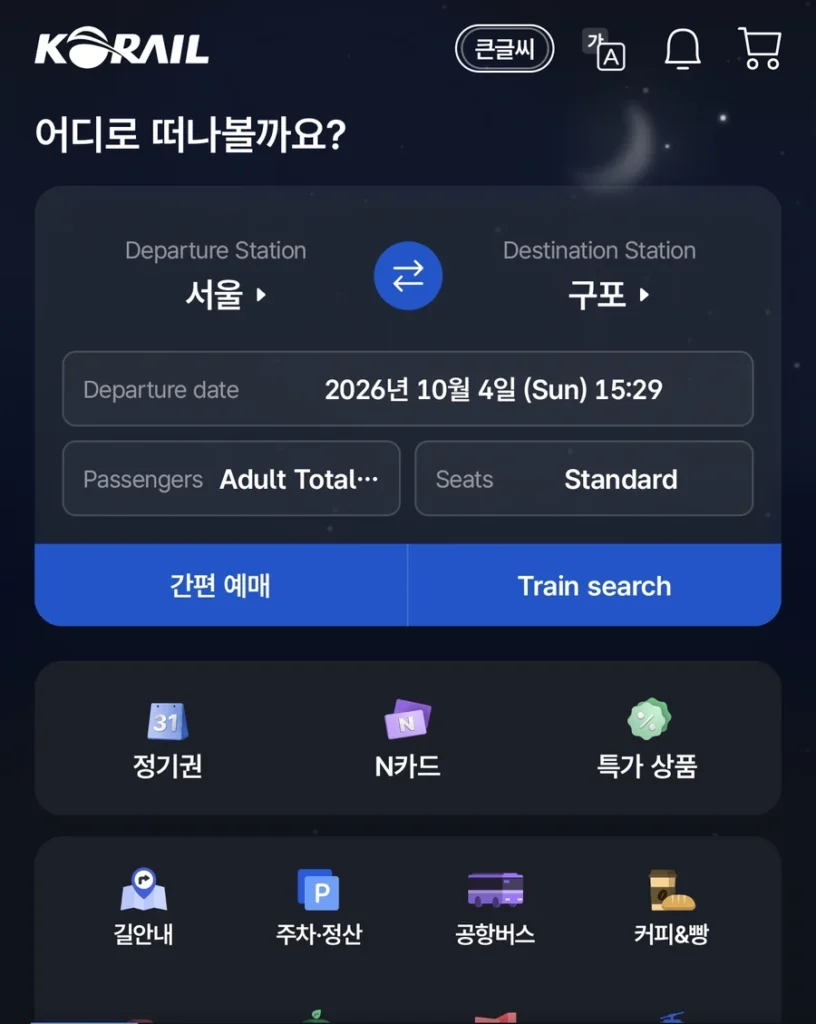
The language button is the small 가A icon at the top of the home screen. Tap it and choose English. The search box changes to Departure Station, Destination Station and Train search — but look at what stays behind. The greeting at the top, 어디로 떠나볼까요? (“where shall we go?”), the blue button marked 간편 예매 (quick booking), and the whole menu bar at the bottom of the screen are still in Korean. The station names you pick can also stay in Hangul, as 서울 and 구포 do in my screenshot.
None of this stops you booking. Use Train search, not 간편 예매, and you will be fine. But it is the reason the last section of this guide exists.
2. Search, and read the list
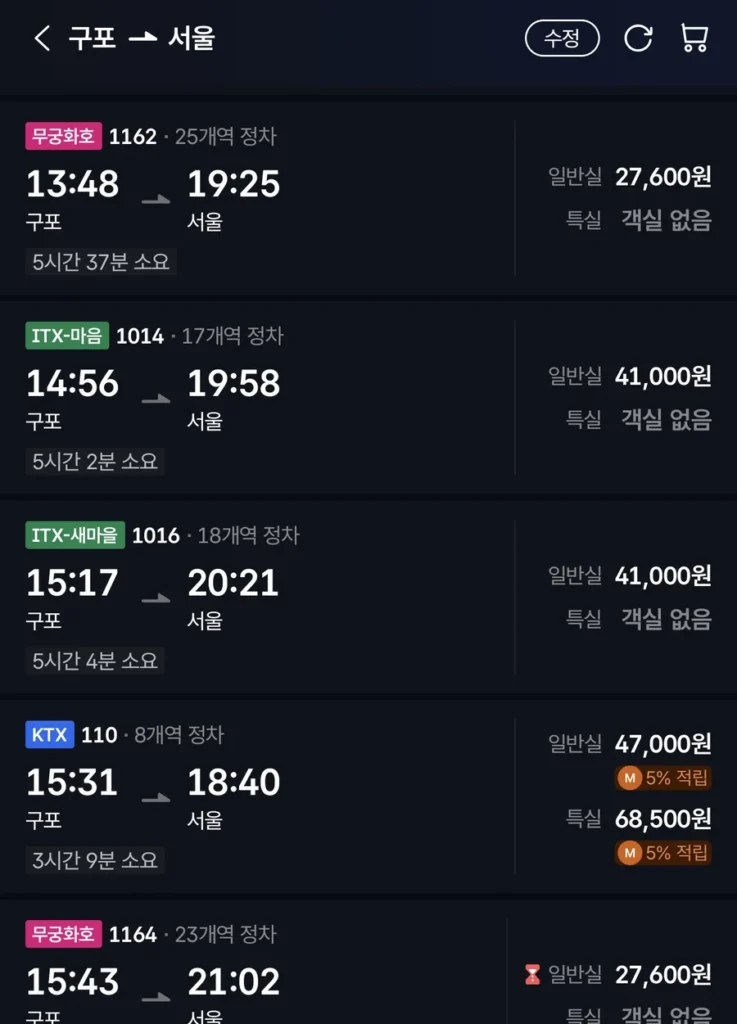
Choose your stations, date, number of passengers and seat class, and tap Train search. The list that comes back shows more than KTX. Korail runs slower trains on the same routes, and the app mixes them all together:
- KTX, KTX-Sancheon, KTX-Cheongryong — the high-speed trains. The name is the type of train, not a different service; the ticket works the same way.
- ITX-새마을 and ITX-마음 — intercity trains, slower and cheaper.
- 무궁화호 (Mugunghwa) — the slowest and cheapest, stopping almost everywhere.
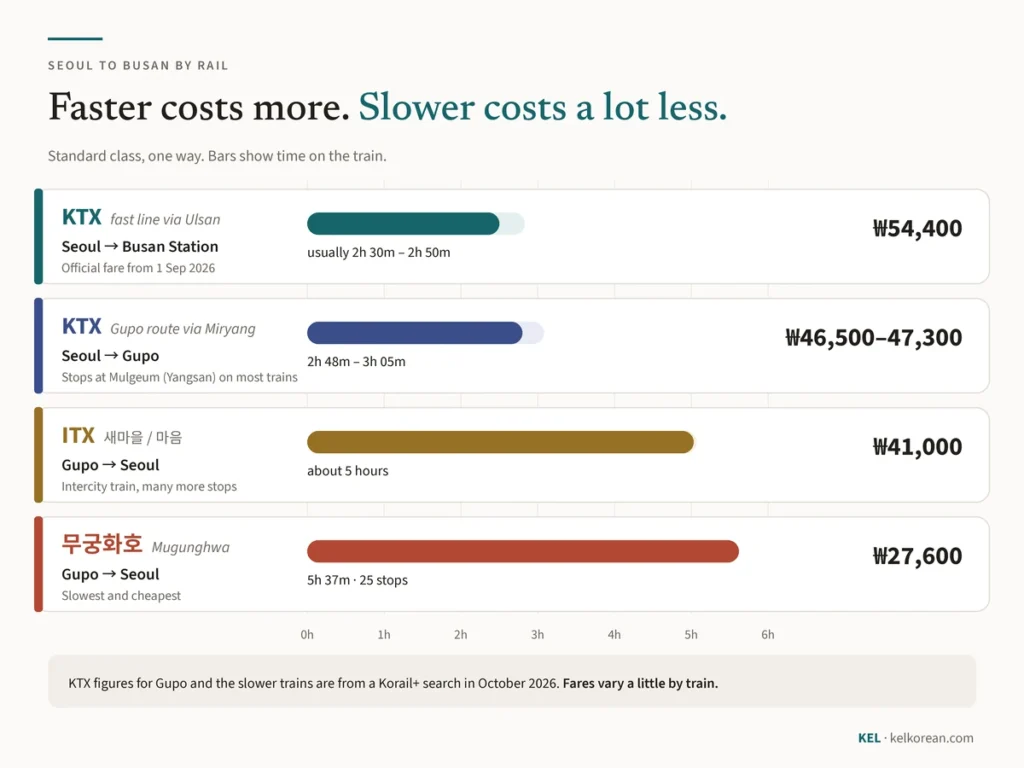
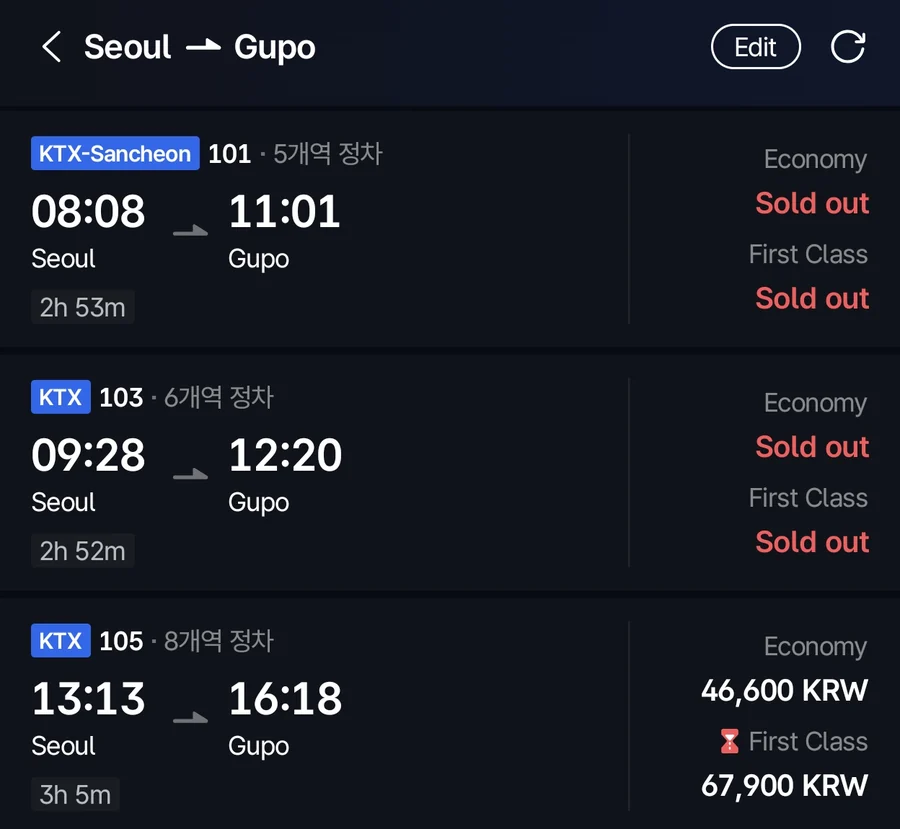
The difference is not small. On the afternoon I searched from Gupo to Seoul, the KTX took 3 hours 9 minutes for ₩47,000. The ITX trains took just over five hours for ₩41,000, and the Mugunghwa took 5 hours 37 minutes, stopping at 25 stations, for ₩27,600. If you want a slow, cheap ride through the countryside, it is right there in the same list. If you are in a hurry, look for the blue KTX label.
Two bits of Korean sit under every train: N개역 정차, “stops at N stations,” and 소요, “time taken.” Fewer stops means a faster train between the same two stations. And if you see 객실 없음 next to 특실, it simply means that train has no first-class car.
3. Choose a seat — and watch for “Reverse”
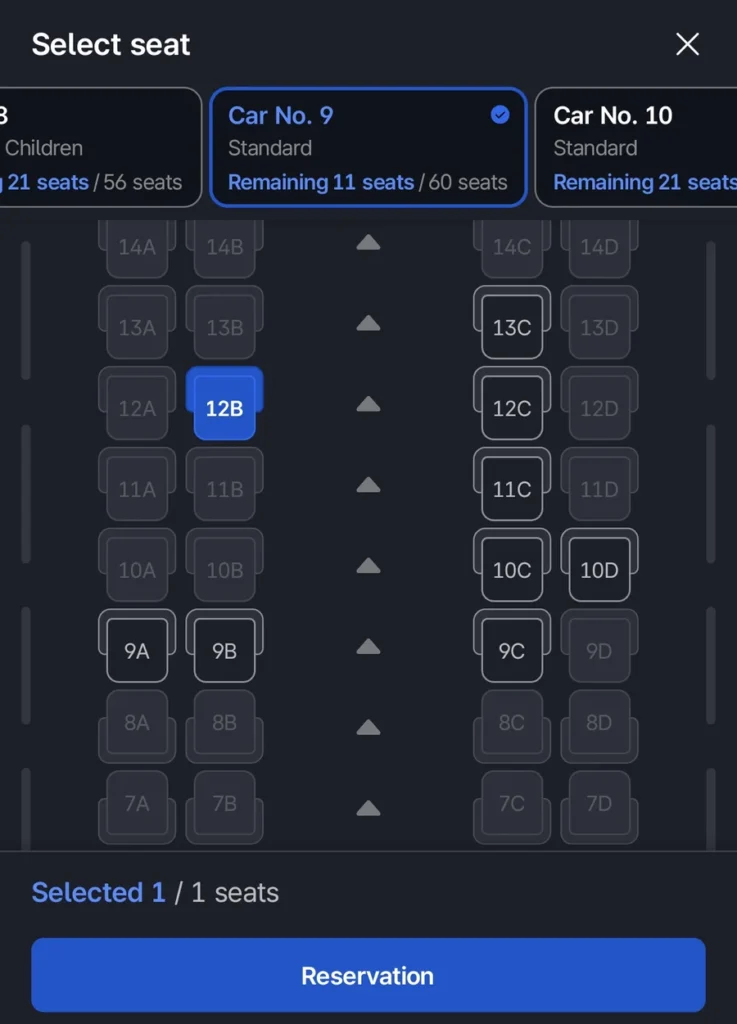
Tap a price and the seat map opens. Along the top, each car is listed with its number, its class and how many seats are left — “Car No. 9, Standard, Remaining 11 seats / 60 seats” in my screenshot. Swipe sideways to see the other cars. Pale seats are taken; outlined seats are free.
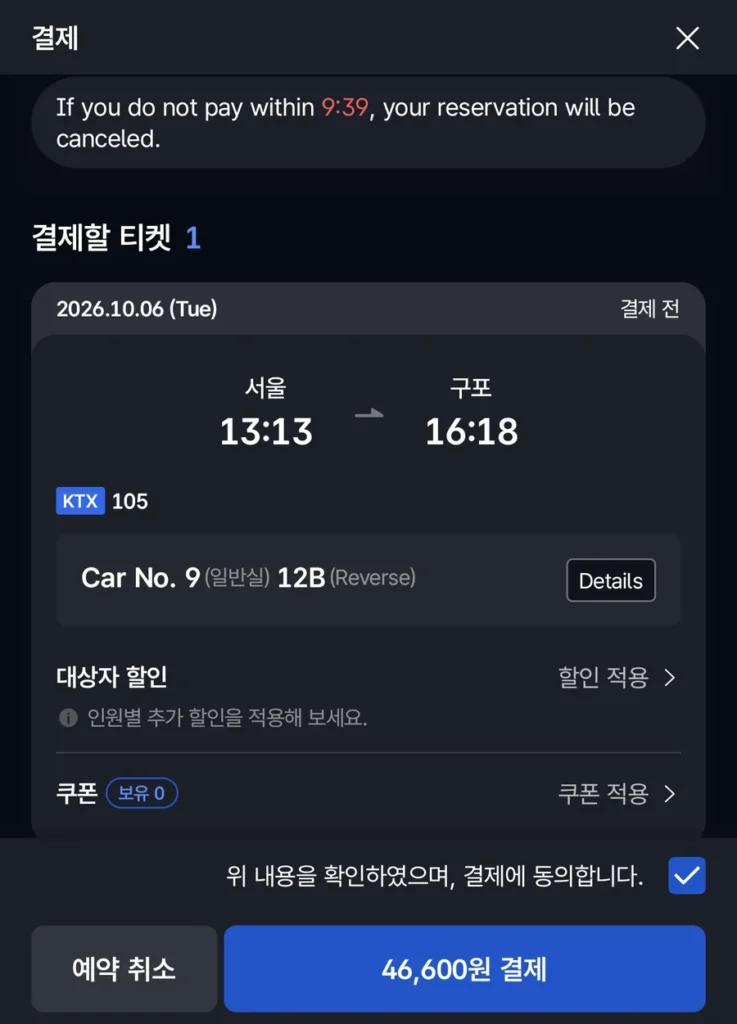
Now look at the small triangles running down the aisle. They point the way the train will travel. On some KTX trains, a large share of the seats are fixed facing backwards, and the seat map does not label them — I only found out on the next screen, where my seat appeared as 12B (Reverse). In Korean that is 역방향, “reverse direction,” and the forward-facing seat is 순방향. A reverse seat costs exactly the same — mine was ₩46,600, the same as the price in the list — so if riding backwards bothers you, check before you pay and go back if needed.
One more thing on this screen: the app calls the cheaper class Standard here and Economy in the train list. They are the same thing, 일반실. First class is 특실.
4. Booking without an account
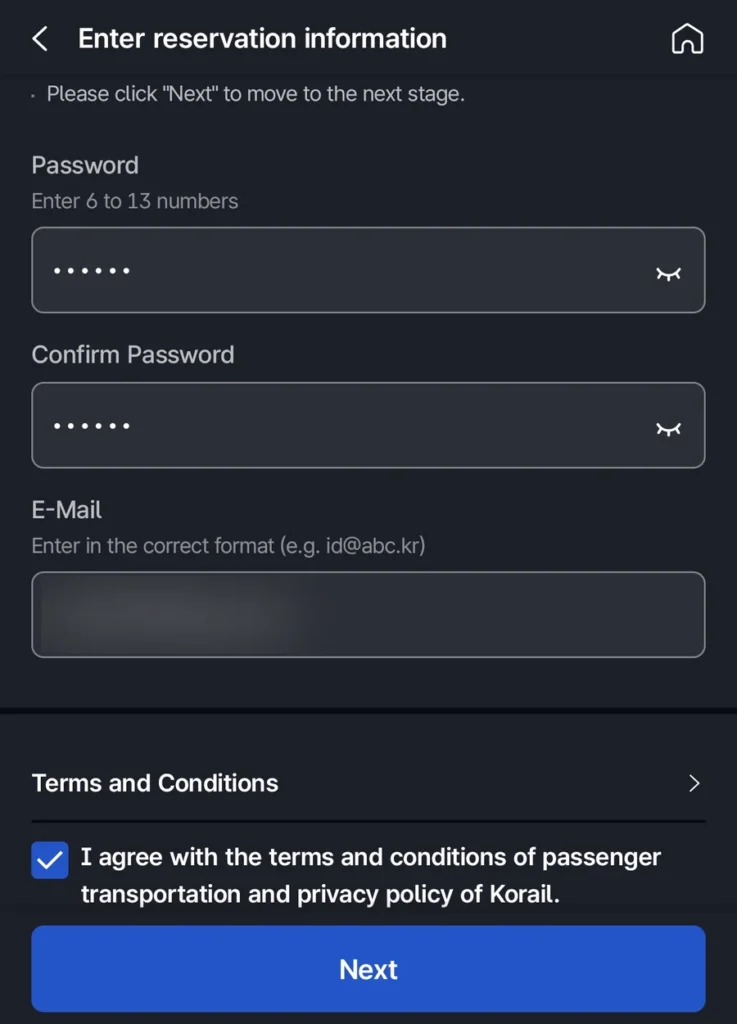
If you are not logged in, Korail+ lets you book as a non-member, and it asks for surprisingly little. When I tested it, the reservation screen wanted only two things: a password made of 6 to 13 numbers, entered twice, and an email address. No name, no phone number, no passport.
Write the password down. It is a number you invent on the spot, and it is what ties the ticket to you if you need to find it again on another device or cancel it later.
5. Pay within ten minutes
The payment screen gives you a countdown — “If you do not pay within 9:39, your reservation will be canceled” — and the seat is held only until it runs out. This is also the screen where English mode gives up most visibly. On my phone, almost everything below the countdown was in Korean:
| On screen | Romanisation | Meaning |
|---|---|---|
| 결제 | gyeolje | Payment |
| 결제할 티켓 | gyeoljehal tiket | Tickets to pay for |
| 결제 전 | gyeolje jeon | Not yet paid |
| 대상자 할인 | daesangja harin | Discounts for eligible passengers (children, seniors and so on) |
| 쿠폰 | kupon | Coupon |
| 위 내용을 확인하였으며, 결제에 동의합니다 | — | “I have checked the above and agree to pay” — tick the box |
| 예약 취소 | yeyak chwiso | Cancel the reservation |
| 46,600원 결제 | — | Pay ₩46,600 |
Tick the box, then tap the big blue 결제 button on the right — not 예약 취소 on the left, which throws your seat away.
A word on cards. Korean apps are not always kind to overseas credit cards, and travellers regularly report a foreign Visa or Mastercard failing at the last step for reasons that have nothing to do with their balance — usually the extra security check their own bank adds. If that happens, you have three fallbacks: book on Korail’s website, korail.com, which has an English version (the old letskorail.com address now leads there); buy at a ticket machine or the counter at the station; or use a travel reseller such as Klook, which takes foreign cards normally and charges a little more. Our guide to how to pay in Korea explains why Korean apps and foreign cards fall out so often.
6. Your ticket is on your phone
There is nothing to print and nothing to collect. Korean train stations have no ticket gates on the KTX platforms: you walk on, find your car, and sit in your seat. A conductor walks through with a handheld device that already knows which seats were sold, and will only ask to see your phone if something does not match. If you booked as a non-member, take a screenshot of the ticket as soon as it appears, so you are not relying on mobile data on the platform.
Seoul to Busan: Which Train, Which Station
Most visitors book Seoul Station to Busan Station and never look at the alternatives. That is a perfectly good choice, but it is not the only one, and it is not always the cheapest.
The fast line to Busan Station. Most KTX trains run on the dedicated high-speed line through Daegu and Ulsan and finish at Busan Station. The official standard-class fare since September is ₩54,400. Journey times vary with the number of stops: across Seoul–Busan KTX services in the first eight months of 2026, the average was 2 hours 48 minutes, and fewer than one train in twenty made it in under 2 hours 20.
The Gupo route. A smaller number of KTX trains leave the high-speed line after Dongdaegu and run the last stretch on the older line through Miryang, stopping at Mulgeum in Yangsan and Gupo in the north-west of Busan before reaching Busan Station. They are slower on paper, but if you are going to north-west Busan, Gimhae or Yangsan, they get you closer and they cost less. On the day I searched, Seoul to Gupo cost between ₩46,500 and ₩47,300 and took 2 hours 48 minutes to 3 hours 5 minutes. Gupo is also the station I use most: it sits across a footbridge from Gupo station on Busan Metro Line 3, so you can walk straight onto the subway.
Busan Station itself is on Busan Metro Line 1, near Chinatown and the ferry terminal. If your hotel is in Haeundae or Gwangalli, you will still have a subway ride of the best part of an hour after you arrive, so check where you are sleeping before you decide which station to aim for. The Korean subway guide covers the rest of the journey, and if you have not decided when to come, here is the best time to visit Busan from someone who lives here.
When Tickets Open, and How Fast They Go
Since 1 October 2026, KTX tickets go on sale two months before departure, at 7 a.m. Korean time. Korea’s transport ministry made the change so that visitors could book trains at the same time as their flights. A train on 31 December, for example, opens for booking at 7 a.m. on 31 October.
For an ordinary weekday, you rarely need to be that organised. Fridays, Sunday afternoons and the trains around public holidays are different. When I searched one popular date to take these screenshots, the first two morning trains from Seoul were already sold out in both classes, and the app said so in red. Sold out on an English screen is 매진 on a Korean one.
A sold-out train is not always a lost cause. Koreans cancel a lot, because cancelling a weekday ticket costs nothing until a few hours before departure (more on that below), and those seats go straight back on sale. Tap the refresh arrow at the top of the list over the following days and seats often reappear. On some routes, when every seat is gone, Korail also sells 입석 (standing tickets) or seats in a 자유석 (unreserved) car, where you sit wherever is free.
The two big holidays, Seollal and Chuseok, work differently. Holiday tickets go on sale in special booking periods announced weeks in advance, and they sell out almost at once. If your trip falls in a holiday week, look up the dates for that year before anything else.
Changing Your Mind: What a Refund Costs
Korail’s refund rules are generous if you cancel early and on a weekday.
- Within ten minutes of paying, a cancellation is free — useful if you pick the wrong date.
- Monday to Thursday trains can be cancelled free of charge until three hours before departure.
- Friday to Sunday and public holiday trains carry fees that start earlier and run higher, rising as departure gets closer.
- After the train has left, you can still get part of the fare back until it reaches your destination, but the deduction climbs steeply.
The exact percentages are shown in the app before you confirm a refund. In Korean, a refund of a ticket is 반환 — you will see it on the button in your ticket list rather than the more general word for a refund, 환불.
Is the KORAIL PASS Worth It?
The KORAIL PASS is an unlimited-ride pass for a set number of days, sold only to foreign visitors, through Korail’s website and travel resellers. With it you reserve seats on KTX and other Korail trains at no extra cost.
Whether it pays off is simple arithmetic, and the September fare cut has made the arithmetic less generous. Before you buy, add up the single fares for the trips you actually plan — Seoul to Busan is now ₩54,400 each way — and compare that total with the pass price shown on the day. If you are only doing Seoul to Busan and back, single tickets usually win. If you are crossing the country three or four times in a few days, the pass starts to make sense.
The Korean on Your Ticket and at the Station
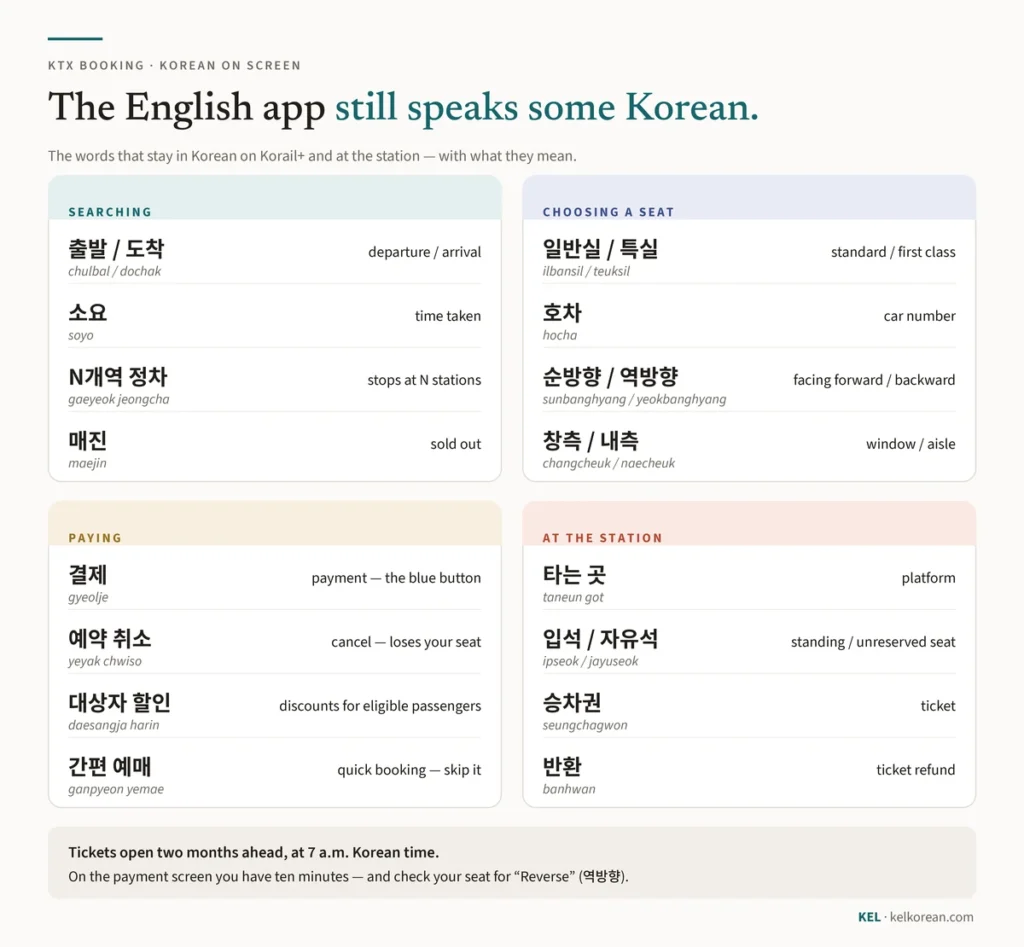
Between the parts of the app that stay in Korean and the signs at the station, these are the words worth knowing.
| Korean | Romanisation | Meaning |
|---|---|---|
| 예매 | yemae | Booking in advance |
| 승차권 | seungchagwon | Ticket |
| 출발 / 도착 | chulbal / dochak | Departure / arrival |
| 소요 | soyo | Time taken |
| 정차 | jeongcha | Stop (at a station) |
| 일반실 / 특실 | ilbansil / teuksil | Standard / first class |
| 호차 | hocha | Car number — 9호차 is car 9 |
| 순방향 / 역방향 | sunbanghyang / yeokbanghyang | Facing forward / facing backward |
| 창측 / 내측 | changcheuk / naecheuk | Window seat / aisle seat |
| 매진 | maejin | Sold out |
| 입석 / 자유석 | ipseok / jayuseok | Standing / unreserved seat |
| 타는 곳 | taneun got | Platform |
| 반환 | banhwan | Ticket refund |
| 적립 | jeongnip | Points earned (members only) |
That last word explains the little orange M 5% 적립 badge next to every KTX price: members collect 5% of the fare as mileage. As a non-member you simply do not collect it.
Listen for the station names, too. Korean adds an n sound in front of 역 (station) after certain endings, so 서울역 is said [서울력], Seoullyeok, and 부산역 is said [부산녁], Busannyeok. That is what you will hear in the announcements.
And five sentences for the counter and the train:
| Korean | Romanisation | Meaning |
|---|---|---|
| 부산 가는 KTX 한 장 주세요. | Busan ganeun KTX han jang juseyo. | One KTX ticket to Busan, please. |
| 창측 자리 있어요? | changcheuk jari isseoyo? | Is there a window seat? |
| 몇 번 타는 곳이에요? | myeot beon taneun gosieyo? | Which platform is it? |
| 이거 부산 가는 기차 맞아요? | igeo Busan ganeun gicha majayo? | Is this the train to Busan? |
| 여기 제 자리인 것 같아요. | yeogi je jariin geot gatayo. | I think this is my seat. |
The last one is the most useful sentence in this guide. Someone in your seat has usually just misread a car number, and “I think” — 것 같아요 — keeps it polite. For the phrases you will need everywhere else on the trip, see our Korean phrases for travelers; if the 24-hour times on the ticket slow you down, our guide to telling time in Korean will help.
On the Day
- Arrive fifteen to twenty minutes early at a big station like Seoul or Busan. The departure boards show the platform, 타는 곳, for each train shortly before it leaves.
- Find your car on the platform. Car numbers are marked on the platform floor, and again above each door of the train, so you can stand where your car will stop instead of walking the length of the train.
- Be ready at intermediate stops. The KTX usually stops for only two or three minutes at stations along the way. If you are getting off at Mulgeum or Gupo rather than the end of the line, be at the door with your bag when the announcement comes.
- Luggage goes at the end of the car, in the luggage space by the doors, or overhead if it fits. Do not leave a suitcase standing in the aisle — on a full train it blocks the way for everyone.
- Keep phone calls short, or take them in the space between cars. Korean trains are quiet, and people notice.
Two Months, Ten Minutes, One Seat
If you remember three things from this guide, make them these. Tickets open two months ahead at 7 a.m., and for a Friday or a holiday that is when you should book. Once a seat is on the payment screen you have ten minutes to pay for it. And before you tap 결제, look at your seat number for the word Reverse — because two and a half hours is a long time to watch Korea disappear behind you.
Before you go, set up the other apps worth installing for a trip to Korea. The trains are the easy part.
Written by Minhyung Cha — 25 years teaching Korean, and 15+ years running an English academy in South Korea. I live and work in Busan, and every example on this site is checked as a native speaker. More about KEL.
Leave a Reply