Search for a Korean jesa table — the 제사상, the table of food set out for an ancestral rite — and you will mostly find two kinds of picture. One is a diagram with neat rows of labelled boxes. The other is a museum reconstruction — every dish perfect, the table untouched by anyone who actually has to cook for it.
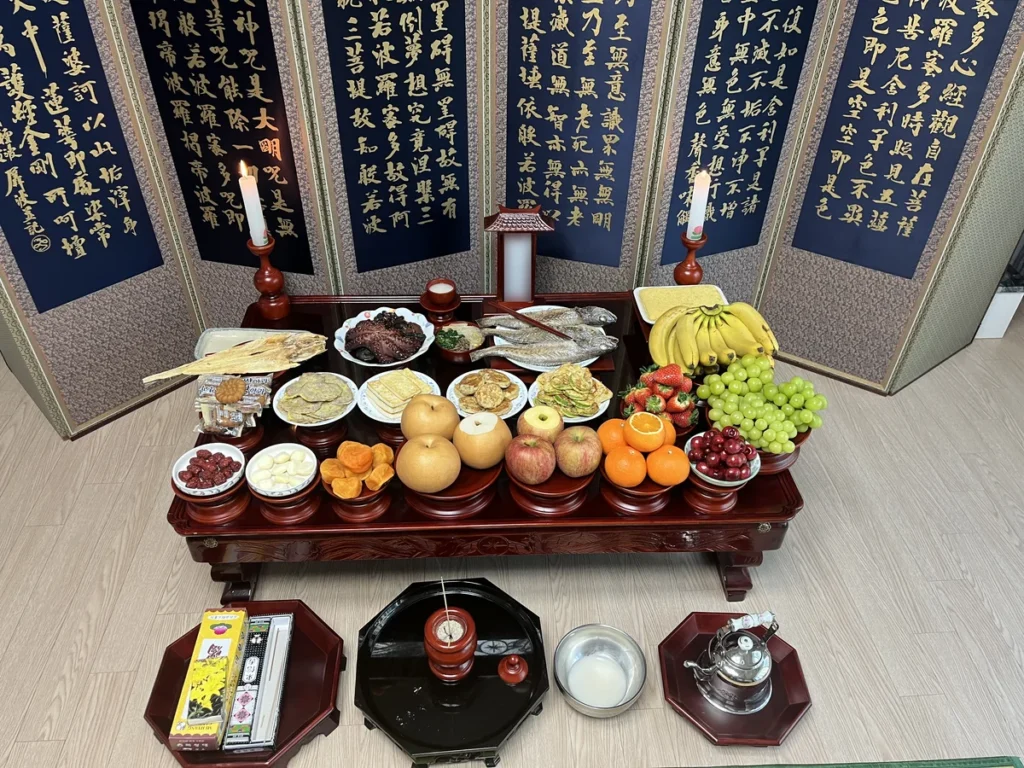
This is neither. It is our family’s table, set in our living room. It has bananas on it. The honey cookies are still in their plastic wrappers. And it breaks at least one of the famous rules you are about to read.
That is the point of showing it. The diagrams tell you what Koreans were taught. A real table tells you what Koreans actually do — and the gap between the two is where almost every interesting thing about 제사 lives.
One Table, Two Rites
Koreans hold two kinds of ancestral rite. 제사 (jesa) is held on the anniversary of a particular person’s death. 차례 (charye) is held on the mornings of Chuseok and Lunar New Year. Our guide to Chuseok covers the difference in timing and why the holiday rite is literally called a “tea rite.”
In the ritual manuals the two are not equal. The holiday rite is the lighter one: no written prayer is read, and the wine is offered once rather than three times. The anniversary rite is the full ceremony, with rice and soup, a prayer, and three rounds of wine.
In our house, the food on the two tables is the same. The Chuseok table and the anniversary table look like the photo above, give or take whatever fruit was good that month. I do not think we are unusual. In most families I know, the difference between the two rites survives in the procedure, not on the plates — once a family has settled on what “our table” looks like, it stops changing with the calendar.
So everything below applies to both. When a Korean says 제사상 (jesasang, “rite table”), this is what they are picturing.
The Table, Plate by Plate
Here is every item in the photo, numbered. The table is read from the family’s side — you are standing where we stand, facing the tablet.
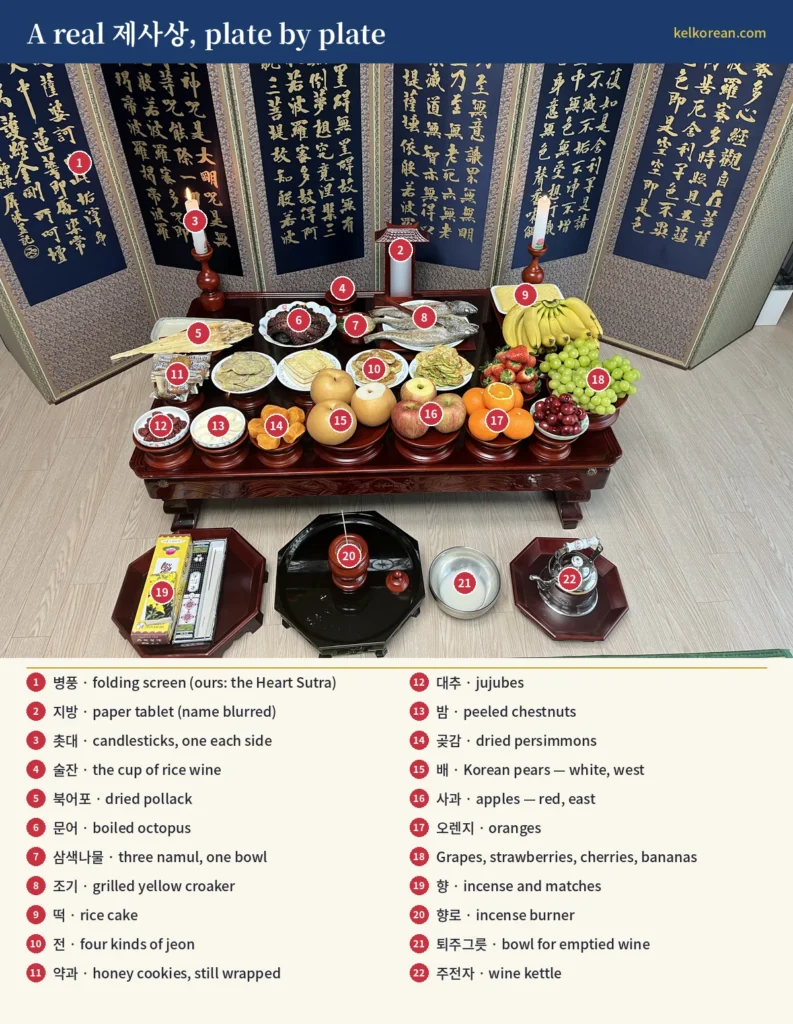
It sorts into four groups, and once you see them the table stops looking like a heap of food.
| Where | What is there | What it is for |
|---|---|---|
| Back, against the screen | 병풍 folding screen, 지방 tablet, two candles, the wine cup | The ancestor’s side of the table |
| Back row of food | 북어포 dried pollack, 문어 octopus, 나물 greens, 조기 croaker, 떡 rice cake | The cooked dishes |
| Middle row | Four kinds of 전, and 약과 | Pan-fried food and sweets |
| Front row | 대추, 밤, 곶감, 배, 사과, oranges, cherries — and more fruit behind | Fruit, closest to the family |
| On the floor | Incense, incense burner, a bowl for emptied wine, the wine kettle | The tools of the rite itself |
If any of the dish names are new, our guide to food in Korean covers the everyday versions — 전, 나물 and 떡 all turn up on ordinary tables too.
The Rules Everyone Quotes
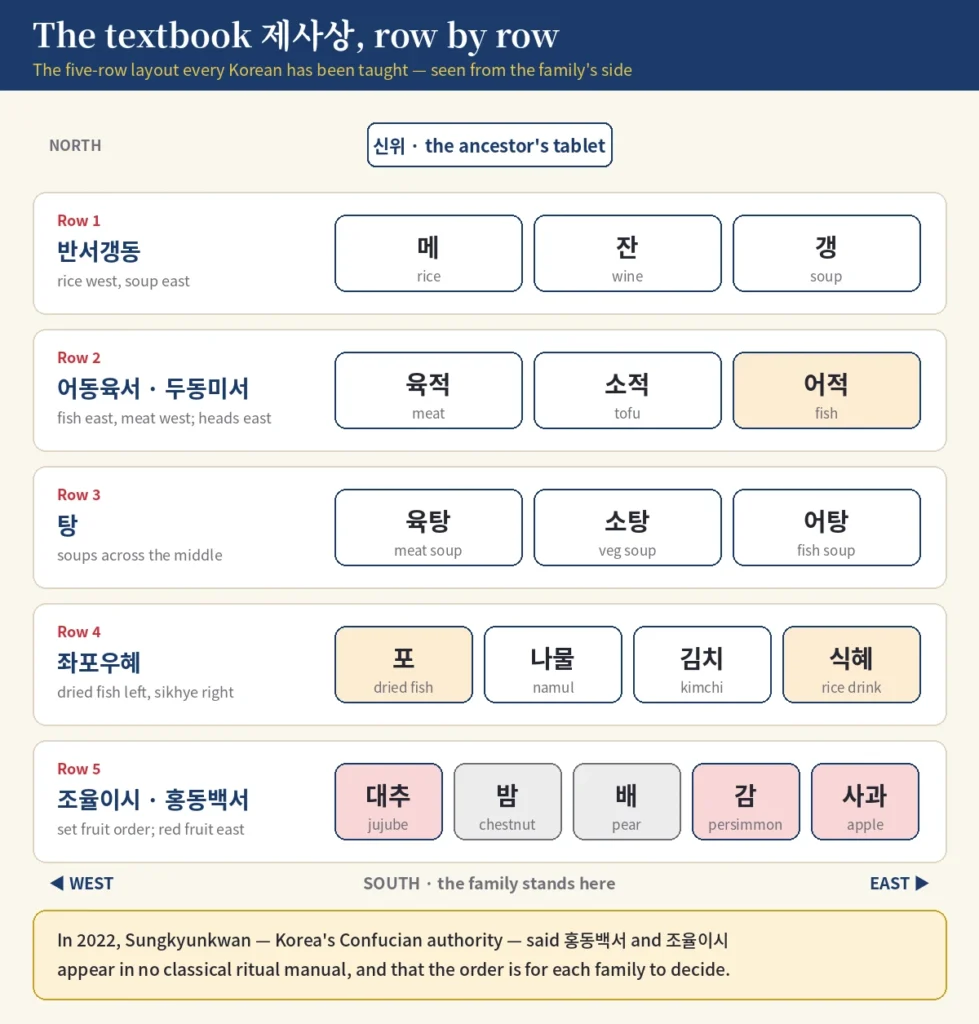
Every Korean has heard the table rules, usually from an aunt, usually while being told they have put something in the wrong place. They come as four-character phrases, and the core set looks like this:
| Rule | Hanja | What it says |
|---|---|---|
| 홍동백서 | 紅東白西 | Red fruit to the east, white fruit to the west |
| 조율이시 | 棗栗梨枾 | Fruit in the order jujube, chestnut, pear, persimmon |
| 어동육서 | 魚東肉西 | Fish to the east, meat to the west |
| 두동미서 | 頭東尾西 | A fish lies with its head to the east |
| 좌포우혜 | 左脯右醯 | Dried fish on the left, 식혜 rice drink on the right |
“East” means your right. The tablet is treated as facing south, whichever way your apartment actually faces, so when you stand in front of the table, east is on your right hand and west is on your left. That one fact decodes all five rules.
The textbook version puts the whole table into five rows, running from the tablet out towards the family: rice and soup at the back, grilled dishes, soups, dried and cold dishes, and fruit in front.
Now Check Our Table Against Them
This is the useful exercise, and it is why a real photo beats a diagram.
The fish pass. The croaker lie with their heads to the right — east — exactly as 두동미서 says. There is no grilled meat competing with them, so 어동육서 has nothing to arrange.
The dried pollack passes. It sits at the far left of the back row, which is where 좌포우혜 puts it.
The pears and apples pass. White pears on the left, red apples on the right: 홍동백서, correctly done.
The front row does not. Read it from the left: jujube, chestnut, dried persimmon, pear. That is not 조율이시. It is 조율시이 — persimmon before pear — and it is not a mistake. Both orders are in common use, and families argue about which is correct with complete confidence on both sides.
And the rules contradict each other. Look at the far left of the front row. Jujubes are the reddest thing on the table, and 조율이시 puts them in the westernmost seat — exactly where 홍동백서 says red things must not go. You cannot obey both. Every Korean family that follows “the rules” has quietly decided which one wins, usually without noticing there was a decision.
That contradiction is a clue. Rules handed down intact from one authoritative source do not usually collide like that.
The Famous Rules Are Not in the Old Books
In September 2022, just before Chuseok, 성균관 (Sungkyunkwan) — the Confucian institution that is the closest thing Korea has to an authority on these rites — held a press conference and said so directly.
Its ritual committee’s position was that 홍동백서 and 조율이시 appear in no classical text on ritual. The manuals simply say “fruit,” and the committee said the order on the table does not matter. It proposed a standard Chuseok table of about nine items built on six basics — 송편, 나물, a grilled dish, kimchi, fruit and wine — with meat, fish and rice cake as optional additions.
It also said something that made headlines: you do not have to fry anything. The committee cited the seventeenth-century scholar 김장생, whose writings say that offering oily foods at a rite is not correct practice. The line the news ran with was the committee’s own: nobody needs to suffer over the frying pan any more.
The committee added two more points that surprise people. A photograph of the ancestor can stand in for the paper tablet. And the final word on what goes on the table belongs to the family, by agreement.
Now look at our table again. Four kinds of 전. And 약과 — which is, precisely, one of the fried honey confections the old text names as improper. We fry anyway. So does nearly every family I know. The announcement changed the conversation more than it changed the tables, and I think that is honest to say: the 전 are not there because of a rule. They are there because the family expects them, and because making them together is half of what the day is.
Bananas on an Ancestral Table
Foreign visitors always point at the bananas. Then the shine muscat grapes, the strawberries, the cherries. None of these would have been on a Joseon table, and the diagrams never show them.
They are there for the simplest reason: the table is set for a particular person, and people eat what they like. The same 2022 announcement pointed to a principle in 김장생’s writings — that a rite does not offer things the person never ate in life — and drew the obvious conclusion that offering food the person actually enjoyed is not against the rules. Plenty of families put out a grandfather’s favourite snack or a grandmother’s favourite fruit, and nobody serious objects.
Look closely at the fruit and you will notice something else.
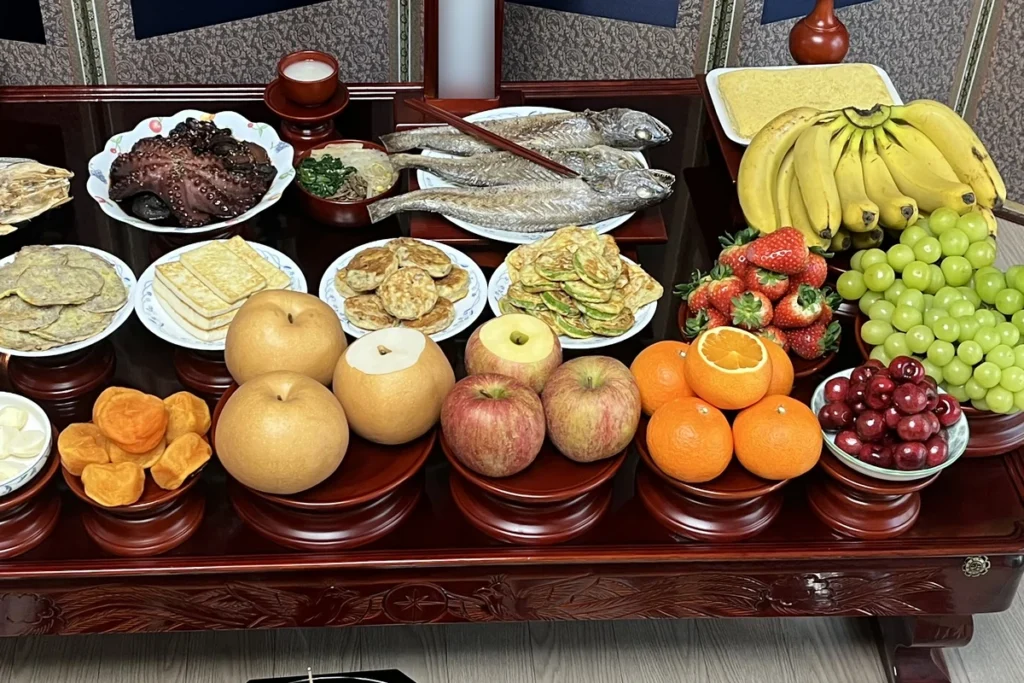
The tops are sliced off. The pear has a flat white disc where its crown was, the apple too, and one orange is cut open. This is one of the most widespread habits on Korean ritual tables. The explanation you will usually hear is that the fruit is “opened” so the ancestors can eat it; practically, it also shows the fruit is fresh. I have never met anyone who could cite where the custom comes from, and I have never met a family that skips it.
The fruit also sits on tall wooden footed dishes, 제기 (jegi), rather than plates. The height is the point — food for the ancestors is raised off the table, not set on it.
The Octopus Tells You Where We Live
There is a whole boiled octopus near the top of our table, and that is a regional signature.
In the southeast, 문어 on the ancestral table is ordinary. Much of Gyeongsang Province treats it as a dish you would be embarrassed to leave off — the octopus is expensive, which is part of the point. Further inland in the same region you will find 돔배기, salted shark, which families around Daegu and Yeongcheon regard as essential; along parts of the east coast, some families have historically put out whale.
A family from Seoul or the southwest might never have seen either on a ritual table. There is no national 제사상. There are regional ones, and then family ones inside those — a principle Koreans call 가가례 (gagarye), “every house its own rite.” When two families marry, the tables sometimes merge, and you get octopus and shark side by side.
What Never Goes on the Table
The prohibitions are more consistent across Korea than the arrangement rules, and people hold them more firmly.
| Left off | The reason people give |
|---|---|
| 복숭아 peaches | Peach wood is believed to drive spirits away — including your own ancestors |
| 고춧가루 chilli powder | Red and hot is said to repel spirits, so ritual food is seasoned without it |
| 마늘 garlic | A strong smell, and the same logic as chilli |
| Fish ending in -치 | 갈치, 꽁치, 삼치 — traditionally considered lowly fish |
| Red 팥 beans | Also used to ward off spirits, so rice cake for the rite gets a pale coating instead |
Treat these as folk rules. Like the arrangement rules, nobody can point you to the page they come from. But they are the ones a Korean grandmother will actually stop you over, which is why the 나물 on a ritual table tastes noticeably plainer than the everyday version — no chilli, no garlic.
Everything That Is Not Food
The screen. A 병풍 (byeongpung) closes off the space behind the table and turns a corner of a living room into somewhere formal. Ours carries the Heart Sutra — a Buddhist text standing behind a Confucian rite. Plenty of Korean households would not see anything odd in that, and it is a good illustration of how Korean ritual has never kept its traditions in separate boxes.
The tablet. The strip of white paper in the small wooden shrine is the 지방 (jibang), and for the length of the rite it is the ancestor’s seat. It is written in Hanja to a fixed formula. For a father it reads 顯考學生府君神位; for a mother, 顯妣孺人 followed by her clan seat and surname, then 神位 — “the seat of the spirit.” The titles 學生 and 孺人 are conventional honorifics used whether or not the person ever held rank. The clan seat is the 본관 explained in our guide to Korean names, and because a woman keeps her own surname for life, it is her family’s name on the tablet, not her husband’s. We have blurred ours in the photos. Traditionally the 지방 is burned when the rite ends.
The floor. In front of the table sit the incense and the incense burner, the kettle the wine is poured from, and a bowl into which wine from the cup is emptied between rounds. The rite happens here, on the family’s side of the table. Nobody reaches across the food.
Same Family, Another Year
Here is our table on a different occasion. The structure is identical; the details moved.
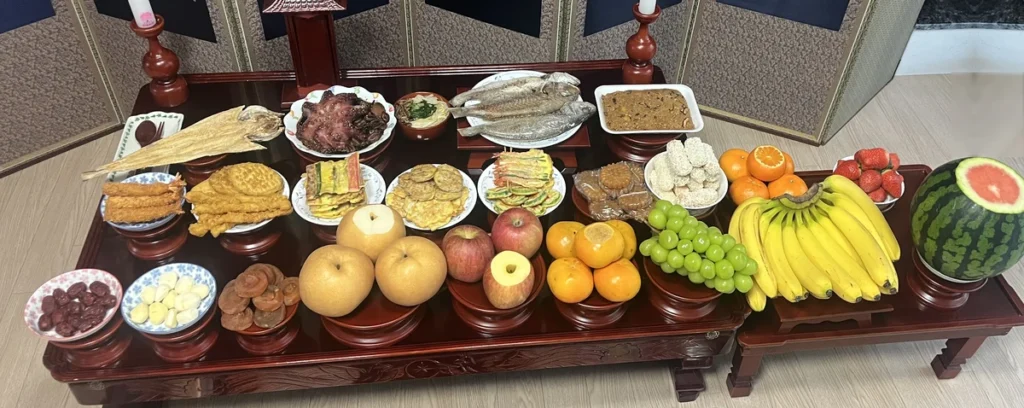
Persimmons took the oranges’ place in the middle. Fried shrimp and a second tray of 전 appeared. The fruit outgrew the table, so a small second table was pushed up against the right side to hold the bananas and a watermelon — with its top sliced off, like everything else.
This is what a family table looks like over time. The fixed points stay fixed — tablet at the back, fish with heads east, fruit in front, the same footed dishes. Everything else depends on who cooked, what was in season, and who is being remembered.
If You Are Invited to One
If you marry into a Korean family, or a close friend asks you home for Chuseok, you may find yourself in front of one of these tables. A few things make it easier.
Do not touch the food. Nothing on the table is eaten until the rite is over — not a grape, not a corner of 전. After the rite, everything is shared, and that shared meal is the warm part of the day.
Follow, do not lead. Families differ on who bows when, how many times, and whether men and women bow separately. Nobody expects a guest to know, and the eldest person present will tell you what to do. Watching and copying is exactly right.
Ask before photographing. The table is set for a specific person the family has lost. Most families will say yes — ours obviously did — but it is their call.
Offer to help in the kitchen. This matters more than anything you do at the table. The 전 on that table took hours, and in many households the work still falls on a few people. Our guide to Korean family terms will help you work out who is who while you are there.
Frequently Asked Questions
What is a jesa table?
The 제사상 is the table of food set out for a Korean ancestral rite. It holds the ancestor’s tablet at the back, cooked dishes such as fish, 전 and 나물 in the middle, and fruit and sweets at the front, with incense and wine on the floor in front of it.
What do 홍동백서 and 조율이시 mean?
홍동백서 means red fruit goes on the east side and white fruit on the west. 조율이시 means fruit is laid out as jujube, chestnut, pear, persimmon. In 2022, Sungkyunkwan said neither phrase appears in the classical ritual texts and that the order is for each family to decide.
Can you put bananas or modern fruit on the table?
Yes. Many families do, and the Sungkyunkwan guidance supports offering food the person enjoyed in life. The folk prohibition on peaches is the one fruit rule most families still keep.
Do all Korean families still hold 제사?
No. Many have simplified the table, moved the anniversary rite earlier in the evening, or stopped holding it. Christian families often hold a memorial service instead. Asking a Korean friend what their family does is a perfectly polite question.
A Family Recipe, Not a Test
The diagrams make the 제사상 look like a test with right answers. A real table shows it is closer to a family recipe: a few fixed points everyone agrees on, and around them a layer of habit, region, taste and memory that belongs to one house.
Our table follows three of the famous rules, sets its fruit in a different order from a fourth, and shows that two of them could never both be kept. It has four kinds of 전 that a scholar four hundred years ago would have disapproved of, an octopus that says we live in the southeast, and bananas because bananas were liked. None of that makes it less correct. It makes it ours — which, if you believe the people who wrote the rules down in the first place, was always the point.
If you want the holiday around the table — the songpyeon, the gift sets, what to say — start with our guide to Chuseok, and for the drinking that follows, Korean drinking etiquette.
Written by Minhyung Cha — 25 years teaching Korean, and 15+ years running an English academy in South Korea. I live and work in Busan, and every example on this site is checked as a native speaker. More about KEL.
Leave a Reply