
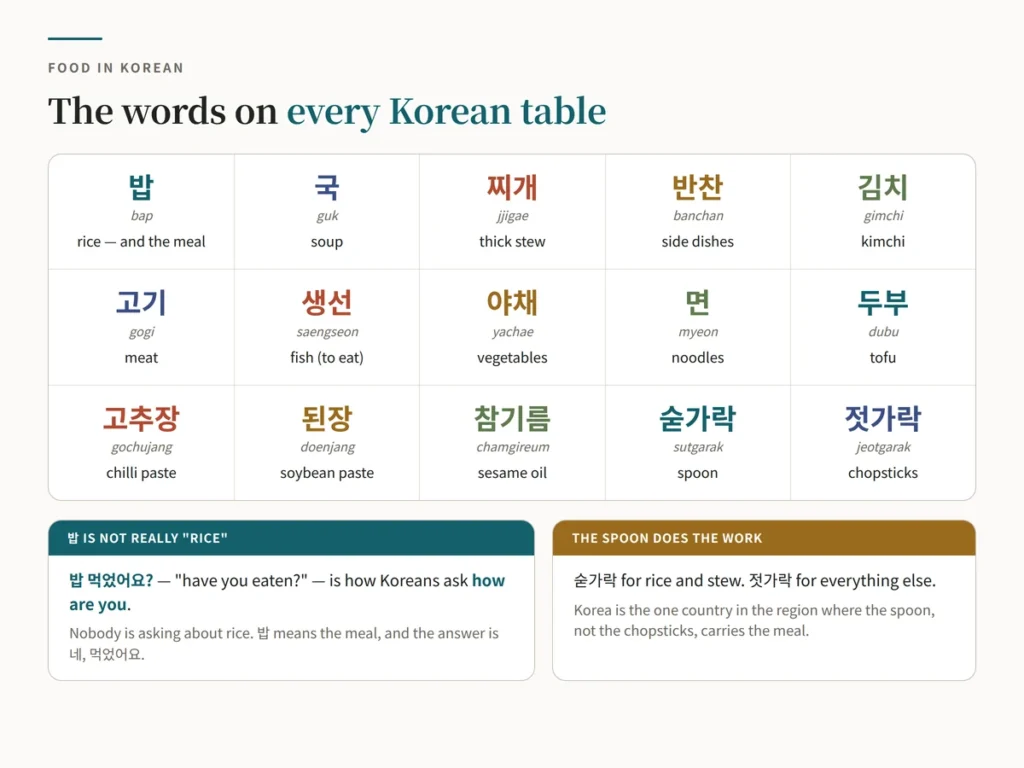
One of the most common things one Korean says to another is not a greeting at all. It is 밥 먹었어요? — “have you eaten?”
It is not a question about food. It is the Korean way of asking whether someone is alright. A mother says it on the phone. A boss says it at 2pm. You are not expected to describe your lunch; you say 네, 먹었어요 and the conversation moves on.
That single habit tells you most of what you need to know about food in Korean. Food is not a topic in this language — it is the frame the language uses for care, for money, for family, and for time.
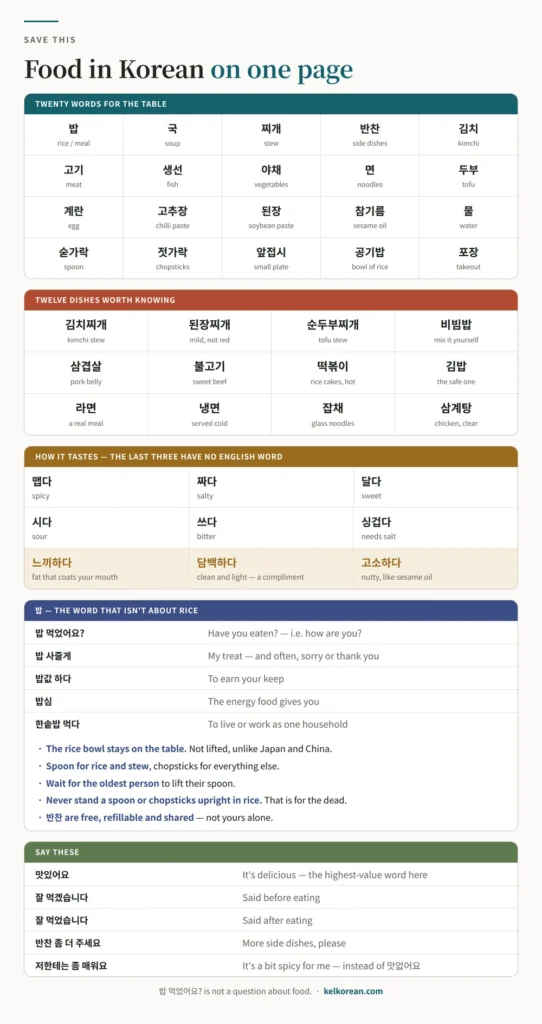
So this guide does two things at once. It gives you the words — twenty dishes, the taste vocabulary, the words on the table — and it tells you what those words are doing when Koreans use them.
밥 Is Not Rice
Open a dictionary and 밥 (bap) is “cooked rice.” That is technically true and practically misleading.
밥 means the meal. It means food in general. It means the thing that keeps you going. A Korean who says 밥 먹으러 가자 is saying “let’s go eat” — nobody is promising you rice.
Once you see it, you find it everywhere:
| Korean | Romanization | Literally | What it means |
|---|---|---|---|
| 밥 먹었어요? | bap meogeosseoyo | Did you eat rice? | How are you? / Are you okay? |
| 밥 먹으러 가자 | bap meogeureo gaja | Let’s go eat rice | Let’s go eat |
| 밥 사줄게 | bap sajulge | I’ll buy you rice | My treat — and often, I’m sorry / thank you |
| 밥값 하다 | bapgap hada | To do your rice-price | To earn your keep |
| 밥심 | bapsim | Rice-strength | The energy food gives you |
| 한솥밥 먹다 | hansotbap meokda | To eat from one pot | To live or work as one household |
밥심으로 산다 — “we live on 밥심” — is something Koreans say only half-jokingly about themselves. The claim is that a Korean who has skipped a proper meal is not fully operational, and the word exists because enough people believe it.
밥 사줄게 is the one to remember. It is the standard Korean apology, thank-you and congratulations, all at once. If you have done someone a favour and they say 내가 밥 살게, they are not being casual. They are settling a debt the only way the culture has a word for. This is 정 in its everyday form, and our guide to nunchi, jeong and han covers where that bond comes from.
There is one more, and it has two lives. 밥맛없다 normally just means “to have no appetite” — 요즘 밥맛이 없어요 is what you say when you have been off your food. But turned on a person, it flips into an insult meaning insufferable or off-putting, and the clipped 밥맛이야 is the blunt version of that. Recognise the second one; do not use it.
And the word for family works the same way. 식구 literally counts the mouths that eat together — which is why it means household rather than bloodline. That word, along with the rest of the family tree, is covered in our guide to Korean family terms.
Twenty Dishes, and What You Are Actually Getting
Most food lists give you a name and a translation. The translation is rarely the problem — what people actually want to know is what arrives at the table.
| Korean | Romanization | What arrives | Heat |
|---|---|---|---|
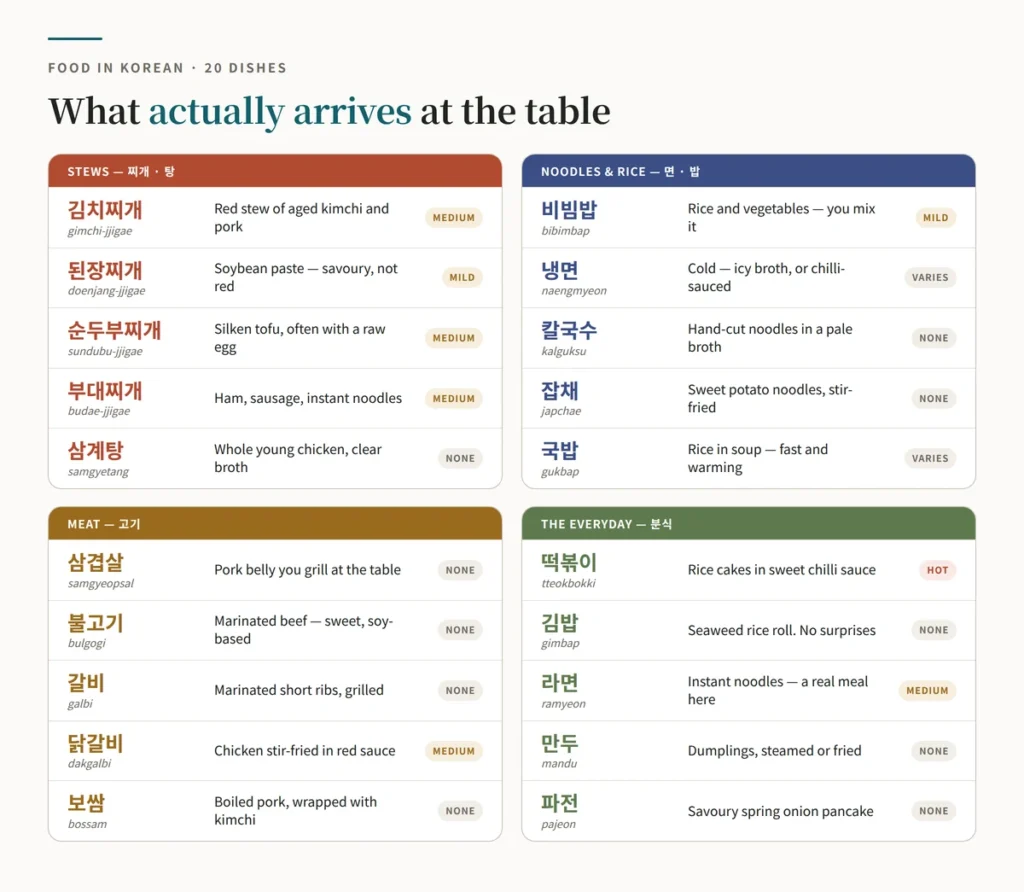
| 김치찌개 | gimchi-jjigae | Bubbling red stew of aged kimchi and pork | Medium |
| 된장찌개 | doenjang-jjigae | Soybean paste stew — brown, savoury, not a red dish | Mild |
| 순두부찌개 | sundubu-jjigae | Silken tofu stew, red, often with a raw egg dropped in | Medium |
| 부대찌개 | budae-jjigae | Stew with ham, sausage, instant noodles — a post-war dish | Medium |
| 비빔밥 | bibimbap | Rice with vegetables on top; you mix it yourself | Mild |
| 불고기 | bulgogi | Thin marinated beef, sweet and soy-based | None |
| 삼겹살 | samgyeopsal | Unmarinated pork belly you grill at the table | None |
| 갈비 | galbi | Marinated short ribs, grilled | None |
| 닭갈비 | dakgalbi | Chicken stir-fried at the table in red sauce | Medium |
| 떡볶이 | tteokbokki | Rice cakes in sweet chilli sauce — the national snack | Medium-hot |
| 김밥 | gimbap | Seaweed rice roll, cut into coins | None |
| 라면 | ramyeon | Instant noodles in red broth — a real meal here | Medium |
| 냉면 | naengmyeon | Cold noodles — in icy broth (물냉면) or chilli-sauced (비빔냉면) | Varies |
| 칼국수 | kalguksu | Hand-cut noodles in a pale broth | None |
| 잡채 | japchae | Sweet potato noodles stir-fried with vegetables | None |
| 삼계탕 | samgyetang | Whole young chicken stuffed with rice, in clear broth | None |
| 국밥 | gukbap | Rice served in soup — the fast, cheap, warming meal | Varies |
| 파전 | pajeon | Savoury spring onion pancake | None |
| 만두 | mandu | Dumplings, steamed or fried | None |
| 보쌈 | bossam | Boiled pork sliced thin, wrapped in leaves with kimchi | None |
Two of these are more useful than the rest. 김밥 is the thing to know when you are hungry, in a hurry and not feeling adventurous — it is cheap, everywhere, and nothing in it will surprise you. 된장찌개 is the safe order at any restaurant that looks intimidating: deeply savoury, not a red dish, and it comes with rice and sides.
And one is a trap. 물냉면 is genuinely cold — broth with actual ice in it. In midsummer it is the best thing in the country. Ordered in February by someone who did not read the 냉, it is a surprise. Its sibling 비빔냉면 has no broth at all and comes tossed in chilli sauce, so the two halves of that menu are not interchangeable.
If you want the phrases that go around these dishes — getting the server’s attention, ordering, asking for the bill — that is a separate guide: how to order food in Korean covers the whole script from door to door.
How Food Tastes — Nine Words, and Three English Does Not Have
This is the part most food guides skip, and it is the part that makes you sound like you have actually eaten here.
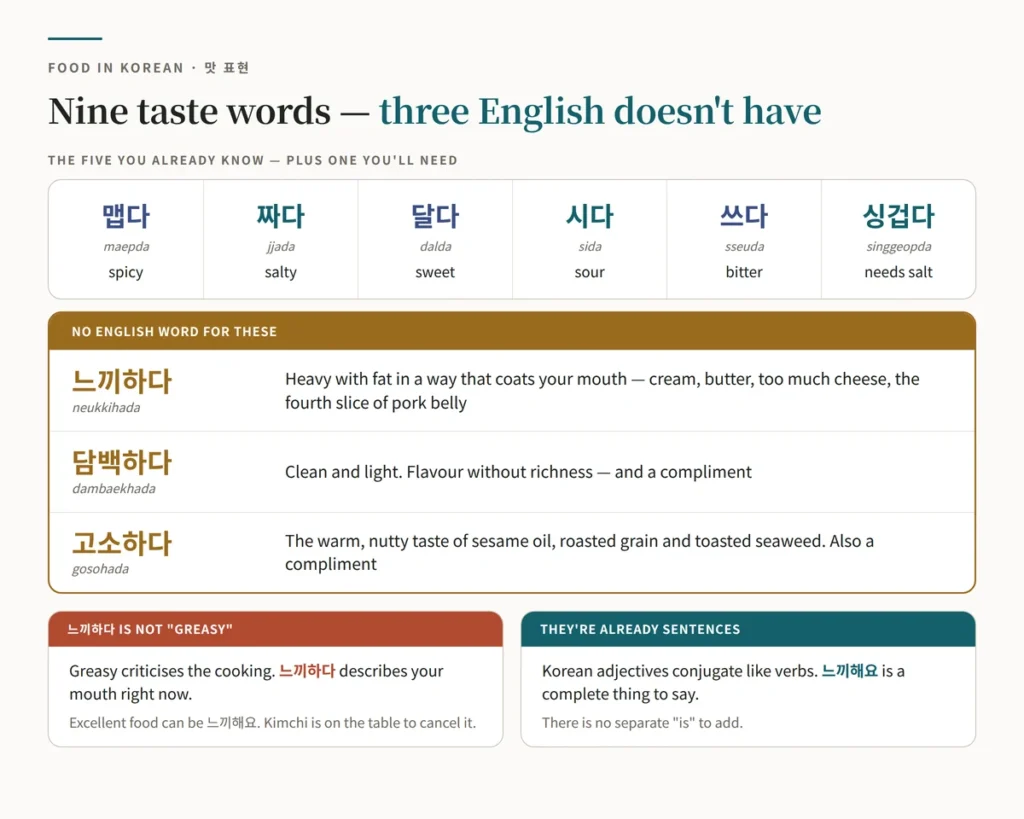
The five English already knows:
| Korean | Romanization | Meaning |
|---|---|---|
| 맵다 | maepda | spicy |
| 짜다 | jjada | salty |
| 달다 | dalda | sweet |
| 시다 | sida | sour |
| 쓰다 | sseuda | bitter |
And one more English does have, but rarely uses: 싱겁다 (singgeopda) — under-seasoned, bland, needs salt. Korean uses it constantly. It is the direct opposite of 짜다, and a Korean cook will ask 싱거워요? the way an English cook asks “does it need salt?”
Now the three that have no English word at all.
| Korean | Romanization | What it describes |
|---|---|---|
| 느끼하다 | neukkihada | Heavy with fat in a way that coats your mouth — cream, butter, too much cheese, the fourth slice of pork belly |
| 담백하다 | dambaekhada | Clean and light — flavour without richness. A compliment |
| 고소하다 | gosohada | The warm, nutty taste of sesame oil, roasted grain, toasted seaweed. A compliment |
느끼하다 is not “greasy.” Greasy is a criticism of the cooking; 느끼하다 describes what is happening in your mouth right now, and it can be true of perfectly good food. Koreans eat kimchi specifically to cancel it — that is what the side dishes on a barbecue table are doing.
담백하다 and 느끼하다 are a pair, and Korean food is built along the line between them. 삼계탕 is 담백해요. Carbonara is 느끼해요. A Korean describing Western food will reach for 느끼하다 within about a minute.
고소하다 is the one you will want first, because it is the taste of sesame oil, and sesame oil is in almost everything. It is also used about roasted peanuts, fresh tofu, and — in a small extension — a laugh you get out of watching someone get what they deserved.
These are adjectives, so they are already sentences. 느끼해요 is a complete thing to say. If that still feels strange, our guide to Korean verb conjugation covers why Korean adjectives conjugate like verbs and need no is.
맛있어요 and the Words Around It
맛있어요 (masisseoyo) is the highest-value word in this entire guide. Say it in any Korean restaurant and watch what happens to the owner’s face.
| Korean | Romanization | Meaning |
|---|---|---|
| 맛있어요 | masisseoyo | It’s delicious |
| 진짜 맛있어요 | jinjja masisseoyo | This is really good |
| 맛없어요 | madeopseoyo | It’s not good |
| 괜찮아요 | gwaenchanayo | It’s fine (polite, non-committal) |
| 별로예요 | byeollo-yeyo | Not great (soft, but it is a no) |
| 잘 먹겠습니다 | jal meokgetseumnida | Said before eating |
| 잘 먹었습니다 | jal meogeotseumnida | Said after eating |
맛있다 is built from 맛 (taste) + 있다 (to exist). Literally, “taste exists.” And 맛없다 is “taste does not exist” — which is why the two look so similar and sound so different.
Watch the romanization of 맛없어요. You would expect ma-seop-seo-yo, and it is not that. The ㅅ hardens to a ㄷ, so it comes out 마덥써요. That is the rule working normally: 맛 becomes 맏 before a separate word. 맛있어요 is the exception — the prescribed pronunciation is 마디써요, and the 마시써요 everybody actually says is an officially tolerated alternative. If that kind of change is unfamiliar, our guide to Korean pronunciation rules covers the eight that reshape written Korean when it is spoken.
잘 먹겠습니다 and 잘 먹었습니다 are not optional. The first is said before you eat, the second when you finish, and they are addressed to whoever is paying. Skipping them is the single most common thing that makes a foreign guest look rude without knowing it. They are fixed forms — you do not need to understand the grammar to use them correctly.
Avoid 맛없어요 in a restaurant. It is not mild. If something is genuinely not for you, name the reason instead — 저한테는 좀 매워요 (“it’s a bit spicy for me”) does the job without insulting the kitchen.
Online, the word people actually type is 존맛 or JMT — covered, along with the rest of the internet’s vocabulary, in our guide to Korean texting slang.
반찬 — The Small Dishes
반찬 (banchan) are the side dishes that appear without being ordered. At almost every Korean restaurant they are free and refillable, and asking for more is expected rather than cheeky.
Two things to know that are easy to get wrong:
They are shared, not yours. The small dishes sit in the middle and everyone reaches. Moving one in front of your own plate reads as claiming it.
Do not over-order because they arrived. The 반찬 are the meal’s supporting cast, and they are the reason a single stew and a bowl of rice is a complete dinner here.
The phrase for more is 반찬 좀 더 주세요. The full set of mid-meal requests — scissors, an extra plate, napkins — is in the ordering guide.
The Table Rules Nobody Writes Down
These are not in textbooks because Koreans learn them at four years old and never think about them again.
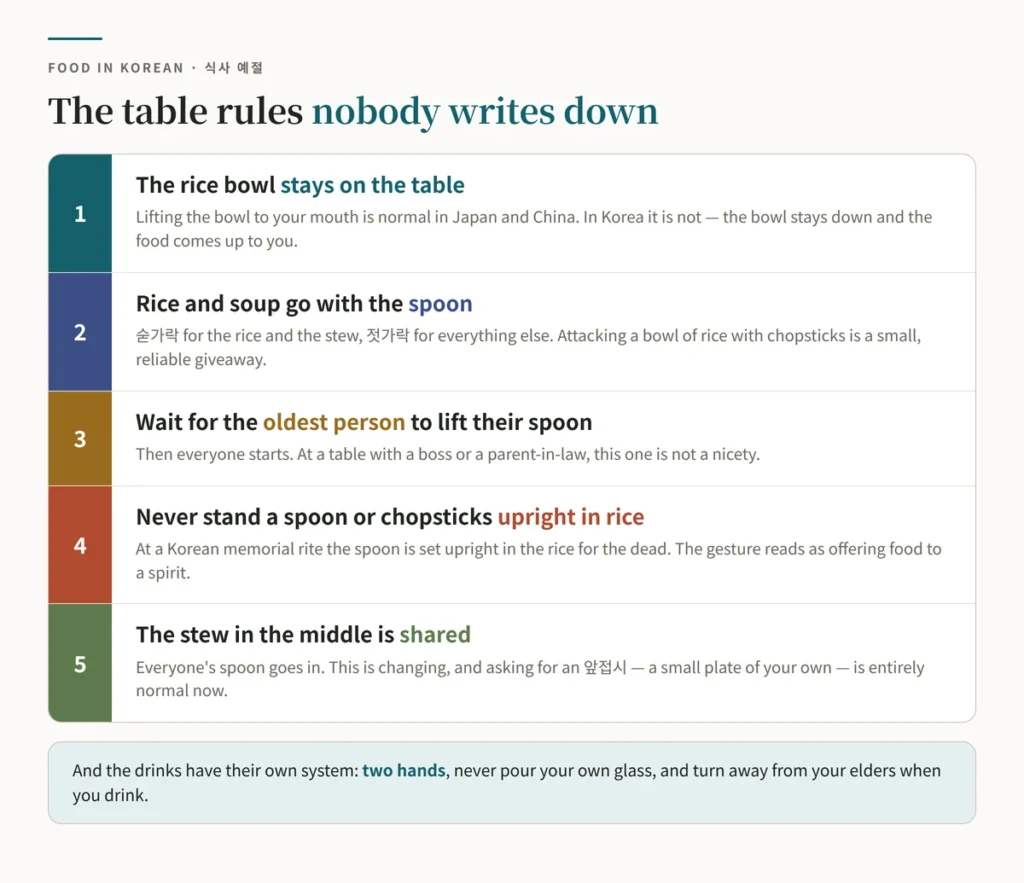
The rice bowl stays on the table. This is the one that catches out visitors who have eaten in Japan or China, where lifting the bowl to your mouth is normal and expected. In Korea it is not. The bowl stays down and the food comes up to you.
Rice and soup are eaten with a spoon. 숟가락 for the rice and the stew, 젓가락 for everything else. Korea is the only country in the region where the spoon does the main work, and a foreigner attacking a bowl of rice with chopsticks is a small, reliable giveaway.
Wait for the oldest person to lift their spoon. Then everyone starts. At a table with a boss or a parent-in-law this is not a nicety.
Never stand a spoon or chopsticks upright in a bowl of rice. At a Korean memorial rite the spoon is set upright in the rice for the dead — 삽시정저 — so the gesture reads as offering food to a spirit. It is not a superstition people shrug at.
The stew in the middle is shared, and everyone’s spoon goes in. This surprises people. It is changing slowly, and asking for an 앞접시 (a small plate of your own) is entirely normal now, but the default at a family table is still one pot.
Pouring drinks has its own rules — two hands, never your own glass, turn away from your elders when you drink. That is a full system in itself, and our guide to Korean drinking etiquette covers it properly.
The Food Words That Escaped Into English
Some of these you already know, and knowing where they came from makes them stick.
| Korean | Romanization | What it is |
|---|---|---|
| 먹방 | meokbang | 먹다 (eat) + 방송 (broadcast) — the eating stream |
| 치맥 | chimaek | 치킨 + 맥주 — fried chicken and beer |
| 혼밥 | honbap | 혼자 (alone) + 밥 — eating by yourself |
| 혼술 | honsul | Drinking alone |
| 김치 | gimchi | Fermented vegetables — there are hundreds, not one |
| 불고기 | bulgogi | 불 (fire) + 고기 (meat) |
| 만두 | mandu | Dumpling |
| 소주 | soju | The clear green-bottle spirit |
혼밥 is the interesting one. It is a recent word, and it exists because eating alone used to be faintly sad in Korea and now, increasingly, is not. The word arrived with the thing it names. You will see 혼밥 환영 (“solo diners welcome”) on restaurant doors — a sign that would have made no sense in 1995.
먹방 went the other way. It is one of very few Korean words to enter English more or less intact, and it did it in about ten years.
김치 is not a single food. 배추김치 is the familiar cabbage one. 깍두기 is cubed radish. 총각김치 is whole small radishes. 물김치 is served in its liquid, cold and barely spicy. A restaurant offering “kimchi” is offering one of several dozen possibilities.
Five Things That Catch People Out
1. Ordering 냉면 without reading the 냉. 냉 means cold. 물냉면 arrives with ice in the broth. This is correct and intentional.
2. Saying 맛없어요 to be honest. It lands far harder than “it’s not really my thing.” Use 별로예요, or say what the actual problem is — 저한테는 좀 매워요.
3. Lifting the rice bowl. Correct in Japan, wrong here. The bowl stays down.
4. Treating 반찬 as a starter course. They are not appetisers and they are not yours alone. They keep coming; there is no need to clear them.
5. Answering 밥 먹었어요? with a description of lunch. It is a greeting. 네, 먹었어요 is the whole answer. If you have genuinely not eaten, 아직요 (“not yet”) will frequently produce food.
Frequently Asked Questions
Does 밥 mean rice or meal?
Both, and the second is more common. 밥 먹었어요? means “have you eaten?”, not “did you eat rice?”. The word covers the meal as a whole, and in expressions like 밥값 하다 (“earn your keep”) it has drifted further still.
Why do Koreans ask if I have eaten?
It is a greeting, roughly equivalent to “how are you?”. It comes from a period when the answer mattered, and it survived as an expression of care. A short 네, 먹었어요 is the expected reply.
What does 느끼하다 mean?
There is no single English word. It describes food that is heavy with fat in a way that coats the mouth — cream sauces, too much cheese, the fourth piece of pork belly. It is not the same as “greasy,” which criticises the cooking. Food can be excellent and 느끼해요 at the same time, and Korean side dishes exist partly to cut it.
Is 고소하다 a compliment?
Yes. It is the warm, nutty taste of sesame oil, roasted grain and toasted seaweed, and Korean food is full of it. Saying 고소해요 about something someone cooked is a good thing to say.
What is the least spicy Korean dish?
불고기, 갈비, 잡채, 만두, 김밥, 삼계탕 and 칼국수 have no chilli in them at all. 된장찌개 is mild rather than chilli-free — it usually has a few slices of green chilli in it — but it is not a red dish. Korean food is not uniformly spicy; the red dishes are simply the famous ones.
Are 반찬 really free?
At almost every Korean restaurant, yes, and refills are free too. A few specialist places charge for particular items, which will be marked on the menu.
Why is the rice bowl not lifted?
Korean table manners differ from Japanese and Chinese ones here. The bowl stays on the table and a spoon brings the rice up. The spoon doing the main work is specific to Korea.
What is the difference between 맛있다 and 맛있어요?
They are the same word at different levels. 맛있다 is the dictionary form — used in writing, and blurted out as an exclamation. To a close friend you say 맛있어. 맛있어요 is the everyday polite form you should use with everyone else. Our guide to Korean honorifics covers the full system.
Final Thoughts
If you learn ten words from this guide, learn these: 밥, 맛있어요, 맵다, 느끼하다, 담백하다, 고소하다, 반찬, 김치찌개, 된장찌개 and 잘 먹었습니다.
That set will get you through a meal, let you describe what you are tasting, and let you say the thing that actually matters at the end of it.
And the next time someone asks 밥 먹었어요?, you will know they are not asking about food.
Written by Minhyung Cha — 25 years teaching Korean, and 15+ years running an English academy in South Korea. Every example on this site is checked as a native speaker. More about KEL.
Leave a Reply