Every English article about Chuseok calls it Korean Thanksgiving. It is the translation everyone reaches for, and it gets the feeling roughly right — family, travel, too much food, a table that took somebody two days to prepare.
It also gets the point of the day wrong.
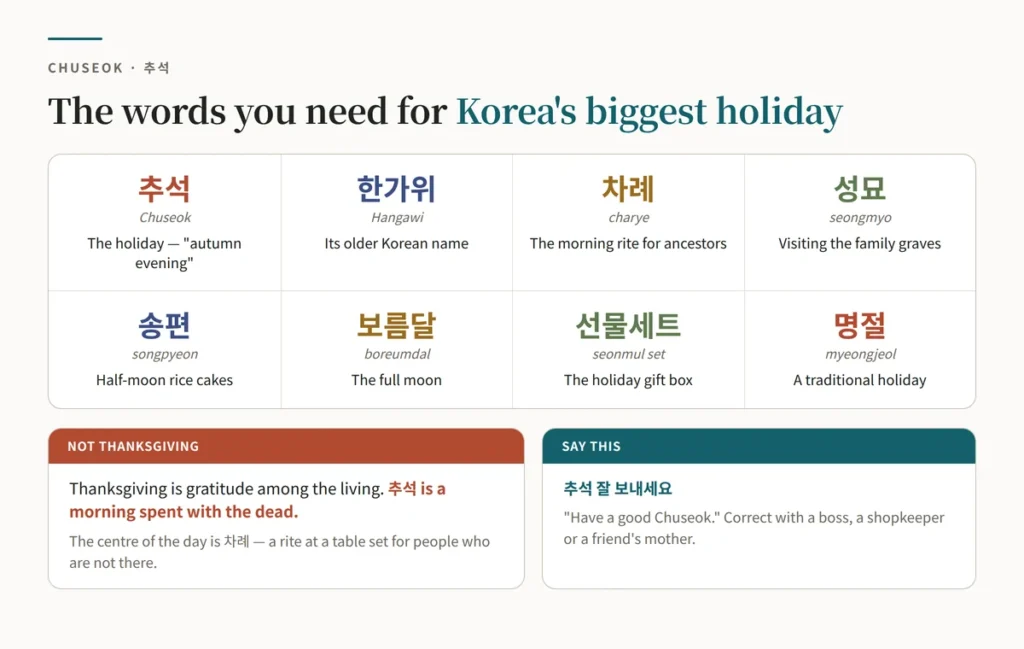
Thanksgiving is about gratitude among the living. Chuseok is a morning spent with the dead. The centre of the holiday is a rite performed for ancestors, at a table set for people who are not there. Everything else — the food, the traffic, the relatives asking when you plan to get married — arranges itself around that.
This guide covers what the day actually is, what to say to a Korean during it, and the part of the holiday that the tourism brochures leave out.
Chuseok Is Not Thanksgiving
추석 (Chuseok) is written with two Chinese characters: 秋 autumn, 夕 evening. The autumn evening. It falls on the fifteenth day of the eighth lunar month, which is to say the night of the full harvest moon.
The older, purely Korean name is 한가위 (Hangawi) — 한 meaning great, 가위 meaning middle. The great middle of autumn. It is the warmer word, and it still turns up in every holiday greeting card.
The day is much older than the American holiday it gets compared to. The Samguk Sagi traces it to a month-long weaving contest in the Silla kingdom between two teams of women, settled on the fifteenth of the eighth month, with the losing side throwing the feast. Whatever the accuracy of that account, Chuseok was already old when the Pilgrims landed.
There is a proverb Koreans say about it every year:
더도 말고 덜도 말고 한가위만 같아라
Neither more nor less — let it always be like Hangawi.
The harvest is in, the weather has turned, and there is enough. That is the whole wish.
When It Is, and Why It Moves
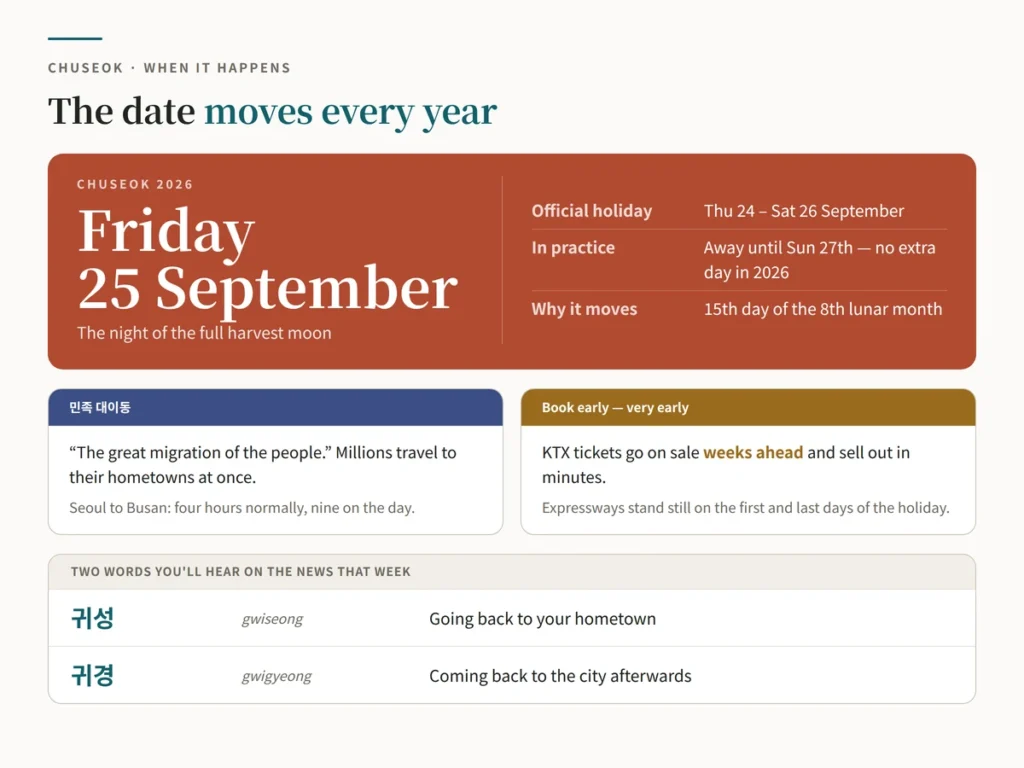
Chuseok follows the lunar calendar, so it lands on a different solar date every year — usually somewhere between early September and early October.
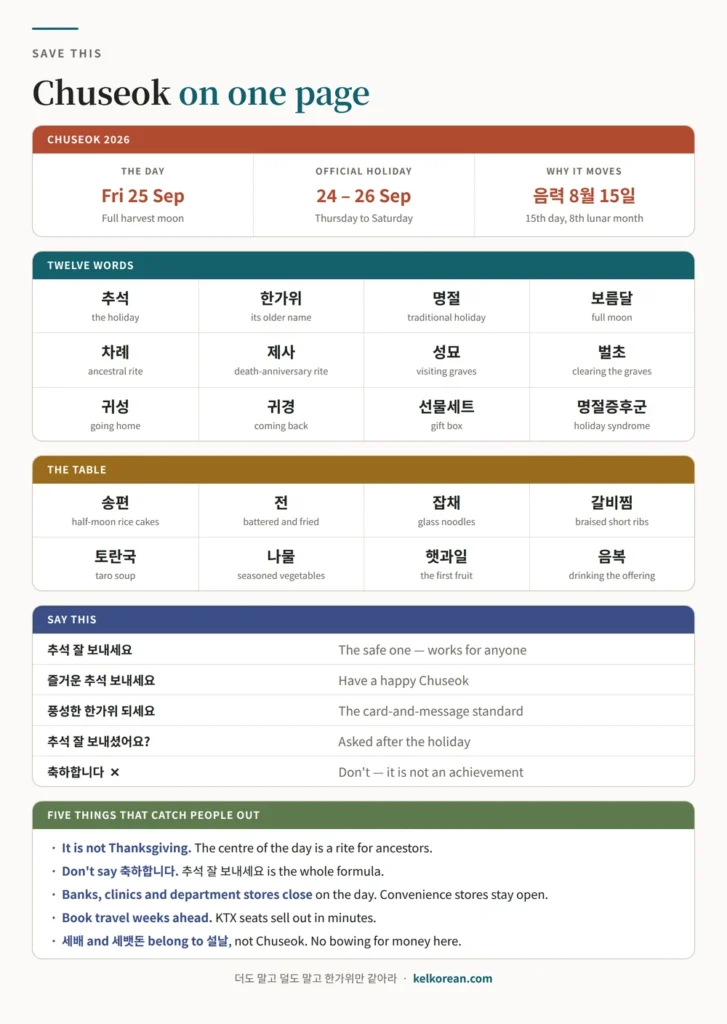
| Chuseok 2026 | Friday, 25 September |
| Official holiday | Thursday 24 – Saturday 26 September |
| In practice | Most people are away until Sunday the 27th |
The day before and the day after are public holidays too, so the country effectively stops from Thursday to Sunday. There is no substitute holiday in 2026 — the 26th falls on a Saturday, which does not trigger one — so Monday the 28th is a normal working day. As Chuseoks go, this is a short one.
The travel is the part visitors underestimate. Korean media has a phrase for it — 민족 대이동, “the great migration of the people.” Millions of people go back to their hometowns at the same time. A drive from Seoul to Busan that normally takes four hours can take nine. KTX tickets go on sale weeks ahead and sell out in minutes.
Two words worth knowing if you are watching the news that week:
| Korean | Romanization | Meaning |
|---|---|---|
| 귀성 | gwiseong | Going back to your hometown |
| 귀경 | gwigyeong | Coming back to the city afterwards |
차례 — The Morning That Defines the Day
On the morning of Chuseok, families set a table and perform 차례 (charye), a rite for their ancestors. Food is laid out in a prescribed order, the family bows, and the ancestors are invited to eat first.
차례 is not the same as 제사. Both are ancestral rites and foreigners often hear the two words used loosely, so it is worth separating them:
| Korean | When it happens | What it is |
|---|---|---|
| 차례 | Chuseok and Lunar New Year mornings | The holiday rite, performed for several generations at once |
| 제사 | The anniversary of a particular death | A rite for one ancestor, usually held at night |
차례 is written 茶禮 — literally “tea rite,” from a time when tea was the offering.
Alcohol is part of the rite. Rice wine is poured for the ancestors during 차례, and afterwards the family shares what was offered — 음복 (eumbok), from 飮 drink and 福 blessing. In practice it covers eating the ritual food as well as drinking the wine.
That is the rite. Later in the day, when the drinking is ordinary drinking, the usual rules take over: two hands, never your own glass, and turn away from your elders. Our guide to Korean drinking etiquette covers the whole system.
성묘 (seongmyo) is the other half: visiting the family graves, usually on the day or the day after. And in the weeks before Chuseok comes 벌초 (beolcho) — cutting back the grass that has grown over the graves during the summer. It is hot, tiring work, and for many families it is a fixed September Saturday.
Not every family does this now. Christian families often hold a memorial service instead of 차례. Many younger families have simplified the table or dropped the rite entirely and just travel, eat, and visit the graves. If you ask a Korean friend whether they do 차례, you will get a very different answer depending on the family.
송편 — And Why the Shape Matters
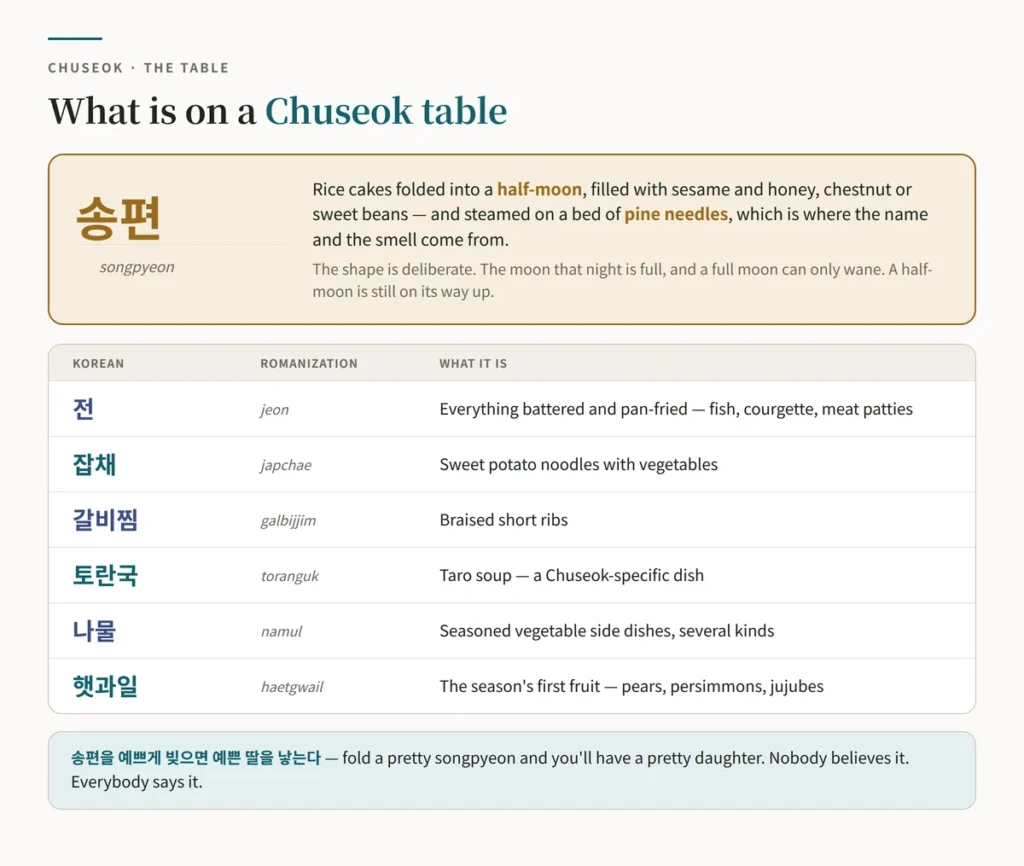
The food of Chuseok is 송편 (songpyeon), a small rice cake folded into a half-moon and filled with sesame and honey, chestnut paste, or sweetened beans.
It is steamed on a bed of pine needles, which is where the name comes from — 松 pine, 餠 rice cake — and what gives it its smell. That smell is Chuseok for most Koreans in the way cinnamon is Christmas for other people.
There is a story about the shape. The moon that night is full; the rice cake is a half-moon. The explanation Koreans give goes back to an omen in the Samguk Sagi, where a turtle shell was read as “Baekje is a full moon, Silla a half moon” — a full moon can only wane, while a half-moon is still on its way up. Whether or not that is why the cake is folded that way, it is the reason every Korean will give you.
There is a line every Korean child hears while helping to fold them:
송편을 예쁘게 빚으면 예쁜 딸을 낳는다
Fold a pretty songpyeon and you will have a pretty daughter.
Nobody believes it. Everybody says it.
The rest of the table is substantial:
| Korean | Romanization | What it is |
|---|---|---|
| 송편 | songpyeon | Half-moon rice cakes steamed on pine needles |
| 전 | jeon | Everything battered and pan-fried — fish, courgette, meat patties |
| 잡채 | japchae | Sweet potato noodles with vegetables |
| 갈비찜 | galbijjim | Braised short ribs |
| 토란국 | toranguk | Taro soup — a Chuseok-specific dish |
| 나물 | namul | Seasoned vegetable side dishes, several kinds |
| 햇과일 | haetgwail | The season’s first fruit — pears, persimmons, jujubes |
If the food words are unfamiliar, our guide to food in Korean covers the dish names and the table rules that apply the rest of the year too.
The Gift Sets
In the two weeks before Chuseok, Korean supermarkets fill with 선물세트 (seonmul seteu) — gift boxes, stacked to the ceiling, bought for parents, in-laws, clients and bosses.
What is in them surprises visitors. Alongside the expected boxes of Korean pears, beef and red ginseng, you will find large presentation cases of tinned Spam, wrapped in ribbon and sold as a respectable gift. This is not a joke. Spam arrived with the American military, became a scarcity food, and never lost its status.
If you are given one, the polite reply is 잘 먹겠습니다 — the same phrase said before a meal.
The Full Moon
Chuseok night is a full moon, and the moon is the point. People go outside, look at it, and make a wish — quietly, without much ceremony.
Two traditions attach to it, and you are most likely to see them at a folk village or on television rather than in an ordinary family:
강강술래 — a circle dance performed by women under the full moon, holding hands and singing, speeding up as it goes. It is on the UNESCO intangible heritage list.
씨름 — Korean wrestling, traditionally the Chuseok sport, with a live tournament televised over the holiday.
What to Actually Say
This is the practical part, and it is short.
| Korean | Romanization | When to use it |
|---|---|---|
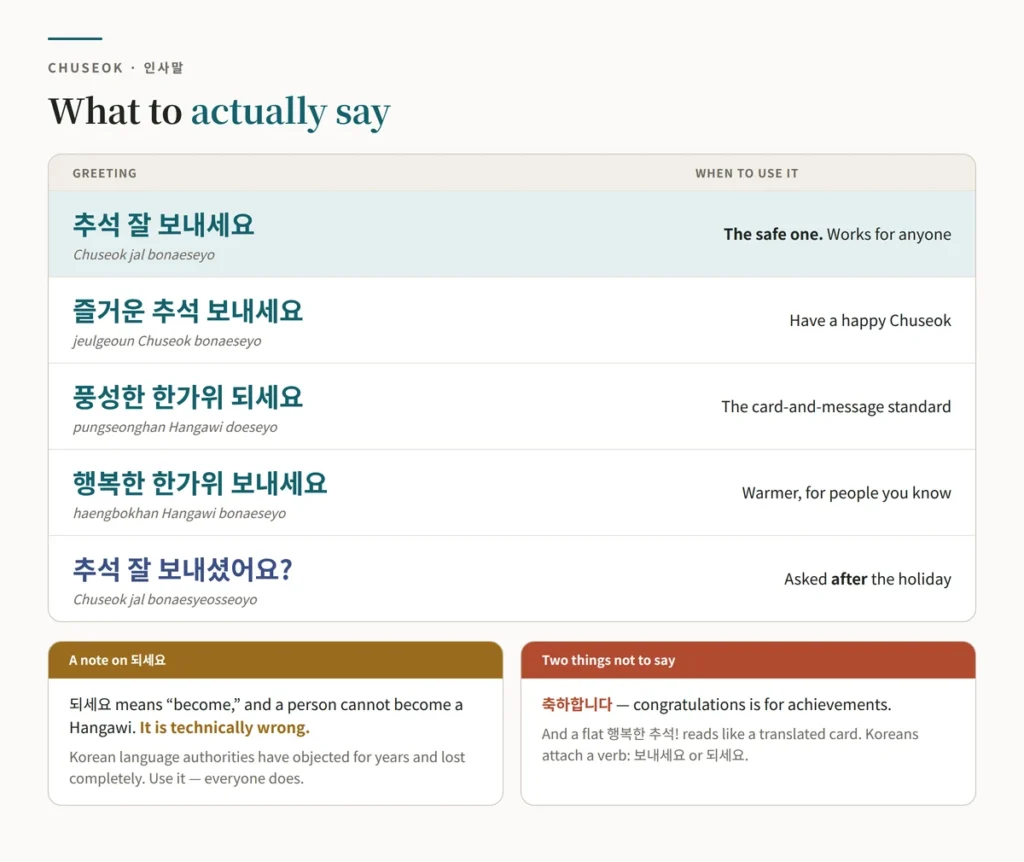
| 추석 잘 보내세요 | Chuseok jal bonaeseyo | The safe one. Works for anyone |
| 즐거운 추석 보내세요 | jeulgeoun Chuseok bonaeseyo | Have a happy Chuseok |
| 풍성한 한가위 되세요 | pungseonghan Hangawi doeseyo | The card-and-message standard |
| 행복한 한가위 보내세요 | haengbokhan Hangawi bonaeseyo | Warmer, for people you know |
| 추석 잘 보내셨어요? | Chuseok jal bonaesyeosseoyo | Asked after the holiday |
추석 잘 보내세요 is the one to memorise. It is neutral, polite, and correct with a boss, a shopkeeper or a friend’s mother.
A note on 풍성한 한가위 되세요. You will see this everywhere — on shop banners, in mass texts, at the end of the evening news. It is also, strictly speaking, ungrammatical: 되세요 means “become,” and a person cannot become a Hangawi. Korean language authorities have objected to this pattern for years and lost completely. Use it; everyone does. Just know that if a Korean teacher winces, that is why.
Two things not to say. 축하합니다 (“congratulations”) does not fit — Chuseok is not an achievement. And a flat 행복한 추석! on its own reads like a translated greeting card; Koreans attach a verb, 보내세요 or 되세요.
If the politeness levels behind 세요 are still fuzzy, our guide to Korean honorifics explains why every one of these greetings ends the way it does, and our guide to Korean greetings covers the everyday set you will need before and after the holiday.
The Part That Is Not in the Brochure
Korean tourism material describes Chuseok as warm, golden and full of family. It is also, for a large number of people, the hardest week of the year, and pretending otherwise does learners no favours — because the thing you will actually overhear is people complaining about it.
명절 스트레스 — holiday stress — is an ordinary phrase. So is 명절증후군, “holiday syndrome,” which describes the exhaustion, back pain and low mood that follow a few days of cooking and hosting.
The work is not evenly shared. The Chuseok table takes two days to prepare, and traditionally it has been prepared by the women of the household — very often at the 시댁, the husband’s parents’ home, by a daughter-in-law cooking for people she may not know well. This is one of the most reliably discussed topics in Korea during the holiday, and it is a real and ongoing argument, not a historical footnote.
And then there are the questions. Relatives you see once a year — and whose exact titles you are expected to know, which is a subject in itself — will ask, in rapid order:
| Korean | What they are asking |
|---|---|
| 취직했어? | Have you got a job yet? |
| 결혼은 언제 해? | When are you getting married? |
| 애는 언제 낳을 거야? | When are you having children? |
| 살 좀 쪘네? | You’ve put on weight, haven’t you? |
And you will need the titles. A Chuseok table is the one day of the year when every branch of the family is in one room, and Korean requires a different word for each of them depending on whose side they are on and who is older. Our guide to Korean family terms is the map for that room.
Younger Koreans trade survival strategies for these every year. Age comes into it constantly too — and Korean age arithmetic is its own subject, covered in our guide to how Korean age works.
Things are shifting. 혼추족 — people who spend Chuseok alone — has become a media word, built the same way as 혼밥 for eating alone. Airports are packed with families who have decided to take a holiday abroad instead. Some families have moved 차례 to a restaurant, or dropped it.
The undercurrent here is 정 and 눈치 — the obligation that accumulates inside a Korean family, and the constant reading of the room that a holiday table demands. Our guide to nunchi, jeong and han is the background to almost everything in this section.
Five Things That Catch People Out
1. Expecting a Thanksgiving. There is no turkey, no going around the table saying what you are grateful for, and the emotional centre of the day is a rite for the dead, not a meal among the living.
2. Saying 축하합니다. Congratulations is for achievements. 추석 잘 보내세요 is the whole formula.
3. Expecting to get things done. Banks, offices, most neighbourhood clinics and most independent restaurants close. Department stores close on Chuseok day itself, usually for two days, and the big discount marts close branch by branch — so check before you go. Convenience stores, standalone malls and tourist sites stay open, and a rota of clinics and pharmacies stays open throughout. Plan the week around it — and for the places that are open, our guide to ordering food in Korean has the phrases.
4. Booking travel late. KTX seats and flights for the holiday are gone weeks in advance, and the expressways are at a standstill on the first and last days.
5. Confusing it with 설날. The deep bow and the envelope of money — 세배 and 세뱃돈 — belong to Lunar New Year, not Chuseok. Relatives often still slip children some 용돈 at Chuseok, but there is no bow that earns it.
One tip for visitors, and it is a good one. Seoul empties out. The city is quieter during Chuseok than at any other time of year, the main palaces are usually opened free of charge over the holiday, and the traffic inside the city is gone. If you are in Korea that week and not travelling, it is the best time you will ever have to walk around the capital.
Frequently Asked Questions
When is Chuseok 2026?
Friday, 25 September 2026. The official holiday runs from Thursday the 24th to Saturday the 26th, and most people are away until Sunday the 27th. The date moves every year because Chuseok falls on the fifteenth day of the eighth lunar month.
Is Chuseok the same as Korean Thanksgiving?
No, although that is the usual translation. Chuseok is a harvest festival built around 차례, a rite performed for ancestors, and around visiting family graves. It is far older than the American holiday and its focus is on the dead rather than on gratitude among the living.
What do you say to someone at Chuseok?
추석 잘 보내세요 — “have a good Chuseok.” It is polite, neutral, and correct with anyone. After the holiday, switch to 추석 잘 보내셨어요? — “did you have a good Chuseok?”
What is 한가위?
The native Korean name for the same day: 한 (great) + 가위 (middle), the great middle of autumn. 추석 is the Sino-Korean name. 한가위 is the warmer one and appears in most holiday greetings, especially 풍성한 한가위 되세요.
What is songpyeon?
A small rice cake folded into a half-moon, filled with sesame and honey, chestnut or sweetened beans, and steamed on pine needles. The pine gives it its smell, and the half-moon shape is chosen deliberately: unlike a full moon, it is still on its way up.
Is everything closed during Chuseok?
Banks, offices, most neighbourhood clinics and most independent restaurants close, and department stores shut on Chuseok day itself. Hospitals stay open for emergencies and inpatients with reduced outpatient hours, and the government publishes a rota of clinics and pharmacies that stay open through the holiday. Convenience stores, standalone malls and tourist sites carry on, and the main palaces in Seoul are usually free over the holiday.
Do Koreans give money at Chuseok?
Not as a ritual. The named custom is 세뱃돈, the envelope given after the deep New Year bow, and it belongs to Lunar New Year. Relatives often still slip children some 용돈 at Chuseok, but there is no bow that earns it. Chuseok gifts run to food and household gift boxes instead — fruit, beef, red ginseng, and yes, tinned Spam.
Why is Chuseok stressful for some Koreans?
The preparation is heavy and has traditionally fallen on women, often on daughters-in-law cooking at their husband’s family home. Add long travel and relatives asking about jobs, marriage and children, and you get 명절증후군 — holiday syndrome — a phrase common enough to appear in newspaper headlines every year.
Final Thoughts
If you only take four things from this guide, take these: 추석 is the day, 한가위 is its older name, 차례 is what actually happens in the morning, and 추석 잘 보내세요 is what you say.
And if a Korean friend seems less than delighted about the holiday approaching, you now know why. Ask them about the traffic. They will have something to say.
추석 잘 보내세요.
Written by Minhyung Cha — 25 years teaching Korean, and 15+ years running an English academy in South Korea. Every example on this site is checked as a native speaker. More about KEL.
Leave a Reply