
The Yeongnam Alps summit challenge took me four months, six hikes and one day with two peaks in it. Between late January and mid-April 2026 I climbed all seven official peaks of the 영남알프스 (Yeongnam Alpeuseu), the cluster of mountains over 1,000 metres just north of Busan, and checked in at each summit with the county’s app. On the last one, the app told me I would receive the silver medal.
I introduced the challenge briefly in our guide to autumn foliage in Korea, along with the silver grass at Ganwoljae. This is the full version for anyone who wants to do it: why it cannot be done in a hurry, the order I climbed in, how the app check-in works, what to eat at the top, and the Korean you will hear on the way up.
The Challenge in One Minute
Ulju County in Ulsan has run the 영남알프스 완등 인증 (wandeung injeung), the Yeongnam Alps summit certification, since 2019. 완등 means reaching the top of every peak on a list, and 인증 means proof. The rules are announced before each season, and in 2026 they were these:
- Seven peaks, all over 1,000 metres: 가지산, 간월산, 신불산, 영축산, 천황산, 고헌산 and 운문산.
- One season, from 1 January to 30 November.
- Two peaks a month at most. A third summit in the same month does not count.
- App only. Each summit is proved with a photo taken in the official app, near the summit stone.
- A silver medal for the first 30,000 to finish, and a certificate on your phone for everyone after that.
The 2026 season ends on 30 November. If the rules stay the same, the next one opens on 1 January 2027, so now is the time to plan.
Why It Takes at Least Four Months
The two-a-month rule changes everything. It was brought in from 2025, for safety and to spread the crowds out over the year. Seven peaks at two a month means four months at the very least: two, two, two and one. Miss a month and it becomes five.
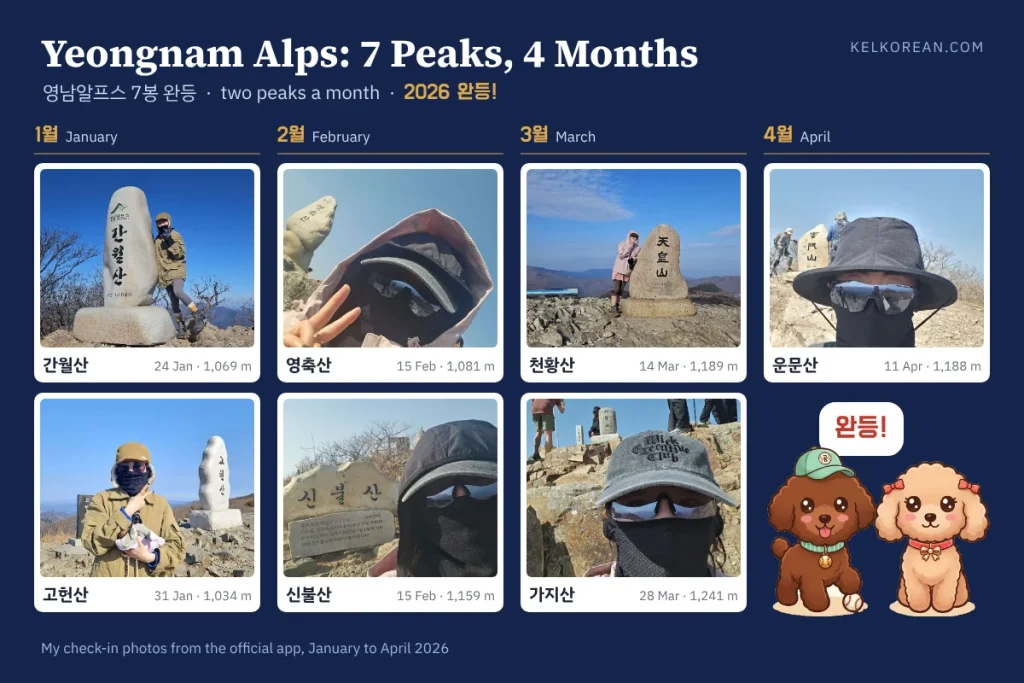
This is how my four months went. The heights are the official figures for each peak.
| Date (2026) | Peak | Height |
|---|---|---|
| 24 January | 간월산 Ganwolsan | 1,069 m |
| 31 January | 고헌산 Goheonsan | 1,034 m |
| 15 February | 영축산 Yeongchuksan, then 신불산 Sinbulsan | 1,081 m / 1,159 m |
| 14 March | 천황산 Cheonhwangsan | 1,189 m |
| 28 March | 가지산 Gajisan | 1,241 m |
| 11 April | 운문산 Unmunsan | 1,188 m |
Each month I used up my two summits, and in April I needed only the last one. Some of these hikes were just my husband and me; on others we went as a group of four with friends. We drove every time and took the popular routes, the ones most Korean hikers use.
Notice the word 산 (san) at the end of every name. It means mountain, so Gajisan is “Gaji Mountain,” and saying “Mount Gajisan” repeats it. A peak in general is a 봉 (bong) or 봉우리 (bonguri), which is why the challenge is called 7봉, “seven peaks.”
Two Peaks in One Day
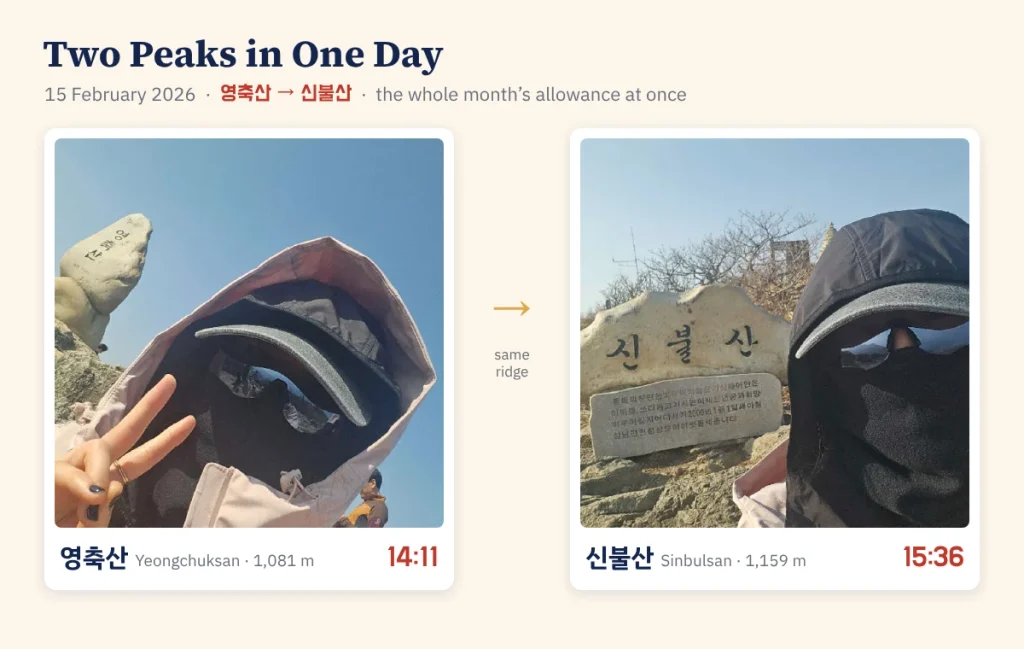
On 15 February we did 영축산 and 신불산 together. The two summits sit on the same ridge, so many hikers walk from one to the other in a single hike instead of driving to a new trailhead. Our check-ins were at 2:11 in the afternoon on 영축산 and 3:36 on 신불산, about an hour and a half apart.
It saves a trip, but count the cost. Two summits in one day is a long day, and it uses up that month’s whole allowance at once. Start early, so that you are not coming down the second mountain in the dark.
The Hardest and the Easiest
가지산 was the hardest. It is the highest of the seven at 1,241 metres, and it felt like it. It was my sixth summit, so I was not new to these mountains by then, and it was still the toughest of them all. If you are planning your own order, save 가지산 for a day when you are fresh.
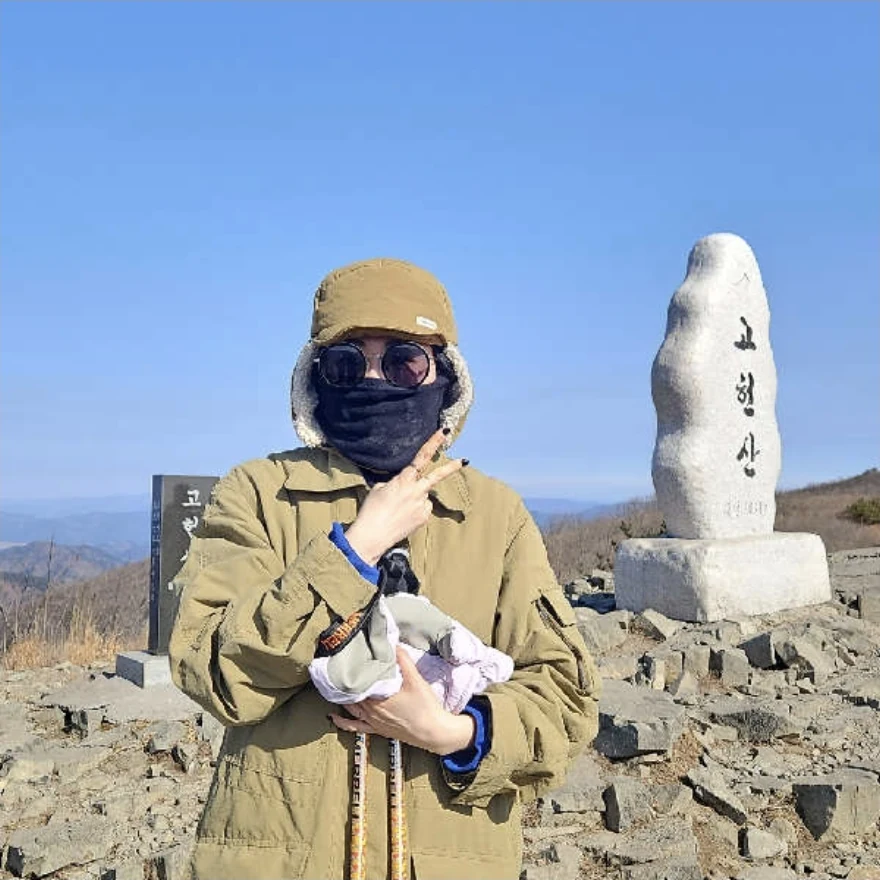
고헌산 was the easiest, and my favourite. It is the lowest of the seven, the climb felt comfortable, and on our day at the end of January the sky was clear blue. The 2026 medal happens to show 고헌산 under snow, so it felt like the right mountain to love.
How the App Check-In Works
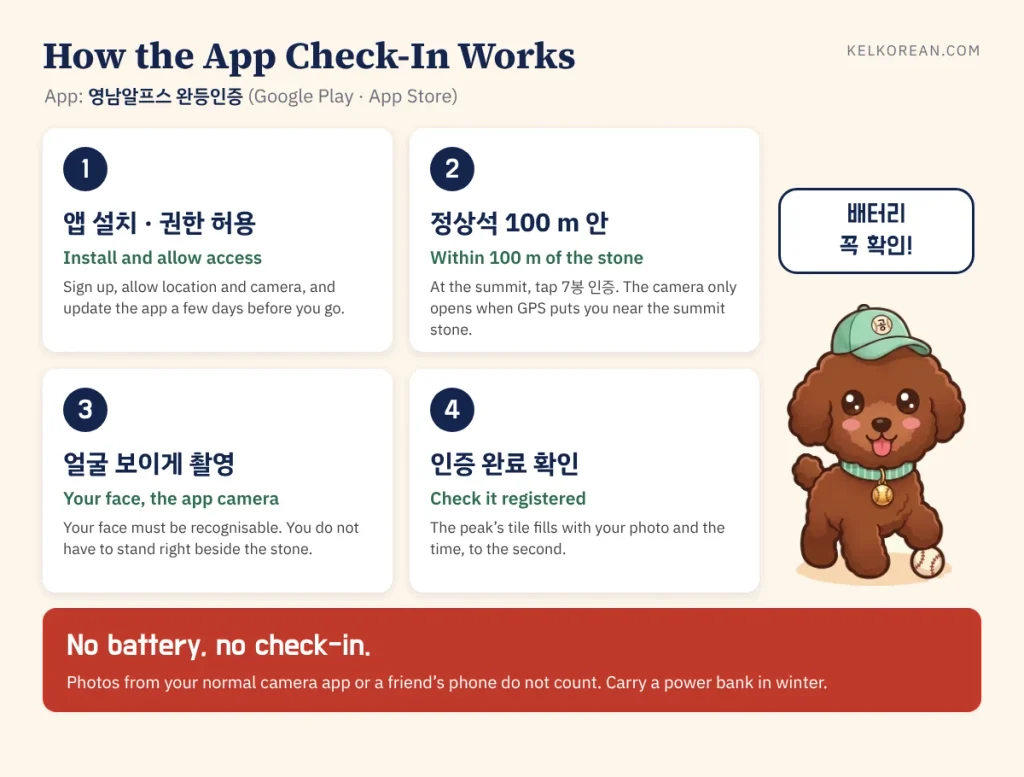
The whole challenge runs through one app, 영남알프스 완등인증, on Google Play and the App Store. There is no paper stamp book and no ranger at the top. This is how a check-in goes.
- Before the hike. Install the app, sign up, and allow location and camera access. Update it a few days before you go.
- At the summit. Open the app and tap 7봉 인증. The camera opens only when your phone’s GPS puts you near the summit stone, within about 100 metres.
- Take the photo. Your face has to be recognisable. You do not have to stand right beside the stone, which helps when there is a queue.
- Check it registered. The peak’s tile fills with your photo, and a card shows the time to the second.
Here is my most important tip: make sure your phone has plenty of battery. The proof is a GPS check on your own phone, taken in the app. Photos from your normal camera app or anyone else’s phone are not accepted. If your phone dies at the top, a friend can take a picture of you, but it will not count. You would have to climb the mountain again. Cold drains a battery fast, so in winter carry a power bank and keep the phone in an inside pocket.
The app is in Korean. I have not been able to confirm whether sign-up works without a Korean phone number, so install it and try registering before you travel. Our guide to travel apps for Korea covers the map apps you will want for finding the trailheads.
When to Start If You Want the Medal
The medal is pure silver, and there are only 30,000 of them. In 2026 they were gone by early June, four months sooner than the year before. More than 40,000 people had joined by then, and the number keeps growing every year.
So my advice, if you want the medal, is to put your effort into February and March. Because of the two-a-month rule, the earliest anyone can finish is April, and the people who get medals are the ones who keep going through the cold months without skipping one. Start in January if you can.
If you miss out, you still get the certificate on your phone. In 2026, completers without a medal could also buy one from the online shop of the Korea Minting and Security Printing Corporation (KOMSCO) in December. The 2026 medal is described in our autumn foliage guide.
Hiking in Winter
Doing the challenge for the medal means hiking in January and February, and a summit at 1,000 metres in winter is a different place from the city below. Even when Busan is mild, the tops are cold and the wind can be strong. Look at my photos: hat, neck warmer, sunglasses and a thick jacket, every time.
- Layers. You warm up fast on the way up and cool down fast at the top. Take a windproof jacket and gloves even on a sunny day.
- Crampons. Shaded paths can stay icy after snow. Korean hikers carry light chain crampons called 아이젠 (aijen), from the German Eisen, and you can buy them at any outdoor shop.
- Daylight. Winter days are short. Start in the morning and give yourself time to be down before dark.
For what a Korean winter is like down in the city, see our guide to winter in Korea.
What We Ate at the Top
Korean hikers love to eat at the summit, and you will see whole groups sitting on the rocks with food spread out between them. We kept it simple. At the top we had 김밥 (gimbap), the seaweed rice rolls sold at every convenience store and snack shop, something chocolatey for energy, and 고구마 (goguma), sweet potatoes, which are filling and easy to carry. Our guide to food in Korean has more on 김밥.
The real meal came after. Popular trailheads have restaurants waiting for hikers on their way down, and after each hike we went to one of the well-known places nearby.
Korean for the Trail
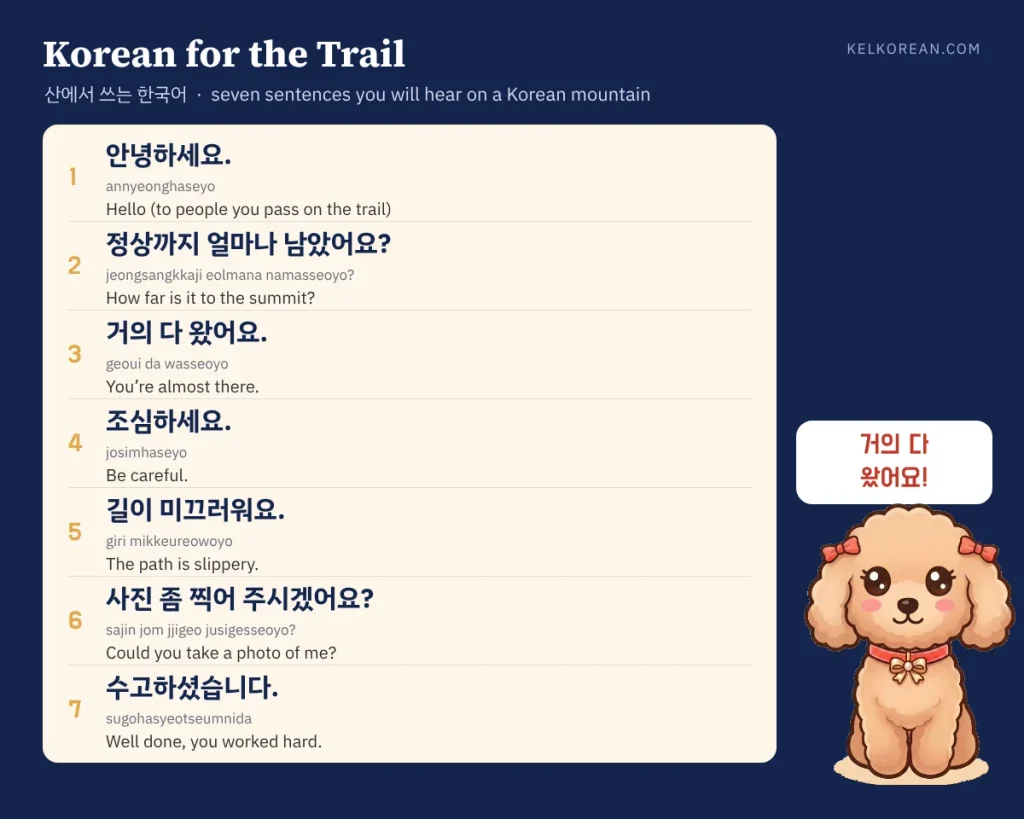
Korean hikers are friendly on the trail, and a few sentences go a long way. These are the ones you will hear and use.
| Korean | Romanisation | Meaning |
|---|---|---|
| 안녕하세요. | annyeonghaseyo | Hello, said to people you pass on the trail |
| 정상까지 얼마나 남았어요? | jeongsangkkaji eolmana namasseoyo? | How far is it to the summit? |
| 거의 다 왔어요. | geoui da wasseoyo | You’re almost there. |
| 조심하세요. | josimhaseyo | Be careful. |
| 길이 미끄러워요. | giri mikkeureowoyo | The path is slippery. |
| 사진 좀 찍어 주시겠어요? | sajin jom jjigeo jusigesseoyo? | Could you take a photo of me? |
| 수고하셨습니다. | sugohasyeotseumnida | Well done, you worked hard |
A few notes. A simple 안녕하세요 to people coming down is normal on a Korean mountain, and you will often get one first. Our guide to Korean greetings explains why it works for almost any situation. 거의 다 왔어요 is what everyone tells you on the way up, and Koreans joke about it, because the person saying it is usually being kind rather than accurate. 수고하셨습니다 is what you say at the top or at the end of the day, to your group and to strangers. It thanks someone for their effort, and on a mountain everyone has made one.
And a few words for the signs and the app:
| Korean | Romanisation | Meaning |
|---|---|---|
| 등산 | deungsan | Hiking, climbing a mountain |
| 등산로 | deungsanno | Hiking trail |
| 정상 | jeongsang | Summit |
| 정상석 | jeongsangseok | Summit stone |
| 하산 | hasan | Going down the mountain |
| 완등 | wandeung | Climbing every peak on a list |
| 인증 | injeung | Proof, certification |
In 등산로 the ㄹ is pronounced like ㄴ, so the word is said deungsanno. The summit stones also give their heights, so it helps to read big numbers. Our guide to Korean numbers covers 천 (cheon), a thousand, and the rest.
Before You Go
- Check the year’s rules. They change. The peaks on the list, the monthly limit and the medal design have all changed in recent years, and the app’s notices have the current version.
- Plan your months. Write down which two peaks you will do each month. Pairing two on one ridge, as we did with 영축산 and 신불산, saves a trip.
- Charge everything. A full phone and a power bank. No battery, no check-in.
- Go early on weekends. Car parks at the popular trailheads fill up, and the best-known summit stones can have a queue for photos.
- Mind the deadline. Every summit has to be checked in by 30 November, and you can complete the challenge once a year.
Two a Month, Seven in All
The Yeongnam Alps challenge is not a race, and the rules make sure of that. Two peaks a month, a charged phone, warm layers and something to eat at the top: that is really all it takes. Start in January, keep going through the cold, and by April you can be standing at your seventh summit stone, telling the people around you 수고하셨습니다.
Written by Minhyung Cha — 25 years teaching Korean, and 15+ years running an English academy in South Korea. I live and work in Busan, and every example on this site is checked as a native speaker. More about KEL.
Leave a Reply