
Autumn foliage in Korea does not arrive all at once. It starts on the highest peaks of Gangwon Province in late September and works its way south and downhill for about two months, until the last red leaves come down on Jeju in November. In 2026 the first colour was confirmed on Seoraksan on 28 September, the mountains of the north are at their best right about now, and the south, Busan included, still has its turn to come in November.
I live in the Busan area, where the colour arrives late, and the mountains I know best are the Yeongnam Alps just north of the city. In 2026 I finished the official Yeongnam Alps summit challenge, all seven peaks, and earned its silver medal. This guide covers when the colour reaches each part of the country, where to see it around Busan, and the Korean words you will hear on every trail this season.
When the Colour Arrives
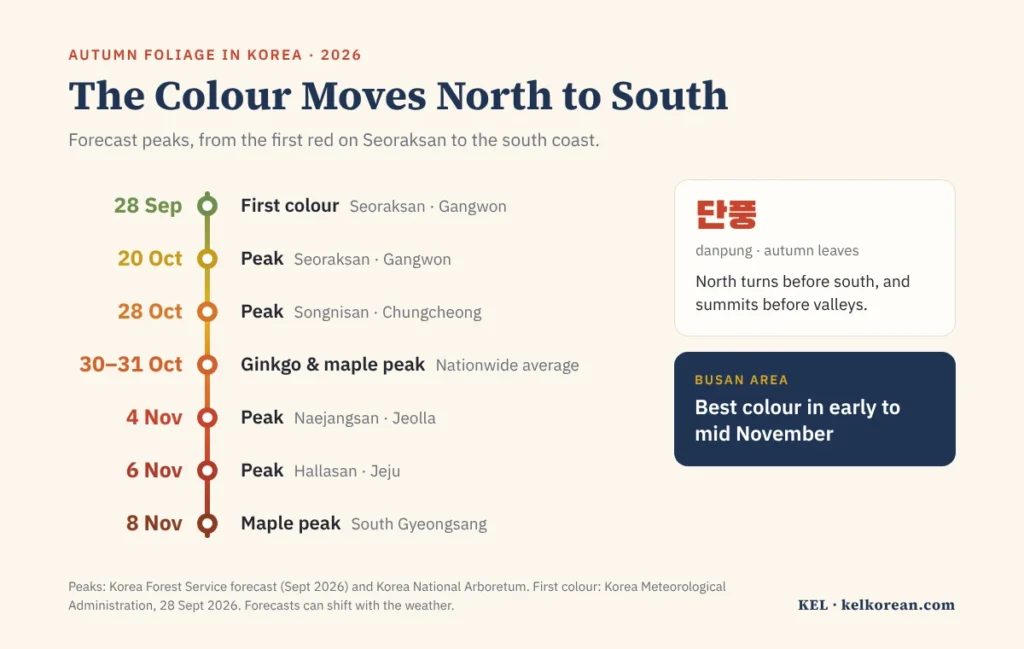
The Korean word for autumn leaves is 단풍 (danpung), and like cherry blossoms in spring, it gets its own forecast. The Korea Meteorological Administration records a mountain’s 첫 단풍 (cheot danpung), its “first colour,” when about a fifth of the mountain has turned, counting down from the summit. On Seoraksan in 2026 that happened on 28 September, the same date as an average year and four days earlier than in 2025.
Each September the Korea Forest Service also publishes a forecast of when the colour will peak. These are its dates for 2026:
| Mountain | Where | Forecast peak |
|---|---|---|
| Seoraksan 설악산 | Gangwon, north-east | 20 October |
| Songnisan 속리산 | Chungcheong, centre | 28 October |
| Naejangsan 내장산 | Jeolla, south-west | 4 November |
| Hallasan 한라산 | Jeju | 6 November |
For the south-east, the national arboretum’s forecast is later still: maples at the South Gyeongsang Provincial Arboretum, near Jinju, are expected at their best around 8 November. Across the whole country, the forecast puts ginkgo trees at their peak around 30 October and maples and oaks around 31 October, which is why late October is the busiest weekend of the season.
Two simple rules explain most of the map. North turns before south, and high ground turns before low ground, so a summit can be bare while the temple at its foot is still glowing. The dates are forecasts, and a warm spell can push them back by days. If you can read a little Korean, or just look at the photos, the weather service’s website, 날씨누리 (weather.go.kr), shows the current state of 21 well-known mountains until 27 November.
Three Colours of a Korean Autumn
When Koreans talk about autumn scenery, they usually mean one of three things, and each has its own word.
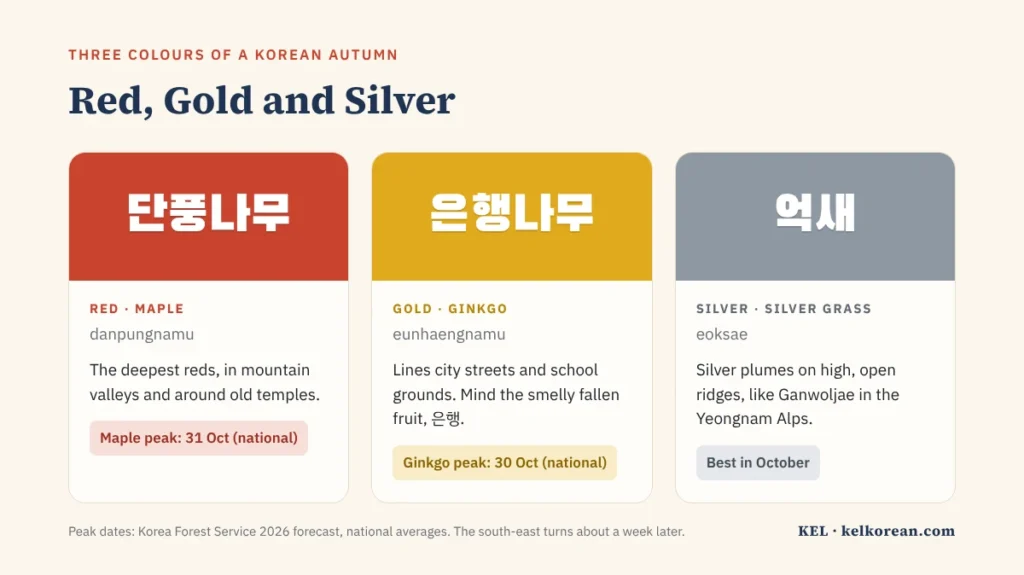
Red: 단풍나무, the maple
단풍 means the leaves changing colour in general, and 단풍나무 (danpungnamu), “danpung tree,” is the maple, the tree that does it most dramatically. The deepest reds are in the mountain valleys, often around old Buddhist temples, which is why so many foliage trips in Korea end at a temple gate. Naejangsan, in the south-west, is the name most Koreans think of first.
Yellow: 은행나무, the ginkgo
The city colour is gold. 은행나무 (eunhaengnamu), the ginkgo, lines streets, school grounds and parks all over Korea, and for a week or two it turns whole avenues yellow and then covers the pavement. One warning: the female trees drop small fruits, also called 은행 (eunhaeng), and when they are stepped on they smell strongly. Koreans walk around them. The nut inside, roasted, is a popular snack with drinks.
Silver: 억새, the silver grass
The third colour is not a leaf at all. 억새 (eoksae) is silver grass, a tall grass whose plumes turn silver-white in autumn and ripple in the wind across high, open ridges. For many Koreans in the south-east, an autumn hike means 억새 first and red leaves second, and the best place to see it is a short drive from Busan.
The Yeongnam Alps: Silver Grass and a Silver Medal
North of Busan, where Ulsan meets the provinces of North and South Gyeongsang, a cluster of mountains rises above 1,000 metres. Koreans call them 영남알프스 (Yeongnam Alpeuseu), the Yeongnam Alps. Yeongnam is the traditional name for the south-east of the country, the region that Busan, Daegu, Ulsan and the two Gyeongsang provinces make up today.
Ganwoljae, the silver grass pass
The famous autumn sight here is 간월재 (Ganwoljae), a pass at about 900 metres between Sinbulsan (1,159 m) and Ganwolsan (1,069 m), covered by about 330,000 square metres of silver grass. The grass starts turning in late September, is usually at its best in October, and lasts into early November in places.
You do not need to be a serious hiker to see it. The gentlest way up is the forest road from Baenaegol: about 6 kilometres each way, mostly paved, and roughly two hours up at an easy pace. The free car park at the bottom fills early on autumn weekends. At the top it is at least 5°C colder than where you started, and the pass is windy, so carry a windproof layer even on a warm day.
The summit challenge
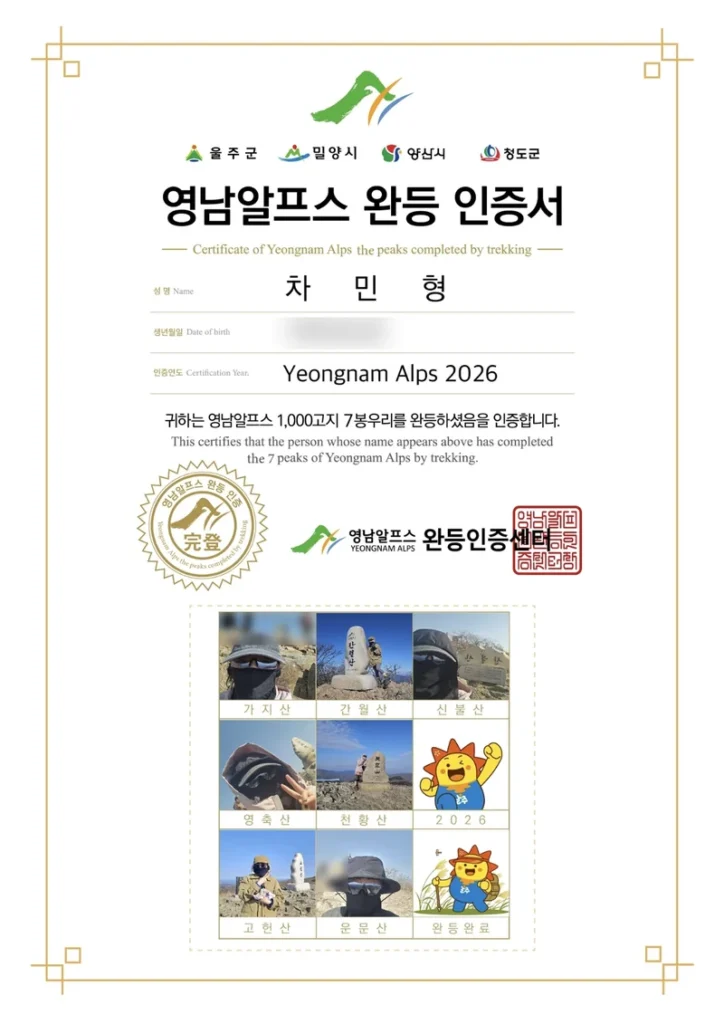
Since 2019, Ulju County in Ulsan has run the 영남알프스 완등 인증 (wandeung injeung), the Yeongnam Alps summit challenge. 완등 means climbing every peak on a list, and 인증 means proof. The mountains cross four local areas, and the certificate carries the emblems of all four: Ulju, Miryang, Yangsan and Cheongdo. You climb each peak within the calendar year and check in at the summit with the county’s official app.
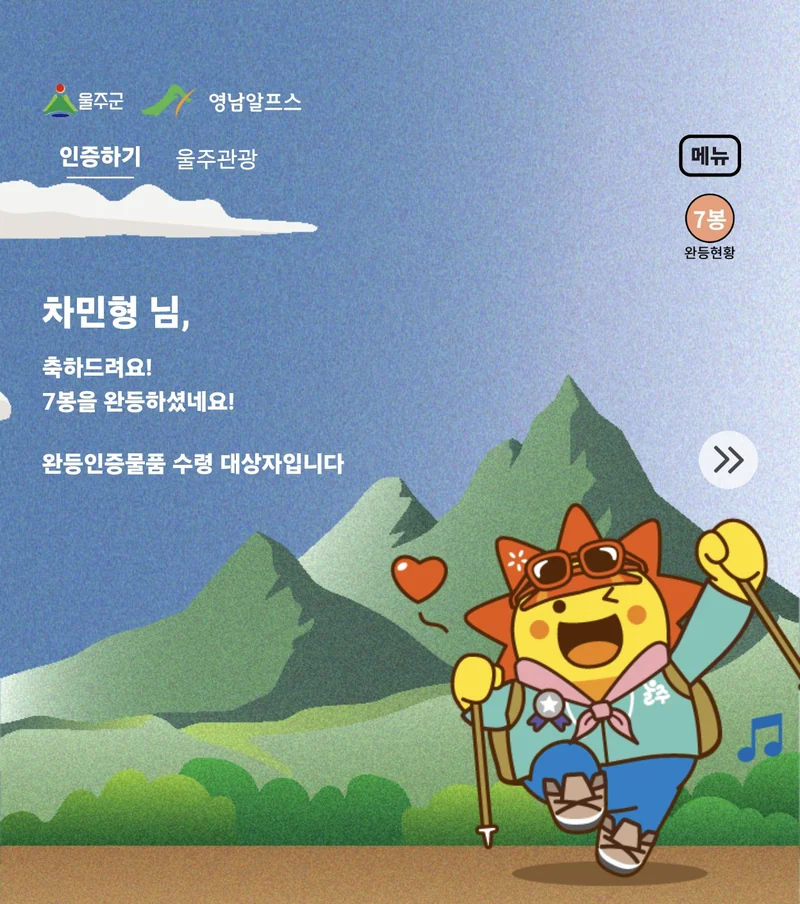
I completed it in 2026. The app keeps count as you go, and when my seventh summit registered, it greeted me with 축하드려요! 7봉을 완등하셨네요!, “Congratulations! You have completed the seven peaks!”, and told me I was among those who would receive the commemorative medal.
The rules change from year to year, so check the app before you start. In 2026 they look like this:
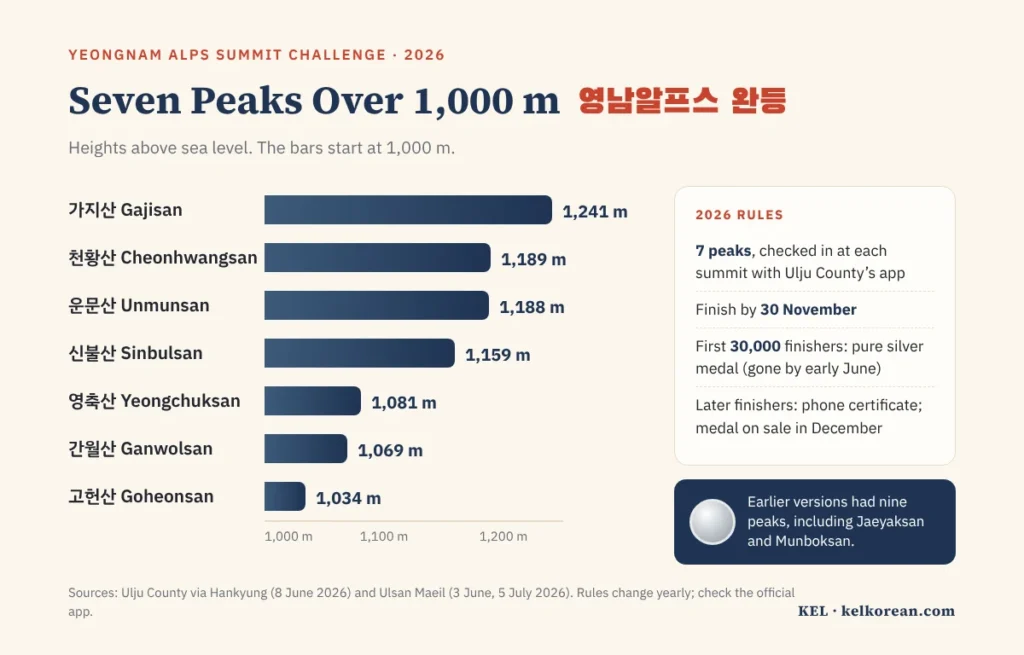
- Seven peaks over 1,000 m: Gajisan (1,241 m), Cheonhwangsan (1,189 m), Unmunsan (1,188 m), Sinbulsan (1,159 m), Yeongchuksan (1,081 m), Ganwolsan (1,069 m) and Goheonsan (1,034 m). Earlier versions had nine; Jaeyaksan and Munboksan were taken off the list over safety and local residents’ concerns.
- A deadline of 30 November. Every summit has to be checked in through the app within the year.
- Medals for the first 30,000. The first 30,000 finishers receive a pure silver medal, which this year shows Goheonsan under snow. The 2026 medals ran out by early June, four months sooner than the year before.
- Still worth finishing. Later finishers get a certificate on their phone, and anyone who completes all seven can buy the medal from the Korea Minting and Security Corporation’s online shop in December.
Challenges like this are a big part of Korean hiking culture. At the top of any well-known peak you will find a short queue of people waiting for a photo with the 정상석 (jeongsangseok), the carved stone that marks the summit. Join it. In Korea, the summit photo is the proof.
My certificate is exactly that: one photo beside each of the seven summit stones, with me wrapped up in layers and a face mask. The certificate itself reads 영남알프스 1,000고지 7봉우리를 완등하셨음을 인증합니다, “this certifies that you have completed the seven peaks of the Yeongnam Alps above 1,000 metres.”
More Autumn Colour Around Busan
Busan sits on the mild southern coast, so its trees are among the last on the mainland to turn. Expect the best colour in early to mid November, around the same time as the Busan Fireworks Festival on 7 November. If you want a whole year’s view of the city’s weather, our guide to the best time to visit Busan goes month by month. Within easy reach of the city:
- Beomeosa (범어사). An old temple at the foot of Geumjeongsan in the north of the city. Take Subway Line 1 to Beomeosa Station, then a bus for the last stretch up the hill. The path from the first gate is lined with trees that are usually at their best in mid-November.
- Tongdosa (통도사). Just north of Busan in Yangsan, this is one of the seven Korean mountain monasteries on UNESCO’s World Heritage list. Its valley turns in November with the rest of the region, and it is close enough to combine with a day in the Yeongnam Alps.
- Daejeo Ecological Park (대저생태공원). Flat riverside walking on the Nakdong River, with silver grass and pink muhly grass. No climbing at all.
For the buses, a Korean map app shows routes and live arrival times far better than the international ones; our guide to travel apps for Korea explains which to download. If you are coming from Seoul for the weekend, book the train early, because seats on autumn weekends go fast: here is how to book the KTX.
Korean Words for Autumn
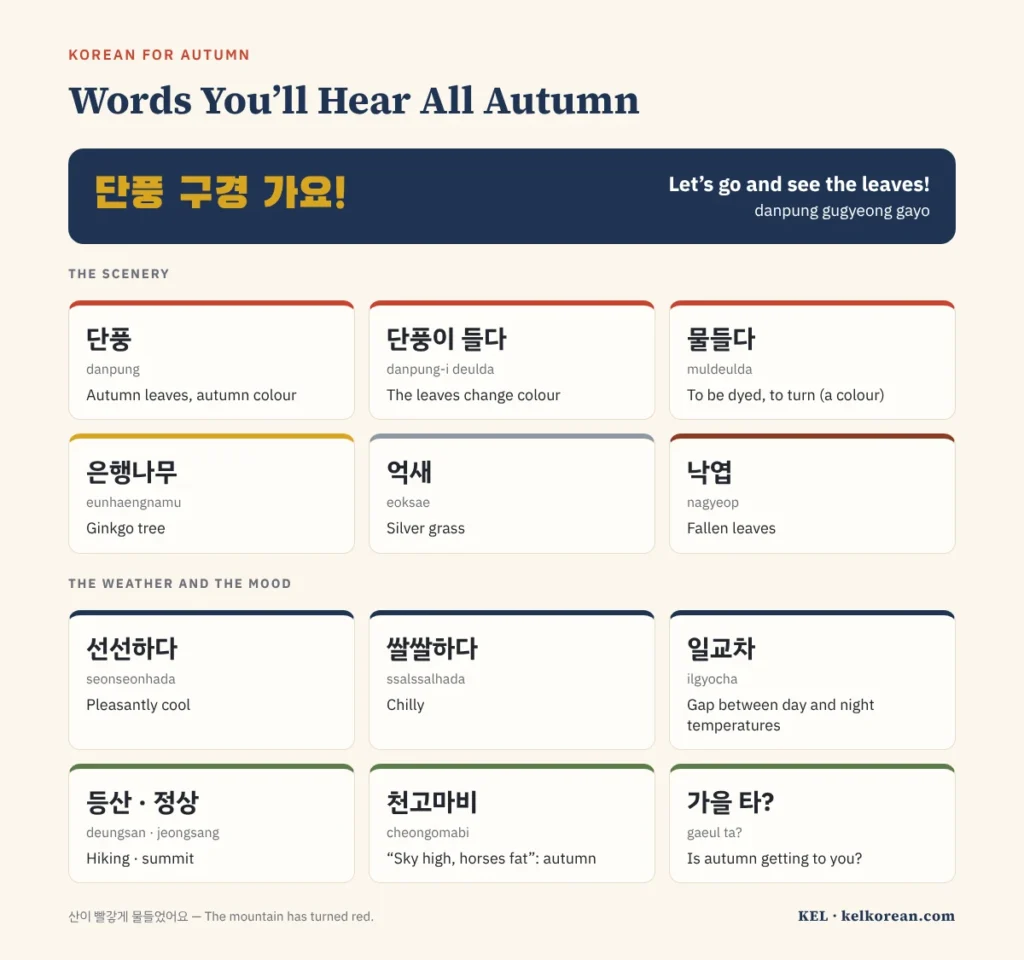
You will hear these on the weather forecast, on the trail and in every conversation about weekend plans from October to November:
| Korean | Romanisation | Meaning |
|---|---|---|
| 가을 | gaeul | Autumn |
| 단풍 | danpung | Autumn leaves, autumn colour |
| 단풍이 들다 | danpung-i deulda | The leaves change colour |
| 단풍 구경 / 단풍놀이 | danpung gugyeong / danpungnori | Going out to see the leaves |
| 낙엽 | nagyeop | Fallen leaves |
| 은행나무 | eunhaengnamu | Ginkgo tree |
| 억새 | eoksae | Silver grass |
| 선선하다 | seonseonhada | Pleasantly cool |
| 쌀쌀하다 | ssalssalhada | Chilly |
| 일교차 | ilgyocha | The gap between day and night temperatures |
| 등산 / 정상 | deungsan / jeongsang | Hiking / summit |
| 천고마비 | cheongomabi | “The sky is high and the horses grow fat”: autumn |
| 가을을 타다 | gaeureul tada | To feel wistful in autumn |
A few of these are worth a closer look. In 단풍이 들다, 들다 is the same verb used for colour soaking into cloth, so the leaves “take on” their colour. You will also hear 물들다 (muldeulda), “to be dyed”: 산이 빨갛게 물들었어요 (sani ppalgake muldeureosseoyo), “the mountain has turned red.” 빨갛게 comes from the colour adjective 빨갛다, which our guide to colours in Korean explains, and 물들었어요 is the past tense, because the change has already happened.
The everyday invitation is simply 단풍 구경 가요! (danpung gugyeong gayo), “let’s go and see the leaves!” On the news, autumn forecasts almost always end with 일교차가 크니 건강에 유의하세요, “the gap between day and night temperatures is large, so take care of your health.” 천고마비 is a four-character idiom from Chinese that every Korean learns at school, and it is often used as a joke to explain a big autumn appetite. And if a friend seems quiet and a little sad in October, someone will ask, 가을 타? (gaeul ta?), “is autumn getting to you?”
Before You Go
- Go on a weekday if you can. At peak season, roads to famous mountains and temples jam on weekends, and car parks fill early in the morning. If it has to be a weekend, start early and use trains and buses.
- Dress in layers. 일교차 is real: an autumn afternoon can be warm while the morning was cold, and the summit is colder than both.
- Do not worry about the gear. Korean hikers are famous for full outdoor outfits, even on easy trails. You do not need to match them. Good shoes and a warm layer matter far more.
- Eat at the bottom. Restaurants near popular trailheads serve 파전 (pajeon, a savoury pancake) and 막걸리 (makgeolli, rice wine) to hikers coming down. Our guide to Korean drinking etiquette covers what to do when someone pours for you.
- Watch your step under the ginkgo trees. The fallen fruit smells, and it travels home on your shoes.
Follow the Colour South
If you missed the peak in Seoul or Gangwon this year, you have not missed autumn. The colour is still on its way down the country, and in the south-east it has a few weeks to go: gold ginkgo streets in the cities, red maples around the temples, and silver grass moving in the wind on the Yeongnam Alps. Pick a weekday, pack a warm layer, and when someone asks where you are going, tell them 단풍 구경 가요.
Written by Minhyung Cha — 25 years teaching Korean, and 15+ years running an English academy in South Korea. I live and work in Busan, and every example on this site is checked as a native speaker. More about KEL.
Leave a Reply