You look up “older brother” in a dictionary and get two words: 형 and 오빠. You look up “older sister” and get two more: 누나 and 언니.
Then you watch a drama and hear a woman call a man she has known for three days 오빠. You hear a customer call a restaurant owner 이모 — “aunt.” You hear two men the same age argue about which of them is 형.
None of this is a translation problem. Korean family terms encode two things English does not: the speaker’s gender and the relative age of both people. Once you see that, the whole system snaps into place — and so does a large share of what confuses learners about Korean social life.
This guide covers the sibling terms, the wider family tree, why Koreans use family words for people they are not related to, and the mistakes that cause real awkwardness.
The Core Rule
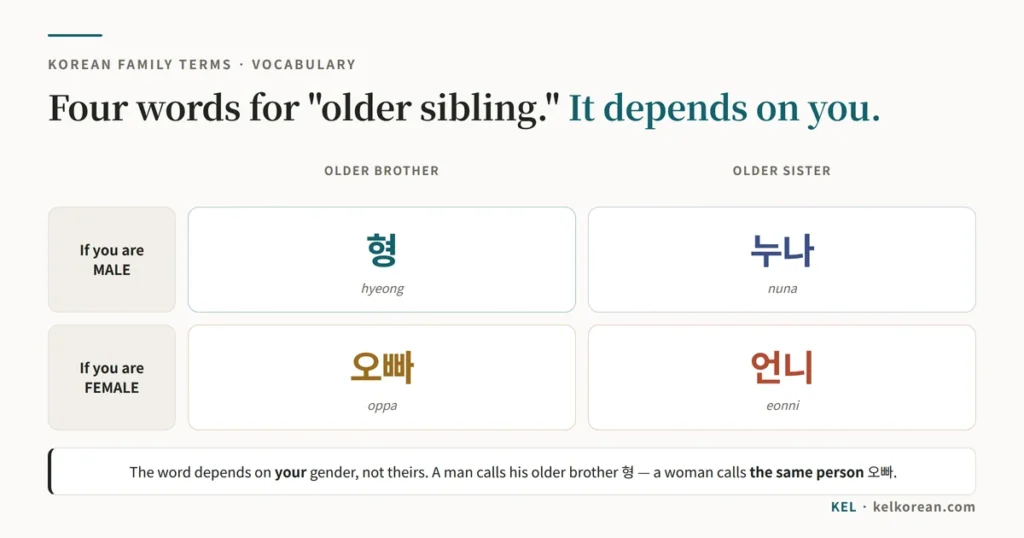
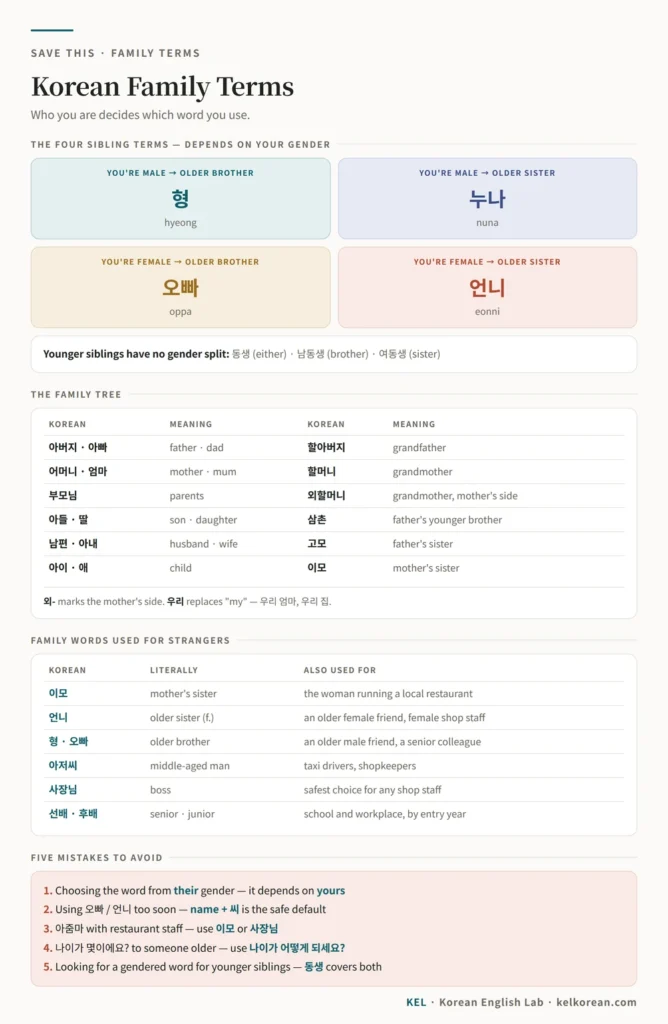
For older siblings, the word depends on who is speaking, not who is being spoken to.
| You are… | Older brother | Older sister |
|---|---|---|
| Male | 형 (hyeong) | 누나 (nuna) |
| Female | 오빠 (oppa) | 언니 (eonni) |
That is the entire rule. A man calls his older brother 형; a woman calls the same person 오빠.
Younger siblings are simpler. There is no gender split:
| Relation | Korean |
|---|---|
| Younger sibling (either) | 동생 (dongsaeng) |
| Younger brother | 남동생 (namdongsaeng) |
| Younger sister | 여동생 (yeodongsaeng) |
Notice the asymmetry: Korean has four words for older siblings and essentially one for younger. That is not an accident. Age hierarchy determines speech level and social behaviour in Korean, so the language marks older precisely and younger loosely. The same logic drives Korean honorifics.
Why Koreans Ask Your Age Immediately
This is the practical consequence, and it is the thing visitors most often misread as rudeness.
Until a Korean speaker knows whether you are older or younger than them, they do not know:
- which term to call you
- which speech level to use with you
- who is expected to pay, pour drinks, or speak first
So 몇 살이에요? (“how old are you?”) is not curiosity. It is the question that unlocks the rest of the conversation. Once ages are established, the relationship has a shape and everyone relaxes.
Even one year matters. Two people born in 1998 and 1999 are not peers in the traditional sense — the older one is 형 or 언니. Among younger Koreans this is loosening, and friends often agree to drop it, but the default assumption is still there.
Terms for People You Are Not Related To
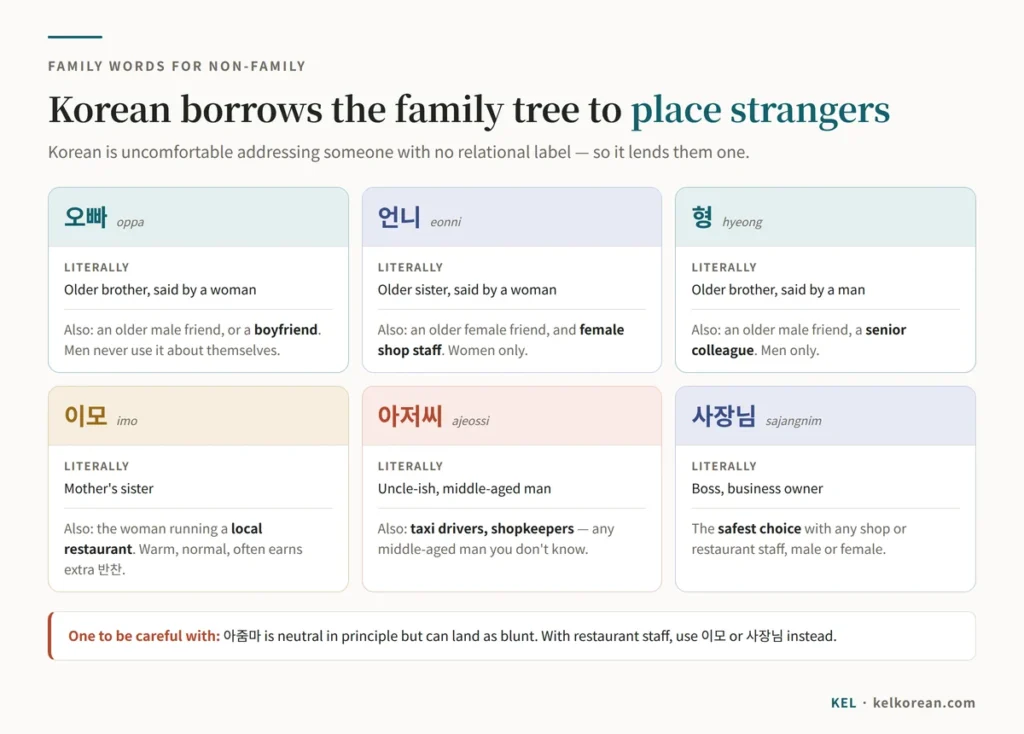
Here is where learners get truly confused: Koreans use family words for non-family constantly.
| Term | Literally | Also used for |
|---|---|---|
| 오빠 | older brother (f. speaker) | An older male friend, or a boyfriend |
| 언니 | older sister (f. speaker) | An older female friend; also female shop staff |
| 형 | older brother (m. speaker) | An older male friend, a senior colleague |
| 누나 | older sister (m. speaker) | An older female friend |
| 이모 | mother’s sister | A middle-aged woman running a restaurant |
| 아저씨 | uncle-ish | Any middle-aged man — taxi driver, shopkeeper |
| 아주머니 / 아줌마 | aunt-ish | Any middle-aged woman |
| 할머니 / 할아버지 | grandmother / grandfather | Any elderly woman / man |
This is not sloppiness. Korean is uncomfortable addressing someone with no relational label at all, so it borrows the family tree to place strangers on a map of relative age.
이모 in a restaurant is worth knowing. Calling the woman running a small local place 이모 is warm and completely normal — it signals familiarity and often gets you extra side dishes. You will hear Koreans do it constantly. (Our guide to ordering food in Korean covers the rest of the restaurant vocabulary.)
아줌마 needs care. It is neutral in principle but can land as blunt or ageing. 이모 or 사장님 (“boss”) is safer with restaurant and shop staff.
The 오빠 Question
Because it appears constantly in dramas and K-pop, 오빠 deserves its own note.
오빠 means all of these, depending on context:
- A woman’s actual older brother
- A woman’s older male friend
- A woman’s boyfriend or husband
- A female fan’s way of referring to a male celebrity
The word itself is neutral. What varies is tone and relationship.
For learners, two practical cautions:
If you are male, do not use 오빠 about yourself. It is a term women use. A man saying “call me 오빠” to a Korean woman he barely knows reads as forward at best.
If you are female, 오빠 to a man you just met is quite familiar. Not offensive, but it implies closeness. Use his name + 씨 (민준 씨) until the relationship warms up, or until he suggests otherwise.
The Wider Family Tree
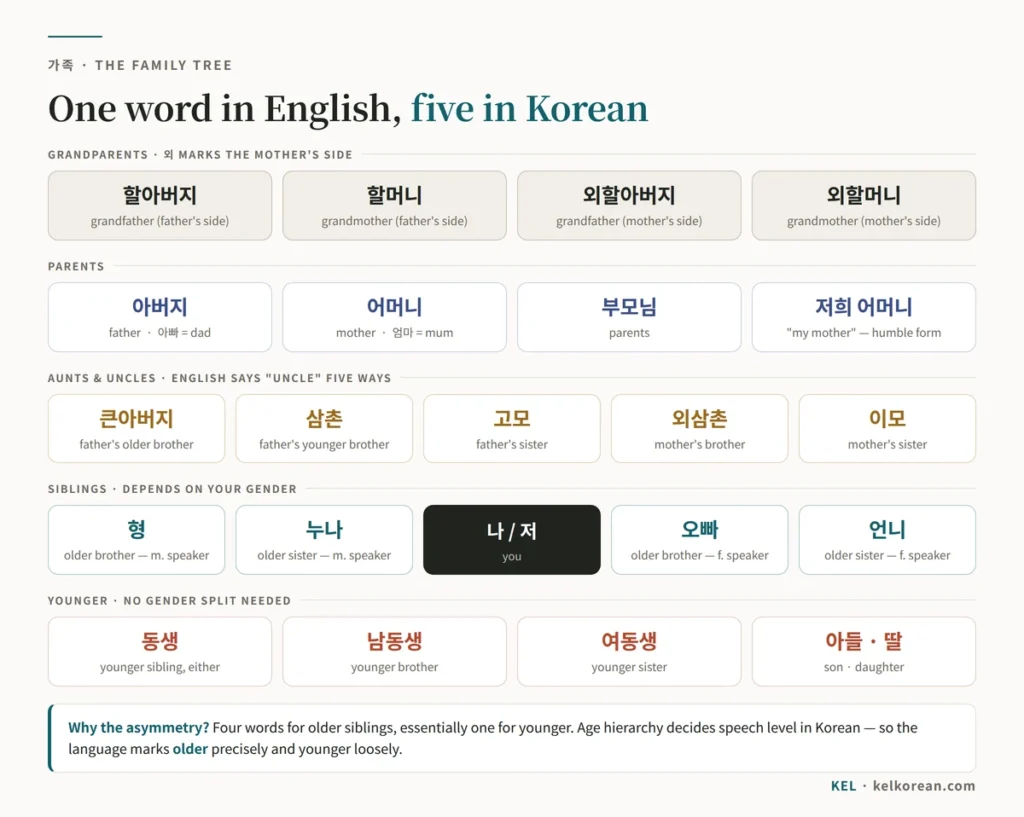
Korean family vocabulary is famously precise — it distinguishes the mother’s side from the father’s side, and older from younger, where English uses one word.
Immediate family
| English | Korean | Notes |
|---|---|---|
| father | 아버지 / 아빠 | 아빠 is “dad,” casual |
| mother | 어머니 / 엄마 | 엄마 is “mum,” casual |
| parents | 부모님 | 님 marks respect |
| son | 아들 | |
| daughter | 딸 | |
| husband | 남편 | |
| wife | 아내 / 부인 | |
| child | 아이 / 애 |
Grandparents
| English | Korean |
|---|---|
| grandfather | 할아버지 |
| grandmother | 할머니 |
| maternal grandfather | 외할아버지 |
| maternal grandmother | 외할머니 |
The prefix 외- marks the mother’s side. 외할머니 is “grandmother on my mother’s side.”
Aunts and uncles
| Relation | Korean |
|---|---|
| Father’s older brother | 큰아버지 |
| Father’s younger brother | 작은아버지 / 삼촌 |
| Father’s sister | 고모 |
| Mother’s brother | 외삼촌 |
| Mother’s sister | 이모 |
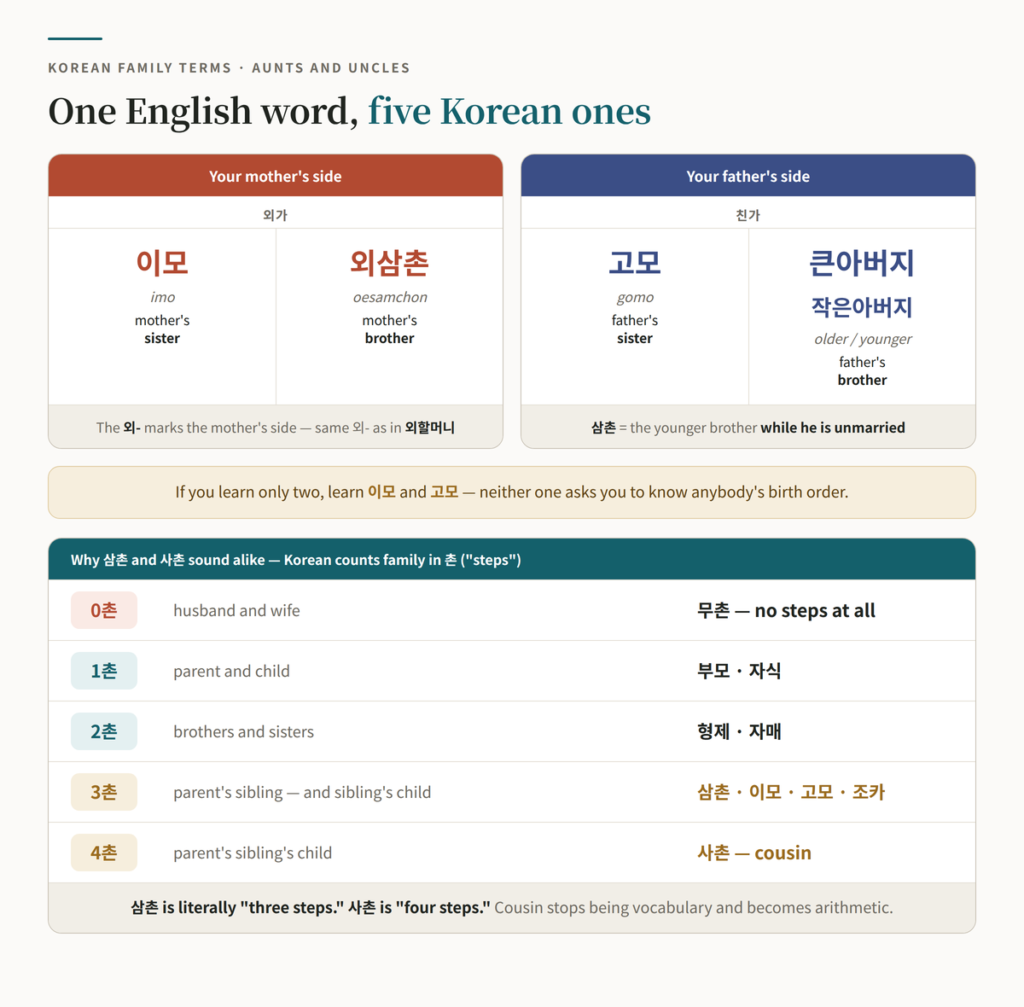
English says “uncle” five ways here; Korean says five different words. You do not need all of these to hold a conversation — but 삼촌, 이모, and 고모 come up often enough to be worth knowing.
“Aunt in Korean” and “Uncle in Korean” — the short answer
If you looked up either word and got five results, this is why: English has one word for each, and Korean splits them by which side of the family the person is on.
| You want | Ask yourself | You say |
|---|---|---|
| aunt | your mother’s sister | 이모 imo |
| your father’s sister | 고모 gomo | |
| uncle | your mother’s brother | 외삼촌 oesamchon |
| your father’s older brother | 큰아버지 keun-abeoji | |
| your father’s younger brother | 작은아버지 / 삼촌 samchon |
If you only learn two, learn 이모 and 고모. They come up constantly, they are short, and — unlike the uncle words — neither of them needs you to know anyone’s birth order.
The easy way to stop those two swapping in your head: pin down 이모 first, because you will meet it outside the family constantly — it is what Koreans call the woman running a small restaurant, as covered above. Once 이모 is fixed as “mother’s side,” 고모 is simply the other one.
삼촌 technically means your unmarried uncle
This one is rarely explained in English, and it is the reason two words appear in the same row above.
- 삼촌 — your father’s younger brother, while he is still unmarried.
- 작은아버지 — the same man, after he marries. His wife then becomes your 숙모.
In practice, plenty of families never make the switch. A nephew who has called someone 삼촌 for twenty years does not start saying 작은아버지 the week he gets married. Both are heard; only one is technically correct; nobody will correct you.
What you must not do is use 삼촌 for your mother’s brother. He is 외삼촌, and the 외- is not optional — it is the same 외- that turns 할머니 into 외할머니.
Why 삼촌 and 사촌 sound alike: the 촌 system
Here is the piece that makes the whole family tree click into place, and almost no English guide mentions it.
Korean counts family distance in 촌 (chon) — “steps.” Each link between a parent and a child is one step, and you count up and back down.
| Steps | Who | The word |
|---|---|---|
| 0촌 | husband and wife | 무촌 — no steps at all |
| 1촌 | parent and child | 부모 · 자식 |
| 2촌 | brothers and sisters | 형제 · 자매 |
| 3촌 | your parent’s sibling — and your sibling’s child | 삼촌 · 이모 · 고모 · 조카 |
| 4촌 | your parent’s sibling’s child | 사촌 — cousin |
삼촌 is literally “three steps.” 사촌 is “four steps.” Once you see that, the word for cousin stops being vocabulary and becomes arithmetic — and 육촌 (six steps) for a second cousin follows without being taught.
And the 0 is not a rounding error. Spouses are 무촌 because marriage is not a step along the family line — you are joined, not descended. Koreans point this out with some affection: your husband or wife is the only relative you have zero distance from, and also the only one you chose.
Their husbands and wives — 이모부, 고모부, 숙모 and 외숙모 — are covered further down in The aunts and uncles by marriage.
The Rest of the Tree: Cousins, Nephews and Grandchildren
The terms above cover the generations that outrank you. The rest of the family — sideways and downward — runs on a smaller set of words, and most of them are refreshingly simple.
친가 and 외가 — the two sides
Korean splits the extended family in two, and the split is marked by a single syllable.
| Korean | Romanization | Meaning |
|---|---|---|
| 친가 | chinga | the father’s side |
| 외가 | oega | the mother’s side |
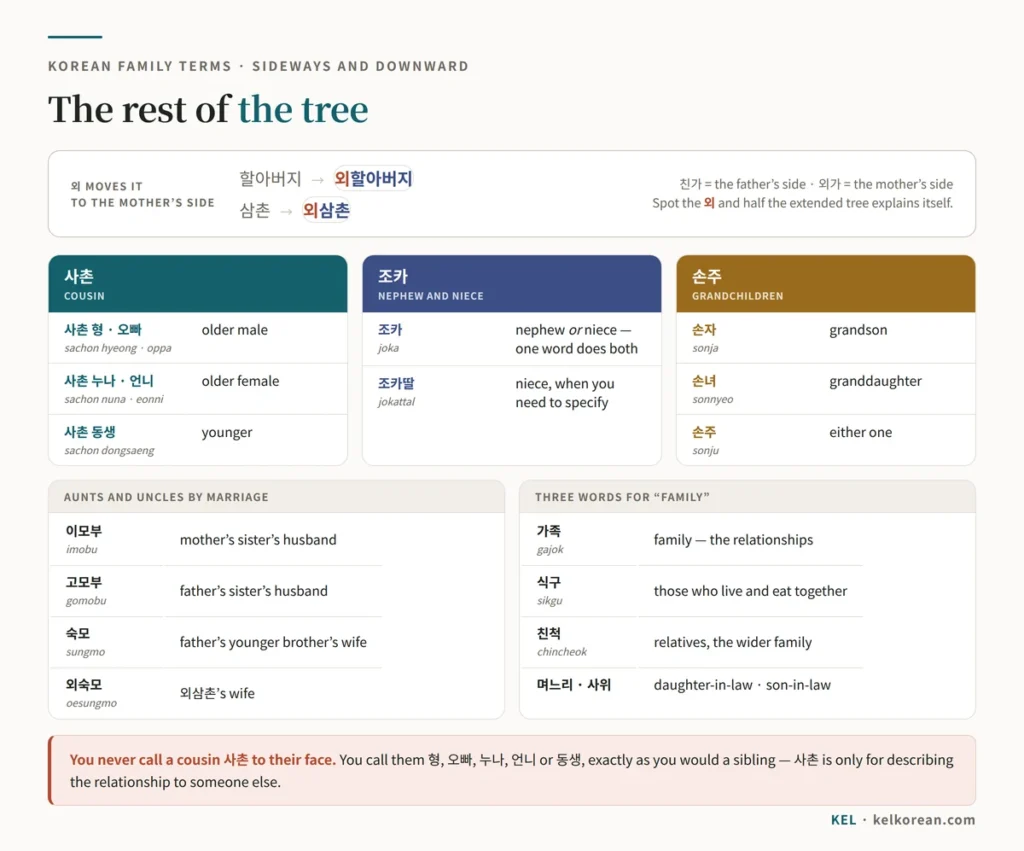
외 is the marker. Attach it and the relative moves to the mother’s side: 할아버지 is your paternal grandfather, 외할아버지 your maternal one. 삼촌 is your father’s brother, 외삼촌 your mother’s brother. Once you notice 외, half the extended tree explains itself.
사촌 — cousin
사촌 (sachon) — cousin
Here is the part that surprises people: you do not call your cousin 사촌 to their face. You call them 형, 오빠, 누나, 언니 or 동생, exactly as you would a sibling. 사촌 is the word you use when describing the relationship to someone else.
| Korean | Romanization | Meaning |
|---|---|---|
| 사촌 형 · 사촌 오빠 | sachon hyeong · sachon oppa | older male cousin |
| 사촌 누나 · 사촌 언니 | sachon nuna · sachon eonni | older female cousin |
| 사촌 동생 | sachon dongsaeng | younger cousin |
So 사촌 형이 왔어요 — “my cousin came” — but to his face, just 형.
조카 — nephew and niece
조카 (joka) — nephew or niece
One word covers both. English needs two; Korean does not bother. If you need to be specific, 조카딸 is a niece, but in ordinary speech 조카 does all the work regardless of gender.
Unlike the upward terms, you can address a 조카 directly by name — they are younger than you, so no title is required.
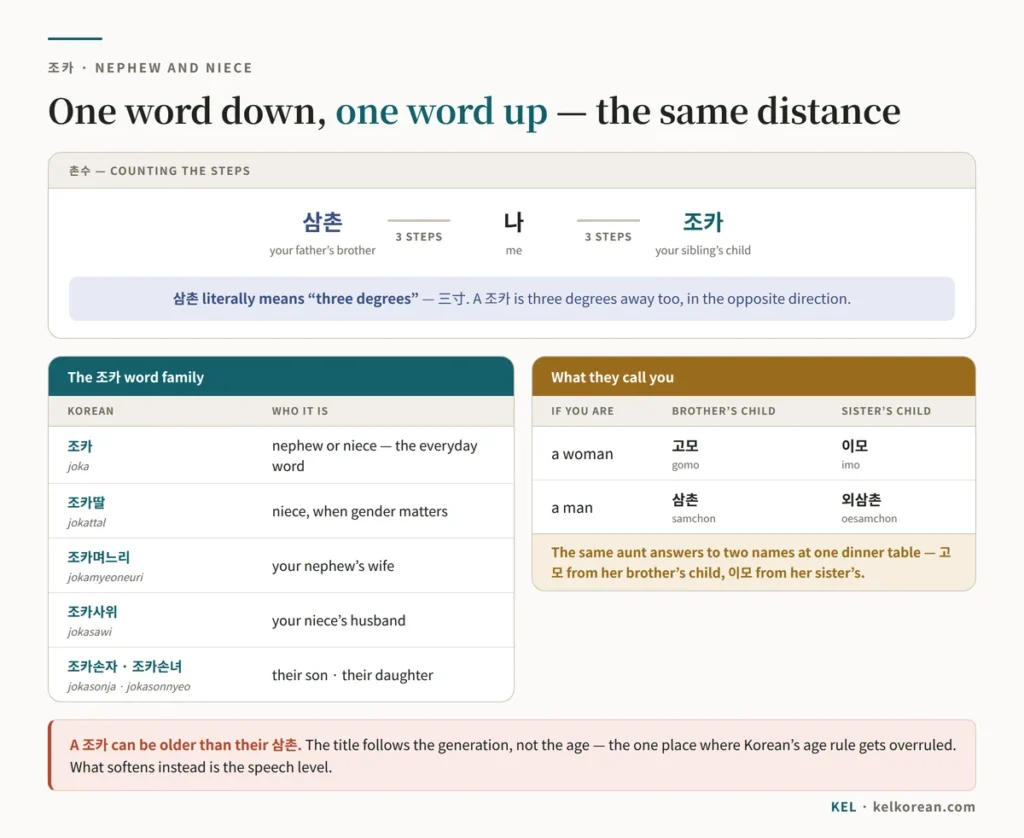
There is a neat piece of arithmetic hiding here. 삼촌 literally means “three degrees” — 三寸 — because your father’s brother is three steps away on the family map: you to your father, your father to his brother. Count in the other direction and a 조카 is also three steps away: you to your sibling, your sibling to their child. 삼촌 and 조카 are the same distance, pointing opposite ways.
The word family extends further than most learners realise.
| Korean | Romanization | Who it is |
|---|---|---|
| 조카 | joka | nephew or niece — the everyday word |
| 조카딸 | jokattal | niece, when the gender matters |
| 조카며느리 | jokamyeoneuri | your nephew’s wife |
| 조카사위 | jokasawi | your niece’s husband |
| 조카손자 | jokasonja | your nephew’s or niece’s son |
| 조카손녀 | jokasonnyeo | your nephew’s or niece’s daughter |
Notice the asymmetry: 조카딸 exists but there is no matching everyday word for a nephew specifically. If the gender needs marking, Korean marks the girl and leaves 조카 to mean the boy by default — one of those small places where the language shows its age.
How you actually address a 조카
You do not call them 조카. That is the word you use about them, not to them — the same reference-versus-address split that applies to 사촌.
To their face you use their name plus a vocative ending: -아 after a consonant, -야 after a vowel. 지현아, 민수야. And when you talk about them fondly to someone else, the phrase is almost always 우리 조카 — “our 조카” — the same 우리 that turns up in 우리 엄마 and 우리 집.
What your 조카 calls you — and why it changes
Here is the part that catches people out. The same person has two different titles depending on which sibling’s child is speaking. A woman is 고모 to her brother’s children and 이모 to her sister’s children — not because she changed, but because Korean marks whether the link runs through the father or the mother.
| If you are… | your brother’s child calls you | your sister’s child calls you |
|---|---|---|
| a woman | 고모 gomo | 이모 imo |
| a man | 삼촌 samchon (작은아버지 or 큰아버지 once married) | 외삼촌 oesamchon |
So a woman with one brother and one sister answers to two different names at the same family dinner, from two children sitting at the same table.
When the 조카 is older than the uncle
This happens more often than you would expect. If your father was the eldest of many siblings and his youngest brother arrived twenty years later, that brother can easily be younger than you — and he is still your 삼촌.
The title follows the generation, not the age. This is the one place where the age rule that governs everything else in Korean gets overruled: a fifty-year-old 조카 still calls their forty-year-old 삼촌 삼촌.
What families do in practice is soften the speech level rather than the title. The older 조카 keeps the word but often speaks 존댓말 in both directions, and the two of them quietly settle on something comfortable. The title is fixed; the tone is negotiable.
손자 · 손녀 · 손주 — grandchildren
| Korean | Romanization | Meaning |
|---|---|---|
| 손자 | sonja | grandson |
| 손녀 | sonnyeo | granddaughter |
| 손주 | sonju | grandchild — either one |
손주 is the useful one, because it saves you choosing.
며느리 and 사위 — the children’s spouses
| Korean | Romanization | Meaning |
|---|---|---|
| 며느리 | myeoneuri | daughter-in-law |
| 사위 | sawi | son-in-law |
These are the words parents use about the people their children married. Note that they are reference terms — a mother-in-law addresses her son’s wife by name, or through the grandchild — 민수 엄마, “Minsu’s mother” — not as 며느리.
The aunts and uncles by marriage
The blood aunts and uncles are covered above. Their spouses get their own words.
| Korean | Romanization | Who |
|---|---|---|
| 이모부 | imobu | your mother’s sister’s husband |
| 고모부 | gomobu | your father’s sister’s husband |
| 숙모 | sungmo | your father’s younger brother’s wife |
| 외숙모 | oesungmo | your mother’s brother’s wife — that is, 외삼촌’s wife |
Two pronunciation notes. 숙모 is not pronounced suk-mo. The ㄱ meets the ㅁ and turns into ㅇ, so it comes out 숭모. The same thing happens to 막내, “the youngest child,” which is pronounced 망내. If that rule looks unfamiliar, our guide to Korean pronunciation rules covers nasalization and the seven other changes that reshape written Korean when it is spoken.
가족, 식구, 친척 — three words for “family”
| Korean | Romanization | What it covers |
|---|---|---|
| 가족 | gajok | family — the relationships |
| 식구 | sikgu | the people who live and eat together |
| 친척 | chincheok | relatives, the extended family |
식구 is the interesting one. It literally means “mouths,” and it counts the household rather than the bloodline. 우리 식구 네 명이에요 — “there are four of us at home.” Koreans also stretch it warmly to a team or a small company: 우리 회사 식구들.
가족 is the neutral word you want most of the time. When talking about your own, Koreans say 우리 가족 — “our family” — rather than “my family,” which is the same 우리 habit covered earlier in this guide.
The Same System at School and Work
Korean applies identical logic outside the family. If you study or work in Korea, these three words will do a lot of work.
| Korean | Romanization | Meaning |
|---|---|---|
| 선배 | seonbae | Someone senior to you — entered school or the company earlier |
| 후배 | hubae | Someone junior to you |
| 동기 | donggi | Same entry year — classmate, same-intake colleague |
| 동갑 | donggap | Same age |
선배 and 후배 are about when you joined, not age. A 30-year-old who joined the company last year is 후배 to a 25-year-old who joined three years ago — and the speech levels follow that, not the birth years.
동갑 is the social release valve. Discovering you are the same age is a small event in Korean conversation: it means neither of you outranks the other, and you can drop to casual speech by mutual agreement. 우리 동갑이네요! (“we’re the same age!”) is a genuinely warm thing to hear.
You will also hear 선배님 and 후배 in dramas constantly — school hierarchy is a staple of the genre.
In-Law Terms
This is the deep end of the system, and even Koreans occasionally need to check. You do not need it as a beginner, but here is the shape of it.
A wife addressing her husband’s family:
| Relation | Korean |
|---|---|
| Husband’s father | 시아버지 / 아버님 |
| Husband’s mother | 시어머니 / 어머님 |
| Husband’s older brother | 아주버님 |
| Husband’s younger brother | 도련님 |
| Husband’s sister | 형님 / 아가씨 |
A husband addressing his wife’s family:
| Relation | Korean |
|---|---|
| Wife’s father | 장인어른 |
| Wife’s mother | 장모님 |
| Wife’s brother | 처남 |
| Wife’s younger sister | 처제 |
Two things to notice. The prefix 시- marks the husband’s side. And the terms are not symmetrical — the wife’s side historically had more elaborate deference built into it, which is one of the things modern Korean families argue about at holidays.
Practical takeaway: 아버님 and 어머님 (the respectful forms of “father” and “mother”) work for either set of parents-in-law and are what most people actually use.
Talking About Family vs. Addressing Them
One thing that trips learners: some words are for addressing someone directly, others for referring to them.
| Situation | Korean |
|---|---|
| Calling your mother | 엄마! / 어머니! |
| Telling someone about your mother | 저희 어머니 |
| Talking about someone else’s parents | 부모님 |
저희 (the humble form of 우리, “our”) is used when speaking about your own family to someone else. 저희 어머니 rather than 우리 어머니 in polite contexts.
Koreans also say 우리 where English says “my” — 우리 엄마, 우리 집, 우리 학교. It is not a claim of shared ownership; it is simply how Korean expresses belonging.
Family Terms and Speech Level
The term you use and the speech level you use move together.
| To… | Term | Speech level |
|---|---|---|
| Grandparents, parents | 할머니, 어머니 | Polite / honorific |
| Older siblings | 형, 언니 | Polite, often relaxed |
| Younger siblings | Their name, or 동생 | Casual (반말) |
| Your own children | Their name | Casual |
This is why the age question matters so much — it is not just vocabulary, it decides the grammar of every sentence you speak to that person. See our guides to Korean honorifics and verb conjugation for how those levels are formed.
5 Mistakes Worth Avoiding
1. Using 형 or 오빠 based on the other person’s gender. The word depends on your gender, not theirs. A woman never says 형, regardless of who she is talking to.
2. Calling someone 오빠 or 언니 too soon. Warm but familiar. Name + 씨 is the safe default until you know each other.
3. Using 아줌마 with restaurant staff. Technically fine, socially blunt. Use 이모 or 사장님.
4. Saying 나이가 몇이에요? to someone older. Too direct. Use 나이가 어떻게 되세요?
5. Assuming younger siblings have a gendered term. They do not. 동생 covers both; add 남 or 여 only when the distinction matters.
Quick Practice
- You are a woman. What do you call your older brother? → ?
- You are a man. What do you call your older sister? → ?
- You are a man. What do you call your older brother? → ?
- You are a woman. What do you call your older sister? → ?
- What do you call your mother’s sister? → ?
- What do you call the woman running your local restaurant? → ?
Answers: 1. 오빠 · 2. 누나 · 3. 형 · 4. 언니 · 5. 이모 · 6. 이모 (or 사장님)
Questions 5 and 6 have the same answer, and that overlap is exactly the point — Korean extends the family tree outward to place people it has no other word for.
Frequently Asked Questions
Do I have to use these terms as a foreigner?
No. Koreans do not expect visitors to navigate the system, and name + 씨 works with almost anyone your age or younger. But recognising the terms transforms how much of a conversation you can follow.
What if I don’t know someone’s age?
Ask, or use name + 씨. Both are normal. Guessing wrong and calling someone younger 형 is a small awkwardness, not an offence.
Is 언니 really used for shop staff?
Yes, commonly, by female customers to a female employee of similar or slightly older age. It is friendly and informal. Male customers do not use it.
Why do Koreans say 우리 엄마 instead of 내 엄마?
우리 (“our”) is the default possessive for things you belong to rather than own — family, home, school, country. 내 엄마 sounds oddly possessive to Korean ears.
Are these terms disappearing among young Koreans?
Softening, not disappearing. Friends close in age increasingly drop the hierarchy by mutual agreement, and workplaces have moved toward name + 님. But the terms themselves are used constantly, including for non-relatives.
Do I need to learn all the aunt and uncle words?
Not at first. 삼촌, 이모, 고모 cover most conversations. The 큰/작은 and 외 distinctions matter when talking about your own family in detail — a later problem.
How do you say nephew in Korean?
조카 (joka). The same word means niece — Korean does not split the two. If you need to be specific, 조카딸 is a niece, but 조카 covers both in ordinary speech.
What is the Korean word for cousin?
사촌 (sachon). But you would not use it to address them. To a cousin’s face you say 형, 오빠, 누나, 언니 or 동생, exactly as you would to a sibling — 사촌 is only for describing the relationship to someone else.
What is the Korean word for family?
가족 (gajok) is the neutral one. 식구 (sikgu) counts the people who live and eat together rather than the bloodline, and 친척 (chincheok) means the extended relatives. Koreans say 우리 가족, “our family,” rather than “my family.”
What does 외 mean in 외할머니?
It marks the mother’s side. 할머니 is your paternal grandmother and 외할머니 your maternal one; 삼촌 is your father’s brother and 외삼촌 your mother’s brother. 친가 is the father’s side of the family, 외가 the mother’s.
How do you say niece in Korean?
조카 (joka) covers both nephew and niece, and it is what Koreans say in ordinary conversation. If you need to make the gender explicit, a niece is 조카딸 (jokattal). There is no matching everyday word for a nephew specifically — 조카 does that job on its own.
What do Korean nephews and nieces call their aunt or uncle?
It depends on which parent the link runs through. Your brother’s children call you 고모 if you are a woman and 삼촌 if you are a man; your sister’s children call you 이모 and 외삼촌. The same aunt therefore answers to two different titles from two different nephews.
Can a Korean nephew be older than his uncle?
Yes, and it is common in families with a wide sibling gap. The title follows the generation rather than the age, so an older 조카 still calls a younger 삼촌 삼촌. What usually gives is the speech level, not the word — the two often use 존댓말 with each other regardless of who is older.
What is 조카며느리?
Your nephew’s wife. The matching word for your niece’s husband is 조카사위. Korean has a dedicated term for almost every position on the family map, which is why the vocabulary looks larger than it is — the words are built from a small set of repeating parts.
How do you say aunt in Korean?
It depends on whose sister she is. Your mother’s sister is 이모 (imo); your father’s sister is 고모 (gomo). Korean has no single word covering both, and 이모 is also what Koreans call the woman running a small restaurant.
How do you say uncle in Korean?
Your mother’s brother is 외삼촌. Your father’s older brother is 큰아버지, and his younger brother is 작은아버지 — or 삼촌 while that brother is still unmarried.
What is the difference between 이모 and 고모?
이모 is on your mother’s side, 고모 on your father’s. Both mean “aunt” by blood — the split is about which parent she is related to, not about her age or marital status.
What does 삼촌 mean?
Your father’s younger brother, strictly while he is unmarried; once he marries he is properly 작은아버지 and his wife is 숙모. Many families keep saying 삼촌 regardless. It never refers to your mother’s brother — that is 외삼촌.
Why is cousin called 사촌 in Korean?
Because Korean measures family distance in 촌 (“steps”). A cousin is four steps away — up to your parent, up to your grandparent, down to your aunt or uncle, down to their child — so 사촌 is literally “four steps.” By the same counting, 삼촌 is “three steps.”
Final Thoughts
Korean family terms look like vocabulary and behave like grammar. They are not four synonyms for “sibling” — they are a system that encodes your gender and your relative age in a single word, and that same system reaches outward to cover friends, colleagues, shopkeepers, and strangers.
That is why the age question comes so early, why a stranger becomes 이모, and why two men can genuinely need to settle who is 형.
You do not need to master the full family tree. Learn the four core terms, know that they depend on your gender, and default to name + 씨 when unsure. That covers nearly every situation — and it means the next time a drama character calls someone 오빠, you will know exactly what just happened.
Pair this with our guides to Korean honorifics and Korean greetings, or start from the beginning with our complete beginner’s roadmap.
Keep learning with Korean English Lab. Our bilingual Korean–English worksheets and printable workbooks are designed for self-study learners who want structured practice, not just theory.
Written by Minhyung Cha — 25 years teaching Korean, and 15+ years running an English academy in South Korea. Every example on this site is checked as a native speaker. More about KEL.
Leave a Reply