English rips the question word out of the sentence and drags it to the front.
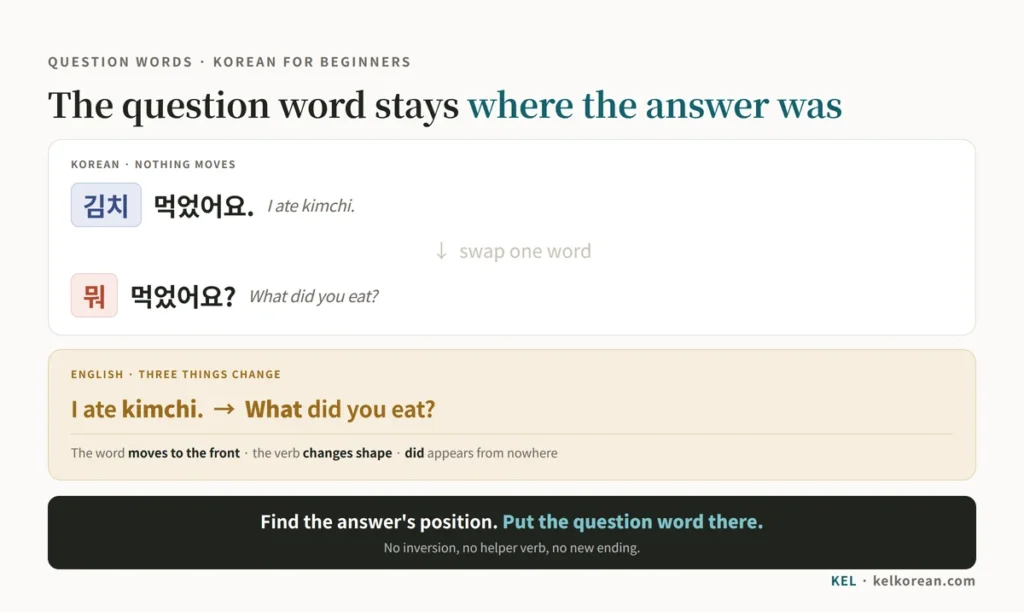
I ate kimchi. → What did you eat?
What came from the end and moved to the beginning. The verb changed shape. An extra word — did — appeared out of nowhere.
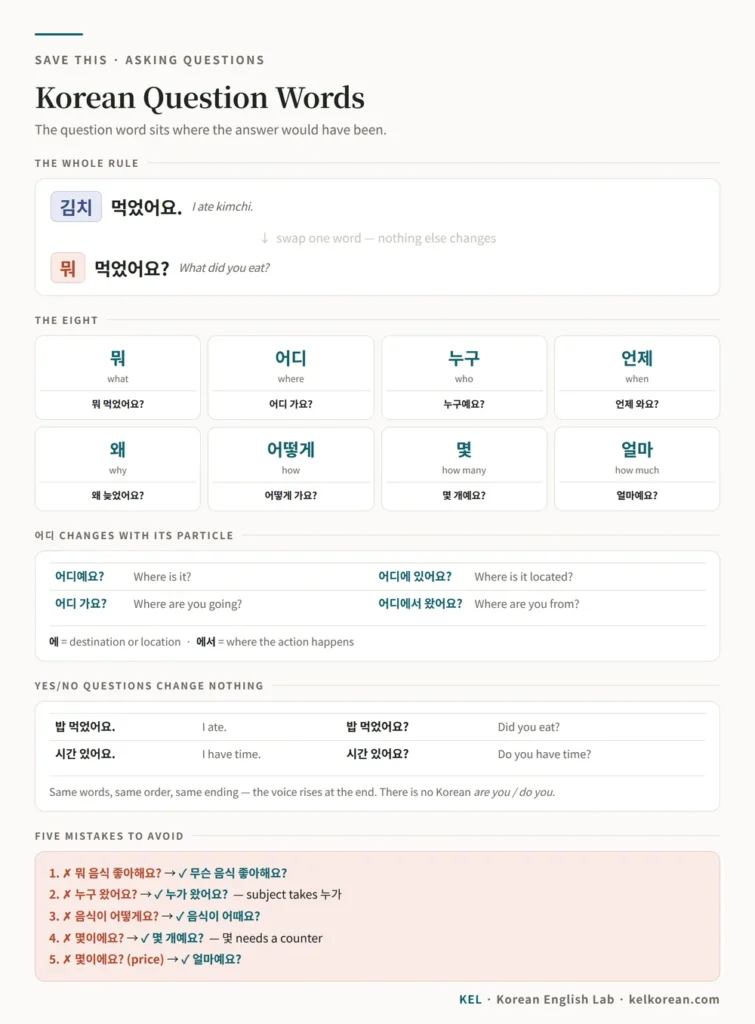
Korean does none of that. Korean question words sit exactly where the answer would sit.
김치 먹었어요. — I ate kimchi.
뭐 먹었어요? — What did you eat?
Same word order. Same verb. Nothing moved. You took 김치 out and put 뭐 in its place.
That is the whole idea, and it is the habit English speakers take longest to break. This guide covers the eight question words worth knowing, the pairs that are easy to confuse, and how to ask a question with no question word at all.
The One Rule
Find the answer’s position. Put the question word there.
| Statement | Question |
|---|---|
| 김치 먹었어요 — I ate kimchi | 뭐 먹었어요? — What did you eat? |
| 학교에 가요 — I go to school | 어디 가요? — Where are you going? |
| 친구를 만났어요 — I met a friend | 누구를 만났어요? — Who did you meet? |
| 세 시에 시작해요 — It starts at 3 | 몇 시에 시작해요? — What time does it start? |
The verb stays put at the end, because Korean sentences always end with the verb. If that word order is still new, our guide to Korean sentence structure covers why the verb never moves.
No helper verb appears either. English needs do, did, does. Korean needs nothing — the same 먹었어요 works for both the statement and the question.
The Eight You Need
| Korean | Meaning | Example |
|---|---|---|
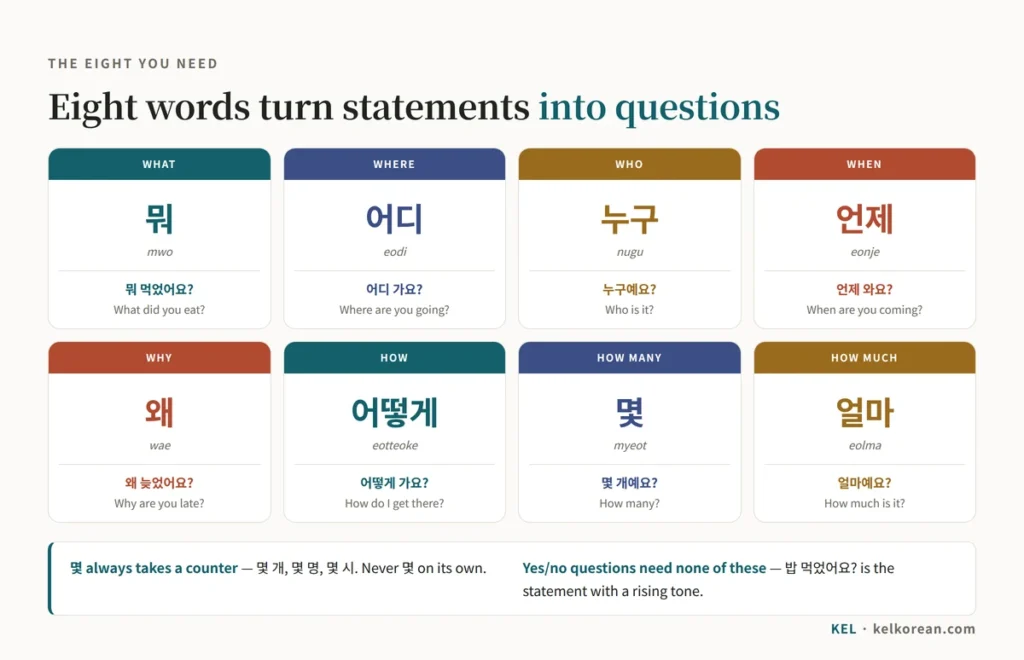
| 뭐 | what | 뭐 먹었어요? — What did you eat? |
| 어디 | where | 어디 가요? — Where are you going? |
| 누구 | who | 누구예요? — Who is it? |
| 언제 | when | 언제 와요? — When are you coming? |
| 왜 | why | 왜 늦었어요? — Why are you late? |
| 어떻게 | how | 어떻게 가요? — How do I get there? |
| 몇 | how many | 몇 개예요? — How many? |
| 얼마 | how much (price) | 얼마예요? — How much is it? |
Six of these behave simply. Two of them — 뭐 and 누구 — have close relatives that trip people up, so they get their own sections below.
뭐 · 무슨 · 어떤
All three translate to “what,” and they are not interchangeable.
| Korean | Use | Example |
|---|---|---|
| 뭐 | stands alone, replaces a noun | 뭐 먹었어요? — What did you eat? |
| 무슨 | goes before a noun — what kind of | 무슨 음식 좋아해요? — What food do you like? |
| 어떤 | goes before a noun — which one of these | 어떤 색깔이 좋아요? — Which colour do you like? |
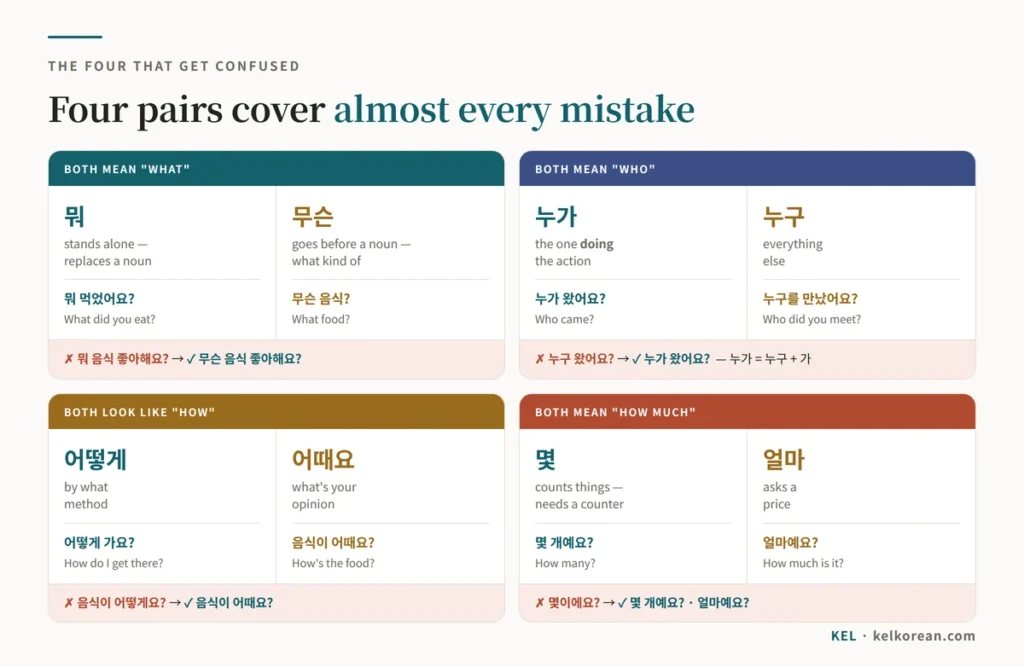
뭐 replaces a noun. 무슨 and 어떤 describe one.
✗ 뭐 음식 좋아해요?
✓ 무슨 음식 좋아해요?
The difference between 무슨 and 어떤 is narrower. 무슨 asks about the category — what kind of food, out of everything. 어떤 asks you to pick from options that are already in view — which colour, out of these. In casual speech Koreans often use either.
You have already met 무슨 without noticing: 무슨 요일이에요? — what day is it? — from our guide to telling time in Korean.
무엇 is the formal written form of 뭐. You will see it on exams and in documents — 무엇을 하십니까? — and almost never hear it in conversation.
누구 · 누가
Both mean “who.” The difference is which job the person is doing in the sentence.
| Korean | Role | Example |
|---|---|---|
| 누가 | the one doing the action | 누가 왔어요? — Who came? |
| 누구 | everything else | 누구를 만났어요? — Who did you meet? |
누가 is simply 누구 + the subject particle 가, contracted. So:
✗ 누구 왔어요?
✓ 누가 왔어요?
Two more you will use constantly:
누구세요? — Who is it? (at the door, on the phone)
이거 누구 거예요? — Whose is this?
The particle logic behind 누가 versus 누구를 is the same logic covered in our guide to Korean particles.
어디 and Its Particles
어디 changes meaning with the particle attached to it.
| Korean | Meaning |
|---|---|
| 어디예요? | Where is it? |
| 어디 가요? | Where are you going? |
| 어디에 있어요? | Where is it located? |
| 어디에서 일해요? | Where do you work? |
| 어디에서 왔어요? | Where are you from? |
에 marks a destination or a location. 에서 marks where an action happens. 어디에 있어요 asks where something sits; 어디에서 일해요 asks where the working happens.
In speech, 에 is often dropped after 어디 — 어디 가요? is far more common than 어디에 가요?. 에서 shortens to 서: 어디서 왔어요?
어떻게 vs 어때요
These look related and are constantly confused.
| Korean | Meaning | Example |
|---|---|---|
| 어떻게 | how — by what method | 어떻게 가요? — How do I get there? |
| 어때요 | how is it — asking an opinion | 음식이 어때요? — How’s the food? |
✗ 음식이 어떻게요?
✓ 음식이 어때요?
어떻게 wants a method. 어때요 wants a judgement.
One phrase worth memorising whole: 이름이 어떻게 되세요? — literally “how does your name become,” and the polite way to ask someone’s name. 이름이 뭐예요? is correct but blunt with strangers, as covered in our guide to Korean greetings and self-introduction.
몇 and 얼마
Both are “how much,” and the split is clean.
몇 counts things. It always takes a counter behind it — never stands alone.
| Korean | Meaning |
|---|---|
| 몇 개예요? | How many (items)? |
| 몇 명이에요? | How many people? |
| 몇 시예요? | What time is it? |
| 몇 살이에요? | How old are you? |
| 며칠이에요? | What’s the date? |
✗ 몇이에요?
✓ 몇 개예요?
몇 behaves exactly like a number, which means it needs the same unit word a number would. Our guide to Korean counters covers which counter goes with what.
얼마 asks a price.
이거 얼마예요? — How much is this?
다 해서 얼마예요? — How much altogether?
얼마나 is the stretched form, used for degree and duration:
얼마나 걸려요? — How long does it take?
얼마나 자주 가요? — How often do you go?
Questions With No Question Word
For yes/no questions, Korean changes nothing at all. Same words, same order, same ending — you just raise your voice at the end.
| Statement | Question |
|---|---|
| 밥 먹었어요. | 밥 먹었어요? — Did you eat? |
| 학생이에요. | 학생이에요? — Are you a student? |
| 시간 있어요. | 시간 있어요? — Do you have time? |
In writing, the question mark does the work. In speech, intonation does. There is no Korean equivalent of flipping you are into are you.
A useful shortcut for turning a question back: add 는요? or 은요?
A: 뭐 마실래요?
B: 저는 커피요. ○○ 씨는요? — And you?
Putting It Together
A short exchange using six of the eight.
A: 어제 뭐 했어요?
B: 친구를 만났어요.
A: 누구를 만났어요?
B: 대학교 친구요.
A: 어디에서 만났어요?
B: 홍대에서요. 저녁도 같이 먹었어요.
A: 뭐 먹었어요? 맛있었어요?
B: 삼겹살이요. 정말 맛있었어요.
Every question here is a statement with one word swapped. Nothing was rearranged, and 했어요, 만났어요, 먹었어요 all come from the rule in our guide to the Korean past tense.
Notice 요 on the short answers. 대학교 친구요, 홍대에서요, 삼겹살이요 — attaching 요 to a fragment keeps it polite without building a full sentence. Koreans do this constantly.
5 Mistakes Worth Avoiding
1. Using 뭐 before a noun. ✗ 뭐 음식 좋아해요? · ✓ 무슨 음식 좋아해요?. 뭐 replaces a noun; it cannot describe one.
2. 누구 as the subject. ✗ 누구 왔어요? · ✓ 누가 왔어요?. If the person is doing the verb, it is 누가.
3. 어떻게 for opinions. ✗ 음식이 어떻게요? · ✓ 음식이 어때요?. 어떻게 asks how something is done.
4. 몇 without a counter. ✗ 몇이에요? · ✓ 몇 개예요?. 몇 needs a unit exactly the way a number does.
5. 몇 for prices. ✗ 몇이에요? · ✓ 얼마예요?. 몇 counts; 얼마 costs.
Quick Practice
Ask these in Korean. Answers below.
- What did you eat? → ?
- Where are you going? → ?
- Who came? → ?
- When does it start? → ?
- How much is this? → ?
- How many people? → ?
- What kind of music do you like? → ?
- How do I get to Hongdae? → ?
Answers:
- 뭐 먹었어요?
- 어디 가요?
- 누가 왔어요? — not 누구 왔어요
- 언제 시작해요?
- 이거 얼마예요?
- 몇 명이에요?
- 무슨 음악 좋아해요? — not 뭐 음악
- 홍대에 어떻게 가요?
Six or more and you can start a conversation instead of only answering one.
Frequently Asked Questions
Can I put the question word at the front like English?
Sometimes, for emphasis — 뭐 먹었어요 and 먹었어요 뭐 are both possible in casual speech. But the neutral position is wherever the answer would go, and that is what you should build the habit around.
Is 뭐 rude?
No, just casual. 무엇 is the formal equivalent, used in writing and formal speech. In conversation 뭐 is standard at every politeness level — 뭐 드시겠어요? is perfectly polite.
Why is it 뭘 sometimes?
뭘 is 뭐 + the object particle 를, contracted. 뭘 먹었어요? and 뭐 먹었어요? mean the same thing; the particle is often dropped entirely in speech.
What’s the difference between 왜 and 왜요?
왜 goes inside a sentence — 왜 안 왔어요? 왜요? stands alone as a polite “Why?” or “What is it?” when someone calls your name.
How do I ask “which one”?
어느 for a choice between named options — 어느 나라 사람이에요? (which country are you from). 어떤 for a quality or type. 어느 is narrower and less common for beginners.
Do I need to add 요 to short answers?
Not grammatically, but socially yes. 삼겹살 alone sounds abrupt to a stranger; 삼겹살이요 does not. It is the cheapest politeness available.
Final Thoughts
Everything up to this point in your Korean has been about producing sentences. Question words are what let you receive one — they are the difference between answering when spoken to and holding a conversation.
The mechanics are unusually forgiving. No inversion, no helper verbs, no new endings. You already know how to say 김치 먹었어요; swapping in 뭐 costs nothing.
The parts genuinely worth drilling are the pairs: 뭐 versus 무슨, 누구 versus 누가, 어떻게 versus 어때요, 몇 versus 얼마. Four distinctions, and they cover almost every mistake learners make in this area.
Practise by asking about someone’s actual day — 어제 뭐 했어요? 누구랑 갔어요? 어땠어요? Real answers are more memorable than drills, and you will need the follow-up question before you have finished planning it.
If you are working through the stages in order, this sits in Stage 4 of our complete beginner’s roadmap, right after word order and verb endings.
Keep learning with Korean English Lab. Our bilingual Korean–English worksheets and printable workbooks are designed for self-study learners who want structured practice, not just theory.
Leave a Reply