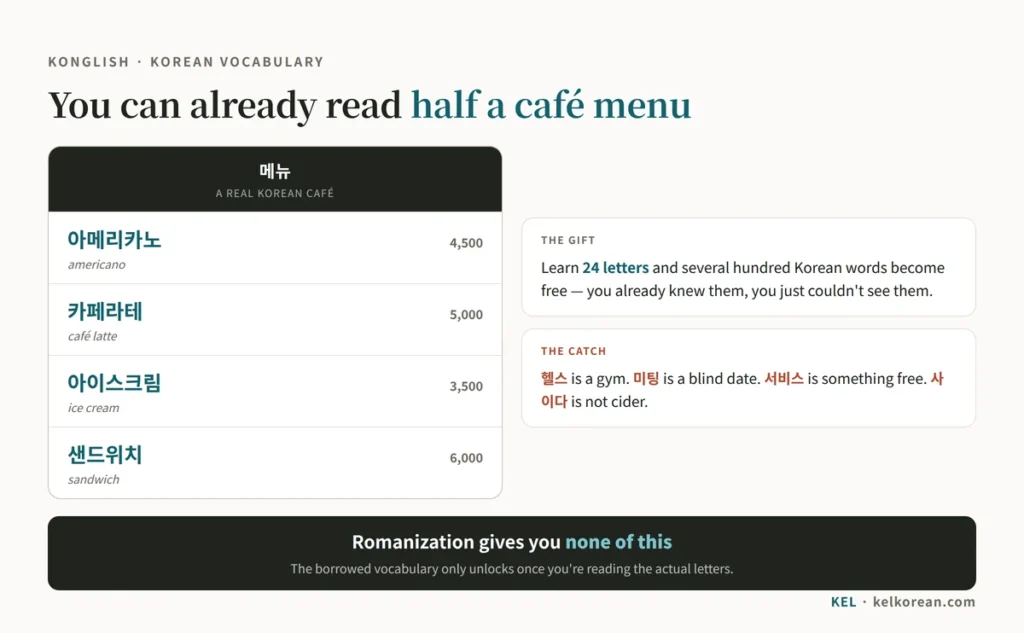
The first time a beginner reads a Korean café menu out loud, something strange happens.
아메리카노 · 카페라테 · 아이스크림 · 샌드위치
They have never studied any of those words. They understood all of them.
Korean has borrowed an enormous amount of English — enough that the moment you can read Hangul, several hundred words become free. Not “easier to learn.” Free. You already know them; you just could not see them before.
That is the good news, and it is genuinely worth the four days it takes to learn the alphabet.
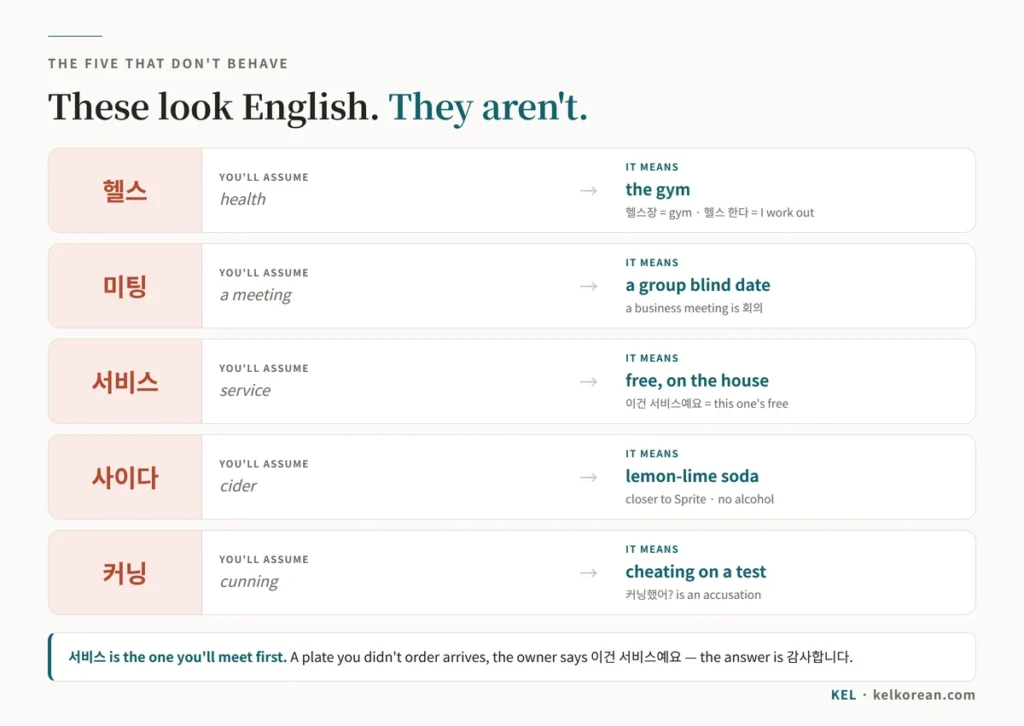
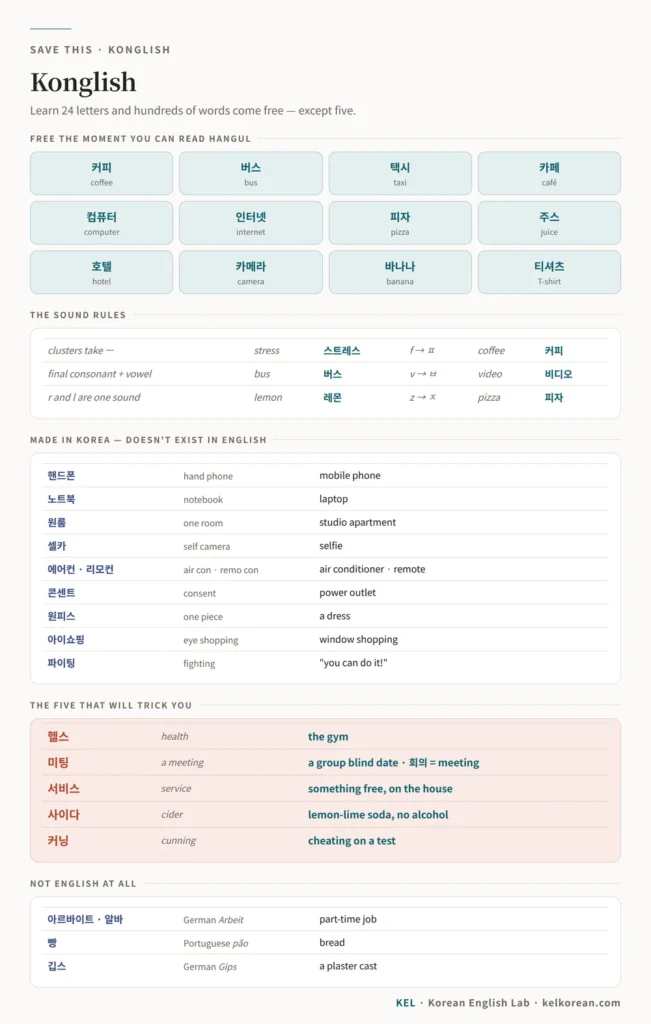
The bad news is that a smaller set of these words has drifted. Konglish — Korean-made English — includes words that look English, sound English, and mean something else entirely. 헬스 is not health. 미팅 is not a meeting. Ordering a 사이다 will not get you what you expect.
This guide covers both halves: the free vocabulary, and the words that will embarrass you.
The Free Vocabulary
These are straight borrowings. Say them out loud and you will hear the English underneath.
| Korean | Romanization | English |
|---|---|---|
| 커피 | keopi | coffee |
| 버스 | beoseu | bus |
| 택시 | taeksi | taxi |
| 카페 | kape | café |
| 컴퓨터 | keompyuteo | computer |
| 인터넷 | inteonet | internet |
| 카메라 | kamera | camera |
| 피자 | pija | pizza |
| 아이스크림 | aiseukeurim | ice cream |
| 초콜릿 | chokollit | chocolate |
| 샌드위치 | saendeuwichi | sandwich |
| 주스 | juseu | juice |
| 호텔 | hotel | hotel |
| 엘리베이터 | ellibeiteo | elevator |
| 티셔츠 | tisyeocheu | T-shirt |
| 바나나 | banana | banana |
There are hundreds more. Menus, cosmetics, electronics, sports and fashion run heavily on borrowed English, which is why a beginner can often read a café or a convenience store long before they can read a novel.
This is the strongest argument for learning Hangul first. Romanization gives you none of this — you have to be reading the actual letters for the words to unlock. Our guide to learning Hangul in a week gets you there in seven days.
Why 스트레스 Has Five Syllables
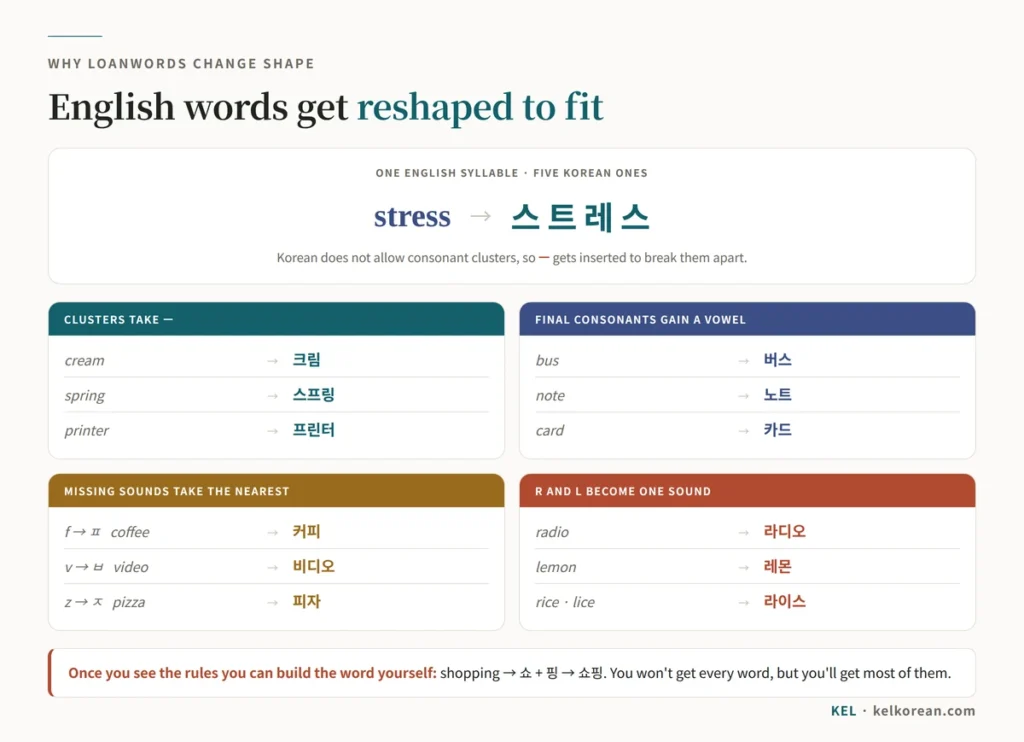
English stress is one syllable. Korean 스트레스 is five. That is not decoration — Korean syllables have rules, and English words get reshaped to fit them.
Rule 1: Korean does not allow consonant clusters. English piles consonants together (st, str, pl); Korean does not. A vowel — almost always ㅡ — gets inserted between them.
| English | Korean | What happened |
|---|---|---|
| stress | 스트레스 | ㅡ inserted twice |
| cream | 크림 | ㅡ after ㅋ |
| spring | 스프링 | ㅡ inserted twice |
Rule 2: Most final consonants get a vowel too. Korean allows only seven consonant sounds at the end of a syllable, so anything else picks up a ㅡ or ㅣ.
| English | Korean |
|---|---|
| bus | 버스 |
| note | 노트 |
| card | 카드 |
| juice | 주스 |
Rule 3: Sounds Korean does not have get the nearest neighbour.
| English sound | Becomes | Example |
|---|---|---|
| f | ㅍ | coffee → 커피 |
| v | ㅂ | video → 비디오 |
| z | ㅈ | pizza → 피자 |
| r and l | ㄹ | radio → 라디오, lemon → 레몬 |
| th | ㅅ / ㄷ | three → 쓰리 |
r and l collapsing into one sound is the big one. Korean has a single liquid consonant where English has two, which is also why Korean speakers find rice and lice hard to separate — the distinction does not exist in their sound system. Our guide to Korean pronunciation rules covers ㄹ in detail.
Converting a Word Yourself
Once you see the rules, you can build the Korean version of most English words without looking them up.
Take printer:
- p-r-i-n-t-e-r — the cluster pr needs a vowel → 프
- in is fine as one syllable → 린 (r becomes ㄹ)
- ter ends in r → 터
- 프린터
Take shopping:
- sho → 쇼
- pping → 핑
- 쇼핑
You will not get every word right — some borrowings came through Japanese and landed oddly — but you will get most of them, and you will recognise the rest instantly when you hear them.
Konglish Proper: English Words Korea Invented
These are built from English parts but do not exist in English. Nobody in London or New York would understand them.
| Korean | Literally | Actually means |
|---|---|---|
| 핸드폰 | hand phone | mobile phone |
| 노트북 | notebook | laptop |
| 원룸 | one room | studio apartment |
| 셀카 | self camera | selfie |
| 에어컨 | air con | air conditioner |
| 리모컨 | remo con | remote control |
| 아이쇼핑 | eye shopping | window shopping |
| 원피스 | one piece | a dress |
| 백미러 | back mirror | rearview mirror |
| 파이팅 | fighting | “you can do it!” |
| 스킨십 | skinship | physical affection |
| 원샷 | one shot | down it in one |
| 개그맨 | gag man | comedian |
| 콘센트 | consent | power outlet |
파이팅 (also written 화이팅) is everywhere. It is a cheer, not a threat — shouted at sports matches, said to someone before an exam, texted to a friend having a hard week. The closest English is good luck or you’ve got this.
콘센트 catches every visitor. When someone asks 콘센트 어디예요?, they want a power socket, not your consent.
The Five That Will Embarrass You
These look like English words you know. They are not.
| Korean | You’ll assume | It actually means |
|---|---|---|
| 헬스 | health | the gym |
| 미팅 | a meeting | a group blind date |
| 서비스 | service | something free, on the house |
| 사이다 | cider | clear lemon-lime soda |
| 커닝 | cunning | cheating on a test |
헬스 — 헬스장 is a gym, and 헬스 한다 means I work out. If you say you are going to 헬스, nobody thinks you are going to the doctor.
미팅 — a group blind date, traditionally arranged between university friends. A business meeting is 회의. Telling a Korean colleague you have a 미팅 with a client will get you a look.
서비스 — the most useful one to recognise. When a restaurant owner puts down a plate you did not order and says 이건 서비스예요, it means this one’s free. Say 감사합니다, not “I didn’t order this.” It comes up often enough that it is worth knowing before your first meal — our guide to ordering food in Korean covers the rest of the table vocabulary.
사이다 — a clear, sweet, non-alcoholic soda, closer to Sprite than to anything fermented. Ordering one expecting apple cider is a small but memorable disappointment.
커닝 — from cunning, meaning to cheat on an exam. 커닝했어? is an accusation.
Not English at All
A few words that feel like loanwords came from somewhere else entirely.
| Korean | From | Meaning |
|---|---|---|
| 아르바이트 (알바) | German Arbeit | part-time job |
| 빵 | Portuguese pão | bread |
| 깁스 | German Gips | a plaster cast |
아르바이트 shortens to 알바 in everyday speech, and it is one of the most common words in student life. 알바해요 — I have a part-time job.
빵 came through Japanese from Portuguese, carried by traders centuries before English had any influence here. It is one of the first hundred words most learners meet, and almost nobody realises it is a loanword at all.
When Not to Reach for Konglish
Borrowed words are everywhere in speech, but they are not neutral.
In writing and formal contexts, the native or Sino-Korean word is often preferred. 회의 rather than 미팅, 손전화 rather than 핸드폰 in official documents, 냉방기 rather than 에어컨 on a government notice.
Older speakers may not know newer borrowings. 셀카 and 텐션 are recent; someone in their seventies may not use them.
And some borrowings replace a perfectly good Korean word. Using 컬러 instead of 색깔 or 프렌드 instead of 친구 sounds affected rather than fluent — which is the opposite of what you want.
The safe rule: use the Konglish word if you have heard Koreans use it. Do not invent your own by attaching English words together, because that is how you end up with something nobody recognises.
5 Mistakes Worth Avoiding
1. Pronouncing loanwords in English. 커피 is keo-pi, three beats, not “coffee.” Saying it the English way often makes it harder to understand, not easier.
2. Assuming the meaning transferred. 헬스, 미팅, 서비스, 사이다, 커닝 — five words, five different meanings from the English.
3. Using 미팅 for a business meeting. ✓ 회의.
4. Inventing Konglish. Attaching English words together and hoping is not a strategy. If you have not heard it, do not build it.
5. Skipping Hangul because English words are everywhere. The borrowed vocabulary is only free if you can read it. In romanization, 커피 is just as opaque as any other word.
Quick Practice
What do these mean? Answers below.
- 헬스장 → ?
- 노트북 → ?
- 콘센트 → ?
- 서비스 → ?
- 알바 → ?
- 원룸 → ?
- 파이팅 → ?
- 사이다 → ?
Answers:
- gym
- laptop
- power outlet
- something free, on the house
- part-time job
- studio apartment
- “you can do it!”
- clear lemon-lime soda — not alcoholic
Frequently Asked Questions
How many Korean words come from English?
Estimates vary widely depending on what counts, but borrowed vocabulary — overwhelmingly from English — makes up a substantial share of modern Korean, and it is heavily concentrated in food, technology, fashion, sport and cosmetics. Those are exactly the areas a visitor deals with first.
Is Konglish considered bad Korean?
No. Words like 핸드폰 and 에어컨 are simply the normal words for those things. What is frowned on is unnecessary English where a common Korean word already exists.
Will Koreans understand me if I use the English pronunciation?
Often not. 커피 and coffee are different enough that the English version can genuinely fail to land. Say the Korean version.
Why did some words come through Japanese?
Many Western words entered Korean during the Japanese colonial period, arriving already reshaped by Japanese phonology. That is why a few borrowings look further from the English original than the sound rules alone would predict.
Are new Konglish words still being created?
Constantly. 텐션 (energy, mood — 텐션 높다 means someone is upbeat) and 셀카 are both relatively recent. The category is alive, not a fixed list.
Should I learn these before other vocabulary?
You do not need to learn most of them — you need to be able to read them. Spend the time on Hangul and on the core native vocabulary in our list of the 100 Korean words to learn first; the borrowed words will arrive on their own.
Final Thoughts
Borrowed vocabulary is the one place where Korean gives beginners something for nothing. Learn twenty-four letters, and a café menu, a cosmetics shelf and half a subway station’s signage become readable in an afternoon.
Take the gift. Read every sign you pass out loud, and notice how often the word turns out to be one you already knew.
Then keep the five false friends somewhere you will see them again — 헬스, 미팅, 서비스, 사이다, 커닝. Those are the ones that do not behave, and knowing them is the difference between reading Korean and understanding it.
If you are starting from the beginning, our complete beginner’s roadmap lays out where alphabet, vocabulary and grammar fit together over the first year.
Keep learning with Korean English Lab. Our bilingual Korean–English worksheets and printable workbooks are designed for self-study learners who want structured practice, not just theory.
Leave a Reply